100 Years Ago: Notice of Soldier Returning, Red Cross Penny Bag Collection, Patriotic Fund Campaign Organized, Ladies’ Rifle Club Run Tea and Card Party

The Intelligencer February 7, 1917 (page 7)

“From Corp. W. H. Izzard. Dear Mrs. Sherry:—I have greatest pleasure in writing to you a few lines of which you will think it very strange . Learning from a friend you have never met, but the reason is, I would like to tell you I have had the pleasure of seeing your brother, Ernest.

By the way Ernest was in a chair in the hospital, of which I was visiting and I thought I knew him, as I had seen his photo some time ago in Belleville and very mysteriously I asked the nurse his name and she said she did not know, and I remarked, ask him if his name is Carr and the reply was yes, and believe me, I was very pleased to see him and on giving my opinion of him, he is most happy and interesting under the circumstances, and is looking just fine. The strange way in which I found him after me trying to find him for months. I have had the pleasure of seeing his legs dressed and they are healing fine, he has never felt better since he left France, than he does at the present time.

I might say that he will turn up by surprise one of these days, as he has his transportation fixed for coming home either this week or next. I am sure you will give him a good reception, and I am sure if you put the public wise, they will have the band for him. So don’t fail to do that, will you? I just wrote these few lines to put you wise to the fact that he is coming home, shortly. Well, now I will close trusting that Ernest will arrive safely. I am enclosing the compliments of the Season. I remain, Yours truly, Wm. Harold Izzard. Formerly of 27 Grier Street, Belleville.”

The Intelligencer February 7, 1917 (page 7)

“$279.48. Many, many thanks to all of our interested friends, who have with their generous assistance not only met, but exceeded the twenty-nine dollars, the aim set by the Red Cross Penny bag collectors for January.

Encouraged by this response to our standard, we intend to press on to greater things, and make our aim for February $300. And please don’t anybody give back your penny bags, because you think them a petty nuisance.

We don’t want to bother anyone, nor to press you into giving what you feel you cannot afford. What we do want, is everybody’s continued interest and co-operation, and one penny or two will be gratefully accepted, if that is all you can spare. Please notify  one of the workers or take your bag to your district convenor, if it is not emptied each month.

Baldwin ward has the largest amount ever achieved by any ward, and has exceeded its own highest mark by five dollars. Murney has made a similar increase. Sampson is six and Coleman eight beyond their best giving. Foster a few cents ahead. Ketcheson and Bleecker a few dollars short of their best record. But every ward shows a decided increase on the month of December.”

The Intelligencer February 7, 1917 (page 7)

“The Patriotic Fund Campaign Well Organized. On Monday evening a meeting of the executive of the Patriotic Fund Campaign was held at the Public Library. …  It was decided not to have public meetings, but by means of advertising draw attention to the campaign to be held on February 21st, 22nd and 23rd. It was also decided to have a supper each evening during the campaign, and the ladies will be asked to provide same. …

Chairmen and vice-chairmen of wards were selected. …  Their work is laid out. The teams will select their teams of workers. They will be supplied with lists (by the campaign committee of people to be canvassed on the block system. All employers are requested to send in names of employees with house address. The financial committee will wait on manufacturers, the large donors and outsiders. A large lot of lithographs are ready on hand and will be distributed.”

The Intelligencer February 7, 1917 (page 7)

“The ladies of Belleville who are members of the Ladies’ Rifle Club of this city, are to be congratulated upon the success which attended their efforts yesterday, when in the afternoon they gave a tea in the tea room of Hotel Quinte and in the evening held a progressive euchre and Bridge party in the armouries. Both functions were most enjoyable and liberally patronized. Many partook of the tea provided, and it is needless to state that it was all that could have been desired.

The affair in the evening attracted a large number and a most enjoyable function it was. The officers’ quarters were used by those who indulged in playing bridge, while the lecture room was filled with those playing progressive euchre. The rooms were most tastefully decorated by the adept hands of the ladies, while upon the tables were candlesticks with lighted candles. At the conclusion of the card competition dancing was indulged in until an early hour this morning.

The object of the function was to provide field comforts for the boys at the front and a goodly sum was realized. All the members of the Club worked assiduously for the success of the affair and their labors were not in vain. Those who were successful in securing prizes were as follows. Bridge.—Miss Amy Wallbridge, Mrs. Abbott, Miss Ethel Cunningham and Mr. J. V. Truiasch. Euchre.—Mrs. Boyce, Miss Willoughby and Mr. Wallbridge. Five Hundred.—Miss Kathleen Milburn.”
 

100 Years Ago: City Council Grants for 254th and 235th Battalions, No More Recruits Under Eighteen, Letter from Overseas

The Intelligencer February 6, 1917 (pages 1, 6)

“A proposition to a grant of $500 to the 235th Battalion caused considerable discussion. …  A number of spectators were present during the meeting, and apparently took much interest in the proceedings. …  Capt. Sandford said he had been delegated to approach the Council to ask for a grant to the 254th Battalion to assist in securing recruits. Vouchers showing how the money is spent will be furnished the Council. The grant asked for would be appreciated. …

A recommendation was presented that a grant of $500 be given the 235th Battalion for recruiting purposes. Ald. Platt.—We come back to the question of economizing. …  If we give the Battalion $400 we were doing well, and he would make an amendment to that effect.

Ald Robinson said he had seen notices in the two papers that the Government was providing money for recruiting purposes. He would support the amendment.

Ald. Marshall—The Government grant is for recruiting locally, but the battalions have to go all over to procure recruits.

Mayor Ketcheson—It costs much money to keep the boys in khaki. If we want to win this war we must loosen up. He had three boys at the front, and it cost him many hundreds of dollars in addition to what they received as pay. If we do not fight we must pay.

Ald. Woodley suggested that $500 be given to each Battalion.

Ald. Platt—We must stop this mad rash of spending money. We all desire to see this war end for British liberty.

The amendment to the amendment by Ald. Woodley, that $500 be granted to the 235th and the 254th Battalions was carried. Ald Platt and Robinson alone voting against it.”

The Intelligencer February 6, 1917 (page 1)

“Boys under the age of 18 years are not to be enlisted in the C.E.F. in future. An order from Ottawa has been received to that effect. The order also says that boys now in khaki under the age of 17 years, must be discharged. Only those who are well developed and over 17 years of age may be retained on the assumption that they will have attained the age of 18 years before they reach England or shortly afterwards. It is explained that this order is necessary because all minors on reaching England are immediately returned to Canada.”

The Intelligencer February 6, 1917 (page 3)

“From C. A. Wood. France, Dec. 25th. Mrs. C. A. Wood. Dear Wife:—Just a few lines to let you know I am well, and hope you are the same. This is Christmas day and we are far apart. I only wish that I were home for to-day, as it is so lonely here. Perhaps next Christmas I may be home, if it is God’s will to spare me. We are all here together. Fred, Walter and myself. They are all doing fine, but have a cold. We are sitting around in our tent, thinking of home, and chatting cheerfully of times spent at home. May the time soon come when we shall return to our old home in Canada. …

You can rest assured that I will not forget any of my Canadian friends, for I love the sound of Canada. You can tell Margaret she shall not be forgotten, for I always think of home. When other things fail me a home thought will ease my mind.

We are having nice weather; a fine Christmas, not cold. We are living in tents yet, so you can see it is not cold here. …  Well, I will close, as I have no more news, so will say good-night. Your loving husband, C. A. Wood.”


100 Years Ago: Edward Wardhaugh Killed in Action, James Larmer Invalided Home, Nearly Fifty Thousand Americans Fighting, Ad for Wrigley’s

The Intelligencer February 5, 1917 (page 1)

“Some time ago a message was received in Belleville that Private Edward Wardhaugh, of this city was missing. In the casualty list today his name appears and is believed that he has been killed. He formerly resided at 156 ½ Church street and was well known in this city, where he spent the greater portion of his life. His Mother Mrs. A. Wardhaugh lives here.”

[Note: Private Edward Wardhaugh died on November 18, 1916. He is commemorated on Page 178 of the First World War Book of Remembrance.]

The Intelligencer February 5, 1917 (page 1)

“Another Hero Arrives Home. Private James Larmer of Belleville, arrived in the city yesterday, and his coming was not known. Private Larmer, who was a former employee at the G.T.R. shops, in this city, enlisted with the 59th Battalion at Brockville, and went overseas with that battalion. He was severely wounded and returns home minus an arm. The unfortunate hero had been for some time in England.”

The Intelligencer February 5, 1917 (page 2)

“Fifty Thousand Americans Aid. Nearly fifty thousand Americans are estimated to be fighting for the Allies and inquiry shows that nearly four-fifths of these are in the khaki-clad British army commanded by Field Marshal Haig. …  Hundreds of Americans have given their lives for the cause of the Allies, and hundreds of others bear permanent scars of the shock of battle, but each new battalion and each new group of reinforcements arriving from overseas brings numbers of their fellow-countrymen to take their places.

The Canadian regiments naturally attracted the greatest number of Americans, many of the recruits living in the Dominions when the war broke out. But Americans are also scattered throughout the distinctly English battalions, and some are found among the Australians, South Africans, and in the different staff departments.”

The Intelligencer February 5, 1917 (page 5)

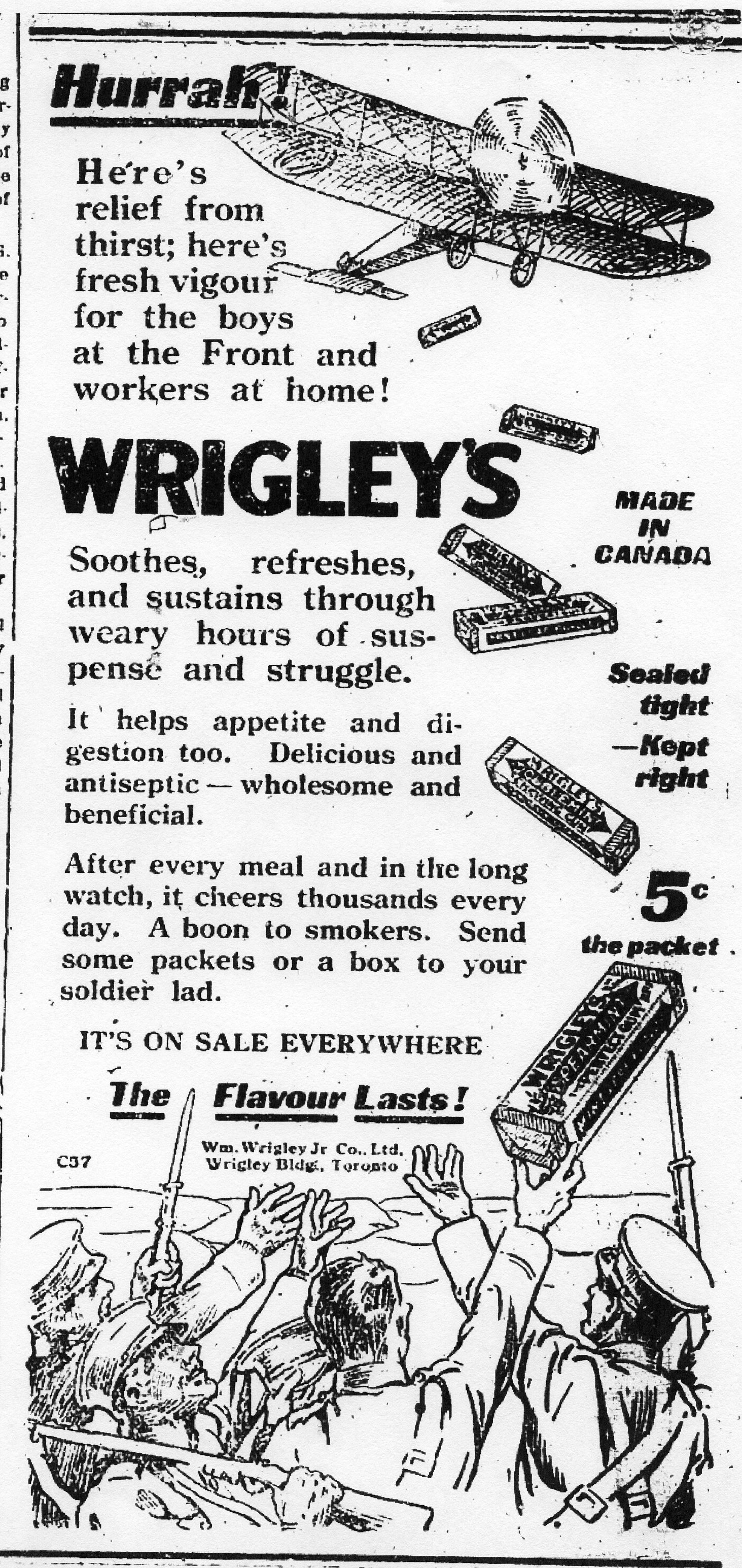
“Hurrah! Here’s relief from thirst; here’s fresh vigour for the boys at the Front and workers at home!

Wrigley’s Soothes, refreshes, and sustains through weary hours of suspense and struggle. It helps appetite and digestion too. Delicious and antiseptic—wholesome and beneficial.

After every meal and in the long watch, it cheers thousands every day. A boon to smokers. Send some packets or a box to your soldier lad. It’s on sale everywhere.”

100 Years Ago: 80th Band Performs, A. Manning Receives Military Medal, Passports Are Necessary Now, Private McDonald Invalided Home

The Intelligencer February 2, 1917 (page 2)

“The Eightieth Band. Another of those fine concerts, for which Lieut. H. H. Stares and his musicians have become famous in England, was recently given at Aldershot for the benefit of the Patriotic Fund. The programme was an extended one, and full of interest. Belleville has every reason to feel proud of the successes attained by these musicians.”

The Intelligencer February 2, 1917 (page 2)

“Honors for an 80th Battalion Soldier. Sergt. T. E. Hyland in writing from Somewhere in France, to a friend in this city says, ‘I had the pleasure of attending the ceremony of the issuing of honors won at Courcelette, and was more than proud to see that A. Manning, one of the old boys of the 80th Battalion, was presented with the Military Medal for services volunteered for and rendered on the night of November 20th, 1916, and I am more than proud to say that he was a member of my own platoon, No. 7 of B Company.

The letter also states that Sergt. Hyland received a box on Christmas morning from the ladies of the Argyll Chapter, I.O.D.E., Belleville, for which he was very grateful and appreciated much the same, and would in the near future acknowledge it by letter.”

The Intelligencer February 2, 1917 (page 7)

“Passports Are Necessary Now. Any person desiring to go to the Old Country must in future receive a passport from the authorities at Ottawa. Hitherto, letters of identification from the Dominion Immigration Officer here have been largely used by those going out from Toronto, but a stop has been put to this practice on orders received from Ottawa this morning. …

Soldiers’ wives have been regular patrons of the immigration office for the past two years. Hundreds of these women have followed or preceded their husbands overseas every month, but from now on they will have to look to the authorities at the capital for their papers.”

The Intelligencer February 2, 1917 (page 8)

“Pte. McDonald Arrives Home. Another Belleville boy unheralded arrived home from the front during the early hours of this morning after doing his bit for his country. The soldier referred to is Pte. E. A. McDonald, who enlisted on July 23rd, 1915, with the 8th Canadian Mounted Rifles, with a number of other Belleville boys. Pte. McDonald was wounded at the third battle of Ypres, and was shortly afterwards invalided. He is a son of Mr. and Mrs. Wm. McDonald, who reside on McDonald Ave., this city, and was before the war an employee of E. C. Sprague’s Dyeing establishment. Pte. McDonald will shortly return to a Kingston Convalescent Home, in order to receive further treatment.”


100 Years Ago: No Foodstuffs or Clothing to Be Sent to Prisoners of War, Marsh & Henthorne Employees Contribute to Christmas Gifts, Letter from Sister Mastin, Two Brothers Killed in Action, Unfit Soldiers to Return, War Savings Certificates Selling Well

The Intelligencer February 1, 1917 (page 1)

“The Post Office Department is in receipt of a cablegram stating that no parcels containing foodstuffs or articles of clothing should be forwarded in future from Canada for Prisoners of War in Germany. …

The Canadian Red Cross Society through its London office undertakes that every Canadian prisoner shall receive adequate relief in food and clothing, sending one parcel every week to each prisoner. Therefore, existing Organizations should continue their work of collecting funds to be sent to the Canadian Red Cross Society; and it is most desirable that they should not relax their efforts in this respect.

Persons desiring to have additional food or supplies sent to a Canadian Prisoner should send money for that purpose to the Prisoners of War Department, Canadian Red Cross Society. …  The remittance should be in the form of a Post Office Money Order drawn in favor of the Prisoners of War Department, Canadian Red Cross Society, for the Prisoner of War in question. Any person wishing to send a remittance direct to a Prisoner of War may do so by means of a Post Office Money Order.”

The Intelligencer February 1, 1917 (page 2)

“Annual Meeting Marsh & Henthorn Shareholders. A Christmas present of one day’s pay was given to each employee. All in the organization from Manager and Superintendent to the errand boy are working hard to produce the maximum quantity of shells that can be turned out from the shops.

The esprit de corps shown is evidence in the fact that everyone in the organization voluntarily contributed one half-day’s pay to send Christmas remembrances to each of the 32 who have volunteered from the Office and Shops and are either overseas or in training to get there.”

The Intelligencer February 1, 1917 (page 2)

“From Sister Mastin. Dear Mrs. Bowell,—I received your lovely parcel, everything came just grand in it. The cake is simply fine. I gave the cigarettes to my patients and they were more than delighted with them. We had a grand picnic, our wards were all decorated with flags and evergreens, they looked lovely. We had plenty of good things to eat on Christmas day. …

How are all the Belleville people. It seems ages since I left my home. Miss Waters and Miss Jenkins are here with me, and they received numerous parcels from home, in fact I did too. Everybody is real good to me.

We are kept real busy all the time. It is just a year since I signed up. One can hardly realize where this year has gone, and this terrible war not anywhere near ending. …  So many of our Belleville boys have been killed lately. My, if this terrible war were only over and all back home how much more happier every one would be.

I think I have told you all the news I can think of. Thanking you once again for your parcel, which was so kind and thoughtful of you to send. Lovingly, Sister Mastin, No. 7 Canadian General Hospital, B. E. F. France.”

The Intelligencer February 1, 1917 (page 2)

“Two Brothers Make Supreme Sacrifice. Mrs. Joseph Pickell, residing at 319 ½ Church street, Belleville, has received official notification that her son, Private Isaac J. Pickell, has been killed in action, the death taking place on the 2nd of June, 1916. Private Clayton Pickell, another son was killed on May 24th, 1916. Both young men were well known in this city, and left here with the 39th Battalion. They were members of Court Moira Independent Order of Foresters. Mrs. Pickell and other relatives will receive the heartfelt sympathy in this, their hour of sore affliction.”

[Note: Private Clayton Pickell died on May 24, 1916. He is commemorated on Page 148 in the First World War Book of Remembrance.]

[Note: Private Isaac Joseph Pickell died on June 2, 1916. He is commemorated on Page 148 in the First World War Book of Remembrance.]

The Intelligencer February 1, 1917 (page 3)

“Within the next few months twelve thousand disabled or medically unfit soldiers will return to the Province of Ontario alone, and the Soldiers’ Aid Commission of Ontario is face to face with a heavy problem in regard to their disposition.

It is expected they will come at the rate of between three thousand and four thousand a month. The highest number of monthly arrivals to date has been about seven hundred. The Commission has agencies in each large town and city to carry on its work. Every facility will be given in disabled or partially disabled men to learn new trades.”

The Intelligencer February 1, 1917 (page 6)

“The campaign for greater national saving has met with splendid support. The Canadian Manufacturer’s Association, Boards of Trade and other representative organizations have signified their willingness to assist to the fullest extent possible. Special appeals are being sent out by Sir Thomas White to the clergy, the press, mayors and reeves of municipalities, local trade unions, and also to the large employers of labor.

Many manufacturing firms have undertaken voluntarily to interest their employees in the war savings certificates and one at least—engaging in the manufacture of munitions—intends to inaugurate a plan whereby employees shall save a stated amount each week to buy the war saving certificates. Nearly five thousand certificates have already been issued.”


100 Years Ago: 235th Battalion Team Challenges Ladies Rifle Club, John Maracle Killed in Action

The Intelligencer January 31, 1917 (page 5)

“When the Ladies Rifle Club received a challenge a few days ago to shoot a match against a picked team representing the 235th Battalion, C.E.F., they simply smiled and said ‘with pleasure.’ The representatives of his Majesty’s Army, thinking they had a snap, entered the fray with confidence. The attack opened at 3 p.m. in the Armories, and from the first shot fired, the men were kept strictly on the defensive, with the result that at 5 p.m. they retired to their reserve trenches on Pinnacle Street with a score of 721 to 632 against them, defeated by 89 points.

Reinforcements are being brought up and a counter attack is expected next week, when they hope to recover their lost ground. The ladies are to be congratulated on the grand scores made, and are now confident they can beat any team brought against them, not excepting the Men’s Club a team of whom they defeated a few weeks ago and are now looking forward to a return match, which is booked for February 9th next.”

The Intelligencer January 31, 1917 (page 7)

“Paid the Supreme Sacrifice. Word has been received that Private John Maracle, who left Belleville for overseas service, had been killed in France on the 12th inst. The hero was 42 years of age and previous to enlisting lived on the Mohawk Reserve, being a member of the Mohawk band.”

[Note: Private John Maracle died on January 12, 1917. He is commemorated on Page 290 of the First World War Book of Remembrance.]

100 Years Ago: Company Contributions to Patriotic Fund, Plans for Belleville Patriotic Fund Campaign, John Kennedy Wounded

The Intelligencer January 30, 1917 (page 1)

“How a Company Can Give $1,000 to The Patriotic Fund at a Cost of $750. It may not be known generally that contributions to the Canadian Patriotic Fund and the Red Cross can be treated as expenses in any business subject to the federal tax on profits. This implies, of course, that the profits on which the tax is based are lessened by the amount of the contributions.

Take a sample case. A business makes a profit of $10,000 in excess of seven per cent. The tax on this of 25 per cent, $2,500. But if the business has contributed $1,000 to the Patriotic Fund its profits will be estimated at $9,000, and its taxation will be reduced from $2,500 to $2,250, a saving of $250. This means, therefore, that a thousand dollar contribution costs the giver but $750.”

The Intelligencer January 30, 1917 (page 1)

“At a meeting of the Campaign Committee held in the Public Library last evening, the campaign for the Belleville Patriotic Fund was started rolling. The Committee was very enthusiastic, and the spirit shown augurs well for the success of the campaign; but it will be necessary for each and every citizen to do his part to assist the various committees to do their work.

It was decided to hold the campaign on February 21st, 22nd and 23rd, and they set as their objective $75,000, which is about the proportion Belleville should stand of the six million to be collected in the Province of Ontario.

The various committees necessary for the carrying on of the campaign have been selected and active work will be started at once. They hope to secure a portion of the show-rooms of Mr. Simmons, corner of Bridge and Front streets, as campaign headquarters.

Put your shoulder to the wheel and do all you can to roll up the amount they have set as their objective.”

The Intelligencer January 30, 1917 (page 3)

“Private John Kennedy, whose name appeared in the casualty list yesterday as wounded, is well known in this city, his home being on Benjamin street. The nature of his wounds are not known. Private Kennedy was for some time a member of the Belleville Police Force, and latterly worked on the Grand Trunk Railway. He enlisted with the 59th Battalion at Brockville, and went overseas with that battalion. He is a married man and has two children. His many friends in the city will hope that his injuries are not of a serious nature.”

100 Years Ago: 254th Battalion Recruiting Meeting, Reception for Manchester Gifford, 254th Battalion Parade for Recruits, Reception for Returned Soldiers

The Intelligencer January 28, 1917 (page 1)

“The recruiting meeting held in Griffin’s Opera House last night under the auspices of the 254th Battalion, was attended by an audience which filled that spacious building. The speakers were four ministers of the city, and each were earnest and practical in their remarks regarding the necessity there was for recruiting. Their remarks were most cordially received by all present, and should be conducive for good.

Lt.-Col. Allen, the Commanding Officer of the battalion, was chairman, and opened the meeting by stating that it was held under the auspices of the Ministerial Association of Belleville, and he was pleased to have the Rev. gentlemen upon the platform and give addresses.

Rev. Dr. Scott, pastor of Bridge Street Methodist Church, was the first speaker, and in his opening remarks said he was gratified at the opportunity of being present at a recruiting meeting even on a Sunday evening. …

Rev. C. G. Smith, pastor of the Baptist Church, was the next speaker, and kept the audience in a genial spirit by the humorous strain he inserted in his brief address. …  Rev. Mr. Smith wished Col. Allen, God-speed in his work of raising his battalion, and asked for the hearty co-0peration of all.

Rev. A. S. Kerr, pastor of St. Andrew’s Presbyterian Church, being called upon, said he could assure Col. Allen that the Presbyterians of the city were behind the 254th Battalion. He congratulated Col. Allen upon the appearance of the men of the 254th Battalion, and it was a great privilege to hear the fine band of the battalion. …  Belleville has done nobly, and we should co-operate with all battalions so that the victory we are waiting and hoping for may be realized. …

Rev. Moore was called upon and delivered a short speech. In his remarks he stated that every man had an interest in this war. He would be ashamed to be called a Canadian if he were a young man and able, but would not go to the front. …  His church, he stated, would be willing to co-operate with a view to enabling Col. Allen to bring his battalion to full strength.”

The Intelligencer January 28, 1917 (page 1)

“Reception to Soldier. A number of soldiers and others gathered at the home of Mrs. Thomas Wells, 36 Murney Street, Saturday evening, to tender a reception to Manchester Gifford, returned from overseas, in recognition of valuable services rendered by him to this King and country. The evening was spent in a social way, a lunch being served.”

The Intelligencer January 28, 1917 (page 5)

“For recruiting purposes the 254th Battalion on Saturday had a parade in this city, and despite the severe cold weather it was a success. Leaving the Armouries shortly after 2 o’clock, Front and other streets were paraded, and many witnessed the procession. It was headed by the fine battalion band, under the command of Bandmaster Lieutenant Hinchey, and a platoon of the battalion stationed in the city. Following were a number of women and children, bearing flags and appropriate mottoes. The scene was an inspiring one, and was witnessed by many citizens.”

The Intelligencer January 28, 1917 (page 5)

“Reception to Returned Soldiers. Saturday afternoon Privates B. Waite, R. S. Fitzpatrick of Belleville, and W. R. McDonald of Stirling, arrived here at 3 o’clock per G. T. R. and were accorded a hearty reception. Despite the inclement weather there was a large number present at the station to welcome the returned heroes. Upon alighting from the train they were escorted to automobiles which were awaiting them. The cars were decorated with flags and bunting.

A parade was then formed, consisting of the 254th Battalion band, a platoon of the 254th Battalion under command of Capt. Bleecker, and a number of women and children bearing mottoes. At the upper bridge the procession was joined by the two hose carts and the hook and ladder truck of the fire department. The boys were most cordially received along the line of march by cheering citizens.”

100 Years Ago: Three Thousand per Month for Patriotic Fund, More News of Construction Battalion, Letter of Thanks, Ad for Canadian Patriotic Fund

The Intelligencer January 27, 1917 (page 1)

“A Grant of Three Thousand per Month for Patriotic Fund. This Sum Was Passed by the County Council Almost Unanimously. Moved by Mr. Montgomery, seconded by Mr. Naylor, that this Council give $3,000 per month to the Patriotic Fund. Mr. Vermilyea thought the grant should be the same as last year, namely $2,000 per month. He moved an amendment to that effect. The situation does not demand the increase.

Mr. Montgomery said he made the motion, and he would support it. We must see that those left behind do not suffer. Farmers, manufacturers, merchants and laborers havc doubled their earnings since the war commenced. Not a man in Hastings County would feel the extra amount named. …  After some further discussion the motion prevailed.”

The Intelligencer January 27, 1917 (page 2)

“A Construction Battalion. With the advent of the 257th Railway Construction Battalion into the local recruiting field, some impetus to the record of recruit-taking may be looked for, on account of the great latitude allowed this corps. The 257th is the first battalion to test out the new physical qualifications which were announced from Ottawa the same day the 257th took the field.

These regulations are much easier to pass than the former ones. A man who is deaf in one ear, or whose vision in one eye is slightly below par, or with some other slight disability, can join this battalion. There are so many men who have offered their services and have been turned down for some minor physical cause that these new orders are keenly welcomed by them. These men cannot see why they should be kept from going to France on account of something or other that has nevcr interfered with their efficiency.

An interesting fact about the 257th is the large number of officers who have had previous railway construction experience during the building of the Transcontinental. As a matter of fact, so many of the builders of this line have been taken on by Col. Martin that the unit has been dubbed the Transcontinental Battalion. …  The 257th has opened a recruiting office at Midland and has opened one in Belleville district. …  It is understood that the 257th has recruited nearly 500 men since January 11th, so prospective recruits in this part of Ontario, should join quickly, or it may be too late.”

The Intelligencer January 27, 1917 (page 6)

“Ontario Military Hospital, Orpington, Kent. Dear Mrs. McFee: Will you convey our heartfelt thanks to the Roslin and Plainfield Women’s Institute to whom we are indebted for cases of feather pillows which reached us this morning. They are in the best of condition and are most useful. They will make many of the men more comfortable than we could make them with issue pillows.
Again many thanks.

You ladies of Belleville have been so very good to us. It seems to me almost every month we have some token that you are thinking of our men, and with best wishes for the New Year, I am, Yours sincerely, G. McPherson, Ass’t Matron.”

The Intelligencer January 27, 1917 (page 10)

“Good-bye, Mother, Don’t Worry! Good-bye—trusting to God to bring him home to her safely—if that be His will.

Good-bye—trusting in you and me to see his Mother through while he, her natural support and defender, is somewhere in France, facing shot and shell for God, for right, and for native land. The Canadian Patriotic Fund. Give As Your Own  Heart Prompts You to the Patriotic Fund.”

100 Years Ago: Royal Naval Recruiting Meeting, 257th Railway Construction Battalion, Welcoming Our Boys Home

The Intelligencer January 26, 1917 (page 1)

“Commodore Jarvis Asks for Recruits—Canada Has Promised Five Thousand. Though not a large audience, it was a very appreciative one, that was present at the Royal Naval Recruiting meeting in the City Hall, last evening, over which Mayor Ketcheson presided.

Before delivering his address, Commodore Aemilius Jarvis, the speaker of the evening, exhibited some very interesting slides and moving pictures. …  After the pictures, Commodore Jarvis launched into his address, which was a plea for recruits for the British Navy, which is quietly and effectively protecting Canada’s shores. It is through the protection of our mercantile marine by the British Navy, that Canada has been able to enjoy her present prosperity. …

Canadian soldiers go to and from Europe in safety, not one life having been lost, and letters pass between the men in the trenches and friends at home, thanks to the Navy that keeps the German navy off the seas.

Owing to a large increase in the tonnage of the British Navy, an increase must be made in the personnel, stated Commodore Jarvis and through Capt. Guinness, a call has been issued for 5,000 Canadians to assist in manning the larger ships. These men need no previous training in order to enlist in the Navy. They will be man-o’-wars men, a sort of soldier-sailor. Every class of trade is needed on these ships, so that the vessel may cruise from place to place, self-sustained.

Men, who have a particular calling, such as a mechanic, etc., will receive promotion. The men wanted are those from 18 to 30 years of age, and will be signed on as seamen, and the pay will be the same as that of a soldier in the expeditionary forces. Seamen with previous experience are also wanted, for duty on the North Atlantic Fleet, with stations at Halifax and Bermuda. …

An appeal was made for recruits for the Naval Service. Belleville and Hastings County had done well in sending men to the front, and Commodore Jarvis was convinced, they would do equally well in providing men for the navy. The speaker also stated that Lady Guinness would award a medal to every Canadian woman who secured a recruit for the Navy. …  The singing of the ‘National Anthem’ closed the entertainment.”

The Intelligencer January 26, 1917 (page 2)

“Men who have been turned down as being unfit, now have a chance to serve their country by enlisting in the 257th Railway Construction Battalion. The medical standard of this battalion is reduced from that demanded for service in the trenches, while the age limit is extended to 48 years.

The battalion is being organized by Lieut.-Col. L. T. Martin, who is himself a well-known railway constructor from Renfrew, and has engaged in many large enterprises. The headquarters of the battalion is stationed in Ottawa and the officers are all practical railway construction men, who have volunteered to form this corps for railway work in France, or wherever it is needed back of the front.

Though the battalion has been authorized for only two weeks, one company of men have already been secured. As soon as the battalion is up to full strength it will without further training be sent direct to France, where it will be employed on Railway construction work. The following is the list of the class of men wanted for the battalion.

Foreman. General foremen, walking bosses, excavation, rock work, drilling, track-work, steel bridge, timber trestle, concrete, master mechanics, shovel, pile driver, rigging, etc., etc.

Mechanics. Carpenters, timber farmers, pipe fitters, mechanics, hoist runners, dinkey skinners, firemen, shovle runners, drillers, driller helpers, powder men, blacksmiths, steel workers, riggers, all kinds of handy men, laborers, etc.”

The Intelligencer January 26, 1917 (page 6)

“Welcoming Our Boys. Belleville, Jan. 26, 1917. Dear Sir,—In reference to the reception given to Pte. Manchester Gifford, one of Belleville’s returned heroes, who has sacrificed his one leg to help protect the women and children of our Dominion, and save the honor of our country; and then to think there was not a hearty welcome awaiting him.

As far as rank is concerned, I think one soldier deserves it as well as another. It certainly must have been neglect on behalf of the citizens of Belleville in not showing their appreciation of the hero. The best welcome we could give, would be small in comparison to what this young man has given up. Is he downhearted? NO! He says he would give his other leg if he could but get one more shot at the Kaiser. From a Soldier’s Wife.”