100 Years Ago: Tag Day, Mayor Urges Decorations for Military Carnival, New Use for Empire Day, Bar Wives Visiting England

The Intelligencer May 20, 1916 (page 2)

“Tag Day a Great Success. Pedestrians upon the streets of the city today were besieged by fair young ladies, who were offering for sale small flags, the proceeds of which were for the 155th Battalion. Donors gave cheerfully to the cause and flags were sold by the hundreds if not thousands. The cause was a worthy one, hence its popularity.

Many automobiles were called into requisition and they were in many cases tastefully decorated with flags and bunting. That a goodly sum was realized, there is not the slightest doubt.”

The Intelligencer May 20, 1916 (page 3)

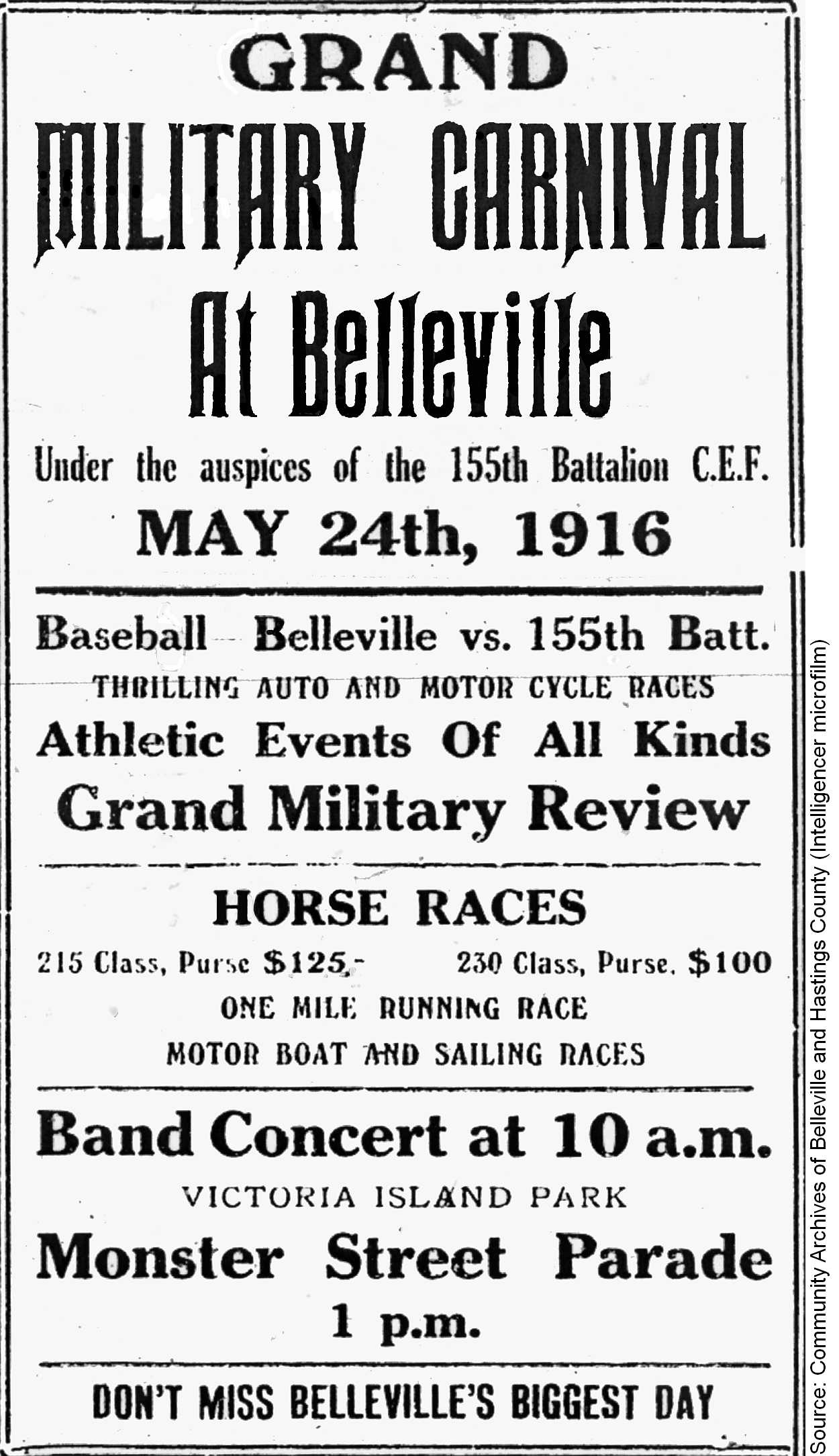
“Belleville’s Big Military Carnival. To The Citizens of Belleville, The 155th Battalion, composed of our own boys from Belleville, Hastings and Prince Edward Counties are putting on a grand military carnival on Victoria Day. It is our duty to give them every encouragement and to make May 24th of this year one of the biggest days that Belleville has ever known.

Every citizen can assist in assuring success. It is necessary that all business places and homes should be decorated. Get out your flags and your bunting, and make our city as attractive and beautiful as possible for this day. Decorate! Decorate! Decorate! H.F. Ketcheson, Mayor.”

The Intelligencer May 20, 1916 (page 7)

“New Use For ‘Empire Day.’ Hon. Dr. R.A. Pyne, Minister of Education, in a circular issued to school teachers and principals throughout Ontario, advocates the devotion of Empire Day school collections this year to comforts for the soldiers. His message reads in part:

‘I believe that the glorious share which the Province of Ontario has had in the struggle for liberty and the freedom of humanity is due in some measure to the early impressions made by such exercises as these. It is not long since that a handful of Canadians, less than forty thousand in all, were the only barriers that stood between the German barbarians and the sea, and history will tell to all succeeding generations the story of how nobly they performed their task upon that dreadful day.

In some of the schools it has been the practice in the past to use contributions by the children for the purpose of flowers for decorative purposes; where this has been the practice, I would recommend that these funds, whether large or small, be devoted to supplying comforts for the soldiers at the front. The contributions, of whatever kind, may either be shipped directly to the front or may be handed over to the local Red Cross Society.’ ”

The Intelligencer May 20, 1916 (page 9)

“To Bar Wives Visiting England. London. Mainly on the grounds that their presence in England has tended to hamper the efficiency of the men, the Canadian agent-general yesterday passed a resolution calling upon the provincial governments to take prompt steps to discourage officers’ and soldiers’ wives from coming to this country until the end of the war.

There are over 3000 wives now in the United Kingdom, and this summer is being increased during the next two or three months at the rate of 1000 a week.

Immediately they arrive they communicate with their husbands, who, perhaps have only just returned from the trenches, urging them to obtain a further few days’ leave. In the vast majority of cases this is of course impossible owing to the military exigencies, but, in spite of that, they persist in demanding the intervention of the agent-general and the high commissioner, and when they find that these men are helpless in the matter, the good women take things in their own hands and write to the military authorities.

In not a few cases they have communicated with the commanding officers direct without the knowledge of the husband to whom such behavior causes some anxiety.

It is far better, said he, for wives to remain in Canada with their friends than to come here on the off chance of seeing their husbands and of spending several months among strangers.”
100 Years Ago: Frederick Willard Dies, Thomas Yateman Welcomed Home, Letter from Ida Denmark, Ad for Victor Records, Sock-Knitting, Send-Off for 155th, Ad for Ritchie’s

The Intelligencer May 19, 1916 (page 1)

“Full Military Honors to Departed Soldier. The remains of the late Private Frederick Willard, who died in this city yesterday, were this morning taken to Stella, his former home for interment.

Deceased, who enlisted with the 80th Battalion, was ill when that battalion left for overseas and he was transferred to the 155th Battalion. Death resulted as the result of pneumonia. The departed soldier was accorded all honors it was possible to give him.

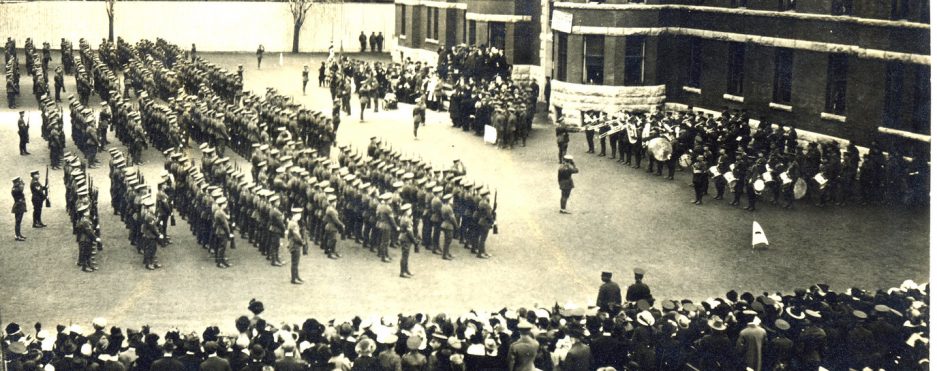
The members of the 155th Battalion, in command of Lt.-Col. Adams, marched to Tickell & Sons’ undertaking establishment, where the remains were placed on the hearse and conveyed to the G.T.R. station. The fine regimental band, under the capable leadership of Bandmaster Hinchey, led the solemn parade, playing funeral marches. The bugle band was also in attendance. Many citizens witnessed the cortege as it proceeded its way to the station.

Over the casket was draped the Union Jack, and the cap and belt of deceased found a resting place upon the casket. The bearers were Privates Phillips, Flavelle, Brownson, Wilkinson, Edmonson and McCann, who were comrades of deceased. Sergt. Vandervoort and Private Sullivan accompanied the remains to Stella.”

[Note: Private Frederick Willard died on May 18, 1916. He is commemorated on Page 182 of the First World War Book of Remembrance.]

The Intelligencer May 19, 1916 (page 3)

“Hearty Welcome to Returned Hero. Gunner Thomas Yateman Royally Received Upon Arrival in The City Yesterday. Despite the inclement weather yesterday afternoon, hundreds of citizens the large majority of whom were ladies, assembled at the C.N.R. station to await the arrival of the 2:15 C.P.R. train from the east. On board the train was Gunner Thomas Yateman, who a year ago was seriously wounded at St. Julien, and who was invalided home.

The bugle band and a number of the members of the 155th Battalion were present to welcome the returned hero. Owing to the nature of Yateman’s injuries, he was unable to walk, and was carried from off the train upon a stretcher and placed in the ambulance and conveyed to the Belleville Hospital, where he will receive every attention.

Cheers upon cheers greeted the returned hero as he was carried from the train to the ambulance. Yateman recognized his friends with a smile, and waved his hands. Upon the train were other soldiers who have done their bit and were being invalided home. The prospects are that Yateman will be confined to the hospital for some time.”

The Intelligencer May 19, 1916 (page 3)

“No. 2. Canadian Stationary Hospital, Outreau, France. 25—4—16. Dear Mrs. Lazier:—The box from the R.C. and P.A. of Belleville, came yesterday, for which many thanks. I kept the white gauze bandages (which are a great luxury) the wash-clothes, and hot water-bottle covers, for my own ward, and turned the remaining contents into the Matron’s office.

The box from the Belleville Cheese Board came at the same time. The contents were very, very acceptable. Will you kindly thank the contributors. I think the Matron is writing you also. We have a very nice hospital here, and get a good many Canadians. Only once have I had a Belleville boy here, he was Sergt. Slater. Such a nice boy.

It hardly seems possible that I have been over here nearly a year and a half, and apparently no chance of the war ending. I hope to remain with the same unit until I resign for good, which will probably be next October. So many nurses want to come out, and I, certainly am not indispensable.

I hear that Mary Hambly has gone back to Canada, so no doubt she will be able to tell you all the many experiences we have. Great excitement here this week with German aeroplanes right over the hospital. No damage done with their bombs, tho’. Again many thanks, and with kindest regards. Yours very sincerely, Ida Denmark.”

The Intelligencer May 19, 1916 (page 5)

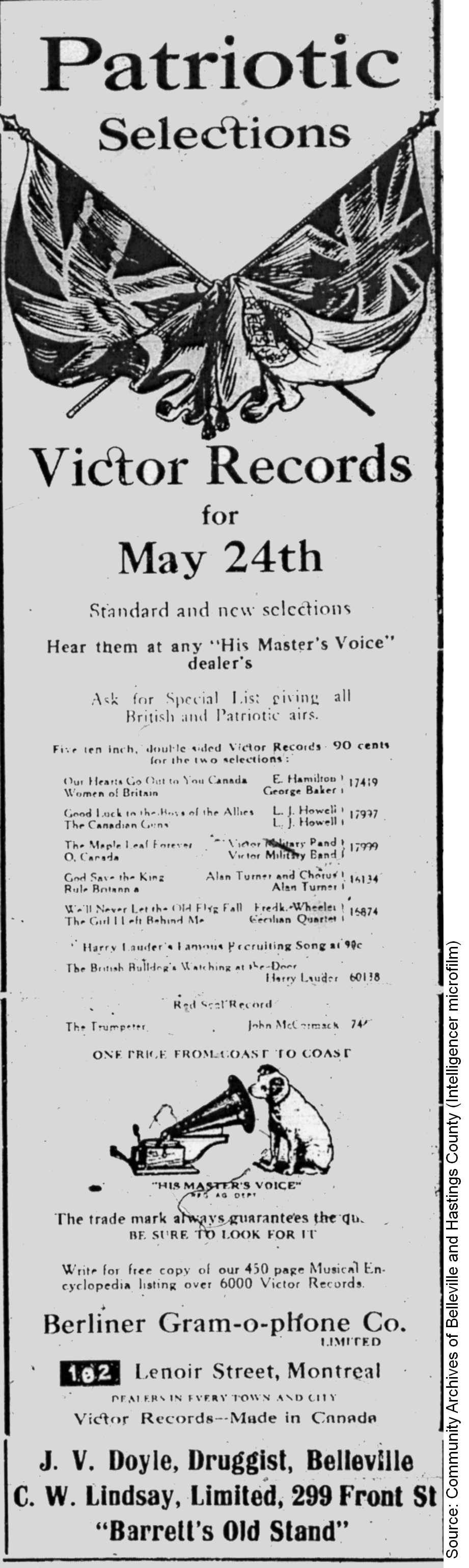
Victor Records

“Patriotic Selections. Victor Records for May 24th. Harry Lauder’s Famous Recruiting Song at 98¢. The British Bulldog’s Watching at the Door.

The Trumpeter. John McCormack.

J.V. Doyle, Druggist, Belleville. C.W. Lindsay, Limited, 299 Front St. ‘Barrett’s Old Stand.’ ”

The Intelligencer May 19, 1916 (page 7)

“Belleville Leads In Sock-Knitting. Mrs. John Colden of Hillcrest Avenue Has 300 Pairs to Her Credit and Still Turning Them Out. Among the champion knitters of socks for the soldier boys, and possibly the leader in our industrious city, is Mrs. John Colden of Hillcrest Avenue, who, besides attending to her household duties, has thus far turned out three hundred pairs, and is still ‘on the job.’

Others, too, are closely following, and if the present energy continues there may be ‘a corner in yarn’ before the war closes. An interesting scene in nearly every local household, is the lady with her knitting needles in hand transforming the yarn into comforts for the feet, the mother-love for our brave boys at the front causing many to work on Sunday from sheer force of habit. Credit? It should be bestowed in abundance.”

The Intelligencer May 19, 1916 (page 8)

“Belleville Will Give The 155th A Rousing Send-Off. The citizens will have a splendid opportunity to give our lads of the Quinte Battalion a grand send off on the 24th of May. This regiment, is more representative of the city and district than any corps yet sent over seas, as it is recruited entirely from Hastings and Prince Edward counties.

As a consequence, we may expect to see a tremendous crowd from throughout these two counties, as well as visitors from anywhere within a hundred miles of here, as the celebration has been extensively advertised, and will be unrivalled by the many counter celebrations of that day, as Belleville has by far the best programme to be given anywhere and a day of exceeding pleasure is promised to all who attend.

Let us get all together and boost for the 155th Overseas Battalion and for a great big smashing success of the Military Carnival at Belleville on Victoria Day, May 24th.”

The Intelligencer May 19, 1916  (page 8)

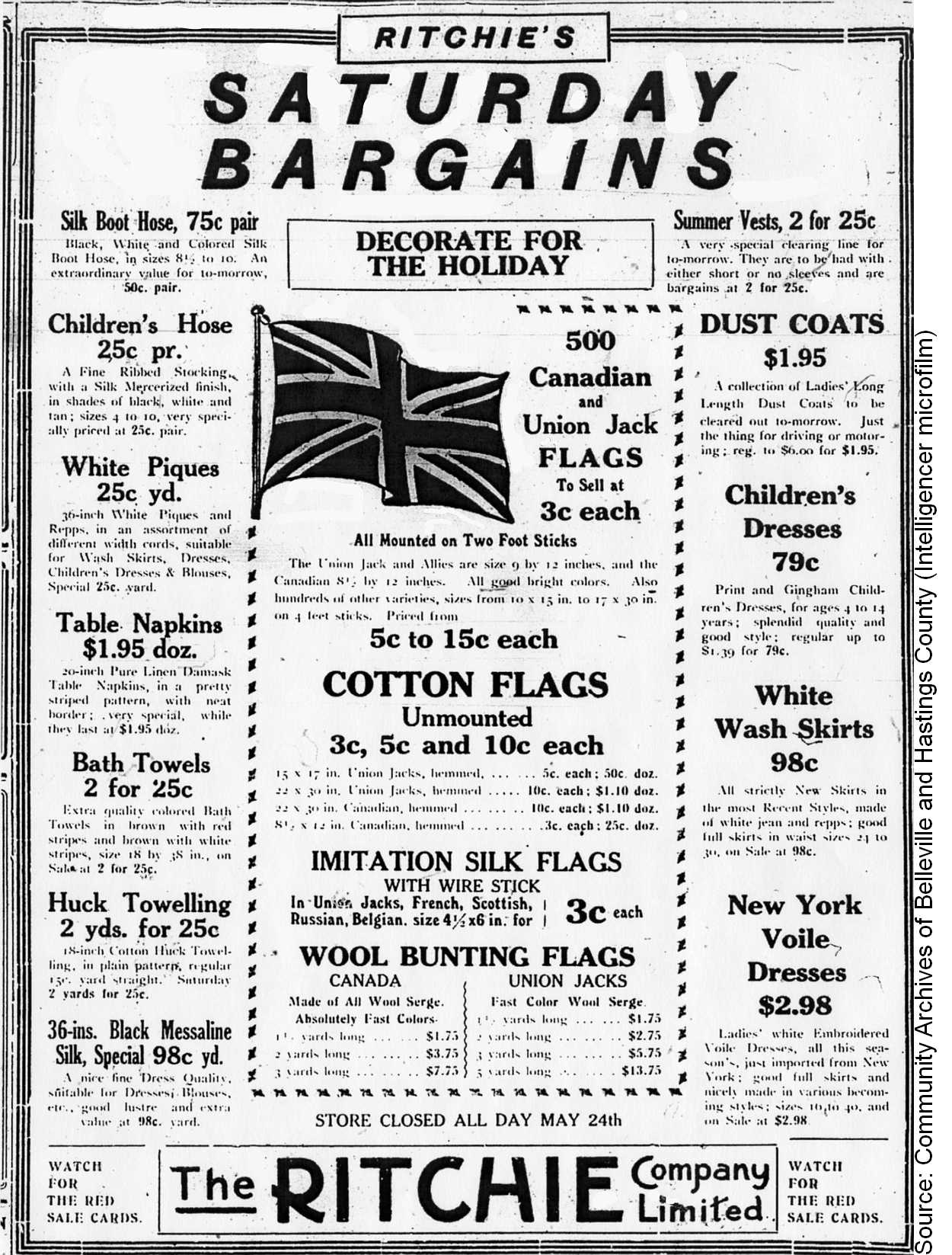
Ritchies

“Ritchie’s Saturday Bargains. Decorate for the Holiday. 500 Canadian and Union Jack Flags To Sell at 3¢ each. All Mounted on Two Foot Sticks. Cotton Flags. Imitation Silk Flags. Wool Bunting Flags.”

100 Years Ago: Soldiers’ Estates, Army Horses, Y.M.C.A.’s Mr. Sharpe Thanks Belleville

The Intelligencer May 18, 1916 (page 1)

“Mode of Dealing with Estates of Soldiers. Ottawa. A memorandum dealing with the distribution of the estates of soldiers killed or dying from other causes while with the Canadian expeditionary forces, was laid upon the table of the House to-day.

It points out that casualties are sent by cable to England and then to Ottawa. Personal effects are collected and forwarded to the base. There they are checked and an inventory sent with them to the director of pay and records services of the estates branch in London. If the deceased resided in Canada his effects are sent to Ottawa.

The pay account is closed as soon as the death is announced and becomes known as a non-effective account. In the case of missing men, thirty weeks must elapse before the necessary steps can be taken to presume death.”

The Intelligencer May 18, 1916 (page 3)

“To Purchase Army Horses. The Hon. Col. Sir Adam Beck is coming to Belleville Thursday, May 25th, to purchase Army Horses. This will give the farmers a chance to sell their horses, and it will also give the citizens a chance to show their appreciation of Sir Adam Beck for what he has done for the Public and Hydro Electric, and what he is doing as Director of Remounts.”

The Intelligencer May 18, 1916 (page 7)

“An Open Letter to the Citizens of Belleville. To the citizens of Belleville:—I could not close six months of very happy work in Belleville as Y.M.C.A. representative with the troops without expressing my deep appreciation of the many kindnesses that have been shown me personally and the hearty co-operation I have received from everyone.

I am greatly indebted to the churches which in turn provided me with pianists, singers, and speakers for our Barracks gospel service on Sunday evenings after church. These informal meetings were looked forward to by many men, and decisions were registered there that will make death—if that be some man’s lot—not the horror it might have been, but instead just an incident in the game of war. …

To the churches I owe thanks for the Christmas dinners served the men. Without their help such an undertaking would have been unthinkable. From time to time through their thoughtfulness I was able to invite groups of men to spend an evening in a church society.

I can not begin to name the many, many services for which I have to thank the ladies of the Khaki Club. Their name is legion. …  Through the efforts of the club a most wholesome environment was provided for every man. If the measure of the good of anything is the amount of evil it displaces, then the Khaki Club was wonderfully successful for I know scores and scores of men who would have wandered into doubtful surroundings had these bright helpful ones not been provided and been so handy. …

Nor has their assistance ended for I take along to still further serve the men in England and in France two splendid gramaphones and a supply of records,—their farewell gift.

To the hospital authorities I am grateful for the liberty I was allowed in visiting and serving the men whom sickness overtook. Among the most sacred memories of Belleville are those held by the soldiers who were ‘fortunate’ enough to spend their sick spell in the hospital.

The tender care, the skill, the sympathy, the kindnesses, and the persistent happiness of those who ministered to them in sickness will be held in continual grateful remembrance.

The press of the city was most generous. It enabled us, by giving us dozens of ‘exchanges’ each day to provide a ‘home-town’ paper for nearly every town represented. This was a more valuable service than appears at first thought.

The papers helped me not a little by keeping my work before the citizens, making our needs known, and thus very largely supplying them. …

Words are a poor return to the Belleville Y.M.C.A. when I think over how they assisted me. Though a Y.M.C.A. representative, I was assigned to special work and they were under no obligation to inconvenience themselves for me or my interests but they most certainly did. In the first place they provided me with personal quarters during my entire stay. They placed at my disposal the whole plant and its splendid equipment. …

The citizens generously have co-operated heartily, in the matter of the Christmas dinners, the providing of reading material throughout the season, in providing programmes at the barracks and social evenings at the Y.M.C.A. rooms, and in a multitude of other ways that only needed suggesting to be undertaken. …

Mine has been a rare privilege in being associated with these men of the 80th. …  It was my privilege to go to Montreal with the Batt., and I felt eleven hundred tugs as I waved them farewell till out of sight. To leave them for the short time till I rejoin them in England was hard indeed.

The chief topic of conversation after the train pulled out of Belleville was the uniform kindness of every one all the time we had been here. Only sleepiness stopped it. Your kindness will be an ever pleasant memory and your fine farewell a continual inspiration. I trust your recollection of the 80th may differ only in degree.

Thanking you again for your continued kindness, sympathy and co-operation. I am, very gratefully yours, C.T. Sharpe, Secretary, Military Y.M.C.A.”


100 Years Ago: Thomas Yateman Reaches Quebec

The Intelligencer May 17, 1916 (page 7)

“Pte. Yateman Enroute. Word has been received from Quebec that Pte. Thomas Yateman, artillery, who was wounded in the spine about a year ago, and is still partly paralyzed, is being brought home with an officer in charge, and will arrive in Belleville to-morrow afternoon on the 2:15 C.P.R. train. He will be taken to the General Hospital from the station.

Everyone who can should make it a point to meet the returned hero, and give him a rousing reception to welcome him home, and show their appreciation for one who has ‘done his bit’ for his country. Pte. Yateman’s father and brother are both members of the 155th Battalion.”

100 Years Ago: Invalided Soldiers Arrive at Quebec, Canadians Cut Wood in Britain, Tom Vance Wounded Again, Khaki Club Provides Parcels for 80th, 155th Battalion to Present Military Carnival

The Intelligencer May 16, 1916 (page 1)

“Returning Soldiers Arrive at Quebec. The Allan liner Scandinavian, arrived at dawn with mails, general cargo, and besides other passengers, 158 invalided soldiers. Among the latter is J.N. Cullett, Belleville.”

The Intelligencer May 16, 1916 (page 1)

“1,500 Canadian Woodsmen Are At Work In Britain. London. The President of the Board of Trade said in the House of Commons to-day that fifteen hundred Canadian woodsmen had come here to cut timber. ‘We are so short of timber that the work must be done forthwith, though every endeavour is being made to do it economically,’ he said.”

The Intelligencer May 16, 1916 (page 3)

“Corporal Vance For Second Time Wounded. Mrs. Wm. Vance, who at present resides at Consecon, Prince Edward County, but formerly lived in Belleville, yesterday received the following telegram: Ottawa, Ont. May 13, 1916. Mrs. Wm. Vance, Consecon, Ont. Sincerely regret to inform you, 8266 Corporal Thos. Vance, infantry, officially reported admitted No. 3 Field Ambulance; April 27th. Shell shock. Will send further particulars when received. Record Officer.

Corporal Vance above referred to is well known in the city where he has many friends. This is the second time he has been wounded whilst upon active service. In April, 1915, at Langemarck he was wounded in the hip, and for some months was in a hospital in England. Upon recovering he again went to the front only to receive his second baptism of fire. His many friends will wish for him a speedy recovery.”

The Intelligencer May 16, 1916 (page 3)

“At the Khaki Club. Eleven hundred parcels of ham and tongue sandwiches were made for the men of the 80th for their journey to Halifax. Each parcel contained four sandwiches. Twelve hundred oranges and twelve hundred boxes of Player cigarettes were put on board the train. The Khaki Club was splendidly helped in this work, both by cash and workers.”

The Intelligencer May 16, 1916 (page 7)

Military Carnival

“Victoria Day, 1916, is to be fittingly celebrated in Belleville, the 155th Battalion presenting the first big Military Carnival ever held in the City of the Bay. Excursions will be run from North, South, East and West, and without a doubt the capacity of the Driving Park will be strained to contain the crowd.

The fine programme in the morning, consisting of spectacular motor boat races, sailing and canoe races and other aquatic sports as well as a big Band Concert on Victoria Island Park, will make the best morning programme attempted yet.

Next, the Grand Military and Industrial Street Parade at 1 o’clock, will be a feature worth travelling miles to see. The parade will be headed by our own 155th Bay of Quinte Battalion, and will be the last opportunity of seeing them on parade in our district. Following our boys in Khaki will be a Trade and Automobile procession, etc.

At the grounds an unrivalled afternoon of amusement has been prepared, thrilling automobile and motor cycle races, baseball game between the Ontarios of Belleville and the 155th Battalion ball team, field sports of all kinds, and high class horse races; there will be two classes, 2.15 and 2.3 class, as well as a one mile running race. The running race has already eight entries, and promises to furnish the most exciting racing event ever given in this city.

Each event of this big day is easily worth coming miles to see, but the last Grand Military Review before the Grand Stand will make every one happy to have spent Victoria Day in Belleville.”

100 Years Ago: 80th Battalion Leaves for Active Service

The Intelligencer May 15, 1916 (page 1)

“Departing Soldiers in Final Street Parade. It was truly a patriotic demonstration that attended the leave-taking of the 80th Battalion from our city on Saturday night. For the moment previous like occasions were forgotten in the emotional outburst of pride for the gallant fellows as they paraded Bridge and Front streets, for the last time.

Crowds gathered from every section, immediate friends visited the soldiers at the Armouries; knapsacks were packed; blankets rolled, and at the alloted hour, headed by the new celebrated band, led by Lieut. H.A. Stares, the boys swung into the street, down Bridge, up Front, as far as the upper bridge, and return, the waving of handkerchiefs and lusty cheers making the welkin ring.

In the ranks headed by the Battalion band, led by Bandmaster Hinchey, were the boys of the 155th, determined to stay by their comrades to the last.

The scene, pathetic yet inspiring, will never be forgotten by those who viewed the parade. It was the final tribute to those who were giving all—perhaps even to their lives—for home and country.

Fathers, mothers, brothers, sisters, wives, children and sweethearts clung to their dear ones to the last moment; lunches had been prepared by loving hands; keepsakes bestowed; the final kiss, and they were gone—to return? Let us hope so.

During the closing preparations Col. Ketcheson and staff were all activity. Nothing was left undone that might add to the comfort of the journey. Cars of the most modern type were in readiness, and from ten to ten-thirty, all having entrained, the engine throttle was opened, and final words of farewell given, and one more battalion of brave Canadian lads left for active service.

That our boys will be missed goes without saying. Since recruiting for this particular battalion began, in September last, many friendships were created; the faces and cheerful greetings had become familiar, and now that they are gone a vacancy in local social circles naturally follows; but the feeling of pride on behalf of their loyalty to the colors, cannot be quenched.

All hail to the boys of the 80th Battalion—May God’s protecting care accompany them—and their return to home and friends be an experience in the near future.”

100 Years Ago: War Tax Raises Cost of Theatre Tickets, R.L. Sewell Wounded

The Intelligencer May 13, 1916 (page 2)

“Save Your Coppers. Beginning with Monday next those purchasing tickets at the Opera House or The Palace Theatre will require to pay the following additional: On ten cent tickets, one cent extra; from ten to fifty cents, two cents extra; from fifty cents to $1.00 five cents extra; over one dollar ten cents extra.

These additional items in no way benefit the theatres, as extra expense is attached to the issuing of special tickets and other items contingent upon the war tax. If those frequenting the playhouses will purchase twenty-five cents worth of tickets at a time it will be of convenience both ways. In any event save your coppers and have the change ready.”

The Intelligencer May 13, 1916 (page 2)

“Belleville Boy Wounded. In to-day’s casualty list appears the name of R.L. Sewell, an old Belleville boy, who has been wounded. His many friends in this city will regret to hear of his misfortune.”

100 Years Ago: Military Y.M.C.A. Sports, Last Khaki Club Night for 80th, Private Leveridge Dies of Wounds, Turriff Boy Enlists

The Intelligencer May 12, 1916 (page 2)

“Local Military Y.M.C.A. Sports. The presence of the whole of the 80th Battalion in this city has made possible the running off of the battalion baseball championship. The champions of the right half battalion league were the bandmen, who almost walked away with the games held in the armouries here during the winter. The Battalion championship title had to be decided then by games between the band, ‘C’ Company and ‘D’ Company.

These were staged at the park on three evenings and provided some very close games which were witnessed by enthusiastic supporters of all the teams. …  ‘C’ Company got the necessary extra run that decided the championship. Enthusiasm ran high and ‘C’ are prepared now to meet an all-star team from the remainder of the Battalion, and it will be the game of the season.

A challenge match in Association football between the left and right half battalions promises some good sport for an afternoon before the battalion leaves. An extra large number of the men are Old Country Soccer players and eager for an opportunity to display their skill in this direction.”

The Intelligencer May 12, 1916 (page 2)

“One More Club Night. Another of the long-to-be-remembered of Wednesday evenings was spent by the men of the 80th at the Khaki Club this week. …  The club was full and overflowing the whole evening. The hurry-up programme was faultless. It was in charge of Miss Milburn who has provided so many. …

It was typical Khaki Club evening. Everyone knew everyone else, and everyone took part in the choruses. The men sang as if determined that the songs would ring through the place till the 155th took it over as their rendezvous next fall. While every man is loud in his praises of the Khaki Club and its work, its real value and the large place it has filled will only be fully appreciated when a Wednesday comes and there is no Khaki Club to go to.

Though no evening before saw such a large attendance and only the afternoon was available for preparation of programme and refreshments everyone went away at 10:00 p.m. delighted and satisfied.”

The Intelligencer May 12, 1916 (page 7)

“Succumbed to Injuries. Word has been received that Pte. Leveridge of Coe Hill, who was seriously wounded while doing his duty at the front, had succumbed to his injuries.”

[Note: Private Frank Ernest Leveridge died on May 5, 1916. He is commemorated on Page 118 of the First World War Book of Remembrance.]

The Intelligencer May 12, 1916 (page 8)

“Presented With Wrist Watch. A very pleasant evening was spent at the home of Miss Margaret Munro at Turiff on Monday, May 8th. The evening was spent in games and music, in the course of which Mr. Alex. McGibbon, who has donned the khaki to ‘do his bit’ for King and Country, was presented with a short address and a wrist watch as a slight token of the esteem in which he is held among his friends.

The young soldier boy responded very fittingly, after which lunch was served and all partook of the dainties, enjoying them. Several patriotic songs were sung, and the evening brought to a close with the singing of the National Anthem.”

100 Years Ago: Making Over Disfigured Faces

The Intelligencer May 11, 1916 (page 6)

“Making Over Disfigured Faces. Lieut. Derwent Wood, A.R.A., is developing one of the oddest occupations that has sprung out of the war. He is manufacturing new faces for those that have been destroyed or horribly disfigured by shell-fire, and men who have seen some of his handiwork declare that it is wonderful.

It is said that such wounds as have been inflicted in this war have never been known before. They are the result of high explosives, for the most part, though expanding bullets have left their own dreadful impression upon many soldiers. In other wars men wounded as have been those treated by Lieut. Wood died from their injuries. Thanks to the improvement of medical art, these wounds though horrible, are frequently not fatal. They are such, however, as would prevent those receiving them from ever appearing in public again. To build them new faces is the task of Lieut. Wood.

One of the earliest cases he treated was that of Driver Ferguson, a member of the Canadian Field Artillery, who was wounded at Ypres. A piece of shell carried away his right eye and ‘the surrounding structures.’ In the ordinary course of events there would have been nothing to attach an artificial eye to, and the disfigurement was so appalling …  that he never could have resumed his old trade. After passing through the hands of Lieut. Wood, Ferguson shows no sign of his injury, even under close inspection. He appears to have two good eyes, and the contour of the injured side of his face is exactly as it was before he received his injury.

To prove that he is no longer an unsightly object it is sufficient to mention the fact that he is about to be married. But perhaps this is no proof at all. The real proof is that he will be able to go about among his fellow-men and not be conscious of their horrified stares. …

Derwent Wood was one of the most distinguished of the younger generation of British sculptors when the war broke out; and like many thousands of other artists, he heard the call of duty and enlisted in the Army Medical Corps as a private. Appalled by the number of men with terrible facial wounds that he encountered in the hospital, he begged leave to see if he could do anything for them. …

The complete cost of one of his plates is $25, which is cheap, since an artificial leg costs from $200 to $250. The Government, of course, bears the entire expense, and, apart from motives of humanity and gratitude, it might well act from motives of economy, since a wounded soldier that is unable to resume his ordinary occupation is much more expensive to the nation than one who becomes self-supporting.”

100 Years Ago: Maynooth Soldier Wounded, Armouries Concert by 80th Battalion Band

The Intelligencer May 10, 1916 (page 7)

“Maynooth Soldier Wounded. To-day’s casualties chronicle the wounding of 458,130, Thomas Nelson Card, of Maynooth, Ont. The extent of his injuries is not given.”

The Intelligencer May 10, 1916 (page 7)

“Farewell Concert. At the Armouries last night a farewell concert was given by the band of the 80th Battalion. There was a large attendance of spectators, and the programme furnished by this well-known musical organization was all that could have been desired. The selections provided were not only tuneful, but varied.

Lieut. H. Stares, Bandmaster, was master of ceremony, and fulfilled that position in his usual affable and able manner. The promenade selections were an enjoyable feature of the programme.”