100 Years Ago: Presentation to Queen Alexandra School, Belleville Boys Wounded, New Testament for 80th Battalion Soldiers, More Magazines Wanted

The Intelligencer May 9, 1916 (page 2)

“Presentation to Queen Alexandra School. Lieut.-Col. Marsh and Mrs. Marsh presented to the Cadets of Queen Alexandra School two drums for use in their drilling. They will be of great service to assist in regularity of marching and Col. and Mrs. Marsh’s kindness is very much appreciated by the faculty and scholars of the school.

The condition of the Queen Alexandra School Corps is first class, and the interest which the boys have in their company will be very much increased by the thoughtfulness of Col. Marsh.”

The Intelligencer May 9, 1916 (page 7)

“Belleville Boys Wounded. The names of 40459, Driver William McKenna, and Lieut. John Gordon Murray, both of Belleville, are mentioned in today’s casualty list as wounded, also Charles Doyle, 37 Cedar street, this city.”

The Intelligencer May 9, 1916 (page 7)

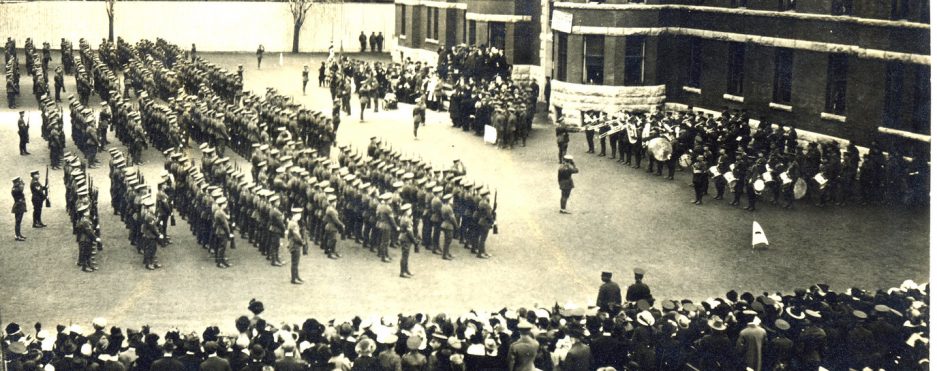
“A Present For Every Soldier. At 8:30 this morning on the barracks parade ground a muster parade of the 80th Battalion was held at which every man received a copy of the New Testament and a devotional booklet from his own denomination.

The New Testaments were secured from the Upper Canada Bible Society by Mr. Sharpe of the Military Y.M.C.A. and were presented to the men as they filed by, by Capt. Milton, a staff chaplain from headquarters at Kingston. They are a military edition, neatly bound in khaki and convenient in size.

After the Testaments were issued, His Worship Mayor Ketcheson presented a Prayer Book secured from the Bishop of Kingston by the Chaplain, Capt. Ketterson, to every Anglican soldier.

Following this the remainder of the men were issued a neat packet containing an attractive book given to the soldiers jointly by all the non-Anglican Protestant denominations. These were secured from the Rev. T. Albert Moore by the Military Y.M.C.A. and were handed to the men by Mayor Ketcheson.

As the Roman Catholic soldiers are being looked after by their church, every man has some token of goodwill from his church to take along with him.

Following the distribution of the books, Col. Ketcheson presented the prizes of the Y.M.C.A.’s military bowling league to the successful teams. …  The bowling league, which was conducted by Mr. Sharpe, was started on the Y.M.C.A. alleys and transferred to the armouries as soon as they were ready. About one hundred men took part, and at least three hundred saw the games.”

The Intelligencer May 9, 1916 (page 7)

“More Magazines Wanted. The Military Y.M.C.A. is urgently in need of more magazines in order to be able to put one in every seat in the coaches for the men and still have plenty for use on the boat.

Those having short story magazines or illustrated papers will greatly help if they can deliver them to the Y.M.C.A., or if impossible, inform Mr. Sharpe and they will be called for.”
100 Years Ago: Classic Concert by 80th Battalion Band

The Intelligencer May 8, 1916 (page 8)

“Classic Concert By 80th Band. Griffin Opera House last night contained an audience which filled the spacious building to its capacity. The occasion was a farewell concert given by the band of the 80th Battalion under the able leadership of Bandmaster Lieut. H.A. Stares, Mus. Bach.

This fine musical organization had previously been heard in this city, but the programme presented last night was, if possible, more varied and intricate than upon former occasions. Three of the numbers rendered were, to say the least, of such a nature as to bring out the musical ability of each and every member of the band. That they executed the same in a manner that was most pleasing, is a mild expression.

For encores to the numbers on the programme, ‘Nearer My God to Thee,’ ‘Oh, Dry Those Tears,’ and ‘Who’s Next?’ were given. Each number was received with much enthusiasm by the audience. …

Bandmaster Lieut. Stares spoke a few words to the audience, stating on behalf of the band that he desired to say good-bye to a Belleville audience, as the band and the battalion would in a few days leave for overseas to do their duty for King and Country.

It may be stated that there are two Bellevillians connected with the band, namely Sergt. W.G. Grant, drummer, and Hurley Vickers, trombone player.”

100 Years Ago: William McCafferty Laid to Rest, Charles Eves Killed in Action

The Intelligencer May 6, 1916 (page 2)

“Laid at Rest With Military Honors. The remains of the late Private Wm. McCafferty, member of the 80th Battalion, who died here on Thursday as the result of an attack of pneumonia were this afternoon buried with full military honors.

Deceased was a young Scotchman, and had no relatives in this country. During his fatal illness, everything possible was done for him and every respect was shown the remains as they were lain away in Belleville cemetery.

At 2 o’clock, Rev. Chaplain Ketterson of the 80th Battalion conducted appropriate burial services at the Belleville Burial Company’s undertaking establishment, and he also officiated at the burial.

The 80th Battalion, under command of Col. W.G. Ketcheson, was out in full strength, also firing party and the fine band of the Battalion in command of bandmaster Lieut. H.A. Stares. The band followed the firing party carrying reversed arms. A funeral march was played and to the slow trend of the battalion the cortege proceeded down Front street and across the lower bridge and thence to the cemetery.

Hundreds of citizens and many from the country who were in the city witnessed the solemn procession as it proceeded on its solemn wend to the city of the dead.

The bearers were six comrades of the deceased namely, Privates Miller, Troumbly, Thom, Burdell, Day and Lomab. At the cemetery after the committal services by Chaplain Ketterson, a volley was fired over the grave and the last post sounded by bugler Kellwain.”

[Note: Private William McCafferty died on May 4, 1916. He is commemorated on Page 122 of the First World War Book of Remembrance.]

The Intelligencer May 6, 1916 (page 2)

“Killed in Action. Mrs. Charles Eves of 13 Harriet street, received word that her son, Charles, had been killed in action on the 24th of April. He was a Belleville boy, but enlisted at Edmonton. He leaves a wife and little child.”

[Note: Private Charles Eves died on April 24, 1916. He is commemorated on Page 84 of the First World War Book of Remembrance.]

100 Years Ago: George Waite of Coe Hill Killed in Action, Anniversary Mass for Leo Ross

The Intelligencer May 5, 1916 (page 2)

“Private George Waite of Coe Hill, Hastings County, has been killed in action at France. His name appears in the Canadian casualty list of today.”

[Note: Private George Elgin Waite died on April 19, 1916. He is commemorated on Page 177 of the First World War Book of Remembrance.]

The Intelligencer May 5, 1916 (page 7)

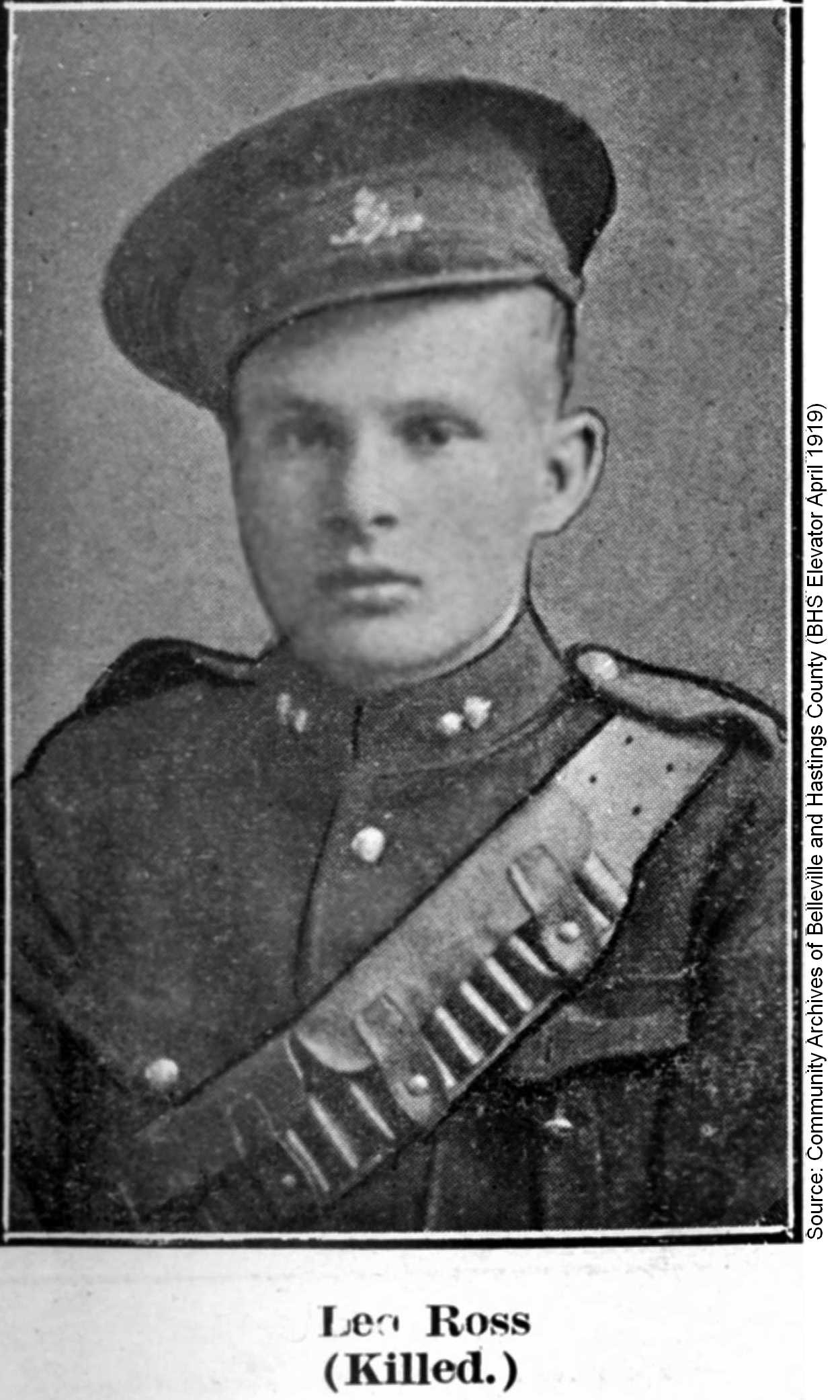
Ross, Leo

“Anniversary Mass. A solemn requiem mass for the repose of the soul of the late Gunner Leo Ross was sung this morning at St. Michael’s Church.

The Rev. Father Killeen was the celebrant, and his altar boys were two young soldiers, Pte. J. Crawley and Pte. W. Smith. The Catholic members of the 155th Battalion attended in a body, in order to show their respect to their brave young comrade.”

100 Years Ago: 155th Overseas Battalion Benefit, Letter from Ernest Phillips, Memorial Service for Albert Green

The Intelligencer May 4, 1916 (page 2)

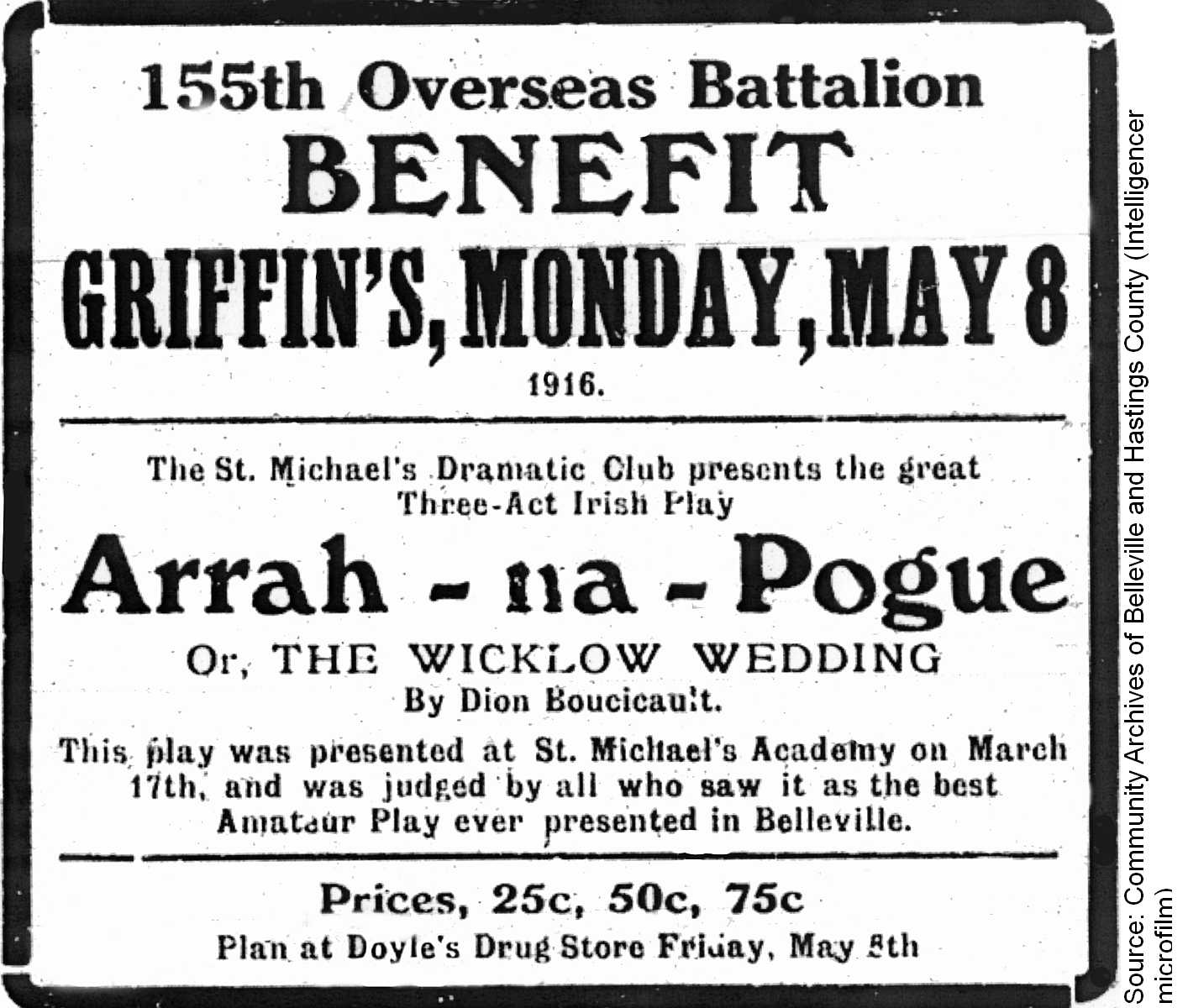
155th Benefit

“Arrah Na Pogue. A Happy Combination of Duty and Pleasure. The news-reading public of the City of Belleville have no doubt seen quite a lot in the Toronto papers of the cost of recruiting a regiment. For the information of those who have not read, it is stated by the authorities that the recruiting of a regiment alone costs anywhere from $12,000 to $20,000. And this in the City of Toronto.

Therefore, one can realize that a regiment like the 155th, our own Bay of Quinte boys, that is recruited over a district twenty times as large as Toronto, must be a costly enterprise. However, the 155th to-day is not only up to strength, but stands first in the military district of Eastern Ontario. Surely this is a source of great pride to the loyal citizens of this city.

Now the 155th, the same as all other regiments, was not recruited by prayers, or pride, or on wind. It has cost a whole lot of money to place this regiment at the top of the district.

The people of Belleville have been asked to contribute less to the 155th than to any corps that has left this city. Someone has to pay. Are you going to ask the fighter to pay? Therefore, it behooves every citizen of Belleville, and citizeness to go down to Doyle’s Drug Store on Friday morning and secure tickets for the beautiful Irish Comedy-Drama, Arrah-Na-Pogue, which is being put on at Griffin’s Opera House on Monday next, May 8th, by the members of the St. Michael’s Dramatic Club. They are contributing the play intact. All the money taken in will go to the 155th Battalion, which is sorely in need of funds at the present moment.

Aside from the sense of duty which should compel every citizen to attend Arrah Na Pogue, it might be said that he who spends 50 or 75 cents to attend this performance will not regret a penny of it, as all who saw the play when presented at St. Michael’s Academy will testify. Many plays that cost $1.50 were not enjoyed nearly so much.

Now then, remember to keep Monday evening open and attend a performance that will last long in your memory, and at the same time, contribute your mite to our brave lads in Khaki.”

The Intelligencer May 4, 1916 (page 3)

“From Ernest Phillips. France, April 17, 1916. This is about the first chance I have had to be able to write a letter to you; so I will try and give you full particulars.

On the morning of April 4th, an officer, a Sergeant, Bert Green and a chap by the name of Rae, and myself started out as an advance party to take over telephone lines etc. …  We had not gone very far on the line we were tracing, when suddenly three German shells came over (quiet and unheard) dropped within a few yards of us ending our career.

I shall never forget the dreadful scene, when I came to myself and realized what had happened. Poor Bert lying dead just a few feet from me. The officer and Rae were literally filled with shrapnel. Both expiring in a few minutes leaving the Sergt. and myself lying wounded between them. …  I was very badly cut up myself, being hit in six places. Chest, right fore arm, right thigh and leg (through the calf) two in left leg, one above and one below the ankle, also through. …

I will probably be all right in a short time. …  I am at present in No. 13 General Hospital Base and pleased to say that I am doing remarkably well. …  I expect to be sent to England in a few days. Yours sincerely, Ern.

The Intelligencer May 4, 1916 (page 3)

“Memorial Service In Recognition of the late Bombardier Albert H. Green—Sermon by Rev. A.M. Hubly. A memorial service was held in Emmanuel Church, Sunday morning, April 30, for the late Bombardier Albert H. Green, who was killed somewhere in Flanders on April 4th.

The pulpit and reading desk were draped with British and Canadian flags. On an easel at the entrance to the chancel, beautifully wreathed, was a photograph of the brave young soldier. …

Those of us who knew our brother in Christ, whom we desire to honor this morning, are confident that he was no coward; he was no traitor. He would be true to his captain, he would obey the commands of his superior officer, and would never go back on a comrade. He would go where duty called though death menaced.

Bombardier Albert H. Green was beloved by all who knew him, as a man and as a Christian worthy of the confidence of all, and of universal esteem.”

[Note: Driver Albert Henry Green died on April 4, 1916. He is commemorated on Page 94 of the First World War Book of Remembrance.]

100 Years Ago: The Y.M.C.A. and the War

The Intelligencer May 3, 1916 (page 3)

“Of all the organizations serving the soldiers that have been set out in bold relief during the last year by reason of their activities in this particular field, none have merited more attention or been of greater interest, than the service of the Y.M.C.A. to the soldier boys. …

Such a value does the war office place upon the services thus rendered that six men have been permitted to go to the front with each division as Y.M.C.A. officers to be among the men ‘as one who ministers.’ …

With the coming of the troops to Belleville came a military Y.M.C.A. representative who has cultivated the friendship and respect of the men and served them in a multitude of ways, too numerous to mention but well known to the men. It is safe to say that no one in the Battalion is better known than ‘the Y.M.C.A. man’ and no one knows the battalion better for he has served not only the men of the 80th and 155th in Belleville but every two weeks through the winter found his way to Picton and Napanee too, where he served those companies in the limited way his short time there made possible. …

Upwards of 50,000 sheets of paper and almost as many envelopes have been furnished the men to write their letters home and the fact that these missives have been written on Y.M.C.A. paper and under Y.M.C.A. surroundings has brought satisfaction to many especially the home folks. …

Mr. Sharpe the local representative of the Military Y.M.C.A. has been notified that he is to be granted an honorary commission and will accompany the 80th Battalion with the rank of captain as Y.M.C.A. representative. If the arrangements to take the same transport with them are not complete in time which is just possible, he is under instructions to take the first passenger boat possible and meet the men at the other side.”

100 Years Ago: Letter from Ted Yeomans to Father

The Intelligencer April 29, 1916 (page 3)

“The following excerpt of a letter from Signaller ‘Ted’ Yeoman to his father, Dr. H.A. Yeoman, of this city, explains in a concise manner, the work, and death of his brother and chum, Horace E. (‘Pat’), on the field of battle. While it is with regret that the Intelligencer publishes the following, it is also a pleasure to give to its readers the final tribute of a loving brother to one of Belleville’s loyal sons. The letter:

Pat has been putting his whole soul into his work as he has always done and since he was made Sergeant he has been the heart and soul of the telephonists’ staff and has worked like everything to make them as efficient as possible. But he, as others, has been called on to make the supreme sacrifice for his country.

Perhaps I should lead up to this in a gentler way, Dad, but I think you would rather I told you straight out. Pat was killed today by a shell that exploded near the battery lines. I am leaving it for you, Dad, of breaking it more gently to the others, for I cannot do it by letter.

I am praying God who has seen best to take Pat away to a happier world than this will give you all strength to bear the news which though appearing so awful to us, is really the greatest blessing that God could give such a man as Pat.

He experienced no pain at all, but died without regaining consciousness five or ten minutes after he was hit. Perhaps it would be better now to give you more details.

The Germans shelled the battery heavily shortly after we moved in, but no one was hurt. I was doing duty at the telephone station in the wagon lines when Pat called me up and told me not to be alarmed if I should be unable to get the battery station at any time as the Germans were shelling heavily and the line was liable to be out at any time. He remained at the phone about fifteen minutes, telling me where the shells hit. I had to attend to some work and had to leave the phone.

Pat then went over to the battery to see if everything was all right there. The shelling continued and those in the telephone hut got orders to leave the phones and take cover out of the shell area, so Pat, Harry Wiseman and Sergt. Evans ran off.

Hearing a shell whistle through the air they dropped to the ground (the only safety when in the open), but this shell hit almost on top of them throwing Harry in the air but without harming him. Sgt. Evans also was not hurt. They got on their feet and thought Pat was safe as he started to his feet as though getting up, but plunged forward and again fell to the ground.

First aid was attempted at once but was of no use for Pat died a few minutes after. One fragment of the shell had slightly scraped his left side and another, the fatal one, had entered his neck in the hollow just under the left ear, passing through and upwards penetrating the brain.

They notified me at once and I hurried up at once, but didn’t arrive until it was all over. I interviewed the chaplain who had charge of the remains, and he showed me all Pat’s personal effects, including the three stripes he had worked so hard for. He will send them on to you through proper channels.

I then went down to where the remains had been placed awaiting burial and when I looked at his face, Dad, I knew he had passed away without any pain for it looked so peaceful that I would have thought he was sleeping quietly in his bed.

The remains are to be committed to the ground to-morrow at three. I was lucky in finding E. O’Flynn by telephone and he and all Pat’s old Belleville friends possible will be present. I will write again to-morrow and tell you about the ‘last service.’ ”


100 Years Ago: Lieut.-Col. Ketcheson Thanks Y.M.C.A.

The Intelligencer April 27, 1916 (page 7)

“What The Local Y.M.C.A. Is Doing. Whilst we are hearing so much of what the Y.M.C.A.’s all over are doing amongst the soldiers, we want the citizens of Belleville to know that we too are doing our share. After perusal of the following letter you will see how much the men are appreciating the free use of our splendid building, and it encourages us to receive this letter and enables us to go on and do all in our power, not only for the soldiers, but for every young man in the city. …

It may also interest the public to know that about 104 of our members have enlisted and gone forth to do their share for King and country. …

Following is the letter received from the Officer Commanding: Belleville, Ont., April 25, 1916. From The Officer Commanding, 80th ‘Overseas’ Battalion, C.E.F. To The Directors, Y.M.C.A., Belleville, Ont.: Gentlemen,— I desire to convey to you the very deep sense of appreciation which is felt by the whole Battalion under my command at the uniform kindness which has been accorded to us by the Y.M.C.A. while located here.

I feel that it will be gratifying to you to know that the free use of the Y.M.C.A. buildings, so generously placed at our disposal, has greatly assisted us in preserving the health of the troops and in carrying out courses of physical training and instruction.

Please accept, on behalf of the officers and men of the Battalion, our most sincere thanks for the splendid work done by the Y.M.C.A. and for the valuable assistance accorded us by your capable Secretary, Mr. Sharpe, and his efficient staff. Yours truly, (Signed) W.G. Ketcheson, Lt.-Col. Officer Commanding 80th Batt. C.E.F.”

100 Years Ago: Letter from Treasurer Tannahill of Canadian Patriotic Fund

The Intelligencer April 26, 1916 (page 1)

“One View of an Open Letter to the City Council. To the Editor, Dear Sir: The public are indebted to ‘Citizen’ for again calling attention to the enormous cost to our townsmen, as well as to the rest of the nation, of the prolonged effort which has become necessary to protect our families and our freedom, our lives and property, and our standard of civilization, from the Prussian deluge of rapine, murder and destruction. …

It is the duty of every one to do all in his or her power to help our forces make sure of victory. Many believe that the only real danger to the Allied armies now, is the tendency of so many to leave all fighting and paying for ‘the other fellow’ to do. We are not free from that tendency in Belleville, though many of our citizens are nobly doing what they can, and by their efforts the city had made a good showing when compared with some other places of similar size and conditions. …

Of Belleville’s 12,000 population, less than 1,000 subscribed anything at all. There are 2,500 householders and nearly as many boarders who earn their living here, all of whom could spare at least one cent per day for the Patriotic Fund as long as the war lasts. A number of them did contribute generously many times that figure. Had every one contributed with reasonable liberality, according to their means, last year Belleville would have raised $80,000 instead of $35,000. …

If a general economy and thriftiness can be brought about, the taxation will be very easily met. …  Yours faithfully, ‘R. Tannahill,’ Treasurer Belleville Branch. Canadian Patriotic Fund.”