Nurses of World War I: Edith May Allison

Edith May Allison was born at the farm house on Concession 2, lot 37 near Marysville, Tyendinaga Township, Hastings County on May 14, 1878 daughter of Jonathan Allison and Sarah Prentice.

Detail from Belden Atlas showing Allison property in Tyendinaga Township

She was educated locally, was a graduate of the Nursing School in Belleville in 1898 and worked at the Belleville Hospital for some years before removing with her family to Calgary, Alberta.
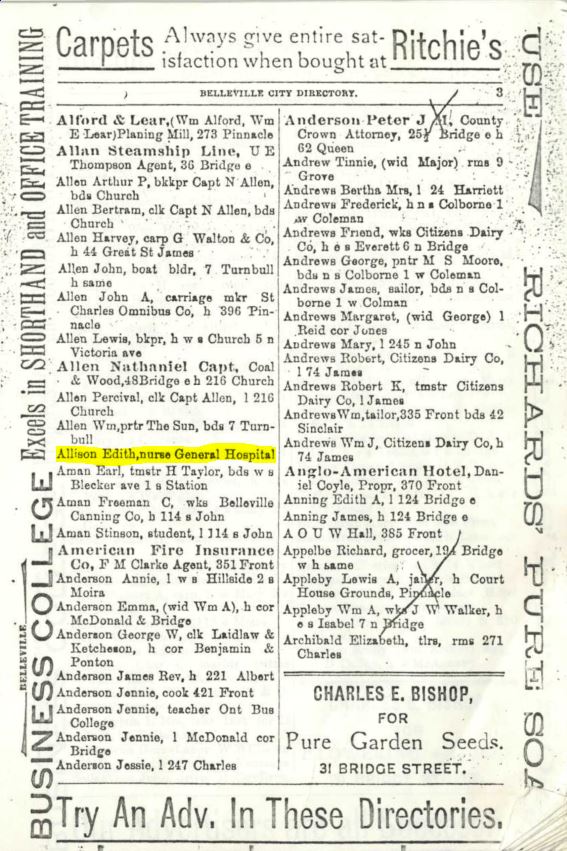
Entry for Edith Allison in the 1899-1900 City of Belleville directory

Edith enlisted in the Canadian Army Medical Corps in Calgary on April 5, 1917.

Height:  5’ 7”

Weight:  150 lb

Stated age: 35 (actual: 38)

Nursing Sister Allison initially served in hospitals in Brighton, Sussex and was then posted to No. 2 Canadian Stationary Hospital in Outreau, France between June 1918 and March 1919. She returned to Canada, setting sail on April 3, 1919 aboard the S.S. Lapland, and was transferred to the Colonel Belcher Hospital in Calgary, a facility recently opened for treatment of War Veterans; Miss Allison was discharged on January 15, 1920. Here she served as Matron-In-Charge until  1933.

Her obituary stated: Miss Allison has been a sincere and sympathetic worker in the interests of all ex-servicemen and her kindness and generosity endeared her to all those who came under her care. In 1934 the Calgary Branch of the United Empire Loyalist’s Association furnished a room in the Colonel Belcher Veterans Hospital in her honour.

Edith May Allison died on July 10, 1933 aged 55 years 1 month 26 days. She is interred at the Deseronto Cemetery.
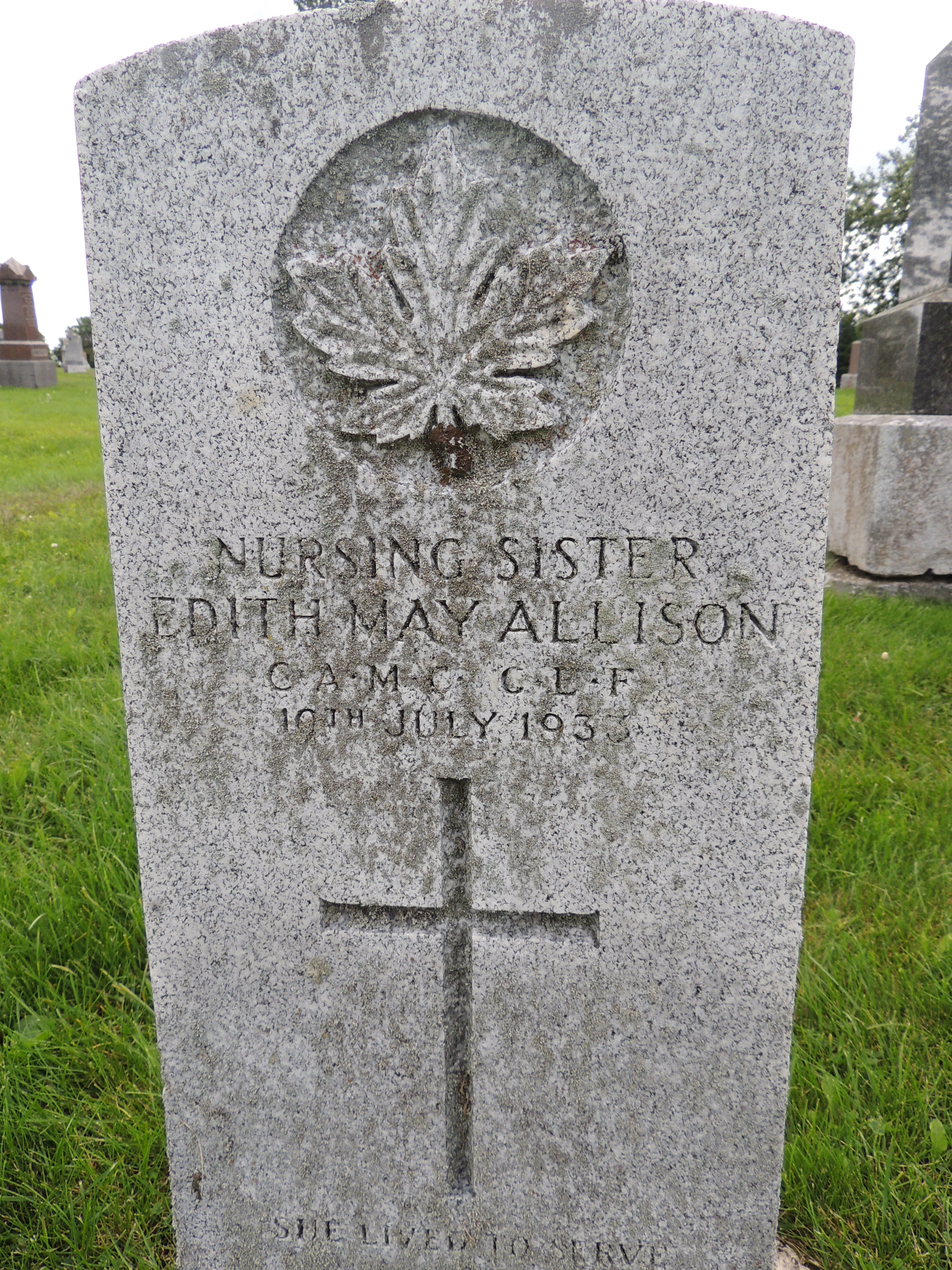
Edith May Allison's headstone in Deseronto Cemetery
Edith May Allison’s headstone in Deseronto Cemetery

Nurses of World War I: Introduction

Stained glass window in Kingston City Hall’s Memorial Hall

2018 marks the 100th anniversary of the end of World War 1, the War to End All Wars. Over the next 10 months leading up to Remembrance Day, guest contributor Dr D. T. Brearley will profile the lives of 40 women with a Belleville connection who served as nurses during the war.

Canadian military nurses were trained nurses before the war, had an average age of 24 and almost all were single. Many had brothers or fathers serving in the Canadian Expeditionary Force, all were volunteers and there was no shortage of candidates. More than 3,000 nurses served in the Canadian Army Medical Corps; they were nicknamed “Bluebirds” because of their blue uniform and white veils. Canada’s Nursing Sisters saved lives by assisting with medical operations and by caring for convalescing soldiers.

Nurses did not work in the front line trenches although they were often close to the front. As patients arrived by truck or rail, the nurses were among the first to meet wounded soldiers, cleaning wounds and offering comfort. They assisted in surgery and often had the primary responsibility for cleaning post-surgical wounds and watching for secondary infection. They served in several theatres of war outside of the Western Front, including Gallipoli, Egypt and Salonika.

Of the 2,504 Canadian nurses who served overseas, 53 were killed from enemy fire, disease, or drowning during the War. On two occasions in 1918, Canadian hospitals in Europe were hit by enemy bombers and several nurses were killed in the line of duty. On June 27, 1918, a German U-Boat torpedoed and sank the Canadian hospital ship, the Llandovery Castle. All 14 nurses on board were killed.

The Canadian Nursing Sisters were the only nurses of the Allied Forces to hold the rank of officers as part of the Canadian Army Medical Corps during World War 1 (Lieutenant) and they were the first women in Canadian history to vote in a federal election.

Nurses returned from overseas with refined medical skills that infused their profession with new medical techniques and a heightened sense of legitimacy. They had won the affection of thousands of Canadian soldiers who often referred to them as “Angels of Mercy”. A memorial to the war’s nursing sisters was erected in Ottawa in 1926 in the Parliament of Canada’s Hall of Honour.