100 Years Ago: Extension for National Service Cards, Free Use of Office Quarters

The Intelligencer March 6, 1917 (page 7)

“The time for the return of the National Service cards by those who have not yet returned them or have returned them improperly signed, has been extended to March 31st, 1917, and further cards have been issued to the postmasters for distribution, among those who have made default.

It is understood that the returns from this Military District have been most gratifying. There are however, even in this district, a number who have not made their returns. The National Service Board has expressed the wish that everyone in the District will use his or her very best efforts in order to make the returns from this district as nearly perfect as possible.”

The Intelligencer March 6, 1917 (page 7)

“A Letter of Thanks. The officers of the 235th Battalion, C.E.F., sent a very graceful letter of thanks to Messrs. Northrup & Ponton, solicitors for the Corby Company, for the free use of their splendid office quarters on Front Street, during the stay of the battalion in Belleville.”

100 Years Ago: 235th Battalion Farewell Recruiting Meeting, Cadet Shooting Contest at Queen Alexandra School, 235th Battalion Leaves for Ottawa, Red Cross Ad for Sinclair’s, Ad for Wrigley’s, Sergeant Chas. Asselstine Killed in Action

The Intelligencer March 5, 1917 (page 1)

“Farewell Recruiting Meeting at Griffin’s. The farewell recruiting meeting held in Griffin’s Opera House last night under the auspices of the 235th Battalion was one of the best ever held in the city. The spacious building was filled to the doors with a representative gathering and the addresses given were in keeping with the occasion. Expressions of regret were general that the Battalion is leaving the city, as the officers and men alike have, by their manners, found a warm place in the hearts of the citizens of Belleville. …  After a selection rendered by the fine band under the able leadership of Bandmaster Laugher and the National Anthem, the meeting was opened.

Mr. Sinclair in assuming the chair said he considered it a great privilege and pleasure to preside as chairman at the farewell meeting of the 235th Battalion in Belleville. For several months the Battalion has been in our midst, and all citizens had learned to esteem the officers and men: We will wish them godspeed to their new quarters at Ottawa and also to their trip overseas. We all regret their removal from Belleville, but like good soldiers they had to obey the call where duty called them. …

Mr. Sinclair then read the following letter which speaks for itself: Belleville, Feb. 4, 1917. To Lt.-Col. Scobell, Officer Commanding 235th Battalion, C.E.F., City. Dear Col. Scobell: On behalf of the City Council and all the citizens of Belleville and myself personally, I desire to express the regret we all feel of parting from the officers and men of your splendid battalion. You have been living among us for several months, and we have learned to respect and honor you. The conduct of your men have been most exemplary. They are gentlemen and soldiers, and we know that wherever duty may call them, they will give a good account of themselves.

We wish you God speed and a safe return, and trust that after this unhappy war, in which we are now engaged, is over, we may be able to welcome you back here again. Yours sincerely, H. F. Ketcheson, Mayor.

Capt. Stewart being called upon said the officers and men of the 235th Battalion regretted the departure from Belleville. He would like to see the young men present take the place of the young men and others who have been wounded. The Germans are not beaten yet. It behoves all to get into the game before it is too late. God pity the young man who does not do his duty at the present time. We have the money and the munition but have we the men. The Empire has a great job before it, and she will make good. We will show to the world we are not a defaulting people.

There are young Canadians to-day who should enlist, but they do not. What is the trouble? Are we too wealthy? Are they Canadians? If they are, they should be in the ranks of the British army. What privileges we enjoy under the old flag. If the Militia Act is put in force we are hopeful the young men will enlist. If they do not enlist then it will be conscription. We have got to get the women and the old men to help in recruiting if the young men will not. …

Lt.-Col. Scobell, upon rising to speak, was most enthusiastically received. In his opening remarks the Colonel said it was hard to say good-bye to Belleville. Four happy months had been spent in Belleville. All citizens had done all they could for the members of the 235th Battalion. He referred to the Khaki Club and the good it had and was doing. Some of the boys of the Battalion had no homes in this country, but the Khaki Club was a home to them. We owe much to the ladies of Belleville who have done so much for the officers and men. For this he was thankful. We are sorry to go, but as good soldiers we must obey orders. …

There are young men walking around in Belleville who should be in khaki. If the young men have not enlisted in the 235th then go and enlist with the 254th Battalion. We hold no bad feelings towards the 254th Battalion as we hope to meet them in France and fight side-by-side with them in this struggle for the Empire. …  The meeting closed by the band playing the National Anthem.”

The Intelligencer March 5, 1917 (page 2)

“At the Queen Alexandra. A very pleasing function took place Friday afternoon at Queen Alexandra School, Ann St. The occasion of the school assembling in the auditorium was to see the crack shots among our cadets, receive the prizes they so well merited by their excellent shooting. The boys not only covered themselves with laurel, but their school as well, by taking ten out of fifteen prizes given to the cadets of the Public Schools in the city. To win a prize it was necessary to make at least nineteen out of a possible twenty-five. All riflemen will admit that the boys’ shooting augurs well for the future marksmen of Belleville.

Mr. Sneyd, Chairman of the School, and Inspector H. J. Clarke, B.A., officiated in the presentation. …  Mr. Sneyd gave a very interesting talk to the pupils. He complimented them on the amounts of their savings in the Penny Banks, and exhorted them to bank more, as every penny saved means so much towards winning the war. He told them about the special war bonds now issued by the Government, which, by buying, each child can materially aid in financing the war.

The speaker then encouraged the boys and girls to have vegetable plots of their very own this summer, and spoke of the probability of prizes being awarded to the pupil growing the best specimens. This all aids in winning the war.

Mr. Sneyd then delighted the children and riveted their interest by a vivid description of the submarine menace to England. They listened breathlessly as he described in detail the British method of netting a submarine.

A hearty vote of thanks was unanimously given Mr. Sneyd, voiced by the Principal, Mr. Mott, and our Inspector. All greatly appreciated his talk, and only hope to see him call again.”

The Intelligencer March 5, 1917 (page 2)

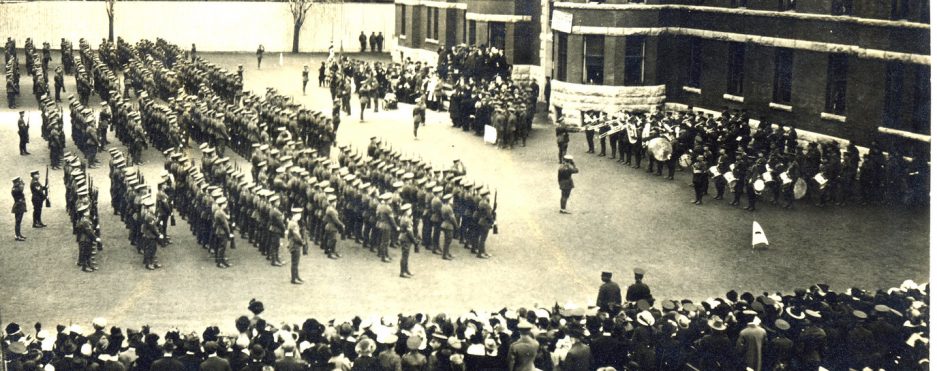
“235th Battalion Leaves For Ottawa. Despite the inclement weather this morning hundreds of citizens of all classes were present at the Canadian Northern Ontario Railway Station for the purpose of saying good-bye to the officers and men of the 235th Battalion, who entrained for Ottawa, where they will be stationed until they leave for Overseas.

Owing to the prevailing storm the proposed march out through Front and other streets was abandoned. Many present at the station expressed regret that the Battalion was leaving the city. The hour of 9.30 was set for entraining but the train which came from Cobourg with the detachments from that town did not arrive until 10.15.

From Cobourg the officers and men totalled 83, and a fine body of soldiers they were. As the officers and men marched in front of the station they were loudly cheered. Many of the ladies of the Belleville Khaki Club were present and the soldier boys were remembered with a supply of oranges and cigarettes, which gift it is needless to say was much appreciated.

Col. Scobell, officer commanding of the Battalion, thanked the ladies for their kind remembrance. At eleven o’clock the train moved off en-route to the Capital. This will be the last appearance of the Battalion in Belleville. It is expected that the Battalion will go overseas in about six weeks’ time.”

The Intelligencer March 5, 1917 (page 2)
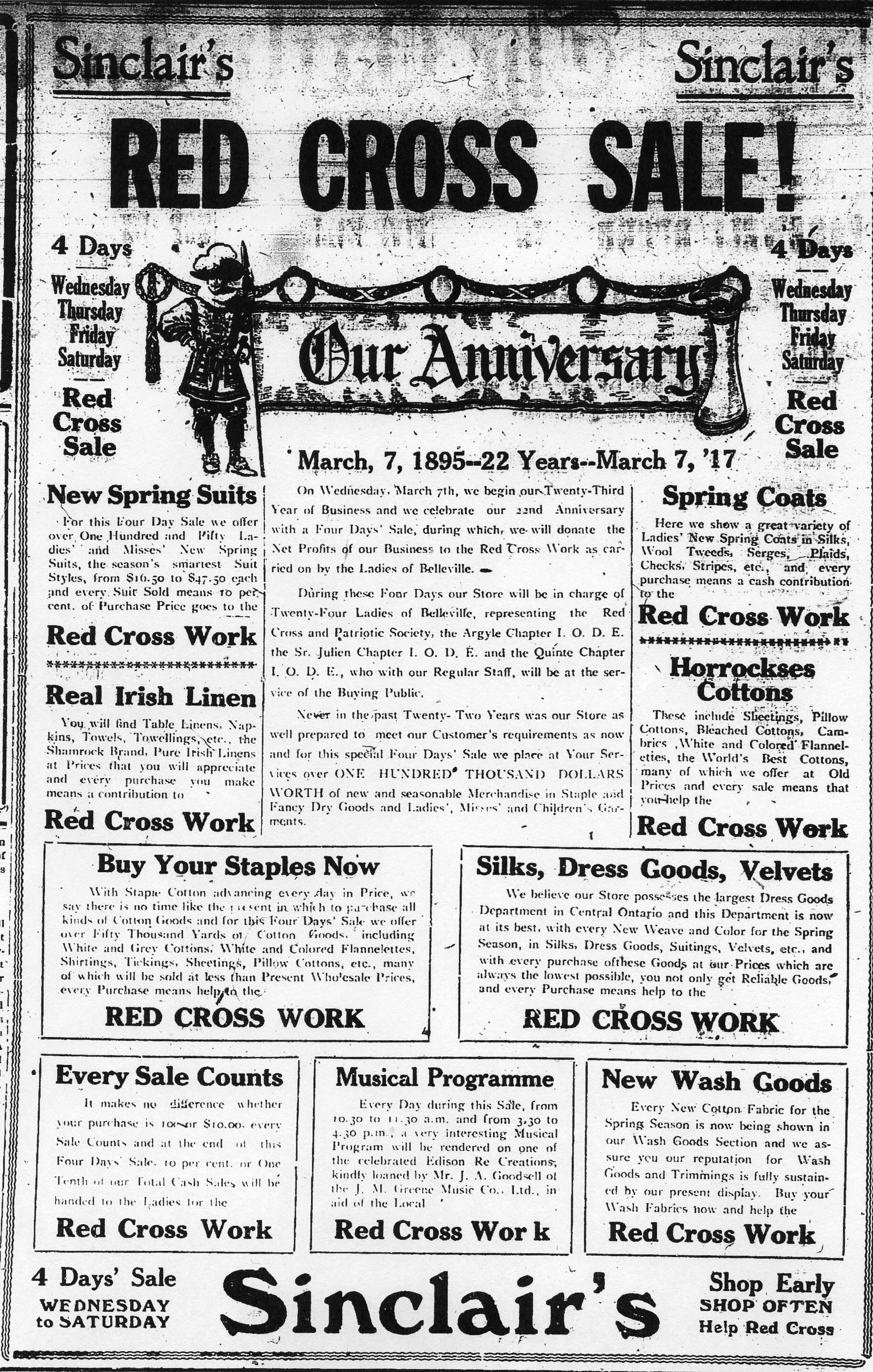
“Sinclair’s Red Cross Sale! 4 Days, Wednesday, Thursday, Friday, Saturday. Our Anniversary, March 7, 1895—22 Years—March 7, ’17.

On Wednesday, March 7th, we begin our Twenty-Third Year of Business and we celebrate our 22nd Anniversary with a Four Days’ Sale, during which, we will donate the Net Profits of our Business to the Red Cross Work as carried on by the Ladies of Belleville.”

The Intelligencer March 5, 1917 (page 3)

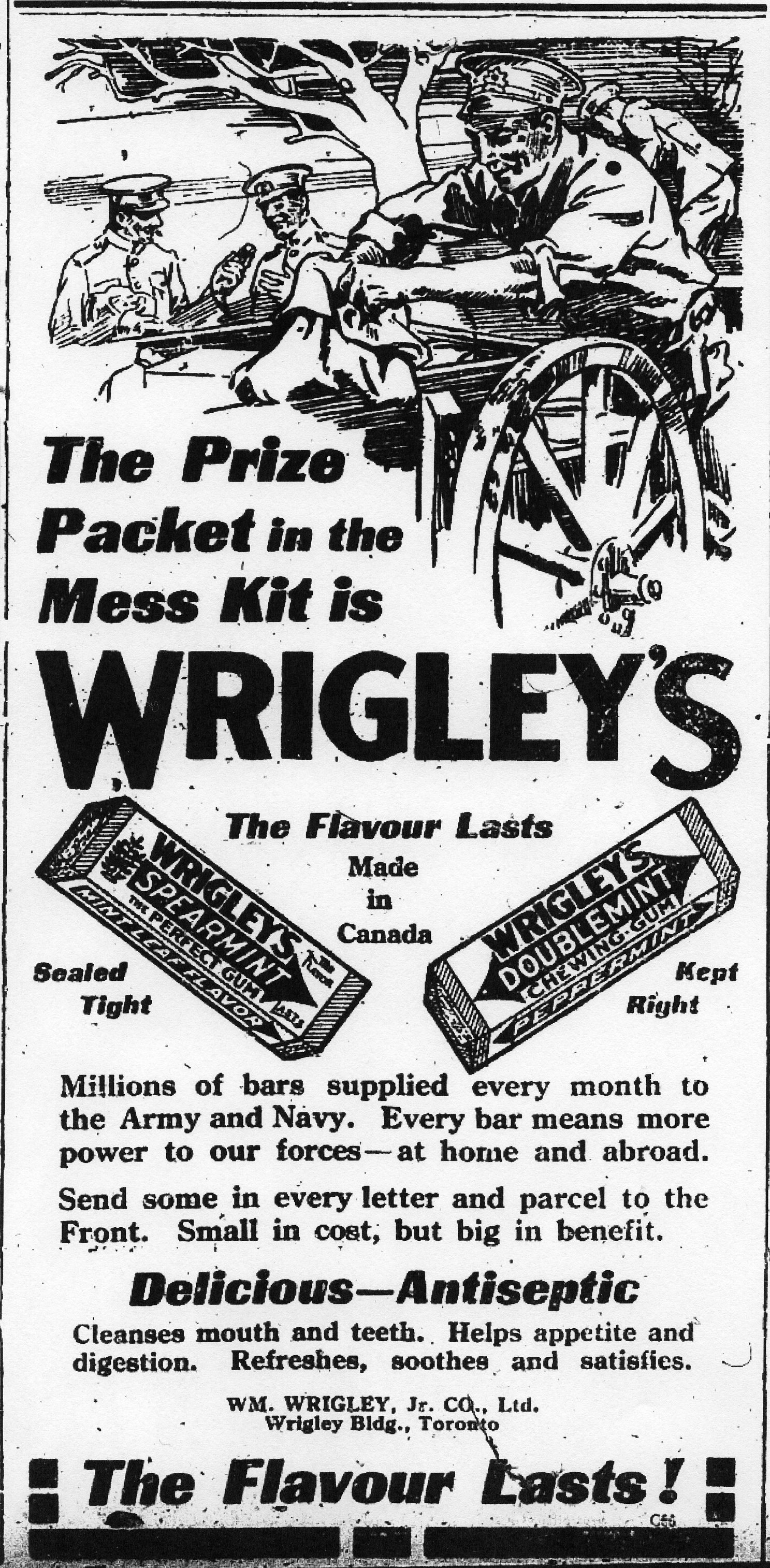
“The Prize Packet in the Mess Kit is Wrigley’s. Millions of bars supplied every month to the Army and Navy. Every bar means more power to our forces—at home and abroad. Send some in every letter and parcel to the Front. Small in cost, but big in benefit.”

The Intelligencer March 5, 1917 (page 5)

“Died Somewhere In France. A few days ago a message was received in this city that Sergt. Chas. N. Asselstine, who left Belleville with the 155th Battalion, was seriously ill, and yesterday a telegram from the Record Office, Ottawa, conveyed the sad intelligence that he was dead. While it is not definitely known, it is surmised that he died at a base hospital in France, as cards recently had been received from him from France.

The brave soldier was well known to this city, where he had resided for the past six years. He, for two years, with Mr. Robert Goudy, conducted the Crystal Hotel in Belleville, and was decidedly popular with the travelling public. Sergt. Asselstine was born at Strathcona, near Napanee, where he resided until moving to this city. He was the second son of Mr. and Mrs. John Asselstine, who reside on Pinnacle street, Belleville. Deceased was a member of the Orange Society, and was a man who was esteemed by all who knew him. His demise will be regretted by a host of friends.

A widow and young daughter survive, also his parents, four brothers and two sisters, all of whom live here. To the bereaved will be extended the heartfelt sympathy of all citizens.”

[Note: Sergeant Charles Nelson Asselstine died on February 28, 1917. He is commemorated on Page 193 of the First World War Book of Remembrance.]
 

100 Years Ago: Lieutenant-Colonel Scobell Extends Thanks, Red Cross Concert at Cannifton, Recruits Wanted for Production, Ernest Carr Becomes Corbyville Postmaster, Poster for Canadian Army Film

The Intelligencer March 3, 1917 (page 1)

“Extended Thanks. Belleville, Ont., March 3, 1917. From Officer Commanding, 235th O. S. Battalion, C.E.F. To The Editor, of The Intelligencer.

Sir:—Will you allow me through your valuable columns to extend to the citizens of Belleville, Ont., our most grateful thanks for the many, many kindnesses which have been showed upon us by all classes since we came among you.

Particularly I desire to thank the Mayor, and Council, the City Clergy, and various Patriotic Societies, the ladies of the Khaki Club, and the gentlemen of the press. All have done everything that was possible to promote our happiness and make our stay here both pleasant and profitable.

I extend to all our sincere wish that their future may be good, that fortune may smile upon them, and the hope that in happier times we may be able once more to see our friends of Belleville and to celebrate and enjoy with them the benefits of a successful peace. With many thanks to you, dear sir for your many personal acts of kindness, believe me, Your obedient servant, S. B. Scobell, Lt.-Col. On behalf of the officers, non-commissioned officers and men, of the 235th O. S. Battalion, C. E. F.”

The Intelligencer March 3, 1917 (page 6)

“Successful Red Cross Concert at Canifton. A successful concert to raise funds for the local Knitting Circle was held at Canifton on Wednesday night in the Town Hall, which was crowded to the doors. The chair was occupied by Rev. Chas. G. Smith, and the main part of the programme consisted of a drama in four acts entitled ‘The Village Doctor,’ which was put on in pleasing style. …

An orchestra of twelve pieces of the 254th Battalion played five numbers, under the direction of Sergt. Dobbs, to the delight of the large audience. A number of recitations were given during the evening, which were well received. Lieut. Coulter, Reeve of Stirling, delivered a rattling good recruiting address and a feature of the evening was the recitations of little Miss Mildred Lloyd, whose father is a soldier, now overseas.

Mrs. Dr. Bert Faulkiner, in a neat little speech, expressed the thanks of the Thurlow Red Cross Society, of which she is president, and which has nearly eighty circles under its auspices, to all the entertainers and announced that the proceeds amounted to $75.”

The Intelligencer March 3, 1917 (page 6)

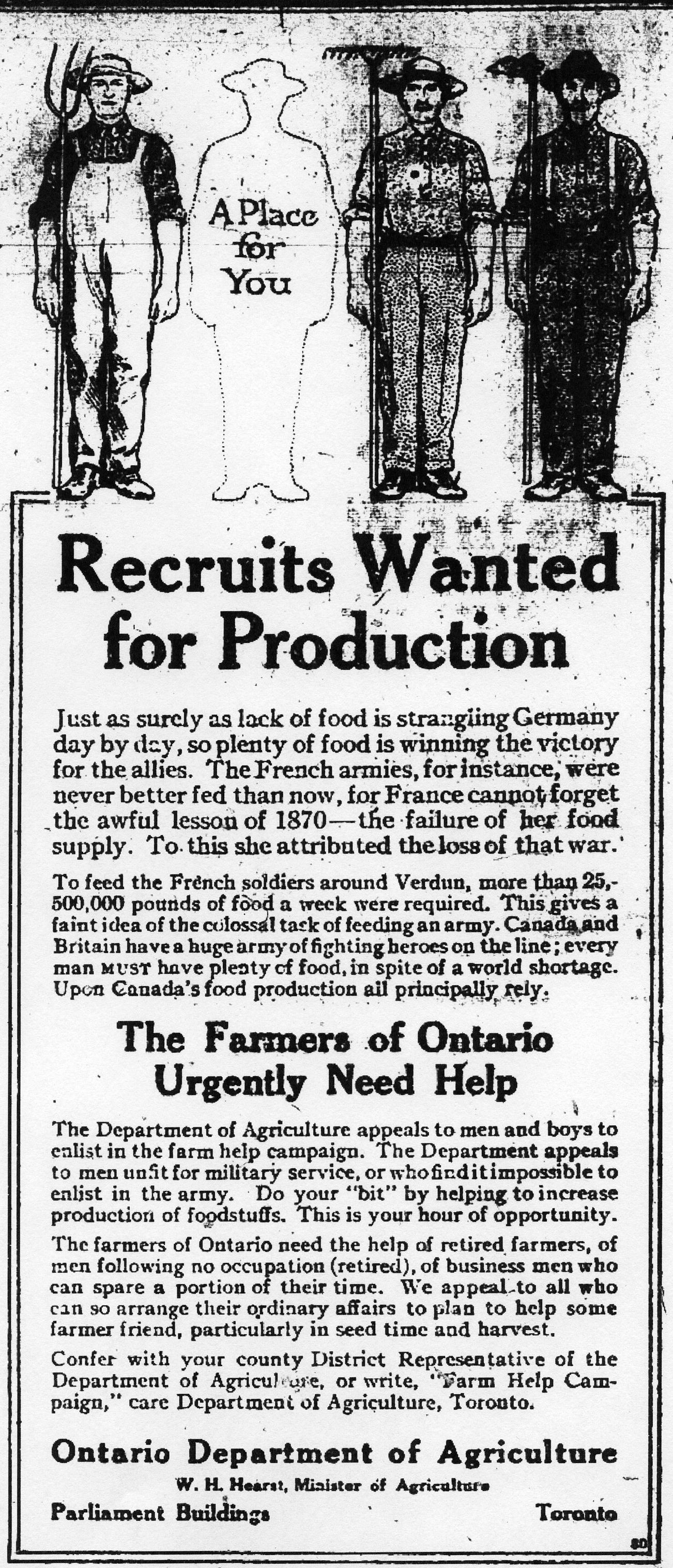
“Recruits Wanted for Production. Just as surely as lack of food is strangling Germany day by day, so plenty of food is winning the victory for the allies. The French armies, for instance, were never better fed than now, for France cannot forget the awful lesson of 1870—the failure of her food supply. To this she attributed the loss of that war. …

Canada and Britain have a huge army of fighting heroes on the line; every man MUST have plenty of food, in spite of a world shortage. Upon Canada’s food production all principally rely.

The Farmers of Ontario Urgently Need Help. The Department of Agriculture appeals to men and boys to enlist in the farm help campaign. The Department appeals to men unfit for military service, or who find it impossible to enlist in the army. Do your ‘bit’ by helping to increase production of foodstuffs. This is your hour of opportunity.

The farmers of Ontario need the help of retired farmers, of men following no occupation (retired), of business men who can spare a portion of their time. We appeal to all who can so arrange their ordinary affairs to plan to help some farmer friend, particularly in seed time and harvest.”

The Intelligencer March 3, 1917 (page 7)

“A Well Merited Recognition As It Should Be. Corporal Ernest Carr, who returned to his home in Belleville a few days ago, minus two legs, which he lost in battle while fighting in the trenches in France, has been recommended by W. B. Northrup, Esq., M.P. for East Hastings to fill the vacant Postmastership at Corbyville made vacant by the resignation of the Postmistress, owing to ill health. This is as it should be and Mr. Northrup deserves credit and the thanks of his constituents for what he has done.

There were many applicants for the position, and one of whom, under other circumstances, would have claims on their representative for the position but will relinquish them in favor of the returned crippled hero. Mr. Carr was an assistant engineer in the employment of the Grand Trunk Railway when he enlisted. It is such men whose services to King and country, who should be not only recognized but rewarded. Let the policy be continued.”

The Intelligencer March 3, 1917 (page 9)

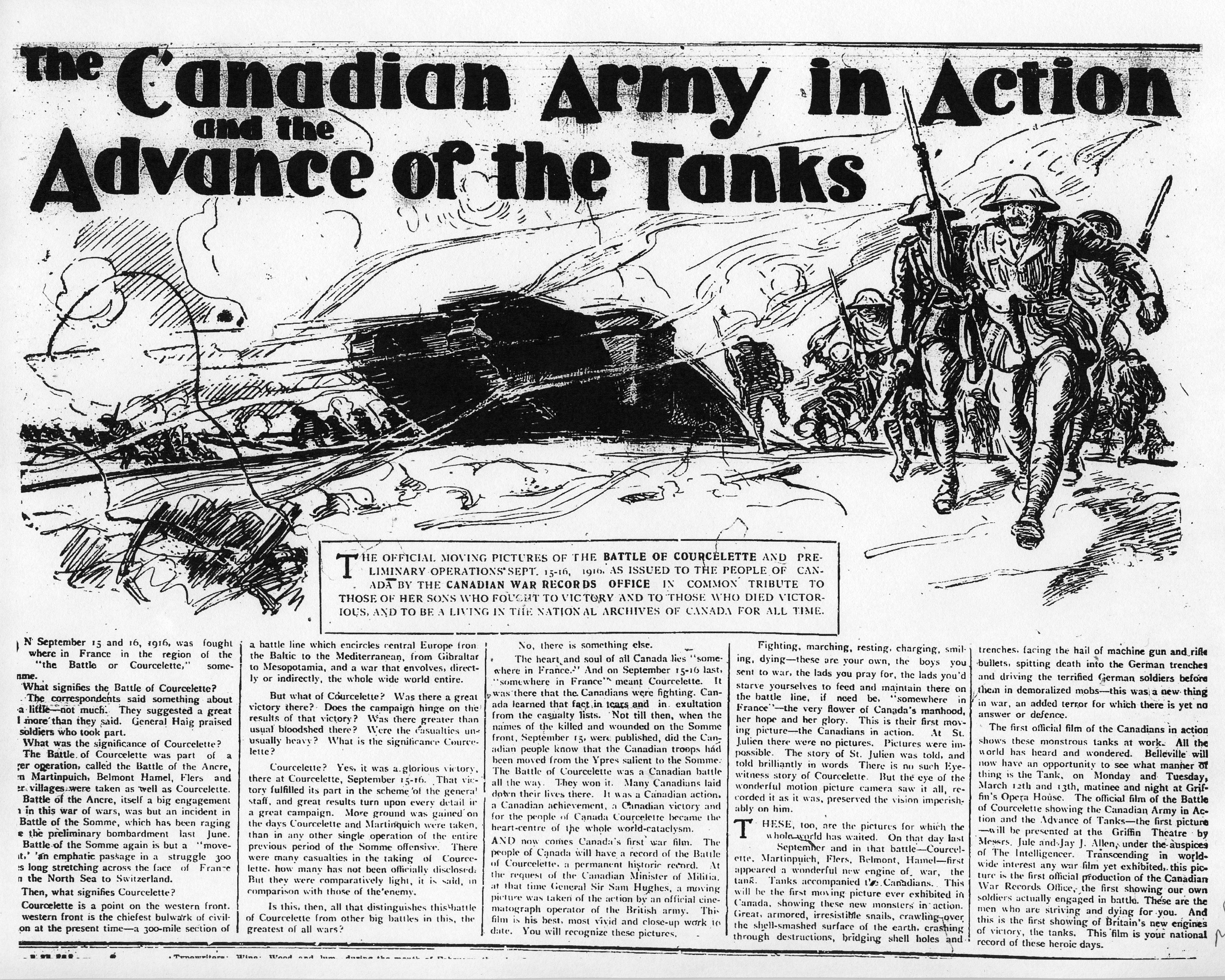
“The Canadian Army in Action and the Advance of the Tanks. The official moving pictures of the Battle of Courcelette and preliminary operations Sept. 15–16, 1916, as issued to the people of Canada by the Canadian War Records Office in common tribute to those of her sons who fought to victory and to those who died victorious, and to be a living in the national archives of Canada for all time. …

The first official film of the Canadians in action shows these monstrous tanks at work. All the world has heard and wondered. Belleville will now have an opportunity to see what manner of thing is the Tank, on Monday and Tuesday, March 12th and 13th, matinee and night at Griffin’s Opera House. …  And this is the first showing of Britain’s new engines of victory, the tanks. This film is your national record of these heroic days.”

100 Years Ago: 235th Battalion Farewell Concert, Private George Dixon Killed in Action, Red Cross Concert at Wellman’s Corners

The Intelligencer March 1, 1917 (page 2)

“Farewell Concert At The City Hall. That the good work accomplished in their behalf by the ladies of the Khaki Club is ever high in the estimation of the men of the 235th Battalion, was evidenced last evening at the entertainment at the City Hall, when the battalion gave an excellent program, rendered by some of the battalion’s talent.

The entertainment was in the nature of a farewell to the citizens, before the battalion leaves for Ottawa. The concert was doubly appreciated, because it afforded the men an opportunity to show the esteem in which they held the ladies of the Khaki Club. …

Col. Scobell in the chairman’s address, remarked that this was the farewell concert before the battalion left the city, and he felt sure that those present were all glad to be together in his last gathering, before they left for Ottawa. The men of the battalion would leave Belleville with a great deal of regret. It has been to the Officers, N.C.O.’s and men of the 235th Battalion, a very pleasant four months, spent in this city, and the Colonel was sure that though the battalion is leaving in body, it will still be with the people of Belleville in spirit.

Although the battalion will have good quarters in Ottawa, the speaker did not think that they could compare with the quarters in Belleville. There is also a Khaki Club in Ottawa, but it was not up to the standard of the Belleville Khaki Club. The ladies of the local Club have been more than kind to the men, in order to add to their comfort and enjoyment. The Colonel stated that many a boy had written home to his mother or sweetheart, and told them of the great care taken of them by the Khaki Club. …

Colonel Scobell in making the presentation stated that in order to make the 235th Battalion’s stay in Belleville pleasant, the ladies of the Khaki Club had left no stone unturned. Their hard-working President, Miss Falkiner, is known everywhere for her good work for the soldiers. The Sergeants and men, continued the colonel, had chipped in a few cents in order to give some present to the ladies, not for their value, but as a token of remembrance. Col. Scobell here presented Miss Falkiner with a beautiful umbrella as a token of the good she had accomplished in providing comfort and enjoyment for the men of the 235th Battalion.

Miss Falkiner in replying thanked the men for their thoughtfulness. It was a real pleasure to her, and she wished the men good luck wherever they went, and when they reach the other side, may they be aware that they have many friends in Belleville. Umbrellas were also presented to Miss M. M. Campbell, Secretary, Mrs. A. R. Symons, and Miss Eva Panter. Mrs. Edwards and Mrs. W. J. Brown, two energetic members of the Khaki Club were presented with hand bags.”

The Intelligencer March 1, 1917 (page 2)

“Missing for Eight Months. In the bombardment of Zillebeke, it is believed that Pte. George Dixon, of the C.M.R. lost his life. He enlisted at Belleville in September, 1915, and in February 1916, was in France. He was reported missing in June, and since then his wife, living at 21 Trafalgar ave., Toronto, tried in vain to learn further of him.

He came from England and worked on the G. T. R. as fireman. Two brothers are fighting in France, and he is survived by his wife and two children. Pte. Dixon was a brother of Pte. Fred Dixon, who is at the front, and who previous to his enlistment was an employee of the Intelligencer Office.”

[Note: Private George Dixon died on June 2, 1916 and is commemorated on Page 78 of the First World War Book of Remembrance.]
The Intelligencer March 1, 1917 (page 5)

“The Red Cross Concert given at Wellman’s Corners on Tuesday, Feb. 27th, was a decided success. Captain Hodge and Pte. Daly, two returned soldiers, gave interesting addresses on their experiences during several months’ service at the front. Miss Ruby Fiske, dramatic soprano, delighted the audience with several selections.”

100 Years Ago: J. W. Johnson’s Bill for Woman Suffrage, Poster for Royal Naval Canadian Volunteer Reserve, Letters of Thanks, David Ketcheson Wounded

The Intelligencer February 28, 1917 (page 1)

“ ‘I have no hesitation in saying that the Government endorses the principles of the bill now before the House and assumes full responsibility for it, and I call upon my supporters to vote in its favor, and I take the full responsibility as leader of the House for what that bill will entail.’ In these words Sir William Hearst yesterday announced the determination of the Ontario Government to make woman suffrage an accomplished fact in the Province—to give to women a voice in the management and control not only of municipal affairs, but the larger questions in Provincial Government.

The Prime Minister was speaking upon the second reading of the bill introduced by J. W. Johnson, Conservative member for West Hastings, and his endorsation of the principle of the measure was greeted by vigorous applause from both sides of the House. There were a few scattered handclaps from the crowded galleries, but the ladies there were very careful of House decorum and vented their enthusiasm in broad smiles and whispered congratulations. …

Throughout the debate most of the members carried in their buttonholes yellow daffodils that the ladies distributed to all the desks before the House opened. Attached to each was a card, asking the member to wear the ladies’ colors and vote for franchise extension.

All the members of the Cabinet, except the Prime Minister, put on the ‘colors’ when they took their places. Sir William gave them a little spell of fear by putting his flower to one side, but he fixed it to his coat as he sat down, after making his announcement.”

The Intelligencer February 28, 1918 (page 6)

“The Royal Naval Canadian Volunteer Reserve. Men are required of good character and good physique, for service Overseas, in the above force, with the Imperial Navy, for the period of the war.

Candidates must be the sons of natural born British subjects; between 18 and 38 years old, at least 5 feet 3 inches in height, and 33 inches chest. No previous sea experience necessary.”

The Intelligencer February 28, 1918 (page 7)

“Canadian Red Cross Society, Belleville Cheese Board District Branch. Letters acknowledging shipments, have been received from Lady Jekyll of St. John’s Ambulance Society; Nursing Sister C. Geen, No. 3 General Hospital, Boulogne, France; also about fifty letters from boys overseas acknowledging parcels received. The following are a few received recently:

France, Jan. 3, 1917. Dear Madam,—Just a line in receipt of your parcels from the Red Cross Cheese Board and the Belleville ‘Y’ which I have received O.K.; and thank you very kindly for the same. I also received one from the Daughters of the Empire some time ago. I should have answered sooner but sometimes we are up against it a little. Little things could be a little more comfortable at times. We are having pretty cold weather here just at present, also some snow and our billets are not any too warm, so if we want to write very much we have to stop and warm our fingers over our candles, which are very useful. We often make coffee, tea and fry eggs in a mess tin over a candle.

The socks and cigarettes are fine and I am sure they are always appreciated by the boys, also the shirt from the old Belleville firm, Deacon Bros. I again thank you very kindly. I remain, ‘A SOLDIER.’ …

Dear President and Members:—Words fail to express my appreciation for your welcome box received on Dec. 25th. It came at an opportune time, having not received any pay for nearly three weeks, the tobacco came in all right, naturally a few of my comrades also shared in a few of your treats. Coming from Belleville as they did, the eats and tobacco had a special flavor.

Wishing you and the members every success, we soldiers surely appreciate such kindness, and only those away from home and surroundings, know the full joy in receiving gifts from Canada. Extend my heartiest thanks to all the members, my best wishes for the future. Sincerely, ‘A SOLDIER.’ “

The Intelligencer February 28, 1917 (page 7)

“David V. Ketcheson Wounded in Action. The following telegram from the Record Office, which explains itself, was received this morning. Ottawa, Feb. 27th. H. F. Ketcheson, 231 Albert Street, Belleville, Ont. Sincerely regret to inform you that Lieut. David Vanderwater Ketcheson, infantry, reported wounded, February twenty-second, nineteen hundred and seventeen. Will send further particulars when received. Officer in Charge Record Office.

Lieut. Ketcheson is the second son of Mayor H. F. Ketcheson, of this city. He enlisted in the 21st Battalion, about two years ago. He was three months ago transferred to the 38th Ottawa Battalion, in which he was serving when he received his wounds. The young officer is very popular in this city, and his many friends will hope that his wounds will not prove to be of a serious nature.”

100 Years Ago: Red Cross Penny Bag Collection, Corporal Ernest Carr Returns, Tradesmen Recruited for Royal Flying Corps, Woman Suffrage

The Intelligencer February 27, 1917 (page 1)

“Three Hundred Is Asked For. Owing to the very recent collection for the Patriotic Fund we are almost afraid to remind our citizens that the aim of the Red Cross Penny Bag collectors for February is $300.00. However we hope since this fund is for the necessities of our brave soldiers, that our patrons will see their way clear to put in a few extra pennies to help swell the amount.

Please have your bag ready for the collectors, tomorrow, Wednesday, February 28th.”

The Intelligencer February 27, 1917 (page 2)

“Hearty Reception to Returned Hero. Corporal Ernest Carr, a well known Bellevillian, who when the war broke out, enlisted to fight for King and country, and who suffered terrible wounds, resulting in the loss of both legs, above the knees, arrived here this afternoon, and was accorded a welcome befitting a hero.

Some days ago Corporal Carr arrived out from England, and was taken to Toronto, from which city he came from to-day. Owing to the fast train from the West due here at 12.10 P.M., being an hour and twenty minutes late, it was 1.30 when it arrived here. At the station hundreds of citizens and children were present, and as the hero was carried off the train he was loudly cheered.

He was taken to an auto, which was gaily decorated with flags and bunting, and placed therein, and a triumphant procession was formed, headed by the 254th Battalion Band, followed by a platoon of the 254th Battalion, under command of Capt. Bleecker. Following the platoon was the car in which was seated Corporal Carr, Mayor Ketcheson, Mr. G. N. Bennett and other relatives. A number of cars and other vehicles were in the parade, and at No. 1 Fire Hall the two hose carts and hook and ladder truck joined in. Along the line of march and especially on Front Street, the returned hero was loudly cheered, and he acknowledged same.

At the market square the procession was disbanded, and Corporal Carr was taken to the home of his brother-in-law, Mr. George N. Bennett, Dunbar Street. It was truly a well planned and carried out programme.

Previous to enlistment Corporal Carr was a G.T.R.  fireman, and he was deservedly popular with his fellow employees. He went overseas with the 34th Battery from this city, a battery composed of military men who have done noble service, and some of whom have made the supreme sacrifice.”

The Intelligencer February 27, 1917 (page 3)

“Opportunity for National Service. Acetyline welders, blacksmiths, carpenters, coppersmiths, motor-cyclists, motor drivers, electricians, engine fitters, motor-cycle fitters, engineers, storemen, motor fitters, millwrights, sail-makers, tailors, milling machinists, metal turners, painters, tinsmiths, cabinet-makers, vulcanizers—men of all these trades who sent in their cards to the National Service Board, are being notified that there is now an opportunity for them to do national service. Only 5,000 are required for this service which is that of becoming members of the Royal Flying Corps in Canada, and the call will be confined to the Eastern Provinces.

This latest addition to the effective forces of Canada will form part of the famous Royal Flying Corps. This is an opportunity for men who want not only to serve but for men with ambition, as after the war they will be able to take their places as leaders in the different branches of the coming great transportation service, through the air.

The object of recruiting mechanics in Canada is to provide the necessary personnel to the upkeep of a number of reserve squadrons that will be used to train pilots for service with the Royal Flying Corps in the field and for this service special rates of pay have been arranged. …

Men who, up to the present, on account of home ties or physical disabilities did not endeavor to enlist and even those who have been rejected on account of not coming up to the military standard, or having flat feet or other minor defects, have now an opportunity to do yeoman service for the Empire by enlisting in this Corps. …

The air mechanics enlisting for service are intended for ground duties only and are not required to fly or to take part in flights. The sole duties consist of keeping the machines in repair and running order at the different squadron headquarters and airdromes. …  The airships will be built in Canada and the work of the corps now being enlisted will consist, as above stated in keeping the machines in proper trim.

According to reports from men who have had experience in this work, it is the most interesting and effective part of the service, and the R. F. C. is known as the eyes of the army.”

The Intelligencer February 27, 1917 (page 4)

“Woman Suffrage And The M. P. For West Hastings. For several sessions past Mr. J. W. (John Wesley) Johnson, M.P.P. for West Hastings, has introduced into the Legislature a bill conferring the franchise upon women. Mr. Johnson is head of the Ontario Business College at Belleville, an institution known throughout and beyond the Dominion. He is a thoroughgoing Conservative as was his brother, Mr. James Johnson, editor of the Ottawa Citizen in the days of Sir John Macdonald, and as was his elder brother, Mr. William Johnson, a leading Orangeman of the Bay of Quinte district. How or why Mr. Johnson came to be an apostle of woman suffrage we are not aware, but that he has been its most persistent advocate in the Legislature  is well known. It is not on record that he ever received much encouragement from Mr. Rowell the present leader of the Opposition.

The war has changed men’s viewpoint on many things. As we said the other day, whatever may be the theoretical objections to woman suffrage, and they are many, most people are now convinced that if women want to share in the perplexities and burdens of Government, they should be allowed to do so. When Red Cross nurses can be found on the firing lines and women in vast numbers are helping to make munitions, it is too late in the day to relegate them to the sphere of the home and the church. Hamilton Spectator.”


100 Years Ago: Sir Sam Hughes Speaks at Griffin Opera House, David Mossman Killed, Railway Men Recruited, Ad for Oxo

The Intelligencer February 26, 1917 (page1)

“Enthusiastic Reception to Gen. Sir Sam Hughes. Were the Griffin Opera House twice its present size it would have been none too commodious to accommodate the crowd which last night sought to gain admittance. The occasion was a recruiting meeting held under the auspices of the 254th Battalion of Belleville, and the speaker of the evening was no less a personage than Lieut. General Sir Sam Hughes, ex-Minister of Militia.

Not only did the citizens of Belleville turn out in large numbers to hear the distinguished speaker, but hundreds from the country and neighboring towns, sought admittance. At a few minutes after 8 o’clock, before the evening services in the churches of the city had been concluded, the Opera House was filled to the doors, and hundreds were turned away. Not only was every available seat in the auditorium taken, but there was a fair sized audience upon the stage, and those in that part of the house were compelled to stand. …

Previous to the meeting being formally opened, the fine band of the 254th Battalion, under the capable leadership of Lieut. Bandmaster Hinchey, rendered some beautiful selections, which the audience were not slow to appreciate.

At about 8.30 Sir Sam Hughes and party arrived, and the meeting proper was commenced. Mr. E. G. Porter, K.C., M.P., was chairman, and filled that position in his usual able and courteous manner. …  Mr. Porter in his opening remarks as chairman, stated he had been requested to preside over the meeting, and he considered it a great privilege to do so. The magnificent audience present was a fine tribute to the statesman, patriot and soldier, who was present as our guest, and whom we were proud to have as such.

The meeting was pre-eminently a recruiting meeting for the purpose of stimulating recruiting. There were many subjects which could be spoken of at the present time, but without doubt the most important was that made by the Premier of Great Britain a day or two ago in reference to the British Empire, the Allies and its needs. It was not so much for men and ammunition, but a great appeal for the husbanding of the resources of the Empire. …

In his (the speaker’s) opinion, it was up to every man in Canada to do his part until this war is happily ended, in the producing of all food stuff possible. The people must produce food to feed the men in the trenches. We all know there is in this city a large tract of vacant land, and if that land is put under cultivation next autumn, we will find we have assisted the Empire to a great extent. …

After a selection from the band, the chairman, in a few well chosen remarks, introduced Sir Sam Hughes, stating that he (Sir Sam) was the admiration of the world. As Sir Sam arose to speak the audience arose and cheered him and the band played, ‘He’s a Jolly Good Fellow.’

Upon rising to speak, Sir Sam was accorded a most hearty reception, and in his opening remarks, referred to the pleasure it gave him to address a Belleville audience. He referred to his sojourn in this city when he was teaching school and of the fact that he was then imbued with a military spirit. …

In speaking of providing the motherland with troops, Sir Sam said, he had been asked by Sir John French about Canada and he (the speaker) said he could send 30,000 men in the first contingent and other reinforcements would follow. In anticipation of this offer being accepted, he immediately got in touch with the officers to get Battalions in shape and 33,000 men were in a short time, marshalled at Valcartier. Six weeks after the war broke out 33,000 men were sent overseas. The system of raising battalions was followed and these battalions as they were filled up were sent over. …

The Empire is in danger tonight, and this war is by no means over. It was our bounden duty to roll up our sleeves and get together another army as large as we have already raised. …  The war is on, our boys are in the trenches and they are calling for others to take their places. It is time we did something, action is what we want. Call out the boys under the Militia Act and train them. The whole heart of this nation will respond to this call. He was an Imperialist and he was ever ready to do his duty for the British Empire. …  He could not conceive how men and especially young men of military age could remain longer out of the game. …  He would appeal to men to train themselves for the protection of their home and loved ones. His associations with Belleville were most pleasant and he had looked with pleasure at being here again to see his friends and to speak to them. (Loud Applause.)

At the close of the masterly address Mayor Ketcheson arose to move a vote of thanks, and in doing so, said this was a proud day for Belleville. He said that Sir Sam Hughes was one of the first men of Canada and we all appreciate his remarks. …

Judge Wills, in seconding the motion, said it was a great pleasure to have Lieut.-General Sir Sam Hughes in Belleville, as he was considered a Bellevillian. We all know him, and what he has accomplished in the position he occupied. Let us have the Militia Act in force, and let us do something. All who are able should be drilling. …  The vote of thanks was carried by a standing vote, and cheers for the Lieut.-General were given, who acknowledged same. The rendering of the National Anthem brought the meeting to a close.”

The Intelligencer February 26, 1917 (page 2)

“Believed to Be Killed. Ottawa, Ont., Feb. 25, 1917. Wm. Mossman, 7 Ridley Street, Belleville. Deeply regret to inform you cable received to-day states 113,409 Private David Wm. Mossman, mounted services, previously reported missing, now believed killed June 2nd, 1916. Will send further particulars when received. Officer in charge of Records.”

[Note: Private David William Mossman died on June 2, 1916. He is commemorated on Page 139 of the First World War Book of Remembrance.]
The Intelligencer February 26, 1917 (page 2)

“Railway Men. Your Last Chance Has Come! No. 1 Section Skilled Railway Employees, is full up.

Sergt. J. R. Cochrane is recruiting for the 2nd Section.

Sergt. S. Underwood left for Overseas this week.

Special rate of pay for all classes of men connected with railway service. This is a non-combatant unit. For further particulars apply SERGT. J. R. COCHRANE, 65 E. MOIRA ST. Phone 560, Belleville.”

The Intelligencer February 26, 1917 (page 3)

“Oxo Cubes in ‘No Man’s Land’

The following is an interesting letter received from France:—’I reached a spot nine yards from the German trenches uninjured, but it was useless going on. I fell where I was, and, lying quite still, was taken for dead. It was exactly a week before our men made another attack, and during the whole of that time I had to lie where I had fallen. It was certain death to try and reach our own trenches. During that week I existed on a biscuit and a tin of OXO CUBES. I ate the biscuit on the first day and the rest of the time lived entirely on OXO CUBES. I am now in hospital recovering from the effects of my week’s exposure, but there is little doubt that without the warming and stimulating effects of OXO I could not have survived while lying there.’

Be sure to send OXO Cubes.”

100 Years Ago: Patriotic Fund Now Over $80,000, Sir Sam Hughes to Speak in Belleville, Death of Private Edward Wardhaugh, Women Refused Passage, Vegetable Garden for Every Home, Poster for 254th Battalion Recruiting Meeting

The Intelligencer February 24, 1917 (page 1)

“The Patriotic Fund Is Now Over $80,000. If the Thermometer at the Patriotic Fund Headquarters, corner of Bridge and Front streets, was a weather indicator, the food problem would be quickly solved, as its present reading shows tropical conditions. During the morning climbed steadily up to the $75,000 mark, but was not satisfied to stay there, and started its journey to the Blue Sky, which is now the limit set for the Patriotic Subscriptions. So, good Citizens of Belleville, get aboard the ‘Blue Sky Limited’ bound for Self-respect, Clear-conscience, and all points right up to Patriotism. …

A great many of the good citizens of Belleville, feeling that they had not done sufficiently by the Fund, have walked into Headquarters and asked to have their subscriptions enlarged. That is the spirit. …

One noticeable thing about the voluntary subscribers is that they are nearly all women. The women of Belleville, throughout this campaign have done nobly. They have encouraged the canvassers and have subscribed liberally, far more so than the men in proportion to their incomes. They can do just one more thing to make their work complete. Get after the men. Make them do their share. Every girl has a brother or a sweetheart (presumably). See that he has done his share. Wives see that your husbands have done likewise. If the men have not done the right thing make them go down to Headquarters tonight and subscribe.

The list of subscribers are now being prepared and will be published IN A FEW DAYS. How will YOUR NAME look? There is still a chance to make your subscription measure up to your standing in the community. Come down, OR MAIL YOUR AMOUNT to the Patriotic Fund Committee, Belleville. …

Don’t forget the big auction sale tonight at 8 o’clock at the headquarters, cor. Bridge and Front streets, and bring something along to be auctioned. Capt. McCorkell, who has recently returned from the Front, where he took part in such tremendous battles as Courcelette, the taking of Regina Trench, etc., brought into Headquarters a pair of German Carrier Pigeons, which were captured in the Regina Trench, where they had been shelled for four days. They will be auctioned off with other valuable articles. Capt. McCorkell had received many offers for these rare birds, but refused them all. This is a most generous contribution, and from one who has ALREADY GIVEN SO MUCH.”

The Intelligencer February 24, 1917 (page 1)

“Grand Recruiting Rally and Sacred Band Concert. 254th Battalion, C. E. F. in Griffin’s Opera House, on Sunday evening, the 25th. The speaker of the evening will be Lieut.-General Sir Sam Hughes, ex-Minister of Militia. Owing to the enormous demand for seating accommodation, children under 16 years of age will not be admitted unless accompanied by parents or guardians. …

Gen. Hughes’ speech at the Opera House tomorrow night, should act as a stimulant to recruiting throughout this city, which lately has not been very brisk. Being connected with the militia affairs for some time, he evidently knows and will tell the audience what measures will be put into force, if the young manhood of the country do not come forward and enlist as they should.

The 254th Band of thirty-six pieces, will be present at the meeting, and will render suitable selections throughout the evening. …  Recruits are being sought for the 254th Bugle Band, now under organization.”

The Intelligencer February 24, 1917 (page 3)

“Death of Private Edward Wardhaugh. The following letter, received by Mrs. May Wardhaugh, of this city is but another of those heart-rending experiences that so many of our fathers, mothers and friends have been called upon to bear. The sympathies of many friends will be extended. Ottawa, Feb. 21, 1917.

Dear Mrs. Wardhaugh:—I desire to express to you my very sincere sympathy in the recent decease of No. 410,654, Pte. Edward Wardhaugh, who in sacrificing his life at the front in action with the enemy, has rendered the highest services of a worthy citizen.

The heavy loss which you and the Nation have sustained would indeed be depressing were it not redeemed by the knowledge that the brave comrade for whom we mourn, performed his duties fearlessly and well as became a good soldier, and gave his life for the great cause of Human Liberty and the defence of the Empire.

Again extending to you in your bereavement my condolence and heartfelt sympathy, I am, Yours faithfully, A. E. KEMP, Minister of Militia and Defence, for Canada. Mrs. May Wardhaugh, 156 ½ Church Street, Belleville, Ont.”

[Note: Private Edward Wardhaugh died on November 18, 1916. He is commemorated on Page 178 of the First World War Book of Remembrance.]
The Intelligencer February 24, 1917 (page 5)

“Women Refused Passage. Halifax. A number of women and children about to sail for England were removed from an Atlantic liner here this morning under the regulation which prevents this class of passengers going to the British Isles at this time. They were repaid their passage money.

Several of the women with their children had come from Vancouver while one man and his family traveled from Australia. Most of the women come from Ontario and Quebec and had sold their homes. The disembarked passengers were wandering about Halifax today in rather a disconsolate fashion.”

The Intelligencer February 24, 1917 (page 6)

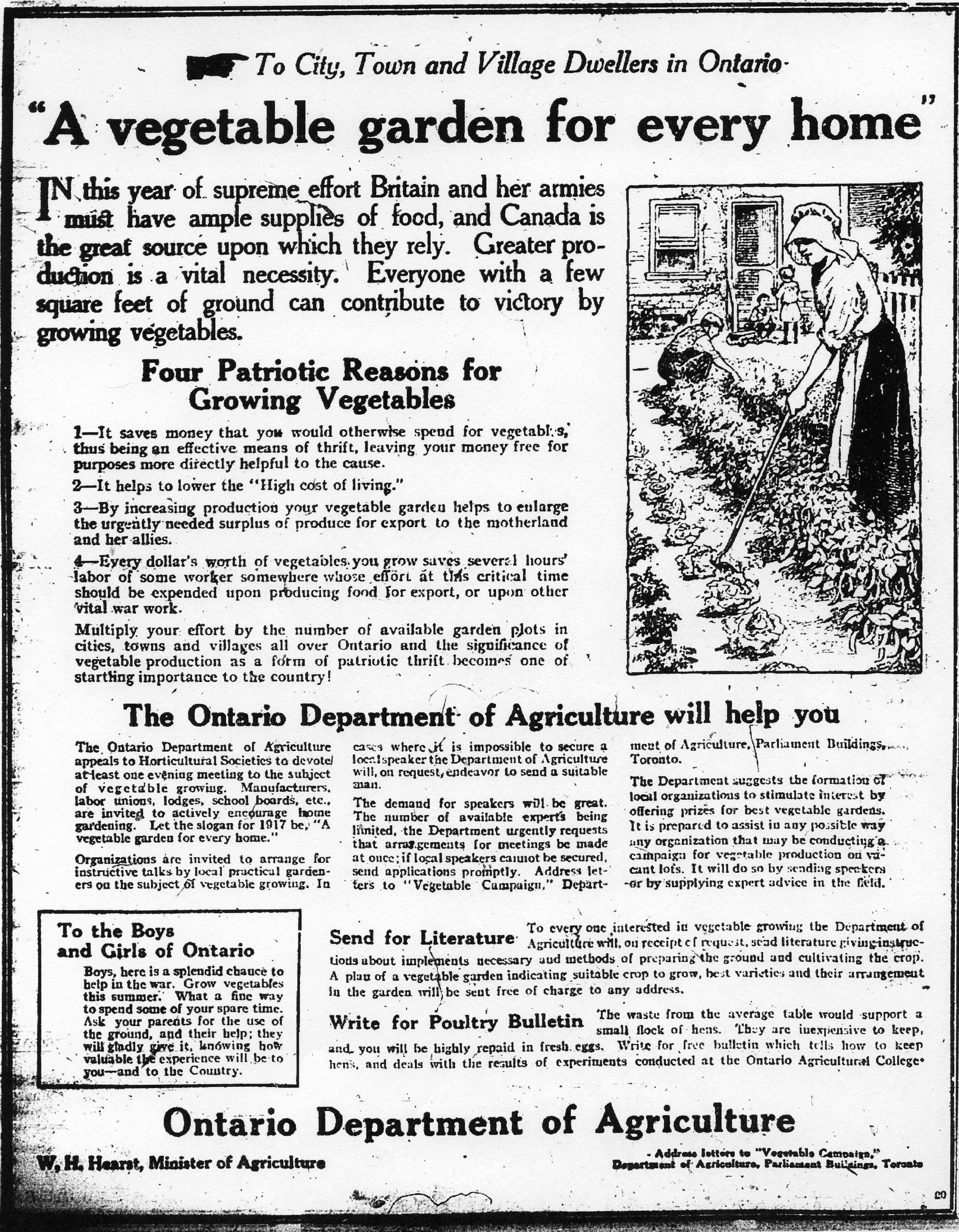
“To City, Town and Village Dwellers in Ontario ‘A vegetable garden for every home.’ In this year of supreme effort Britain and her armies must have ample supplies of food, and Canada is the great source upon which they rely. Greater production is a vital necessity. Everyone with a few square feet of ground can contribute to victory by growing vegetables. …

The Ontario Department of Agriculture will help you. …  Send for Literature. …  Write for Poultry Bulletin. …

To the Boys and Girls of Ontario. Boys, here is a splendid chance to help in the war. Grow vegetables this summer. What a fine way to spend some of your spare time. Ask your parents for the use of the ground, and their help; they will gladly give it, knowing how valuable the experience will be to you—and to the Country.”

The Intelligencer February 24, 1917 (page 6)

“Grand Recruiting Meeting and Sacred Band Concert at Griffin’s Family Theatre Under the Auspices of 254th Battalion C. E. F. Sunday Evening, February 25th.

Lieut.-General, Sir Sam Hughes, Ex-minister of Militia for Canada, will address the meeting.

On account of the large crowd expected from outlying points children under 16 years of age will not be admitted. Doors Open 8.15 P.M.”

100 Years Ago: Madoc Boy Wins Military Cross, Good Old Belleville Doing Grand Work, Play at Holloway Street Methodist Church

The Intelligencer February 23, 1917 (page 1)

“A Madoc boy has been awarded decorations for service in the field. Lieut. Wm. R. Elliot, son of Mr. Wm. Elliot, Peterboro; formerly of Madoc, has been recommended by Sir Douglas Haig for the D. S. O. for the work in the Somme fighting.

Lieut. Elliott went out with his company, which with another company, was given a special duty, and in the attack his fellow officers were shot down. Lieut. Elliot jumped into the breach, the duty was performed and he brought the men back to their lines.

Lieut. Elliot, who has seen much fighting has never been wounded. He is now in England undergoing an operation. He enlisted at Lindsay.”

The Intelligencer February 23, 1917 (page 1)

“$75,000 Now a Certainty. Good Old Belleville Doing Grand Work. At the final luncheon, given by the Ladies of the Patriotic Association last evening at the Y. M. C. A. a general note of optimism was struck. The team Captains, who gave their experiences, were hopeful of big things today, the last day of the campaign, as well as reporting generally good results for the second day of the Campaign. …

Good receptions and success was reported by Ald. Deacon. He gave one experience which was most pleasing. That was of two soldiers’ wives, who walked into Headquarters, and subscribed $20.00 each. Saying that they had been so well treated by the patriotic people of Belleville that they had much pleasure in making this donation.

Mr. D. V. Sinclair had worked hard all day, and had met with a fair degree of success. The young men were certainly not responding, however, the young ladies of the city were doing nobly. In establishments where girls were employed they would cheerfully subscribe $5.00 and young men earning twice their salaries would give up $1.00.

Mr. Arthur McGee had met with very fair success. However, the bright and promising, and in fact, budding career of his team mate, Mr. John McFee, came near to being brought to an untimely end. One of the young self-sacrificing men in a local industrial establishment threatened to bounce a steel shillalah upon his noble dome. The threat was resented most strenuously by the doughty John, who requested the wielder of the said shillalah to come outside where there was more room for arm action. But the gentleman in question was ‘too proud to fight.’ So ended the argument. …

The luncheon was wound up by the passing of a vote of thanks to the ladies, for the splendid way in which they had responded to the call of duty. Everyone present joined heartily in singing ‘They are Jolly Good Fellows.’ After singing ‘God Save the King,’ the gathering was broken up.

CAMPAIGN NOTES. Don’t forget the big Auction sale on Saturday night at the Headquarters, Cor. Bridge and Front. Anyone having any donations to the Sale kindly drop them to Headquarters. The more the merrier.

The thanks of the Citizens are due to the hard working Canvassers. The time that they have given from their businesses and the energy and patience displayed throughout the three strenuous days shows an excellent spirit.

The 235th and 254th bands are also deserving of thanks for their part in the success of the undertaking, also the stenographers of the Ontario Business College for the time they gave in addressing the envelopes, etc. The Hydro-Electric Staff have done nobly also in preparing the lists. Also the Post Office Staff in getting out the circulars.”

The Intelligencer February 23, 1917 (page 3)

“Delightful Function for Worthy Cause. Under the auspices of the Ladies Aid Society in connection with Holloway Street Methodist Church of this city, a play entitled, ‘Our Church Fair,’ was given last evening, in the Sunday School, and it was a great success in every particular. The proceeds of the entertainment were for a most worthy object, namely, the Red Cross, and a goodly sum was realized. There was a large attendance, and all present heartily enjoyed the programme presented.

In addition to the play which was presented in a capable manner by all who took part, there were extra numbers consisting of vocal and musical selections. The 254th Orchestra, under the leadership of Bandmaster Lieut. Hinchey, was present, and the selections given were highly appreciated, they being of a high order. …

At the close of the programme dainty refreshments were served, and the singing of the National Anthem brought the pleasing evening’s programme to a close.”


100 Years Ago: First Campaign Day Shows Fine Results, Canadian Women to Remain Abroad, 235th Hockey Victors, Posters for Patriotic Fund, Jam Reaches 80th in France

The Intelligencer February 22, 1917 (page 1)

“First Day of Campaign Shows Fine Results. The first day of the Fund Campaign, the $20,000 mark was reached and passed. This is a remarkably good showing, and speaks volumes for the hard and energetic work that was expended by the different teams of Collectors.

At the Campaign Luncheon held last night at the Y.M.C.A. the different team Captains gave their experiences. Some were pleasant and some were remarkably unpleasant. A few facts are salient: The same old few are putting up the large sums, and the rank and file of the Citizens, with exceptions, of course, are not doing their duty. Most married men with families earning from $800 to $1200 a year are giving from $25 to $50 and nearly all single men earning the same amount, without any family cares or expense, are giving from $1.00 to $5.00.

These young men still have another day to repent in. The Committee Rooms are open at all times, and cards are there ready to be filled out. If these young men have any moral courage they will walk in and take a card, and fill it out to do their decent share in this most necessary undertaking. Otherwise, they will be called upon again by the Committee and asked to do their share. …

After a most delightful and tasty luncheon, served by the Patriotic Ladies of the City, the Chairman, Mr. Ackerman called upon the various Captains for their experiences. …  While Mr. Sinclair complimented the ladies upon the excellence of the repast he wanted it understood that we did not come here to eat, but to raise enthusiasm, and compare notes. He had the results of his calls tabulated so gave some hard facts which were most enlightening to the assembled workers. He called upon 80 people, with his team mate, Mr. Burrows, with varied results. Six people said No that they could not afford it. ‘They are liars,’ said Mr. Sinclair. Some said they would give to the Red Cross. This was an excuse. These people wouldn’t give to anything. …

Mr. Lack Hughes came up from Foster Ward with nothing but pleasant things to say of his experiences. The subscriptions down there were small, but given cheerfully. …  None of the big industrial establishments in Foster Ward had been visited as yet, and the young men of Marsh and Henthorne and the Rolling Mills, who are earning big money will run the subscriptions from Foster Ward well into the thousands. The young working men in these establishments are expected to do better than the Clerks of Front street, and will give dollars where cents have been given. Let us hope. …

Mr. Hope McGinnis came down from Bleecker Ward with the complaint that some people were insulting, and that some wouldn’t answer. It might be well for some of those people to know that their answers are all carefully recorded at Headquarters, and when the time comes, by their deeds they’ll be known.

Mr. Ackerman, in conclusion, thanked the men who had worked so hard throughout the day, and asked them to go back to their labors with even more determination and energy, if possible, than they had shown today. We still have two days to reach the $75,000 mark, and we’re going to get it. So work hard and success is assured. After singing ‘God Save The King’ the meeting was broken up.”

The Intelligencer February 22, 1917 (page 1)

“Ottawa. Sixty thousand Canadian women and their children now in Britain who have not heeded official advice to return home will have to remain there indefinitely as under the new orders in council their passage across the Atlantic is prohibited.”

The Intelligencer February 22, 1917 (page 2)

“235th Victors in Exhibition Game. A good brand of hockey was put up by the 235th Battalion team and the Depot Batteries at the Arena last night. The game was remarkably clean, and featured with combination and individual plays on both sides. The stick-handling and back-checking was also good. At the opening of play the visitors ran in two goals in succession, the locals getting off to a bad start. They got going in time, however, and before the period ended, they ran in four goals, while the Battery men tallied one. The period ended 5–3.

In the second period only three goals were secured, the locals netting two of them. The play in this period was good, both teams playing an aggressive game, with defence of both sides making several effective rushes. Both Tobin and Micks in the nets were fine, making many spectacular saves. Period ended 7–4 for the locals.

In the third period the locals outplayed the visitors, scoring five goals to the visitor’s three. The game ended 12–7 for the 235th.”

The Intelligencer February 22, 1917 (pages 2, 3)

“Have YOU Been Telling What Should Be Done Or Doing Something Yourself? ?? Put Up Like a MAN or Shut up Like A Mouse. Feb. 21, 22, 23 Patriotic Fund Campaign.”

“Are You A Shirker or a Piker???? If YOU Are a Shirker And WON’T FIGHT Pay Up And Don’t Be a PIKER Also. If You Can’t Fight You Are Not a Shirker But PAY! PAY! PAY! February 21, 22, 23 Or You Are a PIKER.”

“HAVE YOU DONE YOUR BIT? ??? You Will Have If You Give Every Dollar You Can Pinch For To Make Things Easy For The Man In France. February 21, 22, 23. Patriotic Fund Campaign.”

The Intelligencer February 22, 1917 (page 3)

“Friends of Pte. Arthur Ferguson who is now ‘Somewhere in Fance,’ with other members of the 73rd Battalion, R.H.C., will be pleased to learn that in writing to his aunt, Mrs. Taylor, North Front Street, city, he says he is still alive, and in a rest camp.

He mentions that he saw Captain Sharpe just before going into line, and the Captain called him out of the parade and gave him a box of jam and other things for the boys of the 80th in the 73rd Battalion, sent by the women of Belleville. It will be very gratifying, no doubt, to these ladies, to know that their jam arrived at its destination in good condition, and was gratefully received, and doubtless thoroughly enjoyed by the boys.”