100 Years Ago: Lieut.-Col. Ketcheson Thanks Y.M.C.A.

The Intelligencer April 27, 1916 (page 7)

“What The Local Y.M.C.A. Is Doing. Whilst we are hearing so much of what the Y.M.C.A.’s all over are doing amongst the soldiers, we want the citizens of Belleville to know that we too are doing our share. After perusal of the following letter you will see how much the men are appreciating the free use of our splendid building, and it encourages us to receive this letter and enables us to go on and do all in our power, not only for the soldiers, but for every young man in the city. …

It may also interest the public to know that about 104 of our members have enlisted and gone forth to do their share for King and country. …

Following is the letter received from the Officer Commanding: Belleville, Ont., April 25, 1916. From The Officer Commanding, 80th ‘Overseas’ Battalion, C.E.F. To The Directors, Y.M.C.A., Belleville, Ont.: Gentlemen,— I desire to convey to you the very deep sense of appreciation which is felt by the whole Battalion under my command at the uniform kindness which has been accorded to us by the Y.M.C.A. while located here.

I feel that it will be gratifying to you to know that the free use of the Y.M.C.A. buildings, so generously placed at our disposal, has greatly assisted us in preserving the health of the troops and in carrying out courses of physical training and instruction.

Please accept, on behalf of the officers and men of the Battalion, our most sincere thanks for the splendid work done by the Y.M.C.A. and for the valuable assistance accorded us by your capable Secretary, Mr. Sharpe, and his efficient staff. Yours truly, (Signed) W.G. Ketcheson, Lt.-Col. Officer Commanding 80th Batt. C.E.F.”

100 Years Ago: Letter from Treasurer Tannahill of Canadian Patriotic Fund

The Intelligencer April 26, 1916 (page 1)

“One View of an Open Letter to the City Council. To the Editor, Dear Sir: The public are indebted to ‘Citizen’ for again calling attention to the enormous cost to our townsmen, as well as to the rest of the nation, of the prolonged effort which has become necessary to protect our families and our freedom, our lives and property, and our standard of civilization, from the Prussian deluge of rapine, murder and destruction. …

It is the duty of every one to do all in his or her power to help our forces make sure of victory. Many believe that the only real danger to the Allied armies now, is the tendency of so many to leave all fighting and paying for ‘the other fellow’ to do. We are not free from that tendency in Belleville, though many of our citizens are nobly doing what they can, and by their efforts the city had made a good showing when compared with some other places of similar size and conditions. …

Of Belleville’s 12,000 population, less than 1,000 subscribed anything at all. There are 2,500 householders and nearly as many boarders who earn their living here, all of whom could spare at least one cent per day for the Patriotic Fund as long as the war lasts. A number of them did contribute generously many times that figure. Had every one contributed with reasonable liberality, according to their means, last year Belleville would have raised $80,000 instead of $35,000. …

If a general economy and thriftiness can be brought about, the taxation will be very easily met. …  Yours faithfully, ‘R. Tannahill,’ Treasurer Belleville Branch. Canadian Patriotic Fund.”

100 Years Ago: Telegram of Signaller Yeomans’ Death, Gunner Phillips Wounded

The Intelligencer April 25, 1916 (page 2)

“Official Notification of Signaller Yeomans Death. Dr. Yeomans this morning received the following official notification of the death of his eldest son, Sergt. Signaller Horace E. Yeomans.

Ottawa, On., April 24th. Horace A. Yeomans, M.D., Belleville. Deeply regret to inform you 40283 Bombardier Horace E. Yeomans, artillery, officially reported died of wounds, April 10th. Adjutant General.”

The Intelligencer April 25, 1916 (page 7)

“From Sister M. Hopton. No. 17, Casualty Clearing Station. B.E.F., April 6, 1916. Dear Mrs. Dilmott:—I am sorry to tell you your son, Gunner Phillips, 40470, C.F.A., 2 Batt., has been admitted to this hospital very severely wounded in many places, both arms, legs, back and abdomen. Everything that can be done for him will be done here, and he is having every care and attention. You will understand he is very seriously ill. I will write you very shortly and let you know how he is getting on. He sends you his love, and he is very brave and a very good patient. Yours very truly, Sister M. Hopton, Sister-in-Charge, No. 17, C.C.S.”

100 Years Ago: Memorial Service for Horace (Pat) Yeomans, Mr. Flint’s Criticism, Regimental Funds

The Intelligencer April 24, 1916 (page 1)

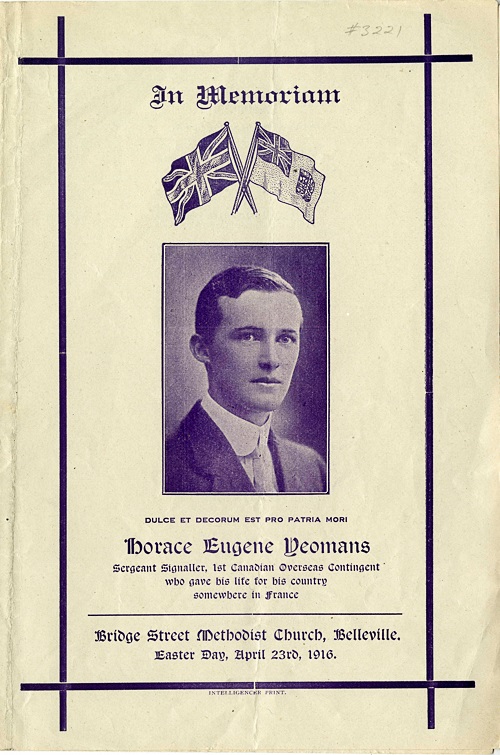
Horace Yeomans File 3221 cover

“Memorial Service At Bridge St. Church. A memorial service, very impressive in its nature, was held in Bridge street Methodist church, in this city, yesterday morning, for the late Sergt. Signaller Horace Eugene Yeomans, who a few days ago ‘somewhere in France’ sacrificed his young life in defence of King and country. It was a service that will linger long in the memory of the hundreds of citizens who were able to gather within the sacred precincts.

The interest in the service was added to by the fact that the 80th Battalion, which will shortly leave for overseas, was present in a body, under command of Lt.-Col. Ketcheson. The number of officers and men on parade was such as to fill the church. The battalion marched from the barracks on Pinnacle street to the church, being led by the fine band under the capable leadership of Lieut. H.A. Stares. The band also took part in the service, furnishing the music for the hymns and rendering other selections in a pleasing manner. …

Two addresses were given during the service, the speakers being Judge Deroche, who is superintendent of the Sunday School in connection with the church, and the Pastor, Rev. H.S. Osborne: ‘Pat,’ as he was familiarly known in the city, was a teacher of a boys’ class in Bridge street church Sunday School, and was also active in Y.M.C.A. work, the Boy Scouts and in sports. He was in every sense of the word a young gentleman.

His capabilities as a signaller were well known, and when it was learned that the 34th Battery would leave this city for overseas services he was at once selected, and with a younger brother, ‘Ted,’ went forth to do his bit. …  In speaking of Sergt. Signaller Yeomans the minister said that seldom had the city been more stirred than on Monday last when a message was received announcing the sad fact that Horace Yeomans had fallen. …

He was an expert signaller, and when the declaration of war came he was found ready for service. When he consulted his father about the matter he said, in his true and brave spirit, ‘If I do not go, who will go?’ He went, and with him a younger brother, scarcely 17 years of age. Side by side, they went at the call of duty. …  There is a game to play in life, and Horace played it well. …  ‘Somewhere in France’ Horace rests—for such lads as he cannot die—their memories go on and on. …

His prayer was that God would help and comfort the parents, brothers and sisters and relatives who have been bereft of a loved one. After prayer a hymn was sung, the benediction pronounced, and the National Anthem sung. The pulpit was appropriately draped with a Union Jack, while on either side were beautiful Easter lilies.”

The Intelligencer April 24, 1916 (page 7)

“Mr. Flint’s Criticism. The name of the author, Mr. J.J.B. Flint, was inadvertently omitted from a letter addressed to the City Council of Belleville, and signed ‘Citizen’ which appeared in Saturday’s edition of The Intelligencer.

Regarding Mr. Flint’s patriotic or unpatriotic proclivities, The Intelligencer has no comment to make, but must beg leave to repudiate the sentiments expressed in the letter as a whole. Patriotism is recognized in the response to the appeal of the hour, and in granting the $40,000 the City Council is doing the right thing.”

The Intelligencer April 24, 1916 (page 7)

“Regimental Funds. There has been considerable discussion as regards Regimental Funds for Overseas Battalions. …  The establishment of Overseas battalions provide for a band, yet no instruments are furnished by the Government. …

An indispensible factor in successful recruiting is the hearty co-operation of civilians with the Military authorization. The leading representative of the men of both parties should be convened at a suitable centre for the purpose of organizing recruiting meetings, and soliciting financial aid; to solicit from County Councils, a money grant, also subscriptions from citizens. Such funds to defray incidental recruiting expenses, also needed equipment.

Some people are under the impression that all recruiting expenses are paid by the Government. As a matter of fact, such is not the case. It is true that the Government pay a considerable proportion of the expenses, but there are numerous expenses which they will not pay; as an instance may be mentioned that the 155 Battalion, now recruiting in Hastings and Prince Edward, have already spent in recruiting over $2,000.00 none of which amount will be repaid to them by the Government.

In addition to this sum, they have paid $1,800.00 for instruments for their band and there is a considerable amount yet to be expended for necessaries that the Government do not supply. …

Our own County battalion, the 155th, has been well received by the people of the two counties and we know that it will receive the same hearty financial support as all other county battalions in the third division, are receiving.

Every cent of money which is given to the Regimental Fund of any Overseas battalion has to be strictly accounted for …  so the public may be assured that none of the money subscribed to Regimental funds is misappropriated.”

100 Years Ago: Colors for 80th Battalion, Coe Hill Soldier Wounded, Letter to Belleville Council, Graham Company’s Dried Food Reaches Salonica

The Intelligencer April 22, 1916 (pages 1, 6)
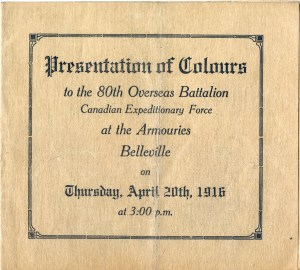
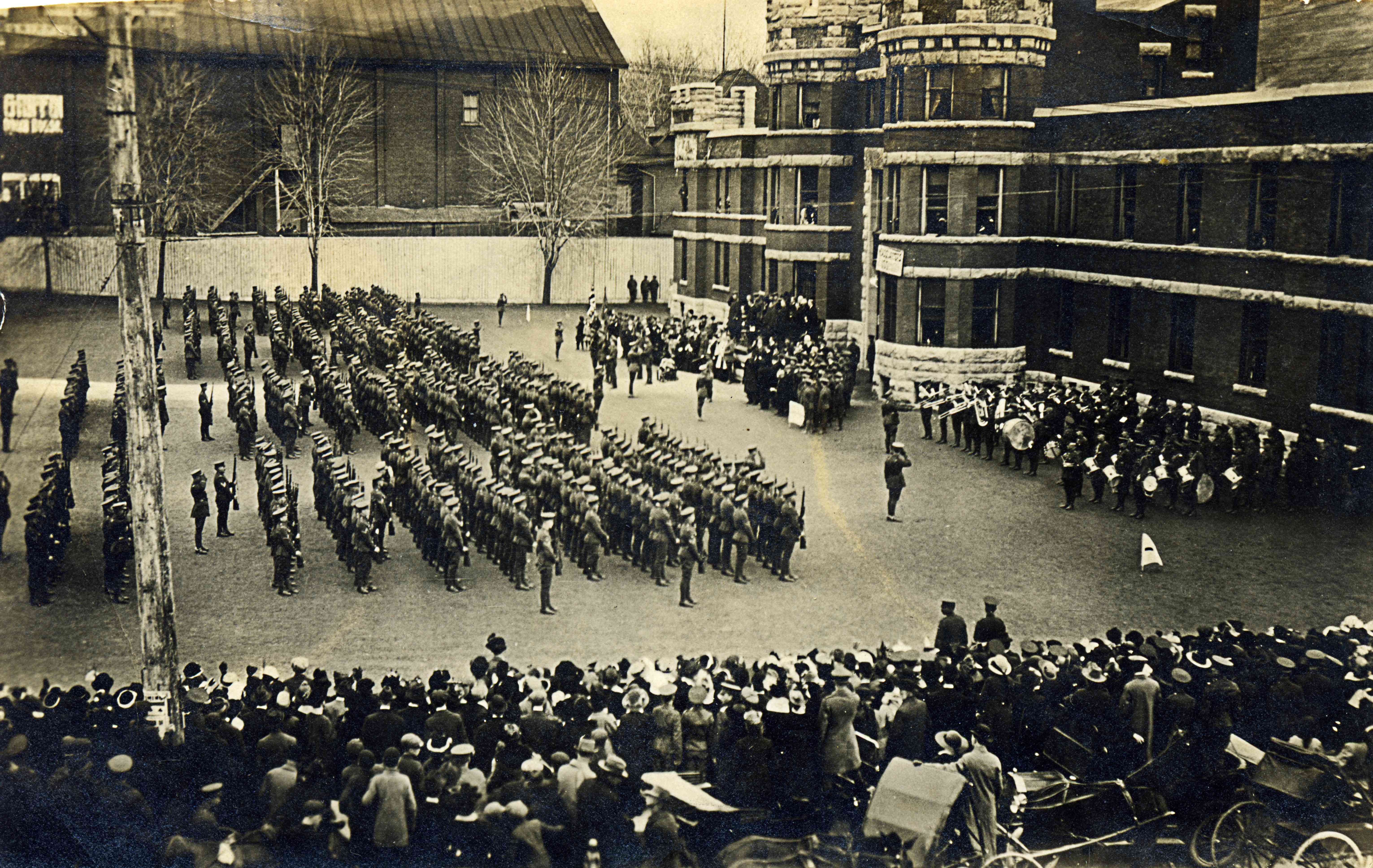
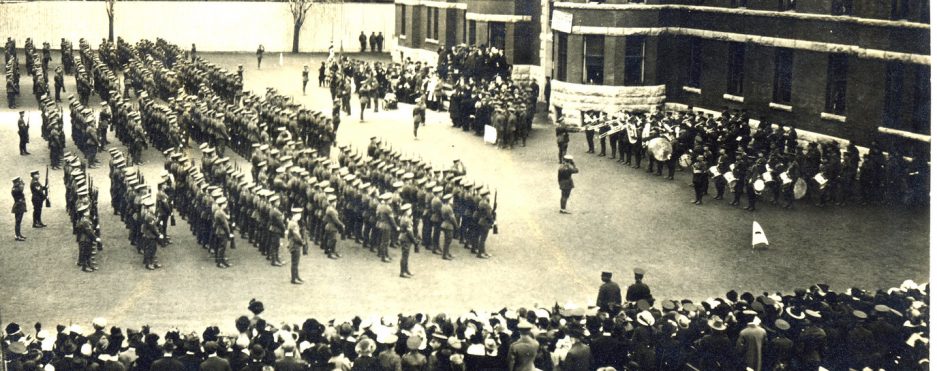
Presentation of Colours File 2206 cover“Presentation of Colors to the 80th Battalion C.E.F. An event which has for some time been looked forward to with interest took place on Thursday afternoon. It was the consecration and presentation of colors to the 80th Battalion, C.E.F., which will shortly leave Belleville for overseas. The colors were the gift of the Ketcheson family of Hastings County, in recognition of the fact that Col. W.G. Ketcheson, who for years was the commanding officer of the 49th Hastings Rifles, is the popular commanding officer of the 80th Battalion.

The battalion was at Barriefield for some time, but last fall two companies, namely, A. and B., were transferred to Belleville, whilst C. Company has since been stationed at Napanee and D. Company at Picton. On Wednesday the last two mentioned companies arrived here, making a full battalion of 1100 men taking part in the memorable occasion.

The colors are most beautiful in every respect. One flag is made of red silk. It bears the inscription and crest of the battalion, and is adorned with gold trimmings. The second flag is the Union Jack, the King’s colors, and is also of silk. Both flags are trimmed with gold fringe.
Presentation of colours HC04019

The ceremony took place on the parade ground in front of the Armouries. About the outside of the grounds were thousands of interested spectators from the city and county. The chief military officer present was Col. Hemming, commanding officer of the Third Division, who was accompanied by his aide-de-camp. …

In front of the main entrance to the Armouries a platform had been erected, and it was appropriately draped with bunting. Amongst those on the platform were Sir Mackenzie Bowell, Col. Hemming, Col. Ponton, Mayor Ketcheson, C. Ketcheson, reeve of Sidney Township, T. Ketcheson, governor of the jail, Albert Ketcheson, of Sidney, R.H. Ketcheson, Belleville, A.M. Chapman, county clerk, Judge Deroche, Dr. Faulkner, Foxboro, J. Elliott, Mrs. G.E. Deroche, Mrs. Wm. Johnson, and Miss Benjamin. The scene from the platform was most inspiring.

After the royal salute had been given and the battalion inspected by Col. T.D.R. Hemming, the consecration of the colors was proceeded with, and it was a most impressive ceremony. The colors were brought forward and placed crosswise upon two drums which were covered with a Union Jack. Rev. Canon Beamish, Rector of St. Thomas Church, performed the consecration service. …

Miss Nettie Ketcheson, daughter of Mayor Ketcheson, of this city, then read the following address: To Lt.-Col. W.G. Ketcheson, Officers, Non-Commissioned Officers and men of the 80th Battalion, Canadian Expeditionary Force: I am greatly privileged as the daughter of the Mayor of Belleville to represent my kith and kin of the Ketcheson family from far and near, in presenting to you, gallant comrades in arms of the 80th Overseas Battalion, these Colours, the gift of the kindred of your Commanding Officer, whose past traditions for many generations, and whose present service, are linked up with loyal devotion to King and Country. …

We commit the Colours to your soldier keeping as a sacred trust. Guard them well. You will, we know, bring them back to Belleville without a stain of dishonour. …  God speed you and God bless you, Officers, Non-Commissioned Officers and men of our 80th Battalion.

An escort then marched to where the colors were located and they were handed to Lieuts. Drayton and Henderson by Miss Ketcheson. The two Lieutenants received them in a kneeling attitude. A general salute was next accorded the colors, and the band played the National Anthem. …

Col. Ketcheson, the commander of the 80th Battalion, received a hearty welcome from all present when called upon to speak. His remarks were brief but to the point. On behalf of the 80th Battalion he thanked Mayor Ketcheson and other speakers for the kind and patriotic words spoken. He promised for the men that they would respect and take care of the colors which had been presented. On behalf of the men he would say farewell. We will fight and do all we can for King and country. Farewell till we come back.

Three hearty cheers were then given for the 80th Battalion. Major Watson called for three cheers for the Ketcheson family, which were heartily given by the members of the battalion. Major Watson: ‘Are we downhearted?’ The response was a loud emphatic ‘NO.’ The proceedings closed by the band rendering the National Anthem.

The Intelligencer April 22, 1916 (page 3)

“Hastings Co. Hero Wounded. Private Leveridge, whose home is at Coe Hill, in the northern part of Hastings County, and who in June of last year left here with the 39th Battalion, has been severely wounded while doing duty at the front. His right arm was taken off and his right leg was terribly lacerated. He is at present in a hospital in the old country. Private Leveridge is about 35 years of age, and has a wife and two children at Coe Hill.”

The Intelligencer April 22, 1916 (page 6)

“To the City Council of Belleville. Gentlemen.—As a taxpayer permit me to call your attention to an old adage, ‘Be just, before you are generous.’ Alderman Deacon states that, chiefly owing to grants to battalions, the city has a deficit of $15,000. …  Every taxpayer feels that our taxes are a very great and grievous load which have to be borne. Some gentlemen have asked you to still further run the city into debt by donating $40,000 to the patriotic fund. …  You gentlemen represent a city which is composed of a very large percentage of people who have small means, and have all they can do to struggle for a livelihood. …

Everything has increased in price, the cost of living has greatly increased. The long closure of the Rolling Mills, Pringle’s Mill, Holton’s Mill, and the cutting down of wages in other industries have had a terrible effect upon the laboring class, as well as citizens generally. In addition there has to be considered the increased taxation for pavements, expensive sewers in West Belleville, the erection of our costly schools, with their many teachers. …

From what source do you derive authority to impose so great a sum upon the city without taking the sense of the people by a public vote upon a bylaw? If you can impose $40,000, what will prevent you imposing $100,000? The only limit would appear to be the sky. If a bylaw was submitted to be voted upon by the citizens who are to pay, and it passed, no one would murmur; but to impose such an enormous amount upon the citizens without consulting them would be a grievous wrong. To gentlemen who have stated salaries not subject to fluctuation from circumstances, the tax would make little difference. I am, yours truly, CITIZEN.”

The Intelligencer April 22, 1916 (page 6)

“Letters from Overseas. From Corp. E.W. Whitaker. It would appear, from the following letter, that in some instances at least Graham & Co.’s ‘Desiccated Vegetables,’ manufactured and canned in Belleville, travel many miles before reaching their destination, particularly when consigned to such regions as Salonica, where many of our Canadian soldiers are stationed.

The face of the label referred to in the message home is very handsome in design, consisting of a combination of colors showing the cabbage, the carrot, the beet, the turnip, the potato, and a bunch of celery, in a beautifully natural state, which, with the firm name of ‘Graham Co., Limited, Belleville, Ont.,’ must have made the boys in that far-away land feel decidedly homesick. The label was probably used in lieu of regular writing paper, and we can imagine the writer stripping it from a can for the purpose indicated. …

Salonica. Feb. 6, 1916. Dear George: You will see I am using one of your firm’s labels for notepaper, therefore you will know ‘Tommy’ is being issued with vegetables—and don’t they just make our stew A1! I must congratulate the Graham Co’y, Ltd., on the fine quality, for the flavor and richness would be hard to improve upon. Before reaching us out here they have been travelling ‘some.’ Keep us well supplied until the war is over, and I pray that may be very soon now. Trusting you are all in the very best of health, will write further anon. Good luck, best wishes. Your affec. brother, Ernest.”


100 Years Ago: 80th Band to Give Promenade Concert Tonight, Private Tapp Invalided Home, Albert H. Green Killed in Action

The Intelligencer April 20, 1916 (page 2)

Promenade Night

“Promenade Concert. 80th Band. Armouries To-Night. By the kind permission of Lt. Col. W.G. Ketcheson, O.C. 80th Overseas Batt. C.E.F. General Admission 10c. Reserved Seats 25c extra. Can be procured at the Armouries Night of Concert. Proceeds for Work of Military Y.M.C.A. Secure Tickets from Soldiers or at Y.M.C.A.”

The Intelligencer April 20, 1916 (page 7)

“Returned Hero Welcomed Home. Private Tapp whose home is in this city, and who left here with the 39th Battalion, was wounded while on service at the front and was invalided home. He arrived here yesterday afternoon and was met at the G.T.R. station by relatives and friends, also by the bugle band and a detachment of the 155th Battalion, and escorted to his home on St. Charles street.

The returned hero is progressing nicely, and no serious results are anticipated from the wounds he received. Tapp is a married man and has resided in Belleville for some time.”

The Intelligencer April 20, 1916 (page 7)

“Albert H. Green Killed in Action. Another of Belleville’s young men has given up his life in the defence of his King and country. In today’s list of Canadian casualties appears the name of Albert H. Green, a former resident of this city, as having been killed in action.

The unfortunate young man was of sterling qualities and a favorite with all who knew him, who will regret his sudden demise. Up to the time of his enlistment with the 34th Battery, the late Mr. Green was in the employ of Mr. John McIntosh, a merchant of this city.”

[Note: Driver Albert Henry Green died on April 4, 1916. He is commemorated on Page 94 of the First World War Book of Remembrance.]

100 Years Ago: Belleville Patriotic Association Requests $40,000, Flags at Half Mast, Another Bellevillian Wounded, Send-Off for Young Men at Cannifton

The Intelligencer April 18, 1916 (page 2)

“Request $40,000 for Patriotic Fund Grant. A request was made by a deputation of the Belleville Patriotic Association for a grant of $40,000, which was supported by several speakers. The matter was referred to the Executive Committee. …  A grant of $400 was made to the 80th Battalion, and it was decided to have a roll of honor prepared of all Belleville citizens who have or will leave for overseas. …

Patriotic Association. …  At a meeting just held by the Association a resolution had been unanimously adopted asking the Council to give a grant of $40,000, and this would be added to by a special appeal to citizens, so as to make about $60,000. This sum would be needed in the year for patriotic purposes. …

Ex-Mayor Wills said …  We will require between $60,000 and $70,000 during the coming year to meet the demands. We will soon be at the $4,000 mark per month, and it will increase. You will see that this is the best course possible to pursue. …

Alderman Deacon …  in addition to this patriotic scheme there were other matters to look after, namely the Red Cross, Canning factory rental, grants to the two battalions. It would mean about $10,000 for patriotic purposes in addition to the $40,000 asked for. Could the city stand $50,000 for patriotic purposes?

Col. Lazier—Certainly, if necessary. …  The matter was then referred to the Executive Committee for consideration.

The Intelligencer April 18, 1916 (page 7)

“Token of Respect. Flags are floating at half mast on the city and Y.M.C.A. buildings out of respect to Signaller ‘Pat’ Yeomans, whose life has been sacrificed at the front.”

The Intelligencer April 18, 1916 (page 7)

“Another Bellevillian Wounded. In the list of Canadian casualties published today appears the name of Clarence Roy Rickett of Belleville, Ont., who is reported as wounded.”

The Intelligencer April 18, 1916 (page 7)

“Patriotic Send Off at Cannifton. Should anyone have any question as to the sympathy of the Cannifton community with the cause of the Allies in the present war, such an one should have been at the Town Hall in Cannifton on Saturday evening last. He would have had his notions blown higher than ‘Gilroy’s kite’ ever soared.

It became whispered about that seven of the village’s young men were about to leave in the service of the Empire, and the community at once set about to give significance to the event and honor to the boys who were stepping into the call of the nation’s heroes. Mrs. Fred Mason and Miss Flossie Watts were the popular young ladies to whom the task of canvassing was committed. The response was ready and generous; and the matronly mothers of the canvassers were commissioned to provide some tangible expression of the people’s interest in their boys, who had donned the khaki.

A meeting was appointed, and the soldiers summoned to the Town Hall. The meeting was called to order and Rev. Mr. Wilson was asked to preside. Mr. Wilson, who long before this had shown his sympathy with the soldiers and recruiting, in his opening remarks called attention to the fact that sixteen of the Cannifton youths were now in active service in the King’s army, while from the immediate vicinity in the Township of Thurlow more than thirty of her sons were in the ranks. Some of them had already given life and blood in battle and acquitted themselves in a creditable manner for their King and nation. …  the Lloyd orchestra, from Sidney, always popular in Cannifton, rendered a number of selections appropriate for the occasion.

The climax of the hour was reached when the names of Wilfrid Badgley, Ross Callery, Blake Waterhouse, Fred Lawrence, Harold and Wilfrid Horn, Jas. Parm and Walter Barlow were responded to upon the call of the chairman. Mrs. Fred Mason and Miss Flossie Watts also were called to the platform, and Mrs. Mason presented to each of the young soldiers a signet ring of gold, the gift of the community, in recognition of their heroism in entering the ranks in defence of liberty.

A few words were spoken by Rev. Mr. Wilson to the boys whom, he believed, would heroically defend the nation’s honor and preserve their own. They would be followed by the prayerful memories of himself and the Church of God in the serious business they had undertaken. Upon their return they might be assured of a cordial and joyous welcome. The interesting event was brought to a close, by all joining in the National Anthem.”

[Note: Eight young men are listed.]

100 Years Ago: Horace Yeomans Is Killed, Ernest Phillips Wounded in Action

The Intelligencer April 17, 1916 (page 1)

“Popular Son of Belleville Numbered With The Slain. Horace Yeomans Is Killed. The following cable message was this morning received by Mr. F.E. O’Flynn of this city: Hoarce Yeomans Killed. Writing, Eddie. Three brief words, but bringing grief to local parents and scores of friends, referring as it does to Horace Yeomans, eldest son of Dr. and Mrs. H.A. Yeomans, of this city, who left with the First Canadian Contingent as a member of the Signalling Corps of the 34 Battery, and sent by Capt. Eddie O’Flynn, also of Belleville, who has been at the front for some time.

There was a feeling of deep regret in this city when the sad news became generally known. The brave lad was well known by our citizens, and no young man possessed more personal friends. He was beloved by all who knew him, and his death will be sincerely regretted.

He was at the time of his enlistment attending Belleville High School, and was recognized as an exceptionally bright scholar. Highly moral, an energetic worker in church circles and at the Y.M.C.A., his influence for good was far-reaching among the younger classes, by whom his death will be deeply regretted.

To the bereaved parents the heartfelt sympathy of the community at large will be extended at this time.”

[Note: Bombardier Horace Eugene Yeomans died on April 10, 1916. He is commemorated on Page 186 of the First World War Book of Remembrance.]

The Intelligencer April 17, 1916 (page 7)

“Ernest Phillips Wounded in Action. Mrs. H.W. Dillnutt, of 16 Turnbull Street, Belleville, received yesterday the following telegram informing her of the wounding of her son in action: Ottawa, April 15.—Sincerely regret to inform you that 40470, Gunner Ernest Linnell Phillips, artillery, was officially reported as admitted to No. 13 General Hospital, Boulogne, April 8th. Gunshot wounds—multiple. Condition good. Will send further particulars when received. Adjutant-General.

Ernest Phillips, well known in this city, and for some years an employee of Marsh & Henthorn, left here in August, 1914, with the 34th Battery, 1st Contingent, and has served gallantly for his country.

Mr. H.W. Dillnutt, Mrs. Phillips second husband, is also in the same battery, connected with the Ammunition Column. John Phillips, a younger son is now a member of the 155th, the three soldiers indicating a patriotic trend in the family.”

100 Years Ago: Canadians at St. Eloi

The Intelligencer April 15, 1916 (page 1)

“Heroic Work of Canadians in Resisting the Hun Attacks. Endeavor to Bring Order Out of Chaos, and While Protected by Rude Trenches Hold Their Positions Against a Severe Bombardment—The Casualties Were Heavy.

Ottawa. April 15.—Heroic and effective work by the Canadians in resisting determined attacks by the Germans at St. Eloi last week is detailed at length in ‘Eyewitness’ communique, received this morning.”