100 Years Ago: Victory Loan Campaign, Letter of Sympathy for William Woods’s Wife, Leo Hamilton Wounded

The Intelligencer October 7, 1918 (page 1)

“Victory Bond Local Campaign Organization Complete. The campaign which will be waged from coast to coast in Canada for the raising of $500,000,000 for Canada’s Victory Loan, 1918 will take place from October 28th to November 16th. The organization in Belleville is being rapidly completed. The various heads of committees have signified their willingness to once more undertake this very necessary work.

The following telegram was received by Mr. W. B. Deacon, who was so successful last year as county chairman, and in answer to this he has once more agreed to assume this heavy responsibility. …  ‘W. B. Deacon, …  Shall be greatly obliged if you will kindly consent to act again as chairman of Victory Loan Committee for Hastings County. The loan is of most vital national importance and I feel that your services will materially contribute to its success. W. T. Hite, Minister of Finance.’

Mr. H. W. Ackerman has also consented to act as secretary and an organization meeting will be held shortly to complete committees. …  Last year the county of Hastings subscribed over two and one-half million dollars of Victory loan and this year it is expected that the good old county will far exceed the record of last year.

No stone will be left unturned to make this, which will probably be the last call on the resources of Hastings county, the biggest and best effort of the citizens towards the winning of the war. Every citizen of the county of Hastings is expected to do his bit in assisting the organization in every way possible, as co-operation means success and without this co-operation of the citizens it will be impossible to have a complete success. Hastings County must not lag behind her sister communities in this great war effort.”

The Intelligencer October 7, 1918 (page 3)

“Brave Soldier Loved by Pals. Mrs. S. Woods, who resides at 20 Water Street, received the following letter from Chaplain J. L. McInnis, Capt. The letter is in connection with the death of her husband, Pte. Wm. Woods who made the supreme sacrifice on September 2nd:

France, Sept. 5th, 1918. Dear Mrs. Woods:—As the Chaplain of the battalion of which your husband was a brave and loved member, I beg to offer my deepest sympathy in your great loss.

The attack, in which he was one of the first to go over the top was one of the most bitterly opposed in the experience of our troops. That we won such splendid victory is due to the high courage of men like Him who feared failure and defeat more than death.

You have endured a long and trying separation. It is hard to walk through this Valley of The Shadow. May God Comfort you. May you have the companionship and sympathy of Him who loved not his own life unto death. May the twin stars of Faith and Duty guide you and yours through these coming days.

Our sacred dead are buried in a cemetery near the village of Dury. His commanding officer unites with me in paying tribute to a gallant soldier who showed splendid devotion to his duty to the end. Believe me, Yours in deepest sympathy, John L. McInnis, Capt. Chaplain O.M.F.C.”

The Intelligencer October 7, 1918 (page 5)

“Pte. Hamilton Wounded. Mr. and Mrs. Geo. T. Hamilton, residing on Albion Street, received word on Saturday from the Director of Records, at Ottawa, stating that their son, Leo, was admitted to the Fifth General Hospital, Rouen, suffering from a gunshot wound in the right foot. Leo is well known in this city and his many friends hope that the wound will not prove serious.”

Nurses of World War I: Florence Helena Upton

Florence Helena Upton was born in Trenton, Ontario on June 20, 1884 daughter of Richard Upton and Rachel Pepper. The father of our subject was a blacksmith in Belleville in the early 1880s; Miss Upton, and her brother, consistently identified her birthplace as Belleville on her attestation papers and travel documents.

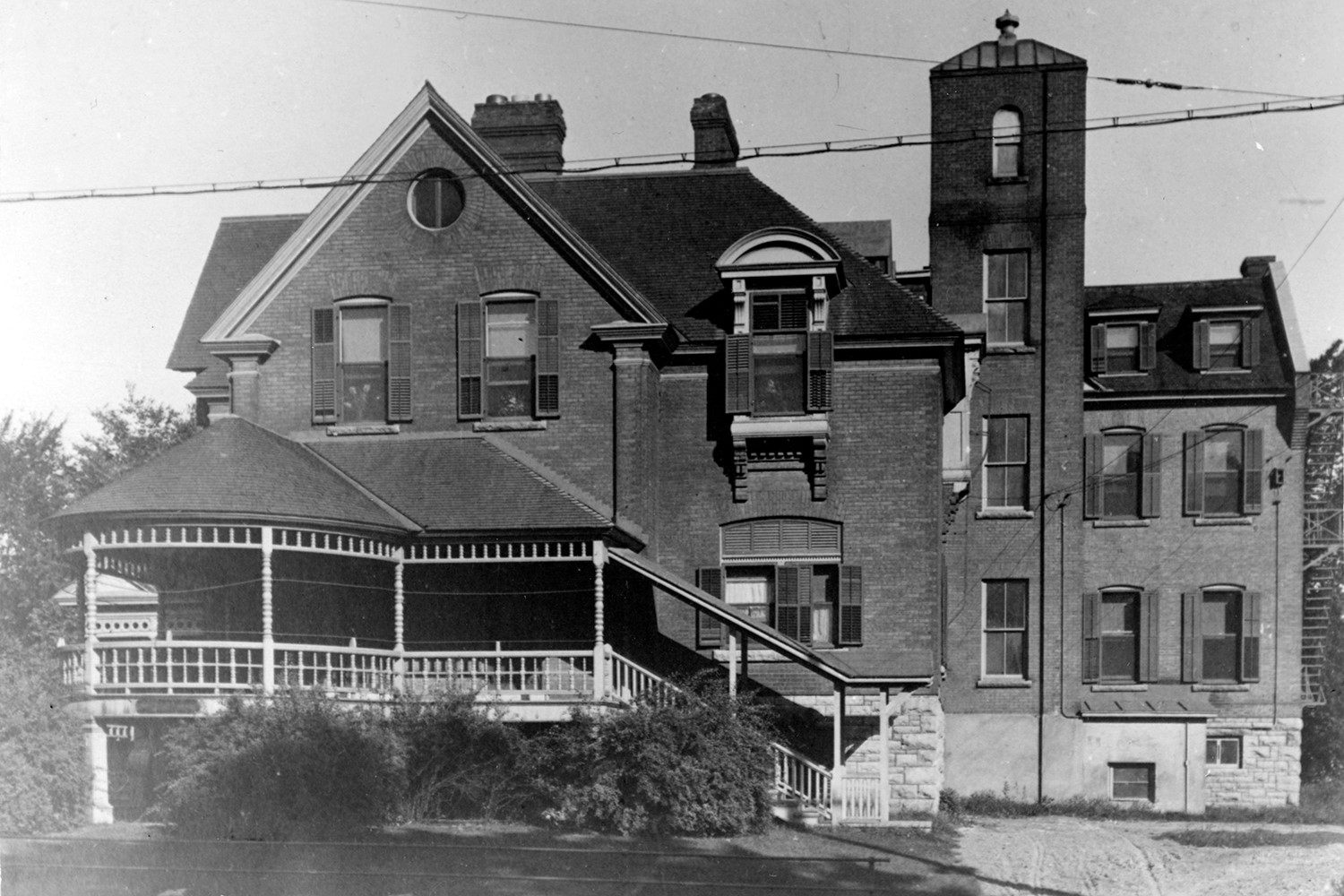
Lady Stanley Institute, Ottawa

Maternity Hospital, Ottawa

She was educated locally, removed with her family to Saskatchewan about the turn of the century and was a graduate of the Lady Stanley Institute for Trained Nurses in Ottawa on May 28, 1907. Helen was charge nurse of the operating room in the Saskatoon Hospital before establishing herself at Winnipeg, Manitoba. Here she enlisted in the Canadian Army Medical Corps on July 1, 1915.

Height:  5’ 4”

Weight: 112lb

Age: 31 (stated age: 28)

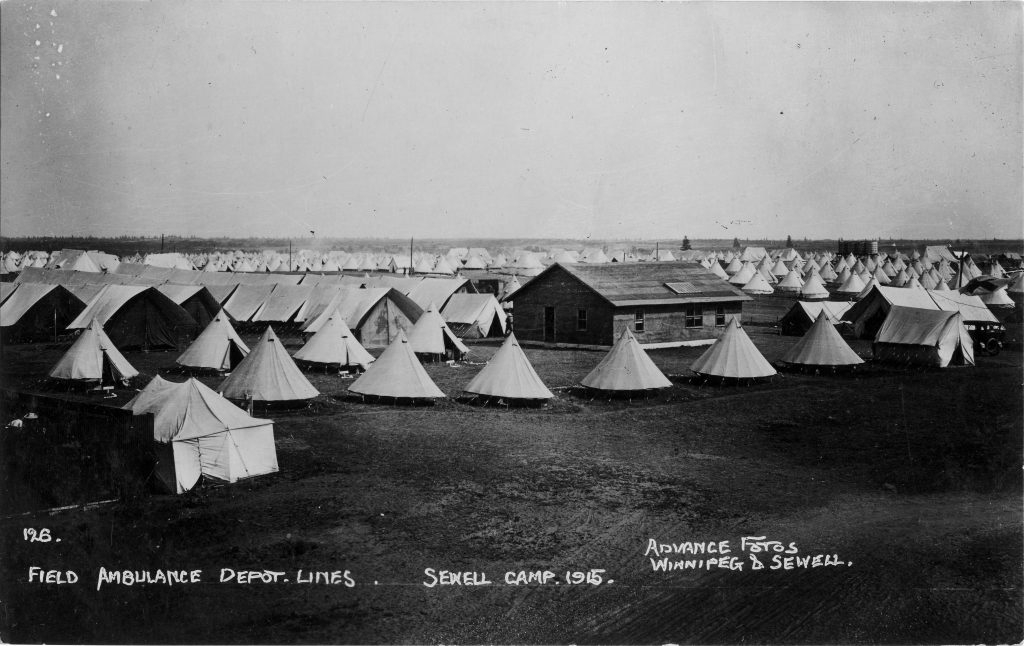
Nursing Sister Upton initially served with the No. 1 Field Ambulance Depot, Sewell Camp in Winnipeg and embarked for overseas service on May 19, 1916.

Field Ambulance Depot, Winnipeg

She worked in hospitals in Shorncliffe, England and Étaples, France before becoming ill with bronchitis. After 9 week hospitalization in Étaples and the Canadian Red Cross Special Hospital in Buxton, England she was invalided home to Winnipeg, setting sail on January 31, 1918 aboard the S.S. Olympic; Miss Upton was given a medical discharge on Feb 7, 1919. After the War she was one of 9 Military Nurses employed in the Soldiers Civil Re-Establishment Staff in Winnipeg. She moved shortly thereafter to California where she worked as a nurse for the Metropolitan Life Insurance Company and was united in marriage to Charles Corlett on January 11, 1945 in Santa Ana.

Florence Helena Corlett died on Nov 5, 1973 in Pasadena aged 89 years 4 months 15 days; her remains were cremated and scattered at sea.

100 Years Ago: Two More Gasless Sundays, Depot Battalion in Belleville, No Epidemic of Flu in Belleville, Lieut. William Henry Freeman Ketcheson Returns, Michael James Callahan Wounded, Letter of Sympathy for William Hunter’s Mother, Poster for Saving Money

The Intelligencer October 5, 1918 (page 1)

“Gasless Sunday for Two Weeks More. Ottawa. Gasless Sundays are to continue for two weeks more. The Fuel Controller informed G. A. McNamee, secretary of the Automobile Club of Canada, that he had been in communication with the United States authorities relative to the supply of gasoline, and that the voluntary restriction regarding Sunday motoring would be continued for about two weeks more. He asks all Canadian motorists to adopt a singular courage and refrain from using their cars for two more Sundays.”

The Intelligencer October 5, 1918 (page 2)

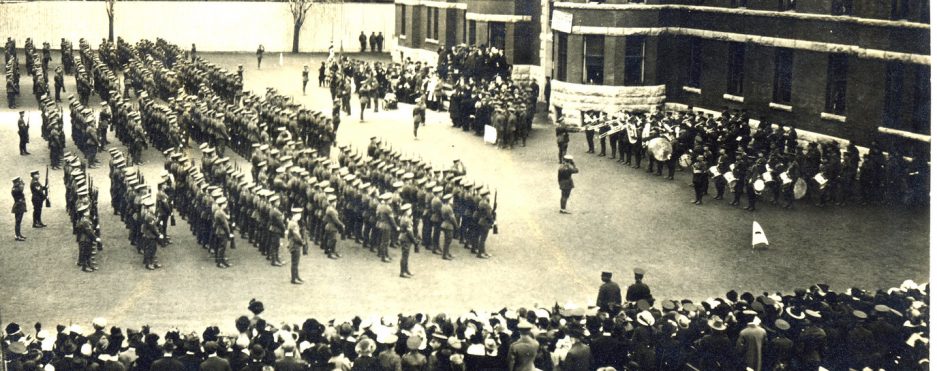
“The balance of the Depot Battalion left the city and camp Thursday for Belleville and are now quartered in the Armories and the city hall there. About 250 in all including Lt.-Col. Smart and staff were in the contingent. It is said that the battalion will possibly remain in Belleville for the entire winter and the officers have moved their families with this intention. It is also said that they will not be among those who may return to occupy the new barracks now being built at Barriefield.—Kingston Standard.”

The Intelligencer October 5, 1918 (page 5)

“No Epidemic Here. Dr. Yeomans, Medical Officer of Health, is closely watching the local situation as regards influenza. Thus far a few cases of influenza have developed, but there is no occasion for alarm. Should there be any signs of an epidemic here prompt action will be taken to close places of public assembly and isolate the cases.”

The Intelligencer October 5, 1918 (page 5)

“Returned from England. Lieut. W. H. F. Ketcheson, son of ex-Mayor Ketcheson of this city, arrived home this afternoon from England. Some two months ago he left Canada on escort duty with a military draft for overseas duty. Previous to this Lieut. Ketcheson had been in France for 26 months and had been invalided home.”

The Intelligencer October 5, 1918 (page 5)

“Pte. Callaghan Wounded. Mrs. Ann Callahan, 141 Pinnacle Street, has received official notification that Pte. Michael J. Callahan, infantry, is dangerously ill at the Fourth General Hospital, Dannes-Camiers, France, where he was taken September 30, with gunshot wound in left leg. Pte. Callahan enlisted on January 4, 1916 and proceeded overseas on May 13, 1916, with the 80th Battalion. After three months of training in England he went to France and has been in the trenches since Sept. 1st, 1916. Pte. Callahan was well known and highly esteemed by his many friends, who all hope for his speedy recovery.”

The Intelligencer October 5, 1918 (page 5)

“Soldier’s Comrades Express Sympathy. The following letter was received by Mrs. Jas. Hunter, who resides at 180 James Street. The letter is in connection with the death of Pte. W. Hunter, who made the supreme sacrifice on Sept. 1st.

Mrs. James Hunter, 180 James Street, Belleville, Ont. Dear Mrs. Hunter,—It is with great regret that I have to advise you of your son’s death. He died with his face to the enemy at the Battle of Arras, a brave man and good soldier. His comrades in the company join me in expressing their deep sympathy with you. Yours very truly, C. Carmichael, Lieut.”

The Intelligencer October 5, 1918 (page 7)

“An Advertisement by Charles Dickens. Charles Dickens is one of the world’s great teachers.

The saving of a part of one’s income was always a good policy. Prudent men and women have always maintained a margin of saving.

If Charles Dickens were writing to Canadians to-day he would probably give us advice to this effect: ‘No matter what percentage of your annual income you have previously saved, your efforts to-day should be to save more. The advantage of so doing is threefold: By the practice of economy you conserve the material and labor which must be devoted to the grim task before us; you cultivate the priceless habit of thrift; you gather more and more money to lend to the Nation for the prosecution of the war to a quick and certain Victory.’

Published under the authority of the Minister of Finance of Canada.”

100 Years Ago: Bugle Band Parades, Toronto Civilians Get Spanish Flu, Ontario Raises War Tax at Theatres, Spanish Flu Hits Renfrew, How to Dodge Flu, Letter of Sympathy for Georges Thibault’s Wife, Poster for Thrift

The Intelligencer October 4, 1918 (page 1)

“Bugle Band Parades. The bugle band in connection with the depot battalion now quartered here paraded the principal streets this afternoon and presented a smart soldierly appearance. The local unit may be augmented in the near future as the exemptions to soldiers at work on the farms expire. About 1200 soldiers belonging to this district are still on farm service.”

The Intelligencer October 4, 1918 (page 1)

“Toronto Civilians Get Spanish “Flu.” Toronto. Spanish influenza has officially reached Toronto. Dr. Hastings, M.O.H., informed a representative of The Globe last night that there was now little doubt that the disease was the same as has been spreading through the United States.

Whether it is a new name or just a new alias for grippe is still in doubt, however. Some bacteriologists claim to have found the old influenza organism, while others have not located it in the new outbreak. …  Dr. Hastings said last night that he had been speaking with a medical man who had considerable experience with the disease in the old country. The mortality, he was informed was not high, ranging from 3 to 5 per cent.”

The Intelligencer October 4, 1918 (page 1)

“Toronto. The Ontario Government, in search of more revenue, has decided to raise the scale of war tax at the regulation theatres and the higher-priced concerts. Instead of the two cents being charged on tickets costing more than 45 cents and not more than 95 cents, 5 cents will be collected after November 1. When the price of admission is more than 45 cents and not more than $1.45 10 cents will be collected instead of 5 cents as at present. Fifteen cents will be charged when the price of admission is more than $1.45 and not more than $1.95, instead of the prevailing tax of 10 cents. Twenty cents will be charged on $2 tickets instead of 10 cents and 25 cents will be the tax on all tickets costing more than $2. There will be no change in the lower priced movie rates.”

The Intelligencer October 4, 1918 (page 1)

“Spanish ‘Flu’ Hits Renfrew Hard. Toronto. The town of Renfrew is in the grip of the first epidemic of Spanish influenza to strike Ontario. Word reached Lt.-Col. McCullough, Provincial Officer of Health, from Renfrew yesterday, stating that there were between 400 and 500 cases of the disease in the town, and that ten deaths had already resulted from pneumonia.

The matter appeared so serious that an immediate conference was held between the Provincial Secretary, Col. McCullough and Hon. Mr. McGarry, whose home is in Renfrew. As a result a bunch of telegrams were sent out at once to the medical superintendents of the provincial institutions at Brockville and Kingston, and also to the General Hospitals at Almonte, Belleville, Brockville, Kingston, Lindsay, Mattawa, Ottawa, Peterborough and Smith’s Falls, requesting them to reply at once stating how many doctors and nurses were available to go to Renfrew.”

The Intelligencer October 4, 1918 (page 4)

“How to Dodge the “Flu.” Many people are sick in Belleville with colds. Influenza or grippe cases are numerous—Spanish, Russian or plain everyday grippe, common to this time of the year and aggravated by the wet and cold weather. What is known as Spanish “Flu” is very prevalent in the United States and is getting a foothold in Canada. …

Avoid all unnecessary crowds, such as in theatres, movies, crowded street and railroad cars, also all private and semi-public gatherings. …  It is essential that all those coming in contact with the sick should wear gauze face masks covering the nose and mouth with at least four thicknesses of the cloth. These should be changed at two-hour intervals and either burned or boiled for five minutes. …  All persons should wash their hands immediately before eating. Avoid all sneezing and coughing individuals. …  Refrain from eating at restaurants where dishes are either imperfectly sterilized or not sterilized at all. …  Ask for destructible cups and saucers, or be sure all dishes and spoons are sterilized by being boiled.”

The Intelligencer October 4, 1918 (page 5)

“Brave Soldier Mourned by Pals. The following letter was received by Mrs. G. Thibault, who resides at 18 Murney Street. The letter is in connection with the death of her husband, who was killed in action on August 28th: France, Sept. 18, 1918. Dear Mrs. Thibault: It is with the deepest regret and sympathy that I write to you of the death of your husband, Pte. G. H. Thibault, of this battalion, who was killed in action on August 28th. So far as I can discover he was killed instantly during the attack that morning, and one can only feel thankful that death came so quickly and that he was spared all suffering and pain. He is buried in Quebec Cemetery about one and a half miles in front of the village of Cherisy and about seven miles southeast of Arras.

His death has been a great blow to us all who knew him. …  I know it was always a pleasure to have him around Headquarters and after Mr. Wilson (whose batman he was) came to headquarters your husband was always with us too and I can assure you he is very deeply and sincerely mourned by us all. …

Your husband’s was a splendid life and he crowned it all with a heroic death and he has won his reward. We can only leave him there and look forward to that great day when we shall see him again in the land where there is no parting or pain. Again assuring you of my deep sympathy and praying that God may send you his comfort and strength in your grief. Yours faithfully, C. Stewart, Capt. Chaplain 24th Can. Batt. V.R.C.”

The Intelligencer October 4, 1918 (page 5)

“Say NO! ‘You might as well have it,’ whispers temptation, but your Canadian Patriotism says ‘No!’

Except for the bare necessities of life, we should not be spending five cents a day. For every expenditure we make on things not absolutely necessary directly affects the fighting strength of Canada and her allies. The materials that go into the making of things you can do without are needed for our soldiers overseas.

Resist indulgence, cultivate thrift—for thrift is an evidence of patriotism. And the money you save by thrift will be yours to lend to your country whenever the call comes.

Published under the authority of the Minister of Finance of Canada.”

100 Years Ago: Mail Christmas Parcels Early, Theophilus George Hammett Wounded, Churches Asked to Conserve Coal, Ad for Columbia Phonographs, Y.M.C.A. Luncheon for Soldiers, Wilfred Harold Dafoe Dies of Pneumonia, William Chisolm Jack Awarded Military Medal, Soldiers Arrive in Belleville

The Intelligencer October 3, 1918 (page 1)

“Mail Christmas Parcels Early. Ottawa. The Postmaster-General states that Christmas parcels for the Canadian expeditionary forces in France should be mailed in time to be dispatched from Canadian ports not later than the middle of November. Transportation is congested during the Christmas season and those who are sending parcels to their friends in the trenches are urged to post them early if they wish to have them delivered by Christmas.”

The Intelligencer October 3, 1918 (page 1)

“Sig. Hammett Wounded. Mrs. J. Hammett, 81 St. Charles street, city, has been officially notified that Sig. Theophilus George Hammett, artillery, was admitted to the Second Western General Hospital at Manchester, on Sept. 30th, with gunshot wound in the back. Sig. Hammett went overseas with the 33rd battery and has been wounded three times. Before enlisting he was employed as brakeman on the G. T. R.”

The Intelligencer October 3, 1918 (page 3)

“Churches Asked To Conserve Coal. Toronto. The churches of the province are to be asked to co-operate in conserving the available coal supplies. The new Fuel Controller R. Home Smith, has already laid before representative clergymen of all denominations a suggestion that church services be curtailed or combined in a way that will effect a saving of fifty to sixty per cent in the consumption of coal.

The controller believes that two or three churches can arrange to hold their services in the one building, and that where union services are not favored the congregations can meet at different hours in the one building. So far the response from the churches has been uniformly encouraging, the clergymen having shown a ready appreciation of the need for unusual measures.”

The Intelligencer October 3, 1918 (page 6)

Ad for Columbia Phonographs

“The Power of Music will help win the world war. In Canada there are many thousands of families in which a breach has been made—brother, son or father has entered the service of their Country. We have the word of the greatest thinkers of all times that there is nothing so uplifting, nothing so comforting, nothing so soul-satisfying in all the world as good music.

England, after four years of war, has not only refused to curtail the phonograph industry, but on the contrary Lloyd George has particularly requested that the phonograph industry be not interfered with.

This is a time, above all others, when you should seek to uplift and divert your mind by the irresistible influence of music. There is a Columbia dealer near you.

Columbia Graphophone Co.”

The Intelligencer October 3, 1918 (page 7)

“Entertained Soldiers. Upon the arrival here last evening of the advance party of the soldiers from Kingston, the officers and men were invited to the Y. M. C. A. building where a luncheon was provided, which was much appreciated. The officers and men were loud in their praise of the hospitality thus extended to them.”

The Intelligencer October 3, 1918 (page 7)

“Answered Last Roll Call. Sapper Wilfred Harold Dafoe, son of Mr. W. C. Dafoe, residing on College Hill, passed away on Tuesday night at the General Hospital, Montreal. Deceased was only 21 years of age. Some months ago he enlisted for overseas service, and was in training at St. John’s, Quebec, and was one of the many who was selected for the Canadian contingent to Siberia.

A few days ago he was taken ill and was removed to Montreal, where he died as the result of an attack of pneumonia. Sapper Dafoe was born here and had lived here all his life. The body was brought to the city to-day and taken to the home of his parents.”

The Intelligencer October 3, 1918 (page 7)

“Awarded Military Medal. Word has been received by Mrs. W. C. Jack of 70 Alexander Street, that her husband, Sergt.-Major W. C. Jack, has been awarded the Military Medal for bravery at the Battle of Amiens, August 8th. Sergt.-Major Jack went overseas with the 39th Battalion from Belleville.”

The Intelligencer October 3, 1918 (page 8)

“Soldiers Arrive. At 8.30 last night the advance party of the battalion which will be quartered in this city during the coming winter arrived here by C. N. R. and marched to the Armouries where sleeping quarters were provided for the men. They are a fine body of men and soldierly in appearance. This morning the office quarters in the City Hall were being arranged for the offices and staff.

The officers in charge of the depot battalion at present are as follows: Col. R. W. Smart, commanding officer; Lieut. L. Baker, Assistant-Adjutant; Capt. Purdy, Quarter-Master; Capt. Lancaster, Lieut. Wood. The above officers came with the detachment last evening. This afternoon at 3.30 the remainder of the battalion arrived here with the exception of a party of 25 men who were left behind to clean up camp.”

100 Years Ago: Letters of Sympathy for William John Howard Black’s Mother, T. F. Orr and Walter James Yatman Visited in Hospital, Rest for Spanish Influenza, Coal Situation This Winter, Letter of Sympathy for William Hunter’s Mother, Letters of Sympathy for Leroy Buck’s Mother, Granville Reed Sinclair Wounded

The Intelligencer October 2, 1918 (page 2)
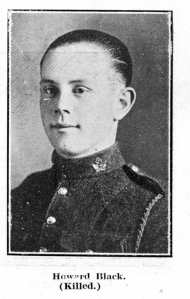
Howard Black“Lives in the Hearts of His Friends. In connection with the death from wounds of Pte. W. H. J. Black, his mother has received the following letters:

‘In The Field Sept. 11th, ’18. Mrs. R. D. Black, 24 Hillside Street, Belleville, Ont.

Dear Madam—It is with the deepest regret that I have to confirm the official notification of the death of your son No. 636710 Private W. J. H. Black. During the period of his connection with the Battalion he has always shown most soldierly and won the confidence of both his officers and his comrades.

His supreme sacrifice for the great cause was a matter of great sorrow among his many friends here who join with me in the expression of sincere sympathy for you in your bereavement. Yours in sympathy, H. Vanderwater, Major, Officer Commanding Canadian Infantry Battalion.’

‘France, Sept. 12th, 1918. My Dear Mrs. Black—It was with the deepest sorrow I heard to-day that your son, Howard, has paid the supreme sacrifice. He was on duty, sentry duty, after the battle of the 31st of August, when he was hit in the head by a piece of shell about 7 p.m. …  As his Platoon Commander I shall greatly miss your son together with his other comrades who also mourn his loss and show great sorrow. I shall long remember his cheerful smile and his record as a good soldier. There is a saying that “One never dies who lives in the hearts of his friends,” so let us feel he is not dead, but just a little further on the way. Yours sincerely, H. G. Barnum, Lieut. Canadian R.E.F. France.’ ”

The Intelligencer October 2, 1918 (page 3)

“Wounded Soldiers Visited in Hospital.

‘Canadian Red Cross Society, 12 Berners Street, London, W. I. Re Pte. T. F. Orr, Mile End Military Hospital, Bancroft Rd., London, E. I., England.

Dear Madam—Our Red Cross visitor has again visited Pte. Orr, who is still at the above hospital. We are pleased to tell you that she reports that although the wound is not yet healed, it is going on very well. We trust that he will continue to make satisfactory progress and that his wound will soon be healed. Yours truly, D. Forrester, P.P.D.N. To Mrs. Frank Orr, 7 Grove Street.’

‘Canadian Red Cross Society, 12 Berners Street, London, W. I. Re Pte. W. J. Yatman, Canadian Suffolk Hospital, Ampton-Bury St. Edmonds, Suffolk, England.

Dear Madam—Pte. Yatman is at present in the above hospital suffering from gun shot wound in the shoulder. Our Red Cross visitor has been to see him and we have no reason to believe from her report that the wound is a very serious one. We trust that he will make good progress toward recovery and that we shall be able to send you an encouraging account of him.

He will be visited regularly and reports on his condition will be sent to you from time to time. Should he be in need of any comforts other than those supplied by the hospital our visitor will let us know and we will send them from our own parcel office. Yours truly, D. Forrester, P.P.D.N. To Mrs. Yatman, Brown Street.’ ”

The Intelligencer October 2, 1918 (page 4)

“Walking Influenza Dangerous. In view of the spread of so-called ‘Spanish influenza’ in the United States and its reported appearance in Quebec and Ontario the utmost care should be taken by citizens to prevent an epidemic. There is nothing alarming about ‘Spanish influenza’ if taken in time, but in common with ordinary colds or grippe neglect is often followed by serious consequences.

Pneumonia will develop from a common cold almost as readily as from influenza and people afflicted with colds or influenza should protect themselves and others by consulting a medical practitioner at once and following his directions closely. Influenza cases should go to bed and stay there until cured, as walking influenza is dangerous to the patient and to the public. Influenza is liable to develop into pneumonia if neglected and by mingling with other people the germs are scattered by sneezing and an epidemic results. Safety First—consult a doctor!”

The Intelligencer October 2, 1918 (page 4)

“Attention, Mayor Platt, et al. In a few weeks the Frost King will tighten up the windows and the smoke of many fires will ascend; navigation will cease and with all the burdens of transportation the railways will become congested and coal shipments uncertain. Upon Mayor Platt and the City Council rests the responsibility of doing all in their power to prevent suffering this winter. The well-to-do no doubt have plenty of coal in their bins, but how about that large section of the population who pay as they go but can not anticipate the future by laying in large stocks of food and fuel.

To cope adequately with any situation the first requisite is to know all the ins and outs of the business in hand. Knowledge now of the amount of coal still required to put Belleville citizens through the winter months would probably result in the securing of an additional supply of coal, even at this late date. Time is slipping away and still the civic authorities make no move to take a census of coal users—in a little while it will be too late. …

And while on this subject may we enquire why the offer of a local coal dealer to secure two thousand tons of coal to be used by the city as an emergency supply for small users was not taken advantage of? To most people this offer looked good enough to be nailed down without a day’s delay, but apparently it has passed into the discard of forgetfulness. When last heard of it was being considered by a committee of the Board of Trade several weeks ago.”

The Intelligencer October 2, 1918 (page 5)

“Brave Soldier Boys Merit Martyr’s Crown. Mrs. James Hunter, who resides at 180 James Street, received the following letter from Rev. Father Chas. A. Fallon, R.C. Chaplain. The letter refers to her son, Pte. W. Hunter, who was killed in action on Sept. 3rd.

France, Sept. 9, 1918. Dear Mrs. Hunter,—It is my sad duty to notify you of the death of your son, Pte. W. Hunter, of the 87th Battalion, which occurred while in action with the enemy on Sept. 3rd. In laying down his noble life for the sake of humanity, your son can truly say with our divine Saviour ‘Greater love hath no man than this, that he lay down his life for his friends,’ and in paying the supreme price for such a noble cause he justly merits a martyr’s crown in heaven, and an inestimable debt of gratitude from mankind.

Your son was buried in the 11th C. I. B. cemetery on Sept. 5th. The map location is—Sheet 51B, P27 Central. His grave is Plot 2, row C, grave 32, and is marked with a wooden cross. I extend to you my sincere sympathy in your bereavement and pray our Divine Lord and Mother of Sorrows to grant you the grace of Christian fortitude and resignation in your present trial. Very sincerely, Chas. A. Fallon, R. C. Chaplain, 102nd Can. Batt.”

The Intelligencer October 2, 1918 (page 5)

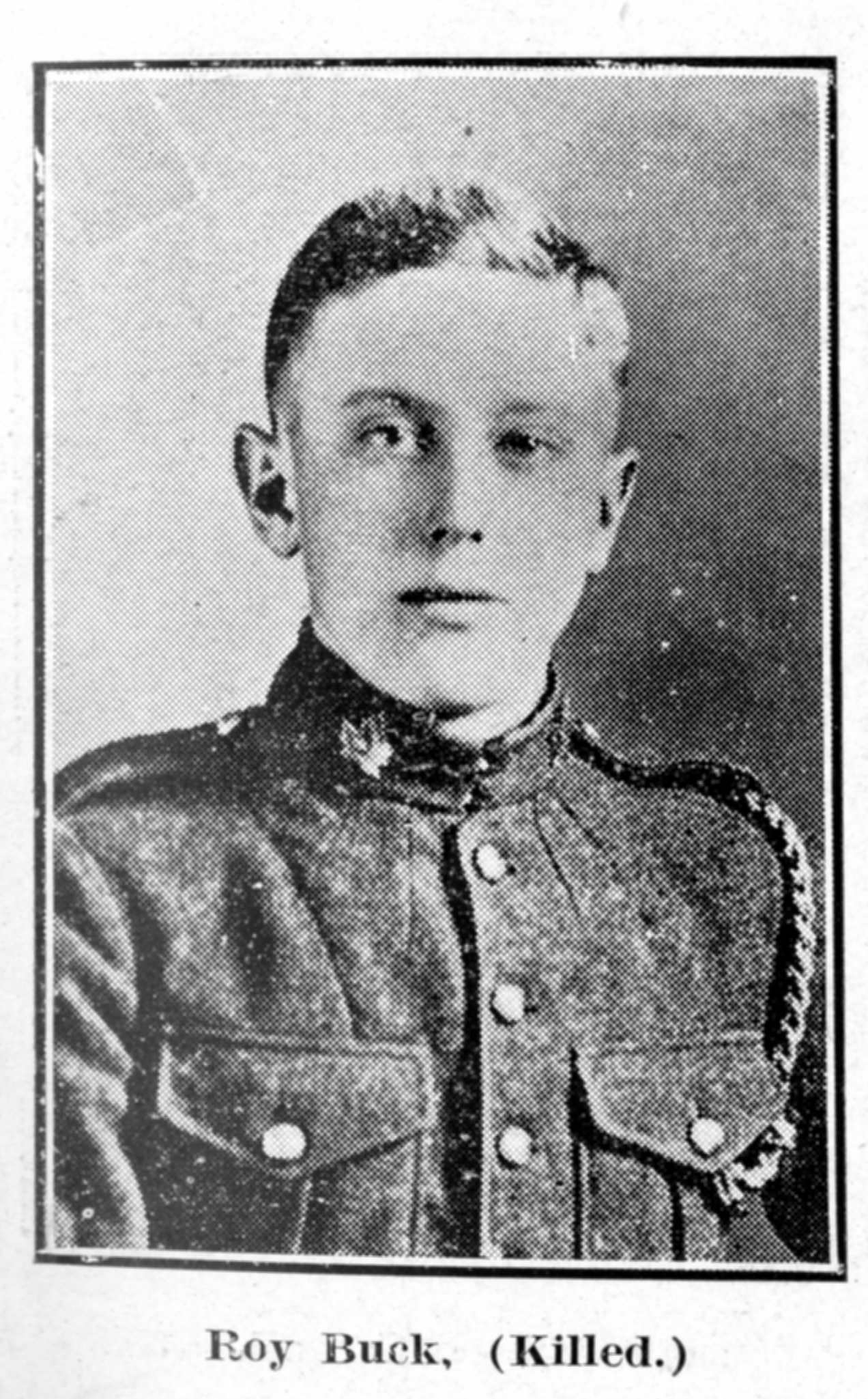
Roy Buck

“Pte. Leroy Buck Was A Gallant Soldier. In connection with the death of Pte. Leroy Buck, Killed in action, his mother, Mrs. Annie Buck, 18 Everett Street, city, has received the following letters:

‘France, Sept. 12th, 1918. Dear Mrs. Buck—I wish to express to you my heartfelt sympathy in this time of sorrow. I am a signaller in ‘Tim’s’ company and he and I were pals—of course coming from Belleville myself it was natural we were good friends. He was a good boy and had good nerve, he wasn’t the least bit afraid while in the line and I expect to see a medal presented for the way he carried on under shell fire also machine gun fire. …  Anything you wish to know about the occurrences I will be glad to answer if I can. Once again I extend my sympathy to yourself and the family. I will close wishing you the best of luck. Tim’s friend, Sig. Art. Clare.’

‘France, Sept. 11th, 1918. Dear Mrs. Buck—I have the painful duty today in writing you re the death of your son 636711 Pte. Buck, M. T. of this Co’y. He, one of the brightest of our soldiers was employed as a company runner, during our attack of Sept. 2nd. Sent to the rear with an important message, he did not return having been instantaneously killed while in execution of his task. I did not know this until the 4th when we were relieved.

Immediately making enquiries, I found that the poor boy was already identified and buried in the soldiers’ cemetery at a place I dare not mention. However, by writing to the Director of Graves, Registration Committee, St. James Court, London, England, you will be able to secure the exact location or perhaps a picture of the boy’s last resting place.

He was a good, clean boy, very popular with the officers and men. I extend to you my sincere sympathy in your great loss, trusting that He who sees all, will comfort you in your sad bereavement. Believe me, Yours sincerely, Huh Smith, Capt.’

‘France, Sept. 12th, ’18. Dear Mrs. Buck:—No doubt you will have heard by the time you get this letter from our Company Commander telling you of your son’s death. I am a Belleville boy myself and thought you would like to hear from me. “Tim,” as we called him here came to my platoon early in March in trench warfare, and he proved himself a good soldier. In the big advance we made on August 8th, we were the attacking company. Tim was then employed as runner, which is a very responsible duty. …

On Aug. 9th we were support company, the other company on our Battalion having got their objective. Tim was sent along with an officer and myself to see if everything was going O.K. …  It will be some satisfaction to you, Mrs. Buck, to know that Tim was recommended for gallantry during these two days of the battle of Amiens. …  On Sept. 2nd we again attacked the enemy and we got to our objective and Tim was sent with a message to the rear. It was in this duty he was killed, but I cannot really think it was a machine gun bullet as at that time they were firing at us from three sides.

Now, Mrs. Buck, I hope this letter will be a little consolation to you to know that Tim died a brave and good soldier doing his duty to the last in what has proved to be Canada’s greatest fight and victory.

I will close now with my deepest sympathy to you and your family. Yours sincerely, W. C. Jack, Sergt.-Maj.’ ”

The Intelligencer October 2, 1918 (page 6)

Granville Sinclair“Lieut. Sinclair Wounded. Mr. D. V. Sinclair, residing at 261 William street, city, was to-day in receipt of the following telegram from Ottawa, which refers to his son: ‘Sincerely regret to inform you Lieut. Granville Reed Sinclair, artillery, officially reported wounded, Sept. 27th, 1918.’

Lieut. Sinclair, after a course of training in Canada, enlisted with the 74th Battery and went overseas with a draft from Petawawa. At Shorncliffe, England, he was also in training, and in June, 1917, went to France with the heavy siege gun section. He has been in France ever since. His many friends in this city will hope that his injuries are not of a serious nature.”
 

100 Years Ago: All Canadian Butter Commandeered by Government, Ad for Dr. Chase’s Nerve Food, Donald McKenzie Waters Wounded

The Intelligencer October 1, 1918 (page 5)

“All Canadian Butter Is Commandeered by Government. Ottawa. All creamery butter made in the Provinces of Alberta, Saskatchewan, Manitoba, Ontario and Quebec, between the 30th day of September and the 9th day of November, 1918, both days inclusive, will be commandeered under the authority of an order-in-council passed yesterday.

The reason for this action is that Great Britain and her allies need Canadian creamery butter. The British Ministry of Food urgently asks Canada to increase her shipments of creamery butter. …  The order-in-council puts Canadian consumers on a creamery butter allowance of two pounds of butter per person per month, as compared with the half-pound allowance in Great Britain.”

The Intelligencer October 1, 1918 (page 5)

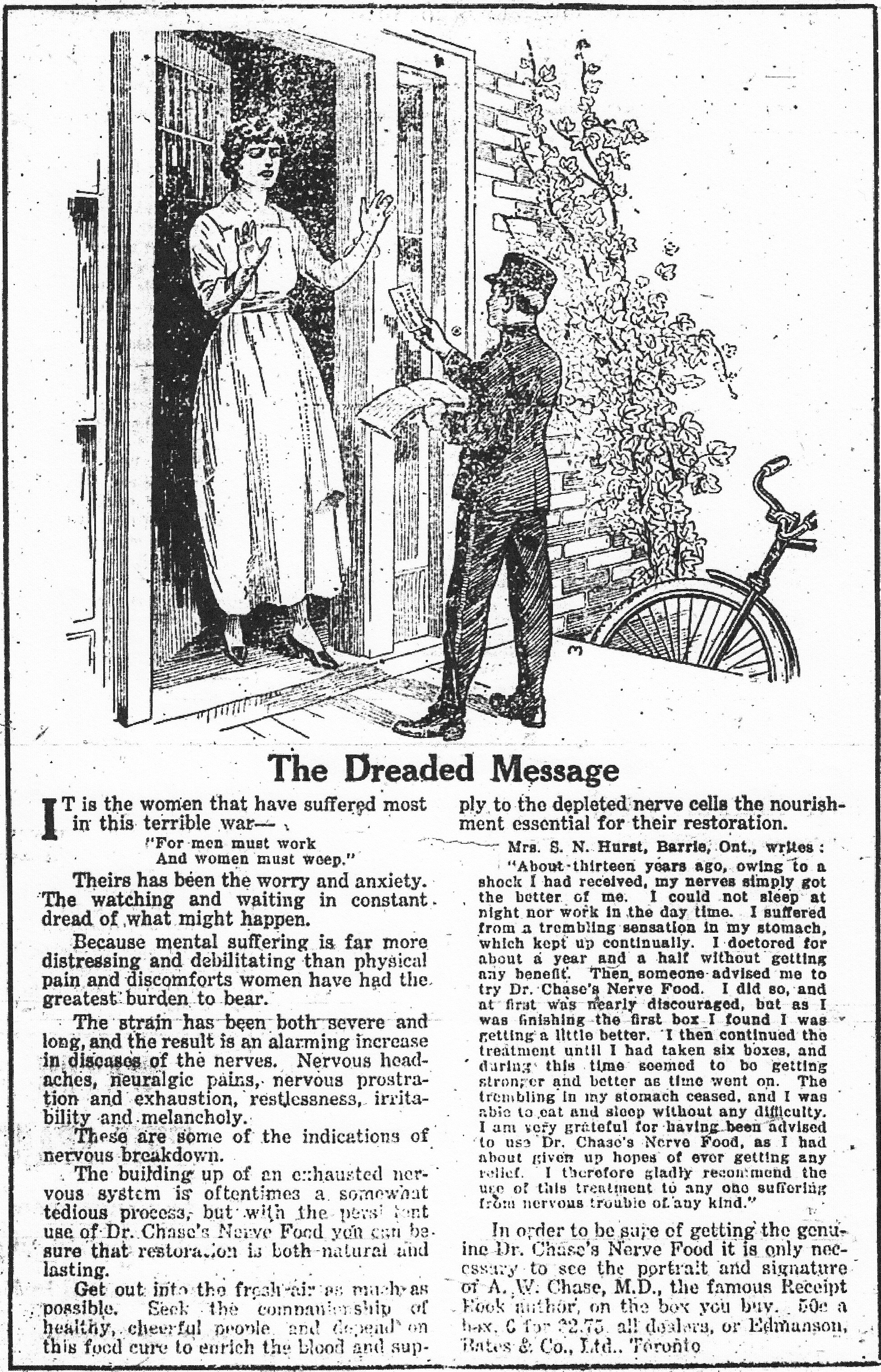
Ad for Dr. Chase's Nerve Food“The Dreaded Message. It is the women that have suffered most in this terrible war—’For men must work / And women must weep.’

The strain has been both severe and long, and the result is an alarming increase in diseases of the nerves.

The building up of an exhausted nervous system is oftentimes a somewhat tedious process, but with the persistent use of Dr. Chase’s Nerve Food you can be sure that restoration is both natural and lasting.

Get out into the fresh air as much as possible. Seek the companionship of healthy, cheerful people and depend on this food cure to enrich the blood and supply to the depleted nerve cells the nourishment essential for their restoration.”

The Intelligencer October 1, 1918 (page 5)

“Acting Capt. Waters Wounded. An official message was received this morning from the Director of Records by Mr. D. M. Waters, stating that his son, Lieut. and Acting Captain Donald McKenzie Waters, artillery, was admitted to No. 5 British Red Cross Hospital, at Winnereaux on September 28, with gunshot wound in the head, severe.

Capt. Waters enlisted in 1916 and trained with an artillery unit at Kingston and Petawawa. Upon entering upon active service in France he was transferred to the trench mortar division in which he rendered valuable service to the Empire. To-day is his twenty-fourth birthday. His many friends trust that he will have a speedy recovery.”


100 Years Ago: Spanish Influenza Invades Toronto, Ad for Gillette, George Conboy Wounded, Sacred Concert at Griffin’s Opera House, Another Gasless Sunday, No Spanish Influenza in Belleville

The Intelligencer September 30, 1918 (page 1)

“Spanish ‘Flu’ Invades Toronto. Toronto. The so-called ‘Spanish influenza’ which has been very prevalent in the United States and Eastern Canada for some weeks past, has apparently invaded Toronto in a very mild form. To all appearances hundreds of cases have developed during the past three or four days, but no deaths have been reported from it locally.

While the epidemic is very active throughout the city, it is not severe and this fact is thought to be largely due to the measures which people themselves took to avoid getting it. The largest number of cases which have so far been reported are in the Royal Air Force of which unit about 150 men are in the Base Hospital, no less than fifty being admitted yesterday.”

The Intelligencer September 30, 1918 (page 3)

Ad for Gillette

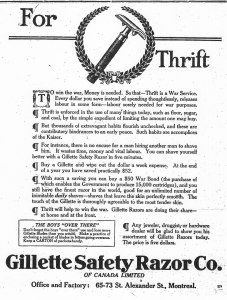
“For Thrift. To win the war, Money is needed. So that—Thrift is a War Service. Every dollar you save instead of spending thoughtlessly, releases labour in some form—labour sorely needed for war purposes. Thrift is enforced in the use of many things today, such as flour, sugar, and coal, by the simple expedient of limiting the amount one may buy.

But thousands of extravagant habits flourish unchecked, and these are contributory hindrances to an early peace. Such habits are accomplices of the Kaiser. For instance, there is no excuse for a man hiring another man to shave him. It wastes time, money and vital labour. You can shave yourself better with a Gillette Safety Razor in five minutes.

Any jeweler, druggist, or hardware dealer will be glad to show you his assortment of Gillette Razors today. The price is five dollars.

Gillette Safety Razor Co. of Canada Limited.”

The Intelligencer September 30, 1918 (page 5)

“Corbyville Boy Wounded. Mr. Geo. F. Reed, of Corbyville, has received word that Pte. George Conboy, (No. 636107) has been wounded in the right ankle on August 28, on the Arras front. Pte. Conboy left Belleville with the 234th Battalion. He has been admitted to the hospital and is doing nicely.”

The Intelligencer September 30, 1918 (page 5)

“Pleasing Sacred Concert. Griffin’s Opera House was last night filled with an appreciative audience which assembled to hear a sacred concert given by the Fifteenth Regimental Band of this city. A silver collection was taken on behalf of the K. of C. hut campaign and upwards of $80 was realized. Previous to the commencement of the programme Mr. J. Laly, who is Chief Knight of the Belleville branch, gave a brief address, thanking the citizens of Belleville for their generous support towards the campaign just completed, also to those who assisted in the campaign and tag day. The results of the campaign he stated, were most gratifying.

The programme, which was thoroughly enjoyed, consisted of six selections by the band under the capable leadership of Bandmaster F. W. Robinson. Each number was rendered in a most capable manner and demonstrated that in the band the city has a first-class musical organization. …  Every feature of the program was all that could have been desired. The pleasing function was brought to a close by the rendering of the National Anthem.”

The Intelligencer September 30, 1918 (page 5)

“Still Saving Gasoline. The third ‘gasless’ Sunday was well observed in this vicinity yesterday and few cars were seen on the streets of Belleville except those on business.”

The Intelligencer September 30, 1918 (page 5)

“Watching for Spanish ‘Flu.’ While there are a number of cases of influenza in Belleville, under medical treatment, so far as known none of the cases are of the ‘Spanish’ influenza type.”


Nurses of World War I: Robertina Lee Thompson

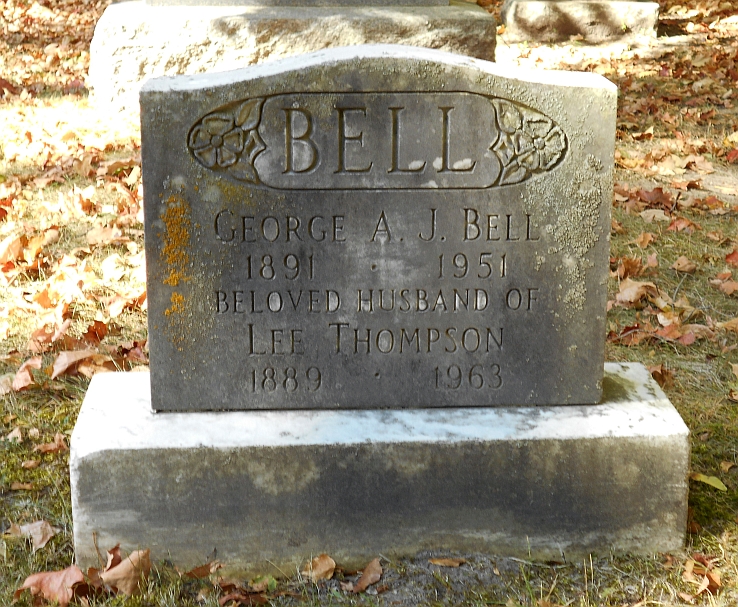
Robertina Lee Thompson was born at the farm house on Concession 3, Lot 21 near Strathroy, Adelaide Township, Middlesex County, Ontario on June 24, 1889 daughter of George Thompson and Christina Lee.

She was educated locally, was a graduate of the Nursing School at Belleville on Dec 3, 1912 and the Divisional School of Military Instruction at Quebec City on March 29, 1915. Miss Thompson enlisted in the Canadian Army Medical Corps on May 5, 1915 at Kingston.

Lee Thompson

Height: 5’ 5”

Weight: 135lb

Age: 25

Nursing Sister Thompson served with the # 1 Canadian General Hospital at Étaples, France; she was united in marriage to Veteran Captain George Alexander James Bell at St. George’s Church, Bloomsbury, London England on April 11, 1916 and resigned her commission on April 13, 1916. Mrs Bell returned to Canada setting sail in Oct 1917 aboard the S.S. Grampian and established herself in London, Ontario and raised her family, residing at 5 Ardaven Place.

Robertina Lee Bell died at the Victoria Hospital in London on Jan 19, 1963 aged 73 years 6 months 25 days. She is interred at Woodland Cemetery, Section QE, Row 31.

Grave marker for Lee Bell

100 Years Ago: Malcolm Linford French Killed in Action, Dr. Hastings Advises Rest and Isolation for Spanish Influenza, Letter of Sympathy for Alexander Beaton’s Mother, In Memoriam for Frederick Coburn, Ad for Sacred Concert, Poster for Thrift

The Intelligencer September 28, 1918 (page 1)

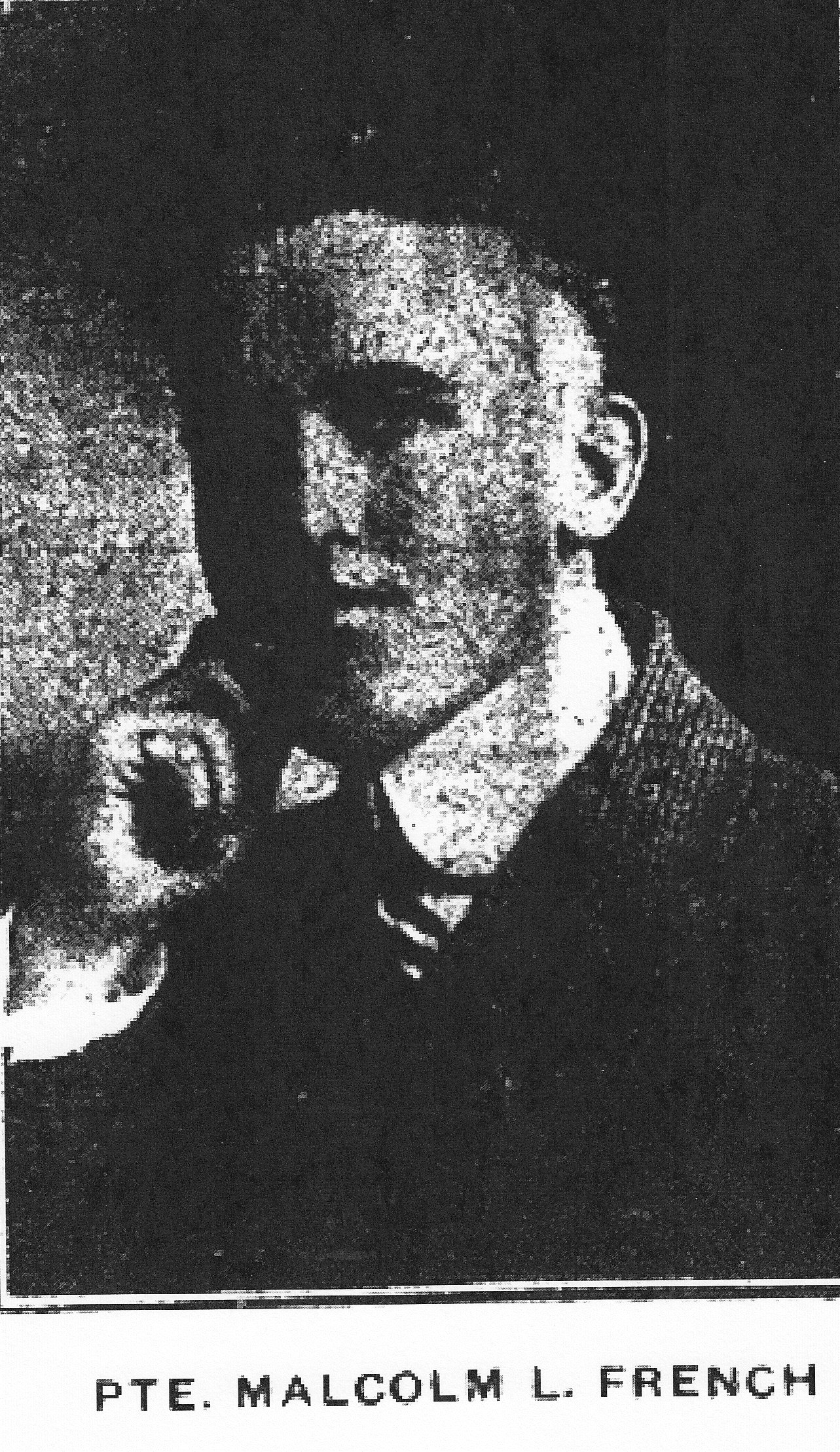
Malcolm Linford French

“Pte. Malcolm L. French only child of Mr. and Mrs. Gilbert H. French, West Bridge Street, killed in action in France, Aug. 30th, 1918. Previous to enlisting he was a pupil of Belleville High School.”

The Intelligencer September 28, 1918 (page 1)

“If You Have the Flu Don’t Try to Fight It. Toronto. ‘If you feel any of the symptoms of influenza, whether of the Spanish, American or Canadian types, don’t fight it—go to bed.’ This was the advice given by Dr. Hastings when asked if he had any message for the citizens, in view of the prevalence of Spanish influenza in some of the cities of the United States, particularly Boston. ‘The great trouble is they think that they can fight the disease and stay up until symptoms of pneumonia develop.’ The doctor emphasized the importance of isolating persons suffering from influenza.’ ”

The Intelligencer September 28, 1918 (page 7)

“Government Sympathy. Mrs. Flora Beaton whose soldier son, Pte. Alexander Beaton, was killed in action September 2, has received a letter conveying the sympathy of the Dominion Government as follows: ‘The Prime Minister and members of the Government of Canada send their deepest sympathy in the bereavement which you have sustained.”

The Intelligencer September 28, 1918 (page 7)

“In Memoriam. Frederick Coburn. In loving memory of my beloved husband, who died of wounds, received in action, September 28th, 1915. Gone but not forgotten. WIFE.”

The Intelligencer September 28, 1918 (page 7)

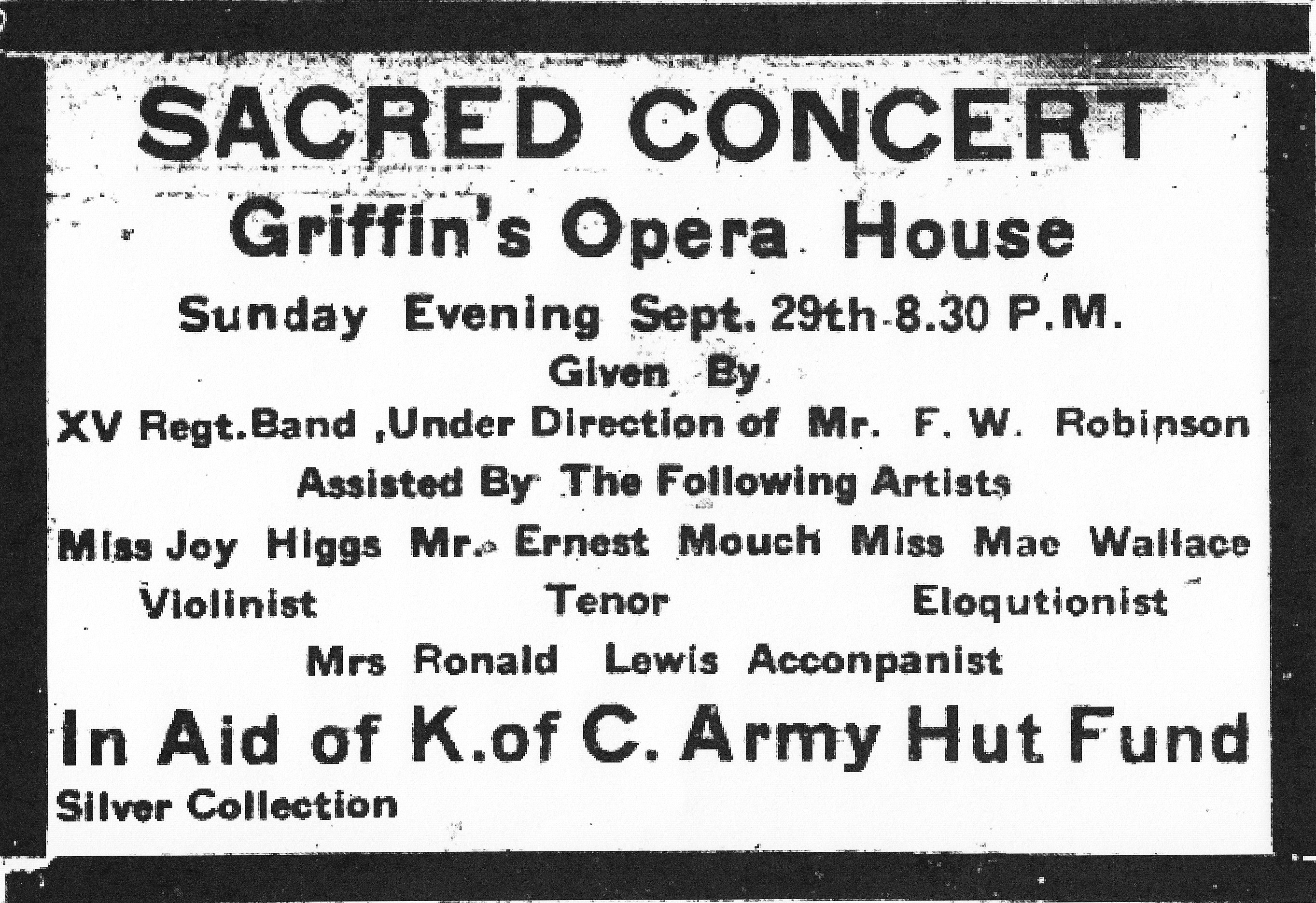
Ad for sacred concert

“Sacred Concert. Griffin’s Opera House. Sunday Evening Sept. 29th 8.30 P.M. Given by XV Regt. Band, Under Direction of Mr. F. W. Robinson.

In Aid of K. of C. Army Hut Fund. Silver Collection.”

The Intelligencer September 28, 1918 (page 9)

Poster for thrift

“Kitchener was right when he said—’Either the Civilian population must go short of many things to which it is accustomed in times of peace or our armies must go short of munitions and other things indispensable to them.’

For the sake of your country and the boys ‘over there,’ spend cautiously. Think of what Lord Kitchener has said, and ask yourself first, ‘Is this something I really need or can I do without it?’

Published under the authority of the Minister of Finance of Canada.”