100 Years Ago: Exemptions Cancelled of Men Between 20 and 23, Poster for Y.M.C.A. Red Triangle Fund, George Francis Sprackett Dies of Wounds, Four Belleville Soldiers Honoured

The Intelligencer May 7, 1918 (page 1)

“All Exemptions Cancelled Of Men Between 20 and 23. Special Despatch to The Intelligencer. Canadian Press, Limited. Ottawa. All exemptions from military service of men between 20 and 23 years of age have been automatically cancelled, said Major General Mewburn, Minister of Militia, at this morning’s session of the House of Commons today.”

The Intelligencer May 7, 1918 (page 3)

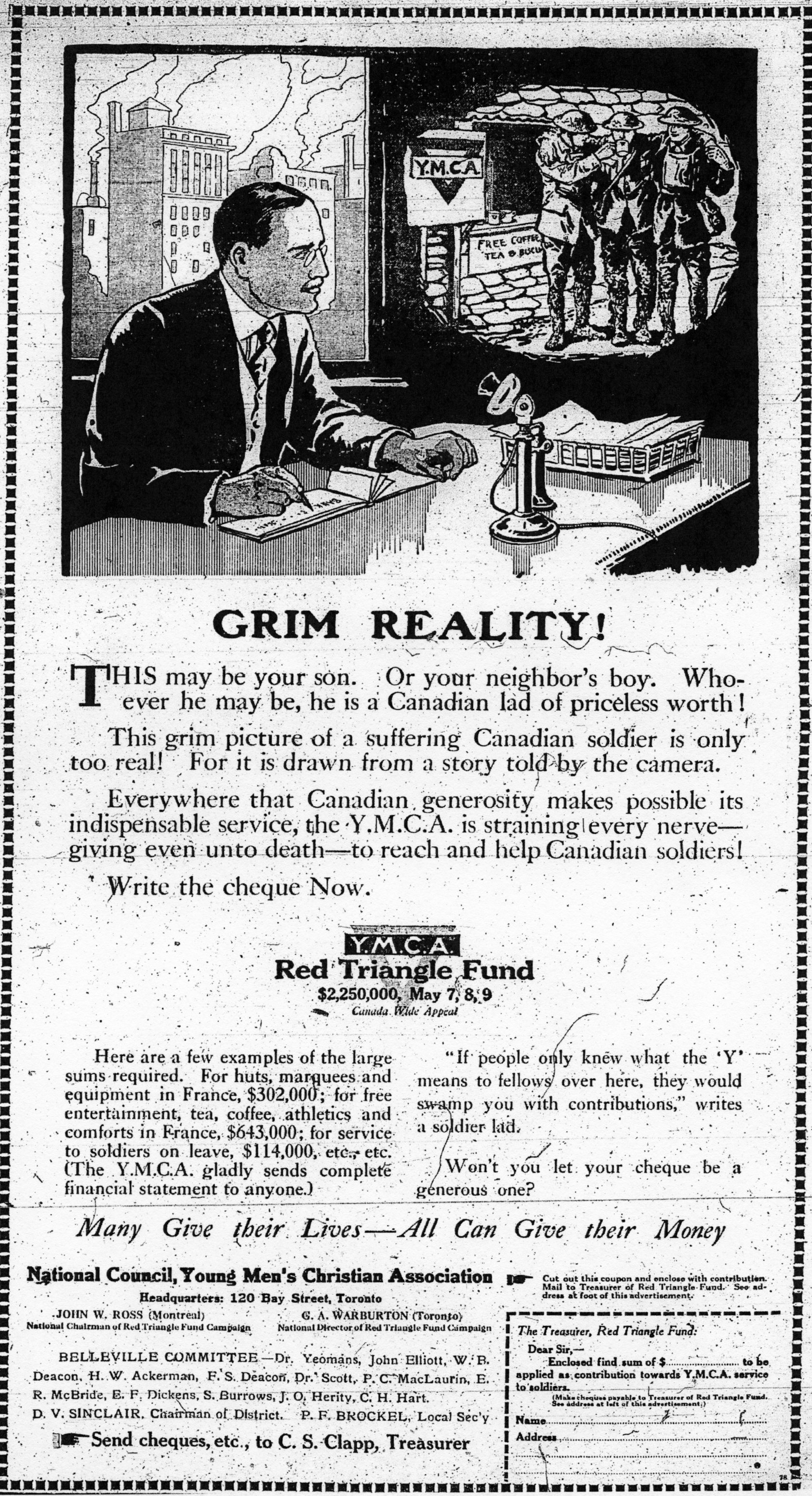
Ad for YMCA Red Triangle Fund“Grim Reality! This may be your son. Or your neighbor’s boy. Whoever he may be, he is a Canadian lad of priceless worth! This grim picture of a suffering Canadian soldier is only too real! For it is drawn from a story told by the camera.

Everywhere that Canadian generosity makes possible its indispensable service, the Y.M.C.A. is straining every nerve—giving even unto death—to reach and help Canadian soldiers!

Write the cheque Now. Y.M.C.A. Red Triangle Fund.”

The Intelligencer May 7, 1918 (page 5)

“Died of Wounds. In the Canadian casualty list today appears the name of Private G. F. Sprackett, of Gilmour, Hastings County, who died of wounds. The young hero was a member of the 254th Battalion, which was mobilized in this city.”

[Note: Private George Francis Sprackett died on April 23, 1918. He is commemorated on Page 505 of the First World War Book of Remembrance.]

The Intelligencer May 7, 1918 (page 5)

“Belleville’s Honor Roll. To the Editor of The Intelligencer. Dear Sir,—Not forgetting honors won by Ketcheson, Johnson and others, Belleville may indeed be proud on reading the last issue of the Canadian Military Gazette to find the record on one page of no less than four of our own boys who the ‘King has delighted to honor.’

Major Edison Franklin Linn, already Military Cross, has D.S.O. added to his distinctions and is in command of his corps of Engineers. Major William Riordan of the Field Artillery received his D.S.O. Major John Ham Sills of the Infantry is also awarded the D.S.O. and Lieut. Stanley Burritt Iler of the Engineers is awarded the Military Cross.

Can any city of our size show such a splendid record in one month? Are we at home living up to the lead given by these splendid men, patient and chivalrous in service and sacrifice. Yours truly, W. N. Ponton.”

100 Years Ago: Poster for Y.M.C.A. Red Triangle Fund

The Intelligencer May 6, 1918 (page 3)

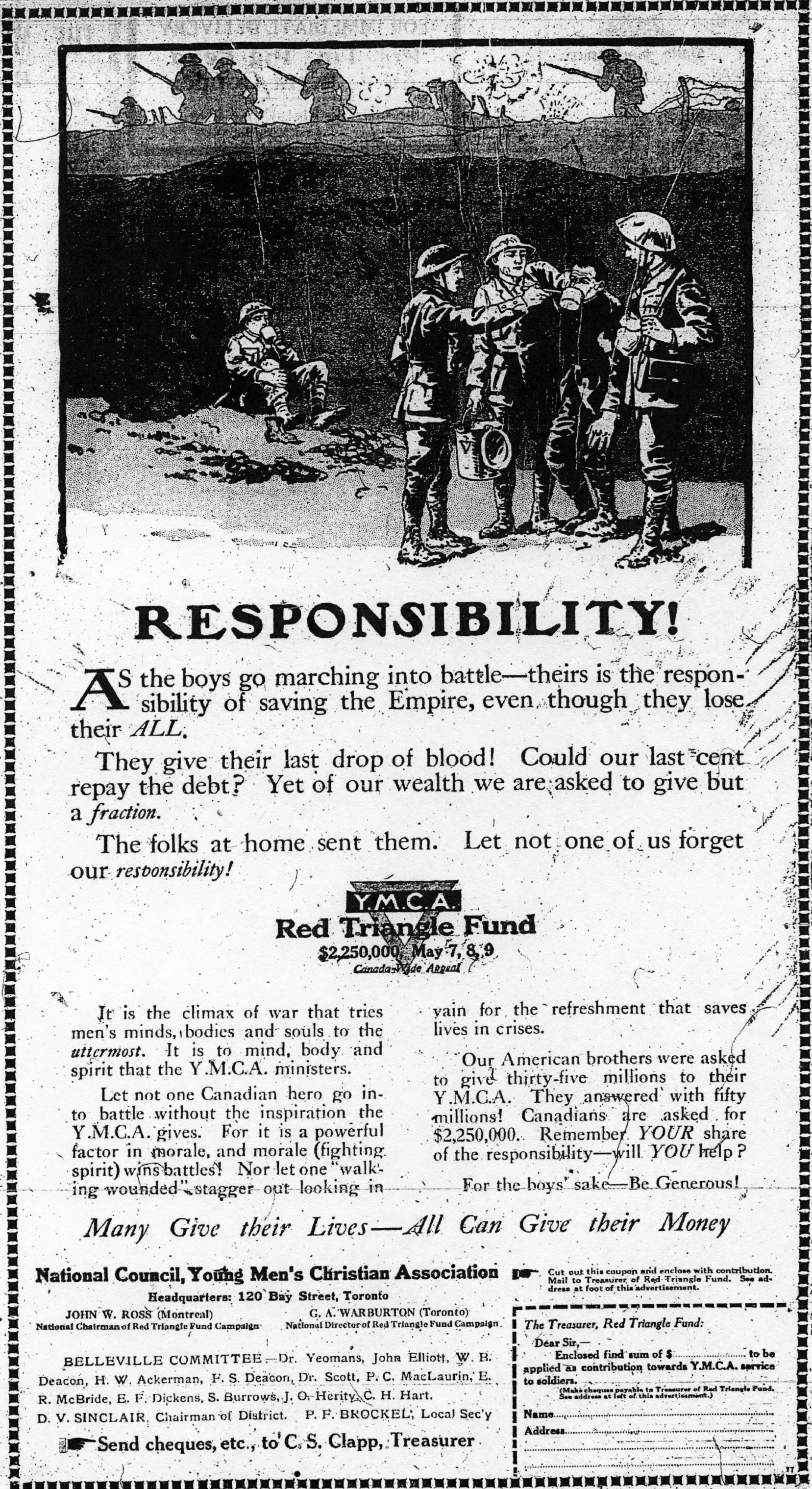
Ad for YMCA Red Triangle Fund“Responsibility! As the boys go marching into battle—theirs is the responsibility of saving the Empire, even though they lose their ALL. They give their last drop of blood! Could our last cent repay the debt? Yet of our wealth we are asked to give but a fraction.

The folks at home sent them. Let not one of us forget our responsibility!

Y.M.C.A. Red Triangle Fund. For the boys’ sake—Be Generous!”

100 Years Ago: Nineteen-Year-Olds Called to Colors, Ad for Merchants Bank of Canada, Aura Lee Club Donation, Lt. E. L. McConnell Returned Home, Intelligencer Printers Join Up, Tea Drinkers Hit with Tax, G.T.R. Gives Employees’ Families Passes, No Candy-Making at Home, Poster for Y.M.C.A. Red Triangle Fund

The Intelligencer May 4, 1918 (page 1)

“Nineteen-Year-Olds Are Called to the Colours. Special Despatch to The Intelligencer, Canadian Press, Limited. Ottawa. A Government proclamation has been issued calling upon nineteen-year-old men to register for military service before June 1st: but they will not be called to the colors before July 1st. The previous minimum age was twenty.”

The Intelligencer May 4, 1918 (page 3)

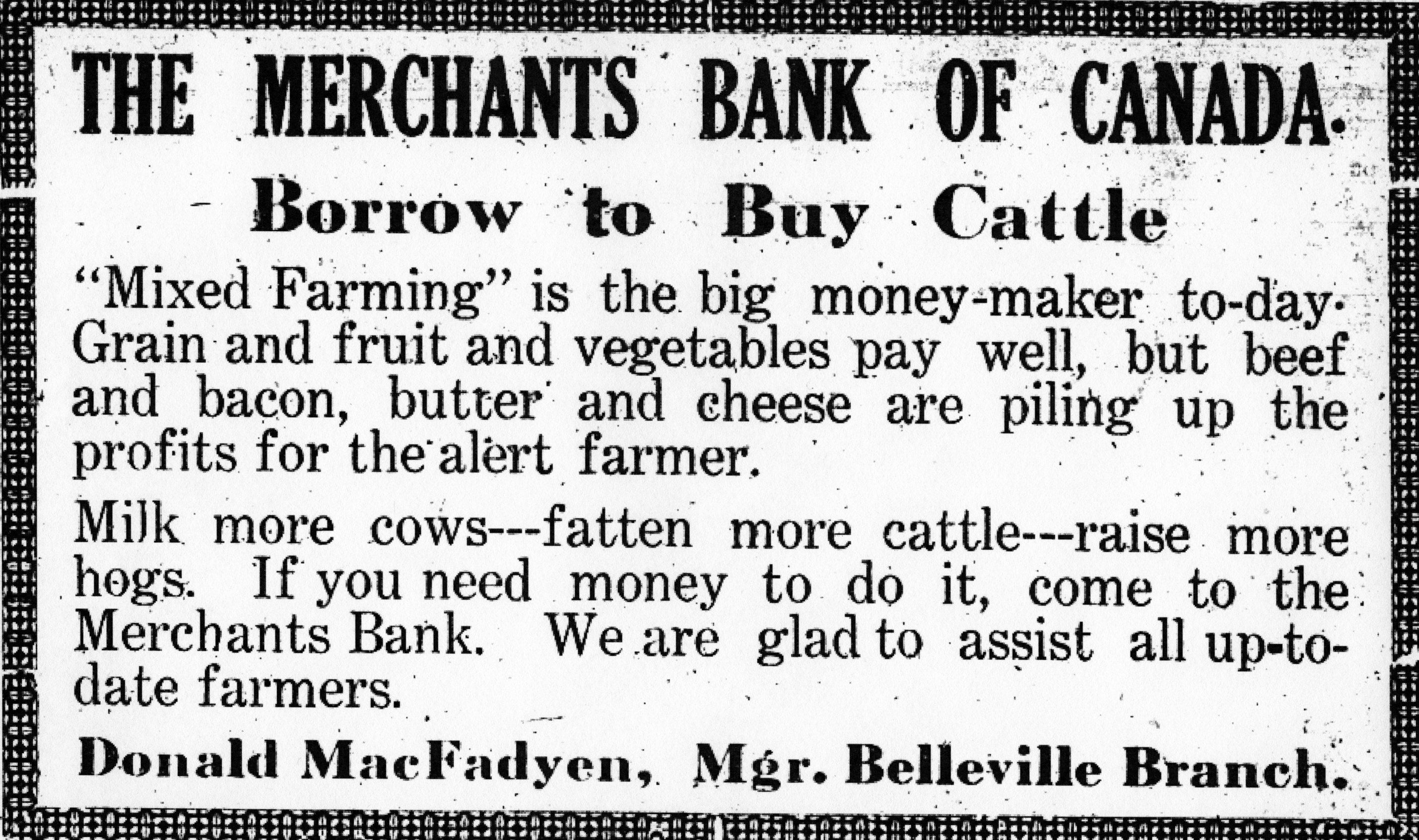
Ad for Merchants Bank of Canada“The Merchants Bank of Canada. Borrow to Buy Cattle. ‘Mixed Farming’ is the big money-maker to-day. Grain and fruit and vegetables pay well, but beef and bacon, butter and cheese are piling up the profits for the alert farmer.

Milk more cows—fatten more cattle—raise more hogs. If you need money to do it, come to the Merchants Bank. We are glad to assist all up-to-date farmers.

Donald MacFadyen, Mgr. Belleville Branch.”

The Intelligencer May 4, 1918 (page 5)

“The Aura Lee Club have donated ten dollars toward the Canadian War Contingent Association, and also ten dollars to the Great War Veterans Association, Belleville Branch. This patriotic action of the young men, who comprise this club, is very much appreciated by the recipients.”

The Intelligencer May 4, 1918 (page 5)

“Lt. E. L. McConnell, of Springbrook, Rawdon Township, returned home on leave recently with his wife, a Scotch lassie, whom he married in Edinburgh. He enlisted with the 59th Battalion, and has been overseas for two years and a half. Lt. McConnell’s father, Mr. Thos. C. McConnell, is still in Scotland, where he has been for some time in connection with a Forestry Battalion.”

The Intelligencer May 4, 1918 (page 5)

“Printers Join Up. Evan Barlow and Jack McKnight, of The Intelligencer staff, both expert linotype operators, report for military duty at Kingston Monday. They were preceded by Lorne Young, an expert job printer, and the trio will join up with a goodly representation of Intelligencer boys already overseas.

The holes in the staff caused by the recent call to service forces additional work and worry upon the management and staff, but ‘Carry On’ is the word and The Intelligencer goes on just the same.”

The Intelligencer May 4, 1918 (page 5)

“Tea Drinkers Hit Hard. ‘The new tax will be no harder on the smoker of cigarettes than on the hundreds of women who drink tea,’ said a lady who takes a studious interest in public affairs. The cigarette-smoker has aired his grievance—he is hit much harder than the chap who can afford cigars—but what of the extensive consumers of tea, which is being taxed almost as heavily as tobacco.

There are, according to this lady, women everywhere who live practically on tea and bread and butter, and who, at a time when food is scarce, will instinctively turn for nourishment to their old friend, the tea-pot. Tea has become a tremendous factor among women who find it difficult to make ends meet, and it is by these that the tax on that commodity will be felt most.

She did not disagree with the new system of taxation—rather the reverse—she expressed the opinion that there are many luxuries which might have been taxed before tea and tobacco, such as expensive articles of wearing apparel, etc., which are, to a certain extent, extravagance.”

The Intelligencer May 4, 1918 (page 5)

“Patriotic Passes. The Grand Trunk have issued a circular to the men advising them that the families of all employees who have volunteered, or who have been drafted for military service, will be granted passes over any part of the system.”

The Intelligencer May 4, 1918 (page 6)

“No Candy-Making At Home Permitted. Ottawa. There is some confusion as to the new order of the Canada Food Board in regard to the home manufacture of candies and pastry. The manufacture of candy is prohibited. The order in regard to pastries and cakes reads as follows: ‘No person shall make in Canada, for private use, French pastries, iced cakes or biscuits, or cakes with cane sugar between the layers or added to the exterior.’

Just how the Food Board proposes to enforce these regulations is not clear. It is presumed that the Board will depend largely upon the patriotism of the housewives of Canada. …  Housewives need not, however, be alarmed as to the effect of the Food Board’s new order regarding sugar upon the preserving and canning of fruit during the coming season. While the order states that no householder shall have on hand at one time more than fifteen days normal supply, that normal supply varies, and is much larger in the canning season than in the winter months. ‘It was for the purpose, among other things,’ declared a member of the Board today, ‘of conserving sugar for the preserving season that the order was promulgated.’ ”

The Intelligencer May 4, 1918 (page 10)

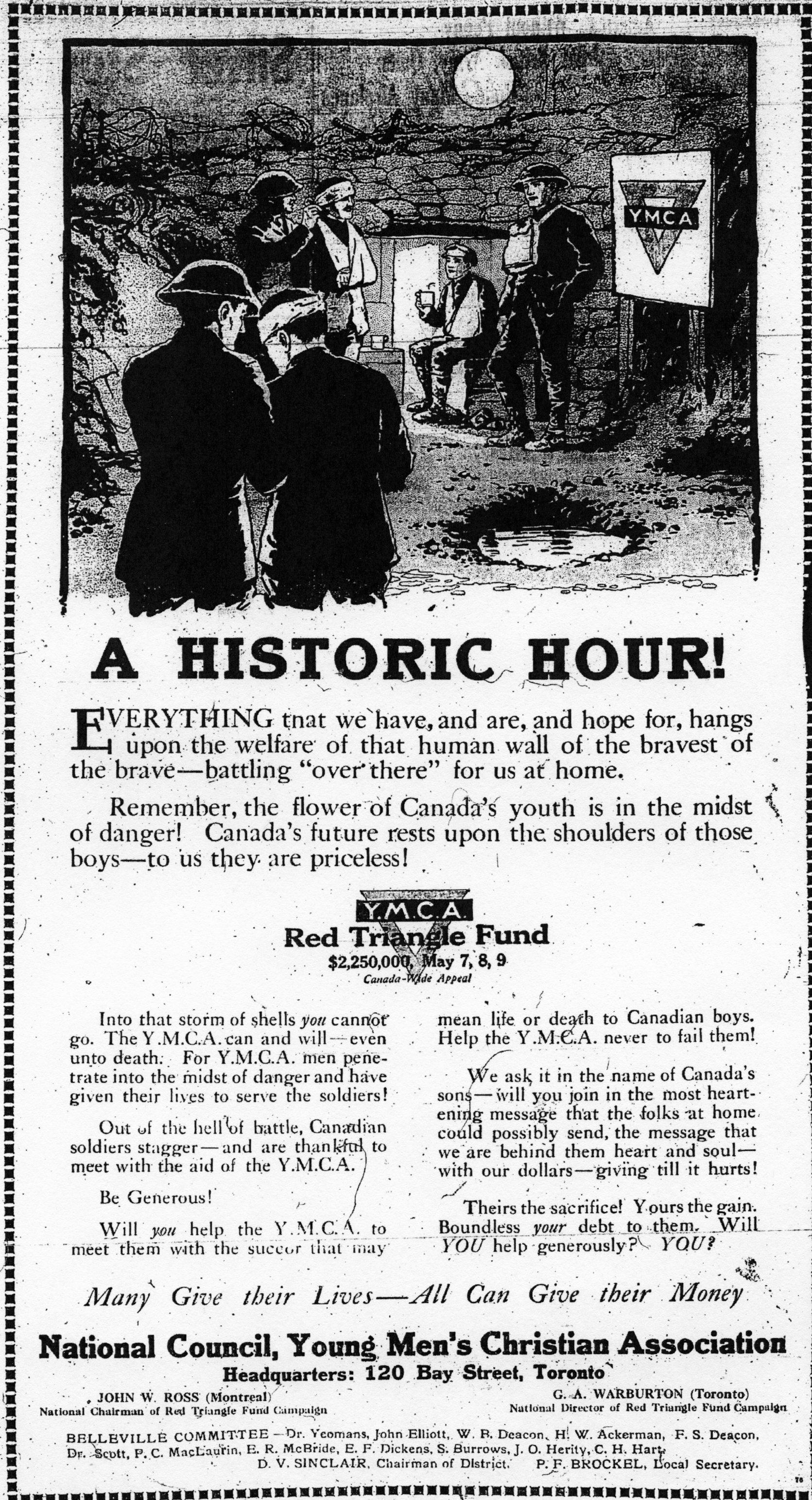
Ad for YMCS Red Triangle Fund“A Historic Hour! Everything that we have, and are, and hope for, hangs upon the welfare of that human wall of the bravest of the brave—battling ‘over there’ for us at home.

Remember, the flower of Canada’s youth is in the midst of danger! Canada’s future rests upon the shoulders of those boys—to us they are priceless!

Y.M.C.A. Red Triangle Fund. $2,250,000, May 7, 8, 9. Canada-Wide Appeal.

Belleville Committee—Dr. Yeomans, John Elliott, W. B. Deacon, H. W. Ackerman, F. S. Deacon, Dr. Scott, P. C. MacLaurin, E. R. McBride, E. F. Dickens, S. Burrows, J. O. Herity, C. H. Hart. D. V. Sinclair, Chairman of District. P. F. Brockel, Local Secretary.”

100 Years Ago: Planning the Garden, Poster for Y.M.C.A. Red Triangle Fund, Willard Storms Is Buried in Bancroft

The Intelligencer May 3, 1918 (page 3)

“War Garden Bulletin. Planning the Garden. In planning the 1918 garden the first thing to take into consideration is the fact that it is a war-time garden and that the vegetables which must receive primary attention are those which are going to be genuine substitutes for wheat. The local substitute is the potato. Therefore, everyone should grow potatoes this year. They repay themselves over and over again. Count on giving them the major part of the garden.”

The Intelligencer May 3, 1918 (page 5)

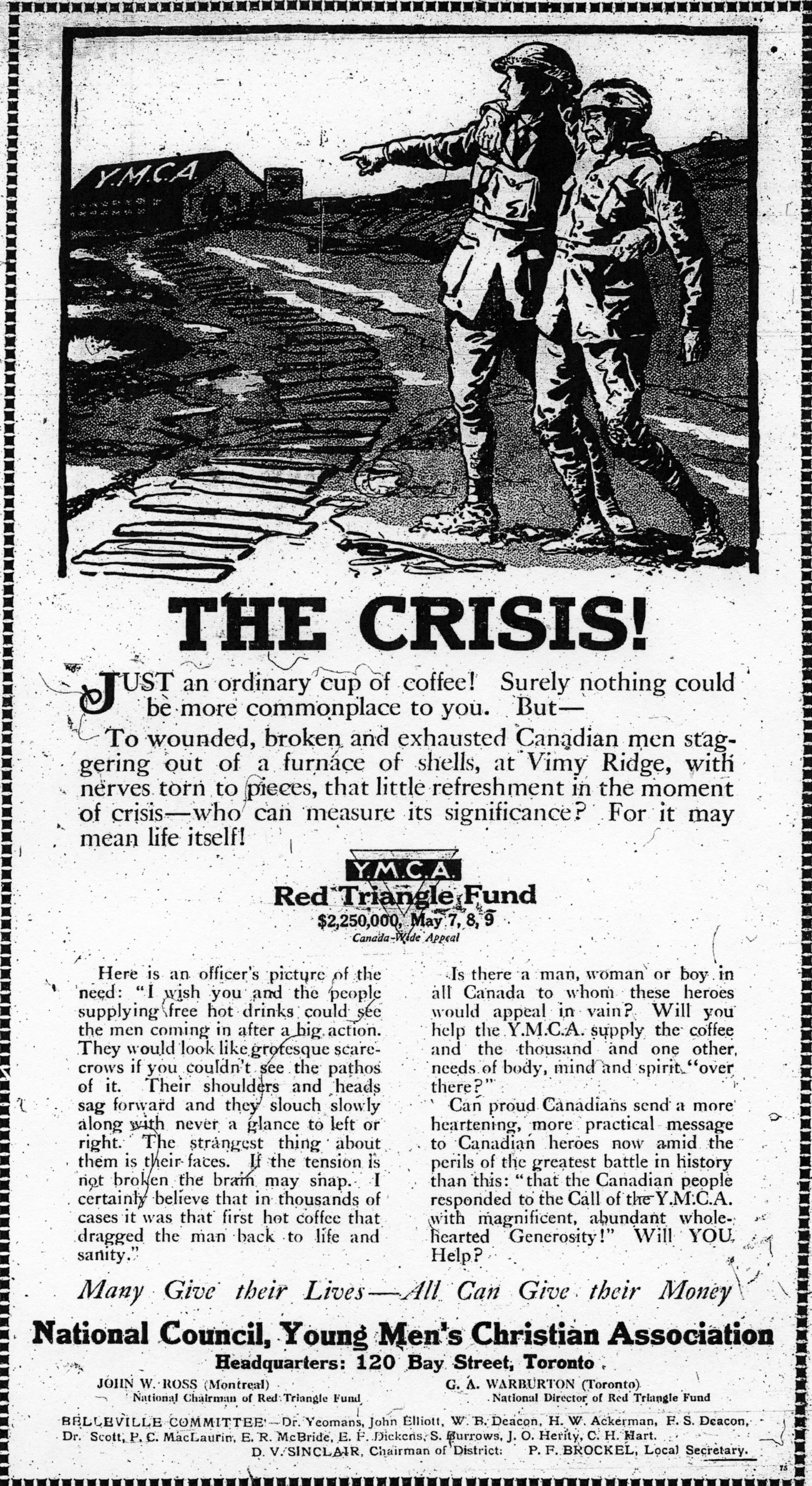
YMCA Red Triangle Fund poster“The Crisis! Just an ordinary cup of coffee! Surely nothing could be more commonplace to you. But—

To wounded, broken and exhausted Canadian men staggering out of a furnace of shells, at Vimy Ridge, with nerves torn to pieces, that little refreshment in the moment of crisis—who can measure its significance? For it may mean life itself!

Y.M.C.A. Red Triangle Fund. $2,250,000, May 7, 8, 9 Canada-Wide Appeal.

Many Give Their Lives—All Can Give their Money.”

The Intelligencer May 3, 1918 (page 7)

“Death of Pte. Storms. Private W. Storms, of Bancroft, died on Sunday last at the Kingston General Hospital, after being ill for some time with lung trouble. On Wednesday afternoon the body was interred at Mount Pleasant cemetery, Bancroft. The services in St. Paul’s Church and at the grave were conducted by Rev. Dr. Cracey of Kingston, and there was a large turnout of citizens to pay a tribute of respect to a brave soldier who sacrificed his life for his country.

Among the floral offerings was a beautiful wreath contributed by the Girls’ Club. The deceased went overseas with the 155th Battalion. He was invalided home last fall, and had been in the hospital for several months. He was thirty-six years of age, and is survived by a widow and two children.”

[Note: Private Willard Storms died on April 20, 1918. He is commemorated on Page 508 of the First World War Book of Remembrance.]

100 Years Ago: Sugar for Preserves, Returning Men Go Direct to Homes, City Dwellers Called Out First, Tools for War Gardens, Patriotic Tea Proceeds, Percy Laidley Wounded

The Intelligencer May 2, 1918 (page 1)

“Hundred Thousand Tons of Sugar For Preserves. Ottawa. The following statement was made by the Food Board when asked whether sugar would be available for sugar preserving.

‘Regulations have been put into force which are expected to effect a saving in Canada’s sugar consumption of about one hundred thousand tons. These restrictions are absolutely necessary if we are to have the sugar with which to preserve our fruit crop during the summer period.

There is sugar in Cuba but the ships to carry it are required elsewhere. We have been using more sugar than necessary. While the restrictions are imposed primarily in order to prepare for the requirements of the preserving season, a curtailment of sugar consumption will involve little hardship but will be conducive to individual health and will help to reduce our expenditures abroad, thus helping to finance the war.’ ”

The Intelligencer May 2, 1918 (page 2)

“Go Direct to Homes. The new system to be used in handling returned men was inaugurated last week and found to be a decided improvement over the former methods. It has been the custom to bring all the returning soldiers for this district to Kingston, where their papers were examined and they were then given passes to their homes.

On Saturday an officer from headquarters went to Montreal and examined the papers of the returning men. On the way up, the men were left at their homes, thus allowing them to go direct to the homes, instead of having to report to headquarters. The new system worked out well and is better for the men returning.”

The Intelligencer May 2, 1918 (page 3)

“No Exemptions. City Dwellers First. Ottawa. General Mewburn, in a statement in the House yesterday said that the city young men would be called out first and the young men on the farms would not be called to the colors until after seeding is over. He stated firmly that there would be no exemptions.”

The Intelligencer May 2, 1918 (page 4)

“War Garden Bulletin. Practical Daily Guide For Vacant Lot And Backyard Gardeners Enlisted in Greater Production Campaign. Tools. The spade, hoe, garden rake, trowel and digging fork are the chief tools needed in gardening. …  Narrow hoes and rakes are best for small gardens. …  Every tool should be ready to use at a moment’s notice. Have a place to keep them and when you are through with them see that you put them away in the proper place. Provide a box of soft grease like axle grease for rubbing over the blades of the spade and the hoe, and the working parts of the tools most frequently used. Rust wears out more tools than use and makes work more laboursome. Either a hose or watering can is an essential part of the gardening equipment.

The Food Board, in conjunction with officials of the Experimental Farm, Ottawa, proposes to give the amateur gardeners of Canada a daily garden bulletin which will contain some useful hint for them to follow.”

The Intelligencer May 2, 1918 (page 5)

“Patriotic Tea. At the tea given Easter Monday by the ‘Canadian War Contingent Association’ at Hotel Quinte the cash proceeds were $209.01. This amount was entirely from silver collection and home-cooking table.”

The Intelligencer May 2, 1918 (page 5)

“Pte. Laidley Wounded. Mr. O. R. Laidley, residing at 257 Albert street, city is in receipt of the following telegram from Ottawa bearing date of April 30th which relates to his son:—Sincerely regret to inform you No. 5582 Pte. Percy H. Laidley, Engineers, officially reported admitted Eleventh Field Ambulance Depot, April 16. Gunshot wound in leg. Director of Records.

Pte. Laidley is one of the ‘Original Firsts’ who went overseas with the Canadian Engineers in October 1914. He was wounded last October but returned to duty before Christmas. His home was originally in Napanee but he has resided in this city about two years and a half before going overseas.”

100 Years Ago: Poster for Royal Flying Corps, Lieut. Kelso Roberts a Prisoner of War

The Intelligencer May 1, 1918 (page 5)

Aerial warriors“Aerial Warriors. Mastery of the air prevents the loss of thousands of allied troops. The more aeroplanes we can maintain at the front the greater becomes the security of our men in the trenches, and the more effective our artillery fire.

Men who come within the provisions of the M. S. A. are eligible only after having joined their Depot Battalion, when they may, with the consent of their Commanding Officer, be discharged for re-enlistment in the R. F. C.

Write for Booklet, ‘Air Heroes in the Making,’ and apply directory to one of the following addresses: Imperial Royal Flying Corps. Recruiting Office, 93 King St. E., Toronto. A. R. Walker, Public Library, Belleville.”

The Intelligencer May 1, 1918 (page 7)

Kelso Roberts“Prisoner of War. A few days ago a message was received in this city stating that Lieut. Kelso Roberts, of Belleville, was missing. This morning Mrs. A. A. Roberts mother of the young Lieutenant received a cablegram stating that her son was a prisoner of war in Germany.”


100 Years Ago: Queensboro Women Donate to Y.M.C.A., William St. Orms Dies, Memorial Notice for Leo Ross, Frank Bateman Wounded

The Intelligencer April 30, 1918 (page 5)

“Y.M.C.A. Work Appreciated. The Women’s Patriotic League of Queensboro have forwarded a cheque to Mr. D. V. Sinclair for $50.00 to apply to the ‘Trench Work’ of Y. M. C. A. overseas. These women have sons and husbands at the front and in this practical way express their appreciation of the splendid work being done by the Y. M. C. A. for our men overseas.”

The Intelligencer April 30, 1918 (page 5)

“Soldier Died. The death occurred in Mowat Memorial Hospital, Kingston, of Pte. William St. Orms. Deceased was born thirty-six years ago and went overseas in 1916 with the 155th Battalion. He served in France, but later on account of illness was returned to Canada and has been confined to the Mowat Memorial Hospital since last August. Before enlisting deceased was a stationary engineer in Bancroft.”

[Note: Private Willard Storms died on April 20, 1918. He is commemorated on Page 508 of the First World War Book of Remembrance.]

The Intelligencer April 30, 1918 (page 5)

“In Memoriam. In loving memory of our dear nephew Gunner Leo Ross who was killed in action in the battle of Ypres, April 30th, 1914.

He sleeps beside his comrades / In a hallowed grave unknown / But his name is written in letters of love / On the hearts he left at home. Mr. and Mrs. Wm. Burd.”

The Intelligencer April 30, 1918 (page 7)

“Signaller Bateman Wounded. Mrs. H. Bateman, residing at 61 Station Street, Belleville, is in receipt of the following telegram from the Director of Records at Ottawa, informing her that Signaller Frank William Bateman, artillery, is officially reported admitted to the Seventh Casualty Clearing Station, April 15th, 1918, with gunshot wounds in the leg and back.

Signaller Bateman left with the 74th Battery from Petawawa, and was located with a siege battery at the front. He was well known in this city, where he was a resident for some time. Previous to enlistment he was employed by the Canadian Express Company.”

100 Years Ago: Restrictions on Sugar and Shortening, Farmers Hold Protest Meetings, 80th Battalion Colours Deposited and Dedicated, Navy League of Canada in Belleville, Gunner W. C. Burgess Returns, Sergeant L. G. Madden Home, Speech on Gardening Given at Queen Alexandra School, Memorial Service at St. Thomas’ Church, Ad for Work Shoes

The Intelligencer April 29, 1918 (page 1)

“Drastic Restrictions on Use of Sugar and Shortening. Special Despatch to The Intelligencer, Canadian Press, Limited. Ottawa. Drastic war time restriction on the use of sugar and shortening in the manufacture of candies, biscuits, cakes or sweet dough products, including the entire prohibition of the manufacture of certain of these products, and curtailment of sugar consumption by candy manufacturers to one-half the monthly average used by them last year, limitations of the amount of fats and sugar which may be used in the manufacture of ice cream—such are the principal provisions of an order just issued by the Canada Food Board.

After June 1st all manufacturers of candies, cakes and like stuffs must be licensed by the Canada Food Board. The new regulations are intended to readjust Canada’s consumption of sugar to the available supply and to prepare for the requirements of the canning and preserving season. The use of fats is curtailed because of the increasing need for edible fats overseas. Further restrictions are made on the use of wheat flour in the manufacture of candy and sweet-dough products.”

The Intelligencer April 29, 1918 (page 2)

“Farmers Say They Can’t Fight and Farm. Toronto. The farmers throughout Ontario are taking definite action towards having the recent order-in-Council reconsidered, which calls to the colors all farmers who are actual owners or tenants or farmers’ sons who have never been otherwise employed.

A great number of farmers’ meetings were held throughout the Province, Saturday and strong resolutions were passed pointing out that the crops and general production of food would suffer if the farmers had to depend altogether on inexperienced help from the cities and towns.”

The Intelligencer April 29, 1918 (page 4)

“80th Battalion Colours Deposited and Dedicated. On Thursday, April 20th, 1916, at the armouries in this city, the presentation of colors to the 80th Overseas Battalion, C.E.F., took place with appropriate ceremony. These colors were the gift of the members of the Ketcheson families of Hastings County, in honor of Col. W. G. Ketcheson, the commanding officer of the battalion. The two beautiful flags were taken overseas when the men of the battalion went overseas to do their bit for King and country.

The colors were recently returned and on Sunday morning were deposited in St. Thomas’ church for safe keeping. The service was both impressive and inspiring. His Lordship Bishop Bidwell of Kingston was present and officiated being assisted by the rector, Ven. Archdeacon Beamish. Many of the members of the Great War Veterans Association and others wearing the King’s uniform were present. The sacred edifice was filled to the doors. …

In presenting the colors to the rector, Lieut.-Col. Ketcheson said: ‘Rev. Sir, on behalf of the officers and men of the 80th Battalion, Canadian Expeditionary Forces, I ask you to accept the charge of the colors of the battalion for safe keeping in your church.’ In accepting the colors, Ven. Archdeacon Beamish replied as follows: ‘We do willingly receive from your hands the colors of the 80th Battalion for safe-keeping in our church, and do pledge ourselves to preserve and guard them with all the care as a most honorable and solemn charge for such time as they shall remain entrusted to our safe-keeping.’ …

His Lordship Bishop Bidwell solemnly dedicated the colors as follows: ‘We do now solemnly dedicate and place for safe keeping in this church the colors of the 80th Battalion, C.E.F. In the name of the Father, and of the Son and of the Holy Ghost. Amen. The colors were then taken and placed on either side of the altar.”

The Intelligencer April 29, 1918 (page 4)

“Soldiers and Sailors Too. Patriotic Canadians find many outlets for their desire to be helpful in the various organizations formed since the war began for effective national service at home and this has resulted in close and intimate touch being kept with the soldier boys on the firing line in many helpful ways besides caring for dependents of soldiers at home. But in all these various activities one great and vital department of military service has been all but neglected—the Navy.

Last week there was formed in Belleville the working basis of a branch of the Navy League of Canada which seeks to arouse interest and enlist helpful service for the lads engaged in the glorious though silent war duty of holding the German navy impotent and protecting the lives of those who have to cross the seas as well as the commerce which means our prosperity and our hopes of victory on the battlefields of Europe. …

The Navy League of Canada is also concerned with the Merchant Marine service of Canada, which is almost a new department of our national life, and as a result of war conditions is creating great interest. The Dominion Government is developing a shipbuilding industry of large proportions and vast shipyards have sprung into being almost overnight with many ships in the making destined to carry Canada’s commerce to many distant ports. …

Belleville citizens so keenly interested in all forms of national service will no doubt willingly take hold and work for the interests of the sailors just as hard as they work for the interest of the soldiers, without in any way neglecting the latter.”

The Intelligencer April 29, 1918 (page 5)

“Gunner Burgess Home. Gunner W. C. Burgess, 40286, arrived home at noon yesterday. He left with the 34th Battery, was gassed during the battle of Loos and has been under treatment since August last. Before joining the army he was employed at the Canada Steel Co.”

The Intelligencer April 29, 1918 (page 5)

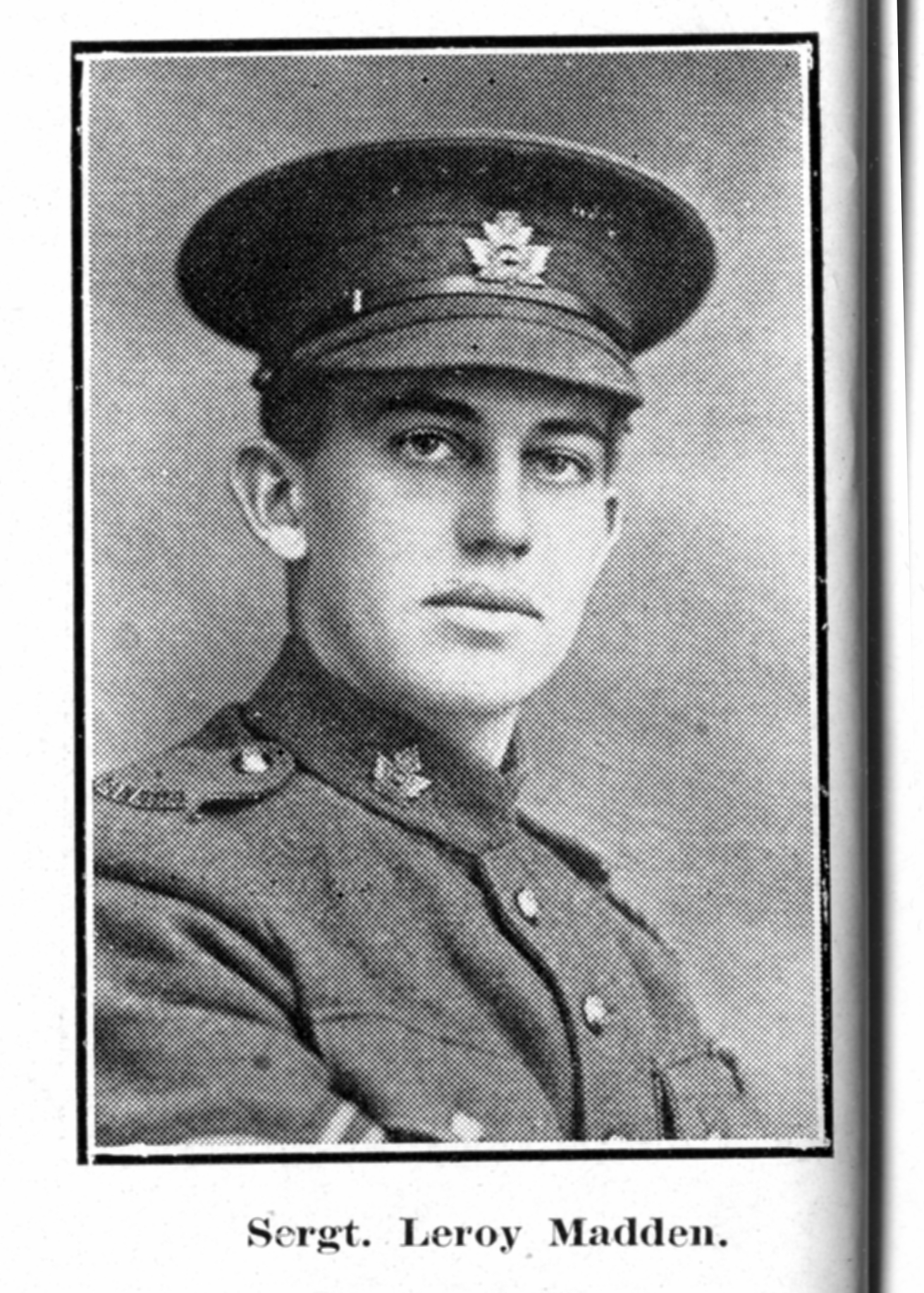
“Returned Home. Sergt. L. G. Madden, Albion Street, arrived home at an early hour Sunday morning. He left here with the 155th Battalion, and was transferred to the 21st Battalion in France, being badly wounded in the right foot at Vimy Ridge and was in different hospitals in England and France for some months. His many friends will welcome him home after an absence of two years full of trials and experiences.”

The Intelligencer April 29, 1918 (page 5)

“Address at Queen Alexandra School. The staff, pupils and the parents of some of the pupils of Queen Alexandra School listened to a very interesting and instructive address on ‘Gardening’ given by Mr. Mackintosh, agricultural representative, on Friday afternoon. The key note of the speaker’s address was ‘what the boy or girl can produce in their gardens.’ All the vegetables could be easily grown but corn and potatoes were especially needed, also vegetables suitable for the winter’s use. …

Apart from the patriotic duty of planting a garden the speaker pointed out it was profitable even to the small boy, one boy of his acquaintance raised vegetables to the value of $13.50 on a very small plot of ground. He very earnestly urged upon all the duty and necessity of making Save and Produce their motto, pointing out that if every family in Canada saved 1 oz. of meat daily it would mean equivalent to 90,000 cattle in one year.

The boys and girls were very much interested and are determined to have back-yard gardens. Each class will have their experimental plot at school and will ‘Help to win the war’ by having a garden at home.”

The Intelligencer April 29, 1918 (page 5)

“Memorial Service. Last evening a very impressive memorial service was held in St. Thomas’ Church for Pte. Charles Hilton and Pte. U. S. Daniels, who lately made the supreme sacrifice in France, and also for Pte. Chas. Osborne, who was invalided home and died last week of heart affection. The beautiful burial service was recited with specially appropriate hymns and the ‘Last Post’ was sounded from the inner vestry with the accompanying drum-roll played on the organ by Prof. Wheatley.”

The Intelligencer April 29, 1918 (page 5)

Ad for work shoes“Greater Production. The Spring season is now here when our MEN and BOYS will be required to do their bit on the land.

Let us supply your requirements with a pair of good durable WORK SHOES in tan or black before you join the great army of workers. Good Values—Good Shoes.

The Haines Shoe Houses. Belleville, Napanee, Smith’s Falls.”


100 Years Ago: Wheat Flour Restricted, No Exemptions for Farmers, Poster for Vegetable Gardens, Saving Sugar, Arthur Linn Wounded, Joseph Frawley Wounded, Poster for Community Gardens, Ad for Gillette

The Intelligencer April 27, 1918 (page 1)

“Flour Is Restricted to Not More Than Fifteen Days Supply. Special Despatch to The Intelligencer, Canadian Press, Limited. Ottawa. By an order issued by the Canada Food Board today all flour, made wholly or in part from wheat, is placed under restrictions similar to those imposed yesterday on sugar holdings. No person two miles or less from a licensed dealer may hold a supply larger than is necessary for fifteen days consumption.”

The Intelligencer April 27, 1918 (page 2)

“No Exemption For Farmers Says Canada War Minister. Tells Delegation He Won’t Open Door Again to Appeals—There Seems Little Chance of Any Revision of the Military Service Act Order. Ottawa. Rural Canada is not taking kindly to the new military service order of the Government, nor to the regulations complementary thereto. …

Yesterday the Eastern Townships sent a formidable delegation, headed by R. R. Ness, one of the most noted stock breeders of Canada, and containing on its personnel many prominent farmers and dairymen. …  The delegation received little satisfaction at the hands of the Ministers. General Mewburn pointed out the urgent need of men. He intimated that to open the door to exemptions of any kind would be tantamount to bringing back all the clumsy machinery of tribunal and appeal. He realized that there would be hardships in many cases, but that hardships at the present time were inevitable. From all indications the Minister of Militia is inexorable on the point.”

The Intelligencer April 27, 1918 (page 3)

Poster for vegetable gardens

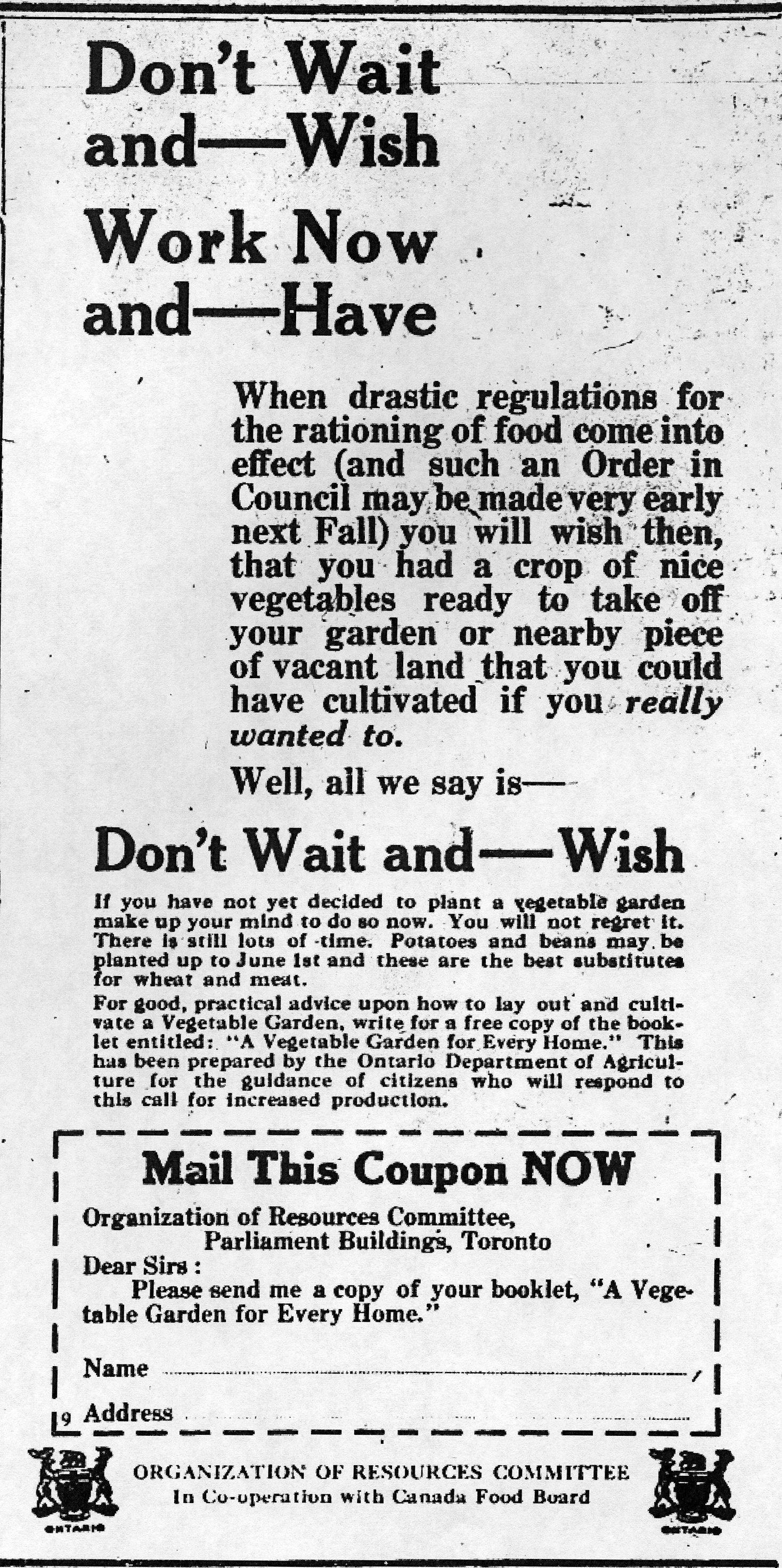
“Don’t Wait and—Wish. Work Now and—Have. When drastic regulations for the rationing of food come into effect (and such an Order in Council may be made very early next Fall) you will wish then, that you had a crop of nice vegetables ready to take off your garden or nearby piece of vacant land that you could have cultivated if you really wanted to.

Well, all we say is—Don’t Wait and—Wish.

For good, practical advice upon how to lay out and cultivate a Vegetable Garden, write for a free copy of the booklet entitled: ‘A Vegetable Garden for Every Home.’ ”

The Intelligencer April 27, 1918 (page 4)

“Save the Sugar. War strikes in the most unexpected places, and its effects are far-reaching. The necessity of conserving food supplies is one of the greatest problems of a war-time government and constitutes the reason for the creation of the Canada Food Board, which is beginning to peer into the cupboards of the homes as well as the cold storage plants of Big Business.

The latest feature of the activities of the Canada Food Board is the order strictly limiting holdings of sugar by householders to a supply sufficient for fifteen days except by persons living at a greater distance than two miles from a licensed dealer. …  The sugar order is but one phase of the efforts which the Canada Food Board will be obliged to make to prevent hoarding of food supplies and the consequent advance in prices and scarcity, with inevitable hardship to the greater number of people who are obliged by their circumstances of life to confine their purchases to small quantities at a time.

The greatest good to the greatest number must always be the concern of governments, as it should also be the guiding principle of individuals.”

The Intelligencer April 27, 1918 (page 5)

“Suffering from Wounds. Miss Ella Linn of Springbrook, Hastings County, has received word that her brother, No. 636414, Corp. Arthur Linn, of the 155th Battalion, had been admitted to the seventh Canadian General Hospital, Letroporte, France, on April 1st suffering from a gun shot wound in the thigh.”

The Intelligencer April 27, 1918 (page 5)

“Pte. Frawley Wounded. Mr. John Frawley, residing at 100 Cedar street in this city is in receipt of the following telegram relative to his son being wounded:

Sincerely regret to inform you 637009 Pte. Jos. Frawley, infantry, officially reported admitted 57 Casualty Clearing station, April 19, 1918; gunshot wound right thigh.—Director of Records.

Pte. Frawley has always resided in this city where he was well and favorably known. Previous to enlistment with the 155th Battalion, he was employed in Messrs. Quick & Robertson’s place of business here.”

The Intelligencer April 27, 1918 (page 9)

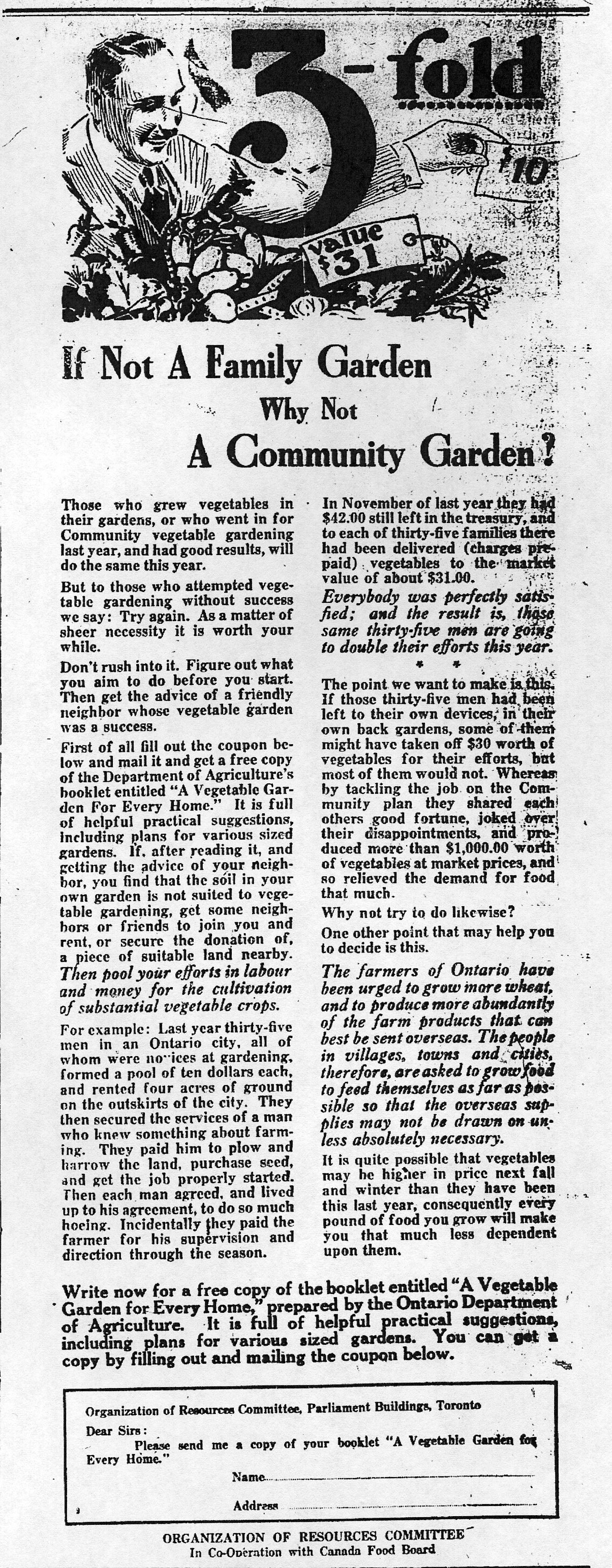
Poster for community gardens

“3-Fold $10 Value $31. If Not A Family Garden Why Not A Community Garden?

Those who grew vegetables in their gardens, or who went in for Community vegetable gardening last year, and had good results, will do the same this year. But to those who attempted vegetable gardening without success we say: Try again. As a matter of sheer necessity it is worth your while.

First of all fill out the coupon below and mail it and get a free copy of the Department of Agriculture’s booklet entitled ‘A Vegetable Garden For Every Home.’ ”

The Intelligencer April 27, 1918 (page 10)

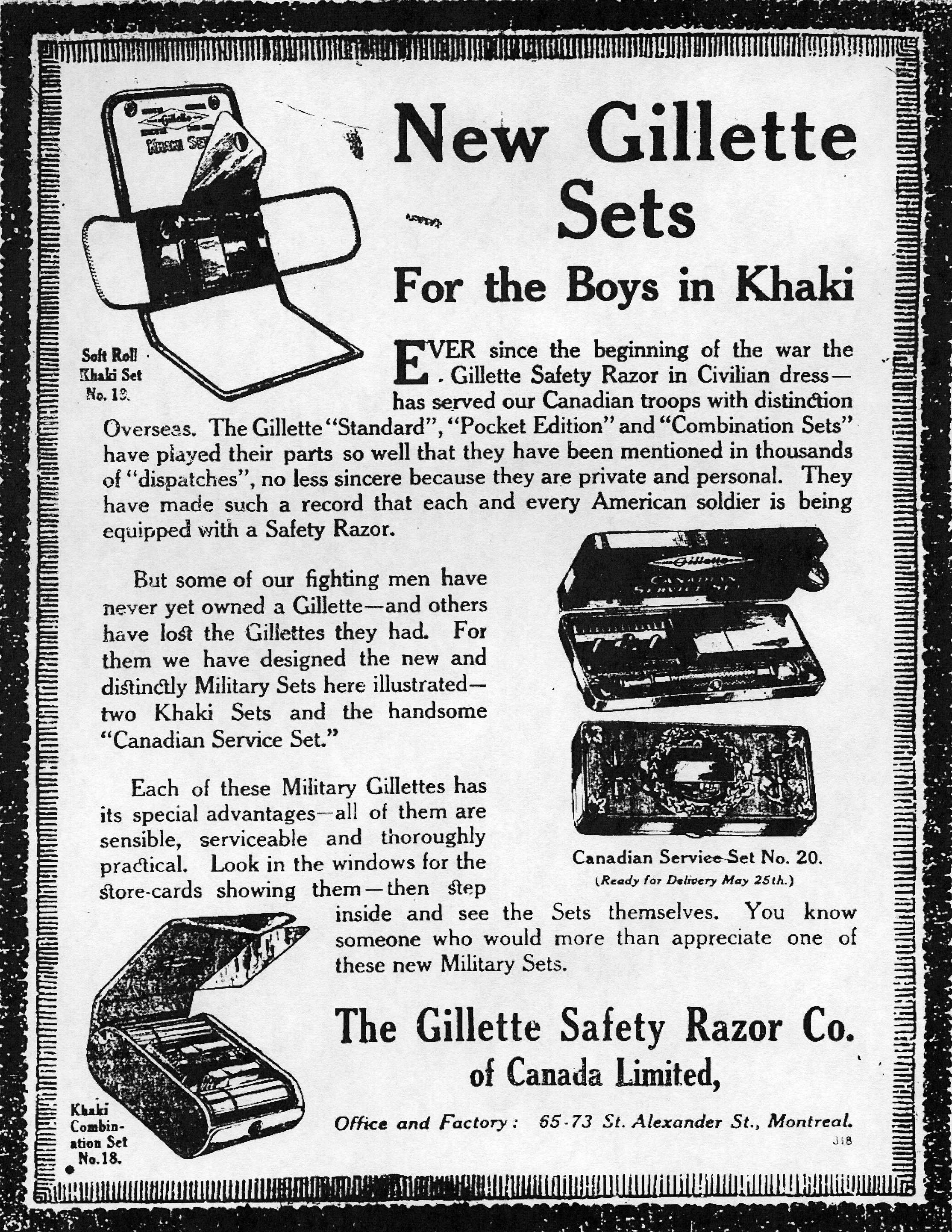
Gillette advertisement“New Gillette Sets For the Boys in Khaki. Ever since the beginning of the war the Gillette Safety Razor in Civilian dress—has served our Canadian troops with distinction Overseas.

But some of our fighting men have never yet owned a Gillette—and others have lost the Gillettes they had. For them we have designed the new and distinctly Military Sets here illustrated—two Khaki Sets and the handsome ‘Canadian Service Set.’

You know someone who would more than appreciate one of these new Military Sets. The Gillette Safety Razor Co. of Canada Limited.”

100 Years Ago: Sugar Hoarders to Be Fined or Jailed, Conscientious Objectors, Back-to-the-Garden Movement, Amateur Hockey Teams Decimated by Conscription, John Arnold Detlor Welcomed Home, Potato Cultivation Booklet Popular, Harold Ingram Wounded, Esmeralda Knitting Circle Holds Dance, Frederick Baker Gassed, Nursing Sister Agnes Forneri Dies

The Intelligencer April 26, 1918 (page 1)

“Hoarders of Sugar Will Be Fined or Sent to Gaol. Special Despatch to The Intelligencer, Canadian Press, Limited. Ottawa. Drastic orders restricting the hoarding of sugar were issued by Canada’s Food Board today, providing that any person, other than a dealer or manufacturer, having on his premises more cane sugar than is sufficient for fifteen days supply, unless he lives more than two miles from licensed dealers, shall be liable to a fine of from $100 to $1,000, or three months in jail, and any excess over the prescribed amount may be seized and forfeited.”

The Intelligencer April 26, 1918 (page 2)

“Conscientious Objectors. A new order from Ottawa regarding the treatment of conscientious objectors was received by Major-General Wilson to-day. It states that such objectors will, in future, be sent overseas to serve in the Canadian Engineers, Army Service Corps, Army Medical Corps, or Canadian Ordnance Corps or on clerical duties. Provision is made for the transfer from any one of these branches to another.

In the event of an objector refusing to obey orders, he will be arrested immediately and tried by district court martial. If convicted, he will be sent to the civil authorities for custody, till a draft leaves for overseas. Then an application for his release will be made and he will be attached to its draft and sent overseas under arrest.”

The Intelligencer April 26, 1918 (page 4)

“Dad’s In The Garden. A great deal of fun is poked at the amateur gardener who spends all his spare moments in the back-yard garden coaxing the young vegetables along. His carrots and cabbages and potatoes may figure up to a right smart price in dollars and cents, but he will eat his own food and a goodly part of his share of the general national harvest can be devoted to the Allies.

He is also accumulating a coat of healthy tan and saving doctor’s bills by a course in the fresh air, and he has no time or inclination for a game of ‘draw’ or other expensive indoor sports. Lastly, wifey knows where he is, and peace and happiness blesses the household.”

The Intelligencer April 26, 1918 (page 6)

“Junior Hockeyists Hit Hard by New Act. There will be some tall scurrying around next Fall for amateur hockey players, if the war is still in progress and all the young men eligible under the new conscription regulations are called into the force. The new regulations knock nearly all the top-notch junior teams into a cocked hat by taking away their 19 and 20-year-old players.

The removal of these youngsters just graduating from junior ranks puts a crimp in the intermediate and senior ranks, too, for the higher classification have mighty little new material from which to fill up holes left by retirement or enlistments. Of the 600 and odd youngsters who were registered with the junior O.H.A. last winter, the call for boys who have attained the age of 20 years since the first draft under the Military Service Act takes 110. The 19-year-old clause in the new Act just passed by the Dominion House nets 130 more. With a total of 240 lads, most of whom were active players, gone from the roster, the sledding is going to be mighty rough in hockey circles next season.

Practically every junior hockey club prominent in last year’s O.H.A. junior championship is decimated as badly as were some of the Hun battalions which tried to break the British lines on the west front.”

The Intelligencer April 26, 1918 (page 7)

“Welcomed Home. A warm welcome was accorded Gunner Jack Detlor of Bancroft, on his arrival home this week. He was gassed the 7th of Sept. last and was sent back to England. His recovery was not very rapid, and the authorities finally declared him unfit for overseas service. He is on a two weeks’ furlough, and may possibly be given his discharge at the end of that time.”

[Note: Lieutenant John Arnold Detlor died on April 17, 1921. He is commemorated on Page 556 of the First World War Book of Remembrance.]

The Intelligencer April 26, 1918 (page 7)

“Potato Growing Made Easy. So great was the demand for the recently issued bulletin on Potato Cultivation, written and edited by the Dominion Horticulturist, that a popular edition of 16 pages has been prepared and can be had free by addressing the Publications Branch, Department of Agriculture, Ottawa.

As an aid to the potato grower, especially to the less experienced and the beginner, this bulletin, which is numbered 90, should prove invaluable. …  A list is given of varieties recommended by different districts in every province.”

The Intelligencer April 26, 1918 (page 7)

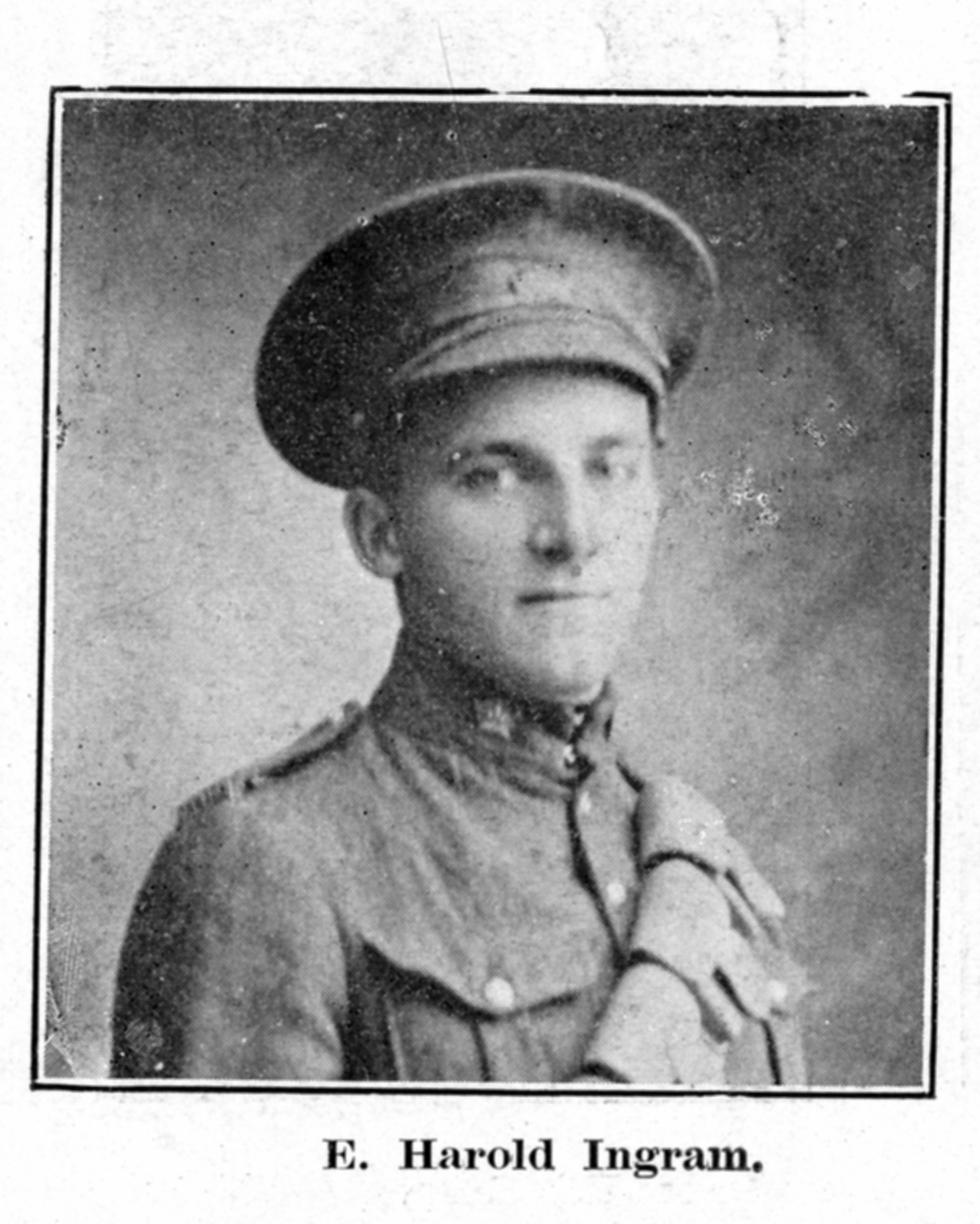
“Bombardier Ingram Wounded. Mrs. Ingram of this city received a telegram from Ottawa which stated that No. 89764 Bombardier E. H. Ingram, admitted Field Ambulance Hospital, April 11th. Gunshot wounds in face, ‘Harold’ was well known in Belleville. He enlisted with the artillery in May, 1915, left for England in September of the same year and has been in France since Christmas of that year. His many friends will hope that his wounds will not prove serious. He is a son of Capt. Ingram formerly of the O. S. D. staff.”

The Intelligencer April 26, 1918 (page 7)

“Patriotic Dance. Under the auspices of the Esmerelda Knitting Circle a successful euchre and dance was held last evening in Johnstone’s Academy, Front St. Card playing was indulged in until ten o’clock and prizes were awarded those most successful. Miss Evelyn Ryan furnished the music for dancing and gave great satisfaction which was noted by the numerous encores.

The spacious academy was crowded with a happy throng including many from out of town, also a few aviators from Mohawk Camp. A dainty lunch was served and dancing continued until a late hour. The proceeds received will be used by the circle for patriotic purposes and to help the boys of the Esmerelda Club overseas.”

The Intelligencer April 26, 1918 (page 7)

“Signaller Baker Gassed. Rev. Dr. Baker, Principal of Albert College, received the following telegram from Ottawa, this morning: Sincerely regret to inform you that gunner Frederick Edward Baker, artillery is officially reported admitted to eleventh field ambulance hospital, April 18th, 1918, gassed.—Director of Records.

Signaller Baker, after graduating from College, enlisted with the Cobourg Heavy Battery, and went overseas some time ago. He had only been in France three weeks when he was gassed. His many friends will hope for his speedy recovery.”

The Intelligencer April 26, 1918 (page 8)

“Supreme Sacrifice Of Nursing Sister. Rev. R. S. Forneri, B. D., of this city, has within the past few months been doubly bereaved, owing to the war. Six months ago his son, Lieut. Forneri, was reported missing, and later reported dead, and this morning the sad message was received that his eldest daughter, Nursing Sister Agnes, had died. The message was as follows:

Ottawa, April 26th, 1918. Deeply regret to inform you that Nursing Sister Agnes Florein Forneri, medical service, is officially reported as having died at the Military Hospital at Bramshott, England, on April 24th, 1918, from hemorrhage of the stomach. Director of Records.

Nursing sister Forneri had been on active service for some time, doing her part in nursing wounded soldiers. Her demise will be sincerely regretted by all who knew her, and the heartfelt sympathy of all citizens will be extended to Rev. Mr. Forneri in this his hour of trial.”

[Note: Nursing Sister Agnes Florien Forneri died on April 24, 1918. She is commemorated on Page 409 of the First World War Book of Remembrance.]