100 Years Ago: Stirling Workers Harvest on Wednesday Half-Holidays, James Marshall Awarded Military Medal

The Intelligencer August 17, 1917 (page 2)

“Helping the Farmers. A large number of the professional, business and tradesmen of Stirling, responding to a Patriotic appeal to help garner the bountiful harvest of this year without loss or waste, turned out on Wednesday afternoon in every direction from the town and spent their half holiday in ‘Faithful Service to Their King and Country,’ by helping the farmers in their harvesting operations.

So far as we know everybody was delighted, and it is not likely that this will be the last time, for the citizens of Stirling are awake to the needs of the Empire and always realize the importance of a bountiful harvest.”

The Intelligencer August 17, 1917 (page 7)

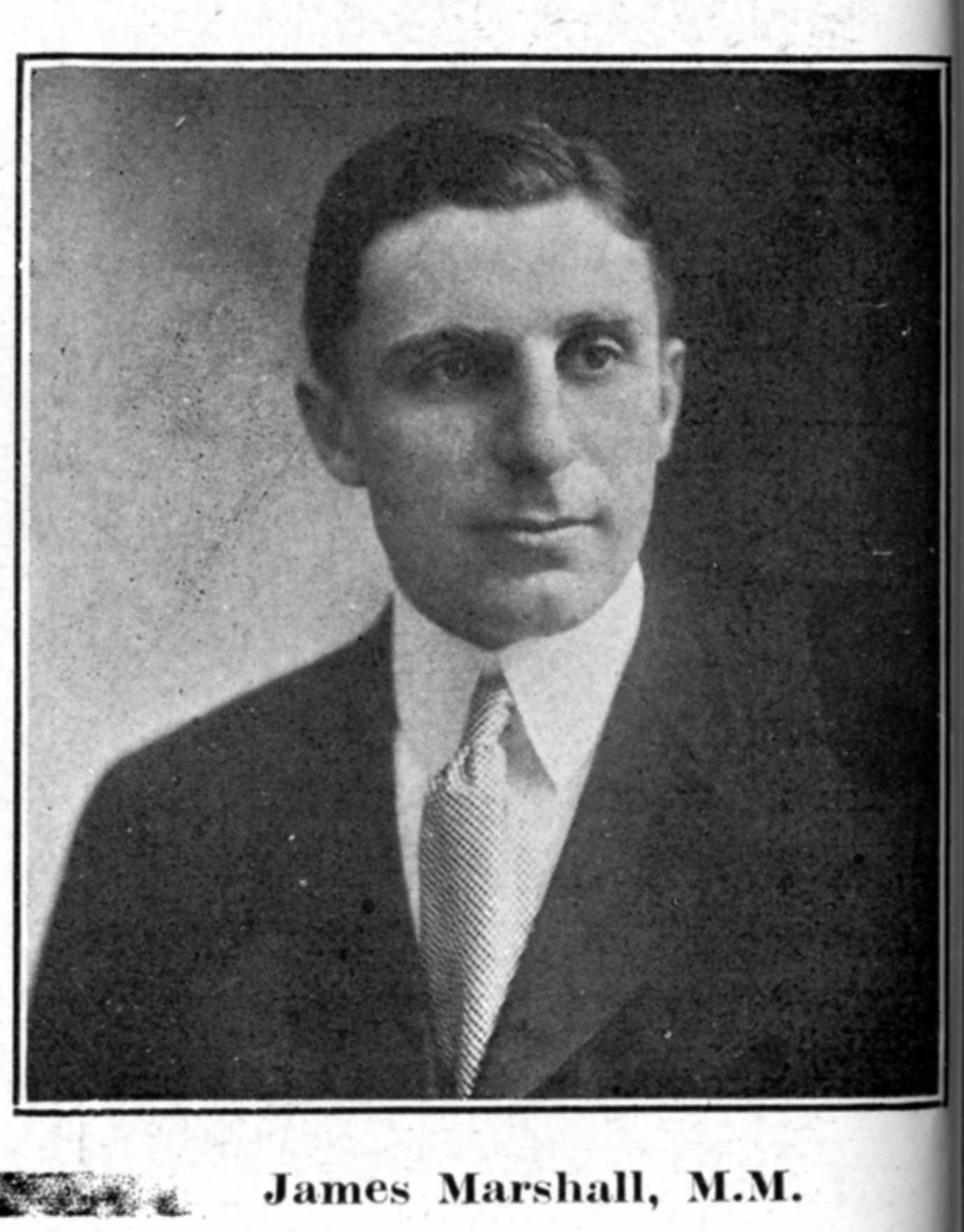
“Belleville Soldier Won Military Medal. James Marshall, of Belleville, who went overseas with the 33rd Battery over a year ago, has been awarded the Military Medal for conspicuous gallantry on the field of battle. In a letter to his aunt, Mrs. Chas. Gibson, Victoria avenue, the young soldier incloses a section of the ribbon which accompanied his decoration.

He modestly disclaims any credit for anything but discharging his duty to the best of his ability. He has been on active duty in France since August, 1916. Many friends in Belleville will be pleased to hear of the honor won by this popular young soldier. He is now attached to the Signalling Corps.”


100 Years Ago: Eating Places Now Regulated, Recruiting for Royal Flying Corps

The Intelligencer August 16, 1917 (page 1)

“Eating Places Are Regulated. Ottawa. An extra issue of the Canada Gazette bringing into effect the order in council regulating eating places was published yesterday:

The order in Council, passed at the request of the Food Controller, prohibits the serving of beef and bacon on Tuesdays and Fridays, and at more than one meal on any other day. Substitutes, such as corn bread, oat cakes, potatoes, etc., must be provided at every meal at which white bread is served. The use of wheat in the distillation or manufacture of alcohol is prohibited, except for manufacturing or munitions purposes, and then only after obtaining a license from the Food Controller.

Heavy penalties are provided for violation of the regulations. Proprietors, managers and employees of public eating places are liable upon summary conviction for the first offence to a penalty not exceeding five hundred dollars and not less than one hundred dollars, or to imprisonment for any term not exceeding three months, or to both fine and imprisonment.

Any person violating any of the provisions regulating the use or distillation or manufacture of alcohol is liable upon summary conviction to a penalty not exceeding five thousand dollars.

The regulations go into effect with the gazetting of the order in Council to-day. Copies of the order can be secured from the Food Controller’s office.”

The Intelligencer August 16, 1917 (page 6)

“Golden Opportunity For Young Canadians to Join Royal Flying Corps. Mr. F. C. Ritchie, secretary of the Aero Club of Canada, is in Belleville today, his mission being to secure the formation and inaugurate the activities of a local committee to assist the club’s work in the Belleville district.

The Aero Club has been formed and is operating in conjunction with the Royal Flying Corps to assist in recruiting its ranks. …  This is now the senior and best branch of the service, and the education derived will, doubtless, be of greatest advantage after the war. It is now possible for any deserving young man possessing the right qualifications to go through without expense to himself. …

A local committee was formed and young men interested in the aviation service can get all information and application forms from Mr. A. R. Walker, Public Library.”

100 Years Ago: Hill 70 Captured by British and Canadians, Meatless Day But No Fines, Frankford Workers Harvest on Wednesday Half-Holidays, Free Lessons in Cooking and Preserving

The Intelligencer August 15, 1917 (page 1)

“Hill 70 Captured by the Canadians. The British pushed their lines into the northwestern environs of Lens in a semi-circle around the eastern side of Hill 70. …  Hill 70 itself, which dominates Lens and the Loos salient, was captured by the Canadians. …

The capture of Hill 70 ranks in importance with the biggest military operations this year. It was the last dominating position in this section which remained in the hands of the Germans and from it a wide territory can be controlled.”

The Intelligencer August 15, 1917 (page 1)

“Meatless Day But No Fines. Ottawa. Yesterday was the first meatless Tuesday in Canada under the terms of the Order-in-Council promulgated last week by the Government at the request of Hon. W. J. Hanna, Food Controller.

The hotels and public eating places at the Capital, including the Parliamentary restaurant, declined to serve beef or bacon when it was asked for, and the same rule will apply to Friday.

Any failure this week to comply with the new regulations will not subject the offenders to the penalties provided because of the fact that the regulations have not yet appeared in the Canada Gazette. They will be printed in the Saturday issue, however, and subsequent to that date the penalties will go into effect. It is expected that there will be a general voluntary compliance with the regulations this week.”

The Intelligencer August 15, 1917 (page 4)

“The Frankford Way. The citizens of Frankford have set an example which may well be copied by other communities, large and small. The Wednesday half-holidays, when all the stores close, is one of the most popular features of life in Frankford, as in many other places. Wednesday is naturally the favored day for picnics and similar outings, but it remained for the business men of Frankford to set the pace for the rest of Canada with an entirely new form of outing containing every needed feature of delightful novelty, exercise, and usefulness.

The business men of Frankford got together and decided to give production a boost, so a general invitation was issued to spend a Wednesday afternoon in the harvest fields helping the hard-pressed farmers. The response was hearty and generous and a fleet of motor cars conveyed the willing workers to the fields where their services were gladly utilized by the farmers. …  It is worthy of note that the men of Frankford refused pay for their services and even refused to be fed on the farms, bringing their huge appetites home with them. …

The idea should be taken up by patriotic production organizations—many people are ready and eager to answer the call, only waiting for a lead. Get busy!”

The Intelligencer August 15, 1917 (page 5)

“Free Lessons in Cooking and Preserving. In the spring of the year citizens were all asked to plant, so that there would be extra production of vegetables, fruit, etc. Now all are asked to can and preserve these vegetables and fruits, so that nothing will be wasted. In order to do this in the most thorough and best methods, the Department of Agriculture is sending skilled demonstrators throughout the Province.

Miss Williams of Toronto is in Belleville at present, and is demonstrating the latest, simplest and best ways of canning and preserving and drying all kinds of vegetables and fruits. …  Two demonstrations were given in the City Hall yesterday, namely afternoon and evening, and many ladies were in attendance and were profited by the experienced demonstrations. Miss Williams will remain in Belleville until tomorrow night, giving demonstrations this evening, tomorrow afternoon and evening.”

100 Years Ago: Walter Morris Wounded, Soldiers and Nurses Will Have Vote, Liquor Advertising Controlled, Prevention of Food and Vegetable Waste

The Intelligencer August 14, 1917 (page 1)

“Wounded in Action. Mr. Thomas Morris of this city, is in receipt of the following telegram, which explains itself. Ottawa, Ont., Aug. 11, 1917. Thomas Morris, 94 Station Street, Belleville. Sincerely regret to inform you 636563 Private Walter Morris, infantry, officially reported admitted to No. 10 Field Ambulance, July 29, 1917. Concussion. Will send further particulars when received. Director of Records.

Private Morris left Bellevilled with the 155th Battalion. Previous to enlisting he was employed at the G. T. R. shops.”

The Intelligencer August 14, 1917 (page 1)

“Soldiers and Nurses Will Have a Vote. Hon. C. G. Doherty, Minister of Justice yesterday introduced a bill entitled ‘The Military Voters Act of 1917.’ …  A change was to be made in the qualification for military voting. It was proposed to extend the vote not only to men of age, but to men under 21 who were overseas.

It was also proposed that not only should men in the Canadian forces vote, but men who had enrolled in Canada and who were now in the Imperial units. This applied particularly to the aviation corps and naval units.

It was also proposed to do away with any distinction  of sex among those engaged in active service; nurses would be included. The fact that a soldier might be an Indian, moreover, would not prevent him from voting. …

The bill, said Mr. Doherty, provided for complete machinery overseas to take the vote. As though an election were actually being conducted there.”

The Intelligencer August 14, 1917 (page 3)

“Ontario Can Be ‘Bone Dry.’ Ottawa. Ontario and other prohibition Provinces get the right, through their Legislatures, to put the ban upon the liquor advertising. The mails are denied to circulars and letters soliciting orders for liquors. The publication of liquor advertisements within those Provinces may be made a punishable offence, moreover—which is the most radical provision—any prohibition Province may prohibit the entrance of any newspaper, published outside its territory, which contains liquor advertising.

The new ‘temperance bill’ making these provisions went through committee and received its third reading in the House on Saturday. …  The bill goes to the Senate on Tuesday.”

The Intelligencer August 14, 1917 (page 3)

“Learn How to Prevent Waste. The Educational Bureau of the Food Controller’s Office, issues the following bulletin which contains much useful information:

There is bound to be a great waste of fruit and vegetables this season unless people are forewarned in time. In the towns and cities where backyard garden movement was most successful, the danger of waste is most imminent.

Early in the spring Canadian city folk betook themselves to the backyard with hoe and spade to convert that ‘Slacker’ into a back garden. Their faithful work is bringing results in fine crops of fruit and vegetables. But the problem of taking care of those crops before they spoil is now pressing for solution.

The Food Controller has said that Waste and Defeat are synonymous at the present time, and surely this end of the fight rests on the shoulders of the women. Every bean and pea, every ear of corn, every berry, and every other ripe fruit and vegetable gazes reproachfully from the new gardens and demands to be popped into some place where it can stand in line and do its bit.

Unlike their sisters in the country, who harvest their garden crops in boxes and bottles against the long winter months, city women have not been trained to store vegetables and fruits. …  Those who are interested in food conservation and methods of canning, preserving, drying and storing should write for information to G. A. Putnam, Esq., B.S.A., Superintendent of Institutes, Department of Agriculture, Toronto, Ont.”
100 Years Ago: Ad for Sunlight Soap, Ad for Wrigley’s, Conservation of Food Supplies Discussed

The Intelligencer August 13, 1917 (page 3)

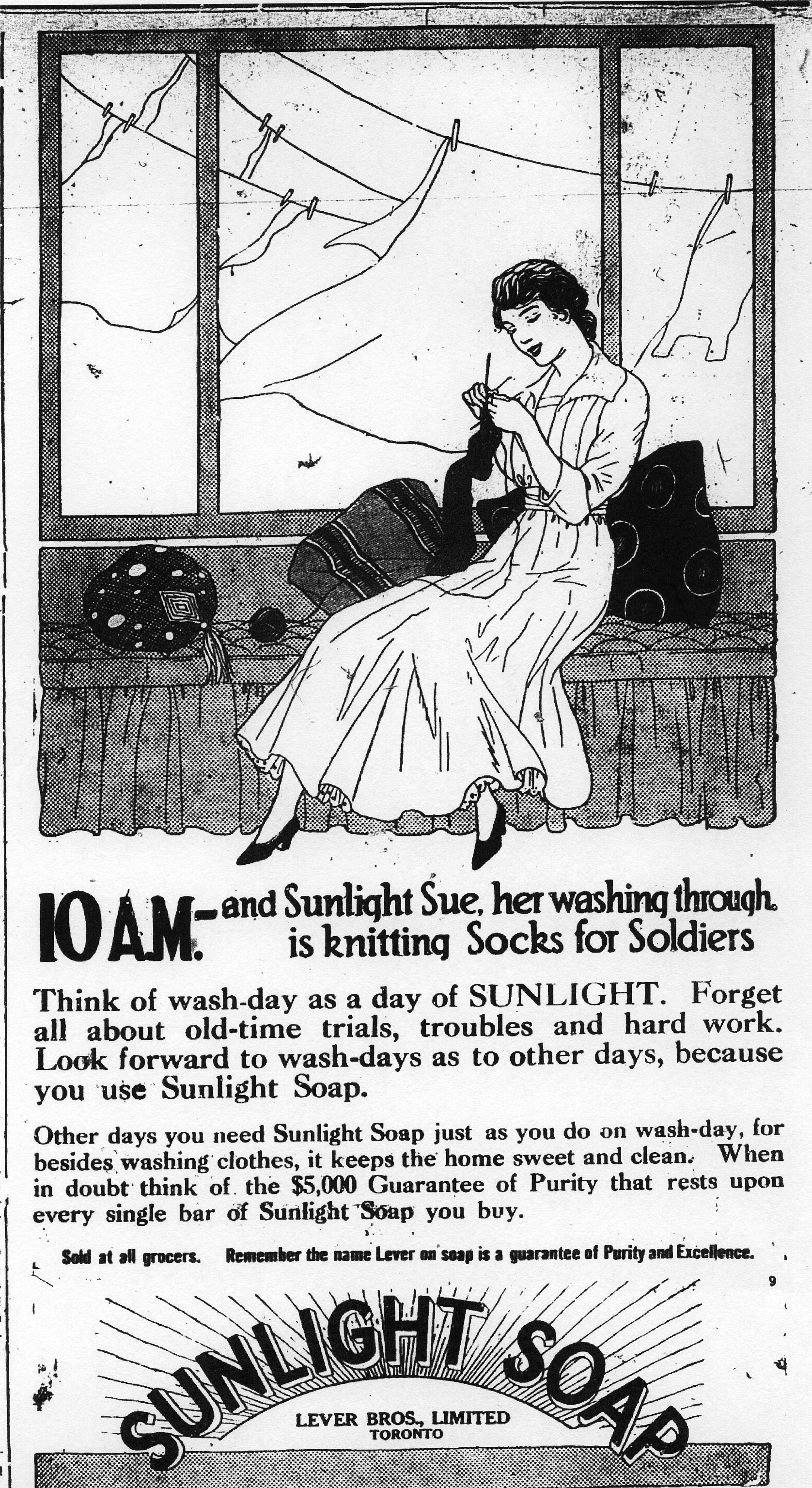
“10 A.M.—and Sunlight Sue, her washing through, is knitting Socks for Soldiers.

Think of wash-day as a day of SUNLIGHT. Forget all about old-time trials, troubles and hard work. Look forward to wash-days as to other days, because you use Sunlight Soap.”

The Intelligencer August 13, 1917 (page 5)

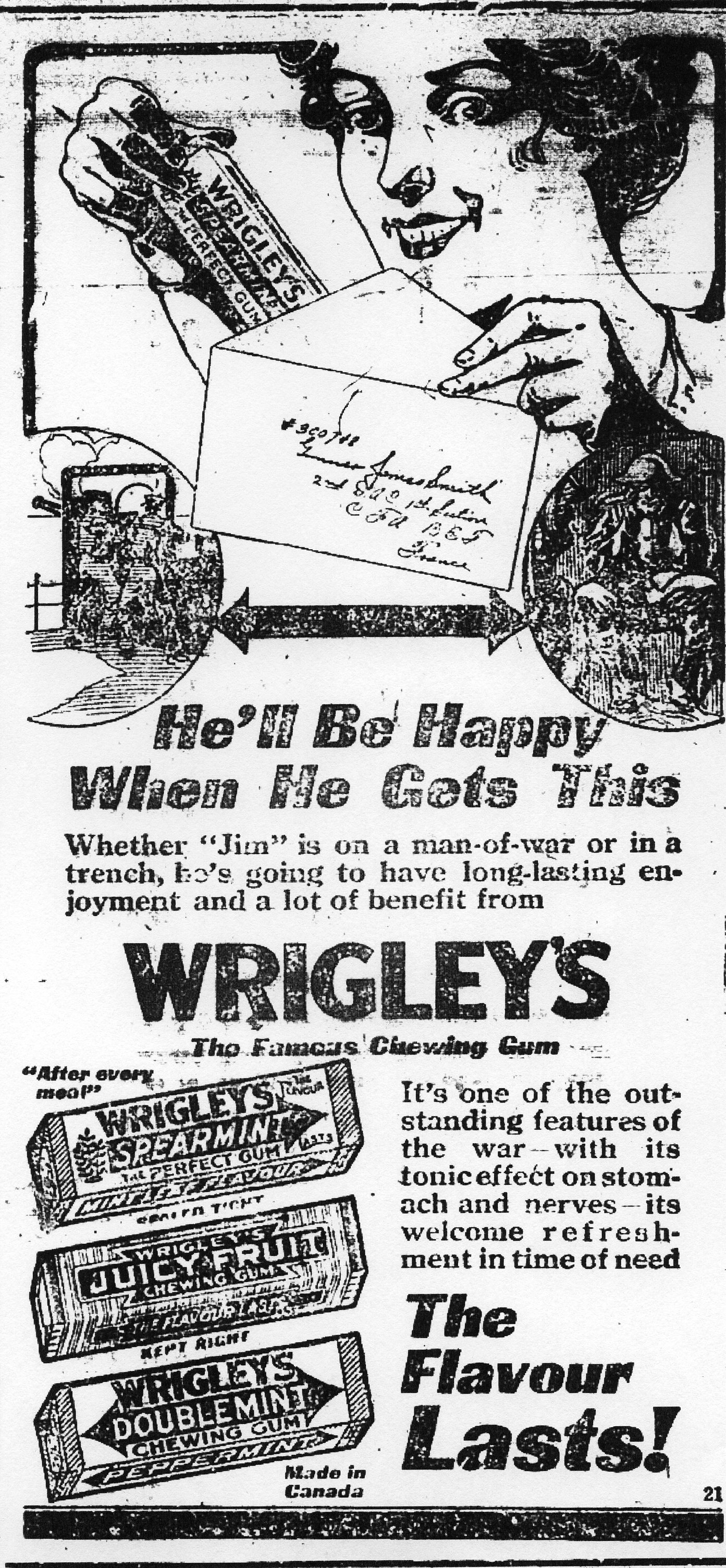
“He’ll Be Happy When He Gets This. Whether ‘Jim’ is on a man-of-war or in a trench, he’s going to have long-lasting enjoyment and a lot of benefit from Wrigley’s. The Famous Chewing Gum. The Flavour Lasts!”

The Intelligencer August 13, 1917 (page 5)

“Conservation of Food Supplies. A meeting of the Organization of Resources Committee, Hastings County Branch, was held in the City Hall on Saturday. …

Mayor Ketcheson occupied the chair and introduced Dr. Parks of Toronto, organizer of Resources Committee for the County of Hastings. Dr. Parks, in addressing the meeting, referred particularly to three important subjects: organization, production and waste. …  Dr. Parks eulogized the women of Ontario for the splendid work they had accomplished and for their enduring patriotism and believed if the men would work as consistently that the object the committee had in view would be realized. …

Warden McLaren, on behalf of the county of Hastings, assured the meeting of the county’s co-operation in furthering the interests of the committee. …

Mayor Ketcheson was confident the city of Belleville would do everything consistent with the public welfare to insure the success of the movement.”


100 Years Ago: Instruction in Food Conservation at City Hall, Ad for Canadian War Savings Certificates

The Intelligencer August 11, 1917 (page 1)

“Food Conservation Organization. Government Expert Will Instruct Belleville Women in Canning and Cooking. A well attended and successful meeting was held in the City Council Chamber Friday afternoon. In response to the call of Mayor Ketcheson, presidents and representatives of all the local Women’s organizations were present to discuss plans for Food Conservation.

All churches and societies are invited to co-operate and every housekeeper must take a personal interest. The government is sending a demonstrator and the following course of instructions will be given at City Hall.

Tuesday, August 14, 3 p.m.—Canning of vegetables. Tuesday, August 14, 8 p.m.—Canning of fruits. Wednesday, August 15, 3 p.m.—Canning of meats. Wednesday, August 15, 8 p.m.—Breadmaking and biscuits. Thursday, August 16, 3 p.m.—Substitutes for meat. Thursday, August 16, 8 p.m.—Substitutes for white flour.”

The Intelligencer August 11, 1917 (page 10)

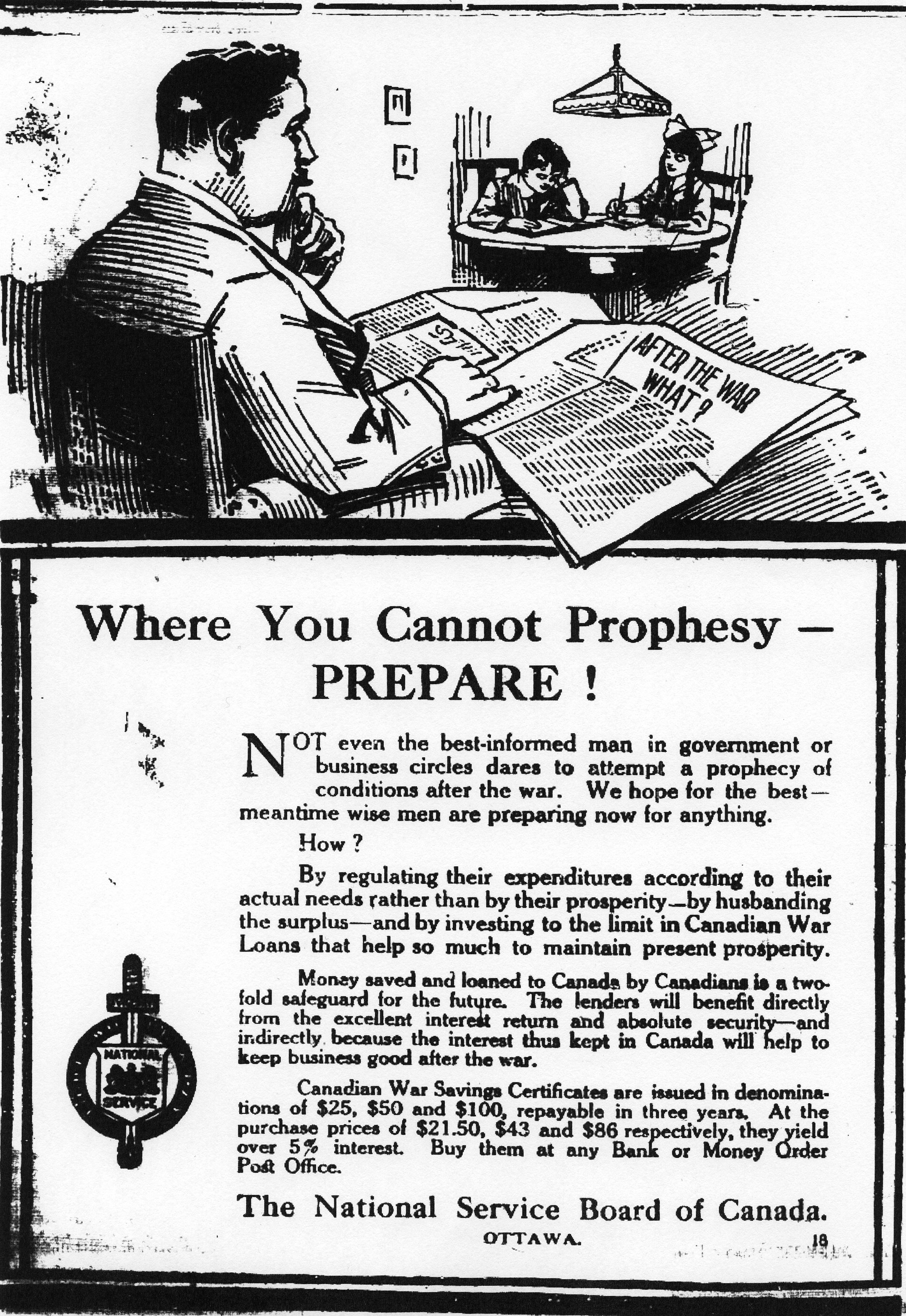
“Where You Cannot Prophesy—Prepare! Money saved and loaned to Canada by Canadians is a two-fold safeguard for the future. The lenders will benefit directly from the excellent interest return and absolute security—and indirectly because the interest thus kept in Canada will help to keep business good after the war.

Canadian War Savings Certificates are issued in denominations of $25, $50 and $100, repayable in three years.

The National Service Board of Canada.”


100 Years Ago: Marson Hitchon Dies of Wounds, George Hoppings Is Wounded, Poster for Men to Help Farmers, Letter from Leslie Yerex on Anniversary of His Arrival in France

The Intelligencer August 10, 1917 (page 1)

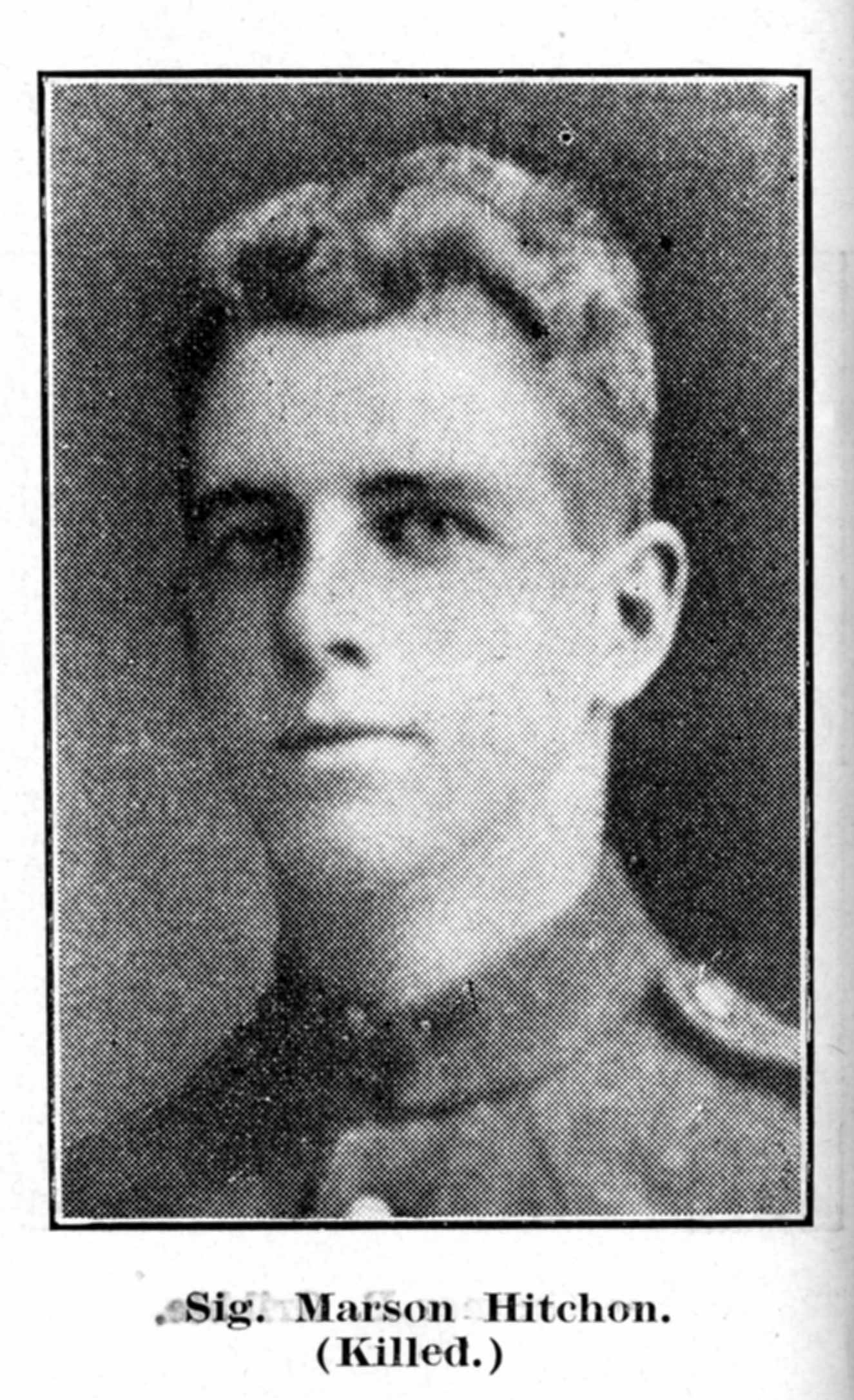
“Pte. Hitchon Died of Wounds. Mr. Joseph Hitchon of this city, Sunday last received a message from the military Director of Records at Ottawa, stating that his son, Marson, had been seriously wounded on August 1st, and had been admitted to the 33rd Casualty Clearing Station. This morning another message was received conveying the sad intelligence that he died on August 2nd, as the result of wounds received.

Marson Hitchon left Belleville with the Signal Section of the 155th Battalion, and was one of the first of that section to be sent to France, and had only been there a short time before he was wounded. He was a young man only 20 years of age and previously to enlistment had been engaged in a vulcanizing establishment here.

He was a very bright and cheerful young man, and while a pupil of the Belleville High School was very popular with his companions. He was an athlete and had won many prizes at the annual field days in connection with the school. The news of his death will be learned with deep regret by all who knew him.

In addition to the parents a brother, Allan, and a sister, Jean, both of Belleville, survive. The heartfelt sympathy of all citizens will be extended to the bereaved relatives.”

The Intelligencer August 10, 1917 (page 2)

“Officially Reported Wounded. Pte. George Hoppings, son of Mr. and Mrs. Geo. Hoppings, Dundas Street, Deseronto, who went overseas with the 155th Battalion, was officially reported wounded on July 25th with gun shot in the left leg. He has been admitted to the General Hospital, Letreport.”

The Intelligencer August 10, 1917 (page 6)

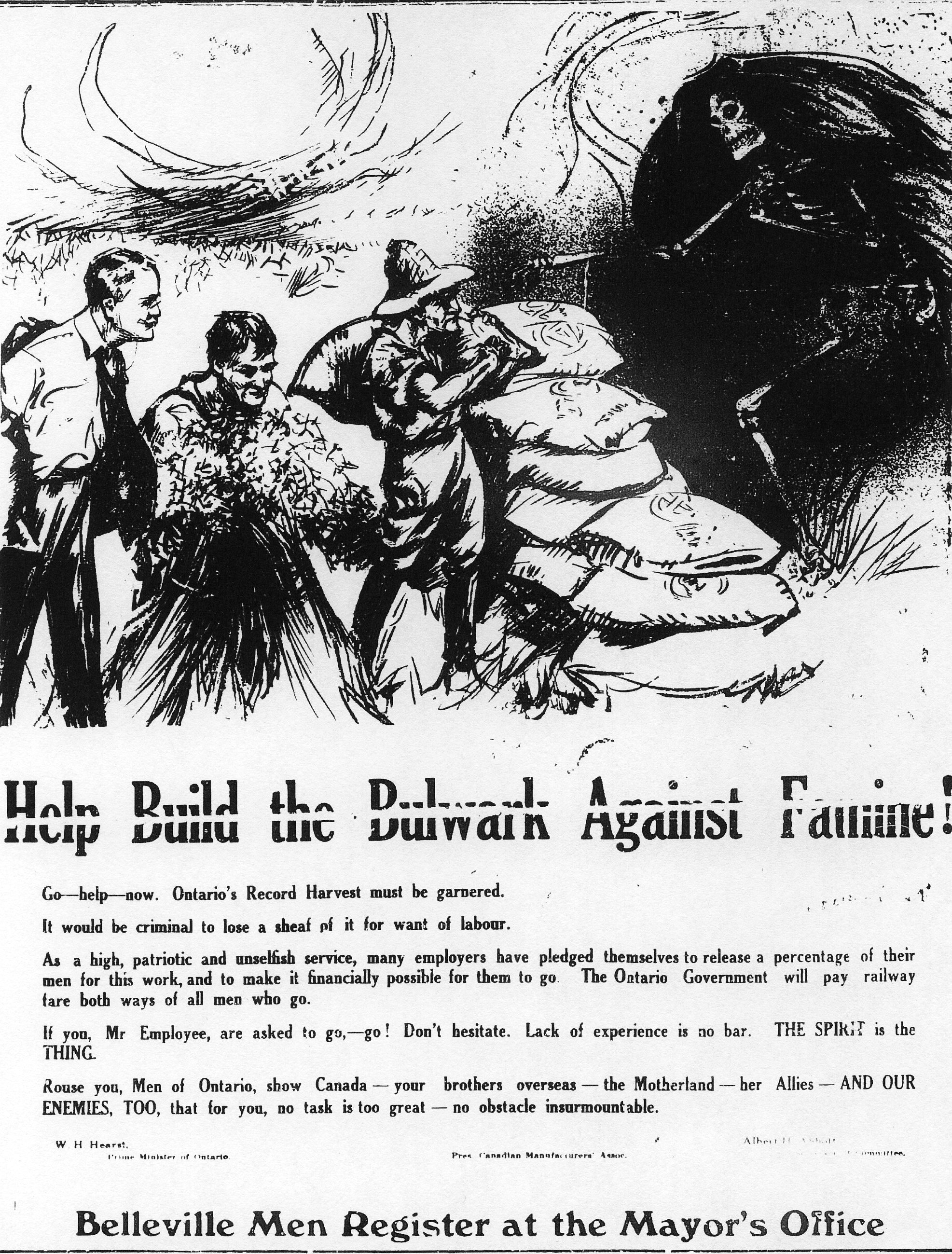
“Take Off Your Coat and Give the Farmer a Hand! When, three months ago, we called upon Ontario’s farmers for mighty efforts to avert the threatened Famine and World-Hunger, they responded splendidly.

Aided by Providential weather, Ontario’s Crop is one of the biggest in her history. The farmer has done his part.

We Town and City Men must do our part.

Belleville Men Register at Mayor’s Office.”

The Intelligencer August 10, 1917 (page 7)

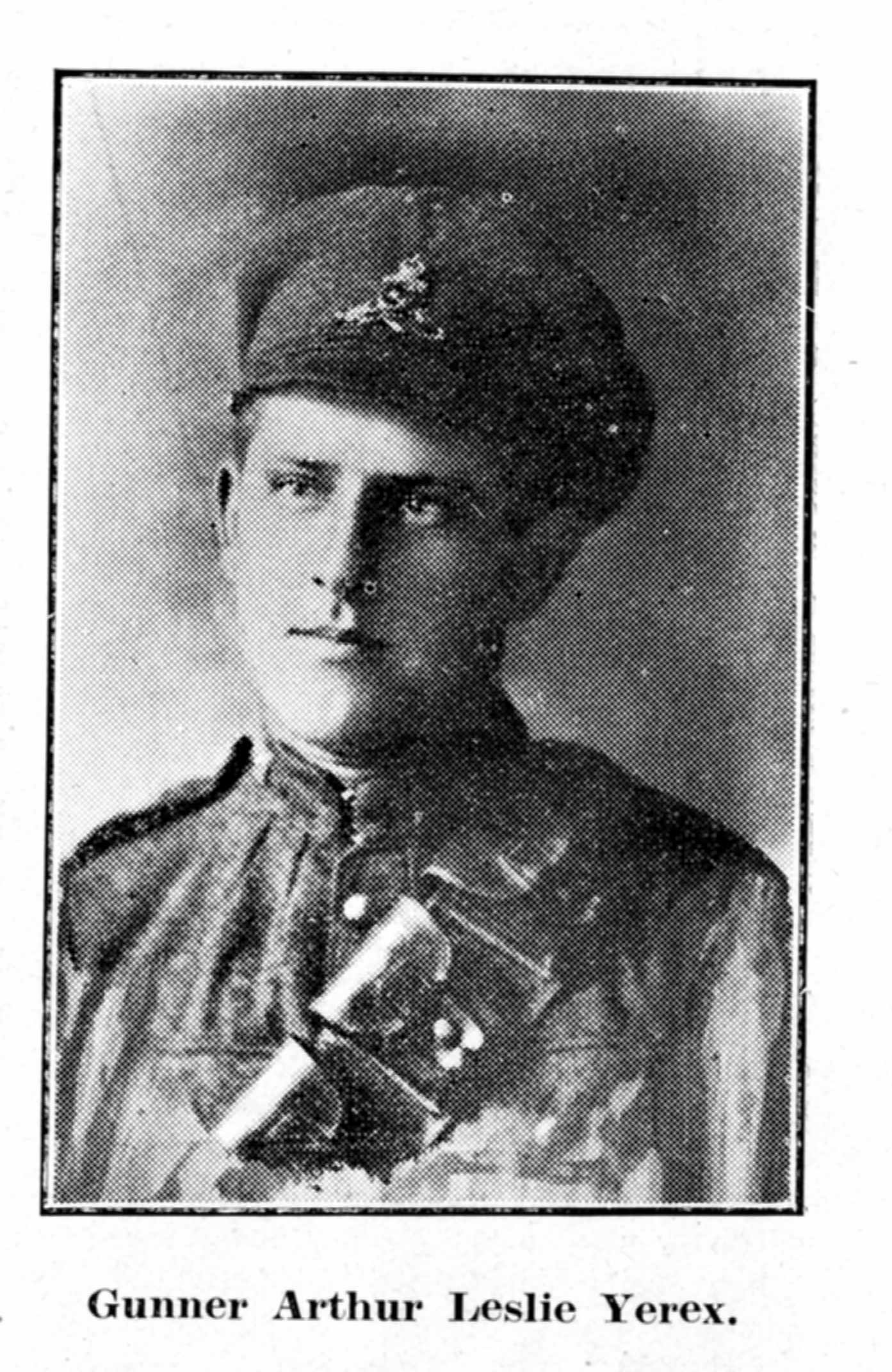
“From Leslie Yerex. 33rd Battery. July 13. Dear Mother:—As this is the anniversary of my arrival in France I thought I would celebrate it by writing to you first thing this morning. It is just six o’clock and I have finished my breakfast, consisting of a spoonful of porridge (I don’t know what it is made of), two pieces of bread, and some tea. …

I received two Top-Notch magazines the other day, also scrap book Elsie made, two magazines from Aunt Bert, received two letters and parcel from you yesterday. They were welcome indeed. Everything in the box was good, but was sorry the cake was not bigger.

Tell Dad if he cannot send more than that he must not make it so good, as then I would not like it and a small one would do. Now don’t mind this little kick, for it’s Dad’s fault for making the cake so good. It was fine. I would much rather have it than canned goods. You see about nine-tenths of what we have at meal time consists of canned stuff, including dried vegetables from R. J. Graham’s.

They are all good, but we do like the home-made things for a change. I have enough cocoa to last me a while yet. The maple sugar was great. Well, I guess this is all for this time. Les.”


100 Years Ago: Michael Gorman Is Wounded

The Intelligencer August 9, 1917 (page 2)

“Corporal Michael H. Gorman, who left Belleville with the 155th Battalion, has been officially reported wounded. The following telegram was received by Mrs. Gorman: Ottawa, Aug. 7, 1917. Mrs. E. Gorman, 34 Bettes St., Belleville. Sincerely regret inform you No. 155131, Corp. Michael Harry Gorman, infantry, officially reported admitted to general hospital, Camiers, July 20, 1917. Gunshot wounds, multiple. Will send further particulars when received.”

100 Years Ago: Food Pledge Cards Issued, Poster Calling for Men to Harvest

The Intelligencer August 8, 1917 (page 5)

“Food Pledge Cards Issued. Ottawa. Adopting the system which has met with such splendid success in Great Britain, and which has been followed by the United States, pledge cards by which it is planned that every Canadian household shall enlist in a vigorous campaign to reduce waste of exportable foods, such as flour and other wheat products, and beef and bacon, have been prepared at the instance of the Food Controller for Canada and will be used in a house-to-house canvass conducted by provincial and local organizations which have been formed in connection with the Food Controller’s work. The first shipment of these cards went out from the Government printing bureau to-day.

The form of pledge is headed by the Canadian Coat of Arms and the words, ‘Food Service Pledge.’ Blank spaces are left at the bottom for the name of the housewife and the address. The number of people in the house is also to be inserted. The pledge itself reads as follows:

‘Realizing the gravity of the food situation and knowing that Great Britain and our Allies look to Canada to help shatter Germany’s threat of starvation. I pledge myself and my household to carry out conscientiously the advice and directions of the Food Controller that requisite foodstuffs may be released for export to the Canadian Divisions, the British forces and people, and the allied armies and nations.’

Cards for Windows. On the other side of the card the householder is requested to hang the pledge in the dining room where the members of the household will be reminded of their obligation daily.

A duplicate card is attached to the original copy by a perforated fold. This duplicate will also be signed by the householder, torn off and returned to the canvasser to be filed at provincial headquarters.

Accompanying the pledge card is a card of the same size to be hung in the front window of each house where the public can see it, and the members of the household may read the imperative reasons for food saving set forth on the back.”

The Intelligencer August 8, 1917 (page 6)

“Help Build the Bulwark Against Famine! Go—help—now. Ontario’s Record Harvest must be garnered. It would be criminal to lose a sheaf of it for want of labour.

Rouse you, Men of Ontario, show Canada—your brothers overseas—the Motherland—her Allies—AND OUR ENEMIES, TOO, that for you, no task is too great—no obstacle insurmountable.

Belleville Men Register at the Mayor’s Office.”

100 Years Ago: Private Leo Sullivan Recovering, The Call of the Farm

The Intelligencer August 7, 1917 (page 2)

“Pte. Sullivan Is Recovering. The following telegram from the Director of Records, Militia Department, Ottawa, has been received by Mrs. Kathleen Sullivan in regard to her soldier husband who has been undergoing treatment in an English military hospital: Ottawa, Ont., Aug. 3, 1917. Mrs. Kathleen Sullivan, 143 Lingham St., Belleville, Ont. Cable received from England states 636679 Private Leo. Sullivan at 1st Southam general hospital, doing very well, to be discharged shortly. Director of Records.”

The Intelligencer August 7, 1917 (page 4)

“The Call of the Farm. Ontario with the greatest crops in the history of the province faces the calamity of being unable to harvest the foodstuffs so much needed by the world today. …  Well-fed and prosperous Canadians are slow to awake to the real seriousness of the situation. With crops larger than ever before no vision of want threatens the average Canadian in his thoughtless complacency.

Does he forget that millions of men have been taken from the fields and productive agencies of the world to kill and destroy. Men employed formerly in production now devote all their energies to destruction. And these men have to be fed. Canada’s 400,000 fighting men, most of them overseas have to be fed, and as Food Controller Hanna says, will be fed first, and the foodstuffs of Canada will be conserved so that the needs of the army will always be protected. …

Many have answered the call—even women and boys are gathering in the golden grain, and setting a glorious example to the men to get into overalls and escape from the pent-up city and town to the sweet-smelling healthy air of the country where patriotism and pleasure can be so delightfully blended.”