Nurses of World War I: Lilly Naomi Gray

Lilly Naomi Gray was born at Beaurepaire, Quebec on October 29, 1881 daughter of George Gray and Jeanie Heron.

She was educated locally, was a graduate of the Nursing School at the Montreal General Hospital on January 6, 1913 and received her Certificate of Military Instruction from the Divisional School of Instruction on March 29, 1915 at Quebec City. Miss Gray enlisted in the Canadian Army Medical Corps on April 22, 1915 at Montreal.

Height:  5’ 5”

Weight: 125lb

Age: 33 (stated age: 31)

Nursing Sister Gray served at military hospitals in Etaples and Camiers, France and later at Shorncliffe and Eastbourne, England; she was awarded the Royal Red Cross award, 2nd Class in June 1918. She returned to Canada setting sail on February 8, 1919 aboard the S.S. Metagama and was discharged on March 4, 1919. Miss Gray subsequently worked at the Tuberculosis Sanatorium in Fort Qu’Appelle, Saskatchewan, at the Contagious Disease Hospital in Philadelphia and was on staff of the Henry Street Settlement in New York City. Later she served with the Victorian Order of Nurses in Montreal and Renfrew and in 1928 was appointed as Superintendent of the Order in Belleville before removing to Winnipeg, Manitoba.

Lilly Naomi Gray died in Ottawa on February 19, 1967 aged 85 years 3 months 20 days. She is interred with her parents at the Mount Royal Cemetery in Montreal Section E, Lot 183. There is no grave marker for Lilly.

Grave marker for Lilly’s parents in Mount Royal Cemetery, Montreal


100 Years Ago: A Patriotic Pig, Automobile Show Proceeds for Patriotic Purposes, Conscientious Objector, Boys to Donate to Red Triangle Fund

The Intelligencer May 11, 1918 (page 5)

“A Patriotic Pig. Mr. W. D. Reed, residing on the Front of Thurlow, has a brood sow which apparently realizes the necessity there is of providing pork to feed the allies. She recently gave birth to nineteen little porkers.”

The Intelligencer May 11, 1918 (page 5)

“Automobile Show Here. Arrangements are being made for the holding of an automobile show in the Armouries here on the 22nd, 23rd and 24th of May, which promises to be a successful and interesting affair. Permission to use the Armouries has been obtained from the Militia Department. The proceeds of the affair will be devoted to patriotic purposes.”

The Intelligencer May 11, 1918 (page 5)

“A Conscientious Objector. Oliver K. Pimlott, a young man well known in Belleville as a singer and church worker, also as a hockeyist, was apprehended yesterday under the Military Service Act as an absentee, and later was taken by an escort to the military depot at Kingston.

Although notified to report for service he neglected to do so,and it is said that his reason for not doing so was that he is what is termed a ‘conscientious objector.’ The young man attended Albert College here for some time with the intention of qualifying himself for the ministry. Of late, it is alleged, he identified himself with a religious order which is against war in any form and the shedding of blood.”

The Intelligencer May 11, 1918 (page 5)

“Earn and Give Campaign. In conjunction with the two and a quarter million dollar Red Triangle Fund which is being raised across Canada for Y.M.C.A. work for soldiers at home and abroad, a special boys’ fund is being promoted whereby 6000 boys are being asked to give $60,000 in ten dollar units, it being understood that they must earn the money themselves or give it out of their allowance or savings. They have to October 1st to make the payments. A regular bond is issued and coupons given as receipts for each payment.

Mr. F. S. Deacon, the local director for the campaign, reports that to date 44 boys have signed up for the Belleville district. It is expected that at least 50 will be secured here. Mr. Ellis of the local Y.M.C.A. who has been organizing seven counties in this district reports excellent returns from all centres. The general fund for the Red Triangle for this district has been covered by grants from the Belleville City Council and County Council of Hastings.”

100 Years Ago: The Garden Trenches, Only Sons of Farmers Not Exempted, Ad for Cowan’s Chocolate

The Intelligencer May 10, 1918 (page 2)

“War Garden Bulletin. The Garden Trenches. To sow a row of seed quickly, evenly and thinly requires care and practice. The beginner is very apt to be prodigal in his use of seed and to sow indiscriminately. This not only entails waste but causes overcrowding and corresponding injury to the plants. …  After the ground is fully prepared for planting, a piece of board or a line may be used to make straight even rows.

In the garden trenches this year Canadians are going to give very real and substantial aid to their kinsmen in the trenches of Flanders. It is anticipated that $60,000,000 worth of vegetables will be grown on the vacant lots and in the backyard gardens of Canada this year, or twice the amount grown last year.”

The Intelligencer May 10, 1918 (page 4)

“Only Sons Are Not Exempted. From the published statements of military officials it was understood that only sons of farmers who remained on the farm, and the last remaining son on the farm with brothers in military service would not be subject to the latest call to the colors of young men from twenty to twenty-two years of age. It now appears that this assumption is entirely erroneous, that the cancellation of exemptions has absolutely no exceptions.

That only sons should be left on the farm commends itself as an eminently fair proposition and no doubt many cases of genuine hardship will result by reason of the fact that the Government can not see its way clear to make this exception. However, we must have faith in the Government which, knowing the seriousness of the war situation, has a disagreeable duty to perform whether it likes it or not. …  The Government has assumed the responsibility of taking the lads from the farm and time will demonstrate whether or no this extreme step was justified.”

The Intelligencer May 10, 1918 (page 5)

Ad for Cowan's Chocolate“Little Miss ‘Maiden’ Canada. Hand It Out To Them as They Pass—Or better, send them half a dozen bars of this nourishing chocolate. There is many a brave fellow hungry today in the trenches, who will appreciate this highly concentrated food more than anything else. Positively the finest eating chocolate made, 5c. and 25c. sizes.

Cowan’s Active Service Chocolate.”

100 Years Ago: Letter of Appreciation to Mrs. W. S. Minna, Sidney Farmers Protest

The Intelligencer May 9, 1918 (page 2)

“Soldier’s Appreciation. Feb. 7, 1918. Dear Mrs. W. S. Minna—Just a line to let you know that I have received the parcel that was sent to me by the Women’s Red Cross and Patriotic Association for Christmas, and you may be sure that I was more than pleased to get it. The parcel was in fine shape and everything inside was great but, then, leave it to the ladies of Belleville to see to that every time.

Our unit had real good luck today in the gift line as we received a complete baseball outfit, a gift, I understand, from the Ontario Government, and also a bale of comforts from Montreal through the Canadian War Contingent Association, so that all the boys are in high spirits.

Well, I must close now. Thanking you again for remembering me, and wishing the Association all kinds of success in their work for the boys, I remain, Yours very sincerely, C. H. McBride.”

The Intelligencer May 9, 1918 (page 5)

“Sidney Farmers Protest. A number of yeomen of the southern part of Sidney Township met on Monday afternoon to discuss the situation brought about by the recent changes in the Military Service Act as to cancellations of exemptions. Nearly all present expressed themselves as impressed by the seriousness of lack of help upon the farms and especially when more production is urged upon the farmers.

Those present placed themselves on record that while Canadians everywhere recognize the call for men, still the true farmer is very sincerely and strenuously answering the call upon the land to produce. The result of the meeting was that it was decided to have a deputation go to Ottawa and present their views upon the Government. The delegation will consist of Rev. L. M. Sharpe, Mr. Chas. H. Ketcheson, Mr. Geo. H. Nicholson and Mr. George Burkett. It is expected that delegations from other rural municipalities will wait upon the Government to urge exemptions in cases where it is considered necessary.”

100 Years Ago: The Red Triangle, Private Mab Oliver Welcomed Home to Foxboro

The Intelligencer May 8, 1918 (page 4)

“The Red Triangle and the Soldiers. The campaign to raise two and a quarter million dollars for the Canadian Y. M. C. A. war work, or the Red Triangle, a symbol of good cheer, rest and fellowship for the weary soldier, is making wonderful strides toward accomplishment, and the objective does not look nearly as large as it did at first. Public spirited men and women everywhere in Canada are giving freely of their time and talents to roll up a mighty fund to enable the Y. M. C. A. to carry out the splendid work of ministering to the comfort of the soldiers on the firing line and in the training camps. …

The Canadian Y. M. C. A. is asking for $2,250,000 to enable it to ‘carry on’ for another year. This will mean that every one of the boys in camp in Canada, in England, and in France, will be given something of the joys of home for the nominal sum of between five and six dollars per man. …

Till the boys come home, the Red Triangle takes home to the boys. What every man and woman of us would do for the boys ‘over there’ had we but the chance, the Y. M. C. A. can do and is doing for us. Its system of work is a triumph of organization. Not only does it reach every man, but it ministers to every side of each man. As the flaming red three-sided symbol indicates, body, mind and spirits are catered to. Tired bodies, minds made soggy by the monotony of camp life, souls distressed and torn by loneliness and temptation, are strengthened and renewed by this ministry.”

The Intelligencer May 8, 1918 (page 7)

“Private M. Oliver Warmly Welcomed Home to Foxboro. On Monday evening, April 29, the village of Foxboro witnessed an event at once unique and entirely without precedent in its lengthy and varied experience.

Authentic announcement had been received the previous day of the arrival at Belleville of one of Foxboro’s brave volunteer lads. Pte. M. Oliver, who had returned, wounded, from those trenches ‘somewhere in France.’ Mr. Frank Sine, manager of the famous Foxboro Brass Band, became master of ceremonies, and during that Monday had slight difficulty in arousing the patriotic citizens of Foxboro and its immediate surroundings to make all necessary preparations to give him a right royal reception.

Mr. C. Empson had the honor of being the one chosen to motor to Belleville and bring him to the village in the early evening. In the meantime, automobiles decorated with bunting and flags, and filled with eager citizens, arrived at the appointed place of meeting, which was at Mr. James Gay’s, at the south end of the village.

Three automobiles were filled with school pupils and other pupils found places in other cars. About fifty pupils each waving a Union Jack made a fine spectacle. Four large Union Jacks, waving high, one over each car, were carried by the school boys.

About 8 p.m. Mr. Empson arrived with the honored soldier at the appointed place. Every eye anxiously searched for the face of Private Mab Oliver, who was seated with his mother on his right, and on his left was Mrs. John Eggleton; whose son Clarence made the supreme sacrifice in 1916. The lusty Canadian cheers were not out of place, as many, in their enthusiasm crowded around the car to shake hands with him, and on all sides rang out the glad greeting, ‘Hello, Mab! Hello, Mab!’

Royally Received. The procession of cars and a number of other vehicles now fell into line, led by the Foxboro Brass Band on foot. Then came the car in which sat Private Oliver, followed by the car of Dr. W. F. Faulkner, with whom was Rev. S. A. Kemp, Rev. P. W. Currie, and Mr. W. Haight. The cars in which were the school pupils came next and then the citizens. The procession moved northward, past the crowds of people on foot who lined the sidewalks.

At G. Shaw’s store were gathered a large number who gave a hearty Chatauqua salute as Private Oliver passed them. At the extreme north end of the village, at S. C. Gay’s store, the procession circled, and returned to the town hall. Here at the entrance, the school pupils massed, and as Private Oliver was borne on the shoulders of two members of the band past them into the hall, three cheers and a ‘tiger’ was given.

The hall had been daintily decorated with flowers and flags; many of the flags of the Allies were displayed on the walls. The hall was filled to capacity, and a large number were prevented from entering. Dr. D. W. Faulkner was chairman. Private Oliver and his mother had a prominent place on the platform. Rev. S. A. Kemp and Rev. P. W. Currie with the band, occupied the remainder of the platform. The school pupils occupied the southeast end of the hall, their flags still very prominent.

The opening prayer was offered by Rev. Mr. Currie. The band played a number of selections. Miss Bell sang a very appropriate solo, ‘Home Again.’ A full chorus, ‘Salute the Flag,’ was given by the school pupils. Speeches were given by Dr. D. W. Faulkner, Rev. Mr. Currie and Private Oliver. Very noticeable was the eager and breathless attention that was given to the speech of the evening by Private Oliver. The hush was almost painful as he related a few experiences, and told of his gratitude for the loyal reception which had been given him.

Sudden peals of thunder and flashes of lightning caused many to leave the hall at this point of the programme, so the chairman closed at once with the National Anthem. Many were the keen regrets expressed because Rev. Mr. Kemp had not been permitted to give his speech, which all averred would have been much appreciated, because of his sustained reputation as preacher and speaker.

Thus was Foxboro’s first reception planned and accomplished. Private Mab Oliver’s brother, Bob, is still in France, having gone over with the 39th from Belleville.”

[Note: Private Clarence Glee Eggleton died on June 3, 1916. He is commemorated on Page 82 of the First World War Book of Remembrance.]

[Note: A Chautauqua salute was the waving of white handkerchiefs.]

100 Years Ago: Exemptions Cancelled of Men Between 20 and 23, Poster for Y.M.C.A. Red Triangle Fund, George Francis Sprackett Dies of Wounds, Four Belleville Soldiers Honoured

The Intelligencer May 7, 1918 (page 1)

“All Exemptions Cancelled Of Men Between 20 and 23. Special Despatch to The Intelligencer. Canadian Press, Limited. Ottawa. All exemptions from military service of men between 20 and 23 years of age have been automatically cancelled, said Major General Mewburn, Minister of Militia, at this morning’s session of the House of Commons today.”

The Intelligencer May 7, 1918 (page 3)

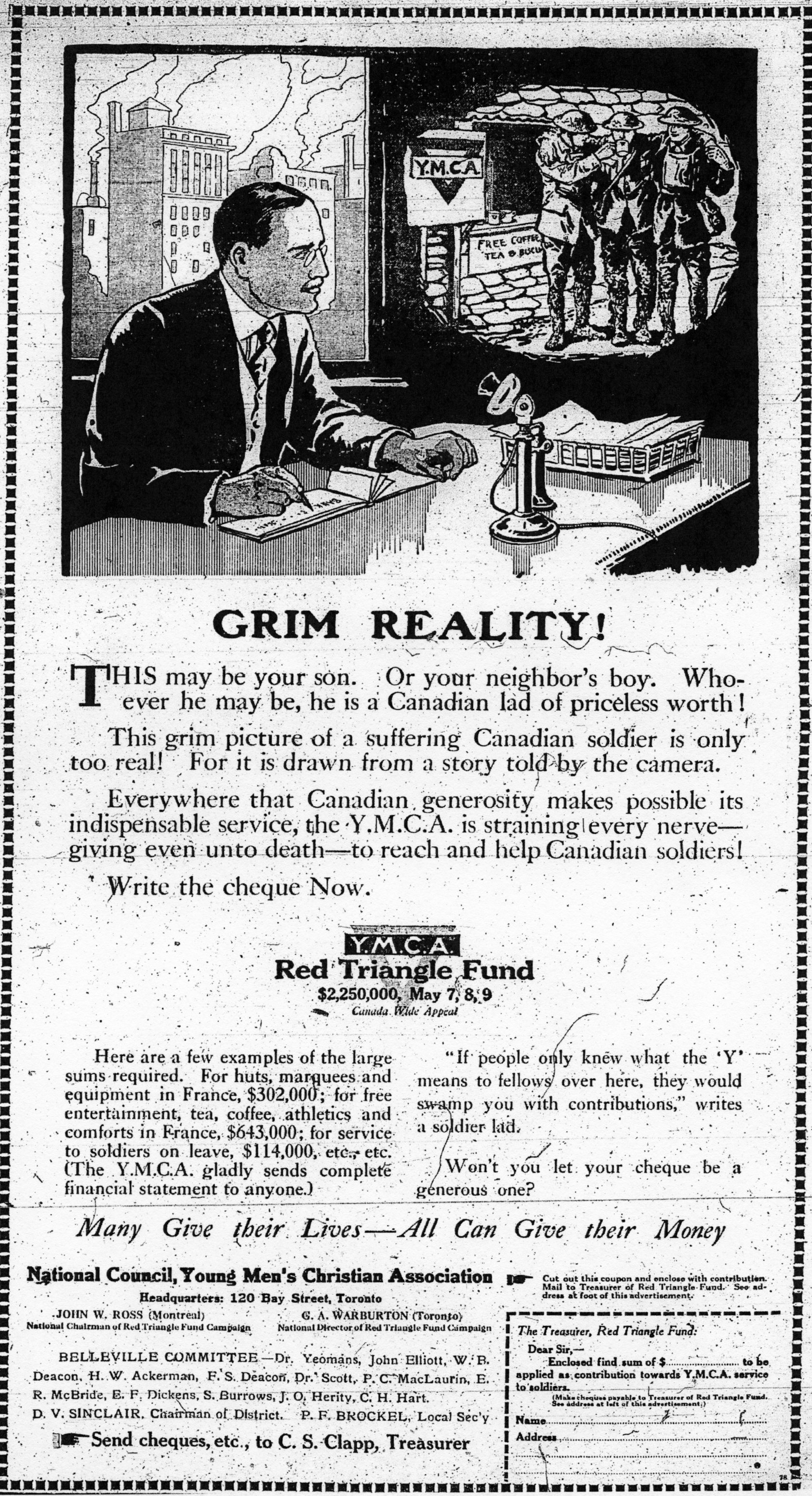
Ad for YMCA Red Triangle Fund“Grim Reality! This may be your son. Or your neighbor’s boy. Whoever he may be, he is a Canadian lad of priceless worth! This grim picture of a suffering Canadian soldier is only too real! For it is drawn from a story told by the camera.

Everywhere that Canadian generosity makes possible its indispensable service, the Y.M.C.A. is straining every nerve—giving even unto death—to reach and help Canadian soldiers!

Write the cheque Now. Y.M.C.A. Red Triangle Fund.”

The Intelligencer May 7, 1918 (page 5)

“Died of Wounds. In the Canadian casualty list today appears the name of Private G. F. Sprackett, of Gilmour, Hastings County, who died of wounds. The young hero was a member of the 254th Battalion, which was mobilized in this city.”

[Note: Private George Francis Sprackett died on April 23, 1918. He is commemorated on Page 505 of the First World War Book of Remembrance.]

The Intelligencer May 7, 1918 (page 5)

“Belleville’s Honor Roll. To the Editor of The Intelligencer. Dear Sir,—Not forgetting honors won by Ketcheson, Johnson and others, Belleville may indeed be proud on reading the last issue of the Canadian Military Gazette to find the record on one page of no less than four of our own boys who the ‘King has delighted to honor.’

Major Edison Franklin Linn, already Military Cross, has D.S.O. added to his distinctions and is in command of his corps of Engineers. Major William Riordan of the Field Artillery received his D.S.O. Major John Ham Sills of the Infantry is also awarded the D.S.O. and Lieut. Stanley Burritt Iler of the Engineers is awarded the Military Cross.

Can any city of our size show such a splendid record in one month? Are we at home living up to the lead given by these splendid men, patient and chivalrous in service and sacrifice. Yours truly, W. N. Ponton.”

100 Years Ago: Poster for Y.M.C.A. Red Triangle Fund

The Intelligencer May 6, 1918 (page 3)

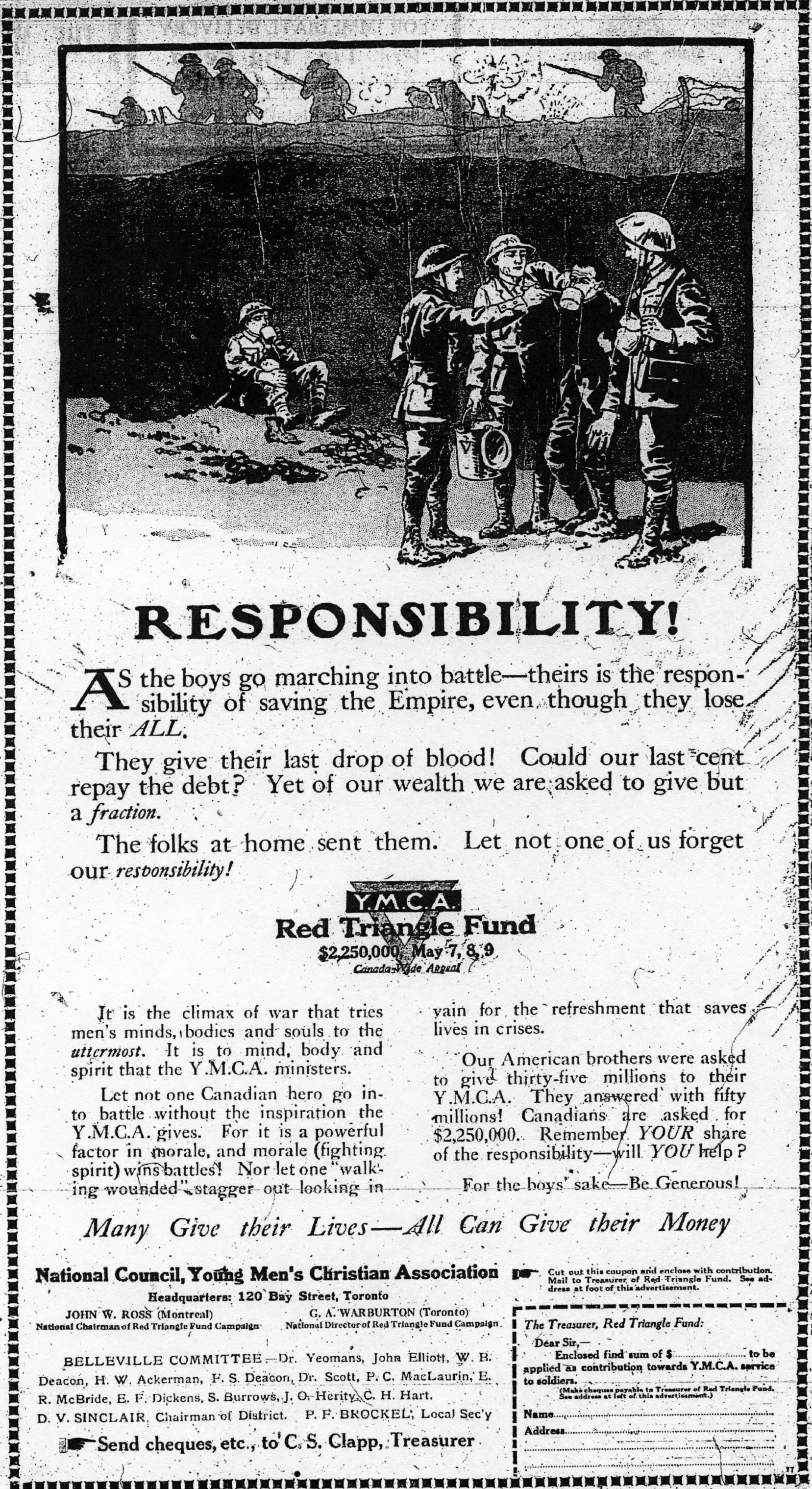
Ad for YMCA Red Triangle Fund“Responsibility! As the boys go marching into battle—theirs is the responsibility of saving the Empire, even though they lose their ALL. They give their last drop of blood! Could our last cent repay the debt? Yet of our wealth we are asked to give but a fraction.

The folks at home sent them. Let not one of us forget our responsibility!

Y.M.C.A. Red Triangle Fund. For the boys’ sake—Be Generous!”

Nurses of World War I: Mary Graham

Mary Graham was born at the farm house near Elmvale, Simcoe County on February 7, 1887 daughter of Richard Graham and Agnes Ritchie.

Mary attended the local schools where she completed grade 9, worked on the family farm and then worked as a nanny for a minister in Toronto. She was a graduate of the Nursing School at the Montreal Western Hospital in 1913 and enlisted in the Canadian Army Medical Corps on April 14, 1915 at Quebec.

Nurse Graham in France

Height:  5’ 4”

Weight:  130lb

Age: 28 (stated age: 27)

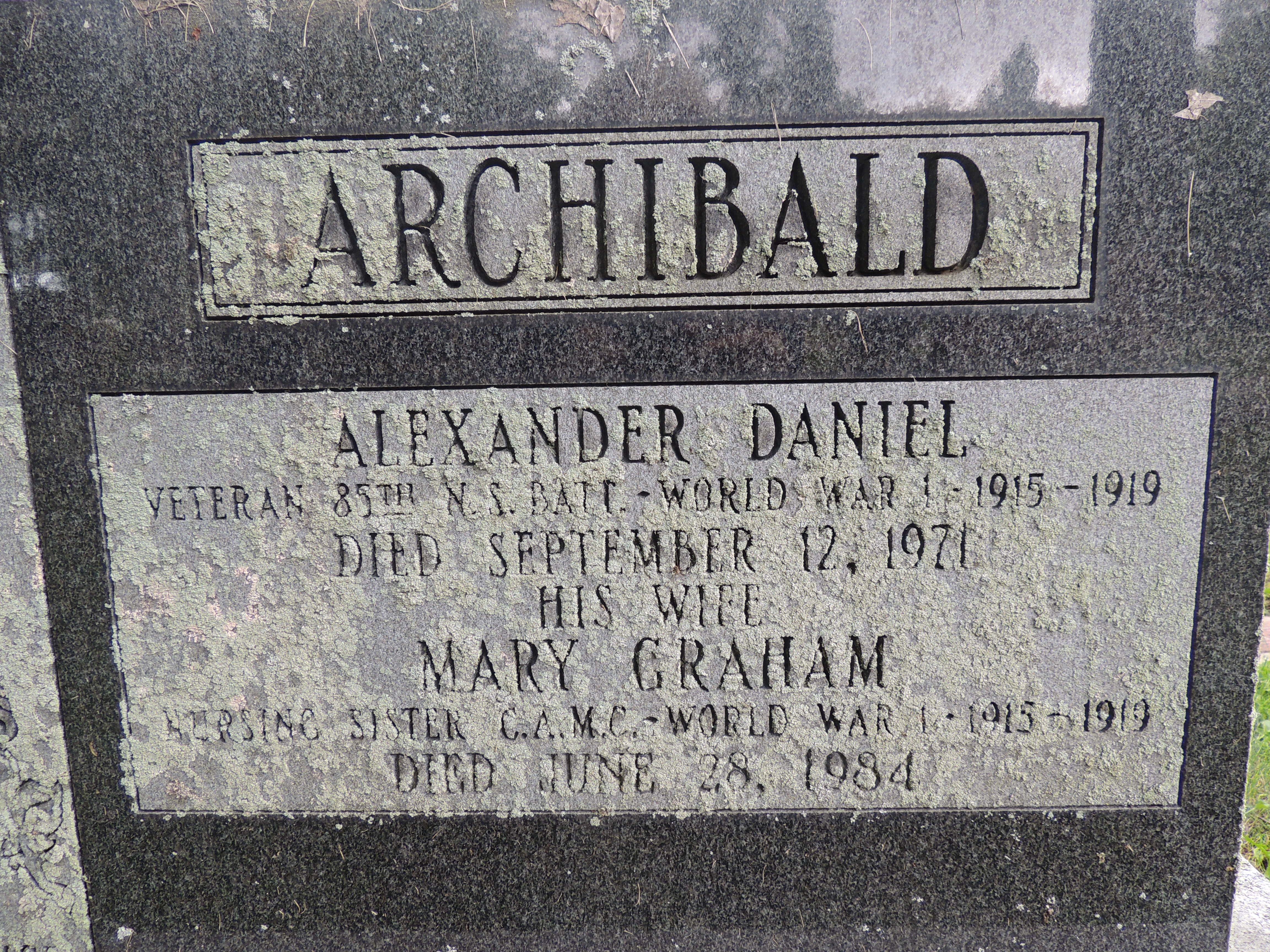
Nursing Sister Graham served at the Imperial Stationary Hospital and Canadian General Hospital in Rouen and Étaples, France and in December 1917 was transferred to the West Cliff Eye and Ear Hospital in Folkestone, England; here she was admitted in March 1918 for treatment of influenza. During her time in France Miss Graham met a theology student and non-commissioned soldier, Alexander Archibald, with whom she was united in marriage on March 12, 1919 at Basingstoke, England. He had risen to the rank of Captain, was wounded at the Battle of Cambrai and suffered an amputation of his right leg. Mrs. Archibald returned to Canada setting sail on March 25, 1919 aboard the S.S. Scotian and was discharged on April 18, 1919.

Alexander Archibald and Mary Graham

Captain Archibald required convalescence at the Christie Street Hospital in Toronto following which he trained as a teacher at the Ontario College of Education. In 1925 they moved to Belleville where he taught at the old Belleville High School and the new Belleville Collegiate Institute and Vocational School. Mary served as a nurse at the Red Cross Blood Donor Clinic, helped organize the Young Women’s Guild and was a member of the School for Leisure, an organization which helped women in strained circumstances learn to keep house. They resided at 180 Dufferin Avenue.

180 Dufferin Avenue, Belleville

Mary Archibald died at Belleville on June 28, 1984 aged 97 years 4 months 21 days. She is interred at the Belleville Cemetery Section G Row 8 Grave 17.

Grave marker for Mary Graham

100 Years Ago: Nineteen-Year-Olds Called to Colors, Ad for Merchants Bank of Canada, Aura Lee Club Donation, Lt. E. L. McConnell Returned Home, Intelligencer Printers Join Up, Tea Drinkers Hit with Tax, G.T.R. Gives Employees’ Families Passes, No Candy-Making at Home, Poster for Y.M.C.A. Red Triangle Fund

The Intelligencer May 4, 1918 (page 1)

“Nineteen-Year-Olds Are Called to the Colours. Special Despatch to The Intelligencer, Canadian Press, Limited. Ottawa. A Government proclamation has been issued calling upon nineteen-year-old men to register for military service before June 1st: but they will not be called to the colors before July 1st. The previous minimum age was twenty.”

The Intelligencer May 4, 1918 (page 3)
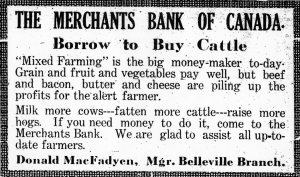
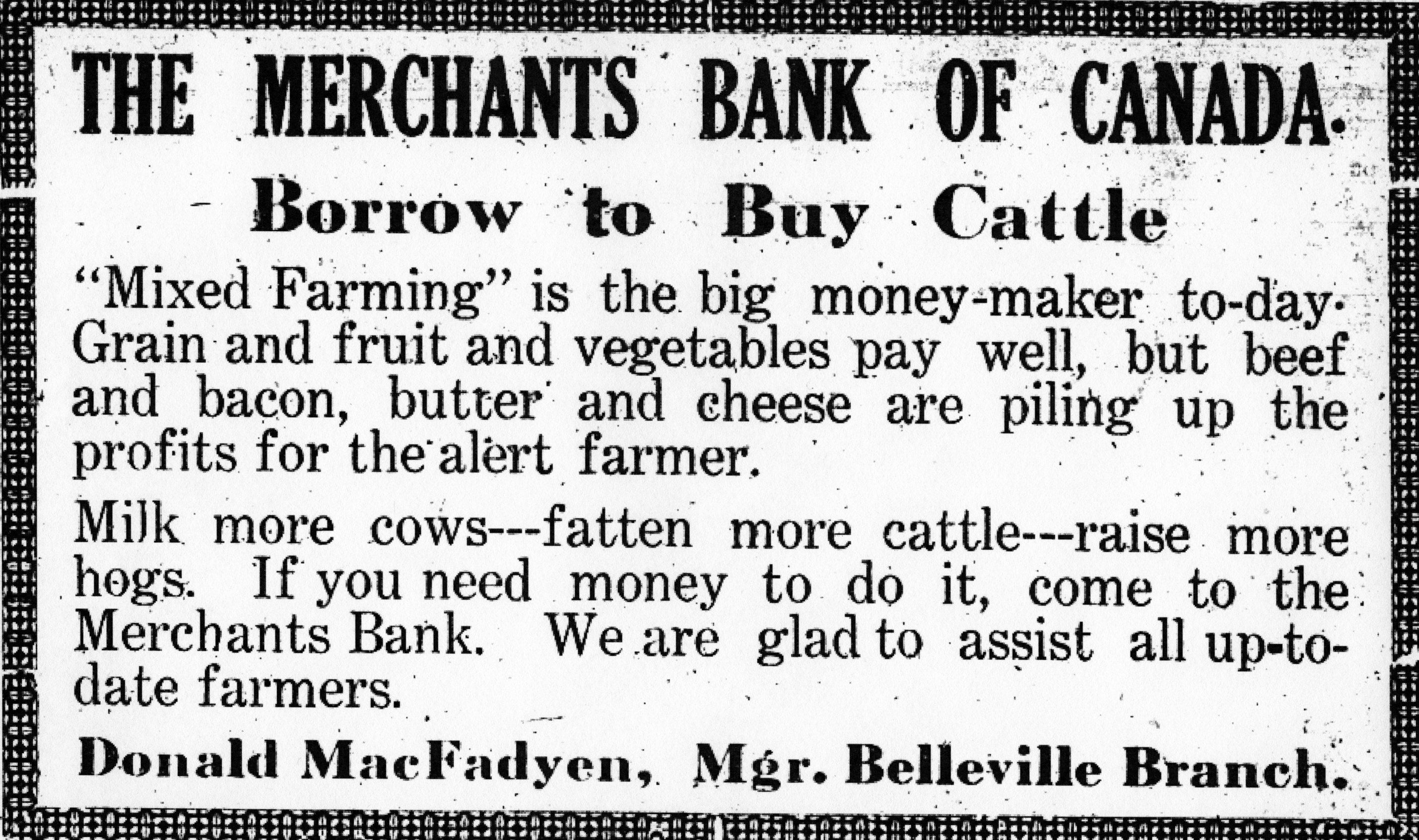
Ad for Merchants Bank of Canada“The Merchants Bank of Canada. Borrow to Buy Cattle. ‘Mixed Farming’ is the big money-maker to-day. Grain and fruit and vegetables pay well, but beef and bacon, butter and cheese are piling up the profits for the alert farmer.

Milk more cows—fatten more cattle—raise more hogs. If you need money to do it, come to the Merchants Bank. We are glad to assist all up-to-date farmers.

Donald MacFadyen, Mgr. Belleville Branch.”

The Intelligencer May 4, 1918 (page 5)

“The Aura Lee Club have donated ten dollars toward the Canadian War Contingent Association, and also ten dollars to the Great War Veterans Association, Belleville Branch. This patriotic action of the young men, who comprise this club, is very much appreciated by the recipients.”

The Intelligencer May 4, 1918 (page 5)

“Lt. E. L. McConnell, of Springbrook, Rawdon Township, returned home on leave recently with his wife, a Scotch lassie, whom he married in Edinburgh. He enlisted with the 59th Battalion, and has been overseas for two years and a half. Lt. McConnell’s father, Mr. Thos. C. McConnell, is still in Scotland, where he has been for some time in connection with a Forestry Battalion.”

The Intelligencer May 4, 1918 (page 5)

“Printers Join Up. Evan Barlow and Jack McKnight, of The Intelligencer staff, both expert linotype operators, report for military duty at Kingston Monday. They were preceded by Lorne Young, an expert job printer, and the trio will join up with a goodly representation of Intelligencer boys already overseas.

The holes in the staff caused by the recent call to service forces additional work and worry upon the management and staff, but ‘Carry On’ is the word and The Intelligencer goes on just the same.”

The Intelligencer May 4, 1918 (page 5)

“Tea Drinkers Hit Hard. ‘The new tax will be no harder on the smoker of cigarettes than on the hundreds of women who drink tea,’ said a lady who takes a studious interest in public affairs. The cigarette-smoker has aired his grievance—he is hit much harder than the chap who can afford cigars—but what of the extensive consumers of tea, which is being taxed almost as heavily as tobacco.

There are, according to this lady, women everywhere who live practically on tea and bread and butter, and who, at a time when food is scarce, will instinctively turn for nourishment to their old friend, the tea-pot. Tea has become a tremendous factor among women who find it difficult to make ends meet, and it is by these that the tax on that commodity will be felt most.

She did not disagree with the new system of taxation—rather the reverse—she expressed the opinion that there are many luxuries which might have been taxed before tea and tobacco, such as expensive articles of wearing apparel, etc., which are, to a certain extent, extravagance.”

The Intelligencer May 4, 1918 (page 5)

“Patriotic Passes. The Grand Trunk have issued a circular to the men advising them that the families of all employees who have volunteered, or who have been drafted for military service, will be granted passes over any part of the system.”

The Intelligencer May 4, 1918 (page 6)

“No Candy-Making At Home Permitted. Ottawa. There is some confusion as to the new order of the Canada Food Board in regard to the home manufacture of candies and pastry. The manufacture of candy is prohibited. The order in regard to pastries and cakes reads as follows: ‘No person shall make in Canada, for private use, French pastries, iced cakes or biscuits, or cakes with cane sugar between the layers or added to the exterior.’

Just how the Food Board proposes to enforce these regulations is not clear. It is presumed that the Board will depend largely upon the patriotism of the housewives of Canada. …  Housewives need not, however, be alarmed as to the effect of the Food Board’s new order regarding sugar upon the preserving and canning of fruit during the coming season. While the order states that no householder shall have on hand at one time more than fifteen days normal supply, that normal supply varies, and is much larger in the canning season than in the winter months. ‘It was for the purpose, among other things,’ declared a member of the Board today, ‘of conserving sugar for the preserving season that the order was promulgated.’ ”

The Intelligencer May 4, 1918 (page 10)
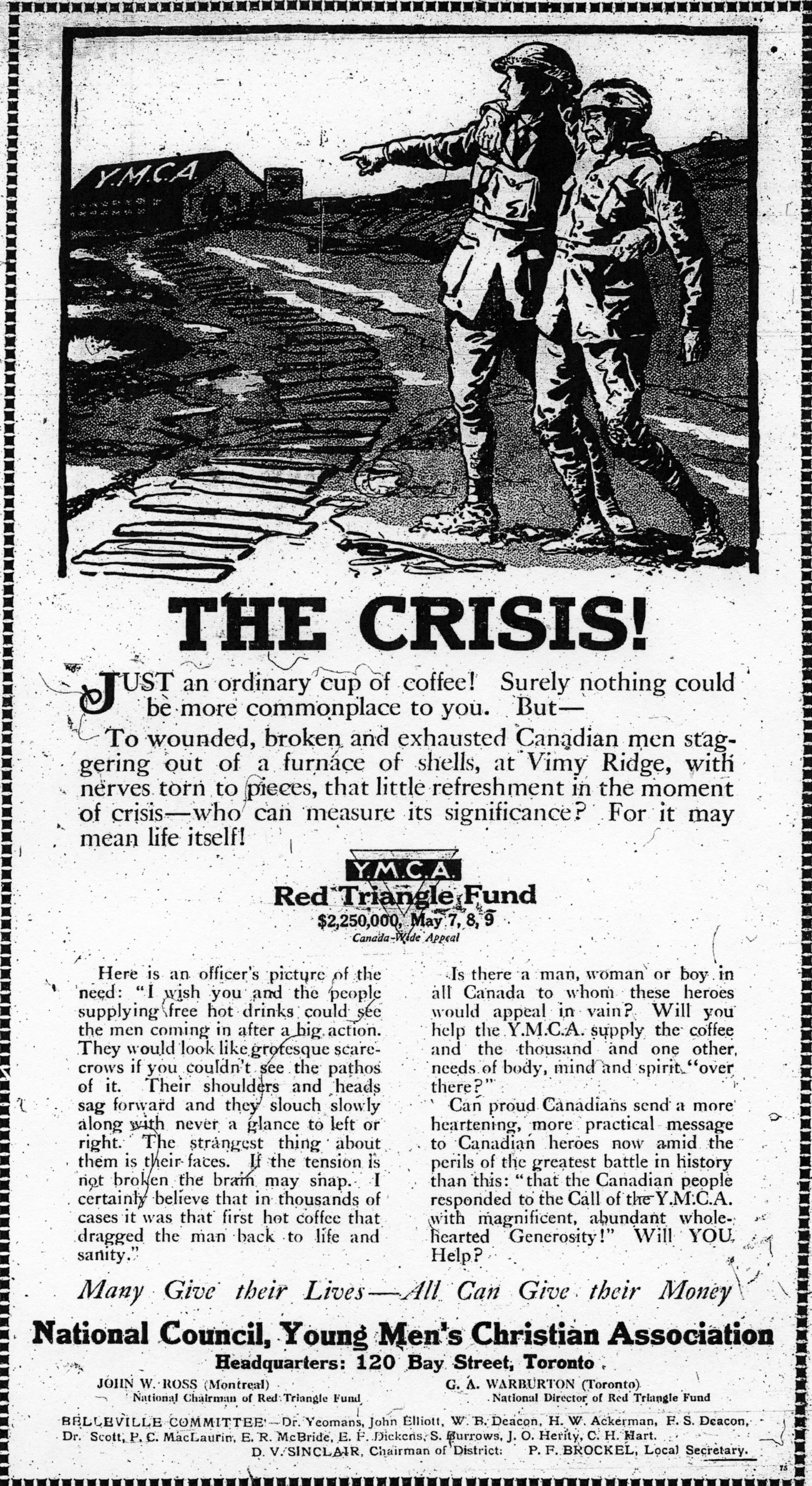
Ad for YMCS Red Triangle Fund“A Historic Hour! Everything that we have, and are, and hope for, hangs upon the welfare of that human wall of the bravest of the brave—battling ‘over there’ for us at home.

Remember, the flower of Canada’s youth is in the midst of danger! Canada’s future rests upon the shoulders of those boys—to us they are priceless!

Y.M.C.A. Red Triangle Fund. $2,250,000, May 7, 8, 9. Canada-Wide Appeal.

Belleville Committee—Dr. Yeomans, John Elliott, W. B. Deacon, H. W. Ackerman, F. S. Deacon, Dr. Scott, P. C. MacLaurin, E. R. McBride, E. F. Dickens, S. Burrows, J. O. Herity, C. H. Hart. D. V. Sinclair, Chairman of District. P. F. Brockel, Local Secretary.”
100 Years Ago: Planning the Garden, Poster for Y.M.C.A. Red Triangle Fund, Willard Storms Is Buried in Bancroft

The Intelligencer May 3, 1918 (page 3)

“War Garden Bulletin. Planning the Garden. In planning the 1918 garden the first thing to take into consideration is the fact that it is a war-time garden and that the vegetables which must receive primary attention are those which are going to be genuine substitutes for wheat. The local substitute is the potato. Therefore, everyone should grow potatoes this year. They repay themselves over and over again. Count on giving them the major part of the garden.”

The Intelligencer May 3, 1918 (page 5)

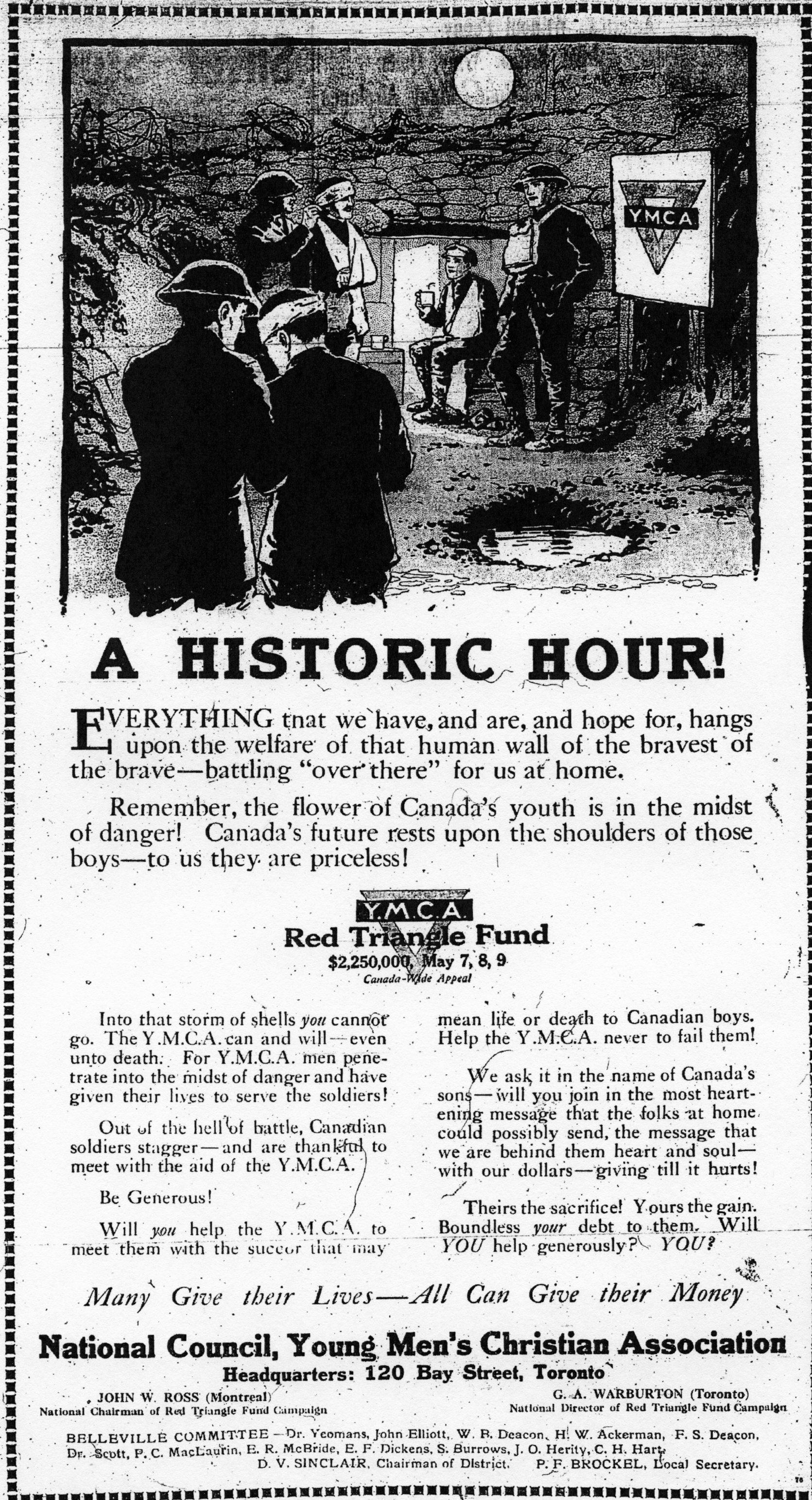
YMCA Red Triangle Fund poster“The Crisis! Just an ordinary cup of coffee! Surely nothing could be more commonplace to you. But—

To wounded, broken and exhausted Canadian men staggering out of a furnace of shells, at Vimy Ridge, with nerves torn to pieces, that little refreshment in the moment of crisis—who can measure its significance? For it may mean life itself!

Y.M.C.A. Red Triangle Fund. $2,250,000, May 7, 8, 9 Canada-Wide Appeal.

Many Give Their Lives—All Can Give their Money.”

The Intelligencer May 3, 1918 (page 7)

“Death of Pte. Storms. Private W. Storms, of Bancroft, died on Sunday last at the Kingston General Hospital, after being ill for some time with lung trouble. On Wednesday afternoon the body was interred at Mount Pleasant cemetery, Bancroft. The services in St. Paul’s Church and at the grave were conducted by Rev. Dr. Cracey of Kingston, and there was a large turnout of citizens to pay a tribute of respect to a brave soldier who sacrificed his life for his country.

Among the floral offerings was a beautiful wreath contributed by the Girls’ Club. The deceased went overseas with the 155th Battalion. He was invalided home last fall, and had been in the hospital for several months. He was thirty-six years of age, and is survived by a widow and two children.”

[Note: Private Willard Storms died on April 20, 1918. He is commemorated on Page 508 of the First World War Book of Remembrance.]