100 Years Ago: Letter of Sympathy for Alexander Beaton’s Mother, Obsequies: Joseph Longden, Women Needed to Care for Influenza Families, Called by Death: Violet May Sanderson, Poster for Victory Loan, Doctor Prepares Vaccine, Queen’s University Closes, Andrew Baxter Hall Wounded, Christmas Boxes for Overseas

The Intelligencer October 18, 1918 (page 1)

“Letter of Sympathy From Major Vandewater. Mrs. F. Beaton, 350 Bleecker Avenue, city, has received the following letter from Major R. Vanderwater, in connection with the death of her soldier son, Pte. Alexander Beaton, killed in action on September 2.

In the Field, Sept. 21st, 1918. Mrs. F. Beaton, 350 Bleecker Avenue, Belleville, Ontario, Canada. Dear Madam,—No doubt previous to receipt of this letter you have received the official notification of the death of your son, No. 455096, Pte. A. Beaton. During the period of his connection with the Battalion he, by his unassuming manner and the willingness in which all duties for which he was selected were carried out, won high commendation of his officers and respect of his comrades.

His supreme sacrifice for the great cause for which we fight was a matter of great sorrow among his many friends here who join with me in the expression of sincere sympathy for you in your bereavement. Yours in sympathy, R. Vanderwater, Major, O.C., 2nd Canadian Infantry Battalion, Eastern Ontario Regiment.”

The Intelligencer October 18, 1918 (page 2)

“Obsequies. ‘Joseph Longden. Many were yesterday afternoon in attendance at the funeral of the late Mr. Joseph Longden of this city. At the family residence, 218 George Street, Rev. Dr. Scott of Bridge Street church, and Rev. J. Capman, of Picton, conducted an impressive service. Interment took place at Belleville cemetery. Many floral designs were contributed by friends. The bearers were: Messrs. N. Hall, W. Rickley, E. Hicks, F. Wheeler, B. Gerow and W. A. Walsh.’ ”

[Note: Age: 30 years, 9 months. Cause of death: Influenza-Pneumonia.]

The Intelligencer October 18, 1918 (page 2)

“Notice. Meeting of ladies of the city is called for this evening at 8 p.m., in Y. M. C. A. Parlors, to consider what can be done to procure volunteers, nurses and assistants to help those families who are suffering from influenza, and are in need of help. Any one interested is welcome to attend and organize for the work. Any persons not able to attend this meeting and who are able to help will please send their name and address to the Y.M.C.A. A. McGie, Chairman Belleville Board of Health.”

The Intelligencer October 18, 1918 (page 2)

“Called by Death: ‘Violet M. Sanderson. Miss Violet May Sanderson, nurse in training at the Belleville Hospital, passed away at noon to-day from an attack of pneumonia. Deceased had been in training at the hospital here since June of last year and was exceedingly popular with the staff and public.

She was 22 years of age, and was born at Peterboro, being a daughter of Mr. and Mrs. Alexander Sanderson. She was a member of the Baptist church. In addition to the parents two brothers and three sisters survive. The brothers are Clayton and Harvey at home, and the sisters are Mrs. Joseph Bullied and Misses Ruby and Leita, all of Peterboro. The body was taken to Tickell & Sons undertaking establishment, where it was prepared for burial and this evening was shipped to Peterboro.’ ”

The Intelligencer October 18, 1918 (page 4)
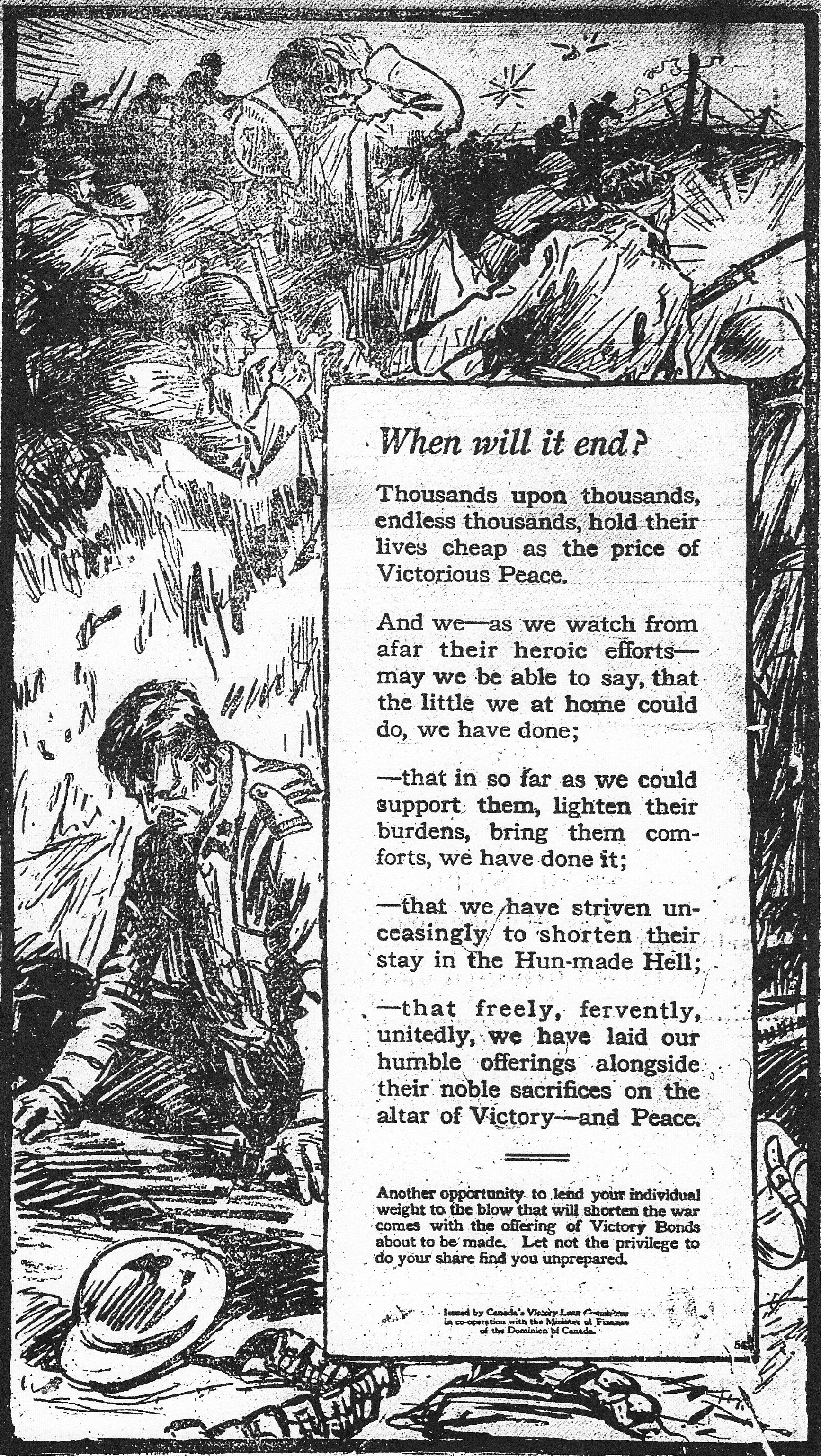
Poster for Victory Loan“When will it end? Thousands upon thousands, endless thousands, hold their lives cheap as the price of Victorious Peace.

And we—as we watch from afar their heroic efforts—may we be able to say, that the little we at home could do, we have done.

Another opportunity to lend your individual weight to the blow that will shorten the war comes with the offering of Victory Bonds about to be made. Let not the privilege to do your share find you unprepared.

Issued by Canada’s Victory Loan Committee in co-operation with the Minister of Finance of the Dominion of Canada.”

The Intelligencer October 18, 1918 (page 7)

“Growing Spanish Germs. Dr. G. B. Reed, assistant professor of botany, and lecturer in bacteriology at Queen’s University, believes he has isolated the Spanish influenza germ. He is growing the germs by millions and has prepared a vaccine with which he has already inoculated some two hundred persons with good results. Each cubic centimetre of the serum contained about a thousand million germs, and about three thousand cubic centimetres was used yesterday.”

The Intelligencer October 18, 1918 (page 7)

“Queen’s University Closes. Theatres, schools and churches in Kingston are closed and hospitals and dispensaries are closed to visitors. The local medical and surgical faculty will place at the General Hospital fifth year medical students, who will be given power to attend cases. Queen’s University closed its doors at noon yesterday and has postponed the annual convocation.”

The Intelligencer October 18, 1918 (page 7)

“Driver Hall Wounded. Mrs. A. B. Hall has received word that her husband, Driver A. B. Hall has been wounded in the left arm. He left here with the 80th Battalion and was employed as fireman on the G. T. R. previous to enlisting. His wife and child are now in Hamilton.”

The Intelligencer October 18, 1918 (page 8)

“Wanted. The Quinte Chapter I.O.D.E. is preparing Xmas boxes for Belleville boys overseas. Will friends kindly leave names and correct addresses with Mrs. (Dr.) Dolan, 17 Victoria Ave., or office Y.M.C.A.”

100 Years Ago: Letter of Sympathy for William Woods’s Wife, Poster for Victory Loan, Kenneth Livingstone MacMillan Gassed, Sailors’ Relief Fund, Women Wanted to Help Nurses, Cecil Everett Brown Killed in Action, Called by Death: Mary Winnifred Losee, Keitha Keller, Harry Bolton, Florence Wickett, Clesson John Dickinson, Newbold D. Carter, Esther Newberry, Arthur Eugene Wrightmeyer, Woolworth’s Cancels Sale Due to Flu

The Intelligencer October 17, 1918 (page 3)

“Minister of Militia Express Sympathy. Mrs. S. Woods, who resides at 20 Water Street, received the following letter from the Minister of Militia and Defence. It is in connection with the death of her husband, who was killed in action on Sept. 2nd. Ottawa, Oct. 11, 1918.

Dear Mrs. Woods,—I desire to express to you my very sincere sympathy in the recent death of your husband, No. 1027643, Private William Woods, Canadian Expeditionary Force, who, in sacrificing his life at the front in action with the enemy, has rendered the highest service of a worthy citizen.

The heavy loss which you and the nation have sustained would indeed be depressing were it not redeemed by the knowledge that the brave comrade for whom we mourn performed his duties fearlessly and well as became a good soldier, and gave his life for the great cause of Human Liberty and the Defence of the Empire.

Again extending to you in your bereavement my condolence and heartfelt sympathy, I am, Yours faithfully, S. C. Mewburn, Minister of Militia and Defence.”

The Intelligencer October 17, 1918 (page 6)

Poster for Victory Loan“Armed to the teeth. The Canadian Army is fully equipped for War. Canada’s war loans have made the glory of the Canadian Army possible—they have been Victory Loans in fact, as well as in name.

It is unthinkable, is it not, that our men should lack any implement of war that money will buy!

The money for the needs of our army will be provided by Canada’s Victory Loan, 1918. Canadians at home will see to that.

Issued by Canada’s Victory Loan Committee in co-operation with the Minister of Finance of the Dominion of Canada.”

The Intelligencer October 17, 1918 (page 7)

Kenneth McMillan

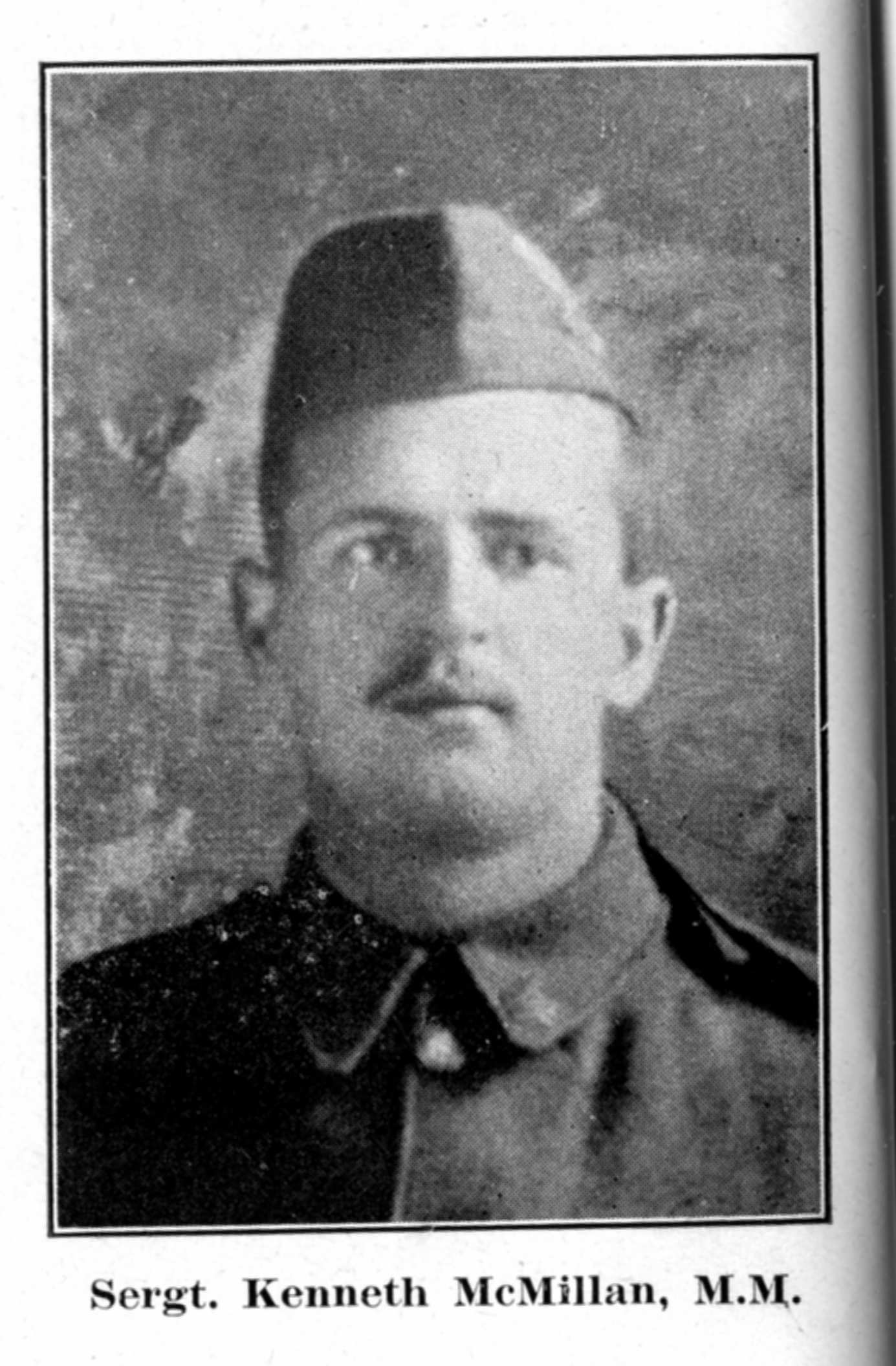
“Corp. K. L. MacMillan Gassed. Word has been received in this city from the Director of Records at Ottawa that Corp. Kenneth L. MacMillan had again been the victim of German gas and has been admitted to No. 30 Canadian Clearing Station. He was well known in Belleville and is a nephew of Mrs. Tower and Miss Bella MacMillan of 281 George St., city. Recently Corp. MacMillan had been awarded the Military Medal for gallantry on the field.”

The Intelligencer October 17, 1918 (page 7)

“Ladies Help Sailors. The Sailors Relief Fund has been further augmented by the sum of one hundred dollars voted by Quinte Chapter Daughters of the Empire, a check for which was received by Mr. Alex. Ray this morning. This brings Belleville contributions up to a total of two thousand, one hundred and fifty dollars.”

The Intelligencer October 17, 1918 (page 7)

“Women Workers Wanted. Requests are coming in to Adj. Trickey of the Salvation Army asking for help from women of the city to give one or two hours a day either assisting the nurses or doing a little work in the homes where the whole family is ill. If any person who can give a little time either gratuitously or for pay, will phone at once to the Adjutant at 603 it will be greatly appreciated. Everyone should unite in an effort to fight the ‘Flu’ to a finish.”

The Intelligencer October 17, 1918 (page 7)

“Pte. Everett Brown Killed. Mr. and Mrs. Egbert G. Brown, residing at 36 Sinclair street, city, this morning received the sad message from the Director of Records that their son, Private Everett Brown was killed in action on September 28th. Private Brown, who was 23 years of age, enlisted and went overseas with a battalion from this city. He had been in the trenches about 2 months, when he met his death. The bereaved parents will receive the heartfelt sympathy of all citizens.”

The Intelligencer October 17, 1918 (page 7)

“Called by Death. The influenza epidemic has been responsible for a number of deaths in this city and vicinity during the past few days and to-day the list was added to.

‘Mrs. Warner Losee. Mrs. Warner Losee passed away yesterday at the home of her brother-in-law, Mr. Joseph Losee, 112 Pinnacle street, city. Deceased was 31 years of age and was a member of St. Michael’s Church. Pneumonia was the cause of death. Besides her husband four small children survive.’

‘Keitha Keller. Miss Keitha Keller, a daughter of Mr. Ryan Keller, residing at Canifton, passed away this morning. Deceased was about 23 years of age and had been ill for some days. She was a young lady who was well known and had many friends who will regret to learn of her demise.’

‘Pte. Bolton. Pte. Harry Bolton, a member of the First Depot Battalion, stationed at this city, died this morning. Deceased was 22 years of age, and his home was at Peterboro, where the body was this afternoon taken for interment after being prepared for burial at Tickell & Sons undertaking establishment.’

[Note: Private Harry Bolton died on October 17, 1918. He is commemorated on Page 370 of the First World War Book of Remembrance.]

‘Florence Wickett. At Niagara Falls, N.Y., last evening Miss Florence Wickett, aged 26 years, daughter of Mr. George Wickett, of Foxboro. Deceased was a nurse-in-training at a hospital at Niagara Falls and was a victim of the Flu. She was a popular young lady and highly esteemed by all who knew her. The body will be brought to Foxboro for interment.’

‘Sergt.-Major Dickinson. Sergt.-Major J. C. Dickinson, who was attached to the First Depot Battalion in this city, died here last evening. The body was taken to Tickell & Sons undertaking establishment where it was prepared for burial and shipped to St. Mary’s, Ont. Deceased was 20 years of age, and was born at Perth, being a son of Mr. John Dickinson of that place.’

[Note: Company Sergeant Major Clesson John Dickinson died on October 16, 1918. He is commemorated on Page 397 of the First World War Book of Remembrance.]

‘Newbold D. Carter. After an illness of a few days from an attack of pneumonia, Mr. Newbold D. Carter of Deseronto, died yesterday. Deceased was a popular shoe merchant and was a son of Mr. T. N. Carter of Trenton, Ont., and a nephew of W. W. Carter, lumber merchant of Toronto. He is survived by his wife and four young children. Mr. Carter had been identified with the shoe business in Deseronto for the last twenty years.’

‘Mrs. Robt. Newberry. Mrs. Robt. Newberry, who died in St. Louis, and whose remains were interred in the Belleville cemetery upon the 15th inst., was Miss Esther Benjamin, eldest daughter of the late George Benjamin, and in whose office the late Sir Mackenzie Bowell became an apprentice, and subsequently publisher of The Intelligencer. Miss Benjamin married the late Robert Newberry, teacher of the High School here and who was most popular and highly esteemed. Mrs. Newberry always exhibited great love for her native city. She has left three sons and three daughters. Her sisters, Mrs. E. F. Milburn, Mrs. MacDonald and Mrs. Shaw still survive.’

‘Arthur E. Wrightmeyer. At an early hour this morning Mr. Arthur Eugene Wrightmeyer one of Belleville’s well-known citizens passed away at his late home on Octavia Street as the result of an attack of pneumonia. Deceased was born at Selby, Ont., and was 40 years of age and was a son of the late Mr. G. F. Wrightmeyer, and had resided in this city the greater portion of his life. By occupation he was a barber and conducted a successful business on Front Street. He was a member of The Belleville Lodge A.F. & A.M.  No. 123 and was also a member of the Orange Order.

Surviving are a widow and one daughter Miss Valiere, also one brother and three sisters. The brother, Mr. W. H. Wrightmeyer, conducts a grocery business in this city and the sisters are Mrs. Walter Luscombe and Mrs. F. Buckley of Belleville and Mrs. Arthur Watson of Toronto. Arthur as he was familiarly called was deservedly popular and his demise is sincerely regretted by a host of friends. To the bereaved will be extended the heartfelt sympathy of all friends.’ ”

The Intelligencer October 17, 1918 (page 8)

“Board of Health Public Notice. To comply with the order issued by the Medical Health Officer who has closed all places where large gatherings of people congregate, we have decided for the welfare of the public at large, to cancel our clerks’ profit-sharing sale which naturally would attract large crowds. F. W. Woolworth Co., Ltd.”


100 Years Ago: Spanish Flu Spreading Westward, Toronto Motormen Wanted, Ontario Emergency Volunteer Auxiliary to Recruit Nurses for Epidemic, Called by Death: Alfred Barriage, Poster for Volunteer Nurses, Poster for Construction Workers at Mohawk and Rathbun Camps

The Intelligencer October 16, 1918 (page 1)

“Spanish Influenza Is Now Spreading To Western Canada. Toronto. Indications that the epidemic of Spanish influenza in Canada is passing westward appeared to-day in despatches from various parts of the country. From Quebec and the Maritime Provinces where the disease first reached its height as far as Canada is concerned, reports came today to the effect that conditions are improving.

In Montreal and Toronto and other Ontario cities, the death rate continues heavy, but it has not increased during the past few days and the medical health authorities are hopeful that with the continuance of fine weather the disease may be checked.”

The Intelligencer October 16, 1918 (page 3)

“Motormen and Conductors Wanted. Steady positions. Ten Days’ Training. New men earn an average of $90. per month. Others make from $70. To $110. per month.

The war will soon be over. Make preparation for the future.

The Toronto Railway Company, 165 Front Street East, Toronto.”

The Intelligencer October 16, 1918 (page 4)

Poster for volunteer nurses“Volunteer Army To Fight Epidemic. ‘The Ontario Emergency Volunteer Auxiliary,’ an organization that through branches in all parts of the province will endeavor to cope with the influenza epidemic, is one result of the conference of interested bodies held at the Parliament Buildings yesterday morning.

The Voluntary Auxiliary will at once begin to recruit volunteer nurses who will act as assistants to professionals or, with such training as can be given them, be sent into private homes to take care of the sick. These volunteers will be given a badge bearing the name of the association and the letters S.O.S. (Sisters of Service). Direction will be given to their work by a series of three lectures to be given on Tuesday and Wednesday dealing with the care of influenza patients. These lectures will be recorded in full and placed at the disposal of the volunteers.

Following the organization of the association yesterday telegraphic reports of the action taken were sent to the authorities of cities and towns in Ontario where the disease has put in appearance. These places will be encouraged to form local branches at once to recruit volunteer nurses and copies of the lectures will be sent to them by wire.”

The Intelligencer October 16, 1918 (page 5)

“Called by Death: Alfred Barriage. At an early hour this morning Alfred Barriage, second son of Mr. and Mrs. Cyrus Barriage, of this city, passed away after a few days’ illness. Deceased was 19 years of age and was born at Bath. He was a machinist and had been employed at Marsh and Henthorne’s plant. He was a member of St. Michael’s Church and a young man who had many friends. In addition to the parents five brothers and three sisters survive. The brothers are Leo, Harold, Kenneth, Gerald and James and the sisters are Emma, Mary and Kathleen.”

The Intelligencer October 16, 1918 (page 5)

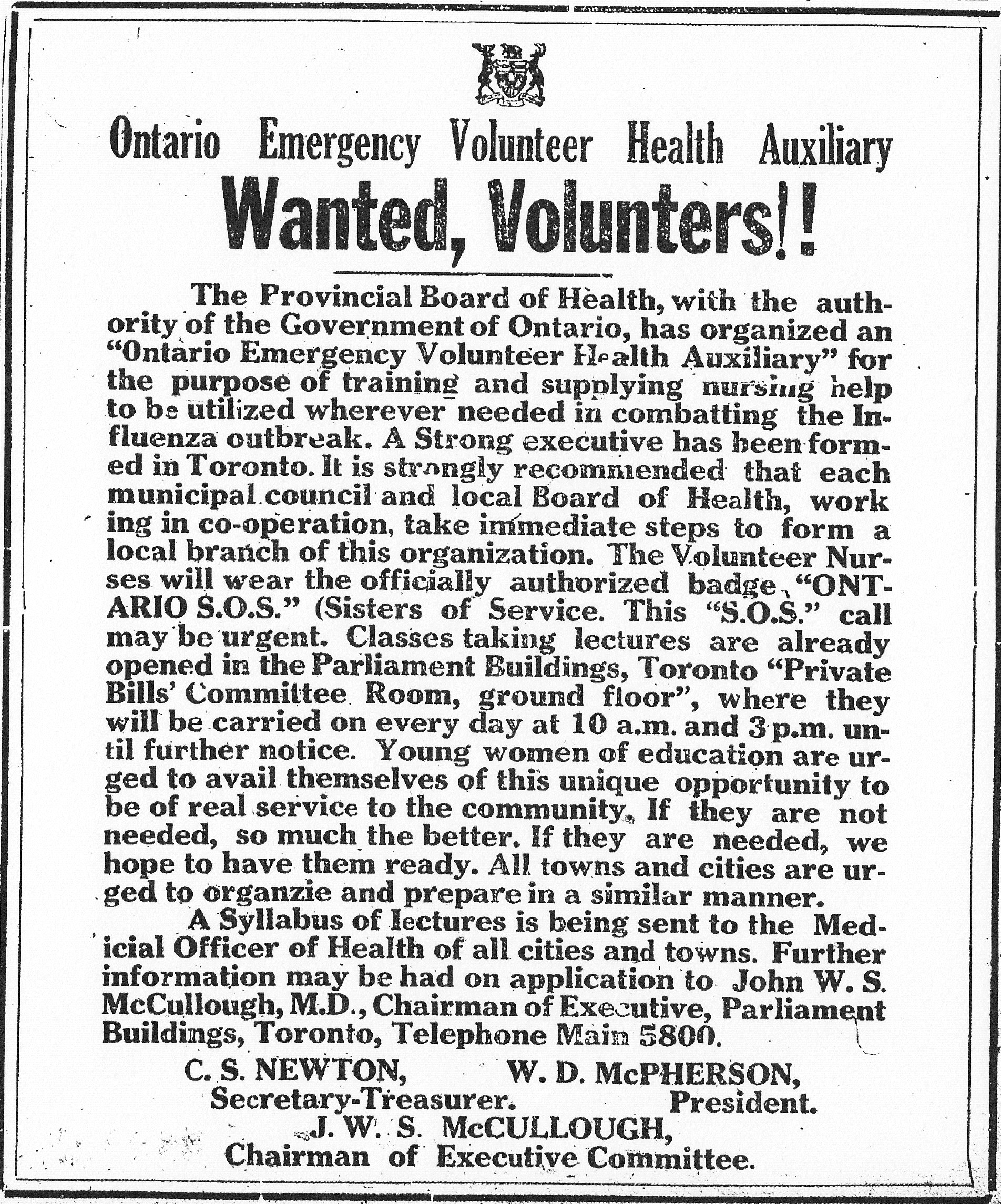
“Ontario Emergency Volunteer Health Auxiliary. Wanted, Volunteers!

The Provincial Board of Health, with the authority of the Government of Ontario, has organized an ‘Ontario Emergency Volunteer Health Auxiliary’ for the purpose of training and supplying nursing help to be utilized wherever needed in combatting the Influenza outbreak.

The Volunteer Nurses will wear the officially authorized badge ‘Ontario S.O.S.’ (Sisters of Service). This ‘S.O.S.’ call may be urgent.

Young women of education are urged to avail themselves of this unique opportunity to be of real service to the community. If they are not needed, so much the better. If they are needed, we hope to have them ready.

All towns and cities are urged to organize and prepare in a similar manner.”

The Intelligencer October 16, 1918 (page 6)

“Imperial Munitions Board. Wanted—For construction work, Mohawk and Rathbun camps.

Steamfitters—Union wages; Sunday work; board six dollars per week. Fare refunded after 3 weeks.

Laborers—Wages 40 cents; Sunday work time and a half; board six dollars a week. Free fare after 3 weeks.

Labor Foremen—Three good labor foremen wanted. Wages 60 cents.

Apply to Westropp Armstrong, Resident Engineer, Deseronto.”


100 Years Ago: Boys Return to Farms, Harold Loadsman Invalided Home, Three Depot Battalion Soldiers Die of Pneumonia, Poster for Victory Loan, Raisins Not Allowed into Canada, No Spitting Strictly Enforced, Ralph Leavitt Killed in Action, Harvey Wheeler Twice Wounded, William Henry Lucas Gassed, Francis Leo Murray Wounded, Herbert John Oscar Collyer Wounded, Public Gatherings Banned in Belleville

The Intelligencer October 15, 1918 (page 2)

“Boys for the Farms. With the closing of the schools on account of the influenza epidemic many of the boys engaged during the summer on farms as Soldiers of the Soil will return to farm labor. Mr. Brockel, Secretary of Belleville Y. M. C. A. will be glad to put farmers in touch with boys willing to resume farm work.”

The Intelligencer October 15, 1918 (page 2)

“Invalided Home. Lance-Corporal Loadsman, youngest son of Mr. and Mrs. G. Loadsman of Herkimer Ave., Belleville, arrived here on the 10th of October, being invalided home. On Saturday he entertained a number of friends and had a most enjoyable evening. Their oldest son George Loadsman, is still serving in France.”

The Intelligencer October 15, 1918 (page 2)

“Three Soldiers Pass Away. Within the past 48 hours three members of the Depot Battalion stationed in Belleville have answered the final roll call. Yesterday Pte. W. J. Griffin passed away and this morning Ptes. Cyril Henry Cox and George Edwin Dillow died. The latter two are cousins and they came from McKee’s Port, Pennsylvania. In both cases the mothers of the boys were here when the end came. Pneumonia was the cause of death in all cases.”

[Note: Private William John Griffin died on October 15, 1918. He is commemorated on Page 420 of the First World War Book of Remembrance.]

[Note: Private Cyril Henry Edward Cox died on October 15, 1918. He is commemorated on Page 390 of the First World War Book of Remembrance.]

[Note: Private George Edward Dillow died on October 14, 1918. He is commemorated on Page 398 of the First World War Book of Remembrance.]

The Intelligencer October 15, 1918 (page 5)

“What last year’s Victory Loan achieved. Last year the people of Canada lent the nation $425,000,000 by buying Victory Bonds. And because Canada now needs more money and will presently ask the people to lend it, the people have a right to know what was accomplished by last year’s loan.

Every dollar of it was spent in Canada. Not only was it spent in Canada—it was circulated—it became the working capital of the nation.

Be ready when the call comes to lend your money.

Issued by Canada’s Victory Loan Committee in co-operation with the Minister of Finance of the Dominion of Canada.”

The Intelligencer October 15, 1918 (page 6)

“Christmas Puddings Will Be Raisinless. Overseas Christmas stockings will be minus something good to eat this year, says a Toronto despatch. So will Christmas plum puddings and mince pies, not to mention numerous other good things. It’s not nuts or dates—not figs or sugar—not currants or butter, but good, old-fashioned raisins.

For at present raisins are scarcely to be had in Toronto and there doesn’t seem to be much chance of a brighter outlook. The fact that many Christmas stockings will have to go overseas without raisins is a great blow to the women filling them for weeks past.

The Canada Food Board has notified importers in Toronto that raisins will not be allowed to come into Canada this year from Spain, from where the Malaga raisins for table use are shipped. …  The other source of supply for raisins is California, and though the Food Board has not forbidden their admittance into this country, the United States Government has. …  The reason given is that the Government needs all the raisins California can produce in its own country for its own troops. The raisins are being used in a number of cases in place of sugar, as they contain a large percentage of sugar.”

The Intelligencer October 15, 1918 (page 7)

“Spitting Rule Should Be Enforced. Police Magistrate Farrell of Kingston, announced in court that the regulation forbidding spitting on the street or in public places, would be rigidly enforced for the duration of the present epidemic, at least. This regulation is law in Belleville and should be strictly enforced.”

The Intelligencer October 15, 1918 (page 7)

“Sapper Leavitt Killed. Word has been received in the city conveying the sad message that Ralph Leavitt, No. 500703, had been killed in action on September 27th. He enlisted in 1915 and went overseas early in the spring of 1916, and was recently awarded the military medal at the battle of the Somme. Ralph was well known in Belleville. He was a son of Mr. Leavitt who for a number of years was the proprietor of the Massassaga Park Hotel. Two brothers are also in the service, Ray, who is with the Motor Air Line Signal Corps in France and Roscoe with the Canadian Engineers at St. Johns, Quebec.”

[Note: Lance Corporal Ralph Leavitt died on September 27, 1918. He is commemorated on Page 447 of the First World War Book of Remembrance.]

The Intelligencer October 15, 1918 (page 7)

“Second Time Wounded. Mr. Walter Wheeler, residing at 37 Ridley Street, city, was yesterday in receipt of the following telegram from Ottawa which refers to his son: ‘Sincerely regret to inform you that 1027455 Lance Corporal Harvey Wheeler, admitted to Beaufort War Hospital, Bristol, on Oct. 4th. Gunshot wounds in right shoulder and neck.’

Lance Corp. Wheeler enlisted and went overseas with the 235th Battalion from this city. Previous to enlistment he was employed at the Ontario Office in this city. This is the second time he has been wounded.”

The Intelligencer October 15, 1918 (page 7)

“Pte. Lucas Gassed. Mrs. Elenor Lucas, residing in this city, received the following telegram from the Director of Records. ‘Sincerely regret to inform you that 1027631 Pte. Wm. Henry Lucas, infantry, officially reported admitted to No. 58 General Hospital Etaples Oct. 2 shell gas.’ Pte. Lucas enlisted with the 235th Battalion and went overseas from this city.”

The Intelligencer October 15, 1918 (page 7)

“Pte. Murray Wounded. Mrs. A. Murray residing at 90½ Canifton Road, city, is in receipt of the following telegram from the Director of Records: ‘Sincerely regret to inform you 636621 Pte. Francis Leo Murray, infantry, officially reported admitted to 32 Canadian Clearing Station, Sept. 30th gunshot wound in knee.’

Pte. Murray enlisted and went overseas with the 155th Battalion from this city. Previous to enlistment he was a G.T.R. employee and was only 19 years of age. His many friends in this city will hope for a speedy recovery.”

The Intelligencer October 15, 1918 (page 7)

“Pte. Collyer Wounded. Mr. W. R. Collyer, residing on Herchimer Avenue, city, to-day received the following message from the Director of Records: ‘Sincerely regret to inform you 192194 Herbert John Oscar Collyer, infantry, reported officially admitted to 7th Convalescent Depot, Boulogne, Oct. 3rd, gunshot wound in right hand.’

Pte. Collyer, who was formerly a G. T. R. fireman, enlisted with the 92nd Highlanders, but is now with the 42nd Highlanders. This is the second time he has been wounded. He has been overseas two and a half years. It is sincerely hoped that the wound will prove to be only slight.”

The Intelligencer October 15, 1918 (page 8)

“Board of Health Public Notice. Owing to the prevailing epidemic of Influenza, it has been decided that in the interest of the Public Health, that all precaution should be taken to prevent the spread of the epidemic.

NOTICE IS HEREBY GIVEN that all Schools, Churches, Theatres, Lodges, and other places of Public gatherings shall close from this date October 15th, 1918, and shall remain closed until further notice. A. McGie, chairman, Board of Health. H. A. Yeomans, Medical Officer of Health.”

Nurses of World War I: Grace Brown Waters

Grace Brown Waters was born on June 15th, 1881, at the 9th Concession, Lot 34 in Brighton Township, Northumberland County near Campbellford, Ontario, daughter of David Waters and Margaret Keith. The family removed to Belleville about the turn of the century, the father of our subject employed as a tailor and living at 27 Forin Street.

27 Forin Street, Belleville

She was educated locally, was a graduate of a 3 year course, and was in the first graduate class of the Nursing School at St Luke’s Hospital in Utica, N.Y. on Oct 18, 1905. Miss Waters was a life-long friend and companion of Stella Jenkins and enlisted in the Canadian Army Medical Corps on Jan 6, 1916 at Kingston, the same day as Miss Jenkins.

Height:  5’ 5”

Weight:  114lb

Age: 34 (stated age: 32)

Nursing Sister Waters served at the Duchess of Connaught Canadian Red Cross Hospital in England and with the # 7 Canadian General Hospital in Le Tréport, France; she was hospitalized in May 1917 with influenza at Étaples. She returned to Canada setting sail on July 3, 1919 aboard the S.S. Celtic and was discharged on July 15, 1919.

Photo by Grace Waters of staff and patients at the Canadian Red Cross Hospital at Cliveden

Miss Waters returned to the Red Cross Nursing Service in Utica and in 1921 was appointed Tuberculosis Nurse in the Utica Health Department. In 1924 Miss Waters and Jenkins, as former Bellevillians, welcomed Gwen Lazier to their Genesee Street home as she trekked on horse-back through New York State on her way to Washington, D.C.

In 1936 the two friends attended the unveiling of the Vimy Ridge Memorial to Canada’s fallen soldiers and were then guests of King Edward VIII of England at a Buckingham Palace garden party; the assembled Veterans sang The Maple Leaf Forever. After the death of Miss Jenkins, Miss Waters returned to Belleville and resided at 290 George Street.

290 George Street, Belleville

Grace Brown Waters died at the Belleville General Hospital on Mar 4, 1972 aged 90 years 8 months 19 days. She is interred at the Belleville Cemetery Section P, Row 7, Grave S5S. Her grave marker gives her year of birth as 1884.

Grave marker for Grace Waters

100 Years Ago: Spanish Flu Cure Discovered, Telephone Service and Spanish Flu, Khaki University Established, Quintin Boyd Awarded Military Medal, Arthur Cousins’ Body Arrives, Charles Andrew Simpson Returns Home, Roy Ernest Gould Dies of Pneumonia, Chiropractors Handle Influenza, Poster for Victory Loan

The Intelligencer October 12, 1918 (page 1)

“ ‘Cure’ for Spanish Flu Discovered. Pittsburg. Dr. George F. Baer, of the Homeopathic Hospital here, announced this afternoon that he has found a successful cure and preventive for Spanish influenza. Dr. Baer said tests on patients suffering from the disease and having fever of 103 have recovered under the treatment which also has proved a successful inoculation against the malady. In announcing the result of experiments since the epidemic began, Dr. Baer said the preparation used is not a scientific secret, but a combination of iodine and creosote.”

The Intelligencer October 12, 1918 (page 4)

“ ‘Telephone Service And Spanish Flu.’ In common with the general community, the operating staff has been affected by the present epidemic of colds and influenza and has been seriously depleted in consequence.

At the same time the volume of telephone calls has greatly increased. So many people are ill at home that the telephone has been used continuously and the load of extra calls on our depleted operating force has been very heavy.

Please keep this extraordinary situation in mind and USE YOUR TELEPHONE ONLY WHEN ABSOLUTELY NECESSARY. You will thus be helping to keep the service intact to meet the urgent needs of the community in the present emergency.

The Bell Telephone Company Of Canada.”

The Intelligencer October 12, 1918 (page 4)

“Khaki University Fully Established. Khaki University has been placed on an official and permanent basis. Acting on the recommendation of the Minister of Overseas Force, the Government has decided to establish a department for educational services in the Canadian Military Overseas Forces. …

Khaki University is the first of its kind to be officially established by any of the allied Governments. The order-in-Council under which it is created recites some of the educational work already accomplished among Canadian forces overseas. From October, 1917, to July 31, 1918, 9,000 members of the overseas forces registered in classes in England; 1,280 registered in correspondence work in England and France. During the same period, attendance at popular educational lectures was approximately 180,000, representing at least 45,000 individuals.

Owing to circumstances, statistics covering activities in France are not available. Were this possible, it is stated, the above figures would be very materially increased. Libraries and reading rooms established for educational purposes at the various centres were constantly in use during hours free from military duties. …  An allotment of $500,000 has been made by private contribution in Canada towards the work of education.”

The Intelligencer October 12, 1918 (page 5)

“Awarded Military Medal. Mrs. W. R. Taylor, Reid Street, city, has received a letter and a copy of an official notification from Mrs. Quintin Boyd, wife of Sergt. Quintin Boyd, that he had been awarded the Military Medal for gallantry and devotion to duty in the recent fighting.

Sergt. Boyd before enlisting in the 8th Canadian Mounted Rifles as a private, was a fireman employed in this city on the Grand Trunk Railway, and was well known here. He was promoted to corporal and recently to the rank of sergeant for his good work and bravery in the field. The official notification from the Officer Commanding the 1st Canadian Machine Gun Corps is as follows:

Dear Mrs. Boyd:—’I have great pleasure in informing you that your husband, Sergt. Q. Boyd, of this battalion, has been awarded the Military Medal for his gallant behaviour in the recent operations for courage and devotion to duty in the capture of Beaufort and Rouvroy on August 9th, 1918. He was in charge of Machine Gun Battery Transports, and under great difficulty and enemy fire succeeded in keeping his transport well up with the attacking forces and thus assuring a constant supply of water and ammunition in the offensive action. All ranks join me in offering their heartiest congratulations. Yours sincerely, S. M. Watson, Lieut.-Col.”

The Intelligencer October 12, 1918 (page 5)

“Body Arrived Here. The body of Mr. Arthur G. Cousins who died at Oswego, accompanied by his wife and infant son, arrived here per G.T.R. at an early hour this morning, and was met at the depot by friends and escorted to his late home, corner of Wharf and Church streets.”

The Intelligencer October 12, 1918 (page 5)

“Arrived Safely Home. The many friends of Pte. Charles A. Simpson of this city, will be pleased to learn that he has arrived safely home. He came to the city yesterday.”

The Intelligencer October 12, 1918 (page 5)

“Answered Final Roll Call. Private Roy Gould, who was a member of the Depot Battalion stationed in this city, died at the hospital here last night from an attack of pneumonia. Deceased was 24 years of age, and was born at Napanee. Previous to enlistment Pte. Gould was for a year and a half a fireman on the Grand Trunk Railway. He was deservedly popular with his former employees and also with the members of the battalion. A father, brother and sister survive. The body, after being prepared for burial, was to-day taken to Napanee.”

[Note: Private Roy Ernest Gould died on October 11, 1918. He is commemorated on Page 417 of the First World War Book of Remembrance.]

The Intelligencer October 12, 1918 (page 6)

“Influenza. Many people read the instructions in the paper from different health officers. The first rule was Go to bed and call a Physician; later in the same article they stated there was No Specific for the disease; also The After Effects of Influenza are worse than the disease.

The medical profession in making such statements don’t seem to give the public credit for even common intelligence. What’s the idea? Demand we have him call, look, ho-hum, and pay for doing nothing? Now how about the after effects? The most common one is Pneumonia. This is an old time disease, almost as old as the medical profession. Why don’t they do something?

Many people are inquiring as to whether Chiropractors handle influenza. We have a number of patients and they are all doing fine and not one case has developed any serious after effects. We also claim that Chiropractor adjustments are a preventative if taken in time. Drs. Redick & Redick. Phone 900. 26 Victoria.”

The Intelligencer October 12, 1918 (page 10)

Poster for Victory Loan

“Why Canada must borrow money to carry on—a nation at war must make tremendous expenditures in cash to keep up her armies and supply them with munitions, food and clothing; Canada must finance many millions of dollars of export trade in food, munitions and supplies which Britain and our allies must have on credit.

For these purposes Canada must borrow hundreds of millions of dollars. And, this money must be borrowed from the people of Canada. Therefore, Canada will presently come to her people for a new Victory Loan to carry on.

Be ready when the call comes to see your country through in its great war work.

Issued by Canada’s Victory Loan Committee in co-operation with the Minister of Finance of the Dominion of Canada.”


100 Years Ago: Minister of Labor to Speak Tonight, Letter of Thanks for Socks, Antoine Labarge Killed in Action, Trafalgar Day, Lorne Edward Young Wounded

The Intelligencer October 11, 1918 (page 1)

“Meet Minister of Labor Tonight at High School Hall. Workingmen, organized or unorganized, and citizens generally, are invited to meet the Hon. T. W. Crothers, Minister of Labor in the Dominion Cabinet, at the High School Assembly Hall, this evening, where he will give an address on the labor situation in Canada. …

The Minister of Labor is a Bay of Quinte ‘Old Boy’ and as such alone is worthy of a hearty and cordial reception from Belleville citizens. …  Members of labor organizations, railway employees and workers generally, men and women, are invited to be present. The meeting will begin at 8.15 o’clock and is under the auspices of the Belleville Board of Trade.”

The Intelligencer October 11, 1918 (page 1)

“Appreciated Socks. France, Sept. 6th, 18. Mrs. L. Massey, R. R. No. 2, Belleville, Ont. Dear Friend: Through the kindness of the member of the Queen Alexandra Red Cross Society and Mrs. Frank Aikens (nee Nellie Spafford) I received last night through the War Contingent Association a parcel containing six pairs of socks. Owing to the nature of the fighting at present and the fact that we have been ‘hard at it’ for a month the members of the gun crews on which I serve were just about stranded for socks this morning when I gave a pair to each of them, keeping one pair, of course for myself. In the pair I kept I found your helpful and cheering note.

The socks were as much appreciated as they were needed—they could not have reached us at a better time. But even more appreciated were your words of cheer. We know that we have the people at home at our backs and it helps more than you can imagine. Thanking you again, I remain, Yours faithfully, Earl W. VanBlaricom.”

The Intelligencer October 11, 1918 (page 7)

“Pte. Labarge Killed. Mr. Frank Labarge of Faraday, North Hastings, received a message on Monday that his son, Pte. Antoine Labarge, had been killed in action. Pte. Labarge went overseas with the 254th Battalion from Belleville.”

The Intelligencer October 11, 1918 (page 7)

“ ‘Trafalgar Day,’ October 21, will be observed in the schools of the Province of Ontario with appropriate exercises tending to awaken interest among the children in historical events, the glorious traditions of the British navy, and national patriotism. The Ontario Navy League has prepared an interesting program of song and recitations to be used in the schools and Mr. Alex Ray, local representative of the Navy League is to-day consulting with the local Board of Education and teachers in regard to a fitting observation of ‘Trafalgar Day’ in the Belleville schools.”

The Intelligencer October 11, 1918 (page 7)

“Pte. Lorne E. Young Wounded. Mrs. Matilda Young of Perth, received word on Monday, that her son, Lorne Edward Young, No. 3057657, was officially reported admitted to the 30th Casualty Clearing Station, on Sept. 28th, suffering from gunshot wounds in the right thigh. Pte. Lorne Young entered the service at Belleville, last spring, and sailed for overseas on the 5th of April, arriving in England on the 20th, and went to France on the 4th of September. He was evidently engaged in the heavy fighting of Canadians in the assault upon the city of Cambrai.

Lorne gave up a good position in The Intelligencer Office, and learned his trade as printer in the Expositor Office, Perth. He worked for some time on the Regina Leader. The many friends of Pte. Young in Belleville will hope for him a speedy recovery.”

100 Years Ago: Request to Lift Liquor Ban for Pneumonia Cases, Ross Ketcheson Killed in Action, Restriction on Coal for Pleasure Clubs, Veterans’ Grievances, Ad for Grape Nuts, Lindsay Gripped by Flu, Soldiers Arrive Home, Clement Carl Clarke Killed in Action

The Intelligencer October 10, 1918 (page 1)

“Suggest Lifting Ban on Liquors. Ottawa. On account of the wide prevalence of influenza the suggestion is being made to the Government to remove, as a purely temporary measure, the ban on liquors. Whiskey is used extensively in the treatment of pneumonia with which many of the influenza cases become complicated, and in Ontario, for example, it can be secured only from a Provincial Government vendor acting upon a prescription from a physician. The prescription costs $2 and the liquor from $2 upwards per imperial quart. …  The matter has not yet been considered by the Cabinet.”

The Intelligencer October 10, 1918 (page 3)

“Ross Ketcheson Was Killed in Action. Mr. and Mrs. Hugh Ketcheson, of Madoc, have received the following letters from France giving particulars of the death of their son, Ross Ketcheson, who went overseas with the 80th Battalion from Belleville, and was killed in action last month:

‘In the Field, France, Sept. 9, 1918. Dear Mrs. Ketcheson:—Being a chum of Ross ever since the battalion came to France, I take the liberty of writing to you. I was right handy when Ross got fatally wounded. We were all together at the time and under heavy shell fire. We kept close to one another because of that reason, for we never know when our time may come. His death was instant, I am glad to say, and he suffered no pain.

The boys of the running section which Ross was in, are very much cut up over it. Every body liked him very much. We took his body out with us and the boys in the section have given him a good burial with a wreath. They don’t know the exact location, but will find out and let you know. I have a few of his trinkets that he packed around with him, which I am forwarding at the same time as this letter. One is a paper knife, also three badges. My home is in Toronto and if I am spared at the end I will call and see you.

The boys send their sympathy. We shall never forget what a good comrade he was with us all. A boy and a soldier to be proud of. I will close now, assuring you that his grave will be well looked after while we are in France. I remain, Yours sincerely, Albert Shred, No. 161251, Runners, 102 Canadian Battalion, France.’

‘France, Sept. 9, 1918. Dear Mrs. Ketcheson:—Just a few lines to tell you how sorry we are to lose Ross and to sympathize with you. He was an ideal comrade  and friend; always bright and happy. It was a pleasure to have him with us. He was always ready to do anything asked him, whether work or play, and we all miss him very much. His body was brought down to our transport lines, and you will be notified of his grave location. I was over to see it, but of course, I can not tell you until we are away from here, just where it is. All the officers and men thought a great deal of him.

Hoping that it will bring you comfort in your bereavement in knowing that your son was one of the best, I remain, Yours truly, J. A. Hall, Cpl., 101167, 102 Batt., Runners, France.’ ”

[Note: Private Ross Stanley Ketcheson died on September 2, 1918. He is commemorated on Page 441 of the First World War Book of Remembrance.]

The Intelligencer October 10, 1918 (page 3)

“Pleasure Clubs’ Coal Restricted. Regulations to restrict the fuel consumption of private country clubs, golf, yacht and canoe clubs, have just been approved by order-in-council, at the instance of Mr. C. A. Magrath, Fuel Controller. During the period from December 15, 1918, to March 15, 1919, no country club, golf, yacht or canoe club is to burn or use fuel of any description or to use power derived from any such fuel for purposes of heating and cooking. There is no restriction, however, on the use of peat by any such club when such wood or peat is available.”

The Intelligencer October 10, 1918 (page 3)

“Veterans’ Grievances Will be Investigated. The Belleville Branch of the G. W. V. A. had one of the largest meetings since its inception on Monday night at their spacious club rooms in the Corby building. Many matters of importance to returned soldiers and dependents were taken up and discussed and the reports show many cases of pension, separation allowance that have been adjusted satisfactorily by this organization.

A most important Committee was appointed consisting of Comrades Ponton, Harris, Carter, and Edmonson, to investigate all complaints and grievances with reference to pensions in this district. This committee invite all returned soldiers whether members of the Great War Veterans’ Association or not, or any dependents of soldiers, to interview any member of the Committee, when the case or cases will be thoroughly investigated and sent to the representative of the Great War Veterans’ Association in Ottawa to take up personally with the Board of Pension Commissioners. …

After the meeting refreshments were served and all the Comrades present entered into the spirit of the Association. The Great War Veterans of this city are greatly indebted to the Corby Company Limited for the magnificent gift and privilege of allowing them to use this beautiful building gratis.”

The Intelligencer October 10, 1918 (page 7)

Ad for Grape Nuts

“Why Worry About Sugar. Grape:Nuts is not only nearly solid nourishment, but is rich in sugar developed from its own grains in the making. This feature, absent in the usual prepared cereal, not only saves the use of sugar but provides food material especially adapted to the cooler weather of autumn.

‘There’s a Reason’ for Grape:Nuts. Canada Food Board License No. 2-026.”

The Intelligencer October 10, 1918 (page 7)

“Lindsay in Grip of Flu. Medical Health Officer McAlpine of Lindsay has ordered all schools and moving picture houses closed for the balance of the week, owing to the Spanish influenza in the town.”

The Intelligencer October 10, 1918 (page 7)

“Soldiers Arrive Home. A number of Belleville soldiers who have been overseas for some time arrived home at an early hour yesterday morning. They were Privates George Ashworth, Nelson J. Babcock, M. Brown, William Hayes, James M. Morton, Isaac Murdoff, Wm. Goulabia, B. Latour and Corp. George Belcher. A number from the vicinity of Belleville were among the party.”

The Intelligencer October 10, 1918 (page 7)

“Killed in Action. The sad news was received this morning by Mr. and Mrs. Harry Clarke, 77 Mill street, in an official telegram from military headquarters at Ottawa, that their son Clement Carl Clarke (8193) had been killed in action on September 27. This young soldier went overseas with the Originals in 1914 as a member of the 2nd Battalion and passed through some of the hardest battles of the war. He had many friends here who regret deeply his death and great sympathy is felt for the bereaved parents.”

[Note: Private Clement Carl Clarke died on September 27, 1918. He is commemorated on Page 385 of the First World War Book of Remembrance.]


100 Years Ago: Captain Arthur G. Cousins Dies of Flu, Industrial Evening Classes Begin, Flu Hits Belleville Businesses, Renfrew Requests V.A.D. Nurses, Soldiers Undergo Gargle Drill, James H. Turney Thrice Wounded, Fire Prevention Day, Fifth Victory Loan Campaign Begins

The Intelligencer October 9, 1918 (page 1)

“Capt. Cousins Dead From Influenza. Capt. Arthur G. Cousins of the schooner Newlands and whose home is in this city, died at an early hour this morning in the General Hospital at Oswego, N.Y. He was taken ill a few days ago while in Oswego harbor with his vessel and despite every attention passed away, a victim of the prevailing influenza epidemic.

Capt. Cousins was the youngest captain between Father Point and Detroit, being but 34 years of age at death and was only 26 years old when he received his master’s papers. Previous to that he was employed at Point Ann. Mrs. Cousins accompanied him on the trip to Oswego, and was with him when the end came. He was a member of the I.O.F. Society. A family of five children, the youngest an infant, survives. The body will be brought here for interment.”

The Intelligencer October 9, 1918 (page 1)

“Industrial Evening Classes Formed. At the High School building last evening Night Classes were commenced under the supervision of Mr. P. C. McLaurin, Principal of the School. It was anticipated that a considerable number in the city would take advantage to thus improve their education, but the attendance was far in excess of anticipations. No less than 175 were present and among these were two who could neither read nor write.

The number desiring to take short hand and typewriting were such that three classes will be necessary. There was also a good class desirous of learning mechanical drawing. Many are desirous of taking French, and not a few made enquiries regarding being taught Spanish. A teacher is available in this city to teach this language. The chemistry, bookkeeping, dressmaking, English and higher mathematics were all well attended also the domestic science class. While a class in millinery was not formed, a number made applications to be taught how to trim head gear.

Ten teachers were last evening busily engaged and more teachers will have to be secured as it is deemed necessary not to have more than 12 or 15 pupils in any class, so that more individual attention can be given to the pupils.

Principal McLaurin is more than delighted at the prospects for a successful term, as it is apparent that there will be at least two hundred in attendance in the near future. Classes will be taught on Tuesday and Thursday evenings and possibly on other evenings.”

The Intelligencer October 9, 1918 (page 7)

“ ‘Flu’ Hits Business. Belleville business places are hard hit by the influenza epidemic and working staffs are very much depleted.”

The Intelligencer October 9, 1918 (page 7)

“V.A.D. Nurses Wanted. Renfrew is sorely stricken with the influenza epidemic but on account of the prevalence of so much illness in other centres is unable to secure a sufficient number of professional nurses to cope with the situation. A call has been sent out for V.A.D. nurses to go to Renfrew, and V.A.D.’s in this vicinity who are willing to go should telegraph at once to Dr. J. C. Mitchell, Eastern Hospital, Brockville.”

[Note: V.A.D. = Voluntary Aid Detachment.]

The Intelligencer October 9, 1918 (page 7)

“Gargle Drill. An interesting feature of daily routine at the local military headquarters is the ‘gargle drill,’ the soldiers being regularly lined up daily, each with a tin cup in hand containing antiseptic solution. When the word is given each soldier proceeds to gargle his throat and the ensuing noises are varied and weird, suggesting the last gasps of German kulture. This is just one of the precautions taken by the local military authorities to prevent an epidemic of influenza among the soldiers.”

The Intelligencer October 9, 1918 (page 7)

“Thrice Wounded. Sergt. James H. Turney, who went overseas with the 59th Battalion, and was wounded three times, has been invalided home, and yesterday his wife at 280 Coleman street, city, received a telegram from Quebec saying: ‘Arrived. Will be home soon.’ ”

The Intelligencer October 9, 1918 (page 7)

“To Reduce Fire Losses. Throughout Ontario to-day was observed as the first Provincial ‘Fire Prevention Day,’ which was set aside for this purpose by proclamation issued by the Ontario Government. The idea has taken hold throughout the Province, and everywhere steps are being taken to minimize as much as possible the appalling fire loss which this country annually suffers. In the various schools in this city the proclamation of the Lieutenant Governor was read, which set forth the needs of children and others co-operating in a general cleaning up day and removing inflammable rubbish.”

The Intelligencer October 9, 1918 (page 8)

“Great Organization Rally Of Victory Loan Workers. The first shot in the 1918 Victory Loan campaign for the sale of one-half billion of Canada’s War Bonds was fired yesterday in Toronto, when the County Chairmen and Publicity Chairmen from all over the Province gathered together for the purpose of listening to inspiring addresses by Canada’s most representative financial business and professional men. …  If the loan were not a success all the magnificent work that has been done by our fighting men in the past four years would be in vain, as at the last moment Canada would have to slacken the efforts of her noble army because we at home had failed them. …

Mr. W. B. Deacon, Hastings County Chairman, and Mr. W. L. Doyle, Publicity Chairman for the County, were present representing Hastings County.”


100 Years Ago: Soldiers’ Wives and Children Return, Salvation Army Appeals for Grant, Sunday Gasoline Sales to Stop, In Memoriam for Sydney Hollgerson, Poster for Thrift, Fighting Flu at School for the Deaf, William Oliver Wardhaugh Gassed, Carpet Bowling, John Nelson Huddlestone Wounded, Letter of Sympathy for Alexander Beaton’s Mother, Flu Precautions, Spanish Flu in Kitchener

The Intelligencer October 8, 1918 (page 1)

“Several Thousand Soldiers Arrive. Ottawa. Several ships have arrived at a Canadian port conveying between four and five thousand returned soldiers. Nearly a thousand are ‘hospital walking cases,’ for whom berths have been specially erected in the ships under the supervision of the medical authorities, about 3,300 are ‘ordinary discharge cases,’ and there are three or four hundred soldiers’ wives and children, and 150 officers, who are returning.”

The Intelligencer October 8, 1918 (page 1)

“Deputation Asks City Council for Grant for Salvation Army Overseas Work. At the City Council meeting last evening the business brought forward was transacted in an expeditious manner, the session lasting but an hour. No matters of great moment were brought up. A request from the Salvation Army for a grant towards a campaign in Canada to raise a million dollars to provide comforts for the boys overseas was referred to the Executive Committee.”

The Intelligencer October 8, 1918 (page 1)

“Sunday Gasoline Sales Stopped. Ottawa. Fuel Controller Magrath announces that regulations have now been approved by the Governor-General in Council to control the wholesale and retail sale of gasoline in Canada. …  Provision is also made for the keeping of certain sales records, and all retailers of gasoline are called upon to post in their places of business the wholesale as well as the retail cost of gasoline handled by them. One important provision of the regulations is that for the duration of the war the sale of gasoline on Sundays is absolutely prohibited.”

The Intelligencer October 8, 1918 (page 2)

“In Memoriam. In proud and loving memory of my only son, Sydney Hollgerson, aged 20 years, a member of the 58th Battalion killed in action on the Somme, October 8th 1916.

Supreme and glorious sacrifice, / In great and noble cause to make / He with his life’s blood paid the price / And fought and died for freedom’s sake.”

The Intelligencer October 8, 1918 (page 6)

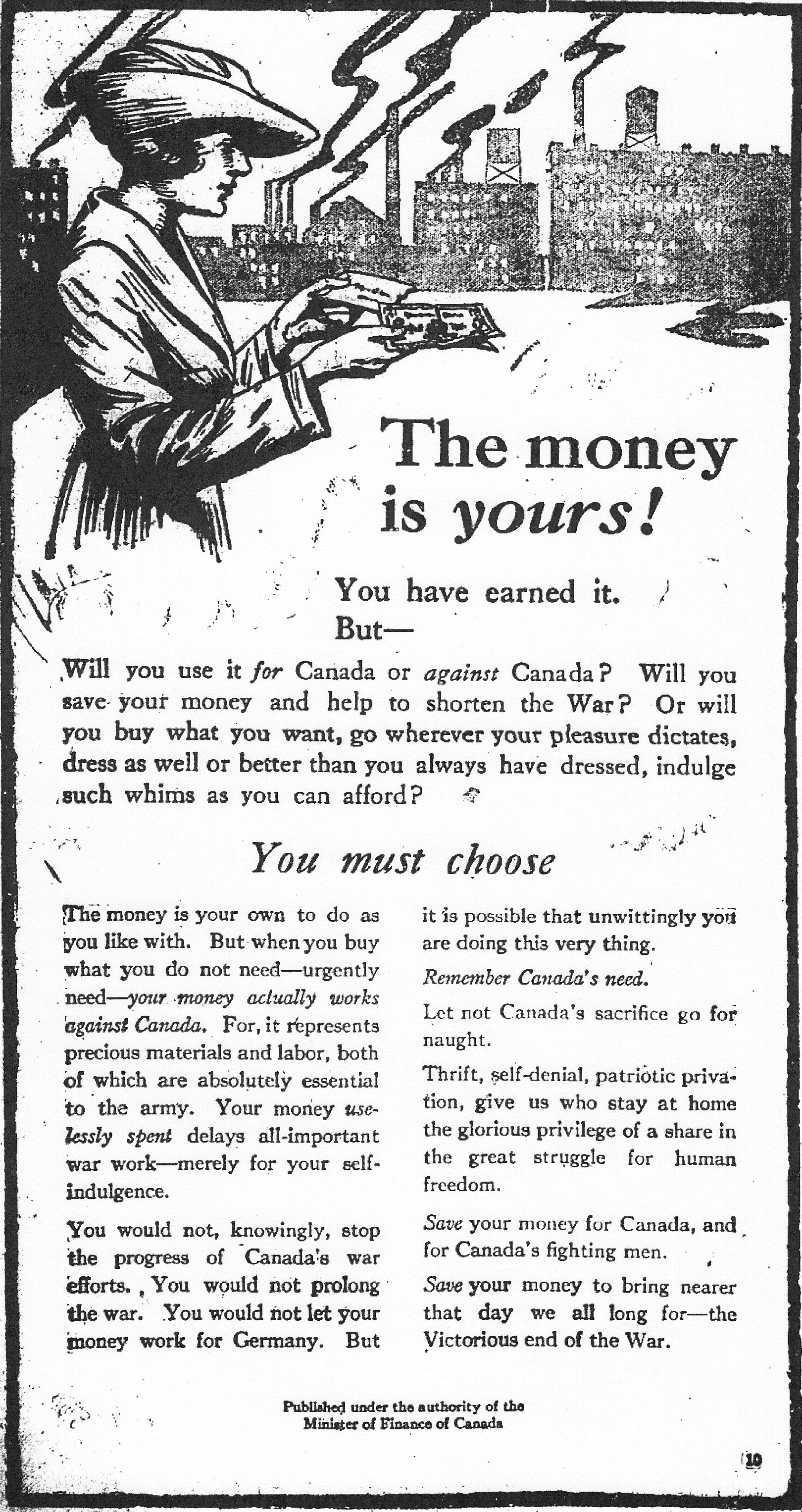
Poster for thrift

“The money is yours! You have earned it. But—Will you use it for Canada or against Canada? Will you save your money and help to shorten the War? Or will you buy what you want, go wherever your pleasure dictates, dress as well or better than you always have dressed, indulge such whims as you can afford? You must choose.

Save your money for Canada, and for Canada’s fighting men. Save your money to bring nearer that day we all long for—the Victorious end of the War..

Published under the authority of the Minister of Finance of Canada.”

The Intelligencer October 8, 1918 (page 7)

“Fighting the Flu. Precautions against the ‘Flu’ have been taken at the School for the Deaf. The pupils are not allowed to leave the grounds without permission and while school is continued the members of the staff are requested not to attend meetings or gatherings of any kind and to do no visiting, but to remain quietly in their homes.

Members of the staff having influenza in their homes are required to report at once and to remain away from the school while there is any danger of them carrying infection. An extra nurse has been engaged and extra hospital accommodation provided.”

The Intelligencer October 8, 1918 (page 7)

“Pte. Wardhaugh Gassed. Mrs. Viola Wardhaugh, Front St., Belleville, has been officially notified that her husband, Pte. Wm. Oliver Wardhaugh, infantry, was admitted to No. 18 General Hospital, Dannes Camiers, France, on Sept. 28th, suffering from the effects of Shell Gas. Pte. Wardhaugh went overseas with the 155th Battalion and his many friends hope that he will have a speedy recovery.”

The Intelligencer October 8, 1918 (page 7)

“Carpet Bowling. At the True Blue hall last evening a well contested match was played between teams skipped by Messrs. B. Kelly and G. W. Kerr of the Belleville Carpet Bowling Club. The match was an exciting one; during the first half, the team skipped by Mr. Kelly held the upper hand, the second half was so skilfully played by Mr. Kerr’s team that the victorious team led by only one point, final scores being 36 to 24. Mr. Kelly’s team won. …  Great enthusiasm was shown by both players and spectators.”

The Intelligencer October 8, 1918 (page 7)

“Pte. Huddlestone Wounded. Mr. Miles Huddlestone, residing on Great St. James street, in this city, was to-day in receipt of the following telegram from the Director of Records: ‘Sincerely regret to inform you 636443, Pte. John Nelson Huddlestone,infantry, officially reported admitted to No. 1 Casualty Clearing Hospital, Sept. 29th, gunshot wound right arm, fractured knee.’ Pte. Huddlestone enlisted and went overseas with the 155th Battalion of this city. He was only 19 years of age. Previous to enlistment he was an employee of the G.T.R. here.”

The Intelligencer October 8, 1918 (page 7)

“Gave His Life For Cause of Freedom. Copy of a letter received by Mrs. Flora Beaton, relative to the death of her son, Alexander Beaton: 5th Can. Infantry Batt., B. E. F., France. Mrs. Flora Beaton, Belleville, Ont.

Dear Mrs. Beaton:—I regret to inform you of the death of your son yesterday, Sept. 2nd, from wounds received in action. I was with a field ambulance at an advanced dressing station when this boy was brought in dead on a stretcher, where he had expired while our bearers were bringing him back off the field where he fell. I read his identity disc at once. It was marked Alexander Beaton, No. 455036, 2nd Battalion East. The stretcher bearers found your name in his paybook.

You will have the consolation of knowing that he was not instantly killed; that he had time for preparation for death and also that our chaplains warned our boys before [going] into this sector of the impending battle and gave them facilities for approaching the sacrament. Your son was wounded in the head. His death resulted apparently from loss of blood.

I am writing to you from the field, and when the action is concluded should I be detailed for burial at the cemetery where he will be interred I shall advise you. Should you wish to have the location of his grave and a photo thereof, you should address ‘Director of Graves Registration & Enquiries, War Office, London, England. The military authorities will of course forward his personal effects to you in due time.

I may add that I felt a special interest in the matter since I left Stirling to come to France. May God bless and comfort you in your hour of bereavement. Yours sincerely, J. J. O’Reilly, Chaplain.”

The Intelligencer October 8, 1918 (page 8)

“ ‘Flu’ Precautions Are Advised by M.O.H. Toronto. Dr. Hastings, Medical Officer of Health, has issued the following statement on Spanish influenza. Influenza is an acute communicable disease, and is contracted by coming in contact with the secretions from the nose, throat, and mouth of a person, who is ill with the disease. For this reason every effort should be made to avoid such contact. …

Crowded places such as street cars, mass meetings, moving picture shows, theatres and other gatherings should be avoided at this time. Kissing should be avoided. No food should be taken without previously washing the hands and the hands should always be kept away from the mouth and nose at all times. The nose and mouth should always be covered with a handkerchief while in the act of coughing or sneezing.

All persons, especially those engaged in factories, large business establishments, etc., where a number of people are congregated should report on the first sign of illness, and be relieved of their duties. To endeavor to fight off the disease by continuing at work not only renders the severity of the illness more serious, but also exposes others to the disease.”

The Intelligencer October 8, 1918 (page 8)

“Spanish ‘Flu’ Still Spreads. Kitchener. Medical Officer of Health Dr. J. McGillawee, acting under instructions from the Kitchener Board of Health, has issued an order closing all schools, churches, and theatres, and forbidding public gatherings until further notice. This action was taken in an attempt to check the spread of Spanish influenza, which already has claimed twelve victims in the past seven days. Reports from local medical men show there are over 3,000 cases in the city.”