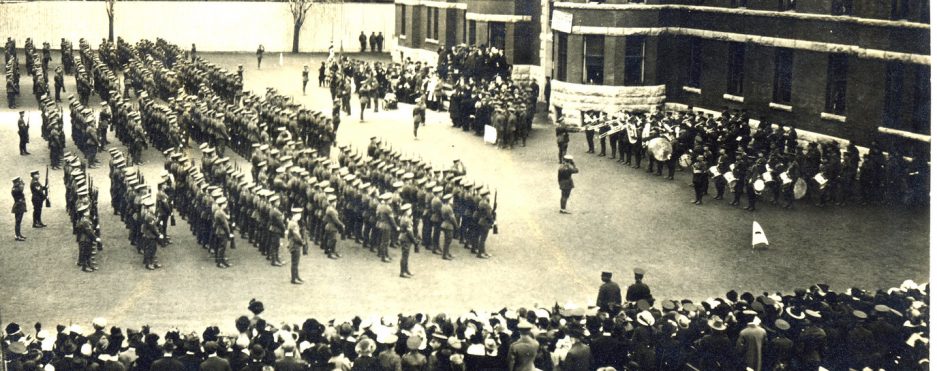
100 Years Ago: Presentation of Colors to 155th Battalion, Service at Bridge Street Church, Band Concert, Sergeant Charles Gibson Returns Unannounced, 155th Battalion Relaxes at St. Agnes School Grounds

The Intelligencer July 31, 1916 (pages 1, 7)

“For the third time within a period of fourteen months the presentation of colors to battalions recruited in this city and vicinity took place. …

On Saturday last the 155th Battalion which was recruited in Hastings and Prince Edward counties received their set of colors, which was the gift of the Argyle Chapter of the Imperial Order of the Daughters of the Empire of Belleville.
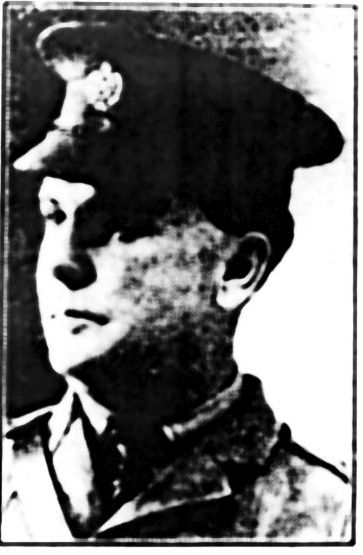
Lieutenant-Colonel Adams

This battalion is under command of Lt.-Col. Adams of Picton, who is deservedly a most popular officer. The battalion has been for some weeks in training at Barriefield Camp. …

The battalion was conveyed to the city by two special trains over the Canadian Northern Railway; the second section arriving at the depot about 11 o’clock in the morning. Hundreds of citizens and friends were at the station, and the brave soldier boys were certainly accorded a hearty reception.

After all had detrained the battalion was formed up and headed by the fine battalion band, …  marched up Pinnacle street to Victoria avenue, down Victoria avenue to Front street, and thence up Bridge street to the Armouries, where the rifles for the time being were deposited. The streets were lined with admirers of the battalion, and cheer after cheer was accorded the men, all of whom appeared to be pleased at the opportunity of again visiting Belleville. The men were then dismissed until 2 o’clock, when they returned for parade to receive the colors.

At a few minutes after 2 o’clock the battalion was reformed in the armouries, and marched out of the western entrance to Pinnacle street, and thence up Bridge street to the Armouries’ parade ground, where the interesting ceremony took place. The battalion was about 1000 strong, and the men certainly presented an appearance which was most commendable and inspiring, every man looking like a true soldier. …

Col. S.S. Lazier of Belleville, took the Royal Salute, and also formally inspected the Battalion going up and down each line. The battalion band was present and played suitable selections. The colors were then brought forward and placed crosswise upon two drums.

The colors are most beautiful in every respect. One flag is made of red silk. It bears the inscription and crest of the battalion, and is adorned with gold trimmings. The second flag is the Union Jack, the King’s colors, and is also of silk. Both flags are trimmed with gold fringe. …

Capt. Rev. Thomas Dodds, chaplain of the battalion, consecrated the colors, following which an appropriate prayer was offered. At the conclusion of this part of the ceremony, Major Allen and Col. Putnam came forward and knelt in front of the drums for the purpose of receiving the colors, the presentation being made by Mrs. Geo. Wallbridge, First Vice Regent of Argyle Chapter, and Mrs. A.P. Allen, second Vice Regent of the Chapter. …

About the outside of the spacious armouries’ grounds, thousands of interested spectators from the city and vicinity were assembled to witness the interesting event.

Owing to the excessive heat and the fact that the members of the battalion were rather tired after their marches etc., the speeches made were brief, but to the point, and elicited the applause of those who were privileged to hear them.”

The Intelligencer July 31, 1916 (page 1)

“At Bridge Street Church. It had been generally understood that the 155th Battalion would worship in a body at Bridge Street Methodist church on Sunday morning, but a later decision of the military heads gave the soldiers the privilege of holding a service at nine o’clock, thus giving the opportunity to visit with families and friends.”

The Intelligencer July 31, 1916 (page 2)

“Delightful Band Concert. On Saturday evening the 155th band under the capable leadership of Bandmaster Hinchey, gave a band concert on Victoria Park.

Thousands of citizens were present and thoroughly enjoyed the beautiful programme given. The selections were of a classic nature, and rendered by the fine band in a manner that was most commendable.”

The Intelligencer July 31, 1916 (page 2)

“Return of Sergt. Chas. A. Gibson. No one had the slightest inkling that the C.P.R. train from Montreal due here at 3 P.M. Sunday, would convey Sergeant Charles A. Gibson to his home, as no news had been received of his coming, other than the official notice received by Mrs. Gibson, and published in The Intelligencer on Saturday. As soon as the S.S. Metagama docked at Quebec, Sergeant Gibson headed for Montreal on the first train, and without delay made his way toward the comforts of home in old Belleville.

Arriving here, and finding no conveyance at hand, he was about to telephone for a hack when ‘Dick’ Arnott and his grey pony hove in sight and took him in. My! but Dick was glad to see Charlie.

It wasn’t an hour before the arrival was heralded throughout the city, in Sunday Schools and elsewhere, the news getting to Mayor Ketcheson and Dr. MacColl, who immediately captured the returned soldier and whirled him down town, to be greeted by military officials, including Col. Adams, in lieu of the demonstration that was intended to be extended. After all, the home-coming was pleasing to both the returned and the waiting friends.

Sergeant Gibson will rest for a few days, as he has not quite recovered from the terrible nerve-shock received when wounded at the front. Anyhow, it’s good to know that he has lived to return home.”

The Intelligencer July 31, 1916 (page 3)

“Soldiers Entertained. At the conclusion of the presentation of colors on Saturday afternoon the members of the 155th Battalion proceeded to the beautiful ground in connection with St. Agnes School, where ice cream and light refreshments were served to them. It is needless to state that this kindly act was much appreciated.

The toothsome refreshments were provided by the ladies who are members of Quinte Chapter, I.O.D.E. of Belleville. The men thoroughly enjoyed themselves beneath the shade of the trees after the trying experience on the Armouries lawn, and were loud in their praise of the kindness extended to them.”

100 Years Ago: Letter from Percy Jones, Lieut. Smith on Sick Leave

The Intelligencer July 28, 1916 (page 3)

“From Percy T. Jones. The following letter has been handed into The Intelligencer Office for publication. The tone is pitiable, and we feel assured that any favor extended the writer will bring him cheer and be fully appreciated:

Abt Kaisin Augusta, Schull, Coln, June 23rd. Dear Friend.—I hope you got my letter. I have been here since the 3rd of June. I have been very ill. I have two wounds on my face and one on my neck. The people who wait on me do all they can to relieve the pain.

Do send me a box with a home-made cake. I could do with a box every week. I hope this will find you and your mother well. Kind regards to all my friends. I thank God I am alive; a lot of my chums are gone. Yours truly, Percy T. Jones.”

The Intelligencer July 28, 1916 (page 7)

“Lieut. Smith Returns. Lieut. Wilfrid Smith, of Madoc, who has been in England for several months, returned home last week on sick leave. The extremely wet climate of England affected Lieut. Smith to such an extent that he has spent several months in hospital in England, suffering from rheumatism.

Lieut. Smith has been given two months’ leave of absence to recuperate, and in September will return to England.”

100 Years Ago: Gun Explodes in Soldier’s Hands, Save Your Waste Paper for Red Cross

The Intelligencer July 27, 1916 (page 1)

“Gun Exploded in Soldier’s Hands. Kingston. Several days ago Pte. D.T. Watson of the 155th Battalion, Barriefield Camp, was allowed to go to his home in Bancroft to spend a few days’ vacation.

On Monday afternoon he brought out a shotgun to clean. While he was handling it, it exploded and the bullet entered his left foot. Medical aid was secured and it was found that the second toe on the left foot was badly crushed. The toe was temporarily bandaged and the man was brought to the city. …

It was deemed by the attending physicians that an operation was necessary and the injured toe was amputated. …

Inquiries were made as to whether he would be unfit for military service after he has completely recovered from the accident. The surgeon who attended him at the hospital stated that he would be medically fit for service anywhere.

Amputations of toes have many times been performed in order that men with some slight defect in their feet might be allowed to proceed to the front.”

The Intelligencer July 27, 1916 (page 3)

“Remember The Red Cross. Save Your Waste Paper For the Red Cross—How to Collect Material. The conservation of waste is proving a valuable source of revenue for the Red Cross, which in view of the great necessities of our wounded, can not have too large an income.

Many towns have tried the scheme and there has been no case of a failure to make it profitable. In the working out of details, a few hints given by Mr. K.J. Dunstan, the President of the Toronto Red Cross Society, are worth bearing in mind.

In general, the scheme is to collect by voluntary effort, all forms of saleable waste such as rags, old rubber, tin-foil, lead and other metals, in addition to paper. Material should be accumulated until shipment can be made by car lots. To save cartage it is economical to store at or near a railway. It is also wise to communicate with a reputable dealer at the nearest large centre and to obtain prices and shipping instructions.

All over the country much valuable material annually goes to waste. To turn it into cash for the Red Cross is not only an act of charity and humanity. It is also patriotism in the truest sense, for it encourages national thrift.”


100 Years Ago: Letter from Pat Boland, Letter from Melburn Sprague, Many Boys Under Eighteen

The Intelligencer July 26, 1916 (page 2)

“From Pat Boland. Dear Mother:—Just received a letter and a roll of papers from home, and as I have a few minutes to spare I had better answer. I have been getting quite a lot of mail from home lately. You will have to excuse me for not answering them all, for you see we are in the trenches nearly all the time, and when I get a couple of hours to myself I try and have a little sleep, that is if there are not too many shells coming over our way.

What kind of a time did you all have on Dominion Day. I suppose you wondered what I was doing. Well, two other chaps and myself had a little home for ourselves in the second line. Its some dug-out,—four feet high, six by eight, made of sand bags. We have a sign, hanging in front bearing the name ‘Dominion Dugout.’

We are having lovely weather over here now, just like the summers you have in Canada. This has been a fine country at one time, but far from being that now. There is hardly a house left standing within two miles of the firing line.

I have just been down to Divisional Headquarters. We get the real news there. There has been some battle along the western front. I don’t know how this war can last much longer. We may be all back home before many weeks.

I received a box yesterday, and certainly enjoyed the contents. When you send parcels don’t forget the cake. Don’t send much, but often. Jimmie Cashman is with the 4th Brigade Scouts. Will give him his parcel when I see him.

I think I will say good-bye for now, with love to all at home, and best regards to my friends. Your son, Pat Boland.”

The Intelligencer July 26, 1916 (page 2)

Left to right: Charles and Melburn Sprague

“From Melburn Sprague. The following card was received yesterday by Mrs. E.B. Sprague, 78 North Front street, this city:—Dear Mother and Ida:—I am in a hospital with some German and Canadian wounded. I am quite happy, so do not worry. We have good doctors and attendants, and are all treated alike. They have used me better than I ever expected.

We went through hell on the 2nd to the 7th of June. I was seriously wounded, but am getting better, so please do not worry. I will be a long time in the hospital. Your son, Melburn Sprague.

The card was dated Telchrieben, Germany, June 29, 1916.”

The Intelligencer July 26, 1916 (page 7)

“Many Boys Under Eighteen. Boys under eighteen years of age who enlist in the Expeditionary Force should be careful to receive their parents’ consent or run the risk of bringing themselves into a lot of trouble.

In their zeal to secure recruits during the winter many officers would take on lads under the age limit and neglect to secure the consent of the parents. This is now the source of great trouble to the officers in command of units at the camp, as the parents in some cases use this means to secure their boys’ release from the army.

It is certainly a contemptible trick for a man to allow his son to enlist, draw pay for six or seven months, and then whine around until he is released.

One particularly disgusting case arose recently in the lines of the 155th Battalion, when a citizen of the north country, while admitting that he knew his son was enlisting six months ago under age of eighteen, demanded that he be released immediately.”

100 Years Ago: Belleville Roll of Honor, Letter from Harold Lloyd

The Intelligencer July 25, 1916 (page 2)

“Roll of Honor Being Prepared. The following resolution was last night unanimously adopted, by the City Council:—Ald Smith moved, seconded by Ald. Woodley, that His Worship the Mayor, Ald. Deacon and Mr. Alex. Walker, be a special committee to prepare a roll of honor of all the men (also nurses) who enlisted from the city of Belleville, as their home or birthplace and that the sum of $75 be appropriated towards the expense incurred.”

The Intelligencer July 25, 1916 (page 7)

“Letters from Overseas. From Pte. Harold Lloyd. The following note has just been received by Mrs. W.A. Lloyd, 20 Franklin Street, this city, from her son, Pte. Harold Lloyd, now at the front:—

Dear Mother,—Just a little line to let you know that I am well, and hope you are all the same. My wound is healing very quickly, and I am well cared for. Send me a box as quick as you can, and remember me to all. Percy is here, and getting along fine. Write soon. Your loving son, Harold.”


100 Years Ago: Snipers to Be Chosen, Fred Mott Is Prisoner of War

The Intelligencer July 24, 1916 (page 2)

“Snipers Are To Be Chosen. The specialist training of the men for this great war has taken a firm hold on Barriefield camp, and almost every man is a specialist in some one or other branch of the service. There is the physical training and bayonet fighting expert, who puts all of his trust in cold steel …  machine gun men who are confident that the machine gun is the only thing that is bad enough for a German. …  Again the bombers and grenade men impress on the soldiers that every person must be able to pitch bombs as accurate as narrow trench fighting demands.

The snipers have not been receiving their share of attention, and that branch of the work is to be attended to. Major Ackerman, who was overseas with the 2nd Battalion, and has for the last three weeks been at Valcartier on this work, has arrived and the training of expert marksmen for the popular sport of ‘getting’ Huns via the lone bullet route will be started.”

The Intelligencer July 24, 1916 (page 7)

“Prisoner in Germany. Pte. Fred Mott, No. 113410, 4th C.M.R., 3rd Canadian Division, reported missing since 2nd of June, is now reported prisoner of war at Stuttard. Word to this effect was received at Campbellford last week.

Pte. Mott enlisted with the 33rd Battery, Kingston, last August, was drafted to the 8th C.M.R. in October and went overseas to Bramshott Camp in January. He was drafted to the 4th C.M.R. and sent to France, thence to Belgium. He is nineteen years of age and only son of Mr. and Mrs. C.W. Mott, formerly of Belleville, now of Campbellford.”


100 Years Ago: Canadian Casualties, Nursing Sister Hambly on Brief Leave

The Intelligencer July 22, 1916 (page 1)

“Casualties Among Canadian Troops. Officially Reported Prisoners of War—Harry C. McDonald, Belleville …  G. McKie, Queensboro.”

The Intelligencer July 22, 1916 (page 7)

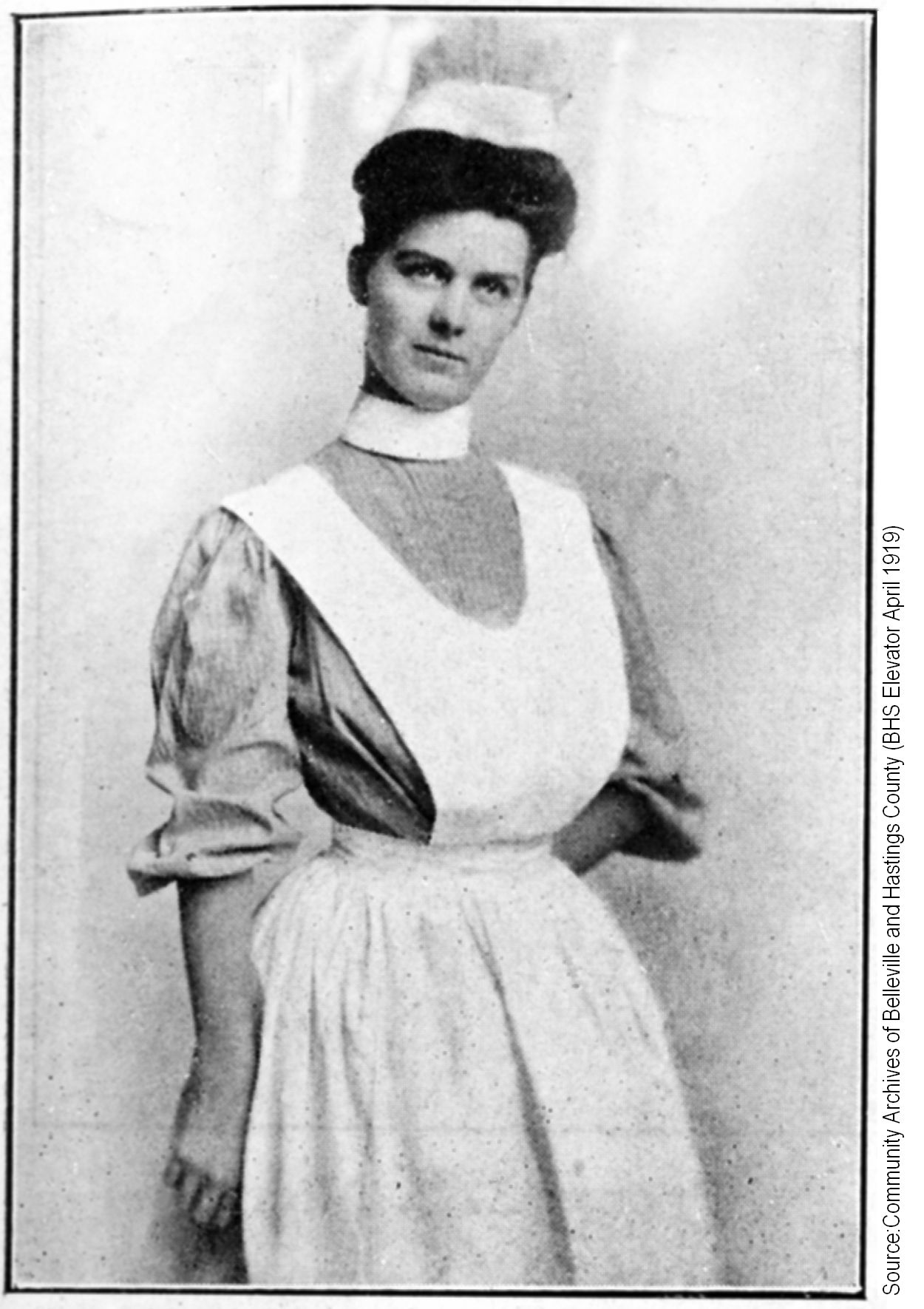
Nursing Sister Mary Hambly

“Nursing Sister Hambly. An officer of the British Army who came from duty at the front unheralded for a brief leave at home with her father, Lt.-Col. P.H. Hambly and family, returned to active service yesterday.

Nursing Sister Mary Hambly was one of our first to enlist and serve, and her skill and enthusiastic work have earned her official commendation. No honor can be too great for our life-saving sisters. Colonel Ponton, President of the Veteran’s Association, saw her off at the noon train, and Col. Stewart, Secretary, presented her with a bouquet of roses on behalf of the Veterans.”

100 Years Ago: Canadian Munitions Deliveries

The Intelligencer July 20, 1916 (page 1)

“Munitions Deliveries by Canadian Manufacturers Total a Million a Day. Ottawa. British orders in Canada for shells and high explosives now total nearly half a billion dollars. So far, Canada has delivered over two hundred million dollars’ worth, and at present the value of daily deliveries is nearly one million dollars. By the end of the year this will be increased to thirty-five million dollars worth per month.

The new fuse plant in Montreal is now being operated with great success, and this country can now produce for Great Britain over 20,000 completed shells per day.

The chief difficulty now is the scarcity of skilled workmen. The employment of more female labor is being urged by the Imperial Munitions Board, which is distributing an illustrated booklet regarding the training and employment of women in munition production.”

100 Years Ago: Letters of Sympathy to Mrs. Corby, Circus Comes to Town

The Intelligencer July 19, 1916 (page 7)

“From J.D. McKeown. Belgium, June 30, 1916. Dear Mrs. Corby:—May I extend to you, on behalf of the officers of the battery, our sincerest sympathy in the loss of your son, Jack. There is little I can say to alleviate the pain caused by such a sad loss, but I hope it will help a little to know that he died without pain.

In a little military cemetery, a short distance behind the lines, and under the shadow of a shell torn church, we laid him, and a white cross bearing his name and battalion, now marks the spot where, together with many other gallant Canadians, he now lies.

Highly esteemed by his officers and his comrades while he was with us, he has now gone to his rest, a hero. Very sincerely yours, James D. McKeown, Lt., 23rd Bty., 5th Bde., C.F.A.”

The Intelligencer July 19, 1916 (page 7)

“From R.S. Armitage. France, June 28, 1916. Mrs. J. Corby, Belleville, Ont. Dear Madam:—I wish to express to you my regret at the death of your son. Since joining this battery in England, Driver Corby has been in my section, and has always shown himself to be a conscientious and faithful worker, as well as a brave soldier. As such, he died, doing his duty to his King and country.

Please accept my deepest sympathy in your great bereavement. Yours sincerely, R.S. Armitage, Lieut., 23rd Bty., 5th Bgde., C.F.A.”

The Intelligencer July 19, 1916 (page 8)

“The Circus. Coop & Lent’s Show Proves a Revelation to Our Towns-People. Yes, it came, with all its paraphernalia, proving an astonishment to the big crowd that gathered upon our streets because of its large proportions.

Our people had never greeted this itinerant show before—it had never come this way. But now that it has shown itself worthy of patronage, the masses of Hastings County are pleased—more than pleased—and to prove their pleasure the big tent off Pine street is well filled this afternoon with a people who know how to extend appreciation.

Speaking of the parade—it was fine—extending about a mile, and as it passed down Victoria Avenue, Pinnacle and Bridge streets, and then up Front street, the reception was most generous.

A feature of the parade was the handsome Shetland ponies—all colors, speckled and otherwise, the large wagons coming in for more or less favorable comment, while the magnificent horses were highly admired. Handsomely attired ladies mounted on chargers; the cowgirls and cowboys; the brass bands—there were several of these; the steam organ, and numerous other sights, including clowns passing funny remarks—all made up a splendid panoramic view, the elephants, the camels, etc., taking their characteristic strides as though in the jungles or crossing a desert.

In the tent, where the performance is going on as we write, three rings are in action, the air-artists turning their somersaults, while the legions of actors—both human and brute—are unstintingly dealing out the programme.

Do not forget that the performance is to be repeated this evening, when the menageries will be open, and—as of yore—the circus lover, with his wife or best girl, will not fail to be there.”

100 Years Ago: Parcels for Soldiers, Belleville Heroes Slated for Honors, Local Women’s Emergency League Formed, Canvass for Recruits

The Intelligencer July 18, 1916 (page 1)

“Parcels for Soldiers. Arrangements have been made by which the Canadian War Contingent Association in England, and the National Service Committee, in Canada, are appointed to receive dutiable goods for Canadians stationed in the United Kingdom, and to forward them, free of customs duty.

Parcels must not exceed eleven pounds in weight. They must only contain dutiable goods, such as tobacco, cigars, cigarettes, alcohol in any form, candies, playing cards and toilet soap. …

They should be marked ‘special dutiable’ with a description of their contents and a statement of their value on the outside cover. The inside cover must bear the name and full regimental address of the recipient. …

The parcels must be prepaid to Toronto or Montreal, but will be forwarded to England, c.o. Canadian War Contingent Association free of charge by freight.”

The Intelligencer July 18, 1916 (page 2)

“Belleville Heroes Slated for Honors. The news has been received in this city from Lieut.-Col. A.E. Swift, Commanding Officer of the Second Battalion, C.E.F., that he has recommended Captain Edmund D. O’Flynn of this city, and Capt. Roscoe Vanderwater of Sidney township, for the Military Cross.

Capt. O’Flynn is strongly recommended for devotion to duty on the afternoon of April 26, 1916, at Ypres, opposite Hill 60. During and after a very severe bombardment this officer carried out the distribution of ammunition and grenades to the front line, helped the Medical Officer and organized parties to look after the wounded. His energy and the way he looked after the details were of great assistance to his commanding officer.

Capt. Roscoe Vanderwater, who left Belleville with the 39th Battalion in June 1915, is recommended for special gallantry and coolness under most trying circumstances. On the afternoon of April 26, 1916, when a mine was exploded in the trench held by his company, he at once took charge and directed his men. He had rapid fire opened on the enemy and prevented them from crossing and occupying the crater, and by his example stimulated the men to heroic service. His handling of this very difficult situation is said to be worthy of the greatest praise.”

The Intelligencer July 18, 1916 (page 8)

“Women Will Take Place of Soldiers. Kingston. A local branch of the Women’s Emergency League was organized here when delegates from the places in the third military district met. The objects of the league are to secure women to take the place of men in the shops and stores and also to stimulate recruiting. The league will also aim to place returned soldiers in positions.

The first meeting was held in the red room at Queen’s. …  Delegates were on hand from Belleville, Perth, Brockville, Cornwall, Prescott, Napanee and locally. After luncheon the delegates attended the meeting in the city hall and then adjourned to the council chamber where a discussion on organization was held. …

The district was arranged in sections: Mrs. Douglas, of Perth, having charge of the east and Mrs. MacColl of Belleville, the west. The district heads for Cornwall and Bowmanville will be selected later.”

The Intelligencer July 18, 1916 (page 8)

“To Canvass for Recruits. Kingston. A canvass will be made of the Third Military District for the purpose of ascertaining the men who are eligible to go to war. This was decided at a conference of military men and civilians from different parts of this military district. The object of the conference was to devise ways and means to stimulate recruiting.

A resolution was passed to the effect that a system of registration should be adopted. One or two of the speakers advocated conscription, but no vote was taken on the matter, as the meeting seemed to feel that such a step would be impracticable at the present time.

Lieut.-Col. E.G. Williams, chief recruiting officer for Canada occupied the chair, and seated on the platform were Lieut.-Col. G.H. Williams, chief recruiting officer for No. 2 military district, Lieut.-Col. Hamilton, special recruiting officer, and Lieut.-Col. Mulloy.

Lieut.-Col. G.H. Williams was the first speaker. He referred to the number of men Canada desired to raise for overseas service, namely, 500,000. Of that number 340,000 had been enlisted, and the remaining 160,000 could be raised without paralyzing the industrial life of Canada.

To secure the number needed there should be perfect organization and effective inspiration. Conscription was impossible at the present time; the Government had given its mandate.

The only coercion possible was the coercion of moral sentiment and public conviction. The private citizen, the press, which had proved itself to be the best coadjutor of the recruiting officer.”