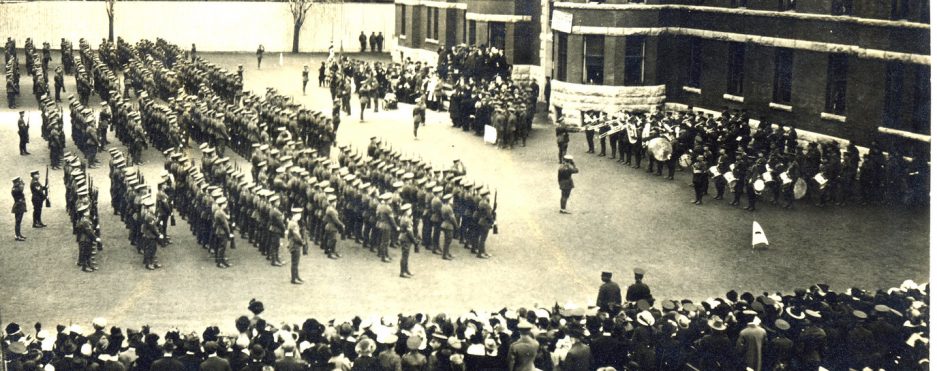
100 Years Ago: Belleville Welcomes Captain E.D. O’Flynn, Tom Vance Writes Home

The Intelligencer July 17, 1916 (page 1)

“Auspicious Homecoming of Captain E.D. O’Flynn. Hardly had the message been received about nine o’clock Saturday morning, that Captain E.D. O’Flynn would arrive on the 3.05 train, than operations were in motion to give the young hero a welcome worthy of his magnificent record as a soldier.

His Worship, Mayor H.F. Ketcheson, immediately became busy in behalf of the city, and after seeing that his own office decorations were thrown to the breeze, he started for a printing office, ordered handbills announcing the homecoming, and soon flags began to appear on Front and Bridge Street business houses, extending to private residences, until the city had become a veritable bower of waving welcome.

Every resident was in the height of ecstasy. Eddie was coming home. Even then the train was bearing him nearer his loved ones and friends.

Those who owned automobiles ordered them in readiness; those not thus blessed, determined to walk or take the van to the depot; and as the hour approached the crowds began to move northward, the open space about the G.T.R. Station becoming packed with decorated cars, the long platform crowded with people.

The remnant of the 15th Regiment Band were on hand to express their loyalty in music. The faces of the vast concourse were turned eastward, hoping the train would be on time. Then the rumbling sound was heard—the smoke was seen ascending—the cry went out ‘It’s coming! It’s coming!’

As the train steamed in the band played a popular air. Then two ‘stalwarts’ were seen to wend their way toward where the particular car was likely to stop. They were the same pair who had carried Eddie to the car upon their shoulders two years previous—Wm. Carnew and Hope McGinnis. The train came to a standstill; a mighty shout went up; and as the lithe, uniformed figure of our young townsman appeared on the car steps, he was immediately grasped, raised to two husky shoulders, and conveyed slowly through the jostling crowd, everyone striving for a handshake. It was truly an inspiring moment. The King himself could not have been more highly honored.

Onward the trio moved until opposite the large touring car of Mr. E. Guss Porter, K.C., M.P., into which Captain O’Flynn was gently deposited between his mother and Mrs. Porter (President of the Quinte Chapter of I.O.D.E.), who, with Miss Falkner and Mrs. S.A. Hyman were in waiting; Mr. F.E. O’Flynn, who had met his son at Kingston, being also of the party.

Then began the parade to the city proper—moving cars to the number of a hundred or more, occupying the street, while pedestrians filled the sidewalks, and as the business portion of Front and Bridge Streets were traversed, the waving decorations and lusty shouts of greeting made up a spectacular event.

At the O’Flynn residence, on Bridge street, a massive crowd had collected, barely room being obtainable for passage to the main entrance. Here the true welcome was extended. As soon as possible, in response to a united call, Captain O’Flynn appeared upon the upper piazza, and briefly thanked his friends for their manifestation of affection, expressing his gratitude at being permitted to return to them.

He was followed by Mayor Ketcheson, in behalf of the city, who heartily welcomed him to his old home, giving voice to the interest that had ever been taken in his work and welfare while in the trenches, and commending his loyalty to the Empire. …

Though wearied by his long journey, Captain O’Flynn responded heartily to the many greetings, at the same time feeling deeply the friendly attitude of his home friends and comrades.

The Captain, in appearance is much improved, the home journey adding to his health, he having gained sixteen pounds in weight while enroute. He came on the Empress of Britain, and is on a furlough of two months.”

The Intelligencer July 17, 1916 (page 7)

“From Tom Vance. Belgium, June 27th. Dear Father, Mother and all:—Just a few lines in answer to your most welcome letter, which arrived yesterday. I am glad to hear you are all well, as this leaves me the same, only a cold, and you know that is a usual thing for me.

Sergeant Hutchinson, who came from Belleville with us is wounded, and a fellow by the name of Frank Barnum, is back in Blighty again, so there are not many of the old Belleville lads here now. I hear Will Styles has gone home on a month’s pass.

I have been in the firing line longer than I was before, and I am thankful I have not been touched yet. I would very much like to be home and get a good home-made meal again. I have been away from home so long I forget what one tastes like. Hope the crops are good this year. Give my love to all the family, and answer. Your loving son, Tom Vance.”
 

100 Years Ago: Capt. E.D. O’Flynn Is Due Today

The Intelligencer July 15, 1916 (page 1)

“Captain E.D. O’Flynn Is Due at 3 P.M., To-Day. Word has been received by the parents of Capt. E.D. O’Flynn that our brave soldier boy is due to arrive at the Belleville station at three o’clock today.

As the Intelligencer is published at noon, a sketch of Capt. O’Flynn’s home-coming will appear in Monday’s issue.”

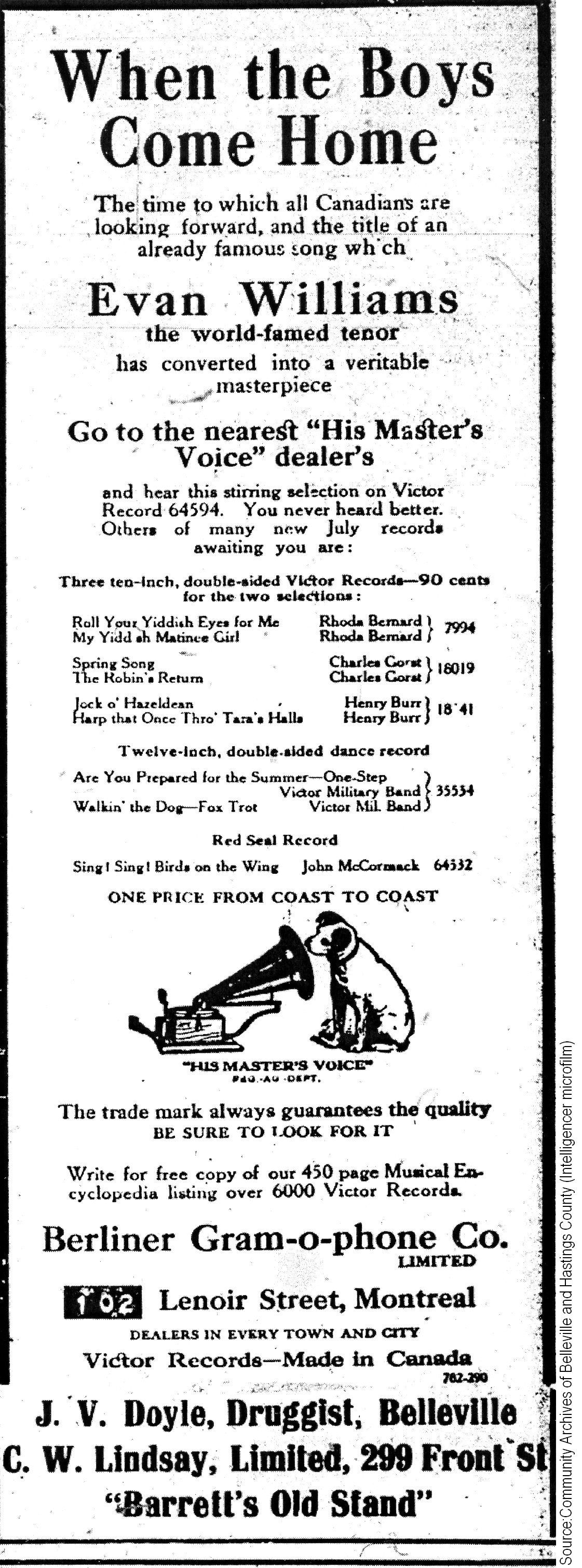
100 Years Ago: Ad for Victor Records

The Intelligencer July 14, 1916 (page 5)

Victor Records014“When the Boys Come Home. The time to which all Canadians are looking forward, and the title of an already famous song which Evan Williams the world-famed tenor has converted into a veritable masterpiece. J.V. Doyle, Druggist, Belleville. C.W. Lindsay, Limited, 299 Front St. ‘Barrett’s Old Stand.’ ”


100 Years Ago: Cigarette Consumption Increases, Hay Harvest Furloughs

The Intelligencer July 12, 1916 (page 1)

“More Cigarettes Used in Canada During War. Ottawa. Special—The consumption of cigarettes in Canada has been increased during the war.

In the last fiscal year the aggregate number entered for consumption at the Inland Revenue Department was 1,168,097,845, of which 86,936,545 were entered for ‘army and navy stores’; 49,000 heavy cigarettes, and 95,363 pounds of tobacco came under the head.”

The Intelligencer July 12, 1916 (page 2)

“Order for Farm Help. The original order from Ottawa dealing with farm furloughs, only dealt with furloughs for ‘plowing and seeding,’ but a more recent order deals with furlough to take part in hay harvest.

In many cases commanding officers when recruiting in country places, promised that they would allow their men to assist in farm work during harvest, until they were really under orders for overseas, and some commanding officers feel that apart from a special order that it is only fair to allow the men to go, although it affects the work of a battalion very seriously. The men have just got nicely into platoon, company, and battalion drill, and a month on the farm will change the military character of any soldier.”

100 Years Ago: Sock Shower for French Soldiers

The Intelligencer July 11, 1916 (page 6)

“The Women of Belleville will give a sock shower for the French soldiers in the trenches, on their national day, the 14th of July, in the Armouries at 8 o’clock.

The Presidents of all the Societies in the city, men as well as women, and regents of Chapters are asked to interest the members of their organizations to make this shower a success. Musical programme. Admission, socks or money.”

100 Years Ago: Canadian Casualties, Harold Lloyd and Percy Jones Are Prisoners of War, Ewart Jones Is Wounded

The Intelligencer July 10, 1916 (page 1)

“Casualties Among Canadian Troops. Killed in Action. …  Pte. Wilbur J. Conkright, Belleville, Ont. …  Wounded. …  Pte. Francis H. Collins, Belleville, Ont. …  Sergt. E.G. Jones, Belleville, Ont.”

[Note: Private Wilbur John Cronkwright died on June 27, 1916. He is commemorated on Page 72 of the First World War Book of Remembrance.]

The Intelligencer July 10, 1916 (page 1)

“Harold Lloyd Prisoner of War. The following has been received by Mr. and Mrs. W.A. Lloyd, of 20 Franklin street, this city:

Coln, Deutschland, June 4, 1916. I was taken prisoner at Ypres on June 2nd. I am wounded in the left arm, but not very badly. Percy Jones is here with me, also a prisoner, and slightly wounded. Don’t worry, for we are used well. Write soon. Best love, from Harold Lloyd.

Harold went from Kingston with 8th C.M.R., last fall.”

The Intelligencer July 10, 1916 (page 1)

“Ewart Jones Wounded. The following intelligence was received Saturday: Nelson Jones, 52 Yeomans St., Belleville. Sincerely regret to inform you 59,523 Sergeant Ewart Garde Jones, Infantry, officially wounded. Admitted No. 1, London General Hospital, Camberwell, July 3rd. Wounded left arm, left thigh. Will send further particulars when received. Officer I.C. Record Office.”

100 Years Ago: 100 Canadians Wanted as Airmen, Negro Battalion to Be Organized

The Intelligencer July 8, 1916 (page 1)

“100 Canadian Birdmen Wanted for Overseas. Ottawa, July 7.—Announcement is made by the Naval Service Department that the British Admiralty have requested the department to enter another hundred men from Canada to train for probation and flight sub-lieutenants in the Royal Naval Air Service. The period of service is for the war.

Candidates must be between the ages of 18 and 25 years, but particularly suitable applicants between 18 and 19 will be accepted. Only athletic and perfectly fit men of good education and intellectual capacity will be accepted. Perfect eyesight is also required of the applicants.

When the number of volunteers asked for have been secured, Canada will have contributed 350 airmen to the Imperial Service, a large number have already rendered valuable service and probably a score have been killed or injured.”

The Intelligencer July 8, 1916 (page 7)

“Negro Battalion to Be Organized. Montreal, July 7.—A battalion of Canadian negroes is the latest development of the recruiting for overseas service. Notice to this effect was yesterday received by Col. Fages, acting O.C. here, with authorization for the organization of No. 2 Construction Battalion, C.E.F. This battalion will be formed along the same lines as No. 1 Construction Battalion, which is still recruiting one-half its force here.

The new construction battalion, however, will be composed entirely of colored men, with the exception that its officers will be white men, in command of Lieut.-Col. Daniel Sutherland. …

This is an entirely new departure with the army service, although there have been a number of Indian companies in various infantry regiments for years past, and of late several companies of Japanese have been raised in British Columbia.

No attempt has hitherto been made to mobilize the colored population of Canada, and it is expected that the call will meet with a good response, the more so as many of the colored families here are closely connected with the negroes who escaped to freedom on British soil before the American civil war.

When the present war broke out a number of Montreal colored people were anxious to start a negro battalion, while this idea was also broached in other cities and towns. They will now have opportunity to back up their loyal impulses with a battalion which will be utilized for some of the most important work of an advancing army—repairing the ravages caused by the enemy.”

100 Years Ago: Recruiting Improves

“The Intelligencer July 7, 1916 (page 2)

“Brings More Recruits. There is a decided improvement in recruiting. It is believed that at no other time during the past two months have so many men joined in one day as on Monday.

The artillery office at Ottawa headed the list with 23 recruits for the 73rd depot battery at Kingston. This was the record day for the office for some months. The Forestry battalion enlisted 13 and the Construction battalion got a goodly number of recruits. The 207th had a large list, and many more are applying to join this battalion. The 230th also did well.

Nothing succeeds like success, and the officers think that the big fighting in France has something to do with the readiness of young men to enroll.”

100 Years Ago: 4th C.M.R. Battalion Missing Troops, Rodney Newton Is Prisoner of War, 155th Leads Route March

The Intelligencer July 4, 1916 (page 1)

“Information as to Missing Troops. His Worship Mayor H.F. Ketcheson received this morning the following, which tells its own story. 4th C.M.R. Battalion. To the Relatives and Friends of those Reported Missing belonging to the 4th C.M.R. Battalion:

During the action of the 2nd-3rd June, in which this battalion took part, some of the records, including the next of kin, were lost, and this prevents us from writing you direct. We are anxious, however, to point out that although they have been reported ‘Missing’ there is still the hope that they may be ‘Prisoners of War.’

Information will not be received from the enemy for some time it is feared, concerning those captured by them.

The officers and men of this battalion wish to express to you their deep sympathy in your anxiety, which we trust may be relieved when the list of prisoners is published. If, however, they should eventually be numbered among the fallen we wish you to know that the battalion fully appreciates how nobly they fought, and we honor them in the supreme sacrifice which they have made. (Sgd.) H.D. Lockhart Gordon, Major, O.C. 4th C.M.R. Bn. June 16th, 1916.”

The Intelligencer July 4, 1916 (page 1)

“Rodney Newton a Prisoner of War. Mrs. J.S. Newton, 46 Hillcrest avenue, received this morning a card containing the following information, which locates the whereabouts of her son, who, apparently is a prisoner of war, in the hands of the Germans. The printed form, filled out by the writer, is the size of an ordinary postal card reads as follows:

Dulmen (Welf), June 4—16. I am a prisoner of war and stationed at Dulmen Weslf. My address is: Name and Christian, Rodney Clark Newton, Rank: Private, 113457. Regiment: 4 Canadian Mounted Rifles. Gefangenenlager Dulmen i W, Germany.

The above limited information will at least relieve the parents of suspense, in that Rodney has been reported missing for some time.”

The Intelligencer July 4, 1916 (page 2)

“The 155th Leads. In Camp, Sunday, July 2nd. Dear Intell.—Just a card to tell you about the route march to Kingston Mills and return Saturday—distance 16 miles.

Our battalion led the parade, and according to accounts made the best showing, by having the largest percentage in the line at the finish. Our band and battalion were complimented by Col. Hemming, and all the men were given late passes to the city as a little indulgence.

The march, on account of the heat and distance, was most trying, and it is estimated that nearly 25 per cent fell out; some dropping unconscious. In one battalion a whole company quit when their Lieutenant collapsed, and a whole band (136th) fell out. Our band was the only one with enough steam left to play at the finish, and we played ‘Hail, Hail, etc.’ Our band was given first place in the parade and finished in the best condition. 155th Member.”