100 Years Ago: Canadian Casualties, Belgian Relief Fund Benefit

The Intelligencer July 13, 1915 (page 1)

“Canadian casualties reported to the Militia Department now exceed the ten thousand mark, the total number being 10,037. The killed number 1,720, the wounded 6,507 and the missing 1,810. The week-end lists included 11 killed, 17 missing, and 45 reported prisoners.”

The Intelligencer July 13, 1915 (page 2)

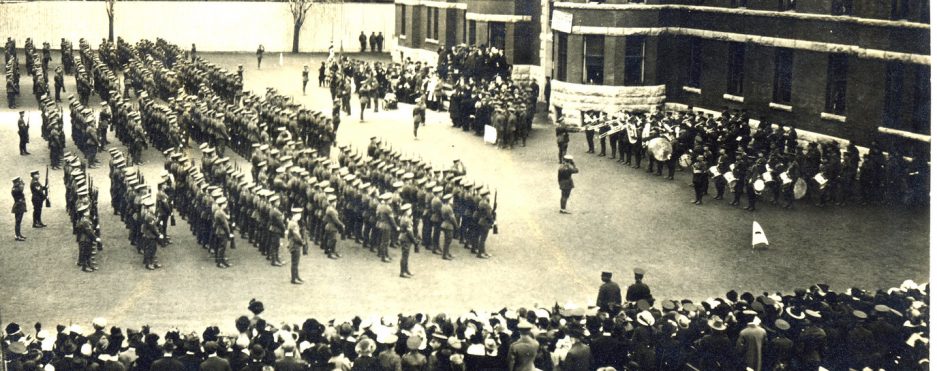
“Belgian Relief Fund Benefit Under the Auspices of XV. Regt Band. Griffin Opera House. Wednesday, July 14th. By Special Arrangement with The National Music Bureau of New York.”


100 Years Ago: Women’s Canadian Club to Continue Scrapbooks in Summer

The Intelligencer July 10, 1915 (page 3)

” ‘News From Home’ For Our Soldiers. The Women’s Canadian Club Asks for Your Help in Sending it to Them. To the Editor of the Intelligencer, Sir,—We all know how, when we are away in distant lands, we are thrilled by the words ‘NEWS FROM HOME.’ How greatly intensified this desire must be among the Canadian soldiers fighting so bravely, in Belgium and in France, so far from home and loved ones!

Realizing how great must be this longing among our troops at the front, pupils of the schools of Belleville joined in the ‘NEWS FROM HOME’ plan introduced into the Province by the League of Empire and carried it out most effectively under the direction of the inspector and the teachers. This is the plan—Clippings from the local newspapers, little items giving home news of people, events and sports, short bright sayings and pictures that provoke a smile, pasted into scrap books made of strong manila paper and then sent off weekly to the men at the front.

A few sentences quoted from a letter received in April last in Toronto, and written by Col. E.W.B. Morrison, commander of the 1st Canadian Artillery Brigade, testify to the feeling of the soldiers. ‘I am sitting in a trench on the embankment of the Ypres Canal in Belgium. …  It just occurred to me that the children at home would like to know that their painstaking work had been appreciated amid this hideous turmoil and that they had contributed their ‘bit’ to help the men behind the guns.’

The schools are now closed until the autumn and concerted work on the part of the school children is in abeyance. If the soldiers are to get their budgets, some one must continue their work. A letter has been received from the Secretary of the League of Empire in Toronto asking the Women’s Canadian Club of Belleville to carry it on here. At a meeting of the Executive it was decided that the Club would undertake to produce a certain number of scrapbooks weekly and they ask for the hearty co-operation not only of all the members of the Club, but also of the citizens generally. …

If you desire to assist in the work you may do so by sending to the convenor of the work, clippings—items of news, not over two weeks old, of interest to the men from Lindsay, Peterborough, Picton, Belleville and surrounding districts; no war news please. …  Sample copies may be seen either at the home of the convenor or in prominent windows on Front street. May B. Johnson, President Women’s Canadian Club.”

100 Years Ago: Duchess of Connaught Hospital, Leave of Absence for Soldiers in Canada to Harvest Crops

The Intelligencer July 8, 1915 (page 4)

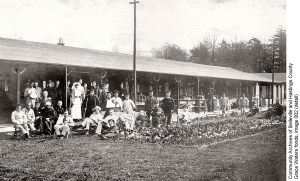
Soldiers and staff on the verandah of a pavillion ward at Duchess of Connaught Hospital, c.1915

“Duchess of Connaught Hospital at Cliveden. Where Canadian

Soldiers are Being Brought Back to Health. Amongst the many hospitals, where our sick, and wounded soldiers are being brought back to health, there is perhaps no institution which will appeal to Canadians more than the Duchess of Connaught hospital at Cliveden, a beautiful country house, along the famous upper reaches of the Thames. …

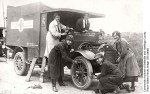
Drivers maintain an ambulance, Duchess of Connaught Hospital, c.1915

It should be remembered that this hospital is a Canadian institution in every way. It is manned by Canadian doctors and nurses, by Canadian non-commissioned officers and men; it receives Canadian wounded and is supported and kept up by Canadian money. It only remains for the Canadian people as a whole to give their whole-hearted financial support to this Canadian hospital where our own fellow-countrymen will be brought back to health and strength.”

Beds outside at Duchess of Connaught Hospital, c.1915

The Intelligencer July 8, 1915 (page 8)

“Soldiers To Go Home To Harvest The Crop. Ottawa. Leave of absence of one month may be granted to non-commissioned officers and men of the expeditionary forces in Canada for the purpose of enabling them to take part in the harvesting work throughout the country. A statement to this effect was issued by the acting Minister of Militia this morning. …

They must proceed to the harvest fields in their working clothes, leaving uniforms and equipment with their units. Pay and allowance will be withheld during leave, but this will be paid them on return with satisfactory proof that they have been bonafide engaged in harvesting work during the whole period of leave. To establish this fact a certificate from the employer must be produced.”

100 Years Ago: Soldiers Suffer from Nervous and Mental Trouble

The Intelligencer July 7, 1915 (pages 1, 2)

“Soldiers Suffering From Nervous and Mental Trouble. Ontario Physicians ask Gov’t to Equip Expedition of Doctors and Nurses. At the meeting of the Ontario College of Physicians and Surgeons, held in Toronto last week, the following resolution was carried amidst much enthusiasm: ‘Whereas it has become known to members …  that many of our soldiers in Europe are now suffering in special ways from various forms of nervous and mental trouble, due to the terrible shock of war. Whereas these various forms of nervous and mental diseases require special treatment, and that efforts are being put forth by those in authority to give this special treatment so far as the circumstances and conditions of war permit. Nevertheless, these circumstances and conditions are such as to render adequate treatment impossible. …

Therefore, be it resolved that this Council respectfully but urgently request the Government of this Province to at once equip an expedition of experienced and specially trained physicians and nurses from its public institutions and others specially qualified for such work and despatch them without delay with proper and full equipment to minister to those afflicted and restore them to convalescence and health; or where this is impossible or likely to be unduly prolonged, request the War Office to send them home to Canada, when suitable accommodation such as that soon available at Whitby be prepared for their reception and that this special treatment and nursing be there continued so long as may be required under the favorable conditions that such location, surroundings, and accommodation afford, and that a copy of this resolution be sent to Hon. W.H. Hearst, Premier of Ontario.’ …

The Council has touched upon a subject that has not received proper attention. This war differs from any incident of its character in the history of mankind. The huge mass of men engaged in the war arena, the power and strength of projectiles, the trench warfare, the aeroplane, the poisonous gases, the searchlights. …  Thus it is in this war we have a new type of ailment or of disability, or, if not altogether new, they are in number and variety far and away beyond anything heretofore recorded in the annals of war.

The character of these diseases is nervous and mental. We find loss of sight, hearing and speech without any apparent reason therefor. We find various forms of paralysis of arms, limbs, of parts of the body in large or small areas. There is loss of function of various organs, always distressing and often quite obscure. Standing out prominently we find many forms of mental disease, loss of memory, excitement, depression. …  the strain and horrors to which the soldier is exposed by day and night have resulted in an increase in insanity beyond anything yet recorded. …

Throughout the Province the suggestions of the Medical Council have been received with universal acclaim. In following the course outlined the Government would receive in full measure the support of the people of this Province.”
100 Years Ago: Red Cross on Importance of Tobacco

The Intelligencer July 5, 1915 (page 7)

“Intelligencer Tobacco Fund. The Importance of Tobacco. The following notes are issued by the Canadian Red Cross Society: While the public is generously answering the appeal for tobacco for the Canadian soldiers at the front, a very large amount is still needed and will be needed continually as the war progresses. …

There can be no doubt of the importance of tobacco in the present crisis. Even those who oppose its use as a matter of principle will admit this. Tobacco has played its part in every war, from Waterloo to the Balkans. It is playing a tremendous part in this, the greatest war in history. Tobacco is a solace and has won and lost battles. It is stated that smokers are far more immune than non-smokers to ‘Occipital Cramps’ and other neurasthenic ailments caused by the terrible ordeal of shell fire. …

Nothing is better than tobacco to relieve the necessary odium of convalescence, when the soldier, too weak as yet for any active physical employment finds the time hang heavy on his hands. Further, no greater act of charity could be performed than the sending of tobacco to prisoners whose life at the best can scarcely be considered one of pleasure.

In short those who know anything about men under nervous tension, know that tobacco is even more of a necessity than food. It is to be hoped that the public will think generously of this matter.”

100 Years Ago: War Relics Sent Home

The Intelligencer July 3, 1915 (page 7)

“Relics of the War. Sent Home by Charles Sprague, of the Divisional Signalling Corps. Mrs. E.C. Sprague, North Front St. has received several interesting articles from the firing line, from her son, Charles Sprague, who is with the Divisional Signalling Corps. Amongst them is a piece of a German ‘Jack Johnson,’ about one inch and a quarter in thickness, and weighing nearly a pound. It is made of the best steel, and gives evidence of the tremendous strength of the explosive used.

There are clips of German, French, and British cartridges and all are different. The French are entirely different from either of the others in shape and material used being shorter, thicker, while the bullet itself is of copper. The German bullet is sharper nosed than the English or French, and it does not give a clean wound, but a ripping gash.

A French shrapnel shell, made of brass, is beautifully cut, cleaned and mounted by the field blacksmith. It is also nicely engraved and ornamented with French and British bullets united. They will all be on exhibit at E. Sprague’s Tailoring store.”

100 Years Ago: Dominion Day Celebrated at Shorncliffe, 49th Regiment Proud of Enlistment Record

The Intelligencer July 1, 1915 (page 1)

“Soldiers Celebrate Dominion Day. London. Dominion Day was celebrated among Canada’s soldiers at Shorncliffe. Early in the morning the bugle and drum bands of the 11th, 12th, 42nd, 49th and Patricia’s reserves paraded to Folkstone, receiving a hearty welcome. A military tattoo was held at night, when the massed bands performed.”

The Intelligencer July 1, 1915 (page 2)

“49th Regiment Make fine Show. Since Outbreak of War 460 Have Enlisted, Including 22 Officers. If there is one rural regiment that has reason to be proud of its record in regard to enlistment and officers offering their services for overseas service, it is the 49th Regiment of Hastings County. Since the outbreak of the war no less than 460 have enlisted from the regiment, the greater number of whom are either at the front or in readiness to proceed thereto. During the month of June 71 recruited and to-day 40 left here for the camp at Barriefield.

The officers of the regiment have not been backward in tendering their services and no less than 22 have been accepted and are on active service. …  Col. W.G. Ketcheson, commanding officer of the regiment is naturally proud of the record of the regiment under his command, and he has certainly every reason to be so.”

100 Years Ago: Last Chance for a Flag for Dominion Day

The Intelligencer June 30, 1915 (page 4)

Advertisement, Belleville Intelligencer, June 30, 1915

“Last Chance Before Dominion Day. Come to the office of this newspaper early and get your flag TO-DAY—one or a dozen, so that YOU may tomorrow fittingly decorate for Canada’s great anniversary. Be Patriotic!

Those who have not secured a UNION JACK should do so at once, thereby expressing a true loyalty and approval of the mighty conflict in which our Empire is engaged. This Presentation is made possible by the leading Canadian newspapers acting in conjunction to provide a flag for every home. These splendid outfits can be secured in no other manner.”

100 Years Ago: Ad for Victor Records, School Children Donate Their Pennies

The Intelligencer June 28, 1915 (page 2)

Advertisement, Belleville Intelligencer, June 28, 1915

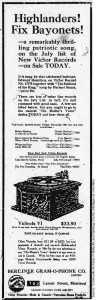
“Highlanders! Fix Bayonets!—a remarkably thrilling patriotic song, on the July list of New Victor Records—on Sale TODAY. It is sung by that celebrated baritone, Edward Hamilton, on Victor Record No. 17775 together with ‘The Soldiers of the King,’ sung by Herbert Stuart,—price 90¢. Berliner Gram-O-Phone Co. Limited. Dealers in every town and city.”

The Intelligencer June 28, 1915 (page 3)

“Patriotic Efforts By School Children. Now that the schools are closing a little incident which recently occurred would not be out of place. The boys and girls of Alexandra School being desirous of showing their patriotism on Victoria Day decided to dispense with fire crackers and donate the money usually expended in this way to help the soldiers on the firing line and as a result Miss Clara Yeomans, treasurer of the Belleville Women’s Red Cross and Patriotic Association received $15.00, a contribution from the scholars of the school saved in this way.

Then Miss Fleming’s class of scholars decided to do something for the purchase of bandages and made a personal effort in saving their pennies and doing services for remuneration and gathered together the sum of $5. to be given to the Women’s Patriotic & Red Cross Association for assistance to the soldiers.

Mrs. O’Flynn was called into the school and Mr. Gordon Collins, representing the class presented her, as one of the representatives of the Women’s Patriotic & Red Cross Association, with $5. which had been saved by the children. Mrs. O’Flynn, on behalf of the Association thanked the children for their thoughtfulness and the teacher for the gift and praised the spirit that prompted the act. The happy face of the teacher and the smiling and delighted children gave evidence of their deep interest in what had been done.

The scholars of the whole school were also thanked for their kindly act in saving $15., which was donated by the school to the fund. This spirit, which permeates throughout Canadian life and is found among the school children is the one that is going to win the victory for the Empire and we are delighted that the school children have shown throughout the city such an interest in the great affairs of the Empire.”

100 Years Ago: Union Jacks Still for Sale

The Intelligencer June 26, 1915 (page 11)

“Is Your Home Still Flagless? ‘While Shot and Shell are Screaming,’ do honor to your brave citizen soldiers on the firing line, by joining the nation-wide movement to place a flag on every home. It is a mark of appreciation and a sense of fine fitness should impel every loyal citizen to show his colors. Take Advantage To-day Of The Presentation By The Intelligencer. This $4 Union Jack Outfit $1.48 Or the Flag Alone $1.10. Just Clip the Coupon. Act To-Day.”