100 Years Ago: Harry Ablard Killed in Action

The Intelligencer May 10, 1915 (page 2)

“First Bellevillian Killed in Action. Mrs. Harry Ablard, who resides at 196 Dundas street, in this city, this morning received the following sad message: ‘Mrs. Harry Ablard:—’Deeply regret to inform you No. 7813, Sergt. Harry Ablard, 2nd Battalion, officially reported killed in action. Yours, Adjutant General.’

Sergt. Ablard was well known in this city, and had many friends. He was for some time a color-sergeant in the 15th Battalion, and when the call for arms was made, responded and enlisted, leaving here with the first battalion. The message conveying the news of his death has been received with deep regret. Mrs. Ablard, wife of the slain Bellevillian, is a daughter of Mr. J.K. Mitchell, gardener, who resides on the Front of Thurlow. Since the Sergeant’s absence to the front, a child has been born, making in all a family of three children.

Mr. Ablard was a member of St. Thomas’ choir of this city for many years. The rector, Rev. Canon Beamish, just lately received a letter from him, written in the trenches. It was written in a very cheerful vein.”

[Note: Sergeant Henry Charles Ablard died on April 22, 1915. He is commemorated on Page 3 of the First World War Book of Remembrance.]

100 Years Ago: Local M.P. Offers Home for Convalescent Soldiers, Archie Cooke Writes Home

The Intelligencer May 8, 1915 (page 3)

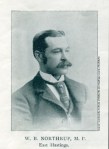
Mr. W.B. Northrup, K.C., M.P.

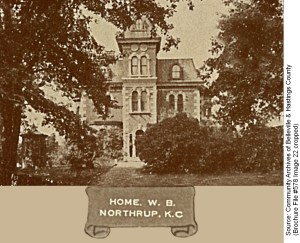
“Practical Patriotism Exhibited in City. The happy possession of a spacious house and grounds and of philanthropic spirit has enabled Mr. W.B. Northrup, K.C., M.P., and Mrs. Northrup to make an offer to the Government of a convalescent home for wounded Canadian soldiers from France and Belgium, who are to be sent to Canada to be refitted and to regain the strength and vigor necessary for them to resume the fight in the firing line.

Home of Mr. W.B. Northrup on Front Street North, Belleville

Mr. Northrup has practically handed over the key of his beautifully furnished home and the Government has accepted his offer provided that the citizens of Belleville and vicinity will undertake the cheering and the outdoor care of the convalescents by volunteering an ample supply of motor cars and motor boats for outings every morning and every afternoon until the convalescents are guaranteed fit for service and are drafted back to the army again.”

The Intelligencer May 8, 1915 (page 7)

“Sergt. A Cooke Writes Home. Mrs. Cooke of College Hill, Belleville, has received the following letter from her son, Sergt. Archie Cook, who left here with the 1st Contingent. Belgium, April 19, 1915. At last we are in Belgium. It has taken quite a long time for us to come from home to there but we are none the worse off by the journey.

Yesterday morning we were awake early and told to get ready to move to some place, we didn’t know where. …  After we had gone about three miles we crossed the Belgium frontier, and about six miles further we arrived at our billets. It is a pretty country around here. There are in some parts large mansions and parks. …  It will not be long before we are back in the trenches again, and I think we are certain of seeing something this time.”

100 Years Ago: Gunner Thomas Yateman Wounded

The Intelligencer May 7, 1915 (page 1)

“Gunner Thomas A. Yateman Wounded. Mr. Walter A. Yateman, 82 Mill St., received the following telegram, at about 10 o’clock this morning.—Sincerely regret to inform you 40520 Gunner Thomas A. Yateman, First Field Artillery Brigade officially reported wounded. Further particulars when received will be sent you. Adjutant General.

Gunner T.A. Yateman is the second brother to be injured at the front. Gunner Richard Yateman, it will be remembered being invalided home about six weeks ago, on account of injuries he received from the kick of a horse.”


100 Years Ago: Two Local Soldiers Wounded, 39th Battalion Volunteers Selected

The Intelligencer May 5, 1915 (page 1)

“Wounded at The Front. Another Belleville Boy to be Included in List of Wounded. Mr. Frederick Slater, of 42 North Front Street has received word that his son, Lance Corp. F.E. Slater, of A Co., Q.O.R., has been wounded at the front. The following is the official notice:—’Sincerely regret to inform you Lance-Corp. Frederick Edgar Slater, 3rd Battalion, officially reported wounded. Further particulars when received will be sent you. Adjutant General.”

[Note: Q.O.R. = Queen’s Own Rifles.]

The Intelligencer May 5, 1915 (page 1)

“One More Local Soldier Wounded. Mrs. Chas. Gatcum, of Canifton, received the following telegram, this afternoon: Sincerely regret to inform you that 1401 Gunner Chas. Gatcum, 1st Brigade, 2nd Artillery, Canadian Field Artillery reported wounded. Further particulars when received will be sent you. Adjutant General.”

The Intelligencer May 5, 1915 (page 1)

“Overseas Contingent Awaiting Orders. Names of Officers and Men of the 39th Battalion Who Have Been Selected to go to the Front at Once. Five officers and 250 men of 39th Battalion stationed in this city are prepared at a moment’s notice to leave here for oversea service. They are a fine body of men and there is not the slightest doubt that they will follow the example of the Canadians of the First Contingent, who shed lustre upon their country.”

100 Years Ago: Canadian Casualties May Exceed 6,000, Memorial Services in Belleville Churches

The Intelligencer May 3, 1915 (page 1)

“Six Thousand Canadians Estimate of Ypres Battle. Casualty Lists Continue to Pour in at Rate of 150 a Day—More Than 225 Officers so Far Announced Dead, Wounded or Missing. Ottawa. Private cables tonight state that the Canadian casualties may exceed 6,000 and that the number killed in action may approximate 600. …  Every battalion at the front has its toll of dead and wounded, while all the detail units, including Engineers, Army Service Corps, and even the Ambulance Corps, have suffered heavily.”

The Intelligencer May 3, 1915 (page 3)

“Belleville Mourns Canadian Heroes. Memorial Services Held in the City—British and German Ideals Contrasted—Canadians’ Self-Sacrifice—’Martyrs in Our Time.’

The self-sacrifice and heroism shown by the Canadian volunteers who have recently died on the battlefield in Flanders, were recognized yesterday in all the places of worship in Belleville. In most of the churches a memorial service was held in the evening, the preachers laying emphasis upon the righteousness of the cause for which the Canadians had laid down their lives.”

100 Years Ago: Volunteers from 39th May Go to Front

The Intelligencer April 30, 1915 (page 1)

“An order appearing in the militia orders states that 250 men of the 39th Battalion mobilized in this city, are required at once for immediate overseas purposes.

When it became know that such an order was issued there was considerable interest created, and numbers immediately volunteered. In fact the entire battalion was prepared to go as a unit, but their services were not required.

In conversation with the military authorities a representative of The Intelligencer was informed that Capt. W. Hudson, an officer of the Fifteenth Regiment of this city, and was attached to the 39th Battalion, had tendered his services and had been selected as the commanding officer of the men leaving here for oversea service. When the detachment will leave is at present unknown.”

100 Years Ago: Second Battle of Ypres

The Intelligencer April 24, 1915 (page 1)

“Brilliant Charge by Canadian Troops. Canadians Fall Back and Lose Four Guns, But Recapture Them After Brilliant Advance—Many Prisoners Taken. (Canadian Press Special) London, April 24.—The war office has given out the following: ‘The fight for ground in which the Germans penetrated between Steenstraate and Langemarck still continues. The loss of this part of the line laid bare the left of the Canadian division, which was forced to fall back in order to keep in touch with the right of neighboring troops.

In the rear of the latter there had been four Canadian 4.7 inch guns, which thus passed into the hands of the enemy; but some hours later the Canadians made a most brilliant and successful advance, recapturing these guns and taking a considerable number of German prisoners, including the Colonel.

The Canadians had many casualties but their gallantry and determination undoubtedly saved the situation. Their conduct has been magnificent throughout.”

100 Years Ago: Regimental Fund for 39th Battalion

The Intelligencer April 20, 1915 (page 3)

“A movement is on foot to provide a regimental fund for the 39th Battalion of a sum of not less than $10,000, to cover the cost of purchase of field kitchens, musical instruments and other necessary articles of equipment, not provided by the Government.

It has been decided to appeal to the different cities, county townships and other municipal bodies throughout Eastern Ontario, as well as to the generosity of private citizens and societies. The Battalion is now at full strength, numbering over 1000 men of all ranks and has representatives from practically every city, village and municipality in its ranks. Send your subscription to the officer commanding 39th Battalion, Belleville who will gladly acknowledge any amount.”

100 Years Ago: Another Member of 39th Dead, Y.M.C.A. Assists Soldiers

The Intelligencer April 15, 1915 (page 1)

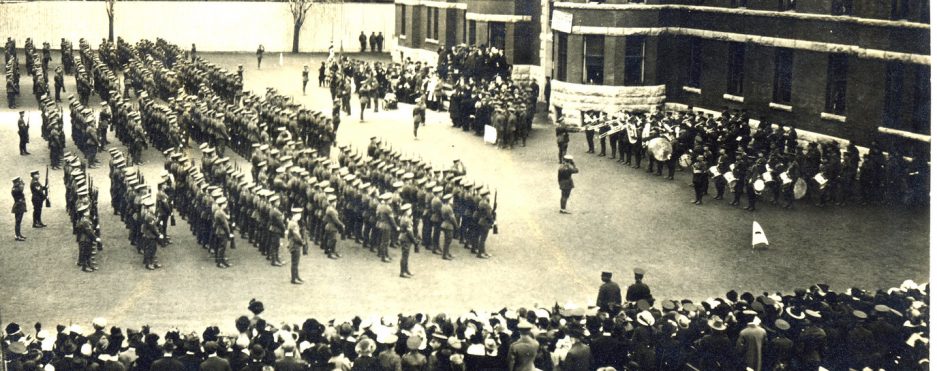
“Private Harry Nichols of Peterboro a Victim of Spinal Meningitis. At an early hour this morning Private Harry Nichols, a member of the 39th Battalion, C.E.F., mobilized in this city, died from an attack of spinal meningitis. …  He had been ill for some days and received every possible attention. This is the third death that has occurred within the ranks since the battalion has been established in the city. The remains of Nichols were taken to Tickell & Sons undertaking establishment. …

A military escort accompanied the remains to the railway station. …  The members of the 39th Battalion paraded in full force under command of Col. Preston and presented a fine appearance. A firing party preceded the hearse and was followed by the Fifteenth Regimental Band playing a solemn dirge. The hearse containing the remains was draped with a large Union Jack. …  Mr. and Mrs. Nichols, parents of the deceased, were the chief mourners.”

[Note: Private Harry Nicholls died on April 15, 1915. He is commemorated on Page 30 of the First World War Book of Remembrance.]

The Intelligencer April 15, 1915 (page 7)

“The Military Y.M.C.A. Marquee. Editor of the Intelligencer,—There appeared in the columns of your paper recently, a letter suggesting that something ought to be done for the soldiers mobilized here. One of our worthy citizens has requested that I outline briefly what the Y.M.C.A. is doing.

With the co-operation of Colonel Preston, Officer in Command, we have secured a splendid large marquee, which has been erected on a 30 by 60 feet platform in the rear of the barracks. Light and heat have been provided. Tables, seats and comfortable chairs, games, writing materials, magazines and a large number of home newspapers, in addition to a piano and gramophone have been furnished. We have also secured a license for selling postage stamps, and have installed a post office for those directing their mail in care of the Y.M.C.A. Decorations of various kinds adorn the walls of the tent. At the back of the platform appears a banner: ’39th’ Battalion C.E.F. For God, for King, and Country.’

Monday, Wednesday and Saturday evenings, a musical programme is improvised by the talent amongst the soldiers, and such city talent (either ladies or gentlemen) as can be secured. On Tuesday and Friday evenings a splendid religious service is conducted. On Thursday evenings the big Military Concert of the week is held at the City Hall. Then Sunday evenings, a soldiers’ illustrated song service is held there, when an evangelistic address is given by one of the city pastors.

Special arrangements are being made with one of the banks so that one of the bank staff will at certain hours each evening be on hand to accommodate such men who wish to deposit their earnings and withdraw by small amounts. Over at the Y.M.C.A. Building almost three hundred of the soldiers have taken out special rates, short term membership tickets, entitling them to all the privileges. Every evening, immediately after supper, the Association game rooms and parlors, and bath rooms are thronged with soldiers. …

The activities of the Y.M.C.A. tent have been put in charge of Mr. W.N. MacQueen, who is fast forming strong friendships with the men. …  Thanking you for the space, I remain, Yours cordially, J.L. Hess.”
100 Years Ago: The War Tax

The Intelligencer  April 12, 1915 (page 4)

“The War Tax. The Post Office Department, having given notice a week or two ago in connection with the War Revenue Act, that all letters and postcards mailed in Canada for delivery in Canada, the United States or Mexico, and letters mailed in Canada for delivery in the United Kingdom and British possessions generally, or wherever the two cent rate applied, should in addition to ordinary postage carry a one cent stamp as a War Tax, and also having notified the public that such war tax, while it should be paid preferably by the postage stamp marked ‘War Tax,’ could, if such stamp were not available, be paid by an ordinary one cent postage stamp, is now issuing further notice to the effect that postage stamps may be used for the prepayment of war duties on bank cheques, bills of exchange, promissory notes, express money orders, proprietary or patent medicines, perfumery, wines or champagne …  the intention being to provide facilities in those portions of the country where the excise stamps are not readily available.”