100 Years Ago: Long Service Medal for Capt. J. V. Doyle, John Bradshaw Wounded, Poster for Bell Telephone, William Gillespie Killed in Action, Daylight Saving

The Intelligencer April 12, 1918 (page 3)

“Long Service Medal. Lieut.-Col. Barragar has received the long service medal of Capt. J. V. Doyle which he is forwarding to him to France where he is on active service. Capt. Doyle left Belleville with the 155th Battalion and was transferred to another Battalion for service at the front. Capt. Doyle has been connected with the Canadian militia for twenty-one years.”

The Intelligencer April 12, 1918 (page 3)

“Wounded in the Shoulder. Mrs. John Bradshaw, residing at 158 Church street in this city today received the following telegram which refers to her husband: Sincerely regret to inform you, four one two nought eight seven Pte. Jno. Bradshaw, Infantry, officially reported admitted to field ambulance depot, April 3rd 1918; gunshot wound right shoulder; will send further particulars when received. Director of Records.

Pte. Bradshaw enlisted and went overseas with the 39th Battalion from here in 1915, and had been in the firing line for some months.”

The Intelligencer April 12, 1918 (page 5)

Ad for Bell Telephone

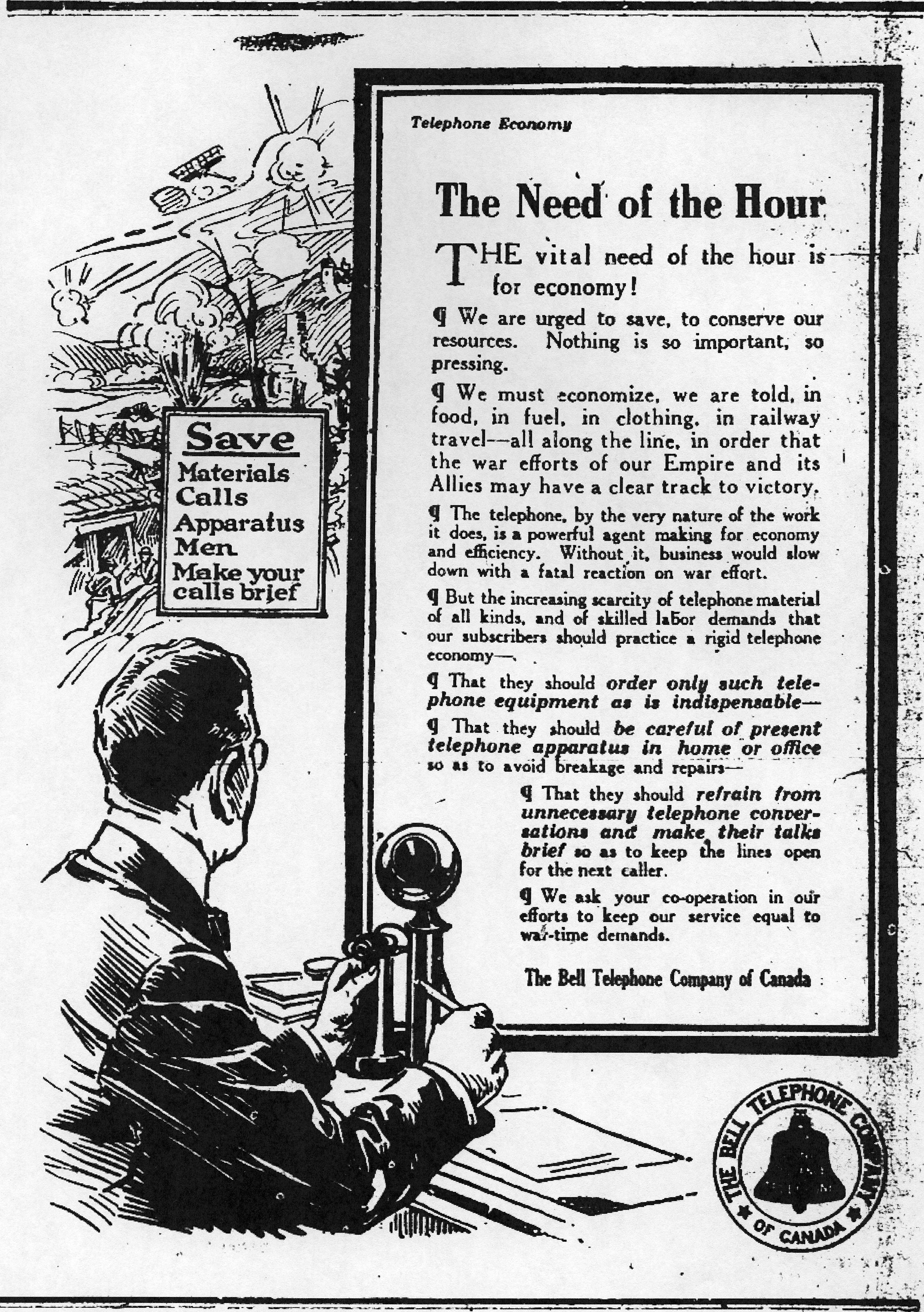
“Telephone Economy. The Need of the Hour. The telephone, by the very nature of the work it does, is a powerful agent making for economy and efficiency. Without it, business would slow down with a fatal reaction on war effort.

But the increasing scarcity of telephone material of all kinds, and of skilled labor demands that our subscribers should practice a rigid telephone economy.

We ask your co-operation in our efforts to keep our service equal to war-time demands.

The Bell Telephone Company of Canada.”

The Intelligencer April 12, 1918 (page 7)

“Made Supreme Sacrifice. Mrs. John Gillespie, residing at Plainfield, Thurlow township, has received notification from the Director of Records at Ottawa that her son, Private William Gillespie had been killed in action. Deceased was about 35 years of age and unmarried. Some months ago he enlisted at Kingston and was engaged for a considerable time in assisting in the bakery in connection with a military camp in England. He had not been at the front for any great period when he was killed.

Private Gillespie was well known in this vicinity where he was born and lived all his life. His father died some time ago. In addition to the mother, two brothers and a sister survive. Mr. Thos. Gillespie, residing on Catherine street in this city is an uncle of the deceased.”

[Note: Private William John Gillespie died on April 2, 1918. He is commemorated on Page 414 of the First World War Book of Remembrance.]

The Intelligencer April 12, 1918 (page 7)

“Daylight Saving. Commencing Monday 15th the leading Merchants of Belleville will open their places of business at 8.30 and close at 5.30 to enable their staffs to get on the land.”

100 Years Ago: Daylight Saving Act to Pass, Belleville Council Requested to Raise $5,000 per Month for Patriotic Fund, Richard J. Gernon Wounded, Quinte Chapter I.O.D.E. Meeting

The Intelligencer April 11, 1918 (page 1)

“Summer Time Begins Monday Morning. Ottawa. Without any playing of trumpets, but as a simple development from wartime conditions, the Act to economize in daylight is being put into shape for final passage. Between now and Friday the Senate, where the measure is now, will put through the Bill, and the deputy Governor-General will come down and give an immediate assent so that the announced plan of the reform becoming operative next Sunday night will be carried out.

There will be absolutely no introductory ceremony attendant upon the new and much discussed departure. On Sunday night, when father puts out the cat and winds the clock, he will move the hands forward an hour. The solar time will be midnight, but the timepiece will make it one o’clock. Daylight will be reached that much earlier, and people at large will, it is believed, reap a great resultant benefit.”

The Intelligencer April 11, 1918 (page 2)

“City Council Requested to Raise $5,000 per Month for Patriotic Purposes. A public meeting of ratepayers and citizens was called to discuss means of raising money for patriotic purpose. …  At 8 o’clock, the hour called for the meeting, there were seven present, including the newspaper representatives and the city messenger. Later a few more assembled, but the Council Chamber where the meeting was held, was by no means filled. …

Col. Lazier spoke of the necessity to raise funds for patriotic purposes. To meet our requirements this year $65,000 would be necessary. There are two ways to raise this money, namely, for the City Council to procure it by taxation or to raise it by public subscription. Personally he would favor the Council procuring the sum required by taxation. …

Suggestions covered a wide range from taxing tenants to placing a poll tax of five dollars each on young men. …

Col. Lazier moved, seconded by Mr. E. H. Tickell, the following resolution which was unanimously adopted: …  the City Council to levy through the municipal taxation a sum sufficient to pay $5,000 a month during the continuation of the war.

The Council to adopt means of taxation if possible to reach all classes in the community so as to make the assessment equitable.

And that a subscription list be opened to allow those to subscribe to the fund who do not pay what they think they ought to pay through their taxation.”

The Intelligencer April 11, 1918 (page 5)

“Pte. Gernon Wounded. Mr. Richard Brown, Canifton Road, received the following telegraph despatch from Casualty 413127 Pte. J. Gernon. Canadian Expeditionary Force. Sir:—I beg to inform you that an official report received by cable from England, states that the marginally noted soldier, was reported slightly wounded on March 21st, 1918, remaining at duty. Director of Records.

Pte. Richard Gernon is a nephew of Mr. Brown residing on the Canifton Road. He left Kingston with the 39th Battalion and has been in active duty since then. He was well known in this city where he had always resided and his many friends will hope that his wounds will prove to be not of a serious nature.”

The Intelligencer April 11, 1918 (page 5)

“An Interesting Meeting. A large number of members and friends were present yesterday afternoon at the monthly meeting of the Quinte Chapter I.O.D.E. in the Y. M. C. A. After the business of the meeting was concluded, the large audience enjoyed a most entertaining talk by Mrs. Parkes Hutchison, on her Y. M. C. A. work overseas. Many interesting experiences were related and showed the great work which is being done by this organization. Mrs. Parkes Hutchison then sang very sweetly several songs which are favorites of the soldiers. After a vote of thanks had been given and the singing of the National Anthem the meeting adjourned.”


100 Years Ago: Daylight Saving Starts April 15, Funeral for Harold Reid

The Intelligencer April 10, 1918 (page 1)

“Daylight Saving Starts April 15. Ottawa. Sir Robert Borden intimated last night that Canada’s daylight saving bill will go into effect on Monday, April 15th. The bill, which is now before the senate, will be put through its various stages this week and assented to.

The necessary proclamation to bring the bill into effect will probably appear in The Canada Gazette on Saturday, and clocks will be advanced an hour at midnight on Sunday.”

The Intelligencer April 10, 1918 (page 2)

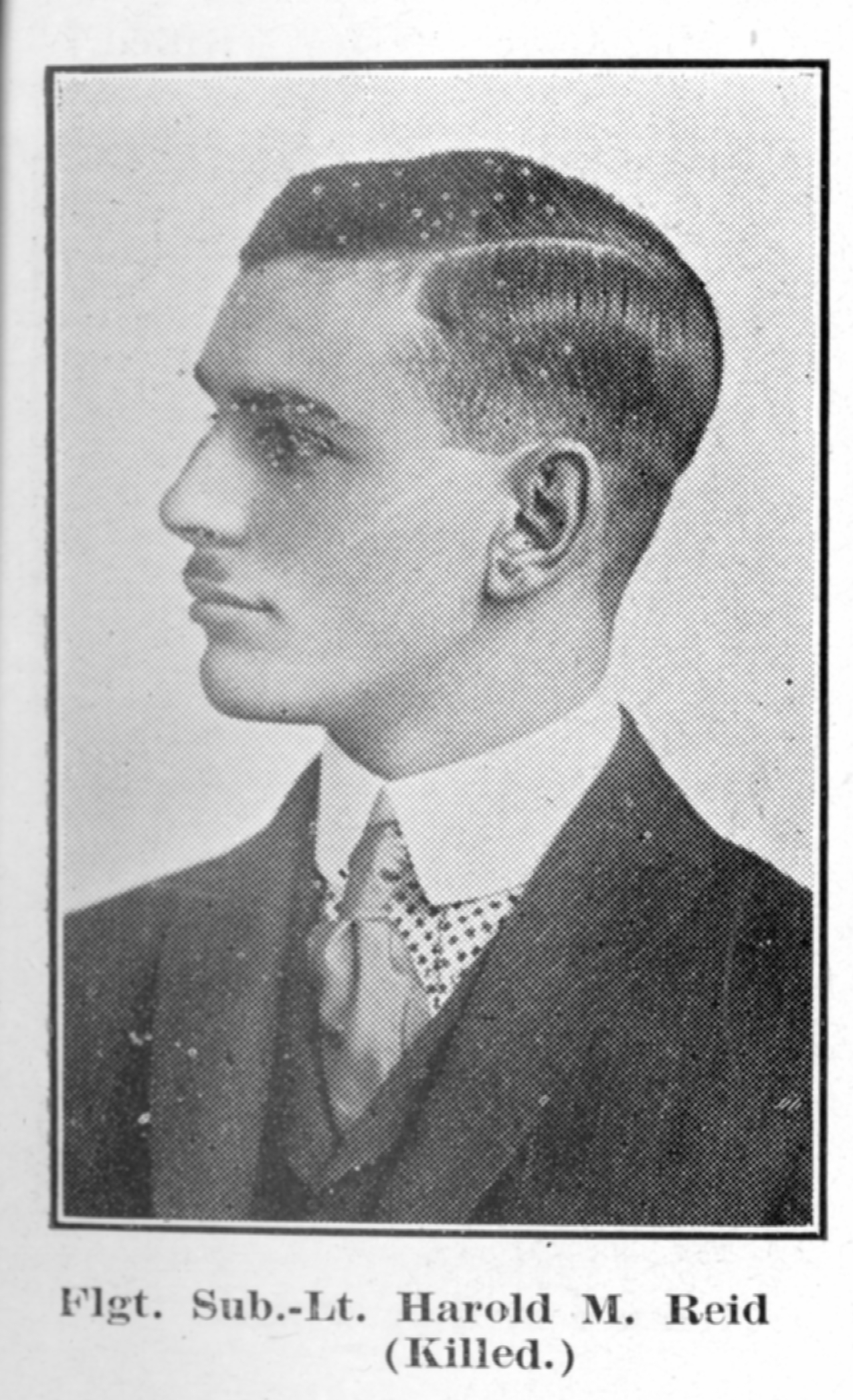
“A Soldier of the Sky Laid at Rest at Belleville, April 9, 1918. The funeral was a military one and was very largely attended by all classes of citizens, who wished to honor the memory of this young man who had given his life for his country just when life was in the springtime and meant so much. Like many other heroic young Canadians, he placed his all on the altar of patriotism and was ready to meet death with a smile in the knowledge of duty well done.

As a mark of respect to the young aviator and his parents a number of business places were closed during the services, as were also Albert College, the High School and some of the classes in the Public schools. Previous to the public service at Bridge Street Methodist Church, a brief private service was held at the family residence, Bridge Street east for the members of the family. …

The body was then conveyed to the church, which was soon filled to overflowing. The interior of the sacred edifice was appropriately draped for the occasion. About the gallery railing to relieve the sombre black draping a few Union Jacks were hung.

The centre pews of the church were reserved for members of the family and friends, the employees of the Ritchie Company, of which the father, Mr. C. M. Reid, is manager, the returned soldiers, High School Cadets, and teachers and students at Albert College. A portion of the gallery was occupied by the pupils of the High School. As the casket was brought into the church Prof. Hunt played the Dead March upon the organ. …

After the service the cortege was formed and was headed by the 15th Regiment band playing the Dead March in Saul. As the funeral procession wended its way down Bridge street that thoroughfare on either side was lined with citizens. …  The cortege proceeded by way of Bridge street west to Commercial street, thence to Belleville cemetery, where interment took place. After the committal service by Rev. Dr. Scott the ‘Last Post’ was sounded and the last sad rites over a soldier hero were completed.”

100 Years Ago: City Council Grants $6,000 to Y.M.C.A., Advances in Modern Army Surgery, Schools Close Out of Respect for Harold Reid

The Intelligencer April 9, 1918 (pages 1, 6)

“City Council Granted $6,000 To Y.M.C.A. Overseas Work. A deputation requesting a grant from the Council to the Y.M.C.A. overseas fund, was on motion heard. Mr. D. V. Sinclair addressed the Council in reference to the National Council of the Y.M.C.A., and the work it was doing in the present war. …  This war will be won by efficiency and this can only be secured by aid of sports, so as to help equip the soldiers. A large sum is required for recreation and other purposes. …  The Y.M.C.A. huts are of great benefit to the boys who are in active service. It is estimated at least $123,000 will be spent this year for writing paper alone. …

Mayor Platt said that he was in hearty accord with the proposition made. What the boys over there are doing we scarcely realize. They are fighting and even dying for us. He felt sure the request would be granted. Ald. Whelan said that whatever the Council did in the matter he would heartily support. He thought it was a better way to secure the money than a house to house canvass. …  The deputation were informed that a grant would be made by motion at the proper time.”

The Intelligencer April 9, 1918 (page 3)

“Reclaiming the Wreckage of War. One of the most interesting developments of the present war has been the wonderful advance in medicine and surgery. The military medical men have performed heroic service in every branch of the operations from No Man’s Land to Blighty and have constantly added to the knowledge of the world by new discoveries for the amelioration of pain and the defeat of death.

Returned soldiers hold the military medical service in a sort of reverential awe and say that there is nothing impossible in modern army surgery; that a soldier can be practically shot to pieces and put together again by the medicos if the pieces can be found and a spark of life remains.”

The Intelligencer April 9, 1918 (page 5)

“A Token of Respect. The High School, public schools and Albert College were closed this afternoon out of respect to the late Flight Lieut. Harold M. Reid, whose father, Mr. C. M. Reid is a member of the Board of Education and also a member of the Board of Albert College.”


100 Years Ago: Original First Contingent Men Won’t Be Discharged, Funeral for Sergeant Charles A. Gibson, Anniversary of Battle of Vimy Ridge, Harvey Wheeler Wounded, Captain W.E. Schuster Now a Civilian, Body of Harold Reid Arrives in Belleville

The Intelligencer April 8, 1918 (page 1)

“Original First Men Can’t Stay At Home. Ottawa. Representations are being made to Ottawa to grant the members of the Original First Contingent who are home on furlough their discharge. General Mewburn and the Militia authorities sympathize with the requests but point out the difficulties in the way.

In the first place, it was only after months of negotiations that the War Office was persuaded to grant these men furlough. …  When it was finally agreed that they would be granted a three-months’ furlough, it was on the distinct understanding that the men returned. …  In addition there are many more men members of the first contingent for whom the Government are still anxious to secure furloughs. It is claimed that if the men now home were discharged, it would refuse absolutely to consider further requests for furlough.”

The Intelligencer April 8, 1918 (page 2)

“Sergt. Charles A. Gibson Hero of Two Wars Lays Down His Arms. Through streets lined with men and women and children, whose faces showed the sorrow they felt, a long procession moved slowly on Saturday afternoon carrying all that was mortal of a brave soldier and gallant Canadian from his earthly home to the last resting place amid the green carpeted aisles of that silent city, where so many loved ones wait in rest and peace the great and joyous reunion which faith has promised.

Sergeant Charles Armstrong Gibson was born and brought up in Belleville, and his life so full of National and Empire service was so well known to everybody that his death caused widespread sorrow and his funeral was attended by thousands who paid this tribute of respect to one who was always first to respond to his country’s call in the hour of danger. Many there were also who honored Charlie Gibson as a friend, kind and generous to a fault, and to these his sudden death brought deep sorrow. …

In the funeral procession were over sixty returned soldiers who had done ‘their bit’ over there, some like Charlie Gibson being Original Firsts of this war, who responded to the first call. Others, too, like him, wore the distinguishing medals of service in the South African war. …

It was one of the largest funerals seen in Belleville for many a day, and during the slow march through Front street both sides of that thoroughfare were crowded with spectators, and many were the expressions of regret heard at the passing of a brave soldier, who was deservedly popular. …

At the family residence 72 Victoria Avenue, at 3.30 o’clock an appropriate service was conducted by the Rev. Dr. Blagrave, rector of Christ Church, who also officiated at the interment at the cemetery. …  After the committal service at the grave the Last Post was sounded, ending the ceremony over the body of one who was worthy of all the honor accorded him. The floral tributes were many and most beautiful in design, being a mute testimony to the numerous friends of the departed, and the casket was draped with the Union Jack, the flag he loved so well.”

The Intelligencer April 8, 1918 (page 4)

“Battle of Vimy Ridge One Year Ago. The week-end is remembered throughout Canada as the first anniversary of the Canadian victory at Vimy Ridge. It was just a year ago that they won such immortal fame. One of the finest chapters in the history of the Canadians was written when they made the famous charge that carried the ground so long coveted.

After months of preparation, with the foe always on higher ground they carried the ridge in half an hour after the first German S. O. S. rocket was fired. The despatches described the attack as majestic, awe-inspiring. It revealed the Canadian spirit. It proved them fighting men. On either side were the dashing British troops, the English battalions, the famous Scotch regiments. To the Canadians had fallen the honor of the main attack and they carried it out with the greatest gallantry.”

The Intelligencer April 8, 1918 (page 7)

“Pte. Wheeler Wounded. Word has been received in the city that Private Harvey Wheeler has been wounded whilst on active service at the front. He was wounded on the knee and chest. The young private enlisted and went overseas with the 155th Battalion from this city.”

The Intelligencer April 8, 1918 (page 7)

“Returns to Civilian Life. Capt. W. E. Schuster is now in civilian life again after two years overseas service as transportation officer on the London Headquarters staff of the Canadian Forestry Corp. There is abundant evidence that this officer’s work has been stamped with efficiency and that he has made good goes without saying. The great and useful work of the above corps will fill interesting pages in history when the entire operations are fully known.”

The Intelligencer April 8, 1918 (page 7)

“An Eventful Voyage. The body of Flight Lieut. Harold Mackenzie Reid, son of Mr. and Mrs. C. M. Reid, who on February 23rd was killed at Eastchurch, England, as the result of an aeroplane accident arrived in this city on Sunday afternoon via C. P. R. Many relatives and friends were at the station to meet the train conveying the body, which arrived at 3.15 p.m. Accompanied by eight members of the staff of the Ritchie store the body was taken to the mortuary parlors of Tickell & Sons. Subsequently the casket was taken to the home of the parents, 105 Bridge street east, being escorted by a number of the employees of the Ritchie Company. …

It is interesting to note that the Transatlantic liner which brought the body from England was torpedoed by a German submarine and obliged to put back to England for repairs, the bow of the vessel being badly damaged from torpedo contact. The second sailing was more successful and the voyage was made in safety.”

100 Years Ago: Men Between 16 and 60 Must Work, Call for Citizens to Pray and Attend Church, Theatre Fare Advertised, Private Clifford Gunn Welcomed in Madoc Masonic Hall, Lieut. A. Kelso Roberts Missing

The Intelligencer April 6, 1918 (page 1)

“Everyone Between 16 and 60 Must Engage in Useful Work. Ottawa. An order-in-Council to suppress idleness has been adopted by the Government. It provides that every male person shall be regularly engaged in some useful occupation, with the exception of persons under sixteen years of age and over sixty, or physically unfit, or a student or temporarily unemployed. …  There are careful provisions against employers using this regulation as a club over the heads of strikers, as these are specifically exempted.”

The Intelligencer April 6, 1918 (page 3)

“Leaders of the Empire are Calling Us to Prayer at This Time, Worship at Your Church To-morrow. Emmanual Reformed Episcopal—Rev. A. M. Hubly; John St. Presbyterian—Rev. D. C. Ramsay, B.A.; St. Andrew’s Presbyterian—Rev. A. S. Kerr, B.A.; Holloway St. Methodist—Rev. J. N. Clarry, B.A.; Tabernacle Methodist—Rev. S. C. Moore, B.A., B. D.; Bridge St. Methodist—Rev. C. T. Scott, D.D.”

The Intelligencer April 6, 1918 (page 6)

Theatre listings

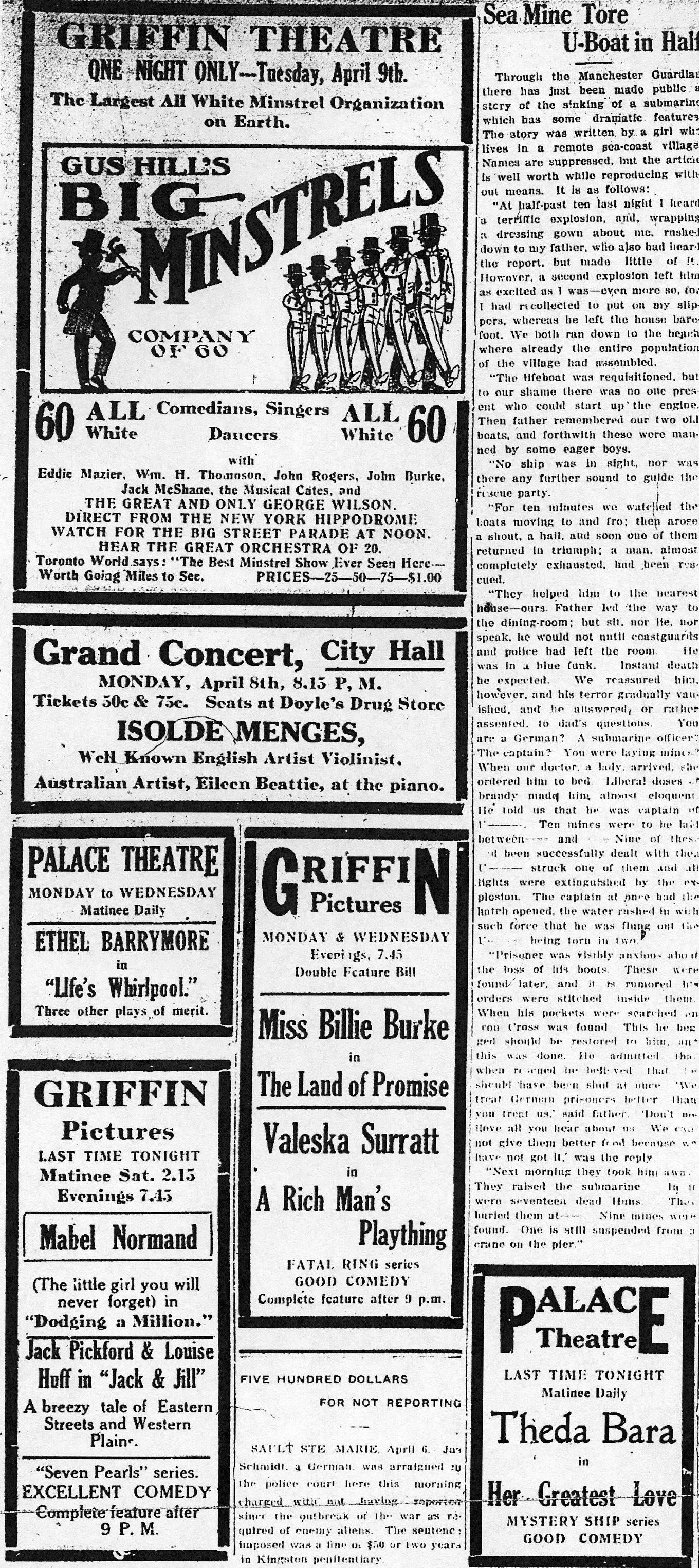
“Griffin Theatre: Gus Hill’s Big Minstrels. Grand Concert, City Hall: Isolde Menges. Palace Theatre: Ethel Barrymore in ‘Life’s Whirlpool.’ Griffin Pictures: Miss Billie Burke in The Land of Promise, Valeska Surratt in A Rich Man’s Plaything. Griffin Pictures: Mabel Normand in ‘Dodging a Million,’ Jack Pickford & Louise Huff in ‘Jack & Jill.’ Palace Theatre: Theda Bara in ‘Her Greatest Love.’ ”

The Intelligencer April 6, 1918 (page 7)

“Reception to Returned Soldier. A large and enthusiastic meeting was held in the Masonic Hall, Madoc, on Monday night to tender a hearty welcome to Pte. Clifford Gunn who has just returned from overseas. Pte. Gunn enlisted at Madoc, went overseas in October, 1916, proceeded to France where he was shell shocked at Vimy Ridge and invalided to Blighty.

Pte. Gunn, although still suffering from the effects of shell shock, is looking well. There appeared on the platform along with him his father looking his approval of Clifford’s actions and happy in the consciousness of his safe return. Madoc Band was out in full force to celebrate Clifford’s return and a hearty welcome on behalf of Madoc’s citizens was tendered.”

The Intelligencer April 6, 1918 (page 7)

“Lieut. A. Kelso Roberts. A cable received by Mrs. A. A. Roberts, who resides at 159 George St., in this city, conveyed the sad intelligence that her son, Lieut. A. Kelso Roberts, who has been on active service in the war zone, is reported as missing since March 21st. Lieut. Roberts obtained his commission from the Royal Military College at Kingston, and went overseas last September. He enlisted with the Royal Field Artillery in England and had been in France since New Years. His many friends in this city will hope that the more favorable news will soon be received from the popular young officer.”

100 Years Ago: Gunner Ralph Coon Killed in Action, Circus Held at Y.M.C.A.

The Intelligencer April 5, 1918 (page 2)

“A Brave Soldier and True Comrade. Mr. and Mrs. D. E. Coon, of the fourth concession of Sidney, received further particulars of the death of their son, Gunner Ralph A. Coon, in letters from some of the members of the 16th Battery, of which he was a member. Ralph went overseas in December, 1915.

The following is one of the letters received: France, February 10, 1918. Dear Mrs. Coon,—The sad news of your son Ralph’s death no doubt long since reached you. However, at the request of the boys of the battery I am writing you this letter with a view of giving you the particulars of how your son and our comrade met his death. From men who were with Ralph when he met his unfortunate end I gleaned the following particulars.

It was on the morning of February 6th, about 7 a.m., when a shell from the German lines came over. Ralph was asleep at the time, and it is our belief that he never knew what happened to him, even though it was two hours before he died. From the gun position he was at once removed to a dressing station close by. Despite the heroic efforts of the doctor there was nothing could be done to save his life. He never regained consciousness. …

In a little cemetery far back from the firing line we buried him the day after he was killed, and, Mrs. Coon, I can safely say the funeral was one of the most impressive ones I ever saw in this country. Practically every member of this big unit turned out to pay homage to one of our bravest soldiers and truest comrades. Our army chaplain conducted the service and in addition to his two cousins, the other pall bearers were A. Bde. J. Lummand, and Gunner L. Smith.

Yesterday two of the gunners made a long trip to a well known little French town, where they succeeded in purchasing a truly beautiful monument. This will be suitably engraved and erected in the course of the next few days. It is customary to erect crosses over the graves of the fallen battery boys, but in Ralph’s case, he was so popular that twelve of his most intimate friends got together and secured a monument.

Well, Mrs. Coon, I guess there is little left to say, so in concluding, permit me to express to you the heartfelt sympathy of every officer and man in the battery, and when you lost your son Ralph we here lost one of the truest, bravest and most popular boys the battery has ever known.

If there is anything further you desire to know please write me and I will feel it more than a duty to answer your letter immediately. I remain, yours truly, A.-Bde. J. Trimm.”

[Note: Gunner Ralph Addison Coon died on February 6, 1918. He is commemorated on Page 388 of the First World War Book of Remembrance.]

The Intelligencer April 5, 1918 (page 4)

“Unique and Amusing Circus at Y.M.C.A. Dingaling & Bungaling Brothers celebrated Country Circus is in the city and is creating considerable excitement and interest not only among the younger citizens, but even with the grown up population. It is rightly termed Belleville’s classy circus. It opened in the Y.M.C.A. building last night and the attendance was such that nearly every apartment of that spacious building was filled.

Previous to the opening of the large show in the gymnasium the side show was a source of great attraction and curiosity. …  Hundreds visited this important feature of the circus, and were edified and pleased with all presented to gaze. Whilst the big show was in progress in the assembly room a minstrel show took place, and the programme was such as to delight all who attended.

At a few minutes after 8 o’clock the grand entry took place. …  The grand entry was a spectacle of surpassing beauty, a galaxy of acrobats, tumblers and gymnasts and gorgeous costumes, funny clowns, weird freaks and ferocious animals, and a stupendous moving tableau. A most entertaining programme was then carried out consisting of boxing drills, gymnastic dancing by a class of young ladies was thrilling and bewildering. …

Six young men gave a fine exhibition of work on the parallel bar. They won hearty applause by their swiftly evolving tricks which were something new, novel and unique. A band of soldiers of the soil wielding rakes and hoes in wonderful evolution and in perfect unison to music, was much enjoyed. …  Every part of the programme was well carried out by those taking part, there being not a dull moment. The performance will be repeated this evening, and those unable to witness it last night should avail themselves of the opportunity to do so.”

100 Years Ago: Cold Storage Plants to Be Emptied, Sergeant Charles Gibson Dies, 1,000 Boys a Day Enroll for Farm Work, La Boutique Held by Quinte Chapter I.O.D.E., Circus Day in Belleville, Dominion Police Force Check Trenton and Belleville Men for Credentials

The Intelligencer April 4, 1918 (page 1)

“Cold Storage Plants Will Be Emptied Of Food Stuffs. Ottawa. Drastic new regulations effective from today are announced by the Canada Food Board in an endeavor to eliminate the speculative element from the Canadian produce business. Monthly reports of all supplies on hand are required from all dealers.

No person or company shall hold meats, lard or oleomargarine in quantities larger than enough to supply his Canadian trade for sixty days. Butter and eggs must not be stocked on December 1st larger than enough to supply customers till May 1st. Restrictions are also placed on poultry, cheese and other products.

For infringement of the new regulations fines up to one thousand dollars and imprisonment for three months are provided for, also cancellation of license.”

The Intelligencer April 4, 1918 (page 4)

“Called by Death. Sergeant Charles Armstrong Gibson, one of Belleville’s best known young war heroes, has answered the final roll call. At an early hour this morning he passed unexpectedly away at his late residence 72 Victoria Avenue. Last evening he was about the house and retired apparently in his usual health.

At about four o’clock this morning he awoke and complained to his wife that he was ill and was suffering from shortness of breath. Medicine was administered and a physician was summoned, but before the latter arrived dissolution had taken place. Heart trouble was the cause of death.

Sergt. Gibson was the only son of Mr. and Mrs. Robert Gibson, residing on Hillcrest Avenue, and was born in this city on March 19th, 1876, thus being in his 43rd year. ‘Charley’ as he was familiarly called while attending the public schools was imbued with a soldier’s spirit and was never happier than when in uniform. …

At the outbreak of the present war Sergt. Gibson was one of the first in this city to enlist and he became a member of the 2nd Canadian Battalion. He went overseas with the first contingent and soon saw active service. He was in the battles of Ypres, Festubert and Givenchy. At the latter place he was severely wounded in the head and was invalided to England where he remained for some time.

Upon his arrival home he was accorded a hearty welcome from the citizens. For gallantry on the field of action he was promoted to a sergeant. Charlie Gibson was an exemplary soldier, and his cheerful manner tided many a young soldier over his first trip under fire. He was fearless and ever desirous of being in the front lines.

Sergt. Gibson was the Hon. President of the Great War Veterans’ Association of this city. He was also a member of Belleville Lodge No. 81 I.O.O.F. and the Canadian Order of Foresters. He was an attendant of St. Andrew’s Presbyterian Church. Surviving is a wife and one son, R. Cecil, also his father and mother. To those suddenly bereft will be extended the heartfelt sympathy of all citizens. The funeral will be held with full military honors.”

The Intelligencer April 4, 1918 (page 5)

“Thousand Boys a Day Enroll For Farm. Toronto. The boys of Ontario are enrolling at a rate of 1,000 per day to help in the greater production campaign. …  It was originally believed that 16,000 boys could be secured in Ontario this summer for farm work, but at the rate that the boys have signed up it is now believed that this number will be largely exceeded. …

The most of the returns are from towns in  rural districts, and the great majority of the boys have previous experience at farm work. The most of them say that they are able to arrange for their own employment, but there are some who cannot arrange for their own employment, and are willing to go on the farm immediately. This latter class will receive the first consideration and will be placed first.

The boys are asked to state their weights in their enrolment forms, and it is found that many of the boys, 16 and 17 years of age, weigh from 150 to 170 pounds. …  Last year the average wage that the boys secured was $18 a month and board, but this year it is expected that they will average more than $20 and board.”

The Intelligencer April 4, 1918 (page 7)

“Results of ‘La Boutique.’ ‘La Boutique’ held by the Quinte Chapter, I. O.D.E. for patriotic purposes, on Saturday last in the City Hall, proved to be a most profitable entertainment as well as a most enjoyable one. The sum of $500 was realized.

The following articles were disposed of by raffle: Luncheon Cloth, donated by Mrs. W. N. Perry, lucky No. 217, won by Mr. C. M. Stork; Knitted Sweater, donated by Mrs. E. D. O’Flynn, No. 31, won by Col. Wilson; Bag of Potatoes, donated by Col. O’Flynn, No. 168, won by Mr. J. W. Pearce; Camisole, donated by Mrs. D. M. Waters, No. 10, won by Gene Caldwell; Socks, donated by Mrs. E. D. O’Flynn, No. 1, won by Mrs. W. C. Mikel. The bottle of money donated by Mrs. J. F. Dolan, for which guesses were made, contained $3.70. The guess nearest the amount was $3.66.”

The Intelligencer April 4, 1918 (page 7)

“Circus Day in Belleville. The big ‘parade’, a mile long, almost, with its glittering golden chariots and open dens of wild and other animals, clashing, smashing bands of music, and other weird and wonderful freaks and fancies, at high noon to-day along the principal streets and boulevards of Belleville broke the news none too gently to those who didn’t know that the Y.M.C.A. Circus, otherwise known as the Bingling-Bungling World’s Greatest Galaxy of Wonders had struck town. …  The parade was well worth seeing and if the entertainment under the ‘Big Top’ is on the same scale of excellence there should be a hot time around the Y.M.C.A. building this evening.”

The Intelligencer April 4, 1918 (page 8)

“Carry Your Papers Or The Dominion Cops Will Get You. Show your papers! Was the salutation which startled many young men last evening as they came out of the local theatres or paused between dances or pool games. Five members of the Dominion police force dropped in on Belleville unannounced last evening after a thorough combing out of Trenton for defaulters under the Military Service Act. …

Many were found without credentials, birth certificate, if under age, marriage certificate or exemption papers, but all kinds of leniency was extended and judgment shown as this was only a preliminary to a thorough combing of Belleville for men who may not be complying strictly with the terms of the Military Service Act. …

The roundup finished about midnight, when the bunch without papers had been sifted out and reduced to six, who were held for further examination at the Police Station, and were finally allowed to go home, one being ordered to report for military duty at Kingston to-day. …

Mayor Platt was an interested spectator of the combing out process at the Palace Theatre. …  It was not until midnight that the excitement quieted down, and it is a safe bet that the young men of Belleville will carry their papers henceforth.”
100 Years Ago: Ad for Royal Flying Corps Recruits, Ploughing of Gardens to Be Discussed at City Council

The Intelligencer April 3, 1918 (page 1)

“The All-Seeing Aviator. The aeroplane upset many old ideas of Military Strategy. Surprise tactics of the enemy, once so effective, are now impossible so long as our aviators rule the air. The movements of troops, the placing of batteries to ‘strafe’ our lines, in fact, all enemy activities are observed by our airmen, who communicate the information they obtain by wireless to the Commanders on the ground.

Clear-headed, keen young men, 18 to 30 years of age, those possessing fair education, and sturdy physique, will be accepted as cadets and trained for the service.

Write for Booklet, ‘Air Heroes in the Making.’ And apply directly to one of the following addresses: Imperial Royal Flying Corps

Recruiting Office, 93 King St., East, Toronto; A. R. Walker, Public Library, Belleville.”

The Intelligencer April 3, 1918 (page 7)

“Ploughs for Gardens. A correspondent queried The Intelligencer yesterday for news of the civic ploughing brigade. Inquiry at the City Hall this morning elicited the information that the question of arranging for the ploughing up of city garden patches will be discussed at a meeting of the City Council committees Thursday evening.”


100 Years Ago: Requests to Plough Gardens

The Intelligencer April 2, 1918 (page 7)

“How About Your Garden? To the Editor of The Intelligencer. Dear Sir,—Would you please give myself and others, who propose having a garden to help increase the production of food, the following information.

Has the Council or the Food Resource Committee made any arrangement by which citizens can get someone to plough up their garden? We hear people all over the city asking where they can get someone to plough up the sod. No one seems to know. Cannot the Council or the Resource Committee get this information and have it available? HOME GARDENER.”