100 Years Ago: Two Belleville Boys Gassed, No Authority for Beef Stew

The Intelligencer August 31, 1917 (page 2)

“Belleville Soldiers Gassed by Huns. Official news has been received from the Director of Records at Ottawa that Gunner W. C. Burgiss, and Bombardier Stephen A. Sword, both of Belleville are in military hospitals suffering from the effects of German poison gas. The official telegrams are as follows:

Ottawa, Ont. Aug. 30th, 1917. J. W. Burgiss, 111 Foster Ave., Belleville, Ont. Sincerely regret to inform you that 40286 Gunner W. C. Burgiss, artillery, officially reported admitted to No. 1 Casualty Clearing Station Aug. 18, 17. Gassed. Will send further particulars when received. Director of Records.

A. Sword, 12 Pope St., Belleville, Ont. Sincerely regret to inform you (40501) Acting Bombardier Stephen Alfred Sword, artillery, officially reported admitted to First General Hospital, Aug. 20, 1917. Gassed. Will send further particulars when received. Director of Records.”

The Intelligencer August 31, 1917 (page 6)

“No Authority For Beef Stew. Ottawa. The Food Controller’s office issues the following: The Food Controller has been informed that the managers of certain restaurants throughout the Dominion declare that they have been given authority to serve beef in such dishes as beef stew on Tuesdays and Fridays. No such authority has been given. …

While it was the intention of the Food Controller to allow managers, proprietors, etc., of public eating places sufficient time in which to adjust their establishments to the new regulations, continued infraction of the regulations will result in early prosecution, and the act will be sharply enforced.”


100 Years Ago: Intelligencer to Be Notified of Casualties, Women’s Military Massage School, Three Belleville Boys Wounded in Action

The Intelligencer August 30, 1917 (page 1)

“Notify Intelligencer About Casualties. Relatives, who receive messages of casualties are requested to notify The Intelligencer as soon as possible, and thus take the best method of giving the news to their friends. The names are not published in the casualty lists till three or four days following the receipt of the official telegram, and the publication of the news is therefore delayed, unless the Intelligencer is notified. Information may be given by ‘Phoning 36.”

The Intelligencer August 30, 1917 (page 3)

“Women’s Military Massage School. Toronto. Women from all parts of Canada have answered the call for masseurs and enrolled in the big training school opened by the Military Hospitals Commission at Hart House, for the purpose of qualifying women as trained workers.

The first class on the opening day, Aug. 20 numbered 82, and the entrants varied from young college girls to mature women of 40 all eager to make themselves proficient in the work, that they might help mend the soldiers who have returned incapacitated and needing such treatment to make them fit again. …  They are all fine women in the most perfect physical condition ready for real work. …

The graduates will be sent to the various military hospitals throughout the country to treat cases of nerve injury, paralysis of the muscles and stiffened joints, which by massage and such treatment as the course includes, have been cured in scores of cases thought at first to be hopeless.

The students will attend these classes regularly from 9 till 5 o’clock daily for six months, and at the completion of their course will be expected to work for the Military Hospitals Commission at any place in Canada to which they may be appointed for 12 months. …

All graduates will receive diplomas which give them the rank of the best masseurs, and the greatly increasing demand for massage treatment following the miracles which are being worked with soldiers through its use, assures them employment indefinitely.”

The Intelligencer August 30, 1917 (page 5)

“Belleville Boys Wounded in Action. At least three Belleville boys have recently been wounded and two members of one family, Privates Thomas and William Crawford Logan, whose parents reside on Church Street.

The following telegrams were received from the Director of Records explain themselves: Mrs. Margaret Logan, 150 Church Street, Belleville, Ont. Sincerely regret to inform you that 136485 Pte. Thomas Logan, infantry, officially reported admitted to 4th General Hospital, Dannes Camiers, August 17, 1917, gunshot wound left shoulder and wrist severe. Will send further particulars when received. Director of Records.

Pte. Thomas Logan enlisted in Toronto with the 38th Battalion. A brother was a few weeks ago killed in action.

Ottawa, Ont., Aug. 26, 17. Mrs. Margaret Logan, 150 Church Street, Belleville, Ont. Sincerely regret to inform you that 69505 Pte. William Crawford Logan, infantry, officially reported admitted to First Canadian General Hospital, August 17, 1917, gunshot wound in hand. Will send further particulars when received. Director of Records.

Pte. Logan enlisted and left with the 124th Battalion at Toronto.

Ottawa, Ont., Aug. 29, 1917. Mrs. J. Hammett, 81 St. Charles Street, Belleville, Ont. Sincerely regret to inform you that 30481 Gunner Theophilus George Hammett, artillery, officially reported admitted to Fourth Southern General Hospital, Plymouth, Aug. 23, 17, gassed. Will send further particulars when received. Director of Records.

Gunner Hammett left for overseas with the 33rd Battery from Kingston. Previous to enlistment, he was a G. T. R. Brakesman, residing in Belleville. He was previously wounded, namely, on April 9th of this year.”


100 Years Ago: William Farrow Killed in Action, Driver Harold Gordon Newton Returns, James Dudley Wounded, John Burns of Madoc Dies of Wounds, Letter of Thanks

The Intelligencer August 29, 1917 (page 1)

“Belleville Soldier Killed in Action. Mr. E. H. Farrow, residing at 19 Patterson Street in this city, and who is connected with the Bell Telephone Company, this morning received the sad intelligence that his son, Pte. William Thomas Farrow, had been killed in action. It was an official notice from the Record Office Ottawa.

‘Bud’ as he was familiarly known about the city enlisted with the 155th Battalion and left for overseas with that Battalion. He was a Sergeant in the Stretcher Bearer Corps. The young hero was in every respect a model young man, and previous to enlistment was clerking in a business place in this city. He had a large circle of friends, who will deeply regret to learn of his demise. Another brother went overseas with the 155th Battalion. To the parents and members of the family will be extended the heartfelt sympathy of all citizens.”

[Note: Private William Thomas Farrow died on August 18, 1917. He is commemorated on Page 236 of the First World War Book of Remembrance.]

The Intelligencer August 29, 1917 (page 2)

“Belleville Soldier Returns from Overseas. Mrs. J. I. Newton, 46 Hillcrest Avenue, was surprised and delighted this morning when her soldier son, Driver H. Newton, returned unexpectedly from overseas, on a well-earned furlough.

Driver Newton enlisted with the 34th Battery three years ago and went overseas. He has been almost continually up with the big guns doing valiant service for Canada and the Empire. Fortunately escaping serious injury, he was the victim of the German poison gas, which still gives him considerable trouble, but it is hoped that with rest and care at home he will soon shake this memento of Hun ‘frightfulness’ from his system.

Driver Newton’s brother, Rodney, who also went overseas in the service of the Empire was taken prisoner on June 16, 1916, and is confined at the German prison camp at Frederickfield.

The many friends of Driver Newton are extending him a warm welcome. He is very optimistic as to the outcome of the war and says it is only a matter of time until complete victory is achieved by the allies. We have the war well in hand now and are dealing such effective blows to the German war machine that the war may be over before next spring.”

The Intelligencer August 29, 1917 (page 2)

“Many Wounds But Cheerful. Private James Dudley, who resided in Belleville for five years, living with the family of Mrs. Henn, 70 S. George Street, and working at the Rolling Mills, enlisted in the 155th Battalion and has seen much service and suffering.

He is now in the Edmonton Military Hospital, London, England, and has lost his left leg amputated above the knee, has two gunshot wounds in his neck, one in the right arm, one in the right leg and finally, as though fate took a final fling, many of his teeth were knocked out by another shell, but he is cheerful, and convalescent, and will return to Canada to marry his fiancée, who is in Hamilton.

Mrs. Henn hears regularly from him and his many friends will be glad to learn that he escaped with his life in the great battle of May 10 where he was so severely wounded.”

The Intelligencer August 29, 1917 (page 7)

“Supreme Sacrifice of Madoc Soldier. Madoc. The following telegram was received Wednesday, Aug. 22nd by a well-known townsman Joseph Burns. Regret to report to you that Sergt. John Edward Burns died of wounds received Aug. 15th.

Sergt. J. Edward Burns was born on the 25th of November, 23 years ago, and spent his life time in Madoc. He received his Public and High School education in Madoc schools, having received his 2nd class certificate at the age of 17 years. He then attended Madoc Model school and taught school for two years.

When the war broke out he enlisted in December, 1914, at Belleville, with the 39th battalion, and left on June 23rd, 1915, for England where he remained until December of that year when he was drafted to the 24th Battalion, France. His first fight was at St. Eloi, from there to Courcelette, all through the Somme over Vimy Ridge and up to Lens. For twenty months he fought the Hun and played the part of the hero, with never a complaint, only at times, he would speak of the hard fighting.

Eddie, as he was known in Madoc, was one of our first boys to go, and he has set an example which any young man should be proud of laying down his life for his God and country that his friends might enjoy freedom.

While the citizens of his home town regret this untimely end, they honor and revere him as a hero gone to receive from the King of Kings that great ‘Well done good and faithful servant enter thou into the joys prepared for thee from the beginning of the world.

Sergt. Burns was a son of Mr. and Mrs. Joseph Burns of Madoc, brother of James Burns of Elk Lake, New Ontario, and the Misses Kay and Jean Burns of Madoc, all of whom have the sympathy of their host of friends in this community.

One more gone for freedom’s sake / Where so many lie. / Falling down without complaint / Not afraid to die.”

[Note: Sergeant John Edward Burns died on August 15, 1917. He is commemorated on Page 210 of the First World War Book of Remembrance.]

The Intelligencer August 29, 1917 (page 8)

“The Spirit of the Gift. The following letter from Lt.-Col. McLaughlin, now commanding the old ‘Iron Scotland,’ heroes of Ypres, is both graceful and suggestive. The ladies of Elzevir may well say to each and all ‘go thou and do likewise,’—similar acknowledgement came from the 21st to Colonel Ponton a short time ago: 2nd Canadian Infantry Battalion, Eastern Ontario Regiment. August 9th, 1917.

Colonel W. N. Ponton, K.C., Belleville, Ont., Canada. Dear Col. Ponton:—I should like you to convey to the ladies of Queensboro, Ontario, the most cordial thanks of the County of Hastings boys in the 2nd Battalion, for their generous gift of comforts and cigarettes which were duly received.

Nothing is calculated to brave up the spirits of the men more than the conviction that our people at home bear us continually in their mind, and are always taking the liveliest interest in our welfare. This conviction substantiated by the very appropriate and thoughtful gift of the ladies of Queensboro, is a source of real assistance and in no small way helps to bear the rigours of a very hard campaign with considerably more equanimity and cheerfulness than would otherwise be the case.

Again, please accept the hearty thanks which I tender in the name of the County men. Yours very faithfully, L. T. McLaughlin.”
100 Years Ago: Canadian Casualties, Harry Dickens Wounded, William Smith Wounded, Joseph Deacon Wounded, Sidney Hector Wounded

The Intelligencer August 28, 1917 (page 1)

“Casualties Among Canadian Troops. Gas Poisoning: Deseronto—A. C. Masters. Wounded: Belleville—R. A. Brown; Bancroft—W. N. McGhee; Faraday—Actg. L. Corp. A. L. Satchell; Trenton—T. Russell; Tweed—G. P. Bowlby. Wounded and Gassed: Coe Hill—A. R. Casement.”

The Intelligencer August 28, 1917 (page 2)

“Slightly Wounded. Mr. Charles Dickens, residing on Brock Street, has received word that his son, Pte. Harry Dickens, has been wounded but not seriously.”

The Intelligencer August 28, 1917 (page 2)

“Pte. Smith Wounded. Pte. William Smith, son of Mr. W. J. Smith, proprietor of the Albion Hotel, in this city, is in the Manchester Military Hospital suffering from wounds, but fortunately not of a serious nature. Pte. Smith went overseas with the 155th Battalion from Belleville.”

The Intelligencer August 28, 1917 (page 2)

“Pte. Joseph Deacon Wounded in Action. Ottawa, Ont., Aug. 26, 1917. Daniel Deacon, 107 Station St., Belleville. Sincerely regret inform you 636893 Pte. Jas. Joseph Deacon infantry officially reported admitted to No. 6 casualty clearing station Aug. 18, 1917. Gunshot wound right thigh and ankle. Will send further particulars when received. Director of Records.

The soldier referred to was well known in this city, where he has always lived. Before joining the 155th Battalion he was employed at the G. T. R. shops. His many friends will hope that his wound is not of a serious nature.”

The Intelligencer August 28, 1917 (page 2)

“Pte. Sidney F. Hector Wounded in Action. Private Sidney F. Hector, who left Belleville with the 155th Battalion, has been wounded. The following telegram was yesterday received by Mrs. Hector: Ottawa, Aug. 26, 1917. Mrs. Margaret Ella Hector, 180 Yeoman St., Belleville, Ont. Sincerely regret to inform you that (637205) Pte. Sidney Frederick Hector, infantry, officially reported admitted to eighteenth Casualty Clearing Station, August 18, 17. Gunshot wounds face. Will send further particulars when received. Director of Records.”

100 Years Ago: Ross Brown Wounded, Harry Holland Gassed, Claude Wallace Wounded

The Intelligencer August 27, 1917 (page 2)

“Mr. David Brown, R. R. No. 3, has received word from Ottawa that his son, Pte. Ross Allen Brown, infantry, is officially reported admitted to the City of London Military Hospital, Clapton, August 20, 1917, gunshot wounds left thigh and back, will send further particulars when received.”

The Intelligencer August 27, 1917 (page 5)

“Mrs. William Holland, of this city, has received the following telegram from the Record Office, Ottawa: ‘Sincerely regret to inform you Pte. Harry Holland, No. 300285, artillery, officially reported admitted to 8th casualty clearing station August 18th, gassed.’

Harry left Kingston with the artillery and has been at the front for some time. His many friends in this city will hope for his speedy recovery.”

The Intelligencer August 27, 1917 (page 6)

“Mrs. C. F. Wallace of this city, is in receipt of the following cablegram which explains itself: Seaford, Aug. 25th, 1917. Royal Herbert Hospital, B. L. N. Ward. Wounded; not serious. Claude.

This refers to Sergt Claude Wallace, son of Mrs. James Wallace of Front street, Belleville. He left here with the 155th Battalion and was transferred to another battalion in France. It will be gratifying to his relatives and friends to learn that his wounds are not of a serious nature. A younger son of Mrs. Wallace was invalided home some time ago.”

100 Years Ago: Ad for Dr. Chase’s Ointment, Mohawk Aviators Visit Bancroft

The Intelligencer August 25, 1917 (page 3)

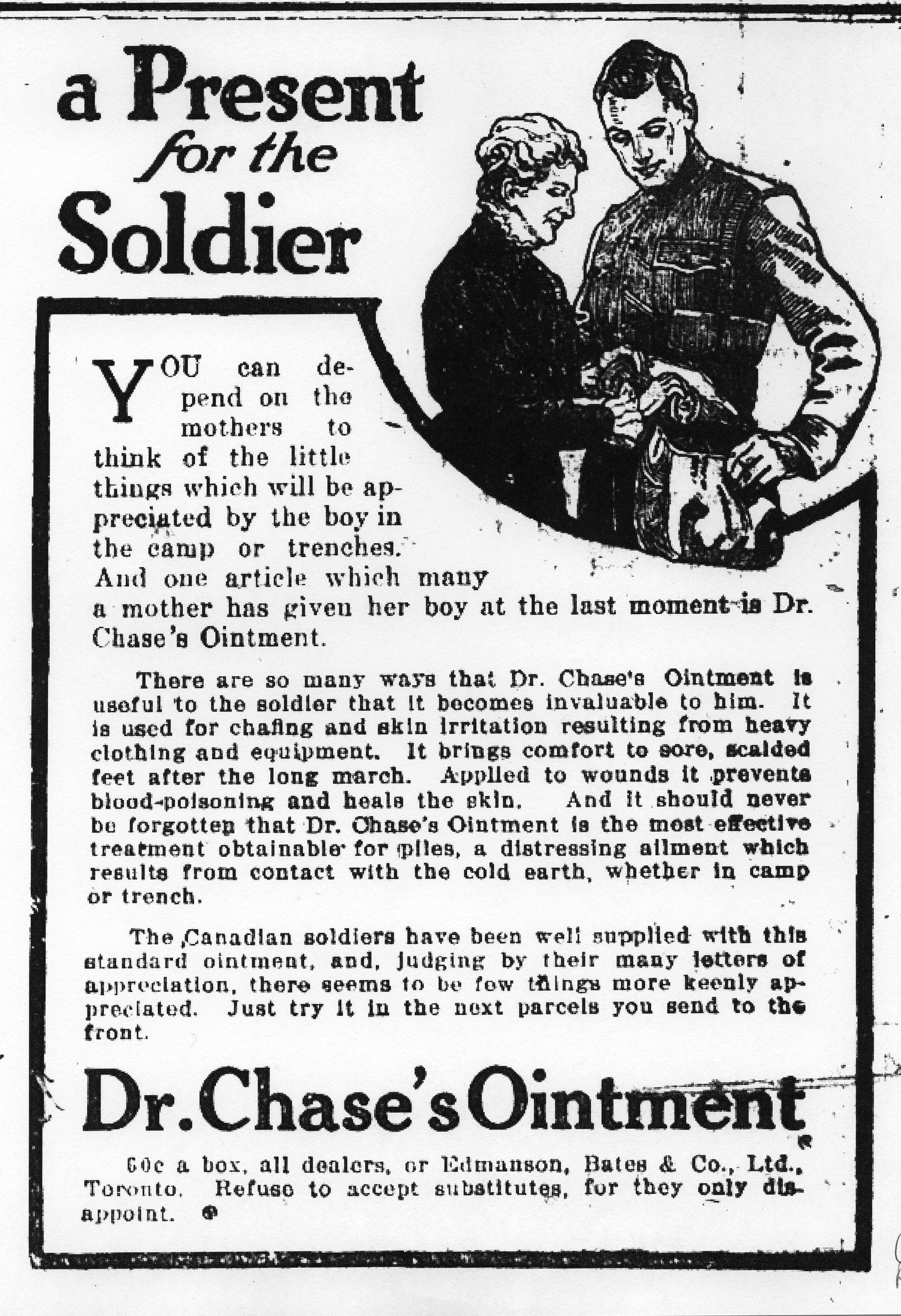
“a Present for the Soldier. You can depend on the mothers to think of the little things which will be appreciated by the boy in the camp or trenches. And one article which many a mother has given her boy at the last moment is Dr. Chase’s Ointment.

The Canadian soldiers have been well supplied with this standard ointment, and, judging by their many letters of appreciation, there seems to be few things more keenly appreciated. Just try it in the next parcels you send to the front.”

The Intelligencer August 25, 1917 (page 7)

“Mohawk Aviators Visit Bancroft. The citizens of Bancroft and many from the surrounding country had a splendid opportunity on Monday last of viewing an airplane at both long and short range, when a machine from the Mohawk aviation Camp at Deseronto passed over here and made a landing in Mr. Herman Kelusky’s field, a couple of miles north of the village.

The birdmen made their appearance here shortly before noon and were flying over the village in search of a landing place; they continued northward, and found what they were looking for on Mr. Kelusky’s farm. The machine was in the charge of Flight Lieuts. Drewry and Blackmore. The latter is a brother-in-law of Mr. Foster, manager of the graphite mine, near Maynooth, and was going to spend the day with his wife, who is camping at Papineau Lake.

The trip from Deseronto here a distance of about ninety miles, occupied one and a half hours. They were delayed here about three or four hours, and everybody quit work and went out to witness the ascension and get a good view of the aircraft that is playing such an important part in the present war. The return trip was made on Tuesday, but the plane was flying very high and far to the east when it passed here.—Bancroft Times.”

100 Years Ago: Embargo on Canned Goods, Stirling Men Harvest Again, Royal Flying Corps Leave Deseronto for Texas, Complaints in 3rd Military District, Merchants Bank Offers Free Depository for War Bonds

The Intelligencer August 24, 1917 (page 1)

“Toronto. Green garden produce must be substituted on the tables of the Canadian consumer, for canned corn, peas and tomatoes. An embargo on the use of canned goods was issued by the Food Controller, Hon. W. J. Hanna, yesterday, after a conference with the Dominion Canners’ Association and wholesale and retail grocers.

The order becomes effective at once and remains in force in the territory east of Sault Ste. Marie until October 15. West of Sault Ste. Marie it ceases on October 1.

‘Housewives have been using too much can-opener and too little cookstove,’ said Mr. Hanna to the press yesterday. ‘Their domestic science has not taught them that there is a difference. We want them to use more cook-stove and less can-opener.’ And this epigrammatic description of the Food Controller’s means the elimination of much waste, as every market-gardener in the Dominion to-day knows.”

The Intelligencer August 24, 1917 (page 2)

“Half-Holiday on Farm. About forty of the male population of the Village of Stirling spent the half-holiday yesterday in helping farmers in the vicinity to stock up their cut grain, and report a splendid afternoon’s work which they thoroughly enjoyed.”

The Intelligencer August 24, 1917 (page 2)

“Fliers Go South. It is said that the Royal Flying Corps will be leaving Canada in a few weeks and take up new camps near Dallas, Texas. This statement will prove very interesting though not pleasant for thousands of people in this district, who have made many friends at the Deseronto camps.

This spring The Royal Flying Corps established two camps near Deseronto. One was on the Mohawk Reserve which was made into the Mohawk Camp and the other was on the Rathbun farm just back of the town. This has since been called the Rathbun Camp.

Last year the aviators near Toronto tried flying in the cool weather. The high altitudes proved so disagreeable that the camp was moved from Long Branch to Texas and Florida. This is the reason for the change and to save any loss of time the arrangements will be completed as soon as possible.”

The Intelligencer August 24, 1917 (page 7)

“In Regard to Complaints. Col. G. Hunter Ogilvie, A.A.G., of the 3rd Military District has informed the different places in the district that any complaints of discharged soldiers, and friends or relatives of soldiers, concerning reports of casualties, pay of soldiers, separation allowance and assigned pay payable to soldiers’ wives, and kindred subjects should be referred to district headquarters for investigation.

The military authorities keenly desire to hear of complaints promptly, in order that they may be inquired into and rectified, if such is necessary, wit least possible delay. No special address is necessary when sending a complaint, but, any letter addressed ‘District Headquarters’ will invariably find the way into the right hands.”

The Intelligencer August 24, 1917 (page 8)

“The Merchants Bank of Canada, Belleville. Free Depository for War Bonds.

By keeping these negotiable bonds in your home you are needlessly assuming the risk of loss by fire or theft. We shall be glad to allow you the free use of our vaults where your War Bonds may be placed in safe-keeping. The War Bond coupons will also be cashed and placed to your credit as they mature, if you so instruct.

N. D. MacFadyen, Manager Belleville Branch.”

100 Years Ago: Canning and Drying of Fruits and Vegetables

The Intelligencer August 23, 1917 (page 6)

“Much interest is being shown throughout the country in the measures adopted for the instruction of our women in the best methods of fruit and vegetables canning and drying. …

People should write to their Provincial government for bulletins on canning and drying. There is a fear that the shortage in bottles will prevent a greater part of the crop from being cared for. It is not commonly known that many of the things which are canned, such as beans, peas, carrots, swiss chard, etc., can be dried without materially altering the flavour. There is no elaborate machinery necessary for this process. It is as easy to dry fruit and vegetables as it is to can them. It simply requires a rack on which to place the material and protection from flies, etc. …

It is a world crisis and no food fit for human consumption should be allowed to go to waste. Save all you can. Can it if possible. Evaporate what you cannot can. Give to someone else what you cannot take care of. Let no food perish. The success of the world struggle will be decided by food.”

100 Years Ago: Mayor Ketcheson Welcomes Three Wounded Soldiers

The Intelligencer August 21, 1917 (page 2)

“Welcomed Returned Soldiers. Mayor Ketcheson extended a warm civic welcome to three soldiers who have been invalided home with wounds from the war zone and arrived in Belleville Saturday. Pte. Varley, a G. T. R. employee, went overseas with the 21st Battalion, and saw active service in many important engagements. He was severely wounded.

Pte. Phillips, whose wife and five children reside on Yeomans street, went overseas with the 39th Battalion. He was wounded in action but is recovering nicely.

Pte. Schmeld, of Eldorado, was attached to the 38th Battalion leaving Canada and was severely wounded.”

100 Years Ago: Month at Christmas for First Soldiers Possible, Letter from Corporal Roberts

The Intelligencer August 20, 1917 (page 1)

“Month at Christmas for ‘First’ Soldiers. London. The oldest troops continue greatly stirred over rumors of possible special home leave for men who have served at the front since the beginning.

The authorities declare any general scheme of leave impossible, but are heartily sympathetic towards the proposal that members of the first contingent who have done much actual fighting should receive possibly a month or six weeks’ Christmas holidays, or as soon after as possible. The proposal is only nebulous, but continues to arouse debate and anticipation.”

The Intelligencer August 20, 1917 (page 5)

“Seaford, Sussex. July 26th. From Corp. C. E. Roberts. Dear Mr. Editor:—I am writing for the Belleville boys in our hut. Some of the boys have received a number of your papers which I read over a dozen times. Some were dated the 3rd of July. We are all glad to hear that Mayor Ketcheson’s son has arrived in Belleville.

You ought to see the 254th Band and Bandmaster Hinchey drilling hard every day. They had the laugh on us when we used to drill in Belleville, but we have the laugh on them now for they are a lot clumsier than we are in their drill; in other words, they are like old women. All that we can hear around here is ‘fall in,’ ‘fall in,’ ‘fall in,’ from morning till night, and then we have to sit down and shine brass from suppertime till bedtime, for the O. C. Parade in the morning. …

Some Canadian mail has just arrived, so I will have to close; all the Belleville boys send their best regards and best wishes to the people of Belleville. We certainly get lonesome at times for dear old Belleville, especially for the Mothers and Sweethearts, which we left behind. I am Yours Truly, Corp. C. E. Roberts.”