100 Years Ago: Men Asked to Serve on Farms, Help Needed for Harvest, Harold Wilkins Reported Missing, Charles Bartlett Killed in Action, Ad for Shredded Wheat, Plea for Men to Harvest, Marson Hitchon Wounded, Return Visit of Whizz-Bang Troupe, Ad for Whizz-Bang Boys

The Intelligencer August 6, 1917 (page 1)

“175,000 Men Asked to Serve on Farms. Ottawa. In an effort to secure farm labor for the present harvest the National Service Board has sent out 175,000 circulars from Ottawa to men who indicated on their National Service cards their willingness to make a change of occupation if the public interest and exigencies of war demanded it.

When the registration cards were returned last spring, more than 300,000 men declared that they would be willing to undertake some essential war work. From these three hundred thousand names has been compiled a list of 175,000 men who are apparently physically fit, and not now engaged in occupations from which they could not be spared, for a time at least, to engage in farm labor. To these men a National Service letter has gone. …  Those who cannot serve at the front are urged to serve the cause at home by helping on the farms.”

The Intelligencer August 6, 1917 (page 1)

“Help Wanted For The Harvest. Mayor Ketcheson is in receipt of the following telegram, which explains itself. Toronto, Aug. 4th. To Mayor H. F. Ketcheson, Belleville, Ontario. The extreme need for help to harvest Ontario crop, leads me to appeal to you to release every possible corporation employee for this work, and to interest yourself in the immediate organization of your municipality to secure harvest help. W. H. Hearst, Prime Minister.”

The Intelligencer August 6, 1917 (page 2)

“Reported Missing. Pte. Harold Wilkins of this city, who was severely wounded some months ago, and who returned to the front after being convalescent, is now reported to be missing. His many friends in Belleville will regret to learn of this, but will hope for the best.”

The Intelligencer August 6, 1917 (page 2)

“Belleville Soldier Killed in Action. Word was received in this city on Saturday from the Record Office conveying the sad intelligence that Pte. Chas. H. Bartlett, of Belleville, had been killed in action. Private Bartlett was well known to many in this city where he had resided for some time. Previous to enlistment he was employed in the Belleville Hardware establishment.

He was a married man, his wife being the eldest daughter of Mr. John McKenna, residing on West James street. In addition to the wife three children survive, the baby having been born since the father went to the front. He enlisted with the 80th Battalion and went overseas with that contingent some months ago. He had only been in France a short time when he was killed. He was a member of Christ Church. The many friends of Pte. Bartlett will regret to learn of his demise and to the bereaved will be extended the heartfelt sympathy of all citizens.”

[Note: Private Charles Henry Bartlett died on July 23, 1917. He is commemorated on Page 197 of the First World War Book of Remembrance.]

The Intelligencer August 6, 1917 (page 3)

“The Waste of War is terrible, but the waste of food in times of peace is colossal. Rich and poor alike eat tons of food that has little food value—and this useless food breaks down the so-called eliminating organs and depletes the physical and mental powers.

Shredded Wheat Biscuit is all food, prepared by a process which makes every particle digested. It is 100 per cent. whole wheat. Two or three of these Biscuits with milk, make a nourishing meal, supplying the greatest amount of energy at lowest cost. Delicious with sliced bananas, berries or other fruits. Made in Canada.”

The Intelligencer August 6, 1917 (page 3)

“10,000 Men Needed Now! Ontario’s Crop Must Be Harvested. Three months ago, in order to avert Famine and World Hunger, the farmers of Ontario were urged to seed every possible acre. To-day, thanks to their response, and favorable weather conditions, we have the result in a record crop of foodstuffs.

As we appealed to the farmers in April and May to plant, so now do we appeal to the employers of labor and their employees for help to harvest this crop.

In comparison with the sacrifices being made by our men in the trenches, the most that any man is called upon to sacrifice in helping with the harvest must be insignificant.

As Prime Minister of Ontario, I call upon Employers to make it easy for their Employees to assist, and upon Employees to face the obligation of the hour in a Spirit of Service and Loyalty. W. H. Hearst, Prime Minister of Ontario.”

The Intelligencer August 6, 1917 (page 7)

“Pte. Marson Hitchon Dangerously Wounded. Mrs. Joseph Hitchon, residing on Forin Street, of this city, received the following telegram from Ottawa yesterday: Ottawa, Ont., Aug. 4th. Mrs. Joseph Hitchon, 33 Forin Street, Belleville. A.A.A., 389. Sincerely regret to inform you 636265, Pte. Marson Hitchon, infantry, officially reported dangerously wounded, admitted to 33rd Casualty Clearing Station, August 1st, 1917. Will send further particulars when received. Director of Records.

Marson left Belleville with the Signal Section of the 155th Battalion, and was one of the first of that section to be sent to France, and had only been there a short time before he was wounded. The numerous friends of ‘Mars’ will hope that his wounds are not as seriously as stated, and that he will soon recover.”

The Intelligencer August 6, 1917 (page 8)

“Great interest is being shown in Belleville on account of the return visit, which will take place on Wednesday, Aug. 8th, of the Whiz-Bang Troupe. They are booked for the City Hall, and it is fully expected the building will be packed to its limit. The troupe has visited most of the large towns in Ontario almost in every case they have looked again for a return visit.

Every man has been to the front, and they declare they can entertain just as well as they fought. A number of the players were connected with the stage before the war. …  The whole entertainment is in dress, and no reference is made to the conditions overseas, or to the war matters at all. The boys feel they have done their share and they want to forget the horrors they have already passed through.

The first part of the programme takes the part of a minstrel show, and the stage setting is certainly striking. The second part is given up to Vaudeville. …  The popularity of this troupe is proven in the fact that two well known Toronto artists have offered a six months’ engagement to tour the Continent. This offer was turned down by the Military authorities.

A big house is the greatest thing that the boys would like, and an enjoyable evening will certainly be given to all who attend.”

The Intelligencer August 6, 1917 (page 8)
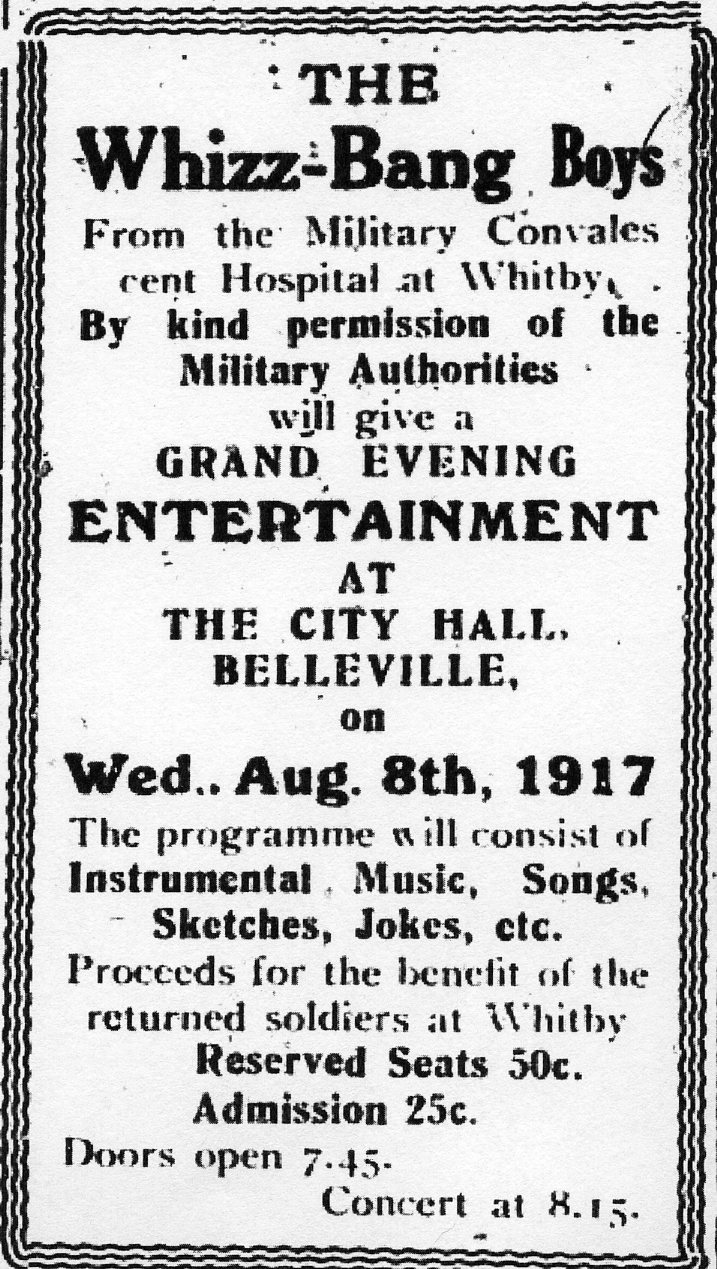
“The Whizz-Bang Boys From the Military Convalescent Hospital at Whitby. By kind permission of the Military Authorities will give a Grand Evening Entertainment at The City Hall, Belleville, on Wed., Aug. 8th, 1917.

Proceeds for the benefit of the returned soldiers at Whitby. Reserved Seats 50¢. Admission 25¢.”


100 Years Ago: Orange Knitting Circle Members Entertained, Burt Power Welcomed Home, Major Bywater Medically Unfit, Mayor Requests Help for Whizz Bang Boys, Lieutenant Doug Graham Wins Military Cross, Three Years of War, Farmers in Despair, Poster for Naval Service

 The Intelligencer August 4, 1917 (page 2)

“Members Entertained. The members of the Orange Knitting Circle of this city were the guests of Mrs. George VanTassel and Mrs. Arthur Peck at the Willow Camp, Avondale. A delightful afternoon was spent; tables were laid at the tea hour and a bountiful spread was partaken of. All returned by motor bus about eight o’clock.”

The Intelligencer August 4, 1917 (page 2)

“Welcomed Home. Pte. Burt Power of L’Amable, who went overseas with the 39th Battalion from Belleville, is home on a well-earned holiday. He arrived at Bancroft on Tuesday and was accorded a hearty welcome. He was attached to the machine gun section of the battalion.”

The Intelligencer August 4, 1917 (page 2)

“Major Bywater, formerly of the D.A.A. and Q.M.G. at Barriefield, but who has been at the front twice, was once wounded and after returning was again compelled to come back was in Barriefield camp yesterday and was before a medical board. To his great disappointment the board pronounced him medically unfit to return to the front.

Major Bywater went over with the 39th Battalion from Belleville after giving up his splendid position at headquarters thus showing a patriotic spirit and a good example. Last winter he was here for a brief visit with his many friends, and went to France again only to be compelled to relinquish his duties there. Major Bywater’s many friends extended him a hearty welcome both at the camp and throughout the city.”

The Intelligencer August 4, 1917 (page 2)

“Whizz-Bang Boys. Belleville, Aug. 4, 1917. To the Editor of the Intelligencer: Dear Sir,—Some weeks ago a groupe of returned soldiers known as the ‘Whizz-Bang Boys’ gave an entertainment in the Opera House which was very much enjoyed by the few Belleville citizens who were present. Owing to bad management they lost over $50.00 on their Belleville trip. I met these boys the day following and found them a splendid lot of fellows and was sorry for their hard luck.

They are coming back to Belleville on Wednesday, August 8th, and will give an entirely new entertainment in our City Hall. I am anxious that every seat will be occupied and commend these boys and their entertainment to our citizens. Every man is a returned soldier and has seen service in France.

The money made is used for little extras that are not allowed them by the Department. A number of young ladies have undertaken the sale of the tickets. When they call on you don’t turn them down—buy a ticket and help the ‘Whizz-Bang Boys.’ Yours truly, H. F. Ketcheson, Mayor.”

The Intelligencer August 4, 1917 (page 2)

“Lieut. Graham Won Military Cross. Confirmation was received today of the report that Lieut. W. D. Graham (Doug.) of Belleville, had been awarded the Military Cross for distinguished service. Lieut. Graham went overseas with the 80th Battalion and was transferred to another unit with which he went to France.

He secured his decoration as the result of outstanding bravery in stopping a German raiding party and holding them with hand grenades until his command came to his assistance with machine guns. The story in detail of his gallant action will be told in Monday’s issue of The Intelligencer.”

The Intelligencer August 4, 1917 (page 4)

“Three Years of War. On August 4, 1914, three years ago this day, Great Britain entered the war of nations and stopped the triumphal march of the Teutonic  host toward Paris with French’s contemptible little army. …  Lord Kitchener’s statement that the war would last three years was thought to be an alarmist pronouncement and was greeted with tolerant smiles. Anyone could prophesy now another three years of war without raising any argument. …

Canada is taking a glorious part in the war with a record of heroic sacrifice and brave deeds on land and sea, and behind the drawn blinds of many darkened homes in this, the homeland. …

Three years of war have saddened many hearts and homes in all the warring countries; many brave Canadians are sleeping their last sleep before the resurrection morn in their green-tented cots by the sea, on Flanders fields where poppies wave, or in the shadow of the grim military prisons of Germany. They will never be forgotten.

Beginning the fourth year of the war all true Canadians should consecrate themselves anew to the great task of rendering the most efficient aid possible to the mother country in this world’s crisis. …

Special prayers will ascend from many altars today and on the morrow, and every heart should form a prayer, whether in church, behind the counter, in the office, on the street, on the farm, or wherever we may be, that this awful bloodshed may cease in a permanent peace and that happiness, security and prosperity return to the earth.”

The Intelligencer August 4, 1917 (page 10)

“Farmers Despair Of Getting Help. The different labor departments of the Ontario Government are being besieged with calls from farmers for harvest help. There are at present over 2,000 applications for help in the hands of the Government bureaus unfilled. The recent hot weather has brought the fall wheat rapidly to maturity. In the meantime the farmers have been making the best of the hot weather to gather in their delayed hay crops. They are seriously handicapped, however, by the labor situation, and wheat which should now be cut is still standing while the farmer gathers in his hay. …

In a summary on his report from the District Representatives, Premier Sir William Hearst, acting Minister of Agriculture, stated that on account of the overlapping of the two crops the farmers are almost in despair of securing adequate help to get the crops in at the right time and in the best condition. Much disappointment is being expressed at the slow response so far of men from the cities and towns to give the help that is expected during the summer.”

The Intelligencer August 4, 1917 (page 10)

“Men Wanted For Naval Service. Stokers and Artificers. Men from 18 to 60. British subjects, and with experience as Stokers or Engine Room Artificers are wanted for service during the war in the Canadian Naval Patrols.

Apply to Commodore Aemilius Jarvis, Naval Recruiting Officer, Ontario Area, Toronto.”


100 Years Ago: Two Beefless and Two Baconless Days Recommended, Lance Sergeant Lorne Bassett Dies in England

The Intelligencer August 3, 1917 (page 6)

“Ottawa. Two beefless and two baconless days each war-time week for all Canadians, is understood to be the recommendation which Hon. W. J. Hanna, the Food Controller, last night placed in the hands of Hon. C. J. Doherty, Minister of Justice, for Government action.

The recommendation is accompanied by others requiring all caterers serving more than 25 meals per day to supply other bread than wheat bread for their patrons at every meal.

Warning to Canadians. Addressing a public meeting in the Russell Theatre last night, Food Controller Hanna issued a solemn warning to the people of Canada that unless the country lined up for economy in food it would be face to face with starvation this winter. Mr. Hanna declared that if all did their duty no one would starve, but if it came to a question of hunger at home or at the front, the boys in the trenches would not be allowed to suffer. …  To the young men he said the best way to serve their country was by eating their meals at the front.”

The Intelligencer August 3, 1917 (page 7)

“Capable Young Officer Dead. L. Sergt. Lorne Bassett, of Madoc Village, died in Moore Barracks Hospital, Shorncliffe, England, on July 26th, after a few days’ illness of endocarditis. This brave young lad enlisted with the 155th Battalion at Belleville, and was among its first recruits.

After a short training he entered the military school in Kingston for a Sergeant’s course, and on his return was acting-sergeant instructor. He had the essential qualities of an instructor—a clear and commanding voice, patient in temperament, and exemplary in character. When the battalion went to England, he tried several times to ‘go on a draft’ to France, but was refused. The authorities there having been of the same opinion as to his fitness as an instructor, and he was detained to assist in the training of the Canadian Reserve Battalion.

He was a splendid young man, 18 years and 9 months old, and was very enthusiastic in his work. Previous to his enlistment he was a clerk in Messrs. Cross Co.’s store. He was a member of St. John the Baptist Church.”

[Note: Lance Sergeant Lorne Bertram Bassett died on July 26, 1917. He is commemorated on Page 197 of the First World War Book of Remembrance.]

100 Years Ago: Graduates of Belleville Institute Make Good

The Intelligencer August 2, 1917 (page 2)

“Deaf and Dumb Telegraph Operators. Toronto. Graduates of the School for the Deaf at Belleville, of the last class, two young women, are now successfully applying themselves to the automatic sending and operating machines in the G.N.W. Telegraph Company and are attaining a success beyond the expectations of the wire chief, The Globe was informed yesterday.

The advances made by the young women since they entered the operating department are a tribute to the education they received in the Belleville Institute. …  The young women entered the operating department at a time when the business was very heavy due to the shortage of skilled men.”

100 Years Ago: Boys’ Camp Meeting at Oak Hills, War Workers’ Social, Lawn Social in Melrose, Poster for Win-The-War Convention, Poster for Women’s Mass Meeting in Toronto

The Intelligencer August 1, 1917 (page 2)

“ ‘Boys Day’ at Oak Hills Will Be An Interesting Event. H. W. Kingerley, of Toronto, Boys’ Work Secretary of the National Council, Y.M.C.A., and Zone Supervisor of the Boys’ Farm Service, is in the city to-day in the course of a tour of inspection of farms on which school boys have been doing patriotic production work. Mr. Kingerley is one of a squad of Y.M.C.A. young men working in connection with the organization of Resources Committee to provide assistance to the farmers. …

A Boys’ Day is being arranged in connection with the camp meeting at Oak Hills for Friday, Aug. 3, and all Belleville boys from thirteen years who wish to attend, are invited to leave their names with Mr. Phil Brockel, Secretary of the Belleville Y.M.C.A., who will arrange for transportation to Oak Hills. …  a very interesting program is being arranged for the entertainment of the boys, the key-note of the gathering being to interest them in National Service as applied to farm work.

A number of Belleville boys are already engaged in farm work and more are preparing to go. Boys who have nearly completed their three months of service on farms will be encouraged where possible to remain at work, until the harvest is finished.”

The Intelligencer August 1, 1917 (page 2)

“War Workers’ Social. The West Belleville War Workers, composed of a noble band of ladies, last evening held an ice cream social on the West Belleville playgrounds. It proved to be a most successful affair in every respect. There was a large attendance and the proceeds amounted to a neat sum, which will be applied for patriotic purposes. The grounds when lighted with electric lights and Chinese lanterns, presented an attractive appearance. The several booths were well patronized.”

The Intelligencer August 1, 1917 (page 2)

“Lawn Social. Under the auspices of the Ladies’ Aid Society of the Melrose Methodist Church a lawn social was held last evening at the residence of Mr. Geo. Lazier, Tyendinaga township. There was a large attendance and the proceeds, which are for a worthy object, were large. …

a number present gave appropriate addresses, including Mr. J. Blatt of this city who referred to the noble work being done by the ladies of the Red Cross and other organizations and the necessity there was at the present time for even greater efforts being made. He also spoke of the need of help to reap the harvest, and that all who possibly can should assist in this imperative work.”

The Intelligencer August 1, 1917 (page 6)

“Win-The-War Convention. The Arena, Toronto. Thursday, August 2nd. Friday, August 3rd. The Convention will meet to record the decision of The People of Ontario.

The Ladies have commanded us to make no distinction between men and women. We have obeyed. Red and Blue Badges will have exactly the same privileges.

At 8 p.m. THE WOMEN OF ONTARIO will take over the Arena and hold a meeting of endorsation. This will be conducted and advertised entirely by them. GOD SAVE THE KING.”

The Intelligencer August 1, 1917 (page 6)

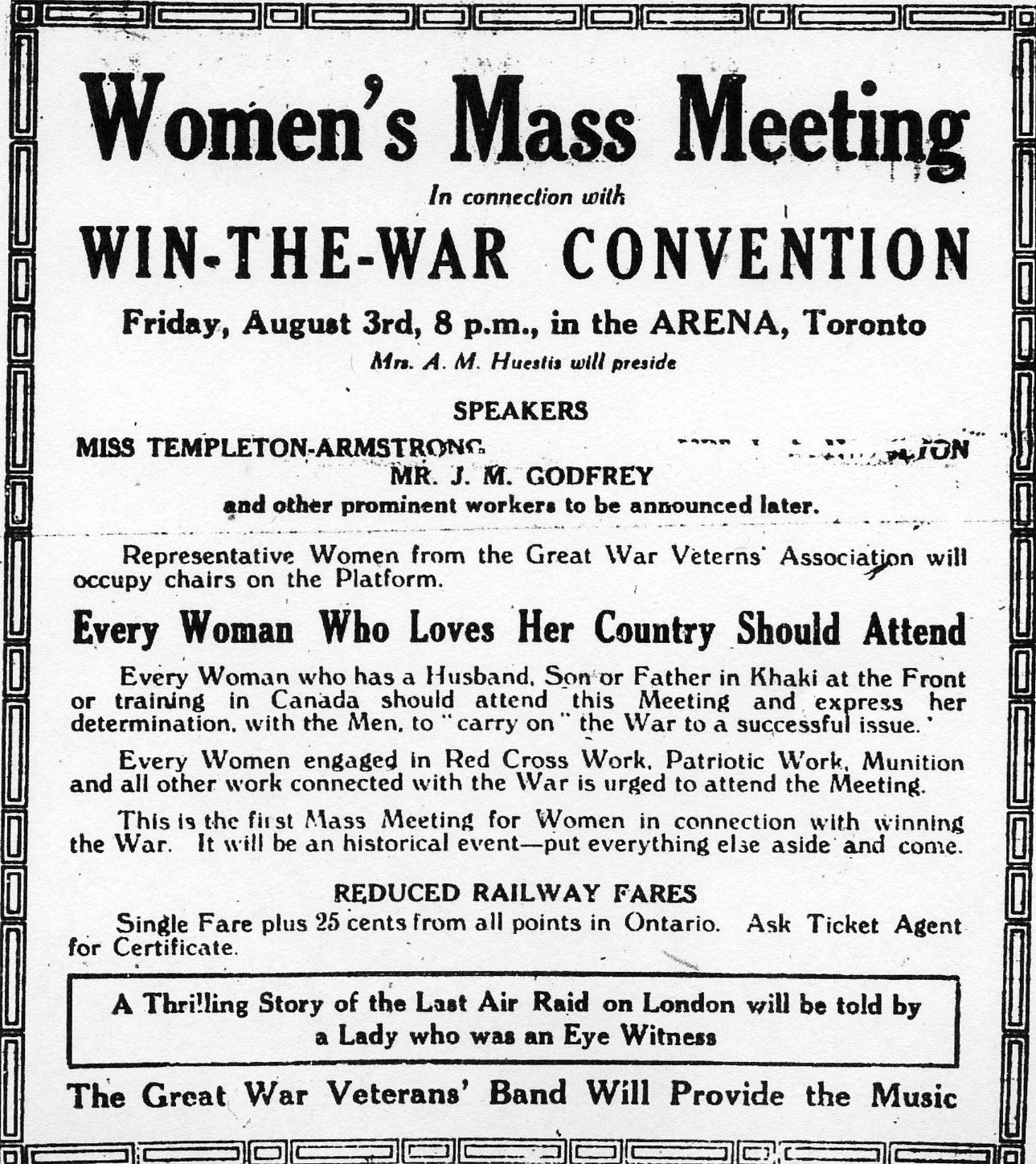
“Women’s Mass Meeting In connection with Win-The-War Convention. Friday, August 3rd, 8 p.m., in the Arena, Toronto. Representative Women from the Great War Veterans’ Association will occupy chairs on the Platform.

Every Woman Who Loves Her Country Should Attend.

Every Woman who has a Husband, Son or Father in Khaki at the Front or training in Canada should attend this Meeting and express her determination, with the Men, to ‘carry on’ the War to a successful issue.

Every Woman engaged in Red Cross Work, Patriotic Work, Munition and all other work connected with the War is urged to attend the Meeting.

This is the first Mass Meeting for Women in connection with winning the War. It will be an historical event—put everything else aside and come.

Reduced Railway Fares. Single Fare plus 25 cents from all points in Ontario. Ask Ticket Agent for Certificate.

The Great War Veterans’ Band Will Provide the Music.”


100 Years Ago: County Organization to Plan Urban Help on the Farms

The Intelligencer July 31, 1917 (page 1)

“Crops Are Heavy But Laborers Are Few. ‘The war will be won by food and the nation with the last bushel of wheat will be the victor,—let us be that nation,’ said Professor William A. Parks, of Toronto University. …  Prof. Parks addressed a small gathering of citizens in the City Hall last evening and a local organization was started to form a central link in an organization taking in the entire county of Hastings and having for its purpose the encouragement of increased production, food saving, especially of foodstuffs that can be exported for the benefit of the allies, and anti-waste campaigns. …

Mr. John Elliott presided over the meeting and gave many helpful suggestions toward an effective organization. He will accompany Prof. Parks and Mr. D. A. McIntosh, District Agricultural Representative, upon a tour of Hastings County to organize for a greater production next year. …

There is only one possible solution of the difficulty—the employment of unskilled, urban help on the farms, and there is only one spirit that can be evoked to bring about this desirable end. The name of this spirit is Sacrifice. …  Given a supply of labor, let us say that 1,000 men, women and boys of the city of Belleville are willing to spend two weeks on a farm next summer. How can these good intentions be translated into deeds? Only by an effective organization and kindly co-operation between town and farm. …  It was decided to form a county organization.”


100 Years Ago: Ontario Premier Commends Boys for Farm Work, Mrs. Dunnan Completes 250 Pairs of Socks

The Intelligencer July 27, 1917 (page 5)

“Ontario Premier Writes to Boys. Premier Sir William Hearst has written the following letter to the 5,000 high school boys who have gone on the farms for their vacation: ‘You are now rendering to your country, to the allies, and to the cause of civilization the greatest service which you can possibly render. At this time when the production of more food is absolutely essential to the winning of the war you are helping the Province of Ontario to take the place which it ought to take.

As prime minister of Ontario I wish to convey to you the thanks of the people of this Province for the manful part that you are playing. But the need for your services is even greater now than it was in the springtime, when you answered the call to help in food production. Harvest will be upon us in a few days, and the country needs your help to garner the bountiful harvest which you have, in a large measure, made possible. Therefore, I appeal to you to continue your patriotic service until the harvest is over.’ W. H. Hearst, prime minister.”

The Intelligencer July 27, 1917 (page 7)

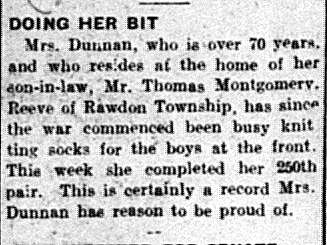
“Doing Her Bit. Mrs. Dunnan, who is over 70 years, and who resides at the home of her son-in-law, Mr. Thomas Montgomery, Reeve of Rawdon Township, has since the war commenced been busy knitting socks for the boys at the front. This week she completed her 250th pair. This is certainly a record Mrs. Dunnan has reason to be proud of.”


100 Years Ago: Poster for Win-The-War Convention, Ad for Cowan’s Cocoa, Musical Festival Continues, Overseas Boxes for Sale

The Intelligencer July 26, 1917 (page 3)

“Do You Put Winning The War Ahead of Everything Else? Are you willing to have party politics dropped until after the war has been won? Do you believe that Canada must ‘carry on’ to the end, and support civilization with men, money, munitions and food? Ought every ability and activity of Canada to be devoted to winning the war? Are you determined that honor, duty and patriotism shall prevail over selfishness and indifference? Shall we support those sons, those brothers, those husbands, those fathers who are fighting for us at the front, and shall we send them the aid needed to save them from being killed alone and unaided?

Of course you answer YES. Then fill out and mail this coupon and get your friends to do the same. Win-The-War Convention, Toronto, August 2nd and 3rd, 1917.”

The Intelligencer July 26, 1917 (page 3)

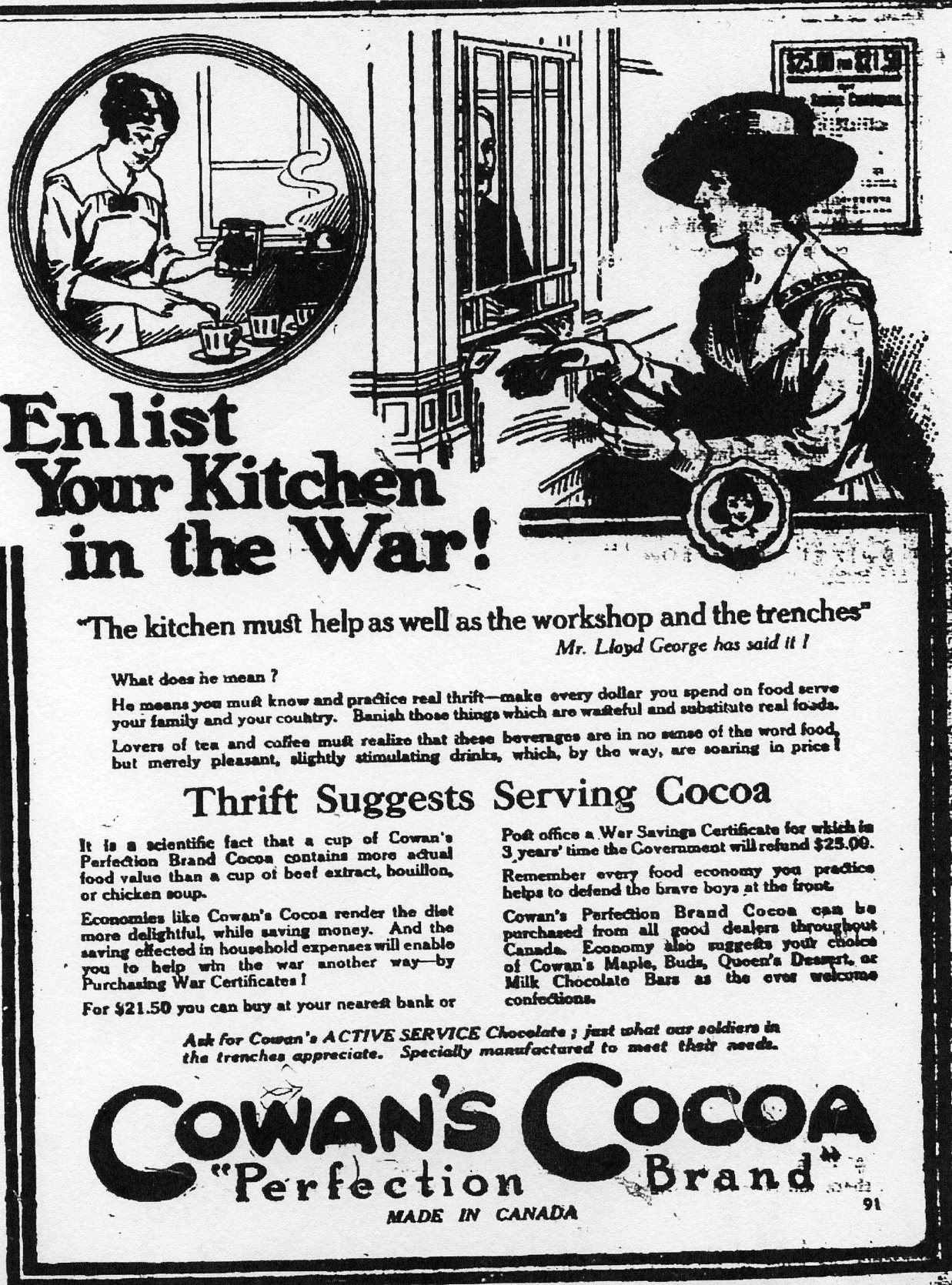
“Enlist Your Kitchen in the War! ‘The kitchen must help as well as the workshop and the trenches’ Mr. Lloyd George has said it! What does he mean? He means you must know and practice real thrift—make every dollar you spend on food serve your family and your country. Banish those things which are wasteful and substitute real foods.

Thrift Suggests Serving Cocoa. Cowan’s Cocoa. ‘Perfection Brand’ Made in Canada.”

The Intelligencer July 26, 1917 (page 8)

“Appreciation of Musical Festival. While the extremely hot weather has to some extent marred the success of the Veterans Music Festival, those who go to the City Hall are pleasurably surprised at its coolness. The excellence of the work of Isolde Menges, and her associate artist Miss Eileen Beattie, accompanist, continues to evoke enthusiastic commendation. …

The programmes for the remaining nights cover a range of delightful classic selections with a generous sprinkling of popular airs. …  It is to be hoped that the remaining concerts will be attended in a way appropriate to the beauty of the music and the good of the cause.”

The Intelligencer July 26, 1917 (page 8)

“Overseas Boxes By Express, just received. Another lot of these splendid, strong, durable, steel sewn boxes for sending overseas. We have them in three sizes, and they sell at 15¢ and 20¢ each. Chas. S. Clapp.”

100 Years Ago: No Furlough for Soldiers, Food Economy Is Urged, War Veterans Musical Festival

The Intelligencer July 24, 1917 (page 3)

“No Furlough for Soldiers. Toronto. No greater pleas for conscription could be found than an extract from a letter written by Sir Edward Kemp, K.C., M.G., M.P., Minister of Militia, to Sergeant W. E. Turley, Secretary of the Great War Veterans Association, regarding an enquiry as to the possibility of bringing soldiers who had been on active service since the commencement of the war back to Canada on furlough.

The Minister says that every fit man is needed for service in the field and the request cannot be granted. …  Sir George Perley, Minister of Overseas Military Forces from Canada, while expressing every sympathy for the men and their relatives, states that under present conditions it is impossible to give leave to Canada to any man who is fit for service in the field.”

The Intelligencer July 24, 1917 (page 5)

“Soldiers’ Meals. On the average every Canadian family wastes enough to feed a soldier. Such is the declaration of Miss B. Phillip of Macdonald College who urges every Canadian woman, as a necessary war measure, to at once examine the details of her household expenditure. She says:—’The average Canadian household is not organized with a view to the greatest measure or efficiency. The possibilities in the way of economies are enormous. It has been calculated that on the average each Canadian family wastes enough to feed a soldier. The most satisfactory economies that may be effected are in small things. They involve sacrifices or even discomforts.’ ”

The Intelligencer July 24, 1917 (page 7)

“The opening entertainment of the Musical Festival being given this week by the Belleville branch of the Great War Veterans’ Association was held last evening in the City Hall and the pleasure afforded by the splendid program of popular and classical violin literature as rendered with rare charm by the talented young English violinist, Miss Isolde Menges, augurs well for the success and appreciation of the entertainments to be given each evening during this week. …

The pleasure of the program last evening was enhanced by the assistance rendered by the talented young Australian pianist, Miss Eileen Beattie, who accompanied the selections of Miss Menges. …

The interest taken in the entertainment last evening was evidenced by the large crowd of citizens which gathered outside the City Hall and enjoyed the entire program from vantage points in the open air. The only drawback to an unofficial audience of this kind, however, while being entertained in this manner by a talented musician, the veterans of the Great War are deriving no revenue from the enjoyment furnished as a result of their enterprise. However there can be little doubt but that the audience outside would be pleased to contribute their bit or ‘two bit?’ if given an opportunity so to do, and the veterans would do well to provide the opportunity.

Notwithstanding the heat of the day, the large assembly hall was quite cool and the audience was able to enjoy the program in comfort.”