100 Years Ago: William Rowles Wounded, Letters from Willie Clarke Before and After the Battle

The Intelligencer April 30, 1917 (page 2)

“Pte. Wm. Rowles Wounded. Ottawa, Ont., April 26, 1917. Mrs. Hazel M. Rowles, c/o Mrs. Wm. Sharpe, Belleville, Ont. Sincerely regret to inform you that 220360 Private William Rowles, infantry, officially reported admitted to No. 1 Convalescent Depot, Boulogne, April 13, 1917, shell-shock. Will send further particulars when received. Officer in Charge Records.”

The Intelligencer April 30, 1917 (page 5)

“From W. E. Clarke. Somewhere in France, April 8th. Dear Mother, Father, Sisters and Brothers:—Just a few lines to let you know I am still alive and well, and hope this finds you all the same. Well Mother and Dad, I am writing you these few lines just behind the firing line, and I tell you the big guns are firing something fierce.

By the time you receive this letter I may be in Blighty, that is what we call England when we get wounded. We expect to go into a fierce battle before long, and this may be the last letter you will receive from me for awhile (I have the best of hopes of coming through safely, but if the worse should come to the worse, why I will not be counted in as one of the cold-footed ones, but we must look on the bright side. …

I only wish I could get home and see you all, if only for an hour, but I may be back, so don’t worry. I will close now with my best love for you all. Bye, bye. Answer soon. I remain, Your loving son, Willie.

England, April 12. Dear Mother:—Just a few lines to let you know I am still alive, but in a hospital in England, so do not worry, as I am not seriously wounded. I was only blown up by a shell in the attack on Monday, and I tell you we made the Germans call for mercy, but did not give them much.

I arrived in England last night, and I am in a place called Easleigh, but expect to be shifted to another one on Monday; a larger Canadian Hospital near London. I have got the muscles of my back strained; they call it contusion multiple. I expect I will be all O.K. again soon, and will be back in France in about 2 months. So do not worry. …

Well, Mother, remember me to all my friends, and tell them I will be all O.K. Kiss Kenneth, Russell and Mabel for me. I am weak, Mother, and tired, so I will close with my best love and wishes for you all. Bye bye. Will write soon. I remain, Your loving son, Willie.”

~ ~ ~ ~ ~ ~ ~ ~ ~ ~ ~ ~ ~ ~ ~ ~ ~ ~ ~ ~ ~
100 Years Ago: Sergeant Harry McCrodan Killed in Action, Lance Sergeant Arthur Power Killed in Action, Banquet for Madoc Platoon of 254th, How Women Get on Voters’ List

The Intelligencer April 28, 1917 (page 1)

“Belleville Soldier Killed in Action. A telegram was received in the city to-day conveying the sad intelligence that Sergt. Harry McCrodan of Belleville, was killed in action on the 12th inst. Sergt. McCrodan was well known in this city and deservedly popular. He was for some time a clerk at the Hotel Quinte, and in that capacity made many friends with the travelling public.

He was born in Belleville, being a son of the late Sergt. McCrodan of the City Police Force. The young man went overseas with the 80th Battalion. A wife and three children survive, also a mother and sisters. To the bereaved will be extended the heartfelt sympathy of all citizens.”

[Note: Sergeant Thomas Harry Gay McCrodan died on April 12, 1917. He is commemorated on Page 280 of the First World War Book of Remembrance.]

The Intelligencer April 28, 1917 (page 5)

“War’s Great Toll. Death of Pte. Wesley Power of L’Amable. Bancroft Times. To his mother at L’Amble came the sad intelligence on Friday last that Pte. Wesley Powers, who went overseas with the 80th Battalion had been among those who gave their lives in the great Vimy Ridge drive. The young man was killed on April 9th, and the cablegram announcing his death was sent by his brother Bert, who is in the machine gun section.

The deceased was a very promising young man of about twenty-two years of age. He attended the Continuation school here for some time before enlisting, and his death at such an early age, though in a great cause and in a struggle which has brought lustre in Canada and to Canadian arms, is much to be regretted. General sympathy will be felt with the parents and family in the bereavement they have suffered by the loss of their heroic son and brother, who now sleeps with the Empire’s brave dead under the soil of France.”

[Note: Lance Sergeant Arthur Wesley Power died on April 9, 1917. He is commemorated on Page 311 of the First World War Book of Remembrance.]

The Intelligencer April 28, 1917 (page 5)

“Banquet to Madoc Platoon. Madoc Review. Owing to the unexpected departure of the Madoc Platoon of the 254th Battalion the banquet planned to take place in May was held on Tuesday evening.

At 6.30 the boys in uniform, and their friends, in all about 200, sat down to a most bountiful repast which was very much enjoyed and appreciated.

During the evening an impromptu program was prepared and the music by the Deloro Orchestra, the vocal solos by Mr. Wright, of Deloro, were especially fine. Miss Norma Wallbridge contributed two recitations which were enthusiastically encored, while the chorus by the High School boys appealed to all. Mr. Thompson, Reeve, performed the pleasant duties of Chairman, and presented to Capt. Bleecker 100 pairs of pure wool socks. These are to be boxed and held in charge until they are needed for overseas. Also the sum of $45 was presented to Capt. Bleecker for the Madoc Platoon by the Oriental Lodge.”

The Intelligencer April 28, 1917 (page 5)

“How Women Get on Voters’ List. City assessors are being instructed in the new duties which have been imposed upon them by the Act giving votes to women. In the past, where a woman owned property, her husband got the vote. He may still get the vote instead of her, but can do so only by her waiving the right.

Where the wife owns the house in which the family reside, the wife will get a vote as owner and the husband as tennant. Where the house is rented, the vote goes to the person who has the lease, whether the husband or wife.”

100 Years Ago: Price of Bread Rises, Mrs. Plumptre Addresses Belleville Audience

The Intelligencer April 27, 1917 (page 2)

“Bakers in the city of Belleville yesterday raised the price of bread from 14 to 16 cents per loaf and also stated that it was liable to still further advance in price. This is for a three pound loaf.”

The Intelligencer April 27, 1917 (page 2)

“Timely Address Before Women’s Canadian Club. Many were present at a meeting of the Women’s Canadian Club in the City Hall last evening to hear Mrs. H. P. Plumptre, one of Canada’s leading workers, and Honorary Secretary of the Canadian Red Cross Society, also Canadian War Contingent, discuss the subject, ‘Women as Patriots.’

In commencing her subject, Mrs. Plumptre stated that she had heard a great deal about Belleville, but had never before the pleasure of seeing it, expressing her delight with the place, as well as the people. Mrs. Plumptre knew much of the work that has been carried on by the Belleville people for our Canadians in England and France who are fighting for us over there.

We, the people at large, are fighting at home; each in our own way. Some by the use of needles, pens, as speakers, and many other ways; but Mrs. Plumptre says that in no way can we fight better, or be more patriotic than those who are taking up the farm work. While we people here may get tired of doing the same thing all the time as most people like a change of style or fashion now and again, we must not forget that one of the greatest hardships that our boys contend with, is the intense and dreary monotony. If they can do all this, then we at home, should never murmur.

Mrs. Plumptre then spoke on Hospitals, and how they were equipped, giving one an idea of the enormity of the work and the time and money which has to be first obtained from the people. She stated that as a rule the women did the work, and the men carried the purse, and she thereby urged each one to do his or her part.”

100 Years Ago: Canadian Casualties

The Intelligencer April 25, 1917 (page 1)

“Casualties Among Canadian Troops. WOUNDED—J. N. Anderson, Tweed; R. E. O’Connor, Marmora; C. R. Watson, Madoc; J. Gunyou, Belleville; R. W. Durant, Belleville; J. G. Marr, Belleville; A. G. Cracknell, Belleville; H. T. Rushaw, Coe Hill.”

100 Years Ago: Canadian Casualties, Belleville’s 254th Battalion Draft Leaves, Bill Wallace Invalided Home, Canadian Defence Force Needs 50,000 Men, Ad for Gillette Safety Razor, Thomas Keegan Is Wounded

The Intelligencer April 24, 1917 (page 1)

“Casualties Among Canadian Troops. WOUNDED—A. Fuller, Belleville; J. McEwen, Springbrook; D. Fraser, Frankford; P. Pylott, Madoc; G. Kimmett, Marlbank; W. H. Thomas, Bancroft; H. R. Lake, Bancroft; J. L. O’Rourke, Madoc; H. B. Stewart, Madoc; J. Brown, Madoc.”

The Intelligencer April 24, 1917 (page 2)

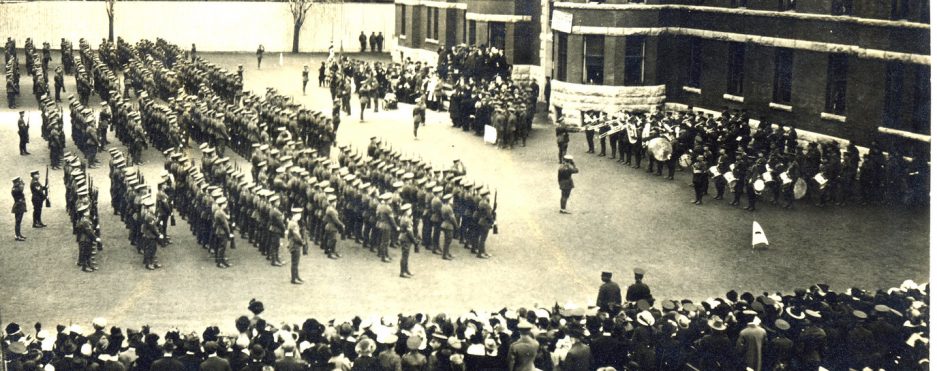
“Belleville’s Draft for Overseas Service Leave. A draft of 50 members of the 254th Battalion, of Belleville, was made to the 253rd Battalion, of Kingston, which is about to leave for overseas service. At 5.30 yesterday afternoon the men left the armories here and entrained at the Grand Trunk Railway station for Kingston. A number of the officers and members of the 254th Battalion accompanied their comrades to the station.

The ladies who are members of the Argyle Chapter, I. O. D. E. of this city, provided the men with a lunch, which act was much appreciated.”

The Intelligencer April 24, 1917 (page 2)

“Lieut. W. Wallace, son of Mrs. James Wallace, arrived at his home this afternoon. He was wounded severely last fall, and since that time has been in a hospital in England. ‘Bill’, as he was familiarly called, went overseas with the 39th Battalion, 2nd Contingent, as a Private, and since then won the rank of Lieutenant in England.”

The Intelligencer April 24, 1917 (page 3)

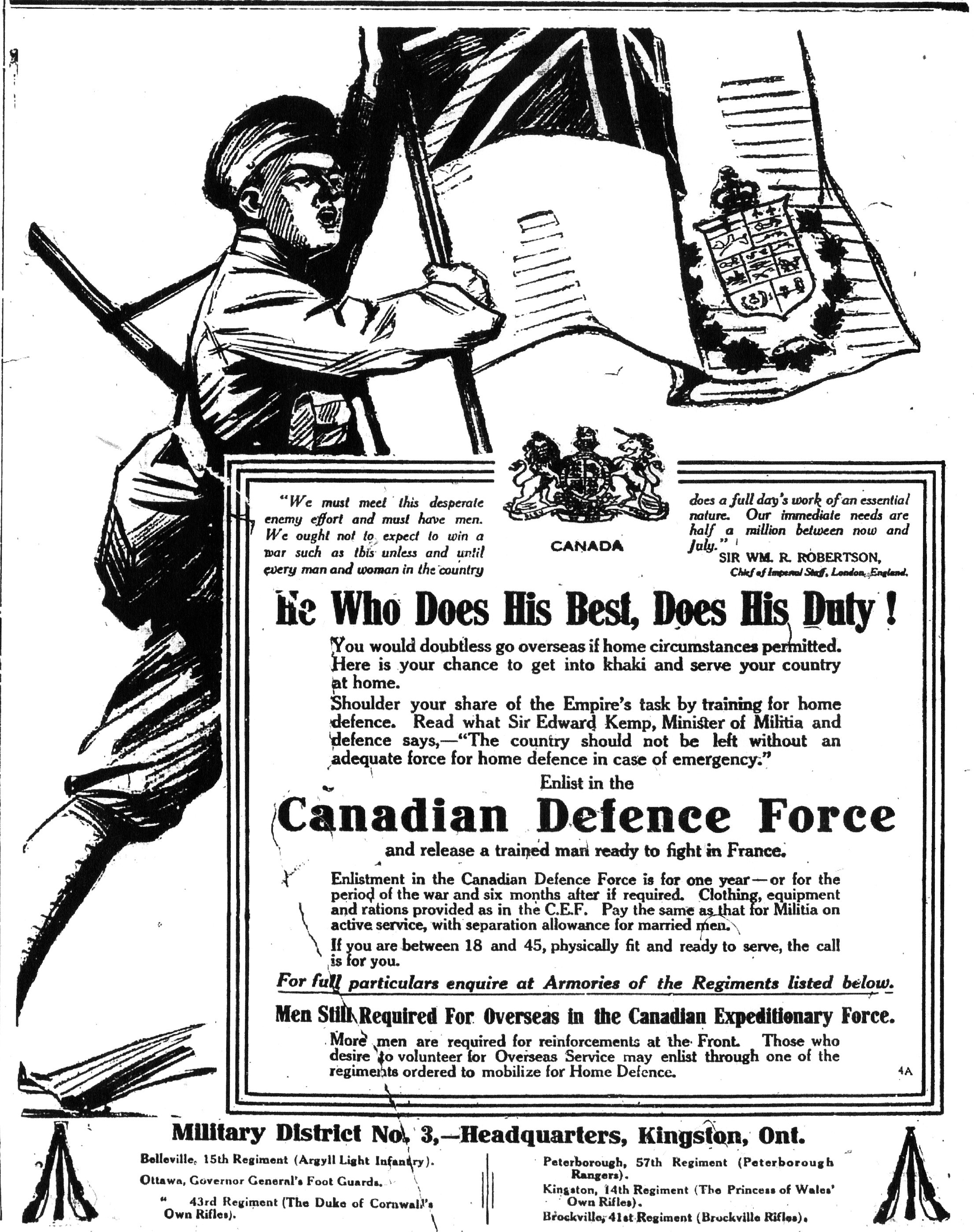
“Canadian Defence Force Recruiting Now. All Canadians must thrill with pride when they read of the effective work which their countrymen have recently been doing on the western front. The capture of Vimy Ridge will live in Canadian history as one of the most notable achievements of armies of all times, and those who took part in it will be among the most honored of men.

But there are many in Canada who will regret that they were unable to take part in such a glorious undertaking. …  The government has recognized that there are many men in this position. It has, therefore, decided on a plan for a Canadian Defence Force of 50,000 men. The need for men on the firing line is so great that all the overseas troops in Canada are being hastened across the Atlantic as quickly as possible. …

To fill the places of these men who have hitherto undertaken the duty of defending Canada, the Government has decided to issue a call to these men who have been unable to go overseas, and as an opportunity is now laid before them of serving Canada at home. Men, physically fit, are required for this Canadian Defence Force, and they are needed at once. …

Terms of enlistment are the same as for overseas service, pay, equipment, clothing and subsistence are the same too, and separation allowances are given in the cases of married men. …  the Government is conducting the advertising campaign in the press in which it explains the plan, and lays before the people the need for such a force. …

It is expected that the young men will be quick to come forward and grasp this opportunity of serving Canada and the Empire.”

The Intelligencer April 24, 1917 (page 5)

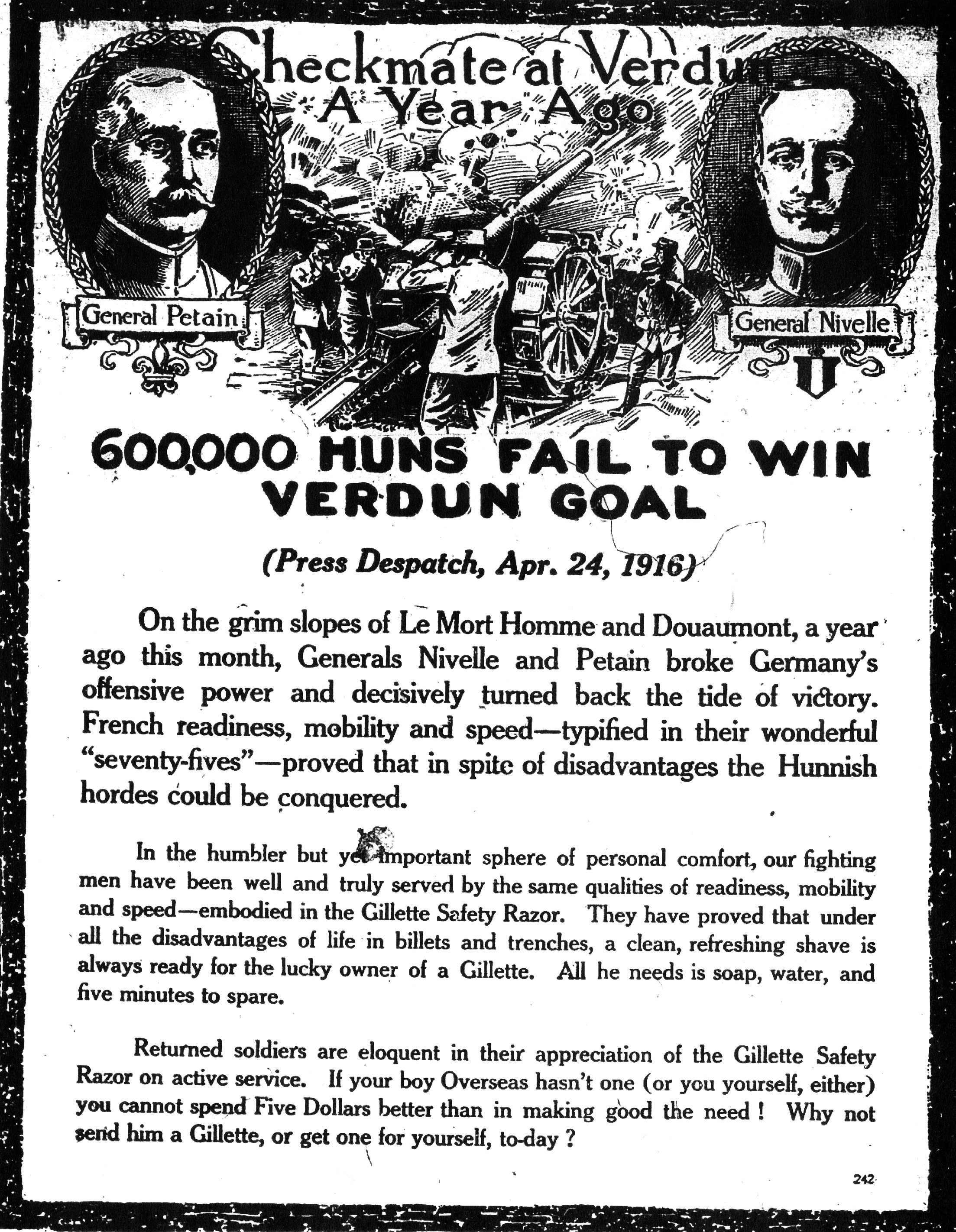
“Checkmate at Verdun A Year Ago. On the grim slopes of Le Mort Homme and Douaumont, a year ago this month, Generals Nivelle and Petain broke Germany’s offensive power and decisively turned back the tide of victory. French readiness, mobility and speed—typified in their wonderful ‘seventy-fives’—proved that in spite of disadvantages the Hunnish hordes could be conquered.

In the humbler but yet important sphere of personal comfort, our fighting men have been well and truly served by the same qualities of readiness, mobility and speed—embodied in the Gillette Safety Razor. They have proved that under all the disadvantages of life in billets and trenches, a clean, refreshing shave is always ready for the lucky owner of a Gillette. All he needs is soap, water, and five minutes to spare.”

The Intelligencer April 24, 1917 (page 8)

“T. J. Keegan Wounded. Ottawa, Ont., April 21st, 1917. Mrs. Ellen Keegan, 11 Corner Brook & King Sts., Belleville, Ont. Madam:—With sincere regret I beg to inform you that an official report has been received by cable from England to the effect that 636375 Pte. Thomas James Keegan, Canadian Expeditionary force, was admitted to No. 3 General Hospital, Boulogne, April 14th, 1917, suffering from a gunshot wound in face. I have the honor to be, Your obedient servant, Frank Beard, Record Office.”


100 Years Ago: Canadian Women and Children Return to Canada, Canadian Casualties, Fifty Drafted from 254th Battalion, Memorial Service for William McConnachie, Belleville Boy Wins Honours

The Intelligencer April 23, 1917 (page 1)

“Halifax. The first party of women and children returning from England under the scheme recently inaugurated arrived here yesterday morning. The steamer docked during the afternoon. It is understood there was upwards of 600 women and children on board.”

The Intelligencer April 23, 1917 (page 1)

“Casualties Among Canadian Troops. ILL—J. Hayes, Belleville. WOUNDED—R. B. Dyer, Queensboro; G. I. White, Belleville; W. Gordon, Madoc; Sapper E. S. Jackson, Coe Hill; A. R. Dunkley, Stirling; M. Darlington, Point Ann; F. J. Sager, Deseronto.”

The Intelligencer April 23, 1917 (page 2)

“Fifty Drafted from Here. Some fifty members of the 254th Battalion in this city, will leave here this evening for Kingston, having been drafted to the 253rd Battalion, which is being mobilized in the Limestone City for overseas service. The fifty soldiers secured all readily volunteered for service and have been pronounced fit for the duties devolving upon them.”

The Intelligencer April 23, 1917 (page 2)

“Memorial Service. At Christ Church yesterday morning a memorial service was held for the late Pte. Willie McConachie, a member of the church, who was recently killed in action somewhere in France. Rev. Dr. Blagrave, Rector conducted the service and preached an appropriate discourse. During the service the ‘Dead March’ was played upon the organ by Mrs. Col. Campbell.”

[Note: Private William Herbert McConnachie died on April 10, 1917. He is commemorated on Page 279 of the First World War Book of Remembrance.]

The Intelligencer April 23, 1917 (page 5)

“Belleville Boy Wins Honors. Mr. and Mrs. George Bowen, Lime Street, have received word that their son, Corporal Geo. T. Bowen, 50th Canadians, has received the military medal for bravery in the field. The presentation was made by Colonel Westinecott. Corporal Bowen was wounded November 24th, 1916, and is now convalescing at Alderly Park, Auxiliary Hospital, Eng.”


100 Years Ago: Thomas Smith Wounded, War Workers of West Belleville Hold Tea, William McConnachie Dies of Wounds, 28 High School Boys to Register for Gardening, Ad for Canadian Defence Force

The Intelligencer April 21, 1917 (page 2)

“The following telegram was received in this city yesterday: Ottawa, Ont., April 20, 1917. Mrs. Gladys Smith, 149 Bridge Street, Belleville, Ont. Sincerely regret to inform you that 210891 Pte. Thomas George Smith, infantry, officially reported admitted thirteen general hospital, Boulogne, April 11, 1917, gunshot wound in right shoulder. Will send further particulars when received. Officer in Charge Records.”

The Intelligencer April 21, 1917 (page 2)

“The War Workers of West Belleville held a very successful tea in St. Mary’s School yesterday afternoon and evening. A goodly sum was realized from the sale of articles donated, and much interest was shown in the splendid exhibit of work done by the children of the school. The assembly room was suitably decorated with flags and flowers. Instrumental music was furnished in the afternoon while the orchestra was present in the evening. The proceeds will be given in aid of the Red Cross.”

The Intelligencer April 21, 1917 (page 7)

“Died of Wounds. The following telegram received by Mr. John McConnachie of this city, is but one of many which has caused sadness to homes in Canada. Ottawa, April 17, 1917. John McConnachie, 48 Great St. James St., Belleville, Ont. Deeply regret to inform you, 636631 Private William Hurbert McConnachie, mounted service, officially reported died of wounds. Six Casualty Station, April tenth, nineteen and seventeen. Officer in charge of Records.”

The Intelligencer April 21, 1917 (page 7)

“Willing to Do Their Bit. Principal McLaurin of the Belleville High School, reported to the Board of Education last night, that 28 boy pupils of the school had signified their intention of taking part in the production of garden produce in the city during this year. The pupils were willing to do what they could in gardens, etc., if ground was provided for them.”

The Intelligencer April 21, 1917 (page 11)

“He Who Does His Best, Does His Duty! Shoulder your share of the Empire’s task by training for home defence.

Enlist in the Canadian Defence Force and release a trained man ready to fight in France. Men Still Required for Overseas in the Canadian Expeditionary Force.”

100 Years Ago: Canadian Casualties, Three Months’ Pay for Soldiers and Nurses After Discharge

The Intelligencer April 20, 1917 (page 1)

“Casualties Among Canadian Troops.

Wounded—G. Empey, Belleville; C. L. Bashaw, Frankford; W. Smith, Deseronto; H. Brooks, Trenton; G. Samuel, Trenton; A. Youngs, Trenton; A. A. Mindlee, Coe Hill; J. F. York, Marlbank.

Died of Wounds—S. A. Mindle, Coe Hill.

Presumed to Have Died—Wm. H. McConnachie, Belleville.”

The Intelligencer April 20, 1917 (page 7)

“Three Months’ Pay for Soldiers After Discharge. Ottawa. Every soldier of whatever rank, who has served six months, a portion of which has been overseas is to receive a grant of three months’ pay and allowances of the rank which he held when honorably discharged. This important decision was made by the Government yesterday.

The object of the extra pay is to keep the soldier in funds during a period in which he may be expected by reasonable effort to find employment, and be re-absorbed into the industrial life of the community. There have been many cases of hardship after discharge and the new order will to a very large extent remedy the conditions.

Nurses will participate in the grant upon the same terms as soldiers and the grant in all cases includes separation allowance as well as pay.”

100 Years Ago: Excellent System of Handling the Wounded, Ad for Canadian Defence Force

The Intelligencer April 19, 1917 (page 1)

“Excellent System of Handling the Wounded. Canadian Headquarters in France (via London). Now that the lists of casualties from the actions of the last week are beginning to appear in the Canadian press, it may bring solace to the sad hearts to know how carefully the wounded were handled and how reverently the dead were buried.

Hospital arrangements were made to handle far more than the number actually wounded. Extra ambulances were provided at the front and many supplementary dressing stations were opened. There was little congestion anywhere. Over two thousand of the wounded on the first day were so lightly hit that they were able to walk back to the stations without aid.

Despite the extraordinary condition of the ground over which the advance was made, the stretcher bearers found and brought out practically all the wounded before nightfall each day. In only a few cases, where the wounded lay in deep shell holes and had not sufficient strength to make their presence known to the search parties, did they remain in the field over night.”

The Intelligencer April 19, 1917 (page 2)

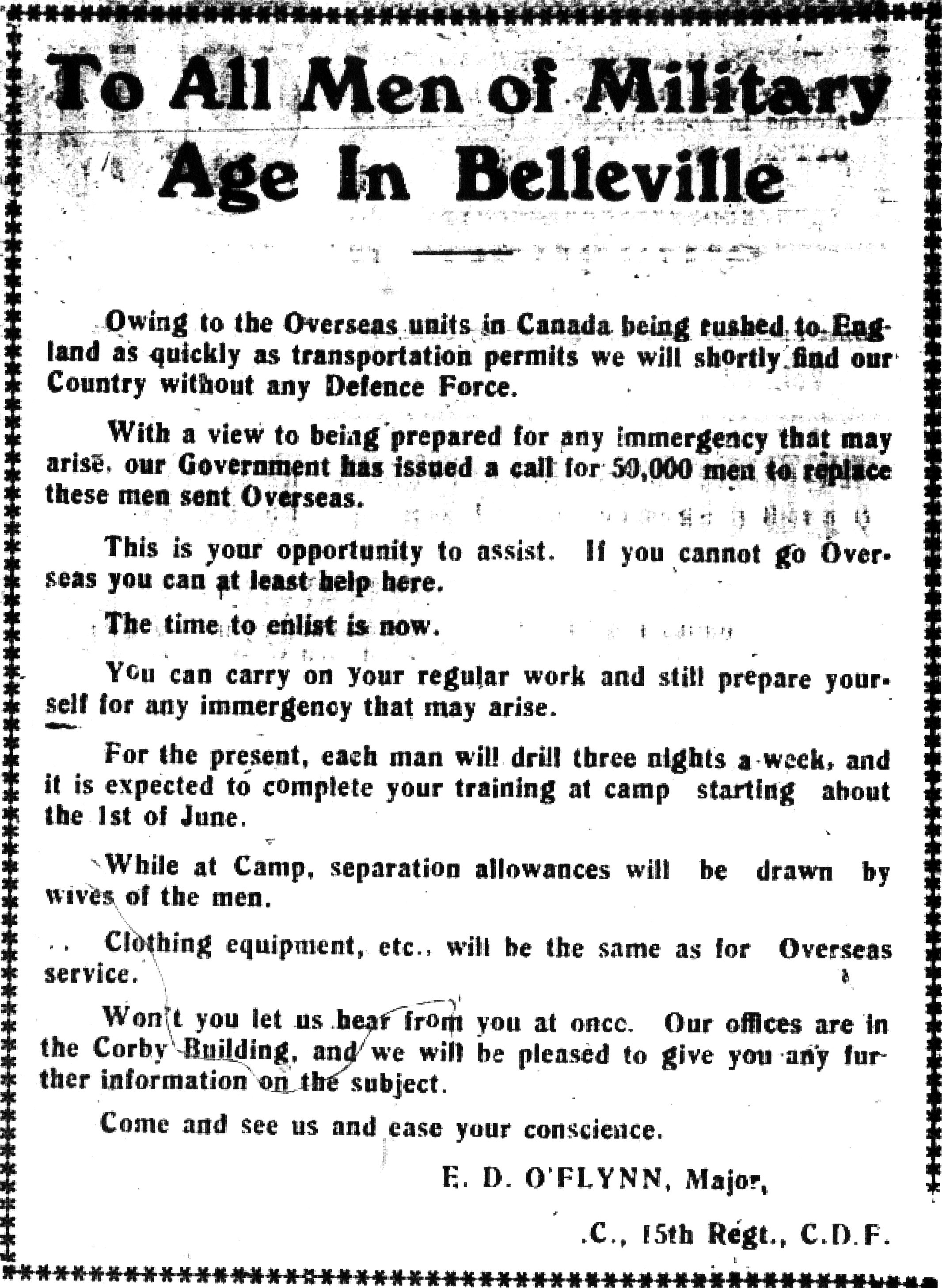
“To All Men of Military Age in Belleville. Owing to the Overseas units in Canada being rushed to England as quickly as transportation permits we will shortly find our Country without any Defence Force.

With a view to being prepared for any emergency that may arise, our Government has issued a call for 50,000 men to replace these men sent Overseas.

You can carry on your regular work and still prepare yourself for any emergency that may arise. For the present, each man will drill three nights a week, and it is expected to complete your training at camp starting about the 1st of June.

Won’t you let us hear from you at once. Our offices are in the Corby Building, and we will be pleased to give you any further information on the subject. Come and see us and ease your conscience. E. D. O’Flynn, Major, C., 15th Regt., C.D.F.”

100 Years Ago: Private Ed Clarke Wounded, Private Grover Empey Wounded, One or Two Meatless Days a Week Warranted, Private Luscombe Wounded

The Intelligencer April 18, 1917 (page 2)

“Ed. Clarke in Hospital. The following telegram was received by Mr. and Mrs. E. Clarke, 103 Cedar St.: Ottawa, Ont., 17th. Edward Clark, 103 Cedar St., Belleville, Ont. Sincerely regret to inform you Pte. William Edward Clarke, infantry, officially reported admitted to the 3rd General Hospital, Boulogne, April 10, 1917. Concussion back. Will send further particulars when received. Officer in charge Records.”

The Intelligencer April 18, 1917 (page 2)

“Admitted to Hospital. The following despatch was received in this city: Ottawa, Ont., April 17th. Mrs. H. Empey, 78 Gordon St., Belleville, Ont. Sincerely regret to inform you that 220267 Private Grover Empey, infantry, officially reported admitted to Stationary Hospital, Boulogne, April 10th, 1917, gunshot wound in hand, severe, will send further particulars when received. Officer in charge of Records.”

The Intelligencer April 18, 1917 (page 4)

“Meatless Days. Existing conditions in Canada and the United States warrant the immediate voluntary adoption of one or two meatless days a week by people not engaged in hard manual labor.

Beef, pork and other flesh foods are advancing in cost because the supply is unequal to the demand, and because grain prices favor the direct conversion of the grain into human food rather than into food for live stock. There is not enough meat in the world to go around and the men who are fighting our battles at the front require a great deal more of it than men who sit in offices and generally follow sedentary occupations. …

In a time when the price of everything mounts considerations of economy are important. It may therefore be repeated that 11 cents spent on oatmeal, 12 cents on skimmed milk, 25 cents on beans, 35 cents on whole milk, or 50 cents on cheese will provide the human body with as much energy as a dollar’s worth of steak.”

The Intelligencer April 18, 1917 (page 7)

“Private Luscombe Severely Wounded. The following telegram was received this morning, explains itself: Mrs. John Luscombe, 93 West Moira Street, Belleville, Ont. Sincerely regret to inform you, 412073, Pte. William Oliver Luscombe, infantry, admitted to 14 General Hospital, Wimereux, France, April 10th, 1917. Gunshot wound in side, severe. Will send further particulars when received. Officer in charge of Records.

Pte. Luscombe referred to, was a Sergeant in the 39th Battalion, and left Belleville with that battalion. He went to the front with the 14th Battalion. His many friends in this city will hope that his wounds are not necessarily of a fatal nature.”