100 Years Ago: Ad for Military Travelling Supplies

The Intelligencer February 11, 1916 (page 3)

“Military Travelling Supplies. The ‘Wolseley’ Kit, Regulation British Army Pattern, the most comfortable Sleeping Kit on the market. The Officers’ Dunnage Bag, Special Waterproof Duck. The Officers’ Hold-all or Roll-up. Steamer Trunks. Wardrobe Trunks, etc.

These Goods are Used by Battalions Going Overseas. We Invite Your Inspection. The J.J. Haines Shoe Houses. Belleville, Napanee, Trenton, Smith’s Falls.”

Military Travelling

100 Years Ago: Another Ad for Grape-Nuts, 15th Battalion Reserve

The Intelligencer February 10, 1916 (page 2)

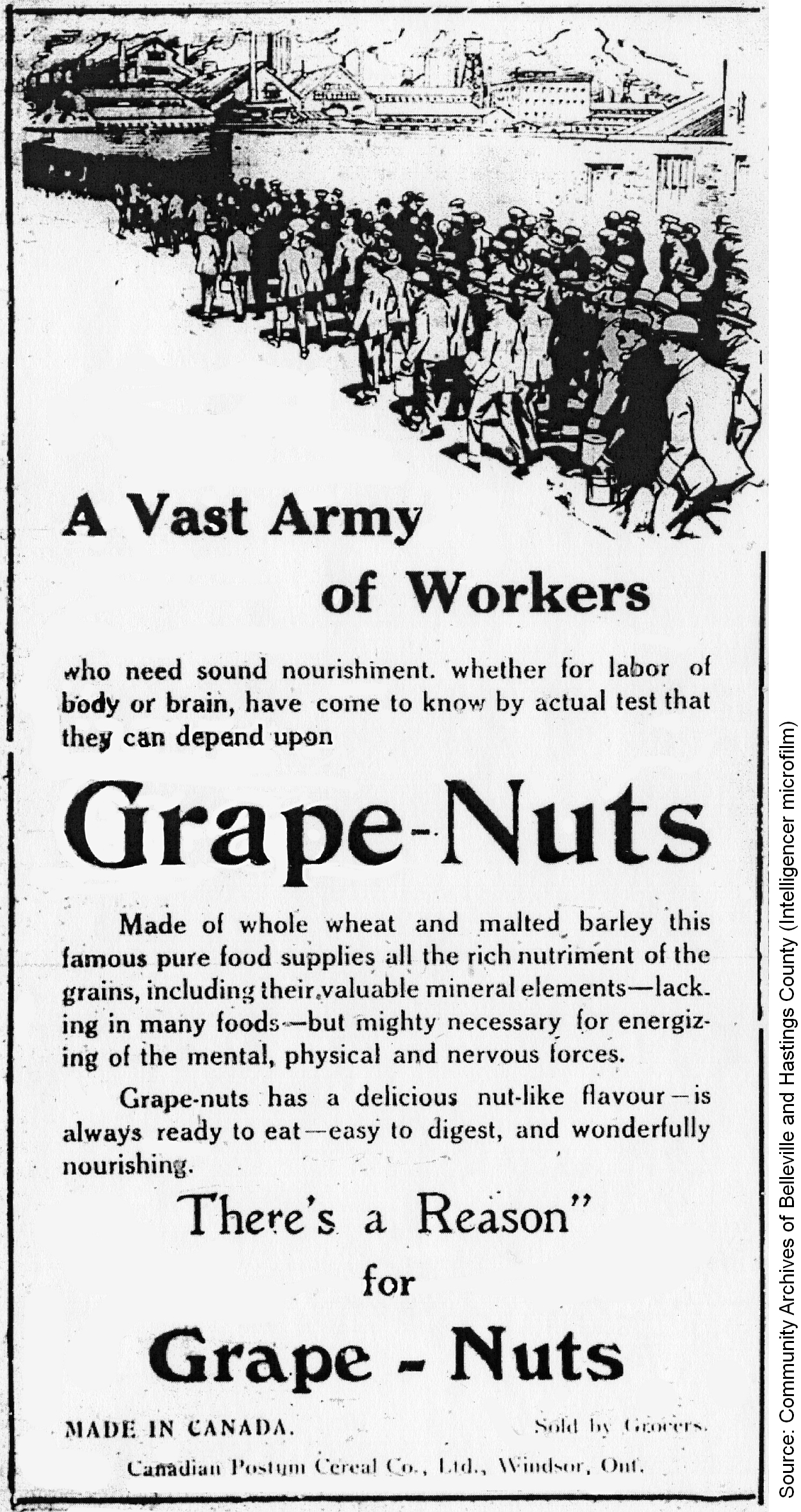
“A Vast Army of Workers who need sound nourishment, whether for labor of body or brain, have come to know by actual test that they can depend upon Grape-Nuts. …  Grape-nuts has a delicious nut-like flavour—is always read to eat—easy to digest, and wonderfully nourishing. There’s a Reason for Grape-Nuts.”

Grape Nuts

The Intelligencer February 10, 1916 (page 7)

“Drill on Friday Night at 8 o’clock sharp at the Armouries. The necessities of the times require every man to become trained to do his share of the protection of our Empire and the repelling of our enemies. The Militia Act requires every man between the ages of 18 and 60 to serve when called upon.

There has not been a direct order for conscription because those in command have confidence in you that you will volunteer. So if you cannot join the 155th for overseas, come down to the Armouries and join the Reserve of the 15th Battalion and get the drill.

You must either be Active, i.e., join the 155th Batt. for overseas, or on the Reserve in training by joining the 15th Batt. Reserve. It is your duty as a citizen. This applies to every man of Belleville between the ages of 18 and 60 physically fit.”

100 Years Ago: Christmas and New Year’s Day Overseas

The Intelligencer February 8, 1916 (page 3)

“Letters were received from Captain O’Flynn this morning, the last bearing the date of 18th January, 1916. He is in the best of health and has plenty of work to do. The battalion has been in rest billets for some time and the boys appreciate very much the chance of having a rest. …

The Captain had just received a box of Northern Spy apples from home, which were sent through the kindness of Mr. George Ketcheson, and wrote that they were very much appreciated by the headquarters staff.

In referring to Christmas and New Year’s day a very different spirit existed among our men than existed a year ago, and they would not fraternize with the men who represented the infernal spirit continued to be displayed by the German nation by the murder of Edith Cavell and the attacking of unarmed villages with Zeppelins. A few Germans started to shout across New Years’ greetings but the men answered with rifle grenades which apparently reached their destination.

The men say this fraternizing one day and killing the next is no good and they have no desire to fraternize with those who will fire on the Red Cross ambulances and hospitals and trample upon everything that is honorable.

From the letter it is apparent that a spirit of grim determination has taken the place of their former free and easy view, and they are doing their part with the judgment and enterprise, realizing more than ever the nature of the race they are fighting. …

The Captain expresses his great appreciation of the kindness of his many friends. …  He sends his greetings to all and looks forward to the day when he can be with those friends of his boyhood again.”

100 Years Ago: Recruitment Campaign, Coe Hill Volunteers Build Drill Hall

The Intelligencer February 7, 1916 (page 7)

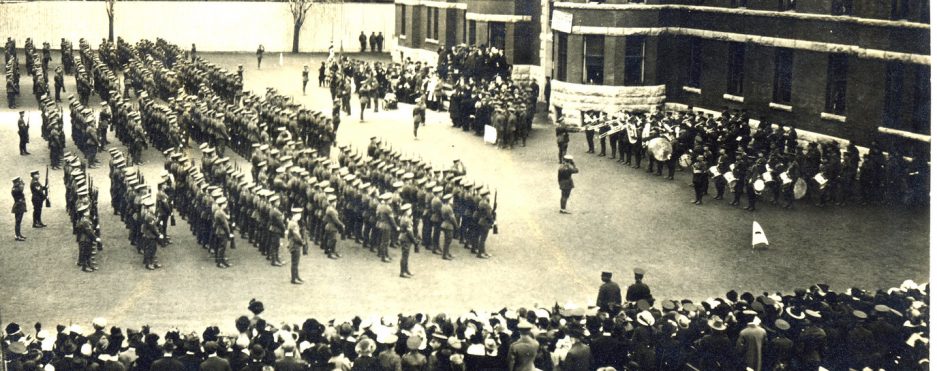
“Campaign to Be Started. Recruiting among Belleville residents has dropped back the last six weeks and the Executive of the Speakers’ Patriotic League and the officers of the 155th decided last Saturday night to put on a campaign for 300 recruits out of Belleville for the 155th.

Preliminary to the campaign it was decided to ask the churches of the city to assist by reference to the movement at the services on Sunday next after which dates will be fixed for the actual work. It was also decided to hold a meeting in the Opera House Sunday afternoon. Badges will be issued to the school children. A splendid line of posters have been procured and various devices will be introduced to assist.

Every man of service age will be given an opportunity to do his bit. The movement to secure 300 recruits in Belleville is a good one. Enlist or assist. The attention of the public has been taken up with other matters during the last six weeks which has resulted in a fall off of recruits. Everybody should now take hold and help along the campaign for 300 recruits.

If the Germans win, you will have to fight without being asked. Liberty breeds its own defenders. Who will be one? Men have thrown up good jobs and travelled hundreds of miles to fight on the side of liberty and justice in this war. Every man fit for service in this city can do the same by a few minutes walk to the Armouries.”

The Intelligencer February 7, 1916 (page 8)

“Coe Hill Volunteers Build Drill Hall. Coe Hill has manifested a great deal of patriotic zeal recently. The village has thirty-one recruits of the 155th Battalion quartered in it, but did not have good enough drill accommodation, so the soldiers volunteered to build an extension to the Exhibition Hall at the Fair Grounds if the people would supply the lumber. This they did, and the recruits constructed a hall which is 65 feet by 45 feet, and has a hardwood floor.

On Friday night the hall was officially opened by a banquet, which was attended by three or four hundred people. Lieut. Col. Adams, Commanding Officer of the regiment, was present. Coe Hill has twenty-six men in service and thirty-one more now recruited for the Bay of Quinte Battalion, although it is only a small village.

One family named Danford, of seven sons, has four drilling with the 155th; one, a member of the 39th Battalion, died while here, and one has to work the farm, with the help of the youngest brother, who is too young to enlist.

Rev. Mr. Herrington of North Hastings, Methodist minister, is the second minister of this denomination hereabouts to enlist within the last few months. The 155th Battalion is now over 600 men strong.”

100 Years Ago: Free Y.M.C.A. Bathing and Swimming for Soldiers

The Intelligencer February 3, 1916 (page 7)

“Y.M.C.A. bathing and swimming privileges free to all Soldiers. Mr. F.S. Shepperd the travelling secretary for the Military Department of the Y.M.C.A. was in town yesterday and met a number of men in connection with the work being carried on locally. …

The Belleville Young Men’s Christian Association have authorized Mr. Sharpe the Military Secretary here to extend to the battalions in town the free use of the bathing and swimming privileges in the mornings and arrangements will be made by the officers that this opportunity may be taken advantage of.

While probably no other organization in the country has suffered more through the war than the Y.M.C.A. on account of more than fifty per cent of its total membership enlisting it has felt its equipment was just the ‘bit’ it could do to bring pleasure and profit to the men’s lives and had promptly put it at the Militia Department’s disposal at cost or below or as in Belleville, absolutely free.

The response to the Military Y.M.C.A.’s request for reading matter has been so general that all the quantities offered have not yet been collected for want of time and facilities to do so. The new quarters are open now and are with the exception of the Toronto equipment probably the best Barracks Y.M.C.A. in the Dominion. The piano will be moved in this week and programmes are to be presented from time to time.”

100 Years Ago: Khaki Club Dance, Letter from Pat Yeomans, Lionel Harris Wounded

The Intelligencer February 2, 1916 (page 2)

“Khaki’s Hold Successful Dance. Large Number of Young and Middle Aged Enjoy Evening at Popular Quarters. Under the auspices of the Khaki Club of Belleville, a dance was held last night in Prof. Johnstone’s Academy, Front street, which was largely attended. The affair proved to be one of the most enjoyable that has taken place in the city for some time. Upwards of 75 couples were present, and indulged in dancing until one o’clock this morning.

The orchestra of the 80th Battalion provided an excellent program and the spacious dance hall was most appropriately decorated for the occasion, whilst numerous lighted candles added to the scene. …  The costumes worn by many of the ladies present, were gorgeous.”

The Intelligencer February 2, 1916 (page 7)

“From Horace Yeomans. Belgium, Jan. 1, 1916. My dear Mother,—This is New Year’s morning early and I am on duty at the observation station. I was up at the time the New Year relieved the Old—and blamed glad he was to get away, I’ll bet, with all this war on his hands. I hope 1916 brings about the finish of this big useless scrap.

Well, we had an elegant Christmas celebration—one that most of those who attended it will not forget for a long time, I’m thinking. The dinner which was served up I’m sure could not be equalled in the Quinte or any other hotel, and was made up of everything nice and good to eat that there was in the dictionary. Everyone enjoyed himself at that dinner.

If the saying is true that ‘the British soldier fights on his stomach,’ it was a good thing Fritz left us alone that day. As it was, he was sportsman enough to respect the day and did not put over so much as one shell all day. …

Your parcels have come in regularly. We have gotten two from you lately and also the big one containing your Rainbow Club boxes. They were all tickled to death with those when I gave them around, and all desire me to thank the ladies of the Rainbow Club from the very bottoms of their hearts for their kindness and thoughtfulness. I believe some of them are going to write personally to ladies whose cards were found in various articles. …

Please remember me to all the folks at home and expect another letter before very long. With love, PAT.”

The Intelligencer February 2, 1916 (page 7)

“Wounded in France. Mr. and Mrs. E.G. Harris, residing on Catherine street in this city, have received word that their son, Gunner Lionel Harris, had been wounded in France. His shoulder was injured by a piece of shrapnel. Fortunately the wound was not of a serious nature. Lionel left Belleville with the 34th Battery.”

100 Years Ago: Frederick Palmer Guest of Belleville Club, Lectures at Opera House, More Smokes Needed

The Intelligencer February 1, 1916 (page 1)

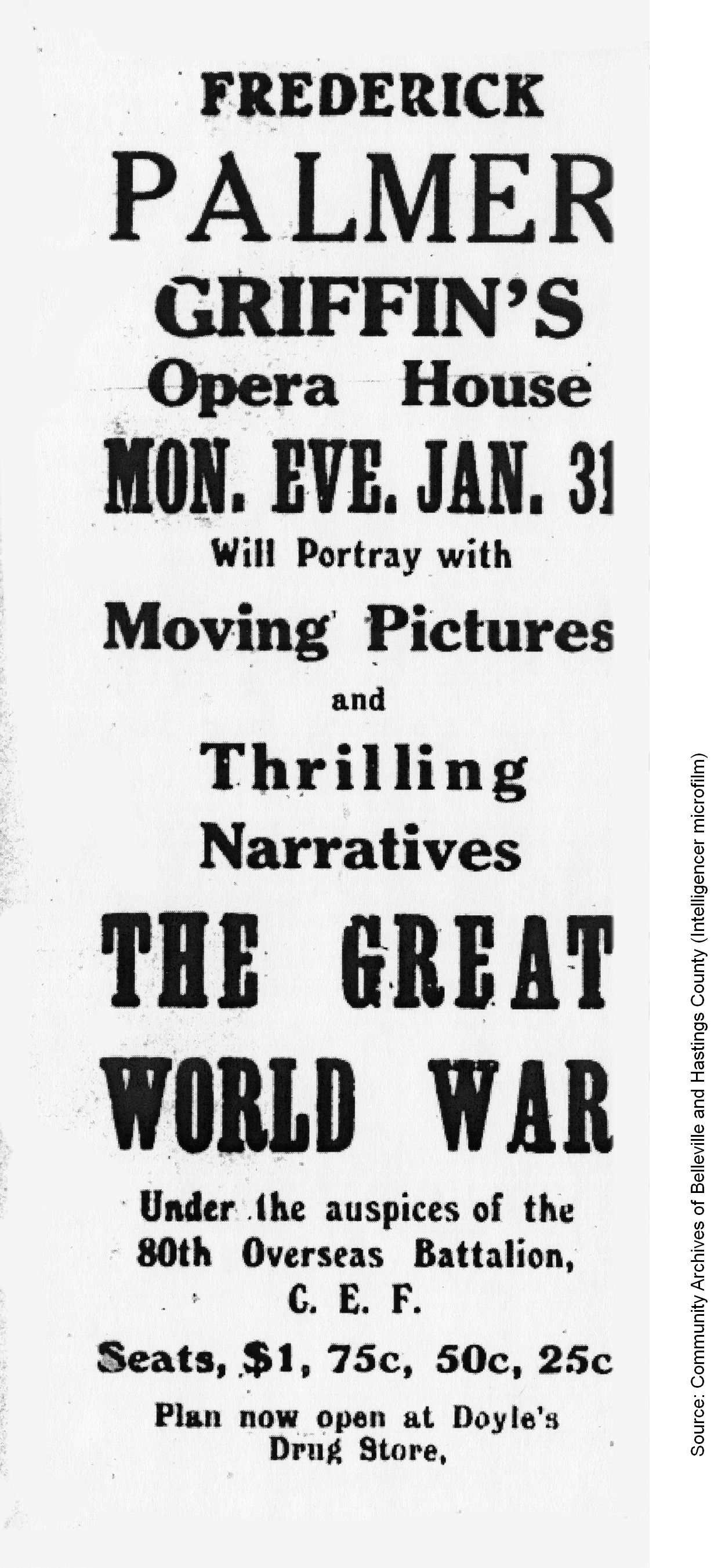
“Mr. Frederick Palmer, the famous war correspondent and lecturer, was the guest of the Belleville Club members during his stay in our city yesterday, enjoying its luxurious comfort and giving in return as pleasing an account of himself as one could desire. …

For half an hour prior to the lecture, Mr. Palmer gave an impromptu address to about a hundred of the club members and local visitors, relating in a brief manner a few personal experiences, but dwelling principally upon the magnificent attitude of Britain in the present war, the strained efforts of Germany to keep up a brave front and declaring positively that the Allies will eventually be victorious. …

Following the lecture in the Opera House Mr. Palmer returned to the Club apartments, where the spacious and luxurious parlors were all his own until time called on him to depart. It was a special privilege for both visitor and hosts—one that will be remembered with pleasure. Mr. Palmer was particularly courteous to the local press representatives, knowing himself what it meant ‘when on the scout.’ ”

The Intelligencer February 1, 1916 (pages 1, 3)

“Frederick Palmer Is Royally Received. Mr. Frederick Palmer, war correspondent extraordinary, the one man of all the American newspaper men who went to England at the commencement of the great war who was selected by Lord Kitchener to go to France with the British army and the Canadian troops, was a visitor to Belleville last night. His coming had been heralded for several weeks and his reputation had arrived before him, and he made good.

Mr. Palmer went to the front as a civilian and a neutral, and he saw everything that it was possible for a civilian to see, and much more perhaps than many soldiers saw, and the impressions made there he reflected on those who heard him last night.

He lays no claim to oratory, but just a plain spoken man, but as soon as he began his address it was apparent that the audience was going to like him, and it did like him.

He was not tiring, for he saw to it that this did not happen, for not only did he lecture, but he also exhibited moving pictures of scenes in Flanders and slides of scenes in other parts of Europe which has been touched by the great war. Some of these pictures were extremely good, and they are official, having been authorized by the French staff, and will be preserved for all time to come. …

The lecture was a success in every way, and the 80th Battalion, who will get the proceeds above expenses, should realize a tidy sum as the result.”

The Intelligencer February 1, 1916 (page 2)

“The Boys Are Relying on You For Smokes. When soldiers have nothing to smoke they are being deprived of a comfort that is absolutely vital and it is no exaggeration to say that any shortage of cigarettes and tobacco inflicts positive pain on them. When a man has to sit all day in a trench with nothing to relieve the monotony but an occasional ‘Jack Johnson’ or the ping-pong of the sniper’s bullet, it is some relief to light up a pipe or smoke a cigarette. Monotony wears out one’s nerves, and against trench monotony the only sedative is tobacco—not inaptly named the soldier’s best friend.

Knowing the truth of this, we appeal to our readers to help the Overseas Club in its praiseworthy effort to raise enough money to give every Canadian soldier at the front enough to smoke. Canada has 80,000 men fighting the Empire’s battles and they nearly all smoke. …  They feel that a country that knows how to admire courage and splendid endurance, will not desert them in their hour of need.

For every quarter you contribute to Canada’s Tobacco Fund …  some soldier on active service will receive a large package of Canadian Manufactured Tobacco, 50 best quality Canadian made Cigarettes and a box of Matches. If bought in the ordinary way and posted direct, this same package would cost you one dollar. Our readers are earnestly asked to contribute to this good cause.”
100 Years Ago: Christmas Gifts Acknowledged, Farm Help Needed in 1916

The Intelligencer January 31, 1916 (page 2)

“Belleville Boys Acknowledge Gifts. Bramshott Camp, England, Jan. 17, 1916. Editor Intelligencer, Dear Sir:—The Belleville boys serving in the 8th C.M.R. at present undergoing training in England, wish to thankfully acknowledge through your paper, the receipt of the Xmas boxes sent by the ladies of the Patriotic League. The pleasing variety of gifts which the boxes contained were all most acceptable and were appreciated both for their own usefulness and for the proof they gave of the thoughtfulness for our welfare.

When we have finished our task on the continent of Europe we hope to return speedily and thank the givers face to face. At present we are all well and in good spirits.”

The Intelligencer January 31, 1916 (page 2)

“Gifts Acknowledged. From O.C. No. 2 Canadian General Hospital. To Mrs. C.J. Bowell, 161 Albert St., Belleville, Ont., Canada. My dear Mrs. Bowell,—On behalf of No. 2 Canadian General Hospital I beg to acknowledge and thank you sincerely for the very acceptable gifts which have recently been received from you and your Belleville friends. These gifts are particularly useful and show great taste in their selection. …

We have been working here since last March, and have treated about 11,000 cases. The little extras in the way of hospital comforts and preserved fruit kindly donated by friends go far to cheer and revivify those who have shown such self sacrifice and devotion in the interest of their country.

Again thanking you and the other kind friends associated with you in your good work, I am, Yours gratefully, J.W. Bridges, Col. O.C. No. 2 Canadian General Hospital.”

The Intelligencer January 31, 1916 (page 3)

“The Labor Situation. The labor problem is with us again, and in a most aggravated form. If all signs hold true, it will be harder to get farm help, experienced or inexperienced, in 1916 than in any one of the last ten years.

The surplus men of the cities, who might have been available for farm work now that English immigration has practically ceased, have joined the ranks. The rest are busy in munition factories. To a greater extent than is generally believed, the boys from the back concessions also have been volunteering for service abroad.

And now the call comes for 275,000 additional men. From where are they to come? ‘From the rural districts,’ answer the recruiting officers in chorus. …  They do not realize that the cities have already swallowed up a big percentage of country boys, until now there is no surplus labor in the country, young or old. …

In many rural sections, every rural young man who enlists leaves a 100-acre farm unworked or only half worked. Is it the part of wisdom to take these workers from the land?—Farm and Dairy.”


100 Years Ago: News from Within the Military Circle

The Intelligencer January 25, 1916 (page 7)

“Free trip to Germany. Apply at the Armouries.

The officers of the Khaki Club intend giving a dance in Johnstone’s Academy on Feb. 1st.

Lieut. Cauldwell gave a lecture to the officers and N.C.O.’s of the 80th Battalion last evening on ‘Machine Gun Tactics.’

The School of Infantry for the 155th Battalion will commence at 8.30 tomorrow morning. The class will be in charge of Lieut. Elliott and will be instructed by Sergt. Dowe. About 40 men of the 155th Battalion will take the course.

The strength of the 155th Battalion is now about 500.

At the request of the chairman of the Soldiers’ Aid Commission in the Province of Ontario, the Mayor, as convenor, is inviting the heads of all the municipalities in Hastings County as well as the Parliamentary representatives and leading citizens generally to meet at the lecture room in the armouries on Friday evening, the 28th inst., at eight o’clock to form a branch of the Soldiers’ Aid Commission of Hastings County, Belleville and Trenton. …  The object of this branch, like the parent association, shall be to take care of and to find employment for members of the Canadian Expeditionary Force who return to Canada during the period of the war, particularly those who have returned to our county and city.”