100 Years Ago: Two 254th Men in Each Trenton Poolroom, Knitting Circle Meets

The Intelligencer January 16, 1917 (page 1)

“The 254th (Hastings and Prince Edward Counties) Battalion is introducing a novel method to aid recruiting here. They have secured permission from the proprietors of the pool-rooms here to place a desk in each pool room with two men stationed there to plead with young men to join the battalion. Some of the leading citizens have volunteered to assist and will make short recruiting speeches to the players and assist the recruiting men in the poolrooms.”

The Intelligencer January 16, 1917 (page 2)

“The R. T. of T. Knitting Circle held their first meeting of the year Friday afternoon, at the home of Mrs. Maston, William street, with an unusually good attendance. A number of ‘Overseas’ letters were read, showing how much our boys appreciate the socks we are forwarding regularly.”

[Note: R. T. of T. = Royal Templars of Temperance.]

100 Years Ago: Reception Plans for Three Belleville Heroes, Government Money to Battalions for Recruiting, Battalions Under 700 to Send Drafts, Memorial Service for Harry Watkin

The Intelligencer January 15, 1917 (page 2)

“A public reception to three returned Belleville heroes, namely C. Lewis, J. V. Ross and James Smith will take place this evening, and the prospects are that it will be a memorable event. The 15th Regimental Band will leave the upper bridge, and accompanied by citizens in conveyances and on foot, will proceed to the residence of Sergt. Ross on Albion street, while the 254th Band will proceed to Privates Lewis’ and Smith’s residence in West Belleville. At the upper bridge both bands with the heroes will unite, and a procession will be formed and proceed down Front street. All citizens are asked to unite in making the reception a grand success.”

The Intelligencer January 15, 1917 (page 3)

“Something unusual is happening to the militia authorities at Ottawa. After two and a half years of war, it has been decided finally to assist battalion and other units financially in their efforts to obtain recruits. …  A battalion requiring a certain number of men to complete its establishment is required to formulate and submit a scheme by means of which it believes it may obtain them. …

Although coming somewhat late in the war, it is believed that a good many at least are now relieved of the necessity of begging for money with which to carry on the work of raising men. In this connection a statement made by R. B. Bennett, Director General of National Service, was to the effect that ‘an atmosphere must be created to make men realize their duty.’ Officers commanding battalions have consistently objected to the niggardly way in which the Government hands out money for advertising when this is one of the few means left to make men see their duty.

The Printing Bureau at Ottawa is grinding out thousands of copies of old recruiting posters which have long lost their ‘punch’ because of their age. They should turn in some of this money into channels whereby officers who are responsible for the battalion could be given authority to use it in a more advantageous way by advertising to suit the local conditions.”

The Intelligencer January 15, 1917 (page 3)

“An order has been issued about more battalions going overseas. In future unless battalions reach a strength of 700 they will not be allowed to proceed overseas as a unit, but will send drafts of men to England. When units do reach this strength they will be allowed to go as far as England, provided the officer in command and the senior officers agree before leaving to either revert to a lower rank upon their arrival or return immediately to Canada.

This order has created a great amount of interest in military circles because of its immediate effect on recruiting and the prospects for battalions generally. The officers also feel the order personally. Those of the rank of captain or higher, by this order, are informed that they will never reach the front unless they make up their minds to go with a lower rank. With recruiting conditions as at present the possibility of battalions getting even as far as England is very small. Drafts will be the rule.”

The Intelligencer January 15, 1917 (page 5)

“Last evening a memorial service was held in St. Thomas’ Church for the late Harry Thomas Watkin, who died of wounds received in action. The prayers of the Office for Burial of the Dead were recited, and appropriate hymns were sung, and the Anthem ‘Lead us gently, Heavenly Father,’ was effectively rendered by the choir as well as the Vesper hymn for our sailors and soldiers.

The Rector, the Ven. Archdeacon Beamish’s …  sermon dealt with the theme of ‘Death, and after Death,’ in which he spoke of the life of the ‘Spirits in safe keeping,’ and that higher school for the souls of men in that waiting life between death and the judgment. ‘No one has ever yet gone to Hell or Heaven, and no one has yet been finally judged; and, thank God, no one has yet been doomed.’ “

100 Years Ago: Patriotic Fund Appeal, 235th Hockey Team Wins

The Intelligencer January 13, 1917 (pages 1, 6)

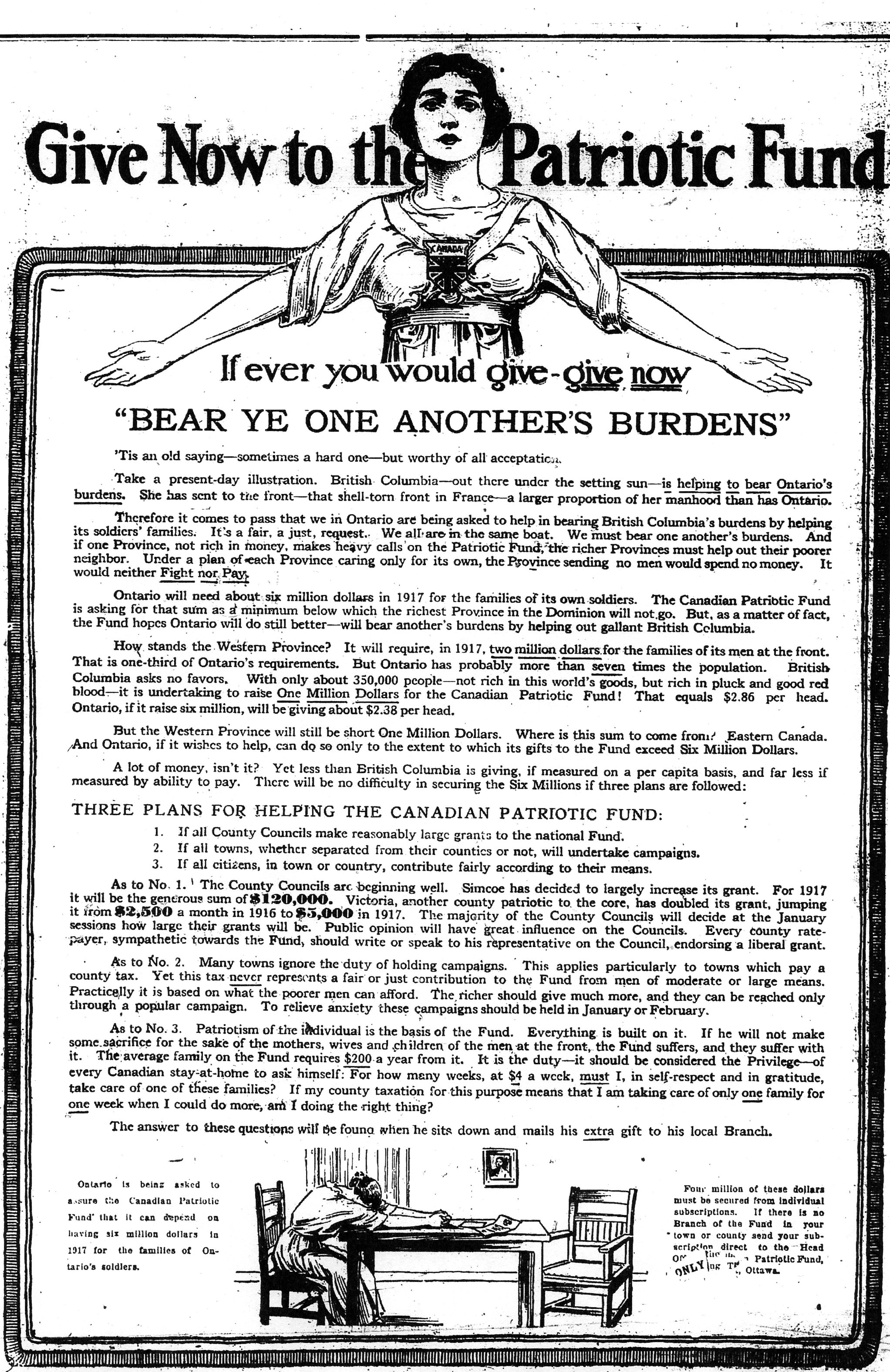
“A Call to the Citizens in General is made by the Canadian Patriotic Association for Tuesday evening in the City Council Chambers. Every citizen is requested to be present. Last year the contributions donated by Belleville reached $30,000. This sum, it is expected, will be greatly increased during the present year.

Give Now to the Patriotic Fund. If ever you would give—give now. ‘Bear Ye One Another’s Burdens’ ”

The Intelligencer January 13, 1917 (page 8)

“235th Turn The Tables on Kingston Team. Holding the ‘Nacs to the score of 2–2 in period one, gaining a lead of 6–4 in the second and completely out-playing them in the last period was how the local 235th Belleville team defeated the Frontenacs here last evening, the final score being 11–4. The game was very fast throughout and very often the ‘Nacs which were far heavier than the locals used their bodies quite frequently, drawing many penalties for their roughhouse tactics. …

For the visitors, Millan was their most effective player, while for the locals every man on the team showed up well. Cryderman, though a sick man, played a most consistent game, working hard throughout. Sammy Symons, and the Whalens, on the forward line were in their highest form, and had it over the visitors like a tent. Of the Belleville defence, Scott, Pimlott and Mitchell, nothing too good can be said of their work. They worked hard during the whole game, and were very effective in their rushes.”

100 Years Ago: Bancroft Recruiting Meeting, Civilians Prohibited from Wearing Khaki, War Orders over One Billion Placed

The Intelligencer January 12, 1917 (page 3)

“Bancroft Times. If music will work its way into the hearts of the young men who are eligible for military duty and induce them to don the khaki, the 254th Battalion will be up to full fighting strength in record time. They have one of the best military bands in the Province, and the concert which they gave in the hall here on Monday night was a treat, and we can vouch for the fact that it was thoroughly appreciated by the big audience that turned out on the occasion. Bandmaster Hinchey is to be congratulated on the splendid musical organization that he has built up.

Dr. Embury occupied the chair, and interspersed with the musical selections were speeches by Lieut. Col. Allen, officer commanding the 254th batt., Lieut. Robt. Cook, M. P. P., and Mr. E. Guss Porter, M. P.

Lieut. Cook said that there never was an occasion when he was inspired by a higher motive in addressing an audience, more men were absolutely necessary, and he appealed to the mothers and fathers to use their influence in inducing the boys to offer themselves in defence of our national liberty. …

Mr. Porter spoke at considerable length, and closed with an appeal which should have aroused the fighting spirit in every young man present. ‘The brave Canadian boys,’ he said, ‘who stepped into the breach at the battle of the Marne and saved the day are calling to you. For God’s sake send us help and we will save you and save the Empire.’ He then referred to his own physical incapacity to serve but he felt that he had already made considerable sacrifice. Only three days before he had received a cable from his only child, a boy of eighteen years, that he had just been ordered to get ready to go into the trenches in thirteen days behind a machine gun.”

The Intelligencer January 12, 1917 (page 7)

“Cannot Wear Khaki. Some time ago an order was sent out from Ottawa prohibiting the wearing of khaki by civilians. From Winnipeg comes the announcement that military headquarters there have ordered that civilians wearing uniforms which even resemble those adopted by the military are to be fined $50, or sentenced to three months in jail.

The order was sent out from Ottawa for the purpose of putting a stop to hundreds of parents dressing their children as soldiers.”

The Intelligencer January 12, 1917 (page 8)

“Half Billion War Orders. The orders placed in Canada since the opening of hostilities have amounted to $1,095,000,000. This accounts to a large extent for the present strong position of industrial Canada. Sir Thomas White predicts that during the year just opening further orders to the extent of $500,000,000 will be placed in the Dominion. With old orders still unfilled and the vast business impending there is surely little reason for a pessimistic outlook in regard to the financial and commercial position of Canada. The impending order is the working out of Britain’s policy to withdraw, as much as possible, orders from the United States.

The additional $50,000,000 credit from Canadian banks to the Imperial Government, for the purchase of munitions and supplies in Canada, under negotiation during the past fortnight makes a total of $250,000,000 provided by the banks and the Government for the above purpose within the space of a year.”


100 Years Ago: Letter of Thanks from Melbourne Sprague, Appeal for Veterinary Hospitals, Letter from Billie Riggs

The Intelligencer January 11, 1917 (page 3)

“To the Members of the Reception Committee, the Firemen and the Citizens and not forgetting the dear school students and children. I deeply appreciate the fine reception you gave me on my return to the City Tuesday.

It was a great pleasure to return to my dear home and people and to know that the people of Belleville appreciate the efforts of their boys in doing their duty for a cause which stands for Right and Liberty.

In this coming year many of you will be called upon to make great sacrifices which will entail many sorrows to those we love, our fathers, mothers, sisters, brothers and friends yet that sacrifice has got to be made in order to know peace and happiness here and hereafter.

There is one thing in particular I would like to mention, that is the boys of the first contingent. They are the fellows who paved the way for those of us who have to follow, they were not afraid of sacrificing their lives for those they love and care for, they are the boys we should be proud of, they are the boys to honor.

I also wish to thank every man of the Band, also my comrades-in-arms. I also wish to acknowledge the noble rescue work of one of the Belleville boys, when on June the 2nd with three or four others he rescued me, when I fell, by carrying me and placing me in a dugout where I would have better protection. I am so sorry that I am only able to give the name of one of my noble rescue party, he being Pte. Harry MacDonald, a Belleville boy. I know right well he did his duty on ‘No Man’s Land’ otherwise I would not be here to pen this acknowledgment of a noble son of Belleville.

I trust some day I may be able to learn the names of my rescuers that I may speak of them in the same personal manner. I plead with the citizens of Belleville to give Pte. MacDonald the reception he such deserves. After having been placed in the dugout there to remain, I heard my companions calling one to the other to come and help dig out other fellows who were buried.

In conclusion, I desire to acknowledge the beautiful flowers handed me on my way home, also those that were sent to my home, some without names. Consequently I am unable to acknowledge otherwise.

Again thanking one and all for their many expressions. I remain Melbourne P. Sprague.”

The Intelligencer January 11, 1917 (page 5)

“Appeal Made to Horse Lovers. Canadians Asked to Provide Hospital for Equines in War Zone. Toronto. Mr. R. H. Rees has come to Canada to seek help for the wounded animals in France and Belgium. Mr. Rees represents officially the Fund for Sick and Wounded Horses, organized by the Royal Society for the Prevention of Cruelty to Animals, London, the principal patrons of which are his Majesty King George and her Majesty Queen Mary.

Soon after war broke out the equipment of the splendidly organized Army Veterinary Corps was found inadequate to efficiently succor all the sick and the wounded horses at the front, and the co-operation of the R.S.P.C.A. was offered the British War Office and accepted. This gave birth to the fund, which has already provided at the front four new veterinary hospitals, with ‘wards’ and ‘beds’ which ensure treatment for 4,000 horses at the same time. In addition to these hospitals are quarters for the men, 40 motor and horse ambulances, corn crushers, motor lorries for fodder, etc.

The first appeal made by the society was answered by over $500,000. But even this large sum has proved unequal to the task, and Canadians are now being appealed to, to provide sufficient funds to erect a hospital for the treatment of Canadian horses. Since the war started 934,265 horses and mules have been shipped from the American Continent to the war area where there are now millions of animals within a five-mile fire zone, chiefly because motor traction is impossible there. The Canadian Veterinary Hospital is estimated to cost $60,000 and will care for 1,000 horses at the one time.”

The Intelligencer January 11, 1917 (page 7)

“Mrs. Walter Riggs, who resides on Bridge Street West, received the following letter from her son, Billie, who was for some time a faithful employee of the Intelligencer Office, and who is now fighting for King and Country: Dec. 27, 1916.

Dear Mother:—I received your letter a few days ago, and was glad to hear from you. I spent Christmas pretty good. We were out of action at the time, back in a little French mining town, quite a few miles behind the firing line. We came out of the Somme about the last of November, and came out to this village, supposedly for a five weeks’ rest, but after we were there for two weeks we were forced to go into action for the days on the Arras front, and came back two days before Christmas. We had a pretty good feed, and had a good concert at night.

I have not had my pass yet. Going into action stopped the passes. I will not be over there for New Years either, for there is only one man going from the battery, and he is going to-night, and is taking this letter, which won’t be censured. …  I don’t know where your parcel with the cigarettes and other things are. I guess it must have got lost on the way over. I received Lois Thompson’s and Evelyn Cooke’s parcel and I want you to thank them for me.

Well, Mother, hoping this finds you all well, with best love to all. I am Your loving son, Billie.”
100 Years Ago: Banquet for Staff of 235th Battalion

The Intelligencer January 10, 1917 (page 2)

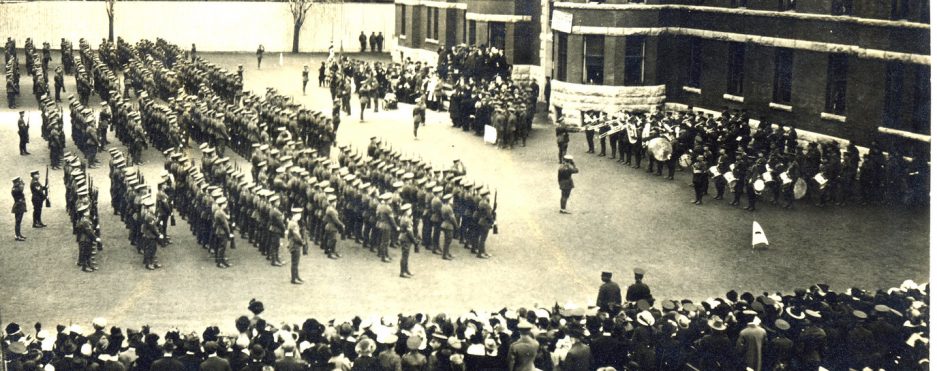
“A splendid banquet was given at the Quinte Hotel last evening, by Captains Meath, MacLean and James of the 235th Battalion, to staffs of their departments. The boys lined up to the number of twenty-five, at the Headquarters Office, and marched to the Quinte, where they did ample justice to a well served meal. The toasts of the evening were ‘The King,’ proposed by Captain Meath. ‘The Officers of the 235th Battalion,’ proposed by Quartermaster Sergeant Ince, and ‘The boys who help us keep our jobs,’ proposed by Captain Meath.

The fun grew as the evening lengthened, and songs and speeches were the orders of the day. Great fun was caused by the excellent elocutions rendered by Captains Meath and MacLean. The comradeship noticed between officers and men augurs well for the future, and many of the men made silent avowals that they would willingly pass through ‘hell’ if need be, for such officers. The evening concluded with ‘God Save the King,’ sung as only the soldiers can sing it.”

100 Years Ago: Reception for Melbourne Sprague, Ernest Moore Is Wounded, 235th Hockey Team Loses First Game

The Intelligencer January 9, 1917 (page 1)

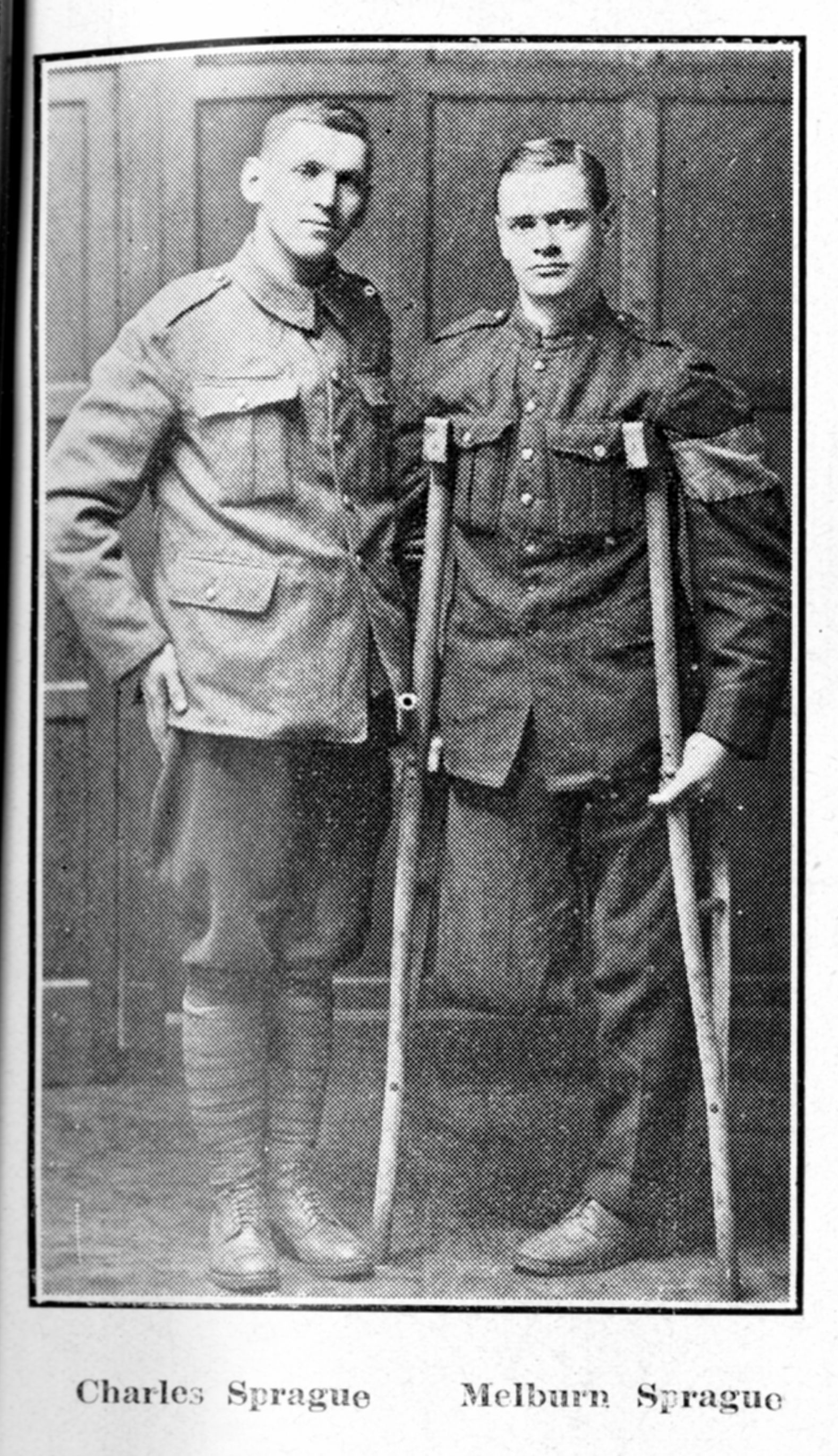
“Enthusiastic Reception to a Returned Hero. Within the past few months in the City of Belleville receptions, enthusiastic in their nature have been tendered to returned heroes from the front, but none was more largely attended or more genuine than that of today, tendered to Private Melbourne Sprague, who may justly be termed Belleville’s crippled son. Despite his crippled condition the young hero wore a smiling face and waved his appreciation to citizens of all classes, who participated in the demonstration.

A few days ago the returned soldier passed through Belleville being compelled to report at headquarters at Toronto. This morning he came back to his native city, and his arrival was made a memorable occasion. He was due to arrive here at 12.10 p.m. but the train was some 25 minutes late. When the train pulled into the station, the yard adjoining was crowded with a mass of humanity, automobiles and vehicles. The 235th Battalion band augmented by members of the 15th Regimental band furnished music and played a lively air as the hero was taken from the train and escorted to a prettily decorated automobile in which was seated Mayor Ketcheson, Mr. and Mrs. E. B. Sprague, the soldier’s parents and a brother. The high school cadets, scholars, pupils from the public schools were present in hundreds, also a platoon from the 254th Battalion.

Cheers upon cheers greeted the hero as he was taken to the auto awaiting his reception. A parade was then formed and it was one of the largest seen in the city for some time. The augmented band led the procession and the auto containing the returned hero and relatives followed. It was flanked on either side by the members of the 254th platoon. Following were the High School and public school girls and boys, citizens in autos and citizens on foot. Many of the autos were decorated with large and small flags, and many men, women and children carried small flags. At intervals along the line of march from the G.T.R. depot to the market square the streets on either side were lined with citizens who were not slow to cheer the hero who acknowledged same. It was certainly a grand sight and one that will long linger in the memory of him for whom the reception was timed, as well as those who participated in same.

When the market square was reached the procession was halted and the members of the platoon opened out and the auto containing Sprague passed through to the cheers of his comrades in arms. In the parade were the two hose carts and the hook and ladder sleighs of the fire department and members of the brigade in uniform. At the market the parade was disbanded and Pte. Sprague was driven to his home on Gordon street.

That the returned hero was worthy of the homage bestowed upon him no one dare deny. He was a member of the 8th Mounted Rifles and received terrible wounds while on active service at Zillebeck, and was taken prisoner by the Germans. He had the misfortune to lose one leg and the other is by no means a perfect one. He will no doubt be for some time confined in a convalescent hospital.”

The Intelligencer January 9, 1917 (page 7)

“Ernest Moore Wounded. The following telegram will be read with interest by the many local friends of Gunner Moore: Ottawa, Jan. 8; S. S. Moore, 188 Charles St., Belleville.

Cable received to-day states 301185 Gunner Ernest Godfrey Moore, artillery, is officially reported wounded, December 24th. Returned to duty on December 26th. Officer in Charge of Records.

This is just like Ernest. No idleness for him when there is fighting on hand.”

The Intelligencer January 9, 1917 (page 8)

“While the local juniors were piling up the score here last night, the 235th intermediates were not faring so well in their match with the Frontenacs in Kingston. The score, which was 10 to 0 does not, however, indicate the play, or the merits of the local team. Good clean and close checking by both teams was a feature throughout the game.

The Belleville team lacked condition and fell down at the end of each period, when the Kingston septette made nearly all their goals. The locals’ line up was also considerably weakened by the absence of Simmons and Mitchell, through sickness. Cryderman, who was forced to play, was suffering from a very heavy cold with temperature at 101 degrees. Pimlott played an excellent game, though it was his first game of the season, and Ted Whalen was there and played a star game, but did not receive the proper support. The Frontenac aggregation has had considerable more practice than the locals, and have developed a splendid combination. The play at all times was free from roughness. …  Stan Burgoyne of Toronto, a former Belleville hockeyist, refereed the game.”

100 Years Ago: Percy Kennedy Dies of Wounds, Reception for Ernest Geen, Harry Watkin Dies of Wounds, Welcome Urged for Melbourne Sprague, Paper Collection Started

The Intelligencer January 8, 1917 (page 1)

“Another Stirling soldier has made the supreme sacrifice. Last week Mrs. A. Kennedy received a telegram, stating that her son, Pte. Percy Kennedy, had died of wounds at No. 19 casualty clearing station on December 19.”

[Note: Private Percy Kennedy died on December 19, 1916. He is commemorated on Page 112 of the First World War Book of Remembrance.]

The Intelligencer January 8, 1917 (page 2)

“Reception to Returned Soldier. On Saturday afternoon upon the arrival home of Lieut. Ernest Geen from England, he was escorted by the 254th Battalion Band, and a platoon of the same battalion, accompanied by some officers. Upon arrival at the residence of Rev. A. L. Geen, West Bridge Street, Lieut. Geen in a few well chosen remarks, thanked the Mayor, the band and the members of the 254th Battalion for the reception accorded him upon his arrival home.

Rev. A. L. Geen also spoke a few words, expressing the thanks of the members of the family for the heartiness of the reception tendered his son upon his return home. The Giver of all good had been watchful over him and permitted him once more to return to his home. Cheers were given for the returned soldier, and the proceedings brought to a close.”

The Intelligencer January 8, 1917 (page 2)

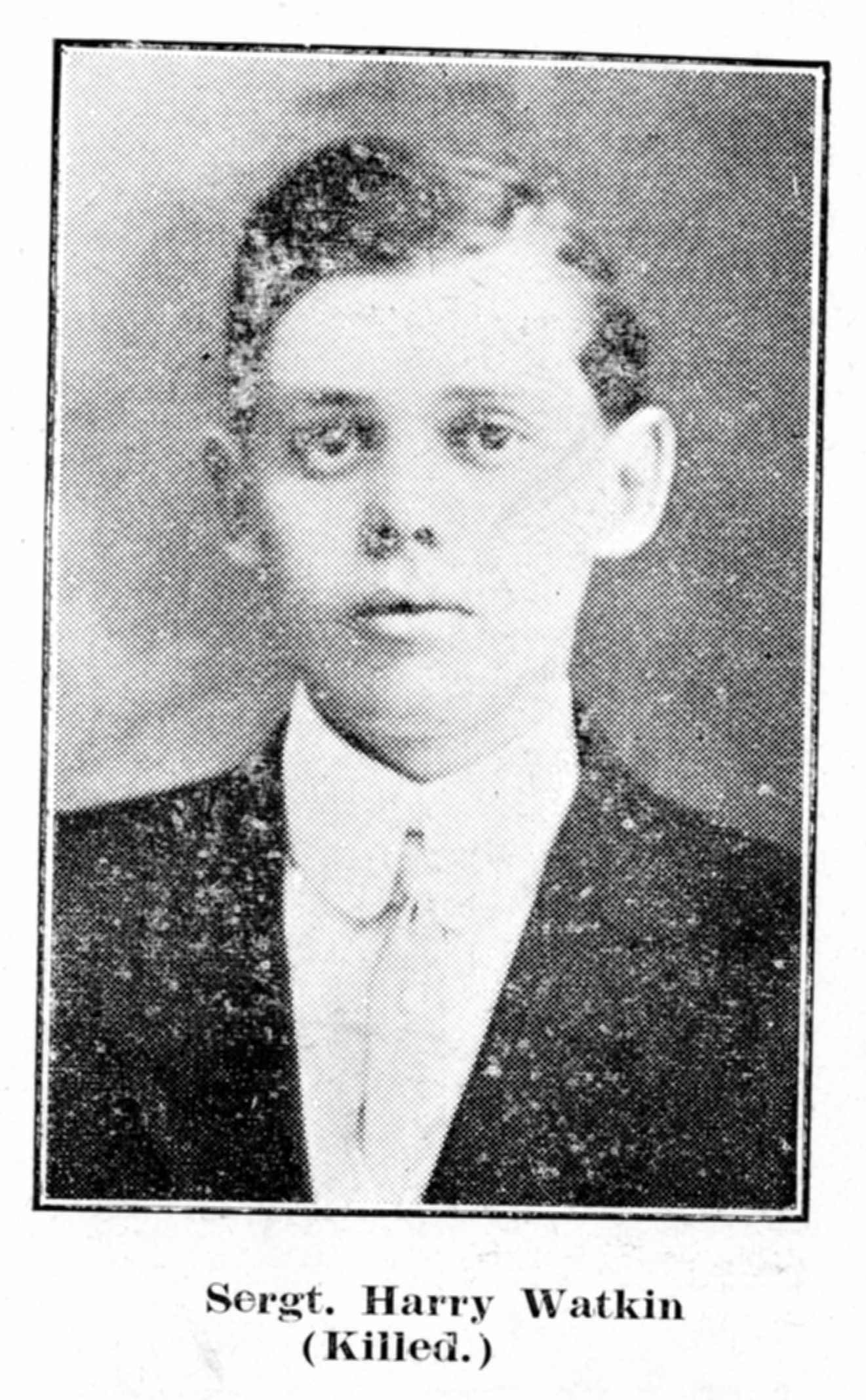
“Another home in this city was plunged in grief yesterday when a message was received from Ottawa conveying the sad intelligence that Pte. Harry Thomas Watkin had died of wounds on November 19th, 1916.

Private Watkin was the only son of Mr. Delos Watkin, a well-known grocer of this city, being in his 28th year. He enlisted in this city on May 23rd, 1915, and was attached to the 38th Battalion, and was stationed in Bermuda for some time, prior to proceeding to Europe. Besides his father, two sisters, Mrs. Wm. Adams, and Miss Cora Watkin, both of this city, are left to mourn his loss.

‘Son,’ as deceased was favorably known, was a young man of genial companionship, straightforward manner, fine character and withal a true soldier, well liked by all who knew him, who will regret very much his demise, caused by wounds received while doing his duty in defence of King and country on the battlefields of France.”

[Note: Private Harry Thomas Watkin died on November 19, 1916. He is commemorated on Page 179 of the First World War Book of Remembrance.]

The Intelligencer January 8, 1915 (page 3)

“Dear Sir:—Melbourne Sprague, Belleville’s crippled son and hero will arrive home by Grand Trunk Railway at noon on Tuesday, to-morrow. He will be on the flyer. Postpone your dinner hour until one o’clock and help to make Melbourne feel that he has not sacrificed for us without our full thankfulness and appreciation. Those who do not find it convenient to go to the depot could congregate at the upper bridge which bridges the river, as he will pass that way to his father’s home on North Front St. We might well bury our dignity for half an hour, and on foot surround and accompany him to his home, but a short jaunt up North Front St., and cheer him to the echo. It may help him to bear his burden and make him to feel life is worth living after all.

Ladies and girls could, with much grace, hand him a rose as he passes through the street, for remember he has been fighting for us and has paid the price. Since the hour of arrival is so opportune, how appropriate it would be if the Public and High school students, pupils of the very schools in which he was educated, were to gather at the Upper bridge or along the North Front Street route to cheer, as children only can.

He was an old High School boy and the boys, they would make a splendid guard of honor. High school boys know how to cheer, too, and would do honor to themselves and their school, by honoring one who has spilt much blood that they might continue at school, and all too without a murmur we are told. An Old High School Boy.”

The Intelligencer January 8, 1917 (page 3)

“The St. Julien Chapter received $5 from the children of Queen Alexandra School, the result of their first paper collection.

The Chapter is endeavoring to raise money by collecting old paper—and is quite encouraged by the help given by the Queen Alexandra School. It is to be hoped the children of the schools will follow the good example for it is only the co-operation of the children bringing the paper to a few central points that the scheme can be worked successfully. Hoping the parents will second their efforts by reminding the children about regular collections and thus augment the fund, for carrying on the work for overseas both for hospital and trench supplies.

L. Cohen, 345 Front St., has made very satisfactory arrangements for shipping the paper. A special committee of Chapter members has been formed, and it is to be hoped our citizens will support their efforts.”


100 Years Ago: Death of Lance Corporal Dingman, Edward Wardhaugh Wounded, Food for Canadian Prisoners of War, Poster for Canadian Patriotic Fund

The Intelligencer Janary 6, 1917 (page 3)

“London, Dec. 22, 1916. Dear Mrs. Dingman, Our Department of Militia has, I presume, advised you of the death on October 6 last of your son, who was No. 8200 Lance-Corpl. W. Dingman, of our 2nd Canadian Battalion. I assume you are his mother.

You will, I know, be gratified to know that your brave boy’s body was buried with all the ordinary marks of honor and respect shown as far as possible under very strict active service conditions. The service was conducted by me, in the presence of representatives of the 2nd Battalion,—all who could be spared from duty to attend.

Articles of personal interest, belonging to your son, will be sent to you through our Record office. I am sorry I cannot give exact location of grave as that is not allowed, but I have marked it with a cross and location can be easily established after the war. Yours very truly, Rev. D. V. Warner, Major.”

[Note: Private William Andrew Dingman died on October 6, 1916. He is commemorated on Page 78 of the First World War Book of Remembrance.]

The Intelligencer January 6, 1917 (page 6)

“Another Bellevillian Wounded. Mrs. Mary Wardhaugh, who resides at 156 1/2 Church street in this city was on Thursday in receipt of the following telegram: Ottawa, Ont., Jan. 3, May Wardhaugh, 156 1/2 Church St., Belleville, Ont. Sincerely regret to inform you that 410664 Private Edward Wardhaugh infantry, officially reported wounded Nov. 18th, 1916. Will send further particulars when received. Officer in Charge Records.”

The Intelligencer January 6, 1917 (page 7)

“Get Food to The Canadians in German Prisons. Toronto. Thanks to the Canadian Red Cross, Canadian prisoners in Germany are not threatened with any shortage of food, although the food situation in Germany is acute. There are 2,196 Canadians confined in Germany. They are scattered in ninety camps, and the task of caring for them is made very difficult by the German practice of shifting prisoners from place to place. The Red Cross, however, has been extremely successful in finding the men and getting food through to them.

Each man gets every week 6 pounds of bread, besides parcels of other food. The expense of providing for these prisoners is $120 a year. Thus a great hole is made in the Canadian Red Cross finances, and Toronto will have an opportunity of helping this organization in the big campaign coming in two weeks.

The work of the Patriotic Fund is no less useful in caring for the dependents of soldiers. The local branch has received many letters of appreciation from soldiers, because they know that those dependents left here are being cared for.”

The Intelligencer January 6, 1917 (page 8)

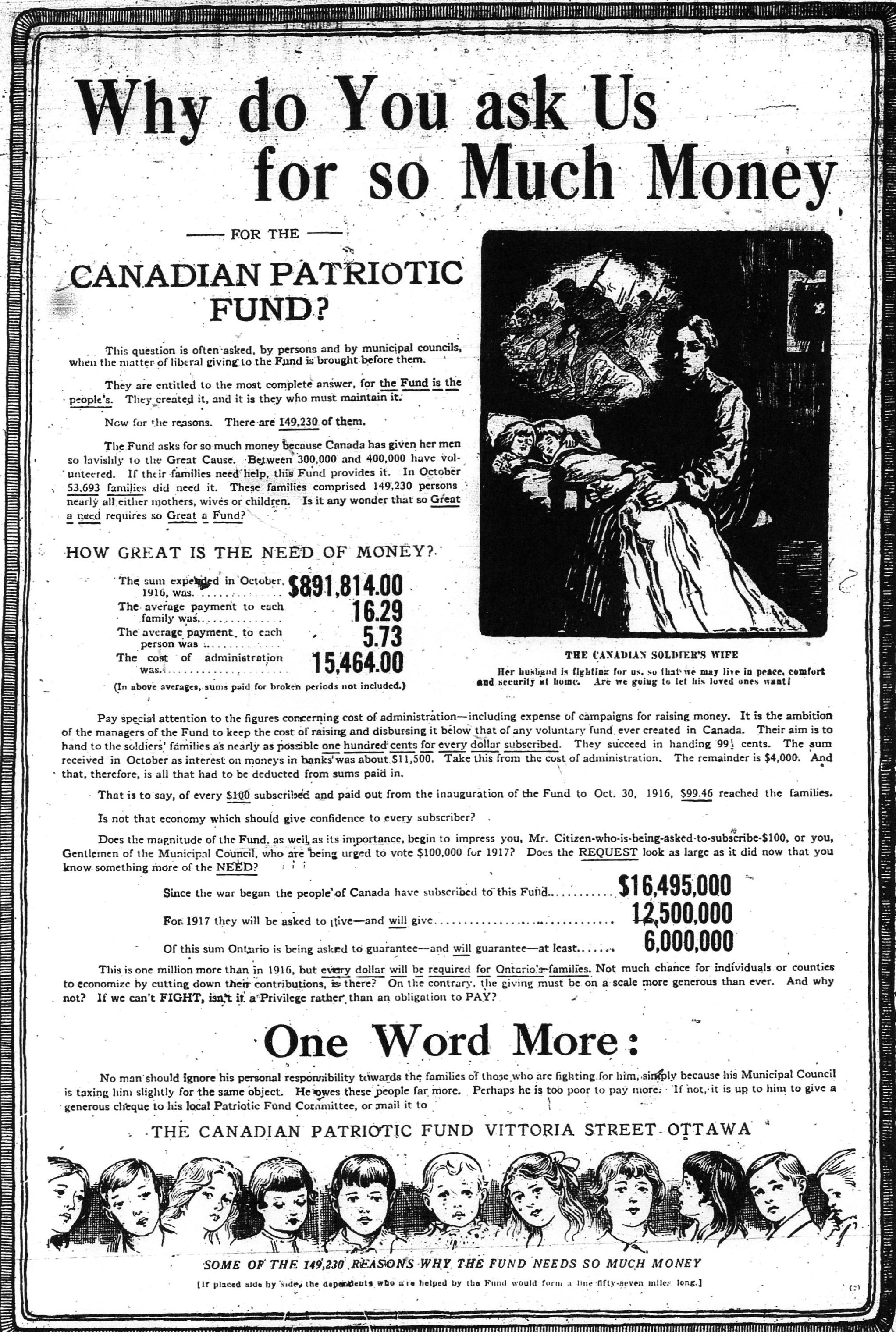
“Why do You ask Us for so Much Money for the Canadian Patriotic Fund? This question is often asked, by persons and by municipal councils, when the matter of liberal giving to the Fund is brought before them. …  The Fund asks for so much money because Canada has given her men so lavishly to the Great Cause. Between 300,000 and 400,000 have volunteered. If their families need help, this Fund provides it. …  Since the war began, the people of Canada have subscribed to this Fund $16,495,000. For 1917 they will be asked to give—and will give $12,500,000. Of this sum, Ontario is being asked to guarantee—and will guarantee—at least $6,000,000.

One Word More: No man should ignore his personal responsibility towards the families of those who are fighting for him, simply because his Municipal Council is taxing him slightly for the same object. He owes these people far more. Perhaps he is too poor to pay more. If not, it is up to him to give a generous cheque to his local Patriotic Fund Committee, or mail it to The Canadian Patriotic Fund, Vittoria Street, Ottawa.”

100 Years Ago: Melbourne Sprague Passes Through Belleville, Corporal Clifford Receives DCM, 254th Band Concerts, Shipments by St. Julien Chapter

The Intelligencer January 5, 1917 (page 3)

“Melbourne Sprague, the Belleville hero, returning almost legless, went through here on the G. T. R. at 7.30 yesterday on his way to Toronto Discharging Office and Hospital. He was with a trainload of amputation cases, billed to report at Toronto. Unable to leave the train Melbourne had a boy phone to his father to go to the G. T. R. railway bridge that he might see him as the train passed. Unfortunately the father, Mr. Edward Sprague, arrived just too late to see his crippled son.

Melbourne told a friend who saw him at the station, that he hoped to get two days’ leave to get home to see his parents prior to returning to the hospital for further operations, necessary to save his only leg.

Some of Melbourne’s outside friends are endeavoring to learn the day and hour of his arrival home, when it is hoped a splendid reception and ovation will be tendered a noble and terribly crippled hero. All citizens should turn out and show their appreciation for services rendered by this noble boy at so great a cost to him. Those who know Melbourne understand full well the fine type of manhood he represents.”

The Intelligencer January 5, 1917 (page 6)

“Eightieth Soldier Gets Decorations. Word has lately been received in this city by friends that Corporal A. E. Clifford, 219686 has been decorated by Sir General French with the Distinguished Conduct Medal for putting two German machine-guns out of action at the Sugar Refinery at the Somme. Corp. Clifford is now lying in a hospital at Epsom recovering from wounds.

He left Belleville on Saturday, May 13, 1916, with the 80th Battalion. After reaching England he was transferred to the 74th Battalion and then drafted to France with the 44th Battalion with which he was serving as a sniper when he received the wounds which gave him his decoration.”

The Intelligencer January 5, 1917 (page 7)

“The officers of the 254th (Quinte) Battalion are inaugurating an aggressive recruiting campaign, and are going to give a series of band concerts in the Northern district, commencing at Bancroft on Monday next, January 8th. On Tuesday evening they will be at Monk Road schoolhouse and Fort Stewart; at Maynooth on the 10th, and Coe Hill and St. Ola on the 11th.

Addresses will be delivered at these concerts by Lieut.-Col. A. P. Allen, O. C. 254th Battalion; Lieut. R. J. Cook, M. P. P., and E. Guss Porter, M. P. The 254th Battalion Band will play at a concert to be held in Stirling this evening.”

The Intelligencer January 5, 1917 (page 7)

“From August, 1916 to December, the St. Julien Chapter have shipped overseas twenty-one cases and twenty-five mail parcels, containing the following articles: Hospital supplies; sheets, 46; pillows, 23; towels, 335; night shirts, 85; bandages, 127; triangular bandages, 44; many tailed bandages, 13; dressings (large) 192; eye dressings, 114; handkerchiefs 2; dusters and old linen, 23, in all 1324 articles.

The shipments were sent to Queen’s University hospital (No. 7 Canadian General) French Red Cross and Canadian war contingent association. To the soldiers overseas were sent one hundred and fifty-two parcels containing socks, handkerchiefs, pads, pencils, envelopes, post cards, tobacco, cigarettes, gum, candy, chocolates, nuts and playing cards, tooth brushes, paste, canned soup, coffee, cocoa, tea tablets, raisins, bachelor buttons, boot laces, soap and towel, candles, 3,474.”