100 Years Ago: Captain Joseph Edward McCorkell on Furlough, Railway Lines Taken Up and Sent to France, Driver Frank Palmer Dies, 235th Hockey Team at Practice

The Intelligencer December 21, 1916 (page 2)

“Reception to Returned Soldier. Capt. J. E. McCorkell, a member of the 39th Battalion which left here over two years ago returned to this city yesterday on a short furlough, coming over from England in charge of a number of invalided soldiers and was tendered by the citizens of Belleville a most hearty reception. It was anticipated that other returned heroes would have arrived here yesterday but from some cause they did not.

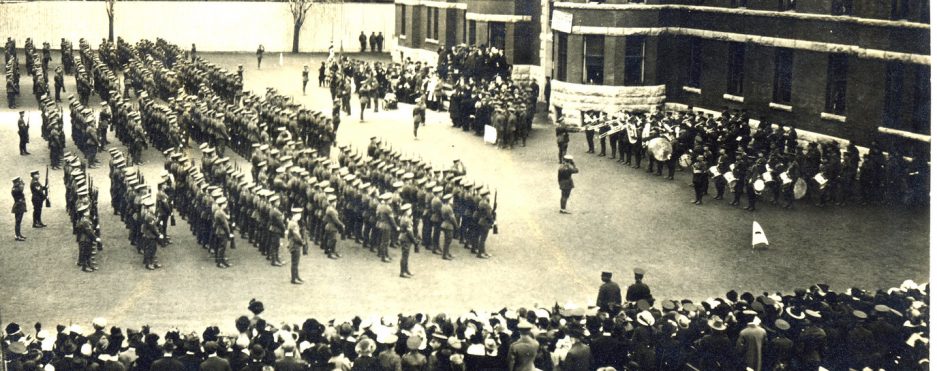
Capt. McCorkell arrived here at 3 p. m., by the G. T. R. International Express and many citizens were at the station to give him welcome. Prominent among them were Mayor Ketcheson, ex-Mayor Col. Marsh and ex-Mayor Ackerman. Upon alighting from the train the Capt. was received with cheers and entered ex-Mayor Ackerman’s car which was appropriately decorated with the Union Jack and bunting.

A parade was then formed and triumphantly Capt. McCorkell was escorted down Station street to Front street. At intervals he was loudly cheered. The procession was headed by the 235th Battalion Band, followed by an escort of the 254th Battalion under Lieut. Leavens, after which came the car containing Capt. McCorkell followed by a number of cars decorated with flags, etc.

The procession proceeded down Front St., to Bridge and up Bridge St. to the Post Office building where Capt. McCorkell will visit his father-in-law, Mr. S. F. Haight. After alighting at the Post Office, Capt. McCorkell made a brief speech thanking the citizens for their enthusiastic welcome after which he was cheered by the assemblage.”

The Intelligencer December 21, 1916 (page 6)

“Material For The Firing Line. Three hundred miles of Canadian Government Railways and some 220 miles of privately owned railway lines in this country are to be immediately taken up to supply railway material for military lines in France.

Other trackage on Government and private lines will later be removed until in all at least 1,000 miles of complete roadway has been supplied by Canada. Such was the announcement made after to-day’s meeting of the Cabinet. …

The transportation facilities in France have been inadequate to permit the Allies to take full advantage of the material and supplies available, and it is felt that the war could be materially shortened and thousands of lives saved if sufficient additional railway facilities could be provided promptly. …

It became apparent that the munitions work on which the Canadian mills are at present engaged precluded any possibility of early delivery of rails, tie plates, bolts, etc., from those quarters and it was evident that the situation could be properly and promptly met only by the taking up of Canadian tracks. …  the first 20-mile section, sufficient to load one steamer, is on the way, and other material will be forwarded as promptly as British boats can take care of it at the seaboard.

It is expected that at least one thousand miles of complete roadway be supplied by Canada, and in order to facilitate the taking up of rails all local labor available will be used, but where this is not sufficient troops will be employed to rush the work through.”

The Intelligencer December 21, 1916 (page 7)

“Corbyville Family Sorely Bereaved. Heartfelt sympathy will be extended to Mr. and Mrs. R. R. Palmer of Corbyville, owing to the death of their son, Driver Frank Palmer, which occurred at Kingston hospital yesterday.

The sorrow is to a certain sense a double one as only some weeks ago another son, Private J. J. Palmer was killed in action at the front. Two other sons, Private Arthur C. and Allen C. are at present in the firing line somewhere in France.

Driver Palmer who was 26 years of age, enlisted in a battery but owing to illness was prevented from going overseas. He was at Kingston and his illness became so acute as to prevent his removal. He was born at Corbyville where he always lived. Deceased was a bright young man and his demise is sincerely regretted by his comrades in arms who knew him.

The remains were today brought from Kingston and taken to the parents home at Corbyville. In addition to the parents and two brothers at the front two others are living namely, James E., of Rochester, N. Y. and S. B. at home.”

The Intelligencer December 21, 1916 (page 7)

“First Practice. About twelve men of the 235th Hockey Team turned out for their first practice of the season last evening. Two of the Belleville Juniors also were out, and from 6.45 to after 8 o’clock a stiff workout was held.

The 235th Battalion has some very good fast material on their team who will it is hoped bring the bacon home this year. Among those taking part in last night’s workout were Huffman, Kent, Cryderman and Marshall. All these men show lots of speed and considerable stick handling ability.

The next practice will be held on Friday evening, when it is expected that sufficient men will turn out to form two teams which will make things interesting.”

100 Years Ago: Robert Troup Killed, George Hearns Killed, John Drury Wounded, Munitions Needed

The Intelligencer December 20, 1916 (page 2)

“Another Local Soldier Killed. Word has been received in this city of the death at the front of Corporal Robert Troup of Belleville. ‘Bob’ as he was familiarly called, was a Grand Trunk engineer, having been running an engine in Belleville for three years and was about 30 years of age. He enlisted with the 21st Battalion at Kingston, and has been at the front for some time. He was a transport driver, and also won an extra stripe on the field.

With the death of Robert Troup also came the official notice that his brother, an officer in the Seaforth Highlanders, had been wounded. Deceased has one brother in Canada, who resides at Gananoque. He was a highly respected member of the Brotherhood of Locomotive Engineers of this city, and his heroic death is sincerely regretted by his brother trainsmen.”

The Intelligencer December 20, 1916 (page 3)

“News has been received that Private George Hearns of the 80th Battalion, has been killed. No particulars as to how he met his death have as yet been received. He had been in the trenches about three months and had written letters frequently during that period.

Pte. George Hearns enlisted on November 20, 1915, and left Belleville on Saturday evening, May 13th, 1916 with the 80th Battalion to go overseas. He spent the summer in England and reached the fighting scene in the fall.

Private George Hearns was taken from the ‘Children’s Shelter’ in Belleville when he was a little boy by Mr. and Mrs. Donald Robertson of Roslin, Ontario, where he soon came to be regarded as a member of the family. He attended the Carter school on the 8th Concession of Tyendinaga where he was always a favorite with his teachers and school mates.

In the fall of 1914 he hired to Mr. George Henderson, a farmer, who resides on the 4th Concession of Tyendinaga, and he stayed with him one year, during which time he frequently visited his home in Roslin where he ever received a warm welcome. As soon as the time he had hired for was expired, he went to the home of his foster-brother, Mr. W. D. Robertson, also of the 4th Concession of Tyendinaga.

It was while he was staying there that the call of duty came home to him, and he enlisted in Belleville, November 20, 1915, leaving Mr. Robertson’s home the following Monday to begin his training as a soldier of the King. As long as he was in Belleville his friends often saw him and he visited them quite frequently and spent a happy week with them last Christmas.

Private George Hearns was 20 years of age, and a young man of handsome appearance and fine physique, and he was possessed of very pleasing manners which endeared him to all with whom he came in contact with.

Another young life laid down for King and Country given up for the principles of righteousness and justice. Although he is buried many miles away from here and those who grieve for him are not privileged to strew flowers on his grave as tokens of their affection for him. Still the memory of his noble sacrifice will ever be treasured as sacred in the hearts of those who loved him as their own.”

[Private George Hearns died on November 18, 1916. He is commemorated on Page 101 of the First World War Book of Remembrance.]

The Intelligencer December 20, 1916 (page 3)

“Mrs. Emily Drury, residing in Belleville, yesterday received the following telegram which explains itself: Ottawa, Ont., 18th, 1916. Mrs. Emily Drury, 21 Murney St., Belleville, Ont.

Sincerely regret to inform you that 310949 Private John Charles Drury, artillery, officially reported wounded, December 4th, 1916, will send further particulars when received. Officer in Charge Records.”

The Intelligencer December 20, 1916 (page 5)

munitions166

“The Roar of our Destroying Guns on the Firing Line cannot go on without the roar of machinery in the Munitions Plant.

The giant guns belch their unending stream of munitions fed ceaselessly from the storehouse in the rear.

Our soldiers are second to none.

Our production of munitions must exceed that of our enemies.

Munitions are the need of the hour.

Every Shell is a Life Saver. Mark H. Irish, Director of Munitions Labor, National Service Board, Canada.”

100 Years Ago: Manpower Registration in Canada, Death of Eugene Lake, “The Battle of the Somme” Pictures a Success

The Intelligencer December 19, 1916 (page 1)

“Man Power of Dominion to Be Ascertained. Upwards of 150,000 letters have been dispatched by the National Service Commission to chief magistrates, lawyers, doctors, clergymen, school teachers, heads of fraternal societies and associations, members of Parliament and of legislatures throughout the whole Dominion, asking for their co-operation in registration of man power of Canada on cards to be distributed by postmasters.

Clergymen are requested to appeal to their congregations next Sunday. School teachers are asked to call their pupils together and explain claims of National Service Board and thus carry the word home to their parents. …

The Committee is asking that the first week of the New Year be observed as ‘national service week’ for taking of inventory. …  It is expected that fully one million and a half replies will be received from the adult males still left in Canada, each one signifying his present occupation and whether he would be available for other forms of national service should it be necessary or advisable.

These replies will be collated by a large staff at Ottawa and the inventory of the manpower will be analyzed with a view to securing its best distribution and utilization. This work, it is estimated, will take fully four months.”

The Intelligencer December 19, 1916 (page 3)

“Mrs. James Lake, of Sidney Township, received the following letter regarding the death of her son, Private Eugene Lake, of the 80th Battalion, whose life was sacrificed while he was doing his bit at the front:

47th Canadian, B.E.F., France, Nov. 21st, 1916. Dear Madam—I would have written to you before, but have only just come out of the line to a place where letters can be written. While I hesitate to intrude on you at this time, I thought you would like to hear further particulars regarding the death of your son Eugene, who was in my platoon, and for whose intrepidity and coolness in danger I always had the greatest admiration.

Our battalion on the night your son was killed, had succeeded in capturing from the Germans a section of trench that had made trouble for some weeks. …  Owing to the heavy casualties we were called up, and your son volunteered with others to go out to an advanced post in front of the captured line, where we dominated by machine guns and rifles any line of advance from the Germans for a counter-attack.

It was shortly after dawn that your son was killed. He was shot through the heart by a German sniper. His death was instantaneous, and he lies buried, with many of his gallant comrades at a spot which will later be identified for you by the graveyard records commission. Eugene was a fearless and gallant soldier, and he died a gallant death.

It will help you to bear your loss to know also that our night’s effort and sacrifices were not in vain. The Germans have not since been able to get the trench we took from them that night. I beg to remain, Yours sincerely, Lt. F. Phillips.”

The Intelligencer December 19, 1916 (page 3)

the-battle-of-the-somme165

“Battle of Somme Pictures a Success. Great crowds thronged Griffin’s Opera House last evening to witness the Battle of the Somme pictures. The film was given three showings during the evening and each time the building was filled to capacity, by an audience which was loud in their applause of the pictures depicting the conditions under which the great British advance on the Somme front was made on July 1st, 1916.

The film has left out nothing showing the dead and dying on the field, the unfortunate wounded being brought into the dressing stations and being bandaged up, before proceeding to hospitals or back to their places on the front line.

German captives, all bearing a vacant look caused by the ceaseless British bombardment of their trenches and very ill clad are shown being led in by the ever smiling British Tommy, who distributes cigarettes among their captives. …  The Battle of the Somme film is one that should be seen by all as it brings home what war really is, and portrays the conditions under which our brave soldiers fight.”

100 Years Ago: 254th Battalion Recruiting Meeting, Cash for Horses, Stirling Memorial Service for Privates Roy Bissonnette and Harold Constable, Queen Alexandra School Concert

The Intelligencer December 18, 1916 (page 1)

“One of the finest of the many recruiting meetings which have been held on Sunday evenings, was that of last evening, held under the auspices of the 254th Battalion. The Griffin’s Opera House was crowded to the doors, many of whom were ladies, who took much interest in the addresses which were given by the several speakers. …

The meeting was opened by the audience joining in singing the National Anthem, led by the fine 254th Battalion Band, under the able leadership of Bandmaster Hinchey. During the evening the band rendered ‘William Tell’ in a manner which demonstrated the musical abilities of the organization. By special request ‘Who’s Next,’ was given, and other beautiful selections, to the delight of the audience.

In referring to the necessity of recruiting, the Chairman said that there were young men clerks in stores whose positions could be well filled after next Saturday, the ‘Xmas season, under the present circumstance, by women.

Also there were teachers in the High School and Public Schools of Belleville, who should have long ‘ere this donned the khaki, but seemed to find some excuse for not doing so, casting by their action a slur upon the chivalry of the boys of our city, and a bad example to the boys growing up, conveying to their minds false ideals, securing their own safety at the expense of other men more courageous and patriotic. The schools will not be completely destroyed by their absence. Their places can be filled with women just as able and just as intelligent, and apparently much better equipped in mind.

There are young men engaged in factories not making munitions, that are capable, and should at once enlist. We must have the man power of Canada between the ages of 18 and 45, offered to fight for our freedom, and by enlisting now in the 254th Battalion you will fill up the ranks, so that it will be immediately up to strength. …

Col. Allen, the commanding officer of the 254th Battalion, was called upon, and spoke a few words, referring to the new battalions which were being recruited in this division. He appealed to the boys to join the 254th Battalion or some other battalion.

Capt. Ferguson and Lt. Clarke, the two returned heroes, were introduced to the audience by the chairman, and were loudly applauded. The meeting closed by singing the National Anthem.”

The Intelligencer December 18, 1916 (page 1)

“Army Inspection. For the French Government will be held at the Windsor Hotel, Belleville, on Friday, Dec. 22 from 9 a.m. to 3 p.m. Satisfactory and liberal prices will be paid for all horses accepted, grays included.

Do not be afraid to bring in your horses as we will guarantee a square deal and fair inspection for everybody. Ages 5 to 9 years; weight 1100 to 1500 pounds, from 15.1 to 16.2 hands high and serviceably sound. Cash paid for horses accepted.”

The Intelligencer December 18, 1916 (page 3)

“Memorial Service Held at Stirling. A memorial service was held at St. Andrew’s Church, Stirling, yesterday morning, in memory of Privates Roy Bissonette, and Harold Constable, who were recently killed in action.

The minister, Rev. Mr. Hall, conducted the service and also delivered a most impressive address. The minister was assisted by the Rev. Mr. Terrill, who also gave an address at the offertory. A beautiful solo entitled ‘Jesus Lover of My Soul’ was sung by Mrs. Alger.

The local members of the 254th Battalion under the command of Capt. Ingram and Lieut. Coulter, were in attendance and called forth many compliments on their smart soldierly appearance.”

[Private Roy Bissonnette died on November 19, 1916. He is commemorated on Page 55 of the First World War Book of Remembrance.]

[Private Harold Constable died on November 18, 1916. He is commemorated on Page 69 of the First World War Book of Remembrance.]

The Intelligencer December 18, 1916 (page 7)

“School Held Annual Concert. On Thursday evening, Dec. 14th the Queen Alexandra school held its annual concert in the auditorium of the school. It was one of the best concerts in every respect that this school has ever given to the public. The principal and staff are especially gratified in realizing the sum of $58.00 and fully appreciate the patronage of the friends and well-wishers of the school. The proceeds will be given largely to patriotic purposes, and this along with former amounts raised by the staff and scholars makes this school compare favorably in patriotic givings with other schools of Ontario.

The doors were opened shortly after seven and the crowd soon came thronging in till the seating capacity of the auditorium and halls was taxed to its utmost limit, and standing room was at a premium. Many remarked on the simple beauty and harmonious effect of the patriotic and yule-tide decorations.

Everybody felt the welcome and homelike spirit in the air and all seemed for the evening just members of one great family with a single bond of interest—interest in the school and children.”

100 Years Ago: Delay in Mail Delivery, Two Soldiers on Rampage, Poster for Canadian Patriotic Fund, Importance of Munitions

The Intelligencer December 16, 1916 (page 5)

“Delay in Delivery of Mail Explained. Wounded Canadians Move So Much That Tracking Is Difficult. London. A letter appears in the Times from Reverend Frank Leight, of Hespeler, Ont., complaining of the delay in the delivering of letters to Canadian wounded from friends in Canada. …

Canadian Associated Press enquiries reveal every sympathy shown towards the matter upon which the writer ventilates. When a man is wounded, letters for him are sent by postal department of the Canadian record office. Their difficulties are considerable in following the migration of wounded from one hospital to another. A man for instance will remain but one day in a certain hospital, two days in another, and so on. Every endeavor is made to deal expeditiously with the mail in such cases.

Correspondents in Canada, however, send letters by the hundreds, with such addresses as ‘John Smith, care Army Post Office, London,’ whereas the Army Post Office as far as England is concerned, is nonexistent and applies only to the army in the field. The greatest care ought to be taken to have the man’s regimental number plainly indicated.”

The Intelligencer December 16, 1916 (page 7)

“Two Soldiers On Rampage. At about 8 o’clock last night there was for a few minutes considerable excitement on Front street, owing to the conduct of two soldiers, members of the 235th Battalion, who were inflamed by intoxicants and acted in a most disorderly manner.

After using upon the street language most obscene they visited Mr. R. Day’s shooting gallery, where they commenced to smash up things generally. Before being overpowered, they broke two large panes of glass in the window and also some smaller lights of the door leading to the premises. They were taken in charge of by the police and locked up. …

This morning they appeared before Police Magistrate Masson and pleaded guilty to two charges namely, drunkenness and disorderly and wilfully doing damage to property to the extent of over $20. In the former charge the Magistrate imposed a fine of $25 and costs or in default 3 months in jail, and upon the charge of wilful destruction of property they were remanded to jail for a week for sentence.

Magistrate Masson said that as soldiers the accused should have more respect for the uniform they wore than to use the language they were said to have used upon the street. They were not only insulting those they came in contact with but the King.”

The Intelligencer December 16, 1916 (page 13)

canadian-partiotic-fund163

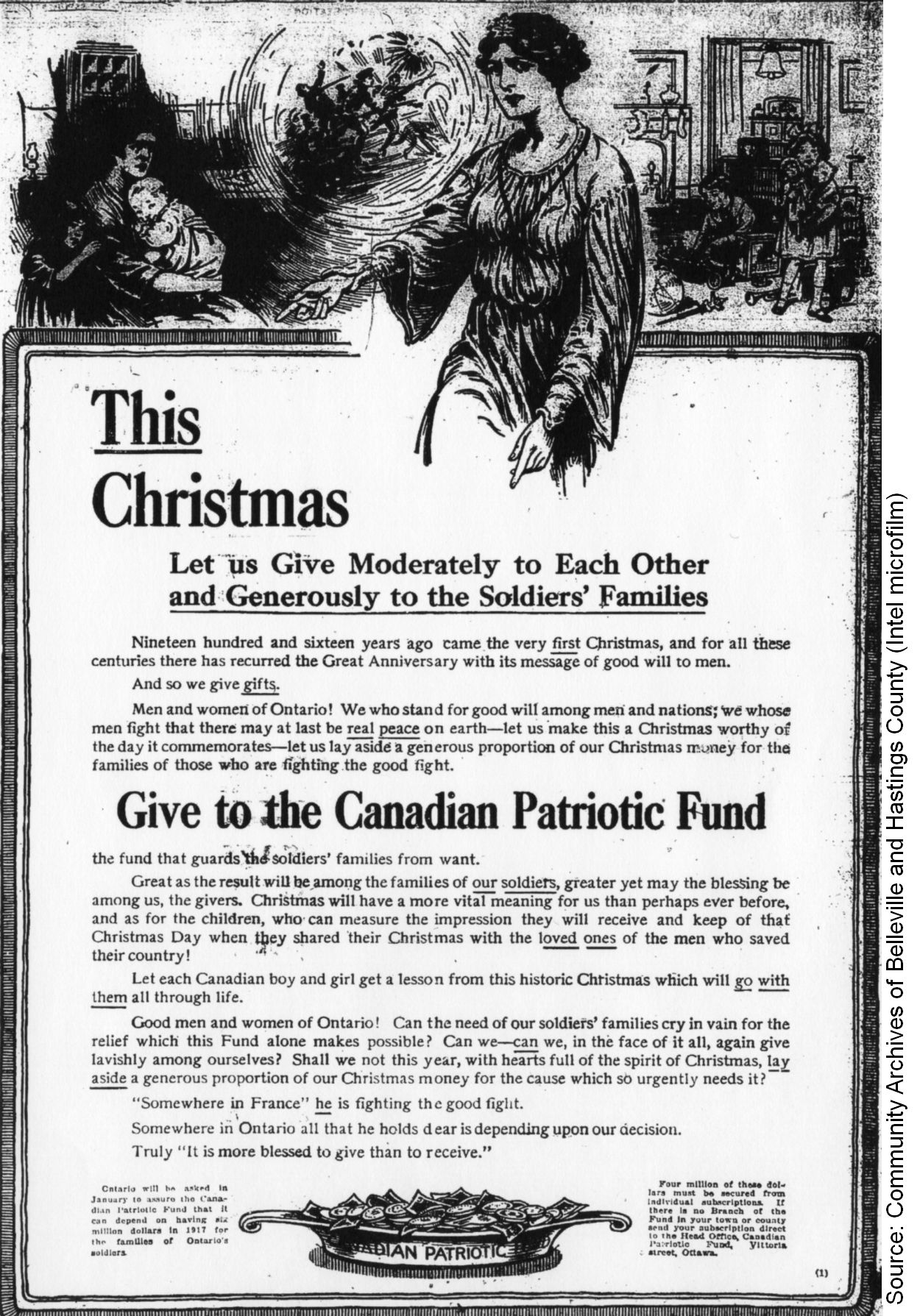
“This Christmas Let us Give Moderately to Each Other and Generously to the Soldiers’ Families. …  Give to the Canadian Patriotic Fund, the fund that guards the soldiers’ families from want.

Great as the result will be among the families of our soldiers, greater yet may the blessing be among us, the givers. Christmas will have a more vital meaning for us than perhaps ever before, and as for the children, who can measure the impression they will receive and keep of that Christmas Day when they shared their Christmas with the loved ones of the men who saved their country!

Let each Canadian boy and girl get a lesson from this historic Christmas which will go with them all through life.”

The Intelligencer December 16, 1916 (page 14)

munitions164

“When you read, ‘a curtain of fire’ it means one of two things: Either that the tremendous expenditure of munitions saved thousands of our soldiers’ lives by protecting them during an advance, or that the enemy attack was smothered before it reached our defences.

These ‘curtains of fire’ use up more munitions in an hour than were used in a month during 1915. This may help you to realize the importance of munitions to our soldiers.

Remember, Every Shell is a Life Saver.

Mark H. Irish, Director of Munitions Labor, National Service Board, Canada.”

100 Years Ago: Melbourne Sprague on Way Home, Gift of AutoStrop Safety Razor, “The Battle of the Somme” Poster

The Intelligencer December 15, 1916 (page 7)

“Melbourne Sprague. Dear Mr. Editor:—Our townsman, Melbourne Sprague, a young man of noble character, who has been fighting for us in France with two other brothers, all sons of Mr. and Mrs. Edward Sprague, North Front St., is on his way home with the Eighteen Hundred disabled soldiers being returned to Canada. …

I address this letter with the hope of enthusing our citizens towards the giving of this young man a grand reception upon his return. Nice receptions have been given those returning and all credit to our enthusiastic Mayor but he must in this matter have abundant assistance of both men and women, everybody should turn out, crowd the main streets and not watch the procession pass as they would a funeral, although we could all remove our hats with good grace.

The reception at the stations have been fine but the people on the street fall down. More cheering and enthusiasm is needed and still more. I have found it an awkward trial to alone commence a rousing cheer, one feels so conspicuous, particularly when so few join and I would suggest that some officially appointed committees be placed in two or three at 100 yard intervals along the Main street for the very purpose of creating enthusiastic enthusiasm by just mingling with the crowd and inciting them to cheering and so arrange that one group pick up the cheering from the next and thus follow the procession.

Furthermore if the ladies who are always doing so much to help, would organize to be at certain positions along the route of procession and hand the hero as he passes a bunch of flowers, I fancy it would be very pretty and much appreciated, in fact organization would not be necessary, the more the better, if ladies would only feel free enough to do this and why should they not?

Surely it is not necessary for a lady to have met the hero to inspire this act of courtesy to one who has been fighting for us and who returns a cripple for life, crippled for the sake of others.

This or some similar programme should be arranged for every returning soldier, it seems to me, for every man who enlists virtually gives up his life for you and I and we never can repay the debt. I also think a hearty demonstration on such lines would greatly aid recruiting.

We may have recognized our returned soldiers quite equal with other cities. I believe we have, but let us put other cities to shame in the future, let us give our boys each and all a grand reception such as they will ever appreciate and never forget. Respectfully, C. B. Scantlebury.”

The Intelligencer December 15, 1916 (page 10)

auto-strop161

“Your Gift to one in KHAKI should be a practical article. An AutoStrop Safety Razor is the most practical gift for him. Why? For the following reasons:

It is the Only Razor which Sharpens its own blades.

It is the Only Razor that permits stropping, shaving and cleaning without being taken apart, without even removing the blade, and like a perfectly stropped ordinary razor, the blade improves with use and is always in perfect condition. …  Obtainable from all dealers in various styles from $5.00 up.”

The Intelligencer December 15, 1916 (page 11)

bttle-of-somme162

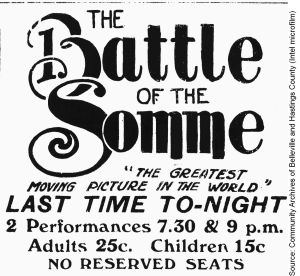
“The Battle of the Somme. ‘The Greatest Moving Picture in the World.’ Under the Auspices of Belleville Daily Intelligencer.

Matinee and Night—Children 15c, Adults 25c.

Griffin’s Theatre Dec. 18th & 19th.”

100 Years Ago: Full Military Funeral for Lieut. McGinnis, At the Khaki Club

The Intelligencer December 14, 1916 (page 2)

“With full military and Masonic honors the remains of the late Lieut. William C. McGinnis were yesterday afternoon consigned to the tomb at Belleville cemetery. The cortege was one of the largest seen in this city for some time, and as it passed through Front street the walks were lined with people.

At the residence of the parents, Mr. and Mrs. Arthur McGinnis, 269 George street, the burial services of the Presbyterian Church were conducted by Rev. E. C. Currie, Pastor of the John Street Church. Rt. Wor. Bro. Col. S. S. Lazier, conducted the Masonic burial services at the house. The spacious residence was filled with sympathizing friends during the solemn service.

At the conclusion of the service, the cortege was formed and proceeded down George street to Victoria avenue to Front street, thence across the lower bridge to Commercial street and to the cemetery. It was headed by the fine band of the 254th Battalion playing a funeral march.

The order of the cortege was as follows: 254th Battalion band, Masons in regalia, 235th Battalion band, Lt. O’Neil and Firing Party of 235th members, Clergy, Bearers, Hon. Bearers, Carriages with Flowers, Funeral car draped with Union Jack, Mourners in carriage, Military officers, Citizens on foot, Citizens in vehicles. …

Officers of the 254th and 235th Battalions who are in the city attended in a body. Upon arrival at the cemetery, Rev. E. C. Currie conducted the committal service of the church, and Rt. Wor. Bro. Mayor Ketcheson, a similar service of the Masonic lodge. The firing party discharged a volley and the last post was sounded.

That deceased was deservedly popular was attested to by not only the numbers in attendance at the obsequies, but the numerous beautiful floral designs contributed.

Major Thompson and Lieut. Gerald Ponton, of the Royal Canadian Engineers, St. John, Quebec, came up to represent that Corps at the funeral of their late comrade.”

[Lieutenant William Clark McGinnis died on December 11, 1916. He is commemorated on Page 126 of the First World War Book of Remembrance.]

The Intelligencer December 14, 1916 (page 7)

“At the Khaki Club. Miss Helen Ketcheson gave a very fine programme at the Khaki Club on Wednesday evening. She was assisted by Miss Bowden and Miss Freda Johnson, of Bleecker Ave., who charmed everyone with her playing.

Miss Ketcheson was most fortunate in having also the splendid assistance of the 15th Battalion orchestra, whose bright music was a great treat. This act of courtesy and good feeling towards the Battalion’s wintering here, was very much appreciated, both by the officials of the Khaki Club and the soldier boys.

The canteen was well-looked after by Miss Robina Templeton and Miss Helen McCuaig.”

100 Years Ago: Christmas Gifts, Successful Tea in Tyendinaga, Death of Clifford Westlake, Belgian Children’s Christmas

The Intelligencer December 13, 1916 (page 1)

“Twenty thousand letter cases are going to the Canadian wounded through the Red Cross as Christmas gifts. Eighteen thousand Christmas stockings were received from Montreal.

Extra parcels for prisoners in Germany containing plum pudding, muscatels, fruit cake and chocolate were despatched in November to insure delivery by Christmas. Returned prisoners testify that the parcels reach the men in good condition.”

The Intelligencer December 13, 1916 (page 3)

“Tea-Meeting A Great Success. Eastern Star Lodge No. 94, L.O.B.A., held a very successful 15-cent tea on Wednesday, December 6th, in Carter’s Lodge room on the 8th line of Tyendinaga. The hall was daintily decorated for the occasion with flags and other articles calculated to please the eye. The seating capacity was taxed to the utmost, many young men finding it necessary to stand throughout the lengthy programme. The proceeds of the evening amounted to $26, all of which was handed over to increase the funds of the Red Cross Society.

The programme was lengthy but thoroughly enjoyed by all present. …  Mr. Charles Sargent quite brought down the house with his song, and great rounds of hearty applause constantly greeted the ever-popular Mr. Joe Gow, who with his talented accompanist, Miss Ida Pitman, were frequently recalled. …

One of the best features of the programme, was the great part played by the children all eager to ‘do their bit’ for a good cause, prominent among them being Miss Olive Hamilton, who has a happy faculty of delighting every audience which hears her.

One of the most interesting features of the evening was the awarding of a lamp to the holder of the lucky ticket, from a number which had been sold prior to the meeting, and the sale of which realized the sum of $16.70, which was devoted to the Belgian Relief Fund. Much praise is due to the officers of the lodge, under the worthy Mistress Mrs. W. H. Alford, and especially to Mrs. W. B. Colden, who worked so hard to make the evening so great a success.”

[Note: L. O. B. A. = Ladies Order Benevolent Association]

The Intelligencer December 13, 1916 (page 3)

“How a Brave Belleville Soldier Met Last Call. How gallantly Pte. Clifford Westlake a well known boy of Belleville faced death to help save a wounded comrade in the trenches and for his King and country, is told in a letter from the officer commanding his company, received by his mother, Mrs. J. Westlake 328 Coleman St., and reads as follows:

Wednesday, Nov., 1916. My Dear Mrs. Westlake:—It is with the deepest regret that I have to write to tell you of your son’s death. I presume the sad news has been telegraphed you by now, but it is a very little tribute that I can pay to one of my boys to tell his mother how bravely and with supreme self-sacrifice your son’s life has been given.

One of our comrades lay badly wounded in our trenches; everyone was very tired, and played out after the hardships of our journey into the trenches. I had to do something for this poor wounded chap and called for volunteers to take him out—your son was near me and he and three other brave lads volunteered. Immediately with the utmost bravery, your son and one other of the four were instantaneously killed by a shell while trying to help a wounded comrade in trouble—the utmost devoted action a soldier can volunteer for.

I am an old 80th officer and was in Belleville all last winter, so your son was a member of my old family, as we feel toward all 80th men. I sympathize with you, Mrs. Westlake very much, indeed, and I can only comfort you by saying that your son died a brave and devoted soldier giving his life for a comrade and for his King and Country. Yours very truly, LT. F. L. DRAYTON. B. Co. 80th Canadian Infantry. B. E. F.”

[Private Harry Clifford Westlake died on October 27, 1916. He is commemorated on Page 180 of the First World War Book of Remembrance.]

The Intelligencer December 13, 1916 (page 7)

“What about the Belgian Children’s Christmas? This is not an appeal to give the children of our Ally the same kind of a Christmas that our own little ones expect, with Santa Claus and toys and candy. They have given up hope of that till after the war.

It is simply a call for food—for enough bread and soup to stop the pangs of hunger that hundreds of them feel every day.

The cost of a moderate size turkey—of two or three boxes of chocolates—of one of the many presents we have formed the habit of giving to those who do not need them, will feed a Belgian family a whole month!

Don’t you think the money will do more good if this year you give some of it to the Belgian Relief Fund? Will it not be more pleasing to Him whose birth we celebrate?

Send your contribution weekly, monthly or in one lump sum to Local or Provincial Committees, or send cheques payable to Treasurer Belgian Relief Fund, 59 St. Peter Street, Montreal. The Greatest Relief Work in History.”

100 Years Ago: First Moira Boy Killed in Action, Belleville to Glimpse War, 235th Battalion Recruiting Meeting, Memorial Service at St. Thomas

The Intelligencer December 11, 1916 (page 1)

“First Moira Boy to Give Up His Life. Stirling. Chas. Welsh, eldest son of Edward Welsh of Moira, has been killed in action, according to an official message received by his father on Thursday. He is the first of the boys from Moira to give his life for his country. He had been in France for some months.”

[Note: Private Charles Sidmer Welsh died on November 18, 1916. He is commemorated on Page 180 of the First World War Book of Remembrance.]

The Intelligencer December 11, 1916 (page 2)

“Belleville to Get Glimpse of War. On Monday and Tuesday, Dec. 18 and 19, the Daily Intelligencer proposes to present to the people of this city some real facts about the war, and the great battle of the Somme. There is a great recruiting lesson coming for Belleville, and it has one supreme superiority over every other lesson and argument about recruiting—it is objective. It ‘shows you.’

On July 1, the British and the French initiated the allied offensive on the western front, breaking a trench deadlock of two years. …  Every despatch is ‘played up’ eagerly by the editors of newspapers in every country where printing presses are in use, and read with avidity by everybody to whom has been given the ability to understand print.

But pitifully unable are people removed by distance of land and sea, of longitude and latitude, to understand what is really taking place, how millions of men are killing and dying, struggling and suffering in the throes of an ultra-modern, super-human war, is witnessed by the way life proceeds, to all in our own city.

This very Belleville, which has sent many men to the army, and the names of whose sons are appearing in the casualty lists almost every day. Imagination grows tired, fed only on cable despatches, and gradually the war in Europe far away, seems with some people, to fade into secondary consideration. Routine affairs of every day life absorb them. They are apt sometimes to skim the war news and read the ‘sports’ or the social and personal gossip, and yet because of the number of people and countries affected, this war may fairly be said to comprise the most important chapter in history, ancient or modern.

The Intelligencer is going to bring this war to Belleville. Our people are going to see an actual battle. …  To be exhibited at Griffin’s Opera House, Monday and Tuesday, Dec. 18 and 19, matinee each day, and three times in the evening, 7.15, 8.15 and 9.15.”

The Intelligencer December 11, 1916 (page 3)

“Recruiting Meeting of The 235th Battalion a Rouser. A most successful meeting was held last evening in the Griffin Opera House by the 235th Battalion. The building was packed from pit to dome, the majority of the audience being women. …

The first number on the program was a solo by Miss Ponton which was followed by an address by Capt. McLean, Paymaster of the 235th Battalion, who thanked the audience on behalf of his battalion or Belleville’s Battalion for their attendance. …  Referring to the Canadian’s loyalty in the first days of settlement, Capt. McLean called upon the young men of Canada to-day to follow their example not only to lay down their lives for Canada but for the Empire. …

Judge Huycke of Peterboro was called upon. …  The speaker appealed to the women as well as to the men, to offer themselves for service to the country. A position that can be filled by a woman should be and the man allowed to take his place in the firing line. Employers should also be influenced to allow their employees who are eligible for service to enlist. Our casualties today are much larger than the enlistments.

Before concluding the speaker stated he would leave one watchword with the people and that was to go or send, so that when victory comes we may be proud when the boys come home and be able to say that we have done our bit.

The evening then closed with singing of ‘God Save the King.’ Music was rendered by the 15th Reg’t. Orchestra, to whom the officers of the 235th Batt., are very grateful.”

The Intelligencer December 11, 1916 (page 5)

“Memorial Service At St. Thomas. A large congregation attended the memorial service held in St. Thomas’ church last evening for Privates Sherwood M. Wood and James Meloy, who have recently been reported ‘killed in action.’ The service was conducted by the rector, the Ven. Archdeacon Beamish and consisted of the first of The Evening Prayer, with special Sentences, Psalms and Lessons.

Then the people standing, the names were read of the members of St. Thomas’ congregation, who have made the supreme sacrifice. These names have been framed and hung up at the entrance of the church. …

Of the 170 which have enlisted from St. Thomas’ Church, ten have made the supreme sacrifice, namely, Capt. Bertram Kerr Allen, Lieut. John H. Roquette, Sergt. Harry Ablard, Corp. Leslie Evans, Corp. William Drummond, Pte. John Coburn, Pte. John McMichael, Pte. Charles T. Eves, Pte. Sherwood M. Wood, Pte. James Meloy.”

100 Years Ago: 235th Military Dance Held, Harry Thomas Watkin Missing, Only One Intermediate Hockey Team, Poster for “The Battle of the Somme,” Is Soldier’s Family Overpaid?

The Intelligencer December 9, 1916 (page 1)

“Very Pleasant Military Dance. About 100 couples tripped the light fantastic till the early hours of this morning at the dance in Johnstone’s Academy, given by the Sergeants and staff sergeants of the 235th Battalion, C.E.F. last night. The dance was most successful in every way and sergeants have every reason to feel proud of the splendid results of their initial dance to be held in this city, many more of which will follow during the winter months.

Many out of town guests were present, also several sergeants of the 254th Battalion and an officer of the 253rd Battalion, Kingston. The dance was well patronized by the officers of the 235th Battalion, which is evidence of the good working spirits between the N.C.O’s of the Batt. and the officers. …

The room was tastily decorated with Union Jacks and Battalion pennants. This work being undertaken by the ladies of the committee who have taken a deep and appreciative interest in the boys of the 235th Battalion since the day they arrived in the city. …

The splendid orchestra was supplied by the 235th Battalion Band under the leadership of Band-Sergt. Merchison. Several of the sergeants spoke in very high praise of the work the ladies had done on their behalf, and also Mr. and Mrs. Johnstone who were very active in the arrangements and were in no small way responsible for the successful evening. …  At midnight refreshments were served after which dancing was resumed until the early hours of the morning.

It is the intention of the committee of the sergeant’s mess in course of a few weeks to hold a regimental whist drive and dance, which will be open to all, and no doubt will be as successful as last evening’s function.”

The Intelligencer December 9, 1916 (page 2)

watkin-harry

“Belleville Boy Missing. Mr. Delos Watkins residing on the corner of Queen and John streets, Belleville, this morning received a message from the Record office, Ottawa, stating his son Sergt. Harry Watkins had been missing since November 18th.

He enlisted with the 38th Battalion and was for some time at Bermuda and was also at the Dardenelles, but of late had been at the front in France. His many friends in the city will hope that he is alive and that his whereabouts may be ascertained.”

[Private Harry Thomas Watkin died on November 19, 1916. He is commemorated on Page 179 of the First World War Book of Remembrance.]

The Intelligencer December 9, 1916 (page 6)

“Hockey. Only One Intermediate Team. An adjourned meeting of those interested in hockey was held last evening at Hotel Quinte and a number were in attendance. The chief object of the gathering was to consider and determine what was to be done in reference to placing an intermediate team in the O.H.A. independent of the 235th Battalion intermediate team which is already an established fact.

After some discussion it was decided not to enter another intermediate team in the O.H.A. It was felt that it would not be wise to have two intermediate teams, civilian and military, and it was thought better to combine with the team representing that unit.

The soldiers contend that they have excellent material, and it is felt that with the support of the citizens the 235th team should make a good showing in the O.H.A. and uphold the reputation of this city, whose team was last season’s runner-up.”

The Intelligencer December 9, 1916 (page 15)

battle-of-the-somme160

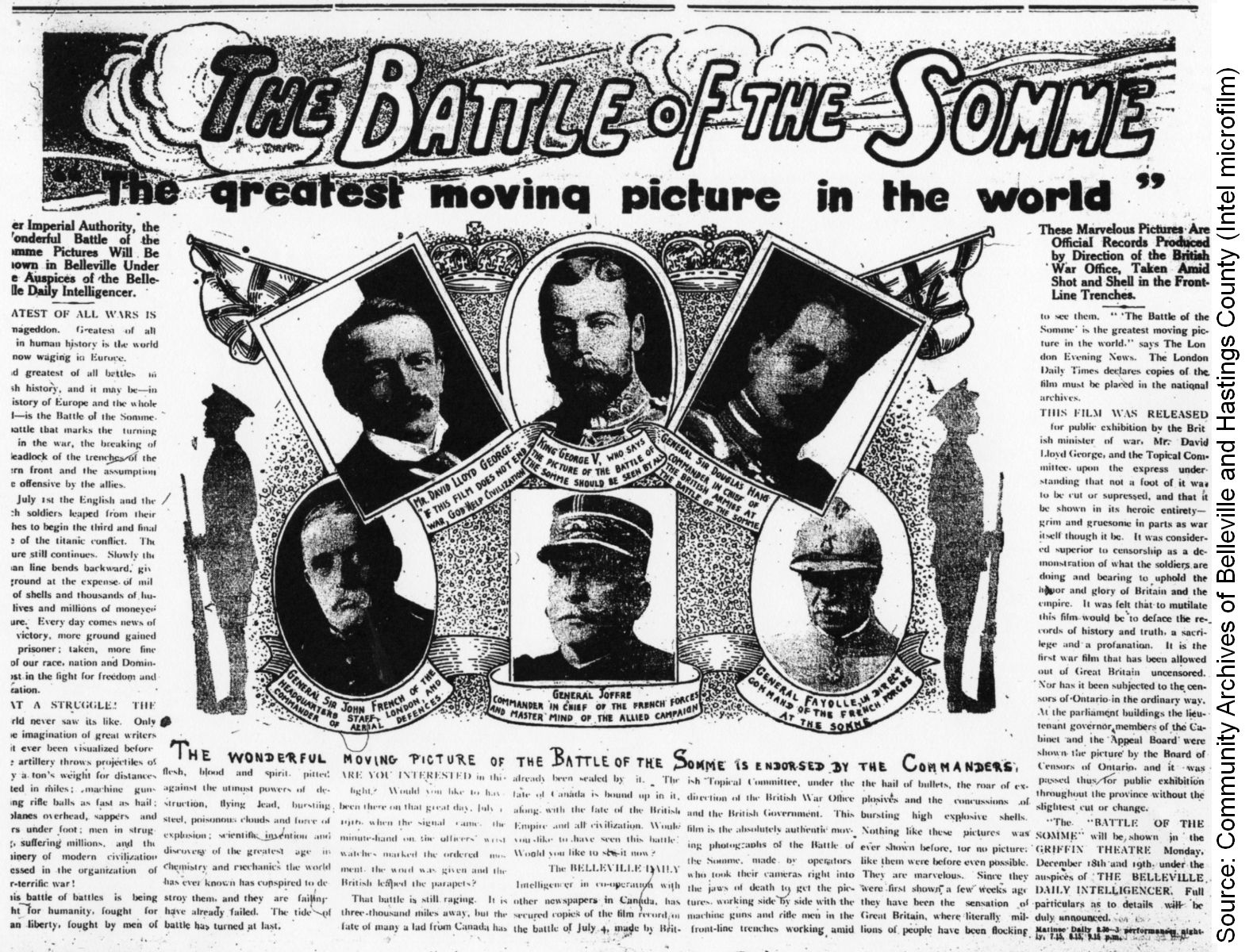
“The Battle of the Somme. ‘The greatest moving picture in the world.’

Mr. David Lloyd George: If this film does not end war, God help civilization.

King George V, who says the picture of The Battle of the Somme should be seen by all.

The wonderful moving picture of the Battle of the Somme is endorsed by the Commanders.”

The Intelligencer December 9, 1916 (page 16)

“The Soldier’s Family Is It Overpaid? No! A thousand times, no! Yet unthinking people, learning that Mrs. Smith, or Mrs. Jones, or Mrs. Robinson is getting from the Government and the Canadian Patriotic Fund, fifty or fifty-five dollars a month, complain that this poor woman is better off than when her husband was home—the Patriotic Fund, therefore, must be wasting money!

Is that a proper attitude? Do the people of Canada wish the administrators of the Patriotic Fund to keep the families of our soldiers close to the starvation line, but not so close, of course, as to be in danger of falling across? No! A thousand times, no!

The aim of the Fund is to maintain each family in a state of comfort equal, at least, to that to which it has been accustomed. If in cases, perhaps of families that through a husband’s improvidence have never been properly housed, fed or clothed, this standard is raised, who will condemn the Fund? Shall we keep those who are down, down? Or shall we try to bring those who are down, up?

The woman has given her man to the country. She has done what she could. Her consent was necessary before he enlisted. She gave it. …  Is our paltry silver and his precious life to be placed in the scales over against each other? No! A thousand times, no!”