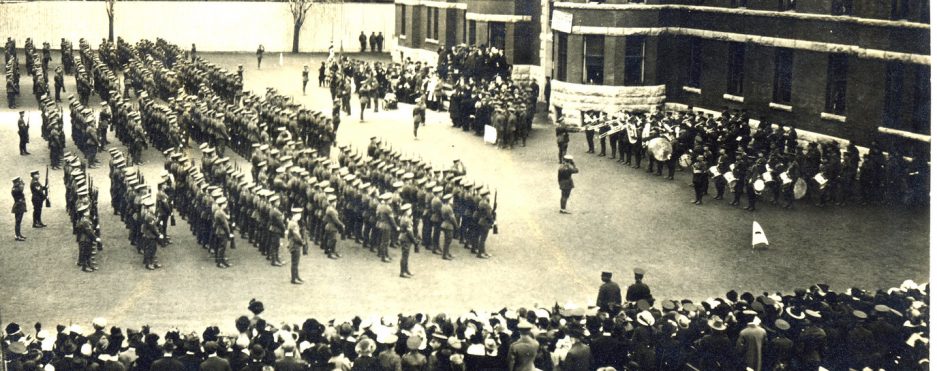
100 Years Ago: The Corby Co. and the River, James Clark Passes Away, North Hastings Given to Peterboro for Recruiting

The Intelligencer August 28, 1916 (page 2)

“The Corby Co. and the River. From what has developed it is only fair to ask the public to suspend judgment pending investigation as to the cause of the dead fish in the River. The company deny that anything poisonous, alcoholic or otherwise injurious to health is being deposited by them. The Provincial authorities are investigating.

The Corby Company are manufacturing only for the high explosives for the Allies in the present war. Apart from this, it would be too bad if Thurlow were to lose such a large industry through its being sent down.

We hope the official enquiry will clear the company and will also result (with the co-operation of the manufacturers) in doing away immediately with any possible cause of complaint.”

The Intelligencer August 28, 1916 (page 5)

“Private Clark of the 155th Passes Away. Private James Clarke, who was an efficient and much respected member of the 155th Battalion, died on Saturday night at Ongawonda Military hospital at Kingston.

Deceased was a resident of College Hill, Belleville, and the remains were brought here after being prepared for burial. Mrs. Clarke was at the bedside of her husband when the end came, and she is most profuse in her thanks for the treatment accorded her husband by the officers of the 155th and the hospital attendants. Inflammation of the kidneys was the cause of death.

Pte. Clarke, who was 43 years of age, was born at South Shields, England. Six years ago he came to Belleville, and was employed as a boiler maker at the G.T.R. shops here. …  Deceased was a member of Oxford Lodge, Sons of England, in this city, and was a member of the Tabernacle Methodist Church. …

The widow and a military escort accompanied the remains to Belleville. In addition to the widow a young son, George, survives. To them will be extended the heartfelt sympathy of all citizens.

Pte. Clarke was deservedly popular with his fellow workmen whilst working in the G.T.R. shop here. The funeral will be held under the auspices of the Sons of England and a military escort will also be present.”

[Note: Private James Clark died on August 27, 1916. He is commemorated on Page 67 of the First World War Book of Remembrance.]

The Intelligencer August 28, 1916 (page 5)

“Making a Protest. Kingston Standard. There is considerable dissatisfaction over the fact that North Hastings has been turned over to Peterboro to form a part of the recruiting area for the 247th Battalion to be commanded by Lt.-Col. Johnston, with headquarters at Peterboro.

A strong protest has been made against the division of Hastings by the recruiting officer, and this protest will be maintained until North Hastings is returned to the fold of the county in which it is expected that a new battalion will be recruited and trained for the coming winter with Major Allen, now of the 155th Battalion in command.

The headquarters of the new battalion which will be recruited in Hastings and Prince Edward counties, will be Belleville, and in view of the fine showing that Belleville and Hastings have made in recruiting, it is claimed that a division of the county of Hastings, and the part given to Peterboro, is unfair and will result in injury to both Peterboro and Belleville in recruiting. …

Since the war began Hastings has done well, for out of it has gone men for the 2nd battalion, and many of the departmental corps at the commencement of the war. It raised the 39th Battalion, the 80th, and the 155th. It recruited a complete ammunition column, and has contributed to the 21st, the 59th, and quite liberally to artillery units and other infantry units now at the front, and the people feel that if permitted to keep their county as a whole, they can recruit another battalion.”
100 Years Ago: Soldiers’ Wives Should Stay in Canada

The Intelligencer August 26, 1916 (page 3)

“Wives Should Stay in Canada. Ottawa. Word has been received here from people engaged in relief work in London and elsewhere in England that a number of wives of Canadian soldiers now fighting in France are suffering distress because of lack of means of support.

In a number of cases the wives of Canadian soldiers left for England without notifying the military authorities, and they as a consequence are now without their separation allowances.

The wives of officers who have gone to England usually know how to look after themselves, but many of the wives of Canadian soldiers who are stranded in London are totally ignorant of what to do. The Soldiers’ and Sailors’ Families’ Association have given aid in some cases.

The military authorities here state that it is most unwise for the wives of soldiers to think of going to England unless they have private means of support.”

100 Years Ago: A Pleasant Visit to Barriefield Camp

The Intelligencer August 25, 1916 (page 2)

“A Pleasant Visit to Barriefield Camp. Sir Mackenzie Bowell, Mayor Ketcheson, J.W. Johnson, M.P.P., W.C. Mikel, K.C., and Messrs C.N. Sulman and G.A. Bennett, motored to Barriefield Military Camp yesterday and paid a visit to Col. Adams, officers and men of the 155th Battalion, and were, they inform us, right royally received and entertained.

These gentlemen speak in the highest terms of the courtesy and kindness of the Col. officers and men of the battalion in showing and explaining all that pertains to the life and duties of a soldier, from the baking of a loaf of bread to the intricacies of a hand and field grenade.

It were well, says these gentlemen, if some of the fault finders at the cost of the munitions of war to the country would study and examine the mechanism of these apparently simple instruments of warfare and the necessary machinery to manufacture them there might be less growling and fault finding.

The party informs us they made a halt on the road down and visited the Cataraqui Cemetery for the purpose of paying a visit to the grave of the never-to-be-forgotten statesman, Sir John A. Macdonald, and express no little surprise at the simple and unostentatious granite cross that marks the resting-place of one of Canada’s greatest men.”

100 Years Ago: Soldier Disputes Exaggerated Claims

The Intelligencer August 24, 1916 (page 5)

“The Canadians and the Ypres Salient. A soldier just returned from the front writes as follows: Coming to Canada for the first time since the early days of the war, it is quite a surprise to find the impression current that Canadian troops have been given an undue share of the strenuous work on the British front.

This is perhaps due to the fact that people are prone to remember various active operations in which our men have been engaged, and to forget the long periods of comparative inactivity that have come between them.

They also are apt to forget that all the principle offensives, Neuve Chapelle, Loos, and so far, the Somme, have been conducted without the assistance of Canadian troops.

Another factor in creating wrong impressions is the imaginative letters that occasionally come from unreliable men at the front describing actions that never occurred, and which are sometimes taken seriously here. A classic example is the hoax perpetrated on a certain M.P.P. last spring.

I point this out with no wish to disparage the work done by our men on various parts of the line. I know them and it, too well for that. But the work should be viewed in some sort of perspective and not allowed to hide from our view the equally good and much less trumpeted work done by the Imperial forces.

That Canadians have had the honor of holding parts of the Ypres salient at times is a matter for pride, a pride that the casualty lists should not dim for us. But we must not, in fairness to our own men attempt to exaggerate that honor.

The Canadian force in Flanders is one corps in a very large army, and the people and press of Canada can do them no greater disservice than to make them ridiculous in the eyes of their fellows by foolish and exaggerated ideas and assertions as to their doings. Then men in the trenches who read your papers (including the advertisements) with considerable thoroughness, will laugh heartily, though perhaps somewhat sarcastically at your statement.

Perhaps you will forgive me for reminding you that the 1st Canadian Division was in the salient in 1915 for one or two weeks and not again for eleven months. The Canadian corps moved into the salient again this spring, and has held part of it for some four and a half months—a total for Canadians of five months.

I do not, of course, refer to the P.P.C.L.I. who were with an English division and got into rather more fighting.”

[Note: P.P.C.L.I. = Princess Patricia’s Canadian Light Infantry.]

100 Years Ago: Deserters Apprehended, Jeffrey Deane Dead

The Intelligencer August 23, 1916 (page 2)

“Deserters Apprehended. No less than nine enlisters, all members of the 155th Battalion, were yesterday placed under arrest. Five are charged with being deserters and four with being absent without leave. They will all be taken back to the camp at Barriefield.”

The Intelligencer August 23, 1916 (page 2)

“Jeffrey Deane Dead. Mrs. G. Deane, 27 Pinnacle St. received today the following from overseas. ‘Deeply regret to inform you, 45,430 Private Jeffrey Dean, Infantry, officially reported died of wounds Military Hospital, Shorncliffe; August 21, gunshot wound, shoulder. Officer in charge. Record Office.’ ”

[Note: Private Jeffrey Deane died on August 21, 1916. He is commemorated on Page 76 of the First World War Book of Remembrance.]

100 Years Ago: Nursing Sister Hambly Returns to Active Service

The Intelligencer August 22, 1916 (page 7)

“Nursing Sister Hambly. An officer of the British Army who came from duty at the front unheralded for a brief leave at home with her father, Lt.-Col. P.H. Hambly and family, returned to active service yesterday.

Nursing Sister Mary Hambly was one of our first to enlist and serve, and her skill and enthusiastic work have earned her official commendation. No honor can be too great for our life-saving sisters.

Colonel Ponton, President of the Veteran’s Association, saw her off at the noon train, and Col. Stewart, Secretary, presented her with a bouquet of roses on behalf of the Veterans.”

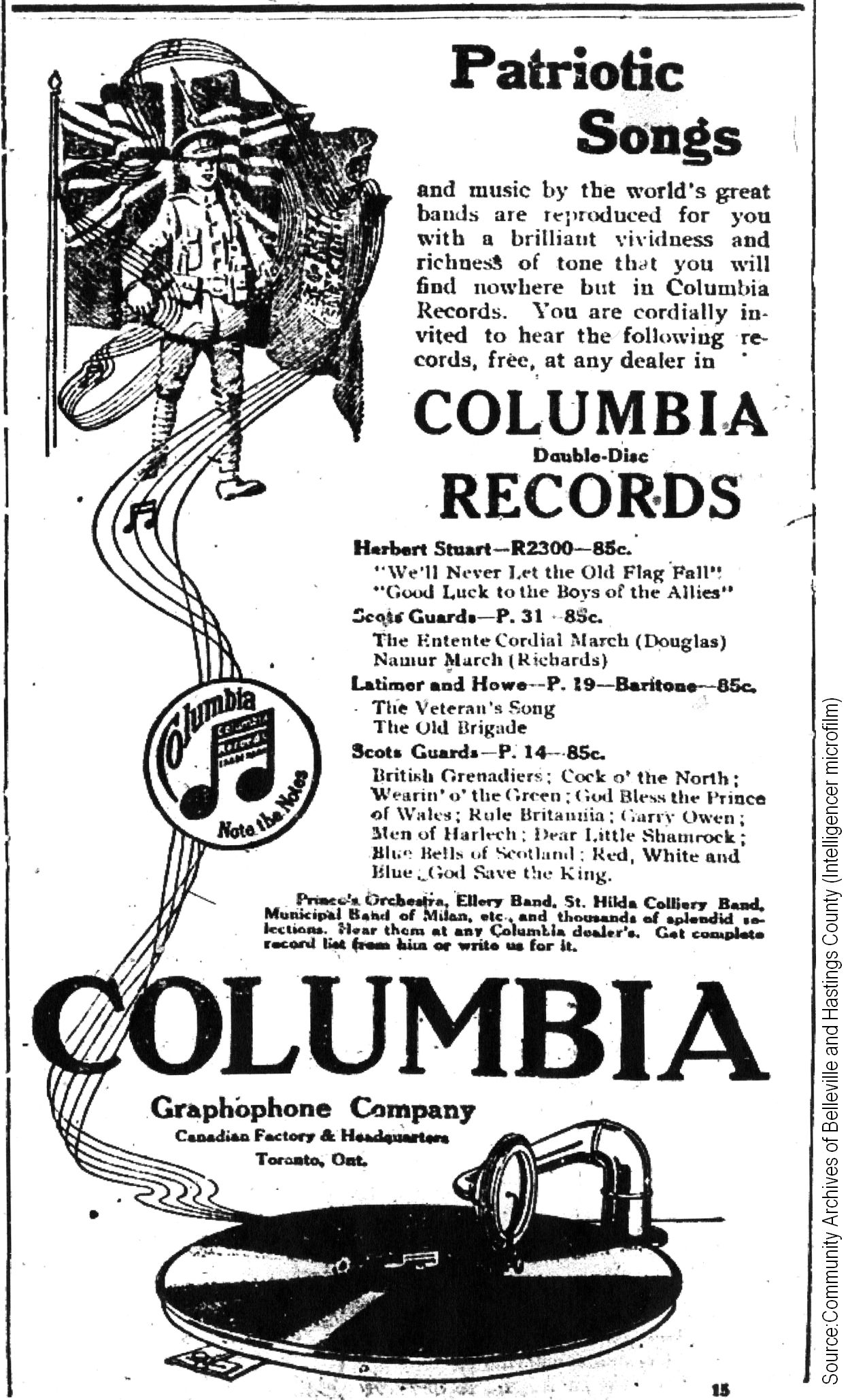
100 Years Ago: Patriotic Songs from Columbia Records

The Intelligencer August 21, 1916 (page 2)

Columbia Records019

“Patriotic Songs and music by the world’s great bands are reproduced for you with a brilliant vividness and richness of tone that you will find nowhere but in Columbia Records. …  Herbert Stuart. We’ll Never Let the Old Flag Fall, Good Luck to the Boys of the Allies, The Veteran’s Song, The Old Brigade, British Grenadiers.”


100 Years Ago: Assistance Needed for Belgian Homeless

The Intelligencer August 19, 1916 (page 5)

Belgians018

“Millions of homeless and penniless Belgians urgently need our assistance. It is our sacred duty to aid these innocent victims until their cowardly despoilers have been put in their proper place, and Belgium restored to her people and to her brave King.

If your wives, your brothers and your children were in a similar plight, how would you feel? Let your response be generous.”

100 Years Ago: Belleville Boy Returns to Enlist

The Intelligencer August 17, 1916 (page 2)

“Belleville Boy Returns to Enlist. Mr. William O. Wardhaugh of Washington, D.C., accompanied by Mrs. Wardhaugh and three children, who has just arrived in this city, to-day signed up with the 155th Battalion, and will shortly report at Barriefield.

In company with Recruiting Officer Henry Foltz, also an old resident of Belleville, Mr. Wardhaugh visited the Intelligencer Office this morning and expressed his determination to do his bit toward defeating the Germans. He is a splendid specimen of the perfect athlete, and was passed without hesitation by Dr. MacColl.

Mr. Wardhaugh is a son of Mr. Oliver Wardhaugh of Front street, this city, was born here, and fifteen years ago left for the United States, settling finally in the American Capital, where he has been following the occupation of a contractor, with prosperous results. Like many another full-blooded Canadian, his loyalty came to the surface, and he now gives his best energies for his country’s cause. He is 31 years of age. The act of this loyal subject should be an incentive for other local young men to follow.”

100 Years Ago: Canadians Moved to Somme Front

The Intelligencer August 16, 1916 (page 1)

“Canadians Moved to the Somme Front. Ottawa. The Canadians have been withdrawn from the famous blood-soaked Ypres salient, where so many sons of the Dominion have lost their lives in the past year. Word to this effect has been received by the Militia Department.

This does not mean that the Ypres salient has been abandoned nor that the Canadian troops have been withdrawn from the fighting line. As a matter of fact the Canadians apparently will now be taking part in the general British offensive, as they have been moved to the Somme district, where the great push is taking place.

The Canadians have been in the Ypres salient almost from the time the First Division landed in France. The salient will be always associated with the name of Canada, as it was here the First Division won undying fame by holding back the whole German onrush in April of 1915.

When the Battle of Verdun became serious and the British took over part of the French line the Canadians were moved to the most dangerous part of the salient, the apex, subject to a constant crossfire from three sides. The Canadian casualty list since then has been terrific.”