100 Years Ago: Poster for British Red Cross Fund

The Intelligencer October 24, 1917 (page 6)

Poster for British Red Cross Fund“To-Night! There will be a meeting of ALL Committees and their Chairmen of The British Red Cross Fund. City Hall To-Night.

Every man and woman in Belleville is included in above notice, so if your heart is with our Noble Boys in France, you will attend.

Nov. 1st is Our Day! Prepare to do your bit.”

100 Years Ago: British Red Cross Drive Planned, Poster for Employers on Exemption

The Intelligencer October 23, 1917 (page 2)

“Big Red Cross Drive in Belleville. A representative gathering of citizens was held in the Council Chamber last night to organize for a British Red Cross campaign for this city. November 1st has been selected as our British Red Cross Day. The mayor took the chair at 8.15, calling the meeting to order. …

Suitable offices will be arranged for at once and another meeting will be held in the Council Chamber on Wednesday night to complete the organization. The ward chairmen are expected to arrange large and representative committees for their wards. It is intended to canvass every citizen and the amount collected should not be less than an average of $1.00 per head of population.

Our citizens gave $8,000 last year. This year at least $12,000 is expected of Belleville.”

The Intelligencer October 23, 1917 (page 6)

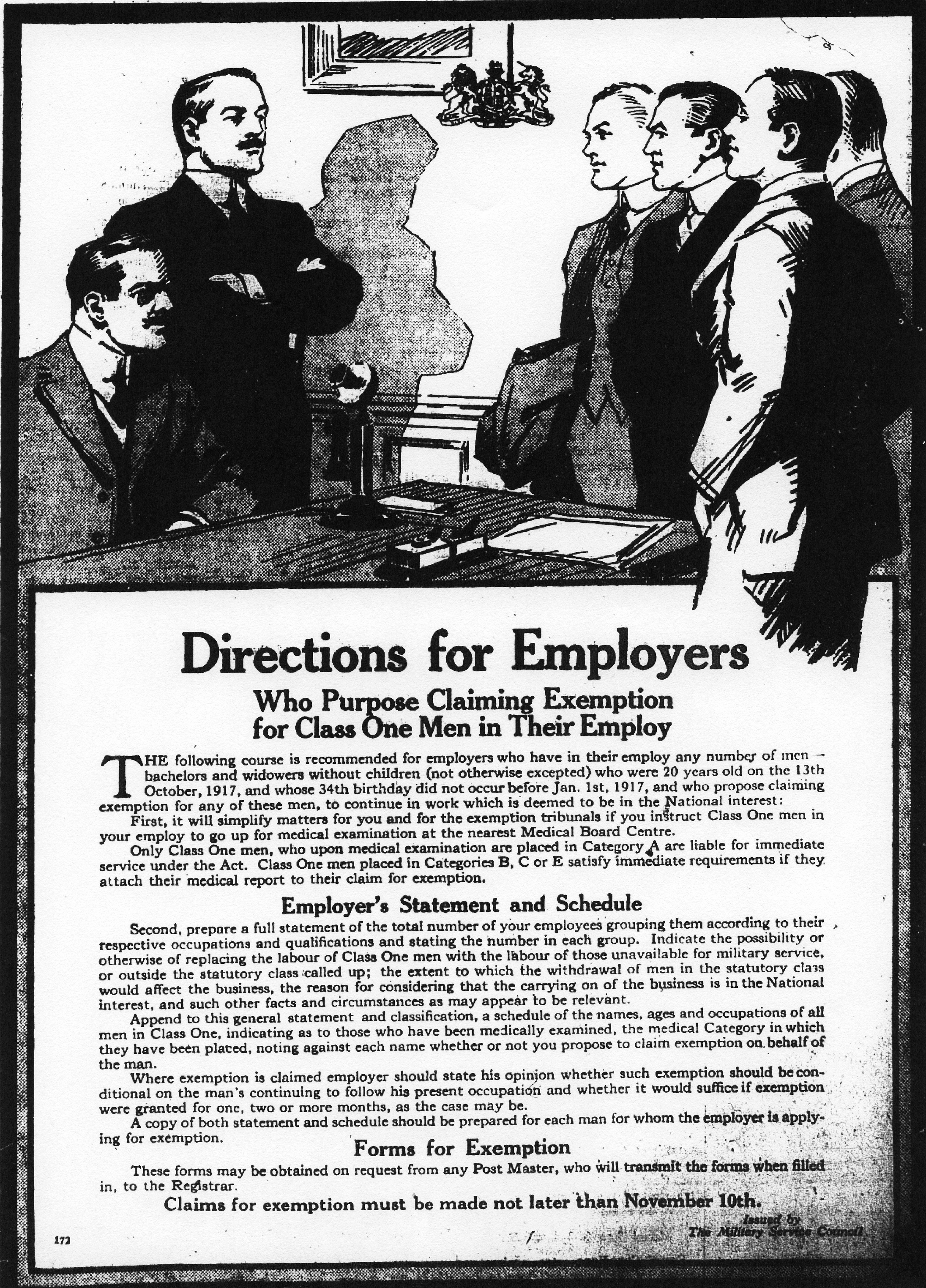
Poster for employers on exemption“Directions for Employers Who Purpose Claiming Exemption for Class One Men in Their Employ.

Where exemption is claimed employer should state his opinion whether such exemption should be conditional on the man’s continuing to follow his present occupation and whether it would suffice if exemption were granted for one, two or more months, as the case may be.

Claims for exemption must be made not later than November 10th. Issued by the Military Service Council.”

100 Years Ago: Chatterton Women’s Institute Sends Christmas Cheer, Jack Summers Returned to Duty, Many Eligibles Examined, Christ Church Choir Club Holds Shower, Recital Held at Bridge Street Church, Ad for Gillette Safety Razor, Ad for Wrigley’s

The Intelligencer October 22, 1917 (page 1)

“Sent Christmas Cheer to the Soldiers. Chatterton. Will you allow us space in your paper to thank all who so kindly contributed to our Christmas box fund for the boys overseas. House to house canvass $33.37. We also wish to thank Mr. and Mrs. R. N. Bird, for so kindly opening their house for a social evening which realized us $24.10.

Our grateful appreciation is due Mr. Stillman, Gay, Foxboro, and Mr. J. Morton, of Stirling, for their liberality in their dealings with us.

Twenty-seven boxes were sent to boys, whose addresses were handed in, and thirteen Christmas stockings were sent to be given to boys that receive nothing at Christmas.

Signed on behalf of Chatterton Women’s Institute: Miss Beatrice Guffin, President. Sadie Boardman, Secretary.”

The Intelligencer October 22, 1917 (page 2)

“Recovered from Wounds. Corp. Jack Summers, of Belleville, who has been a patient in an English military hospital for some time being treated for gunshot wounds, has recovered and returned to active service. Mrs. M. Summers, 36 Hillcrest avenue, city, has received the following official telegram from Ottawa:

Cable received from England states that Corporal Jack Summers (154,990) returned to regimental duty, September 9. Director of Records.”

The Intelligencer October 22, 1917 (page 2)

“Many Eligibles Examined. The Militia Medical Board of this city, has been exceptionally busy the past few days in examining eligibles who come under the first draft of the Militia Service Act. Upwards of 1200 have been examined, the great portion of whom were placed in Class A. Of this number over 100 have applied at the post-office here for exemption papers. Not a person has yet applied for an active service paper.”

The Intelligencer October 22, 1917 (page 2)

“Christ Church Choir Club held a Shower last Tuesday in the Parish Hall from 3 to 6 p.m. Our boys at the front will be encouraged with the comforts and other good things in their Christmas parcels. Following is a partial list of gifts provided by the members of Christ Church:—38 handkerchiefs, 30 pairs socks, 107 wax candles, 40 Trench candles, smokes of all sorts, 95 plugs tobacco, 40 writing pads, 48 pencils, 150 chocolate bars, cloves, apples, home-made candy, 132 pkgs. Gum, 25 lbs. sugar, sardines, cheese, oxo, potted meats, toilet and shaving soap, toilet paper, mentholatum, tooth paste, boot laces, raisins, dates, cake, biscuits, literature, post cards, waxed leaves.

All this is pure giving, for no refreshments of any sort were offered nor were any ‘good’ eats for sale, yet there was filled a large clothes basket with comforts, and sufficient money to defray all postage.

The Intelligencer October 22, 1917 (page 2)

“Pleasing Musical Event. The Organ and Song Recital in Bridge Street Church on Saturday was fairly well attended and greatly enjoyed. Mr. V. P. Hunt, who arranged the recital, contributed the organ solos, and the beautiful Casavant organ was heard to advantage. …

Mrs. Ella Sipson Bowerman, teacher of singing at Albert College and contralto soloist in Bridge Street Church delighted the audience. …  Mrs. Bowerman has a contralto voice, with a great range and pleases by her beautiful tone, distinct enunciation and charming unaffected manner.

The collection was given to help send Christmas cheer to the many Albert College students at the front, some two hundred and thirty of whom are fighting for their country.”

The Intelligencer October 22, 1917 (page 5)
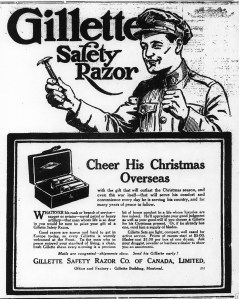
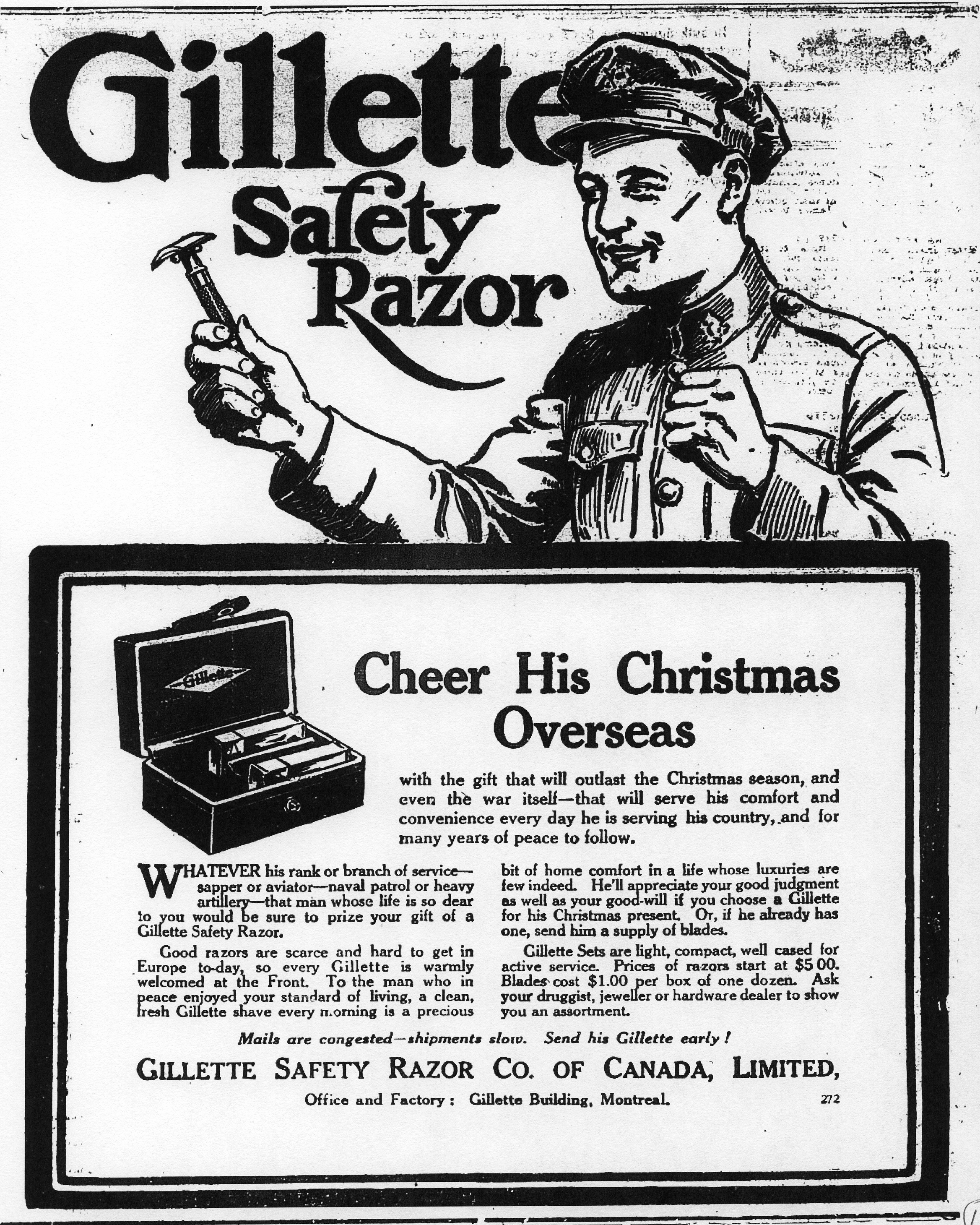
Ad for Gillette Safety Razor“Gillette Safety Razor. Cheer His Christmas Overseas with the gift that will outlast the Christmas season, and even the war itself—that will serve his comfort and convenience every day he is serving his country, and for many years of peace to follow.

Mails are congested—shipments slow. Send his Gillette early!”

The Intelligencer October 22, 1917 (page 7)
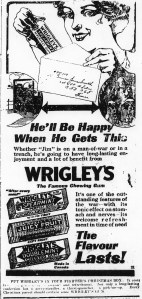
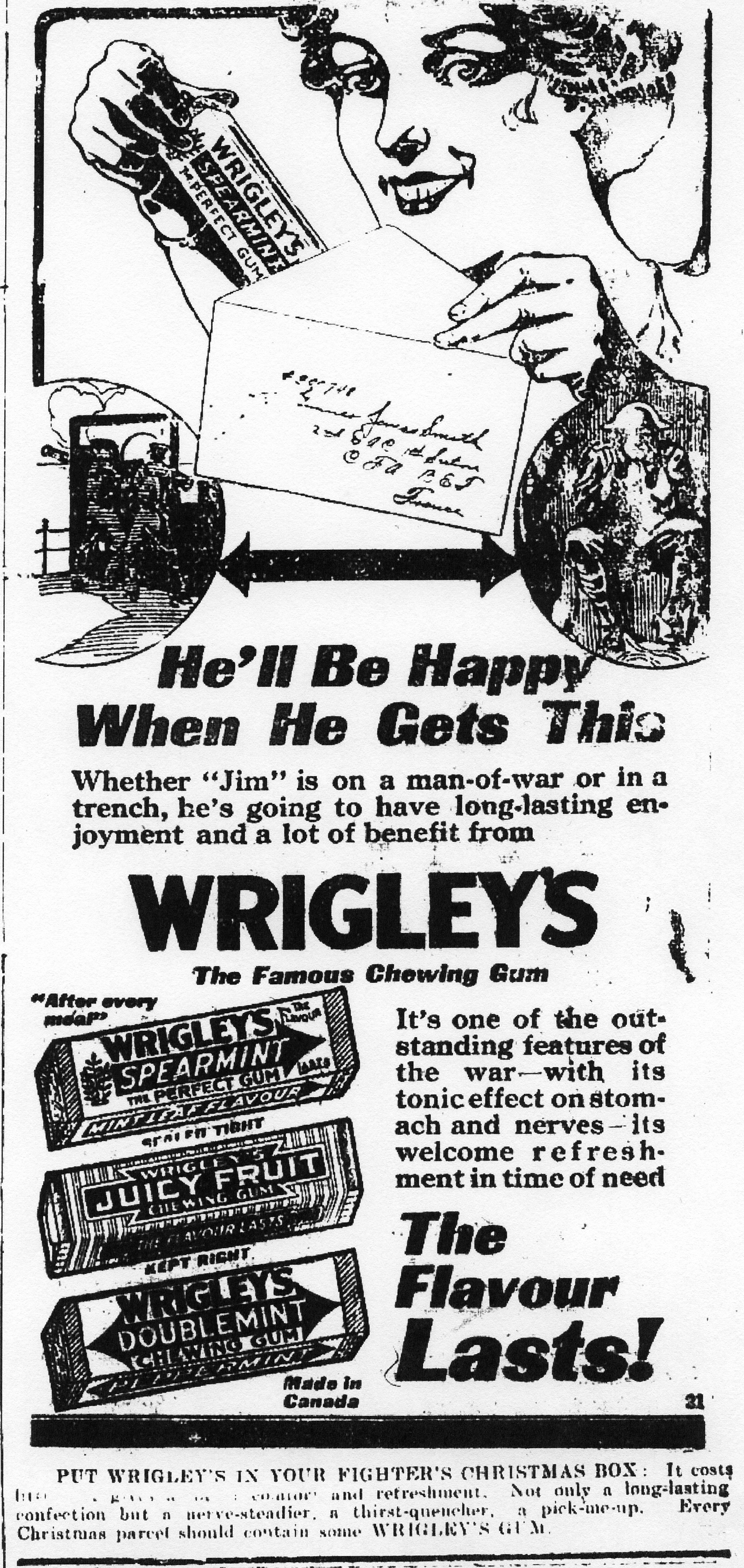
Ad for Wrigley's gum“He’ll Be Happy When He Gets This. Whether ‘Jim’ is on a man-of-war or in a trench, he’s going to have long-lasting enjoyment and a lot of benefit from Wrigley’s The Famous Chewing Gum.

It’s one of the outstanding features of the war—with its tonic effect on stomach and nerves—its welcome refreshment in time of need.”
100 Years Ago: British Red Cross Tea, Victory War Loan, Mayor Ketcheson Announces Date for British Red Cross Collection, Poster on Exemption Tribunals

The Intelligencer October 20, 1917 (page 2)

“For the British Red Cross. The Quinte Chapter I.O.D.E. gave a very successful tea on Wednesday afternoon last in the beautiful rooms of the Belleville Club. A large number were present, and the sum of one hundred and ten dollars was realized. The proceeds will be given to the British Red Cross fund.”

The Intelligencer October 20, 1917 (page 2)

“Victory War Loan. Ald. W. B. Deacon of this city, chairman for Hasting’s County Victory War Loan, with Mr. W. B. Evans, executive organizer, paid a visit to Trenton and succeeded in forming a strong committee in that town to handle the war loan matter.

Ald. Deacon also visited Deseronto, and Major Rixon, as chairman, was chosen as the presiding officer of a committee of citizens in that town.”

The Intelligencer October 20, 1917 (page 2)

“Belleville British Red Cross. His Worship Mayor Ketcheson has fixed the date for the collection for the British Red Cross for Thursday, November 1. An organization meeting for a thorough canvass covering the city will be held in the Council Chamber on Monday evening, October 22nd, at 8 p.m. All citizens are invited to attend.”

The Intelligencer October 20, 1917 (page 10)

Poster on exemption tribunals“Exemption Tribunals. Exemption Boards have been chosen in such a way as to make them absolutely independent and removed from all influence. There are over 1,250 boards throughout the country, each composed of two men, one appointed by the county judge in the district concerned and one selected by a joint committee of Parliament. Being familiar with local conditions where they sit, the members are well-fitted to appreciate such reasons for exemption as are put before them by men called up.

Exemption may be applied for by the men selected themselves or by their parents, near relatives or employers. Issued by The Military Service Council.”

100 Years Ago: 5091 Men Report and 4601 Ask Exemption, Burial of Soldiers

The Intelligencer October 19, 1917 (page 2)

“The latest official figures show that 5,091 men have reported under the Military Service Act in this district. Out of these 490 reported for service and 4,601 exemption. The returns include those from points in this district, where, if the returns were mailed last night, they should reach the registrar’s office today. The returns also bear out the statement of Post Office officials today, that yesterday was the busiest day since the Proclamation was issued.”

The Intelligencer October 19, 1917 (page 6)

“Rev. John Garbutt, Army Chaplain, recently returned from the front, writes as follows about the burial of Canadian soldiers killed in action: …  Every soldier carries on his person, usually by a string around his neck, two discs, one of leather and the other of metal, bearing the name, number, battalion and religion stamped thereon.

When a soldier is killed, the leather disc and all his personal belongings found on the body are deposited in a small cotton bag and forwarded either to his battalion orderly room, or to the office of the divisional burial unit. The leather disc is kept by the authorities as proof of death, and the rest of the belongings sent through the Estate of Deceased Soldiers’ Department to the next of kin. The metal disc is buried with the body so that if the body is removed the disc will establish its identity. …

In ordinary trench warfare, when the front is simply being held, all bodies are usually brought out and buried in certified cemeteries in the rear. In times of advance, when the casualties are heavier, new cemeteries well to the front are laid out by the corps burial officers, and all bodies are collected and buried there if at all possible. …

If for some reason bodies cannot be taken to these cemeteries and must be buried, the spot is carefully marked, the exact map location is made, and besides the metal disc buried with the body the chaplain gets two bottles, and on two pieces of paper writes the information which is on the disc, and in addition the date of death and any other item which he deems of interest. One piece is placed in each bottle. He then places one bottle one foot under the soil at the head of the grave, and the other, with neck downwards, on the top of the grave. If later the body is exhumed and placed in the cemetery, its identity is known.

Each battalion gives particular attention to the burial of its own dead. …  Each unit erects a wooden cross over the grave, bearing the name, number, battalion and date of death. At the front ‘killed in action’ is usually added.”

100 Years Ago: Stirling Gives to British Red Cross, Canary Knitting Circle Holds Shower for Christmas Gifts, Poster on Military Exemption, Fuel Controller Urges Sparing Use of Sugar, Poster for British Red Cross

The Intelligencer October 18, 1917 (page 2)

“Stirling Will Give $2,000. At a meeting held in the Town Hall at Stirling, to discuss ways and means of raising funds for the British Red Cross, a motion was passed advising the Council to pay $2,000 out of the funds of the corporation. This will mean a considerable additional levy upon the 1918 taxpayers.”

The Intelligencer October 18, 1917 (page 2)

“Shower of Christmas Gifts. The Canary Knitting Circle , under the convenorship of Mrs. Carl Storm held a successful ‘Donation Shower’ of Xmas gifts for our boys overseas in St. Thomas Church Parish Hall on Monday evening October 15. The chair was ably filled by Judge Deroche who in his remarks touched on topics of the war, which showed the need of our best efforts at home to help win the war.

Dainty refreshments and ice cream were served by several young girls dressed in white and wearing the Circle colors, and during the evening a very select programme was carried out, instrumental music by The Misses LaVoie, readings by Miss Jessie Tuite, and solos by Messrs. Staples and Pimlott.

A pleasant feature of the evening was the drawing for the hand-painted fern dish kindly donated by Mrs. Newton Thompson (nee Frances Strong). Miss Frances Morton was called to the platform by the chairman and drew the lucky number, which was held by Leo Fenn of the 73rd Battery. The National Anthem brought the evening to a close.”

The Intelligencer October 18, 1917 (page 3)

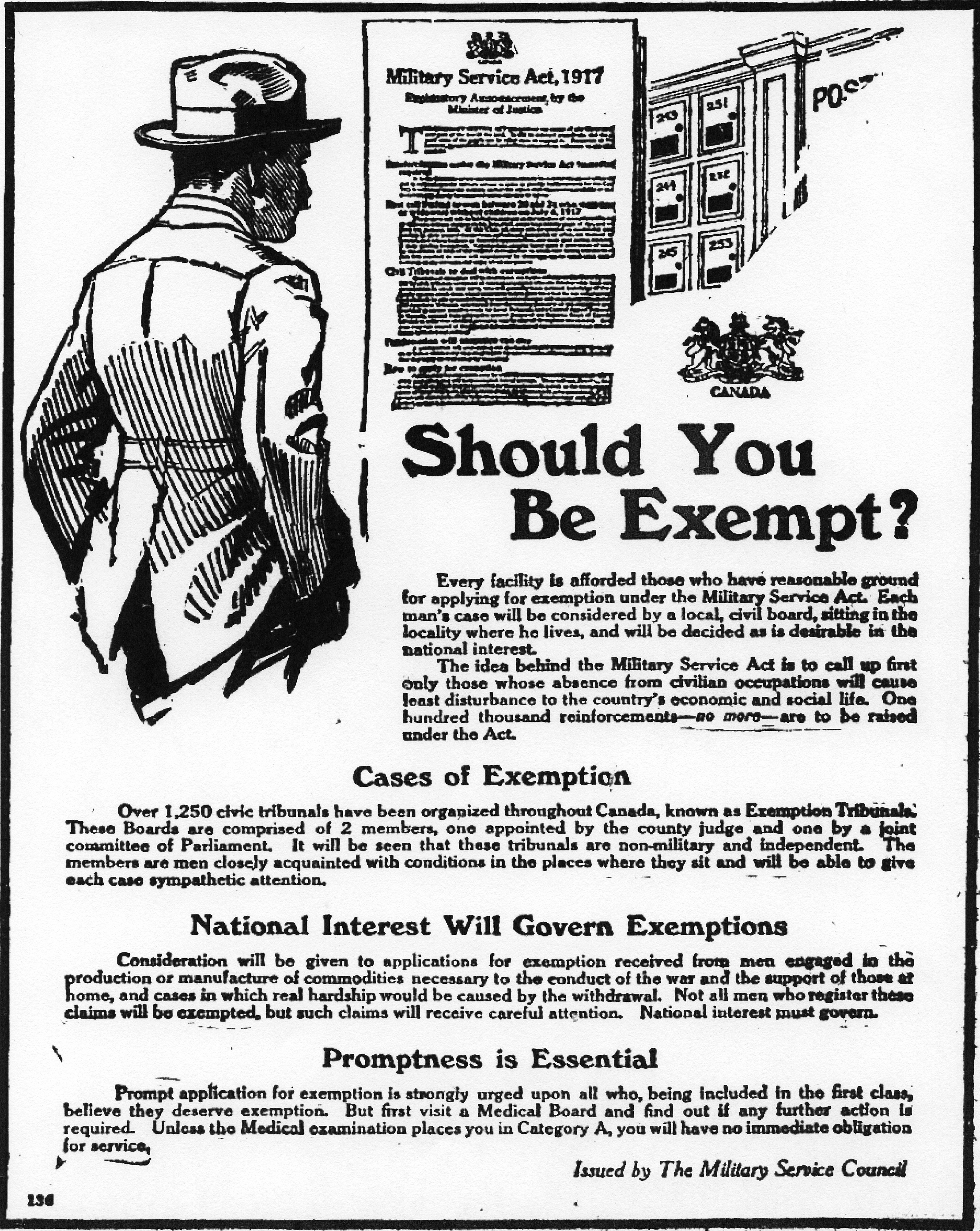
Poster on Military Exemption“Should You Be Exempt? National Interest Will Govern Exemptions. Consideration will be given to applications for exemption received from men engaged in the production or manufacture of commodities necessary to the conduct of the war and the support of those at home, and cases in which real hardship would be caused by the withdrawal. Not all men who register these claims will be exempted, but such claims will receive careful attention. National interest must govern.

Issued by The Military Service Council.”

The Intelligencer October 18, 1917 (page 4)

“Saving Sugar. Sugar now takes a place among the household necessities which Canadians are urged by the Food Controller to use sparingly. When the war strikes the tea cup it is certainly becoming very real and close. If the vast army of tea drinkers respond to the call by using only one lump instead of the usual two or three to every cup the reserve supply of sugar should pile up in considerable quantities. However, people can become accustomed to almost anything, and even the skimping of the morning porridge sweetening will not entail any great hardship.

The breakfast table has been hard hit by the war with the high prices of bacon, eggs, butter and other commodities which formerly held a leading place on the morning menu, and economy has become not only a patriotic duty but a necessity. The price of bacon has hit sixty cents a pound and may be still going up, which indicates that this favorite food will take its place among the luxuries to be served only on rare occasions.

One thing the war is doing which will have a beneficial effect for all time, and that is to inculcate habits of food economy and elimination of waste in the kitchen.”

The Intelligencer October 18, 1917 (page 6)

Poster for British Red Cross“ ‘For the Red Cross’ The British Red Cross once more makes an earnest but confident appeal for our help. That is why today, October 18th, has been set aside as ‘Our Day’ for giving.

Ontario’s trust is, that out of their abundances every man and woman will give generously to aid the work of the British Red Cross. Give Generously Today.”


100 Years Ago: British Red Cross Fund

The Intelligencer October 17, 1917 (page 4)

“Red Cross Day? What is Belleville going to do this year for the British Red Cross fund? On Thursday of this week throughout Canada contributions will be taken for this very worthy object, but as yet no preparation has been made in this city, as far as can be ascertained, to take part.

The British Red Cross service to the sick and wounded soldiers and sailors of the empire since the war began has been wonderful, and is so necessary that the work must not be allowed to lack the funds necessary to carry it on without skimping. …

Citizens of Belleville are ready and willing, yes eager, to contribute to the funds of the British Red Cross and all that is necessary is to arrange for a systematic collection so that Belleville’s contribution will be worthy of this city’s patriotic spirit and determination to assist in every way to win the war.”

100 Years Ago: Capt. Stanley Carman Reverts to Lieutenant, Victory Loan, Applications for Exemption, Poster for Military Service Act

The Intelligencer October 16, 1917 (page 2)

“Reverted to Lieutenant. Word was received in this city yesterday that Capt. S. E. Carman of Belleville, who left here with the 254th Battalion has reverted to a Lieutenant and that he is now serving his King and country in France.”

The Intelligencer October 16, 1917 (page 2)

“Organize for Victory Loan. Mr. W. B. Deacon has been requested by the Finance Minister, Sir Thomas White, to organize the county for the Victory Loan to be issued soon by the Dominion Government. Headquarters will be in the Metropolitan Building on Campbell Street.”

The Intelligencer October 16, 1917 (page 2)

“All Applied for Exemption. Up to the hour of noon to-day Mr. E. Lang, at the money order department of the Post Office, had filled in the names of 25 persons who had applied for exemption papers under the Military Service Act. No application had been made for a service paper.”

The Intelligencer October 16, 1917 (page 5)

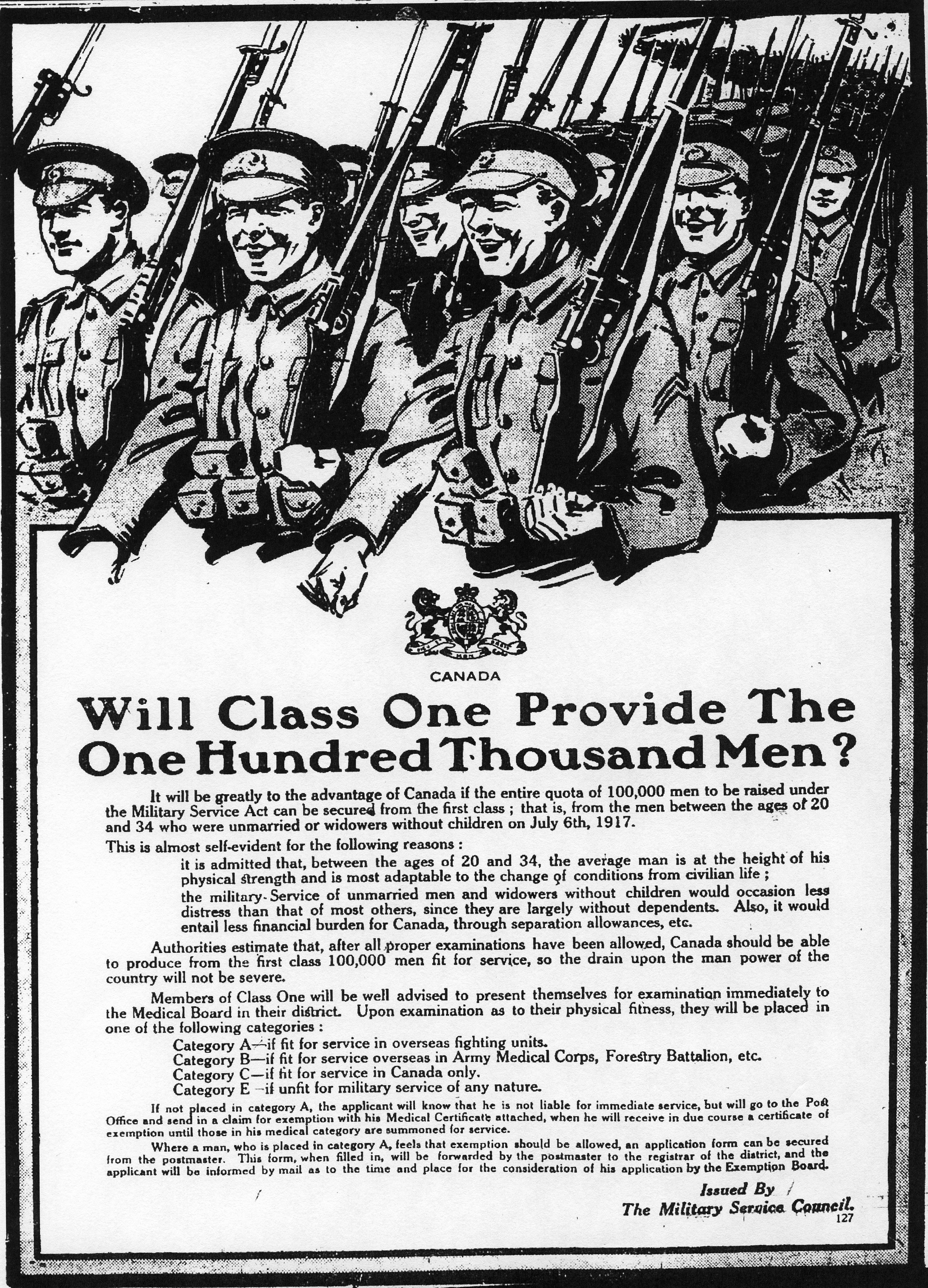
Poster for Military Service Act“Will Class One Provide The One Hundred Thousand Men?

It will greatly be to the advantage of Canada if the entire quota of 100,000 men to be raised under the Military Service Act can be secured from the first class; that is, from the men between the ages of 20 and 34 who were unmarried or widowers without children on July 6th, 1917.

Issued by The Military Service Council.”

100 Years Ago: Canned Goods Can Be Sold, British Red Cross Day Coming

The Intelligencer October 15, 1917 (page 1)

“Canned Goods Can Be Sold. Ottawa. ‘Canned vegetables’ may be now sold without restriction in Canada. An announcement from the food controller’s office states that the embargo of August 24 upon the sale and purchase of peas, beans, tomatoes, beets, celery, corn, spinach, rhubarb and pumpkins preserved in cans, glass jars or other containers has been raised.

The lifting of the embargo applies to the three maritime provinces, Ontario, Quebec and British Columbia, in the three prairie provinces the prohibition was withdrawn some time ago. The announcement adds that the embargo has been effective in stimulating the consumption of fresh vegetables and increasing the supply of canned vegetables available for the coming season.”

The Intelligencer October 15, 1917 (page 4)

“On Thursday, October 18 Canadians will have another opportunity of assisting the wonderful work of the British Red Cross, an organization worshipped by the soldiers and sailors for the constant miracles of joy and comfort brought to the sick and wounded through this great society which with ‘healing in its wings’ never tires in its work of mercy to human beings, battered and bruised by war. …

Canada, of the whole British Empire, is perhaps the best off as regards war conditions. …  With bountiful harvests and busy workshops Canada should break all previous records, and on Thursday, October 18th, roll up an immense fund for the British Red Cross, not only for the great good accomplished by that organization but as a national thanksgiving for the blessings of a prosperous peace in a world of war.”

100 Years Ago: Soldiers’ Medical Appliances Paid by Government, Postmaster Receives Exemption Forms, Albert Hill Invalided Home, Y.M.C.A. Entertains Soldiers Behind Firing Line, Poster for British Red Cross, Military Hospitals Use Mirrors for Paralytic Cases

The Intelligencer October 13, 1917 (page 1)

“Authorities to Aid Injured Soldiers. Ottawa. The important announcement was made by Secretary E. H. Scammell, of the Military Hospitals Commission, that soldiers who incur disabilities requiring special appliances, such as orthopedic services, trusses, rubber bandages and belts, will be given a bill of credit in addition to their pensions.”

The Intelligencer October 13, 1917 (page 2)

“First Call to the Colors. Postmaster Gillen, of this city has received a supply of the exemption forms to be used for eligibles who are answering the call of the Military Service Act. The filling in of the forms will take place at the postoffice. No official word has been received by the local authorities as to what time of day the forms are to be given out. They are waiting for the proclamation and official advice from Ottawa.”

The Intelligencer October 13, 1917 (page 2)

“Injured in England. Gunner Albert Hill, who was injured in England by being thrown from a gun carriage has returned to Belleville and is now at his home 76 Cedar street. Gunner Hill was one of the first to enlist when war broke out and served two years with the first Canadian Contingent, was gassed and invalided home.

He reenlisted and went overseas with the Cobourg Heavy Battery last June and met with the accident while in training in England. He was treated at Moore Barracks Hospital, Shorncliffe, and afterwards invalided home. Gunner Hill is being treated at the Military hospital in Kingston.”

The Intelligencer October 13, 1917 (page 5)

“Play Time With The Soldiers. Writing from ‘Somewhere in France,’ to his parents in Belleville, Sapper J. H. Bone reports that he is in excellent health and had just returned from an enjoyable vacation outside. The letter was written on September 2, and the weather then was fine and cool, just right for baseball. The writer states that the Y.M.C.A. has made three tennis courts which afford the boys great entertainment.

‘I don’t know what we would do without the Y.M.C.A.,’ writes Sapper Bone, ‘they furnish all the outfits for sports free of charge. It must cost them quite a sum too. There’s a dandy concert party playing here all this week, too, so you see there is always something for us to do after we get off work. Oh, yes, and there is a moving picture show here every evening, except Sunday. The Y. M. C. A. are building a new theatre here for the winter, and I guess it will be a pretty nice one. I hear they are going to have a spotlight and everything up to date.’ ”

The Intelligencer October 13, 1917 (page 10)

Poster for British Red Cross“ ‘Let Me Help You Carry the Burden, Mother. It now costs $300,000.00 a week to carry on the work of the British Red Cross, or $16,000,000.00 a year.

Last year Ontario’s magnificent contribution paid for the entire work of the British Red Cross for nearly six weeks. This year, in view of the greater need, it is earnestly and confidently hoped that Ontario’s contributions will be as great proportionately as the magnificent offering of last year.

Our trust is, that the Citizens of Ontario will give generously to this noble cause on—’Our Day’, October 18th.”

The Intelligencer October 13, 1917 (page 14)

The looking glass, banned from the Puritan household and held in suspicion by the pious even into this twentieth century, has come to be a thing of even more importance to the physician than the vain woman.

In all the great European hospitals the mirror is in use in multiple ways, and instances of remarkable cures effected through its use are on record at Hart House in Toronto, where the Military Hospitals Commission provides treatment for the disabled soldiers returned from the front. …

A few weeks ago the young soldier came to Hart House just to look around, and his limp arm attracted the attention of the instructor in charge. …  The instructor …  asked him to move his fingers. He tried, but no action resulted from the effort. …  Then a mirror was placed in such a way as to reflect the arm and hand for the man. Again he was told to move his fingers, watching the hand in the glass, and a slight twitch rewarded his effort. Since then he has been steadily improving, but nothing can be done without the mirror yet. The patient has a new hope, and the instructors believe that his case will ultimately yield to this treatment. …

Other men who have lost control of their limbs are learning to walk by watching their legs in the glass as they try.”