100 Years Ago: Public Meeting on Food Production, Daylight Saving, Jack Foley Welcomed Home to Bancroft, Dick Beauderie Killed in Action, Ritchie’s Ad for Rose Day

The Intelligencer June 8, 1917 (page 7)

“Food Production Theme of Prominent Speakers. A Public meeting under the auspices of the organization of Resources Committee of Ontario, held in the City Hall last evening, was fairly well attended. Mayor Ketcheson presided and in a few well chosen remarks referred to the object of the gathering and the necessity of such gatherings at the present time.

Mr. J. L. Jarvis, of Grimsby, an expert poultry judge, gave an interesting and instructive talk on Poultry and Egg Production, and showed the value of poultry under the present existing conditions. …  M. N. Parliament. M. P. P. for Prince Edward County gave a most practical address in reference to food production at the present time.

Mr. J. W. Johnson, M. P. P., said it was interest in the object of the meeting, not display of knowledge respecting poultry production, that accounted for his presence. With the mild and modest hen and the proud and haughty rooster he had only a neighborly acquaintance. …

Colonel W. N. Ponton, K. C., was the last speaker and caught the spirit of the audience and the occasion by his apt allusions to cocks and hens, ducks and drakes, and the aristocracy and democracy of the farm yard. Chanticleer had his place in the war and the Canadians took Vimy Ridge to the tune of the ‘Cock of the North’ played by the pipers of the Highland Regiments that flanked our boys when they put the vim into Vimy, and won their spurs as their predecessors had done at Langemarck.

Economy always a merit is now a virtue, but productiveness (of which the egg is typical) is even greater than this. The one is negative, the other positive and creative. …

IWM PST 10824 From the Imperial War Museum collection

Col. Ponton exhibited a British Parliamentary poster showing a splendid white hen wearing a broad khaki band emblazoned with a royal crown and the legend ‘Enlisted for the duration of the war’—(and after). Poultry growing would be an ideal occupation for maimed and wounded soldiers after the war. Get into the winged game now and help the piping days of peace return with ‘expanding breasts and merry thoughts’ and other substantial delicacies, and also a ready prepared, well basted vocation in life. Meanwhile the wishbone must be the backbone. Let there be no bone of contention. Lay a good foundation for the future; the hens will attend to the rest. …

Let Hastings produce the eggs and Prince Edward the apples—and together a Bay of Quinte feast. …  Abundant food supply with universal national manhood service spell ‘peace with victory’ for Canada and the Empire and freedom and plenty for our children’s children.

During the meeting Mr. Harold Barrett was heard to advantage in vocal selections.”

The Intelligencer June 8, 1917 (page 1)

“Change of Time in Canada. Dominion Government Will Introduce Measure Providing for National ‘Summer-Time.’ Ottawa. The government has decided to put in force daylight saving throughout the Dominion. Notice has been given of legislation to put all clocks ahead one hour on a day to be fixed later, and keep them so throughout the summer.

The condition is stipulated that the bill shall not become operative until it is proclaimed by order in council. In other words, the bill simply gives the government power to enact a general daylight-saving scheme for the whole Dominion if it is thought wise.”

The Intelligencer June 8, 1917 (page 7)

“Welcomed Home. Pte. Jack Foley, of Bancroft returned home on Wednesday and was accorded a hearty reception by the citizens of that village. He was escorted down town by about a dozen automobiles, gaily decorated with flags for the occasion.

Pte. Foley went overseas with the 80th Battalion, and was in the trenches for six months. He was removed to an English hospital just before the famous battle of Vimy Ridge, suffering from an attack of trench nephritis, and has been honorably discharged.”

The Intelligencer June 8, 1917 (page 7)

“Killed in Action. Pte. Dick Beaudrie, son of Mr. and Mrs. John Beaudrie, residing at L’Amable, North Hastings, has been killed in action. He went overseas with the 155th Battalion from Belleville. Pte. Beaudrie was 23 years of age, and trained at Bancroft. He was a popular young man and his death has cast a gloom over the community in which he resided.”

[Private Richard Benjamin Beauderie died on May 9, 1917. He is commemorated on Page 198 of the First World War Book of Remembrance.]

The Intelligencer June 8, 1917 (page 8)
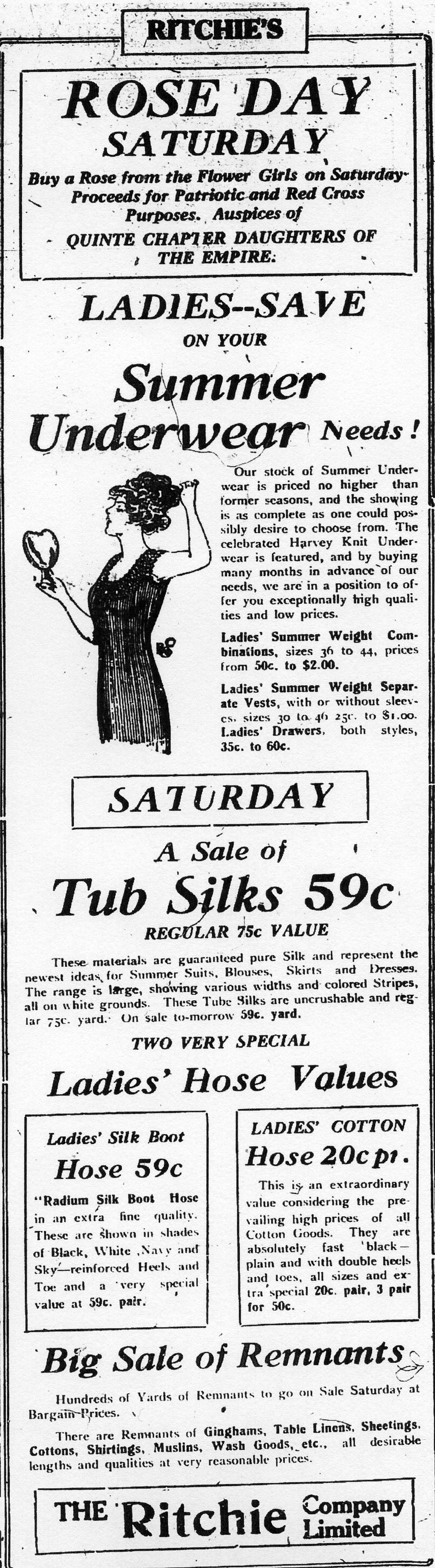
“Ritchie’s. Rose Day Saturday. Buy a Rose from the Flower Girls on Saturday. Proceeds for Patriotic and Red Cross Purposes. Auspices of Quinte Chapter Daughters of the Empire.

Ladies—Save on your Summer Underwear Needs! …  A Sale of Tub Silks 59¢. …  big Sale of Remnants. The Ritchie Company Limited.”


100 Years Ago: Red Cross Penny Bags Report, Ad for Kingston Cotton Mill Workers

The Intelligencer June 6, 1917 (page 2)

“The Red Cross Penny Bags. In February, 1916, Miss Green, Superintendent of the Belleville Hospital, and band of ‘Red Cross Workers’ distributed amongst themselves and a few friends little white bags with a red cross sewn upon them, with the object of collecting small amounts to assist in buying the materials they were making up into hospital supplies, to be sent through the Belleville Women’s Red Cross and Patriotic Association, to the hospitals overseas that were caring for the wounded heroes who are fighting and dying for our freedom, safety and peace.

Recognizing the possibilities of this system, in a wider field, the scheme was handed over to the association and a committee of four, comprising of Mrs. George Bonisteel, Mrs. Seymour, Mrs. Chapman and Miss Mary Yeomans, met together to organize the city into districts, with ward convenors and collectors. …

The bags were made by members of the different knitting circles and other interested ladies, and in the year about 4,000 have been distributed in the various homes in Belleville, the desire being that all of the occupants of each home, rich or poor, from the youngest to the oldest, should put in their pennies. …  We want to thank the people of Belleville generally, and particularly the little children, who have been so interested in ‘doing the bit’ possible to them in this work. …

We want to thank the newspapers, which have, perhaps, done more than anything else to keep up the public interest. …  we still want to press on to our aim of $300 per month. This will be more difficult than last year, as during the past two months a separate association has been formed in West Belleville, which is raising funds by means of monthly collections in blue bags.”

The Intelligencer June 6, 1917 (page 6)

“WANTED! Cotton Mill Workers for Kingston, Ontario. We have positions open for experienced Cotton Mill workers at our Kingston, Ontario, Plant. Entire families can be employed, and we will arrange transportation where necessary. Steady work. Clean Mills.

Write and tell us your experience or apply direct at once to Employment Bureau, Dominion Textile Company, Limited, Kingston, Ontario.”


100 Years Ago: Poster for Y.M.C.A. Campaign, Belleville Cheese Board Branch of Red Cross

The Intelligencer June 5, 1917 (page 5)

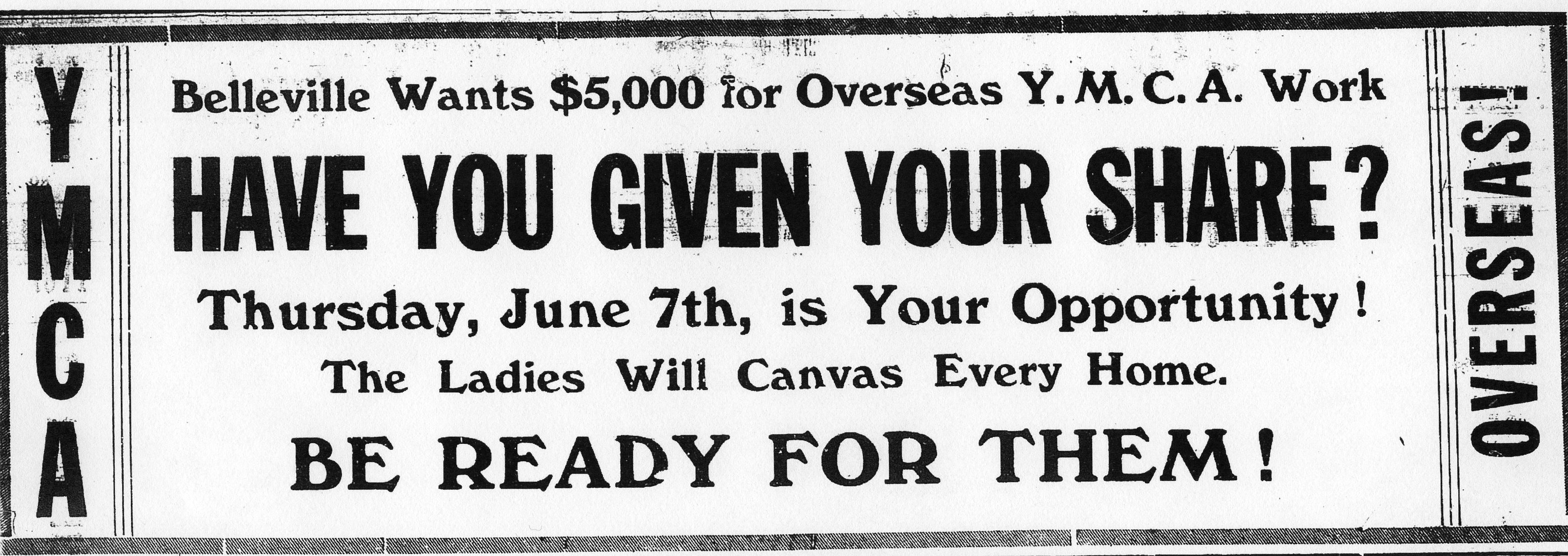
“Belleville Wants $5,000 for Overseas Y.M.C.A. Work. Have You Given Your Share? Thursday, June 7th, is Your Opportunity! The Ladies Will Canvas Every Home. Be Ready for Them!”

The Intelligencer June 5, 1917 (page 5)

“Canadian Red Cross Society. Belleville Cheese Board Branch—Report For May, 1917. Letters acknowledging shipments have been received to-day from Hospitals and Associations; a few of which are appended:

From Lady Jekyell, Chairman: St. John Ambulance Society. To Mrs. J. A. McFee: Dear Madam and Members of the Belleville Cheese Board District Branch, C. R. C. S., ‘On behalf of the Ladies’ Committee of the Order of St. John of which Her Majesty the Queen is President, I write to acknowledge and thank you most warmly for the useful contribution you have so kindly sent. The calls for hospital requirements, clothing and comforts for the sick and wounded at home, and abroad, are so numerous and urgent that all gifts are most gratefully received. We cordially thank you for your sympathy and contributions, which we are very glad to receive and which have reached us safely. Yours faithfully, (Sgd.) Agnes Jeykell, Chairman.’

From Belgian Relief: ‘A box from Belleville came this morning, containing pyjamas, shirts, night shirts, socks and a quilt. These articles are all most beautifully made, and it is a great pleasure to receive such a contribution. Will you please give the grateful thanks of the Committee to the workers of the Societies who have so kindly assisted us to fill our cases. Very sincerely yours, Ladies’ Committee, (Sgd.), (Miss) M. Cory, Cor. Sec.’

From Lady Perley, Chairman. The Canadian War Contingent Association: ‘I have to advise you that the four cases of supplies of which you advised me have now been received and unpacked. Everything came through in excellent condition, and I am directed to convey through you, to your branches, the grateful thanks of the Committee for your welcome gift. Sincerely yours, (Sgd.) Milly Perley, Chairman, Ladies’ Committee, C. W. C. A.’ “

100 Years Ago: Flag Over St. Thomas’ Church, Recruiting Returns

The Intelligencer June 4, 1917 (page 5)

“Flag Floats Over Church Tower. On Sunday morning the service of dedicating and unfurling of a Union Jack took place at St. Thomas’ church in this city. The flag and staff had been donated by members of the parish, and in accordance with Old Country customs the staff was erected on the church tower.

The choir and congregation marched out in front of the church at the opening of the service, while appropriate hymns were sung. Prayers of dedication were pronounced by the rector, Archdeacon Beamish. Mayor Ketcheson, one of the wardens, in accepting the gift, publicly thanked the donors, and said that it was a particularly fitting ceremony for the birthday of his Majesty the King.”

The Intelligencer June 4, 1917 (page 5)

“Military News. Recruiting returns from the Third Military District for the past two weeks show a large increase over the returns for the previous period, and staff officers at Barriefield camp are well satisfied with the result of the efforts of the various recruiting officers in the district.

A total of 536 men were enrolled during the period, being an increase of 200 over the previous period. That this is due, in a large measure, to conscription talk is acknowledged on all sides. All the recruits are of good physique and will make good soldiers.”

100 Years Ago: Meeting on Food Production to Be Held, George Duby Invalided Home

The Intelligencer June 2, 1917 (page 2)

“Food Production. Under the auspices of the Poultry Association of Belleville, the Board of Trade and the City Council, a public meeting will be held in the City Hall next Thursday evening, presided over by Mayor Ketcheson. The object of the meeting is to discuss the food problem situation, and a Government expert will be present to offer suggestions, etc.

Addresses will be given by Messrs. J. W. Johnson, M. P. P. for West Hastings, and N. Parliament, M. P. P. for Prince Edward County. An interesting musical programme will be furnished. Ladies and gentlemen of the city are invited to attend.”

The Intelligencer June 2, 1917 (page 2)

“Invalided Home. Pte. George C. Duby of this city, arrived home yesterday afternoon, having been invalided home. Pte. Duby left Belleville with the 80th Battalion, and passed through several battles before being wounded. He had the misfortune to lose 2 fingers of his left hand, and was otherwise injured. He had been in hospitals in France and England previous to being sent home.”

100 Years Ago: Letter of Thanks to Belleville Red Cross Society, No Demonstration on King’s Birthday, Letter from Celestina Geen

The Intelligencer June 1, 1917 (page 3)

“Sends Respects to Red Cross. Hospital, Shorncliffe, March 14, 1917. Belleville Red Cross Society, Belleville, Ont. I was interested to find the fresh linen  on my bed bearing a little label with ‘Belleville Red Cross, Canada.’ It started me thinking and wondering how many I would know in the society.

I also wondered if you good people were told of how much it is appreciated. I have just come from the Recreation Room—supplied for us by the Canadian Red Cross.

It is splendid; with a very comfortable reading room, a billiard room and a big assembly hall. Big open fires, comfortable chairs, etc. There will be a concert there to-night from six to seven for those of us who are up and can go out. …  Rest assured that all you are doing for us is very much appreciated and we wish every one who is helping could know just how much.

We hope it will not be long until we will be relieved of this terrible strain, though you good people—in Canada do not really realize what it means to be at war. You need to find that out.

Success to your efforts—and many thanks from one you are helping. Yours, L. Cpt. A. K. Lazier, 11th Canadian Reserve Bn.”

The Intelligencer June 1, 1917 (page 5)

“No Demonstration on King’s Birthday. A despatch received from the Under Secretary of State at Ottawa by the Lieut. Governor announces that a special issue of the Dominion of Canada Gazette has been published containing a notice of his Majesty’s birthday be observed on Monday, June 4th with a further expressed wish that no dinners, reviews, salutes or other demonstrations mark the occasion this year.”

The Intelligencer June 1, 1917 (page 5)

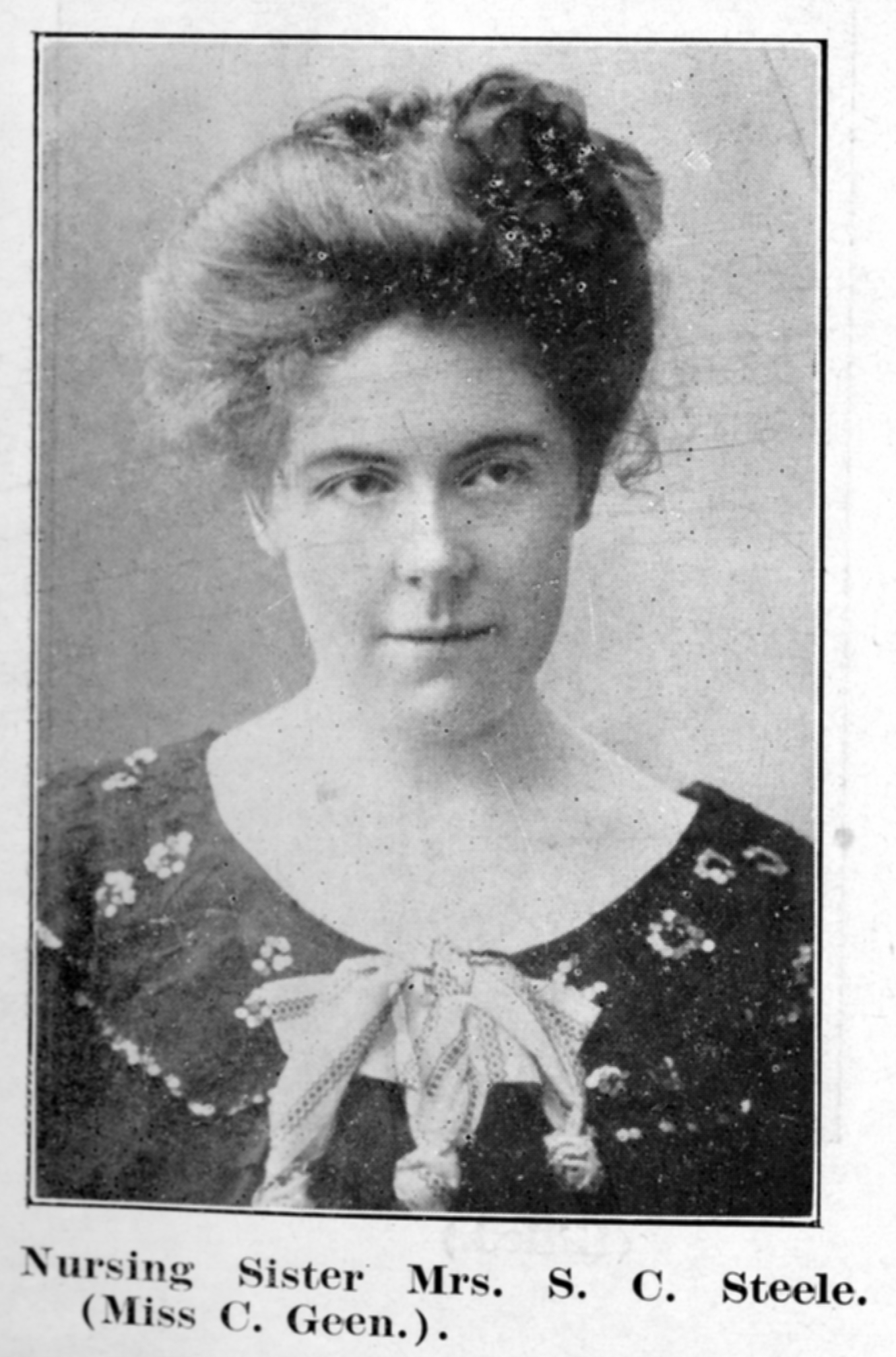
“Pleasing Letter From Miss Geen. 2nd Canadian Casualty. Clearing Station. 20—4—17. B. E. F. Belgium. Dear Miss Hurley,—Yesterday the large box of socks arrived and I really do not know how to thank you and all the good people of the society.

Ontario Military Hospital, Orpington, Kent, 8—5—17. England. You see by the above that I started a letter to you in good time but circumstances prevented the finishing of it in France. We got very busy and writing seemed to be out of season and then something happened that caused far more excitement amongst us than any of the bombs that Fritz used to let down near us. Orders came for six of the nine sisters at our C.C.S. to report in England and here we are.

We all felt very badly at leaving our little quarters in Belgium and we feel so out of the war here in England, we even long to hear the guns and shells. However, four of us are to go over to Canada on transport duty very soon and I hope to have two weeks in Belleville so will see you then.

The socks were much appreciated by the men and as far as possible I gave them to Canadians, and men going back to the trenches and the few dozen I had not given away I left with the little padre who is so good to the boys and he will give them out as he thinks best. …

This is a beautiful hospital and I think I will be very happy here, but just now my heart is very sad and lonely for my old home in Belgium. The C. C. S. is very near Poperingue and we walked to a hill and could see the Cloth Hall in Ypres so we were quite near THINGS.

Again thanking you all for allowing me to distribute your much appreciated gifts, (and I assure you that it was a greater pleasure than you think) and hoping to see you within the next two months. Believe me, Sincerely Yours, Celestina Geen.”


100 Years Ago: Charles Carter Invalided Home, Letter from Prisoner of War Alex Hall

The Intelligencer May 31, 1917 (page 7)

Pte. Charles Carter, who left Belleville with the 39th Battalion, arrived here yesterday morning, having been invalided home owing to being the victim of a severe attack of rheumatism. Pte. Carter had been connected with transport service. Mrs. Carter and family, who went to England, are also returning.”

The Intelligencer May 31, 1917 (page 7)

“From Alex Hall. My Dear Wife:—Just a few lines to say I am always keeping in the best of health. I have received 9 boxes from you lately, so I think I am doing pretty good. It is now about eight months since I was captured and it seems to me like eight years, as the time seems so long in passing, but the good weather is here now, and it won’t be so bad, but I wish it was all over and I was able to say I am a free man again.

I am sorry to hear you can’t send any more parcels, but I suppose we will have to make the best of it, and I must say that the Red Cross is certainly looking after our interests so that is a good job that we have such people to look after us. Well, I have not much more to say, as it is the same old thing here. Write again soon. From your loving husband, Alex Hall, Prisoner-of-War, Oespel, Germany.

Mr. Alex Hall was well known in this city, being a fireman on the Grand Trunk before enlisting. He enlisted with the 4th Mounted Rifles in Kingston, and was captured at the Battle of Ypres and has been a prisoner since last June. He sends a picture of himself and other prisoners at Oespel.”


100 Years Ago: Letter of Sympathy for Harry Burke, In Favour of Passports, Ladies to Canvass for Y.M.C.A. Campaign

The Intelligencer May 30, 1917 (page 2)

“From Thomas Smith. Seaford South, May 7, 1917. Dear Mr. and Mrs. Burke:—It is with a feeling of sincere sympathy I pen these few lines. I hardly know how to express my innermost feelings knowing you are now passing through a dark period of sorrow. I long to extend to you my sincerest sympathy and I hope you see beyond the dark, heavy clouds, the silver lining. …

I know you feel it badly, but one consolation remains, the fact that he died fighting for what he knew was a great cause. No stain of a slacker remains upon his career, although a short one.

He was certainly well liked by all his officers and fellow soldiers, and it was a great shock for us to learn he had fallen in the conflict, seriously wounded. I hope you will accept my sincere message of sympathy. I feel I cannot say what my heart desires, as it strikes home to me as if I had lost my best and only pal.

Well, I will close, hoping you have fought against the sad news which you have received lately from France, and bear up bravely, as I know that would have been Harry’s last wish. I remain, Your sincere friend, Thomas Smith.”

[Note: Sergeant Henry Burke died on March 29, 1917. He is commemorated on Page 210 of the First World War Book of Remembrance.]

The Intelligencer May 30, 1917 (page 4)

“The Passport. The order-in-council which prohibits male citizens between the ages of 18 and 45 from leaving Canada without passports is absolutely essential to making compulsory service effective. Those who have legitimate reasons for leaving the country will not cavil at the inconvenience which the necessity for securing passports will involve. Personal inconvenience is a small matter compared to the welfare of the state as a whole.

Without such a regulation any slacker would find it easy to evade compulsory service by crossing the border and going to the United States. While the percentage of Canadians who would attempt to escape service in this way is very small, public opinion will support the Government in any steps it may take to prevent even a hundred men from making any ‘safety first’ trips.”

The Intelligencer May 30, 1917 (page 6)

“The Y.M.C.A. campaign to raise $5,000.00 as Belleville’s share of the $750,000.00 now being raised in Canada for the work overseas, is making progress and at a meeting held last night nearly $3,000.00 of the amount required was reported as being in sight.

To raise the remainder of this fund it was decided to ask the assistance of the ladies with a view to making a house to house canvass on Thursday, June 7th, and so complete the campaign in Belleville. The committee having this matter in hand report that already arrangements have been made and the ladies of Belleville, ever interested in such good work, will undertake this canvass in the residential parts of the city.”


100 Years Ago: City Council Tries to Procure Cheap Coal, George Thompson Is Prisoner of War, Cobourg Heavy Battery, Lieut. Vernon Castle and Lieut. Coates Fly to Belleville, Private Coon Progressing

The Intelligencer May 29, 1917 (page 1)

“ ‘That this Council take the necessary steps to purchase coal for the coming year and sell the same to the citizens at cost.’ This motion was moved by Ald. Platt and seconded by Ald. Woodley at last night’s Council meeting. Ald. Platt said other cities were doing the same. …  The coal situation, he declared, would be again acute next year. He did not want to interfere with the coal merchants. …

Ald. Deacon declared that the Belleville merchants had treated citizens pretty fair last winter. Belleville was buying coal as cheap last spring as Philadelphia. The local dealers are at their wits’ end in trying to supply Belleville with coal.

Ald. Platt said he did not think the merchants were wanting to ‘do’ the citizens. But if the City Council could get the coal it would do a favor to the people. ‘We want the coal supplied to the citizens at a reasonable rate.’

Ald. Woodley—’Let us see what prices we can get. We can submit them to the Council and to the people. We can let them know what we can give the coal at.’ Mayor Ketcheson said he was as anxious as anyone to get his coal cheap, but the dealers are not making large profits.

The motion carried almost unanimously. The committee of investigation is composed of Aldermen Platt, Robinson and Parks.”

The Intelligencer May 29, 1917 (page 2)

“Belleville Boy Is a Prisoner. The following card tells a story all its own regarding one of our soldier boys: Friedrichsfeld, April 8th, 1917. Dear Intell.:

I am sorry to let you know that one of the old Intelligencer’s news boys is a Prisoner of War taken on the Somme, Sept. 15th, 1916. I am well, and expect to be back with you soon. Would much prefer to be with the boys on the front, formerly of Christie’s Laundry. Best regards to all the boys. Yours very truly Geo. J. Thompson. Princess Patricia’s Canadian L. I. No. 124475.”

The Intelligencer May 29, 1917 (page 5)

“Cobourg Heavy Battery. Since the last list of names of the Belleville lads, who have lately enlisted with the Cobourg Heavy Battery, the following have now put on the Artillery uniform: Messrs G. French, B. McBain, C. Clarke, F. Corby, H. Potter, N. Childs. This makes in all twenty-two Belleville men, who have signed up at Cobourg in one week, and along with the half dozen who are following suit in a few days and the ten Albert College Students, the grand total will be about forty.

The Ninth Draft will be almost entirely Belleville Boys, and any who yet wish to join it must hurry. Bombardier Bullock and Gunner Madill have returned to Cobourg.”

The Intelligencer May 29, 1917 (page 6)

“Birdmen. Belleville was visited on Sunday afternoon by two distinguished Flight Commanders, both of whom have served in France, in the persons of Lieut. Vernon Castle and Lieut. Coates, accompanied by their Flight Sergeants.

They landed on Colonel Ponton’s farm in Sidney and after spending a pleasant hour at ‘Sidney Cottage,’ where they met a number of young people, they left again for the east and before going gave the crowd of at least a thousand people who had gathered to watch their departure, an example of an action in the air. Lieut. Vernon Castle looping the loop several times before waving goodbye.

The air being clear the sight was most striking and one rendered doubly interesting by the fact that both officers had done their duty at the Front and are now training the young Canadians to follow in their foot steps, or rather in their soaring wings.”

The Intelligencer May 29, 1917 (page 6)

“The following message conveys the pleasing intelligence that Pte. F. W. Coon, of this city, who was wounded is progressing favorably.

Ottawa, Ont., Mrs. Elizabeth Coon, 13 Brock St., City. Cable received from England states 219521, Pte. F. W. Coon suffering from impetigo, progressing satisfactorily, but will be some time in hospital. Will send further information when received. Office I.C. Records.”

100 Years Ago: Belleville Bids Farewell to 254th Battalion, Notice to Join C.E.F. Company of Canadian Defence Force, Women in Munition Plants

The Intelligencer May 26, 1917 (page 2)

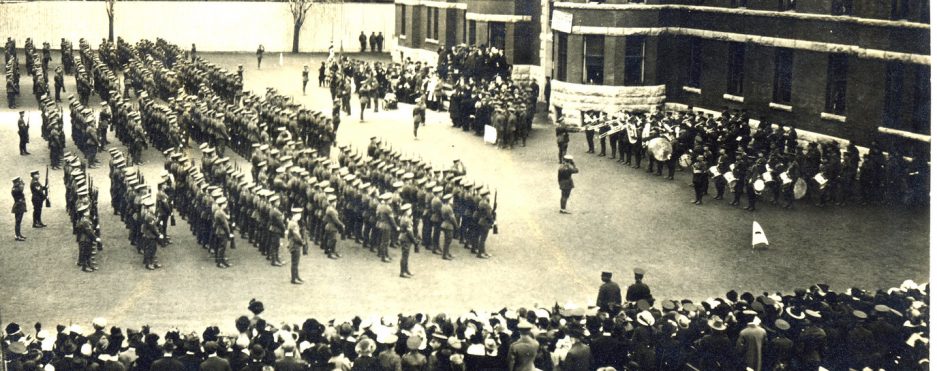
“Belleville Bids Farewell to 254th Batt. Citizens of all classes this morning vied with each other in giving the members of the 254th a hearty send off as they left this city eastward bound preparatory to going overseas. For some time the unit has been in Belleville, and the greater number of the members are residents of Hastings and adjoining counties, and numbered some 375. …

In full marching order the Battalion assembled at the Armouries and previous to leaving the members were provided with lunches furnished by the ladies of the two chapters of the Daughters of the Empire. Many were present at the Armouries, to bid for the present good-bye to loved ones.

The Battalion paraded from the Armouries at 11.30 and proceeded by way of Bridge St., up Front Street to Station Road, to the G. T. R. Station, where they embarked. On the line of march the streets were thronged with pedestrians and the boys were lustily cheered as they marched past, headed by the Battalion Band, under command of Bandmaster Lieut. E. R. Hinchey. A large number of autos and vehicles followed the boys to the station where they were given a hearty send off.

Among the prominent citizens present were Mayor Ketcheson, Mr. E. G. Porter, K. C., M. P., Col. Ponton, Mr. F. E. O’Flynn, and others. Several surplus subalterns, who were attached to the battalion are being retained here in order that they may be available if required.”

The Intelligencer May 26, 1917 (page 2)

“Do Not Wait For Conscription. You still have a chance to be a volunteer. It will not last long. DO IT NOW!

The pay and the allowances of the volunteer are settled. We do not know what the pay of the conscript will be. NOTE THIS!

Join the C.E.F. Company of the C.D.F. and reinforce the famous ‘Iron Second’ Battalion, the finest battalion in the First Canadian Division. DO IT NOW!

There will be no more recruits taken on the Canadian Defence Force. E. D. O’Flynn, Lieut.-Colonel, Comm’ D. G., 15th Reg’t C. D. F.”

The Intelligencer May 26, 1917 (page 3)

“Women Make Good in the Munition Plant. After enumerating the many channels in which women have directed their energies since the outbreak of the war, Owen E. McGillicuddy, in May’s ‘Everywoman’s World,’ pays the following tribute to the women munition workers:

Probably the most interesting, as it is also the most painstaking, is the way in which she has actually gotten down to hard manual work in the foundries and factories which are turning out war munitions throughout Canada.

Here she has learned a newer and larger meaning of the terms ‘citizenship,’ and ‘workmanship,’ and here also has she earned and learned by the sweat of her brow what it means to be truly patriotic. The War has truly given her equal place in the service of the nation, although it still withholds in four Provinces the fuller Franchise of a share in the Government. …

In Canada, there are already 3,500 women in munition factories, and that army is steadily increasing: and notwithstanding the fact that practically all of these employees were absolutely unfamiliar with mechanical work previous to the War, they have demonstrated, not only a mechanical ability equal to man’s, but in some departments they have shown beyond question a superiority to the male help who formerly did the same work.”