100 Years Ago: War Considered Certain for United States, Ad for Gillette, Many Recruits Medically Unfit

The Intelligencer April 3, 1917 (page 1)

“War Considered Certain. The entry of the United States into the war is now a foregone conclusion. The President yesterday asked Congress to declare that a state of war exists. He also urged the raising of half a million men by universal military service. No action is to be taken against Germany’s Allies at the present time.

While the President was preparing to meet Congress the news arrived that one of America’s armed merchantmen, the steamer Aztec, had been torpedoed and sunk by a German submarine in the prohibited war zone.”

The Intelligencer April 3, 1917 (page 2)

“ ‘The States’ Come In! Now that official action has struck off the fetters of neutrality, our cousins across the Line are free to throw their whole weight into the world’s struggle for freedom and humanity.

Unofficially and individually they have already contributed much to the Allied cause—in moral and financial support, in munitions and machinery, and by no means least in those brilliant inventions for which they are famous. The Lewis gun, the Curtis hydroplane, and a wonderful submarine detector are products of their genius which in our hands have done most efficient work by land, air and sea; while the American-invented, Canadian-made Gillette Safety Razor has been a friend indeed to our officers and men on active service everywhere.

Much as men have appreciated the Gillette at home, its real test has come in barracks, billets, trenches and hospitals, and no article of equipment has proved more satisfactory. …

If there is anyone dear to you in Canada or Overseas without a Gillette and a good supply of blades, it’s a chance for you to do him a really good turn by completing his equipment.”

The Intelligencer April 3, 1917 (page 3)

“Low Physical Showing of Many Recruits. Kingston Whig. Due to the fact that special physical qualifications allow a great number of men into overseas battalions such as forestry, etc., and the fact that many who are under age may be transferred to the Special Service Company, there are nevertheless a great number of men who are being lost to the service through being medically unfit. Every day a certain number is discharged for this reason. The explanation, of course, is that in spite of constant urgings on the part of headquarters here there are medical practitioners throughout the district who persist in passing men who should not be taken on the strength of any unit. …  Since Friday last and not including to Friday, there have been eighty-nine men discharged—a high percentage when compared with the number of recruits secured.

Of the eighty-nine men discharged there were fifty-three who were medically unfit. These should never have been taken on. Besides the fifty-three who were medically unfit, one man was under size, seven were under age, eight were special cases, four were absent, one died, two took commissions, and one was discharged by purchase.”
100 Years Ago: Memorial Service for Former Members at Bridge Street Church

The Intelligencer April 2, 1917 (page 1)

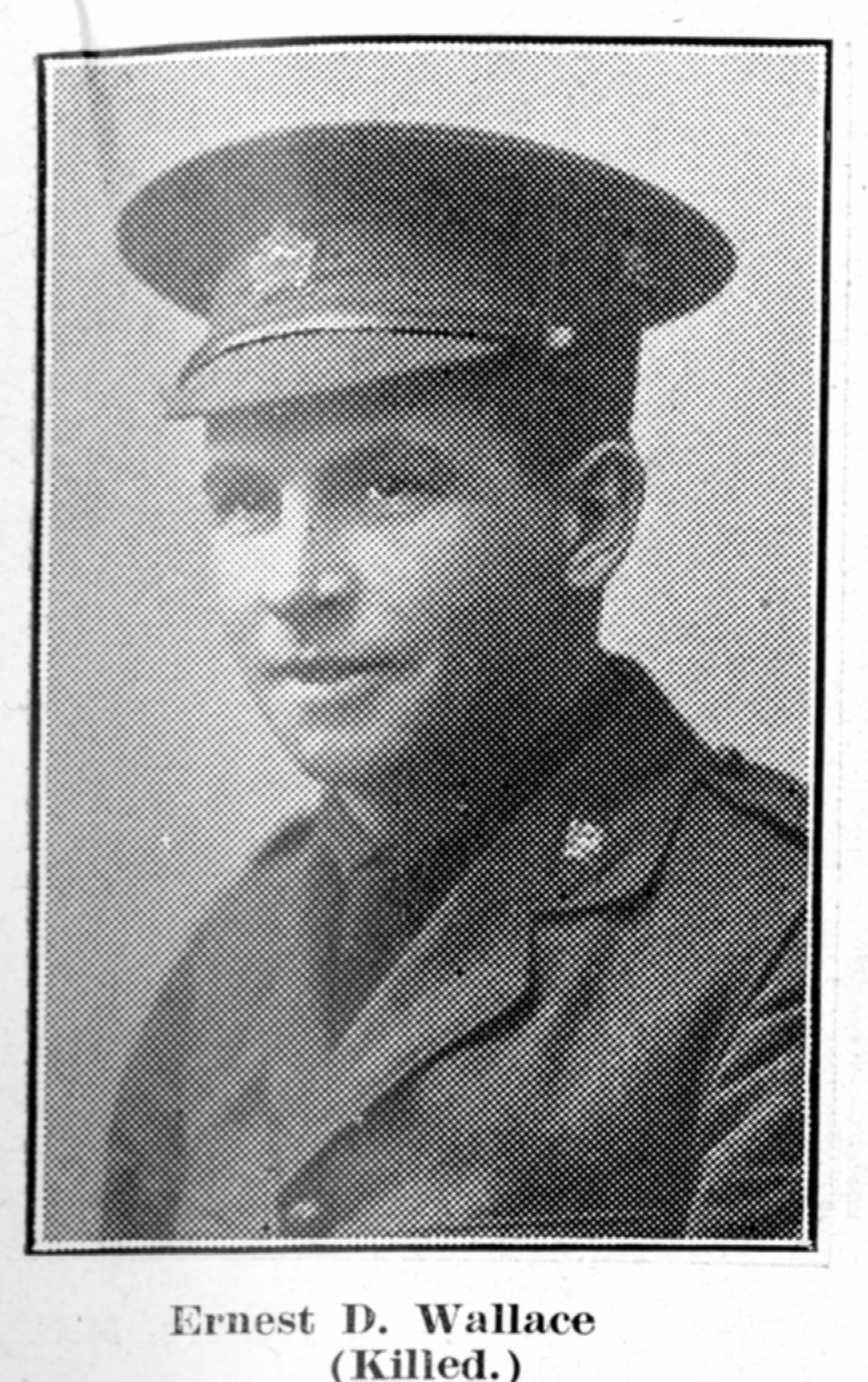
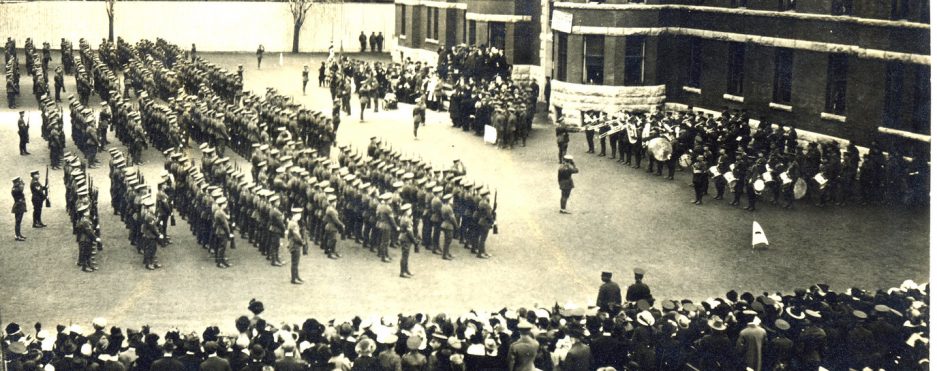
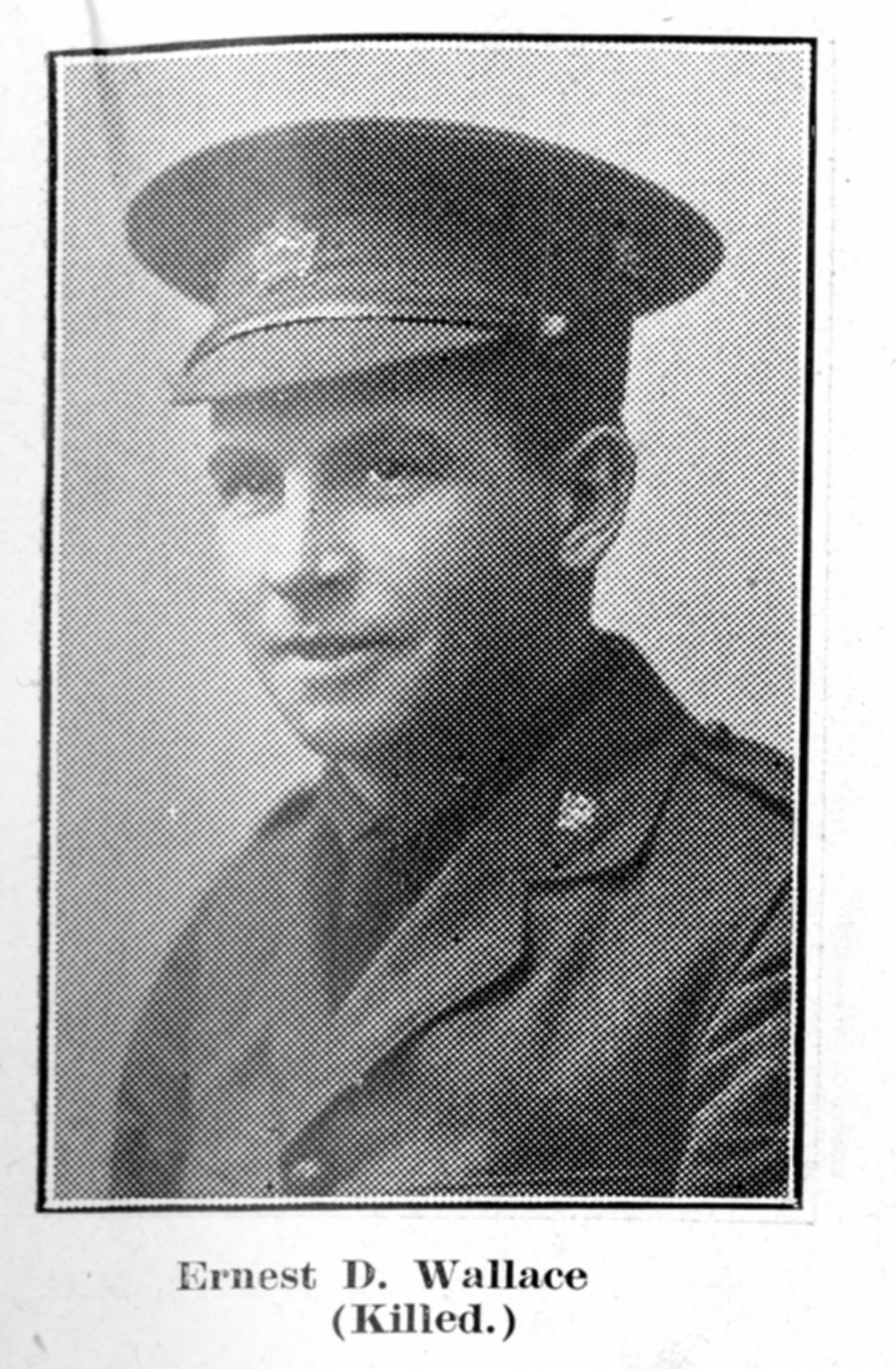
“Yesterday morning special memorial services were held in the Bridge St. Methodist church for Lieut. Ernest Donald Wallace and for William Harold Boyle, both boys of the church, who gave their lives in the service. Lieut. Wallace went overseas with the first contingent, and spent two years in active service in France, when he returned to England and took up work in the Flying Corps, and while engaged in these duties he was killed by accident.

Mr. Harold Boyle was also one of the Bridge St. boys, and was a member of the 20th Battalion, and lost his life on active service in France. The ceremony was one of the most impressive ever held in the city. Lieut. Col. A. P. Allen was present with the 254th Battalion, to pay a tribute of respect to the memories of the boys who had died. The 254th Band, under the leadership of Lieut. Hinchey, rendered two splendid selections; one, ‘The Psalms,’ the other ‘Funeral March,’ Chopin. …

Special reference was made to Lieut. Wallace by Mr. F. E. O’Flynn, who was for many years assistant superintendent of the Sunday School, and was intimately associated with Lieut. Wallace in church matters. …  He closed with a tribute to the mother, and quoted ‘Little Boy Blue,’ expressing a wish that the memories of the young man who died, and the thought that he gave his life in this great work, would soften the burden of the loss. …

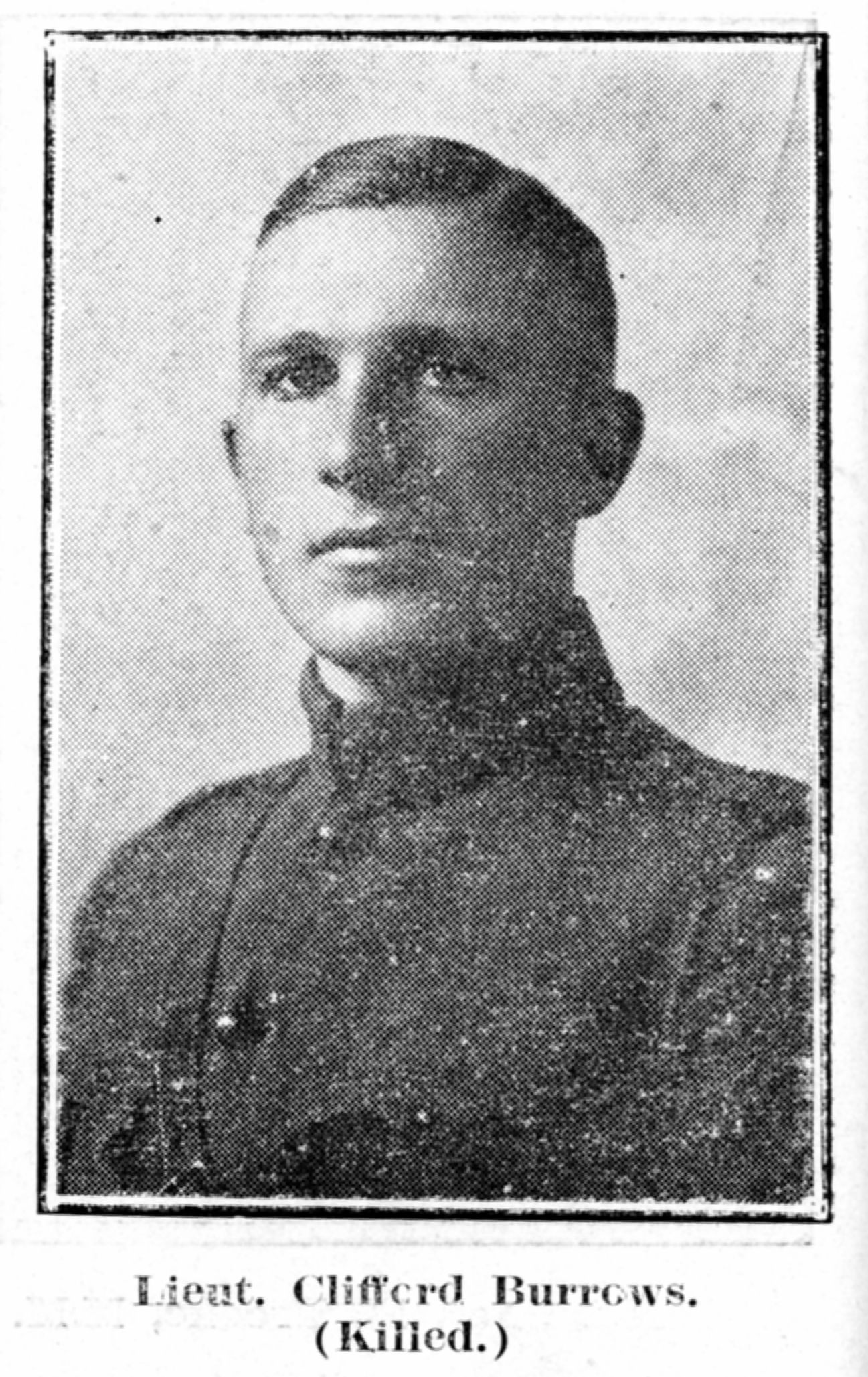
Mr. F. S. Deacon, who was teacher of the Young Men’s Bible Class to which Harold Boyle belonged, spoke of the associations in the school, of the parting banquet given to the boys when Harold Boyle went away, and referred feelingly to many circumstances connected with the life of the deceased. He also referred to Mr. Clifford R. Burrows, another of the boys of the church, who had given his life for Home, Flag and Country.

With the congregation standing, the band played the ‘Dead March in Saul,’ and the beautiful service was closed with the benediction by the pastor.”

[Note: Private Clifford Robert Burrows died on June 2, 1916. He is commemorated on Page 62 of the First World War Book of Remembrance.]

[Note: Private Harold Boyle died on September 26, 1916. He is commemorated on Page 57 of the First World War Book of Remembrance.]

[Note: Lieutenant Ernest Donald Wallace died on March 27, 1917. He is commemorated on Page 344 of the First World War Book of Remembrance.]

100 Years Ago: Poster to Encourage Food Production, Captain Wallace Receives Gift in Tweed, Farm Labour Needed for Seeding, Ad for Collars

The Intelligencer March 31, 1917 (page 4)

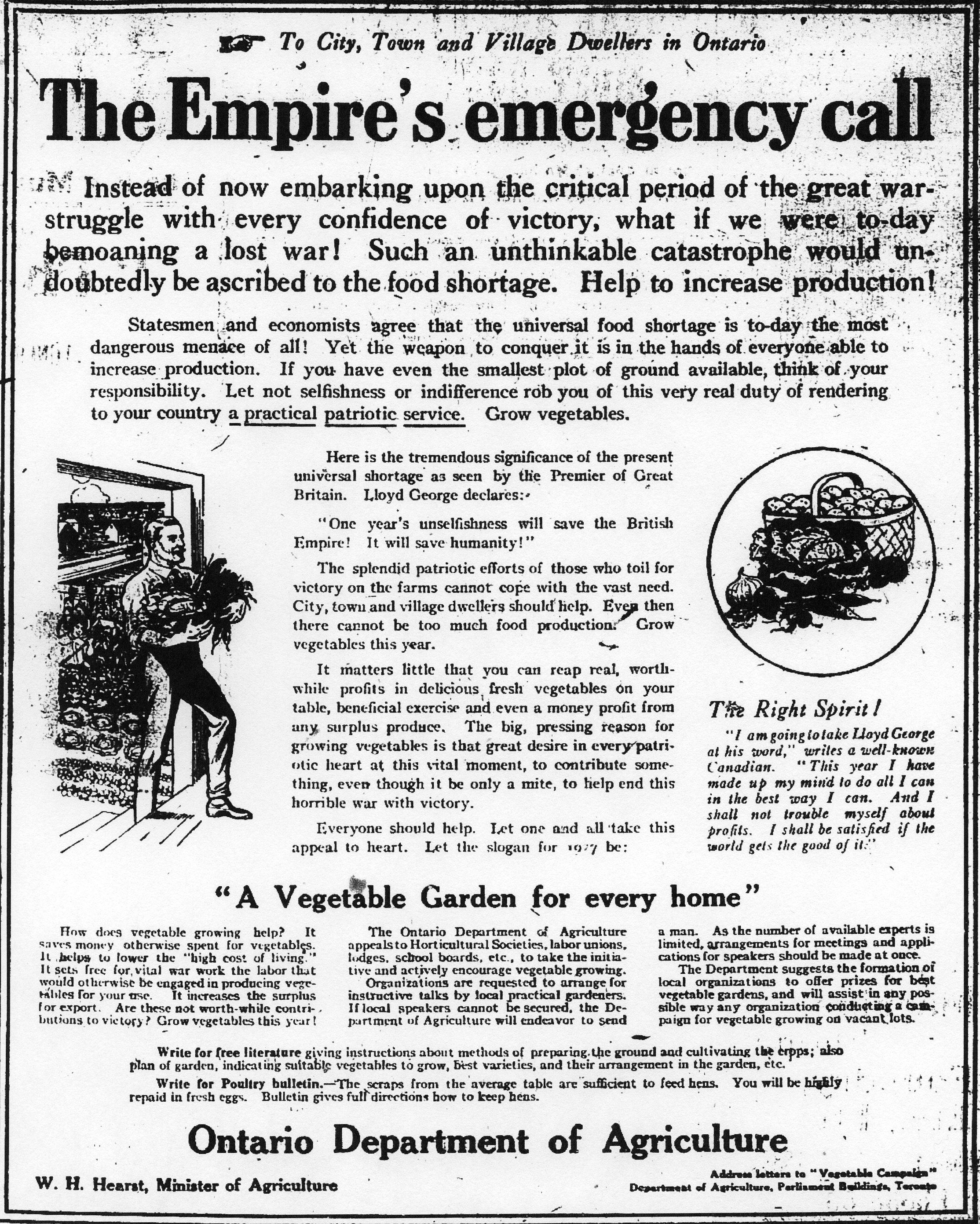
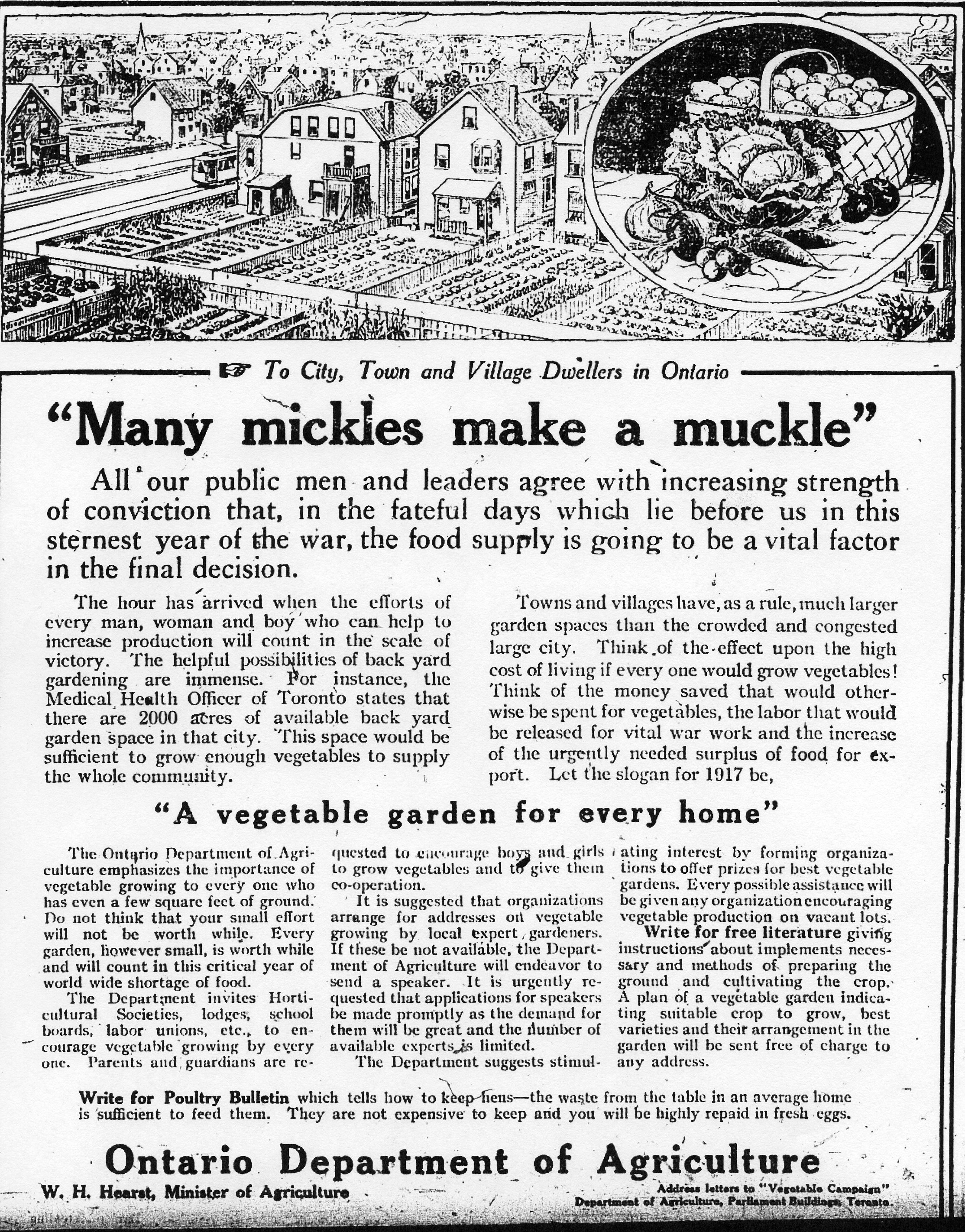
“The Empire’s Emergency Call. Instead of now embarking upon the critical period of the great war-struggle with every confidence of victory, what if we were to-day bemoaning a lost war! Such an unthinkable catastrophe would undoubtedly be ascribed to the food shortage. Help to increase production!

A Vegetable Garden for every home. The Ontario Department of Agriculture appeals to Horticultural Societies, labor unions, lodges, school boards, etc. to take the initiative and actively encourage vegetable growing.”

The Intelligencer March 31, 1917 (page 7)

“Capt. Wallace Surprised. Tweed Advocate. Capt. Wallace, who has been in charge of local recruiting for the past five months and has been transferred to Campbellford, was given a surprise by the boys of the Tweed Platoon and local members of the Artillery on Friday last.

While engaged at his office duties at his desk in the drill hall the boys formed a circle round him and Sergt. Deeks, on behalf of the local platoon and Gr. Brown on behalf of the artillery, presented him with an autostrap shaving set with leather case as a token of the esteem in which he was held by the boys in khaki. The Captain was taken completely by surprise and in responding he assured the boys that the gift would be highly prized by him and he would ever cherish in memory the many pleasant associations of the days spent in Tweed.”

The Intelligencer March 31, 1917 (page 13)

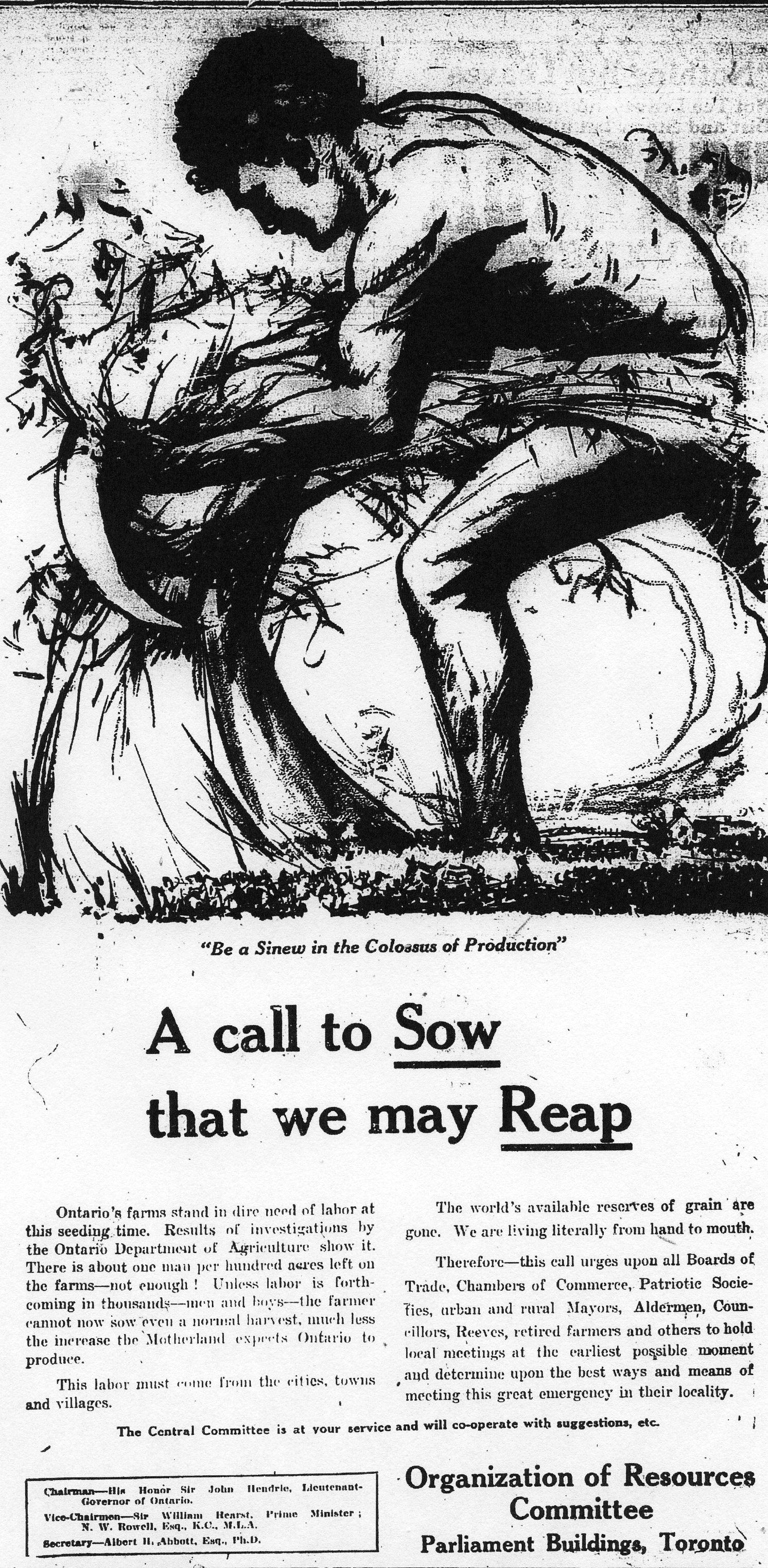
“Be a Sinew in the Colossus of Production. A call to Sow that we may Reap. Ontario’s farms stand in dire need of labor at this seeding time. …

There is about one man per hundred acres left on the farms—not enough! Unless labor is forthcoming in thousands—men and boys—the farmer cannot now sow even a normal harvest, much less the increase the Motherland expects Ontario to produce. Organization of Resources Committee, Parliament Buildings, Toronto.”

The Intelligencer March 31, 1917 (page 14)

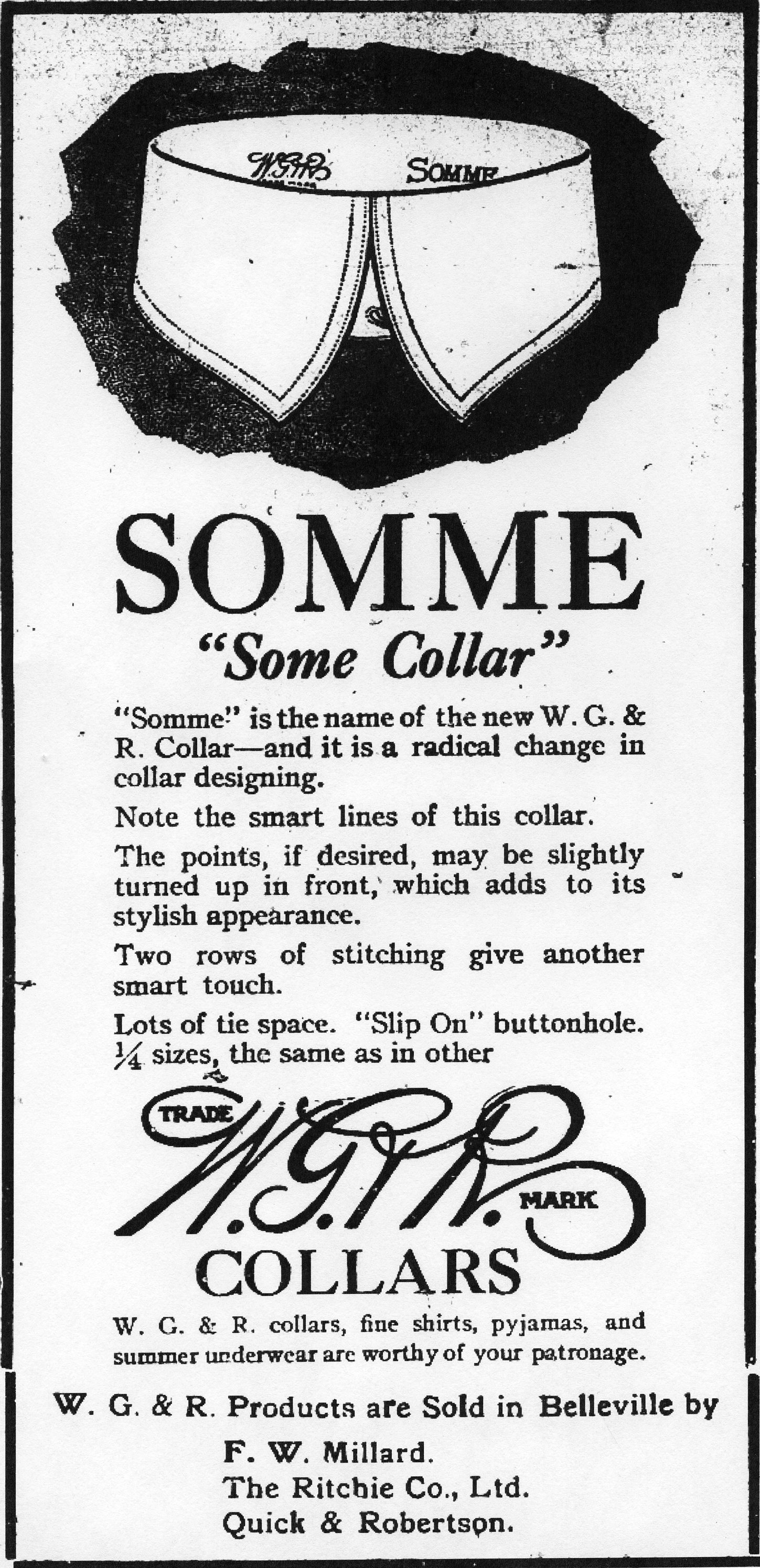
“SOMME ‘Some Collar’ ‘Somme’ is the name of the new W.G. & R Collar—and it is a radical change in collar designing. Note the smart lines of this collar. The points, if desired, may be slightly turned up in front, which adds to its stylish appearance. Two rows of stitching give another smart touch. Lots of tie space. ‘Slip On’ buttonhole. W.G. & R. Products are Sold in Belleville by F. W. Millard, The Ritchie Co., Ltd. Quick & Robertson.”


100 Years Ago: Belleville City Council Grants $50,000 to Patriotic Fund, Robert Gibson Is Wounded

The Intelligencer March 30, 1917 (pages 1, 3)

“City Council Grants Fifty Thousand Dollars. A communication was read from the Belleville Branch of the Canadian Patriotic Fund asking the Council to make a grant of $5,000 per month for this year to the fund. …  Ald. Platt—We have given $5,000 and we should give $45,000 for the balance of the year, making a grant of $50,000 for the year. Mayor Ketcheson—We could issue a debenture now for $25,000.

A motion prevailed that the city make a grant of $50,000 to the Canadian Patriotic Fund, and be paid over at the rate of $5,000 per month, commencing on April 1st.

Sailors’ Relief Fund. A motion moved by Ald. Marshall prevailed that a grant of $500 be made to the British Sailors’ Relief Fund. Committees adjourned.”

The Intelligencer March 30, 1917 (page 2)

“Robert M. Gibson Wounded at Front. Mrs. Gertrude J. Gibson, 16 Harriet St., Belleville, Ont. Sincerely regret to inform you, 455,899 Pte. Robert Wm. Gibson, Infantry, officially reported wounded, March 20, 1917. Will send further particulars when received. Officer in Charge Records.”

100 Years Ago: Lieutenant Ernest Wallace Killed in Aeroplane Accident

The Intelligencer March 28, 1917 (page 2)

“Lieut. E. D. Wallace Killed in England. Another well known and popular Bellevillian has sacrificed his life for King and Country and in consequence the inmates of a home are in sorrow over the loss of a beloved one.

Yesterday Mr. and Mrs. Robert Wallace, residing at 132 South John St., received the following cablegram: London, March 27, 1917. A. A. A. Regret to inform you, your son Lieut. E. D. Wallace killed in aeroplane accident this morning. A. A. A. Aeronautics 40 Reserve Squad, R. F. C. at Oxford.

The victim of the unfortunate accident was one of Belleville’s most popular young men and was widely known throughout the city and vicinity. He was born in this city 29 years ago and virtually all his life was spent here. After passing through the public school he graduated from the High School with honors. In early life he evidenced a military spirit and for eight of nine years was connected with the 15th Regiment, A. L. I. of this city.

Lieut. Wallace was for some time in the local office of the Bell Telephone Company and owing to his business capabilities succeeded in obtaining promotions and at the outbreak of the war was Manager of the Bell Telephone Company’s office at Port Perry.

He immediately resigned his position and took out a commission and enlisted in the 46th Battalion at Port Hope and was transferred to the 34th Battalion. He went overseas with the 2nd contingent and was transferred to the 1st Canadian Motor Machine Gun Brigade, and was in the trenches with that unit for a period of thirteen months. Desirous of joining the flying corps he was allowed to do so and had been in training in England and Scotland and was on the last part of his course when the accident occurred, the particulars of which have not yet been learned.

Lieut. Wallace was connected with a patriotic family. Two brothers of deceased are at present in France, Fred being with the artillery and Sergt. Chas. Wallace is connected with the Army Service Corps. A third brother Capt. Harry L. is connected with the 254th Battalion of this city. Two other brothers also survive, namely Frank D. of North Bay and H. B. of Winnipeg. A cousin of the deceased, Flight Lieut. Wallace Earle of Picton, was killed when the machine he was on fell to the ground.

The heartfelt sympathy of all citizens will be extended to Mr. and Mrs. Wallace and the members of the family, who have been called upon to mourn the loss of a faithful son and loving brother.”

100 Years Ago: Red Cross Penny Bag Collection, 235th Battalion Prepares for Overseas

The Intelligencer March 27, 1917 (page 2)

“Red Cross Penny Bag Collection to-morrow, Wednesday, please have your bags ready with as many pennies as you feel you can spare in them. This month we are again aiming at $300.

Last month some of the collectors in going their rounds, met the charge in a very few instance that ‘the Penny Bag people were too grasping, that they were doing very well indeed, and should be satisfied, instead of aiming at more each month.’

Those in charge of this fund have been so delighted at, and grateful for the generous response of our interested citizens, and for the interest which has increased rather than diminished, as the months passed, in this simple means of raising money to expend for our brave soldiers. The need is so great, the money so well expended.

We don’t want one cent given grudgingly, but we would like to feel that every man, woman and child in our city, was each month trying to do their bit (no matter how small if it’s all they are able to give) towards supplying the needs of those who are suffering so much, for our safety and peace.

Many questions have been asked about the Red Cross Penny bags. About a year ago Miss Greene, Superintendent of the Belleville Hospital, instituted this plan of raising funds toward providing material for the supplies, which a number of faithful workers, met, twice a week, to make up into ‘hospital supplies’ for the wounded soldiers in the hospitals overseas. The penny bags were at first used only by these workers and their friends. The plan appealed to everybody as the simplest way of raising money, a way in which everyone, down to the smallest child, who would sometimes forego a picture show, some candy or other treat, could participate in without feeling any real pinch.

After the first month Miss Greene passed it over, a committee was formed, and the entire city was divided into districts, looked after by various collectors. Anyone who has ever done any collecting knows that it is by no means pleasant work and much gratitude is felt for those who have undertaken this part of the work.”

The Intelligencer March 27, 1917 (page 3)

“The 235th Battalion has been warned to prepare to leave for overseas. The unit will leave Ottawa in the course of a few weeks. When the announcement was made to the officers and men, the news was received with great rejoicing.

The battalion was organized late last summer by Lt.-Col. Scobell and the majority of the recruits were taken from the counties of Hastings and Prince Edward. Headquarters were established at Belleville. A few weeks ago the 235th came to Ottawa and here several men have been enlisted.

Yesterday the battalion mustered 500 strong and Col. Scobell hopes that by the time he takes his unit from Ottawa there will be an additional 300 men in the ranks. Serving in the 235th are many professional men. Six ministers deserted their pulpits, three lawyers, left the bar, two professors forsook the lecture room and joined the 235th in order to go forward quickly. The battalion is considered one of the foremost in Canada.”

100 Years Ago: News of the 254th Battalion, Thurlow Red Cross Association, Officers Revert to Ranks to Get Overseas Quickly, Back Yard Gardening Encouraged, Need for Farm Help, Poster for Canadian Naval Patrols

The Intelligencer March 24, 1917 (page 2)

“Grand Concert by 254th Band. An audience that filled the City Hall was present last evening at the concert given by the 254th Battalion Band, assisted by Miss Mae Wallace, elocutionist; Miss Joy Higgs, violinist; Miss Maysell Stork, soloist; and Mrs. R. Lewis, pianist. …

Col. Allen, Capt. Sandford, Lieut. Hinchey and the band of the 254th Battalion will be present this evening at a Patriotic meeting to be held in Shannonville. …

Capt. Wallace, who has been in charge of the 254th’s recruiting station at Tweed is spending the weekend in the city. He will leave for Campbellford on Monday. …

Divine service will be attended by the 254th Battalion in the Baptist Church to-morrow morning. The Roman Catholic members of the battalion will attend St. Michaels in a body parading at 10.20 a.m. …

Col. Adams O.C. the 155th Battalion, has sent word to Col. Allen, O.C. the 254th Battalion, that he is returning the colors of the 155th Battalion to be deposited in Belleville.”

The Intelligencer March 24, 1917 (page 3)

“Report of Thurlow Red Cross Association. The society has the best report it has ever had. The workers started in with good New Year’s resolutions and in the first three months have knit 1381 pairs socks.

Mrs. James McCreary of Halston, won the silver teaspoon donated by Dr. J. A. Faulkner. She knit 24 pairs of socks entirely by hand in the month of February.

Mrs. Harry Frederick won the cheese knife donated by Mrs. John Heard.

The bag of flour, given by Mr. Wm. Lingham, of Cannifton, was drawn for and won by Mr. Henry Fenn. He very kindly gave it back and it was auctioned and bought for $9.00. Altogether $31.50 was made on the flour and Mr. Lingham’s gift was very much appreciated.

The ladies are now busy selling tickets on the tablecloth donated by the Ritchie Co.”

The Intelligencer March 24, 1917 (page 4)

“Many Officers Have Reverted to Ranks. (Ottawa Journal Press) A large draft of artillery men and officers are leaving for the front in a very short time. These men have been eagerly awaiting sailing orders for the past month, as nearly all of them have chums already in France, serving the Canadian guns.

A feature of this draft is the large number of officers who have given up their commissions and reverted to the ranks, that they might get into action sooner. Four qualified artillery officers enlisted as gunners during the last three days.”

The Intelligencer March 24, 1917 (page 5)

“To City, Town and Village Dwellers in Ontario ‘Many mickles make a muckle.’ …  The hour has arrived when the efforts of every man, woman and boy who can help to increase production will count in the scale of victory. The helpful possibilities of back yard gardening are immense.

Towns and villages have, as a rule, much larger garden spaces than the crowded and congested large city. Think of the effect upon the high cost of living if every one would grow vegetables!

Ontario Department of Agriculture.”

The Intelligencer March 24, 1917 (page 7)

“Urgent Need of Farm Help. The following telegram was received this (Saturday) morning from Toronto. It expresses clearly the need of the hour, and it is to be hoped that every possible assistance will be rendered. …  Editor The Intelligencer, Belleville, Ont. The call of the Empire for more food is urgent, but the Ontario farmer cannot respond unless labor is available for seeding, which commences early in April. Immediate action is imperative if assistance is to be given.

Will your patriotic committee kindly call an emergency meeting and ascertain whether retired farmers and others in your community are willing to help. Co-operation with Boards of Trade and other organizations interested is advisable. Your co-operation should be gratefully appreciated. Organization of Resources Committee: Sir John Hendrie, Chairman.”

The Intelligencer March 24, 1917 (page 9)

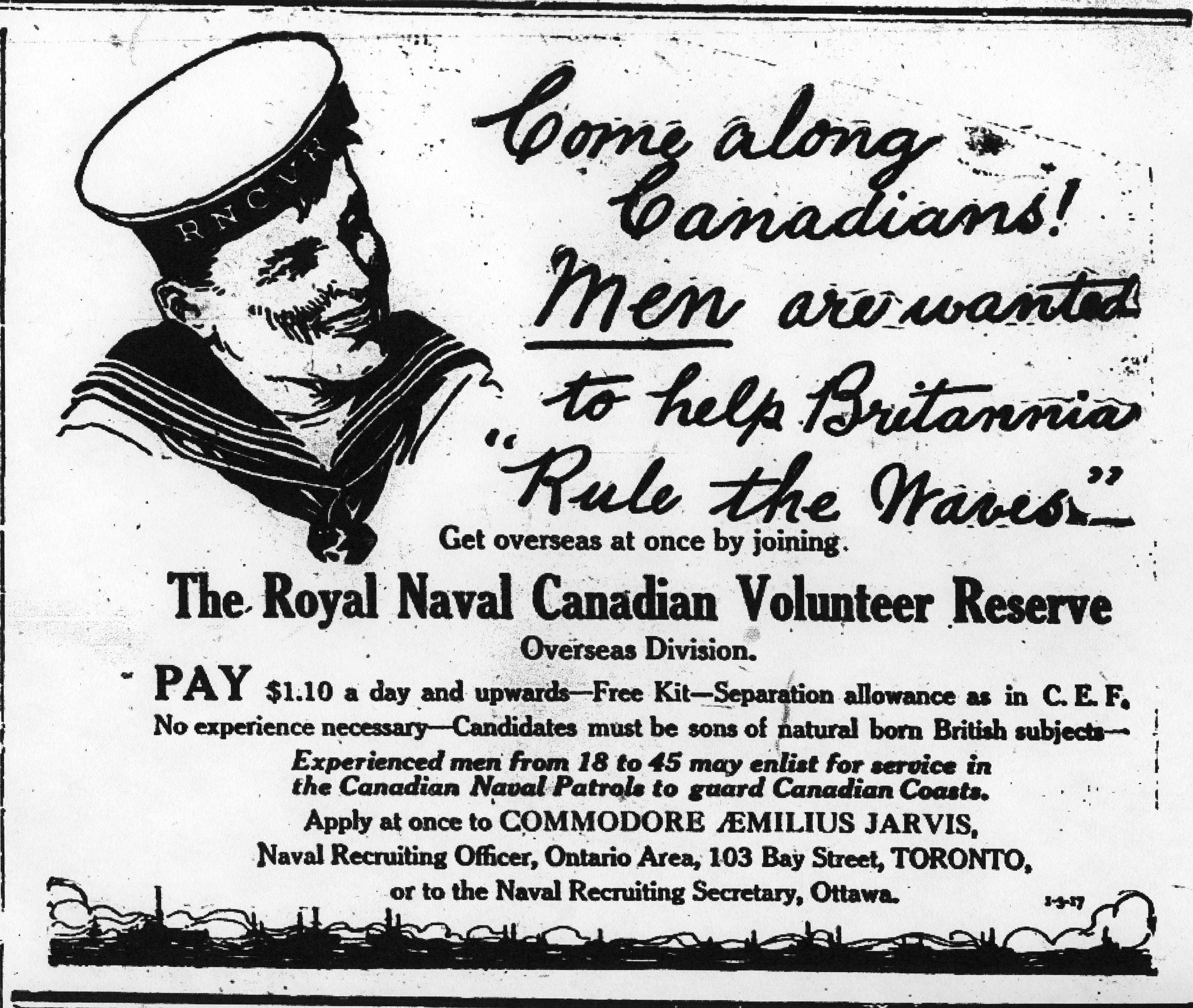
“Come along Canadians! Men are wanted to help Britannia ‘Rule the Waves.’ Get overseas at once by joining The Royal Naval Canadian Volunteer Reserve Overseas Division. …

Experienced men from 18 to 45 may enlist for service in the Canadian Naval Patrols to guard Canadian Coasts. Apply at once to Commodore Aemilius Jarvis.”


100 Years Ago: Private Albert Lawrence Killed in Action, Aeroplane Camp near Deseronto, Belleville Boy Honoured

The Intelligencer March 23, 1917 (page 3)

“Made Supreme Sacrifice. Word was received this week that Pte. Albert Lawrence …  had been killed. Pte. Lawrence worked four years for Wallace Heard in Rawdon Township, and was very highly respected and well liked in the community. He went overseas with the 80th Battalion, and had been in France since November last. His parents live in Colchester, England.”

[Note: Private Albert Lawrence died on February 7, 1917. He is commemorated on Page 272 of the First World War Book of Remembrance.]

The Intelligencer March 23, 1917 (page 3)

“Aeroplane Camp near Deseronto. The Imperial Munitions Board intends to establish at Deseronto an aeroplane industry and training camp which will be practically the exact duplicate of the works at Camp Borden.

Negotiations are now under way for a tract of land known as the flats. Accommodation will be provided for five squadrons of one hundred machines. The contracts will be placed in a few weeks, and the camp will be operated, together with Camp Borden flights from one to another being planned.”

The Intelligencer March 23, 1917 (page 7)

“The numerous friends of Sergt. L. M. Frederick in Belleville, also in Ameliasburg, where he was born, will be pleased to learn that his name has been forwarded to the Secretary of State for War, in recognition of valuable services rendered in connection with overseas action.

Sergt. Frederick is a son of Mr. and Mrs. B. O. Frederick of this city, and a brother of Mr. C. I. Frederick, Assistant Principle of Queen Mary School. He enlisted at Swift Current, Sask., in the 9th C.M.R., in June, 1915.”


100 Years Ago: Poster for Royal Naval Canadian Volunteer Reserve

The Intelligencer March 21, 1917 (page 6)

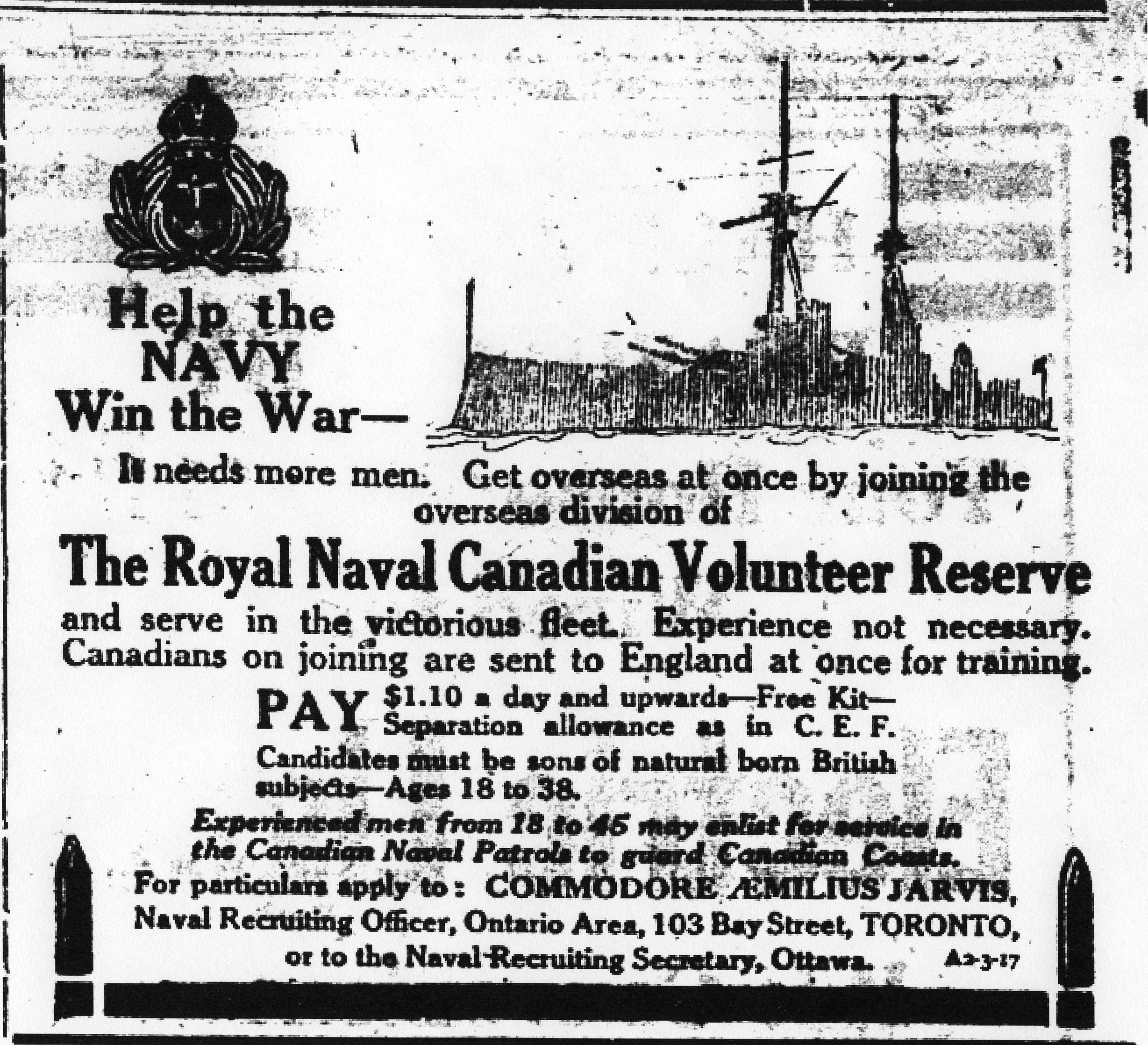
“Help the NAVY Win the War—It needs more men, Get overseas at once by joining the overseas division of The Royal Naval Canadian Volunteer Reserve and serve in the victorious fleet. Experience not necessary. Canadians on joining are sent to England at once for training.

Candidates must be sons of natural born British subjects—Ages 18 to 38.

Experienced men from 18 to 45 may enlist for service in the Canadian Naval Patrols to guard Canadian Coasts. For particulars apply to: Commodore Aemilius Jarvis.”

100 Years Ago: Madoc Recruiting Meetings, West Belleville War Workers Organize, Ad for Oxo, Ad for Wrigley’s

The Intelligencer March 19, 1917 (page 1)

“Lt.-Col. A. P. Allen, Q.C., the 254th Battalion, and the splendid battalion band returned this morning from Madoc, where they held two very successful recruiting meetings on Saturday and Sunday evenings, in the Armouries in that village. Major Campbell, Chief Recruiting Officer, was the principal speaker on both occasions. The Armouries were crowded to the doors at each meeting.”

The Intelligencer March 19, 1917 (page 2)

“The ladies of West Belleville last week assembled for the purpose of organizing a band of war workers. A goodly number were present and proceeded with organization and the election of the following officers: Honorary President.—Mrs. Bailey, Mrs. Anderson. President.—Mrs. McMullen. 1st Vice President.—Mrs. A. E. Wrightmeyer. Secretary.—Mrs. J. S. Hearst.  Assistant Secretary.—Mrs. W. A. Woodley. Treasurer.—Mrs. Lucas. Convenor of Sewing.—Mrs. Grose. Assistant Convenor of Sewing.—Miss Herity. …

As this is an important branch of the Women’s Red Cross, we extend a cordial and felicitous invitation to all the ladies in West Belleville to attend and become members at our next meeting, which will be held on Tuesday, March 20th at 2 p.m. at Queen Mary School. Any person having a sewing machine and table which they would kindly loan for our work would be very acceptable.”

The Intelligencer March 19, 1917 (page 2)

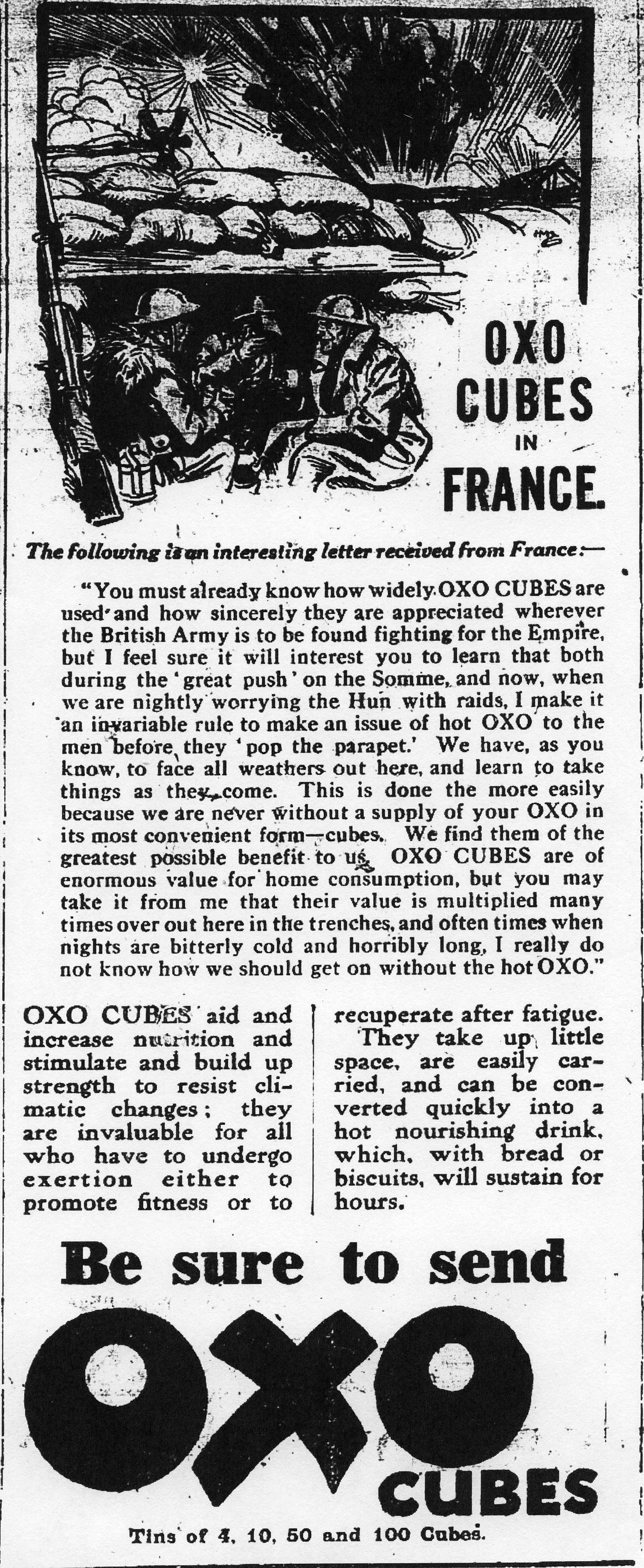
“Oxo Cubes in France. The following is an interesting letter received from France:—’You must already know how widely OXO CUBES are used and how sincerely they are appreciated wherever the British Army is to be found fighting for the Empire, but I feel sure it will interest you to learn that both during the ‘great push’ on the Somme, and now, when we are nightly worrying the Hun with raids, I make it an invariable rule to make an issue of hot OXO to the men before they ‘pop the parapet.’ …

Be sure to send OXO cubes. Tins of 4, 10, 50 and 100 Cubes.”

The Intelligencer March 19, 1917 (page 4)

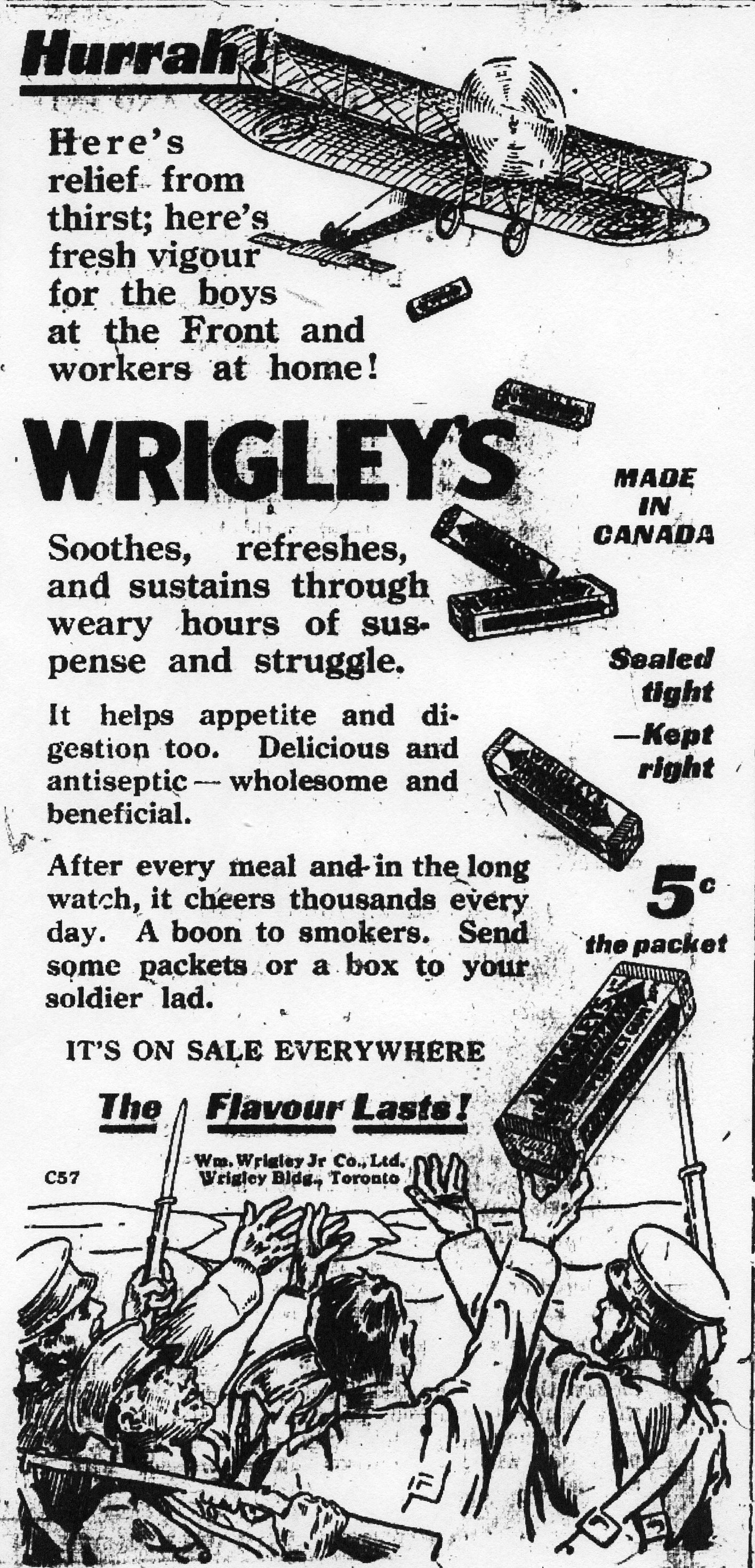
“Hurrah! Here’s relief from thirst; here’s fresh vigour for the boys at the Front and workers at home! Wrigley’s Soothes, refreshes, and sustains through weary hours of suspense and struggle. …

After every meal and in the long watch, it cheers thousands every day. A boon to smokers. Send some packets or a box to your soldier lad.”