100 Years Ago: 80-Year-Old Knits 100 Pairs of Socks, Concert by 254th Battalion Band, George Irvine Enlists, Edward Bellow Is Wounded

The Intelligencer January 2, 1917 (page 2)

“The Soldiers’ Friend. Great honor is due Mrs. James Nobes of Wallbridge, who at the age of 80 years, has knitted 100 pairs of socks for the boys in the trenches. Surely this aged lady has done her bit for the soldiers.”

The Intelligencer January 2, 1917 (page 2)

“At Griffin’s Opera House on Sunday night, a large audience appreciated greatly a sacred concert which was given by the 254th Battalion band. Under the capable leadership of Bandmaster Hinchey, a number of tuneful selections were rendered in a manner that was most pleasing to all present. Bandsman Ayling gave a brief but appropriate recruiting address, and a ladies’ quartette composed of Mesdames Grant, Allen, Nicholson and Duff, rendered a selection which was greatly appreciated.”

The Intelligencer January 2, 1917 (page 2)

“Closed Old Year by Enlisting. George A. Irvine, of the Belleville Post Office staff, is now a full-fledged gunner in the overseas draft of the Cobourg Heavy Battery. He decided to start the new year right and was sworn in at Cobourg on Saturday night.

There are still a few vacancies in the sixth draft which will be leaving for England shortly, and authority is expected this week for the raising of the seventh draft, which several other Belleville men have signified their intention of joining as soon as authorized.”

The Intelligencer January 2, 1917 (page 7)

“Edward Bellow in Scotch Hospital. Mrs. Edith Asselstine, 78 Mill Street, Belleville, On. Dear Madam:—I have the honor to state that information has been received by mail from England, to the effect that 219365 Pte. Edward Bellow, Canadian Expeditionary Force, was admitted to the Voluntary Aid Detachment Auxiliary Hospital, Perth, Scotland, on November 30th, 1916, suffering from a shrapnel wound in the left groin.

Any further communication received will be sent to you without delay. I have the honor to be, Madam, Your obedient servant, Frank Beard, Record Office.”

100 Years Ago: Report of John Phelan’s Death Untrue, National Service Cards

The Intelligencer December 30, 1916 (page 2)

“Mr. J. V. Truiasch of the Belleville Post Office staff, has received a communication from the Militia Department, Ottawa, in reference to Lieut. John Malcolm Phelan. It is to the effect that he was transferred from the 80th Battalion to the 47th Battalion. He was officially reported wounded but evidently returned to duty on November 11th.

It will be remembered that Lieut. Phelan was reported killed about the 7th of December, but this was certainly an error as letters received in Belleville, written by him, bore the date of December 11th, 1916. Lt.-Col. Barragar to-day received a letter from Lt. Phelan bearing the date of December 11th.

His many friends in this city will be pleased to learn that the report of his death was erroneous.”

The Intelligencer December 30, 1916 (page 6)

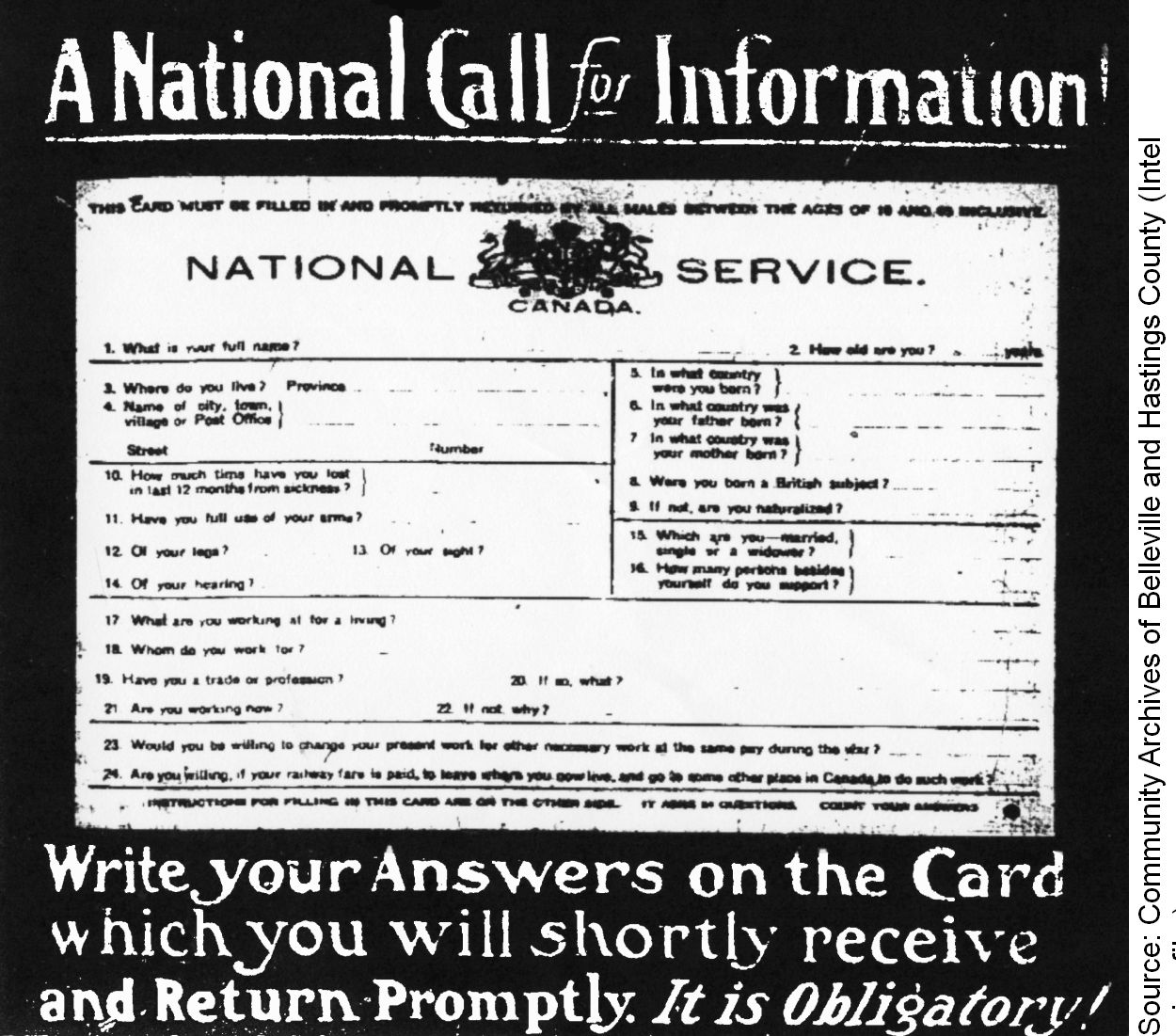
national-service-cards169

“A National Call for Information! National Service Canada.

Write your Answers on the Card which you will shortly receive and Return Promptly. It is Obligatory!”

100 Years Ago: Postmen to Deliver National Service Cards, James Vincent Ross Coming Home, Letter to Munitions Workers

The Intelligencer December 29, 1916 (page 1)

“Distribution of National Service cards by the letter carriers in Belleville commences to-morrow and the collection will start on January 3, Postmaster Gillen announced to-day. …

The letter carrier will ask the keeper of every house on his route how many males between the ages of 16 and 65 reside there and will leave a corresponding number of cards. The keeper of the premises is to distribute the cards to all the male residents in the house between the prescribed ages and to collect same and have them ready for the letter carrier when he calls for them. The letter carrier will check the number of cards returned with the number left at each house. …

Recipients of cards are asked to answer all the twenty-four questions and to write plainly.”

The Intelligencer December 29, 1916 (page 2)

“Coming Home. Mrs. J. V. Ross, No. 1, Emily St., received a letter from her husband, written by him on the 11th of December, stating he was expecting to sail for home in two or three days. Mrs. Ross is expecting him home with this boat that is about to land at Quebec.”

The Intelligencer December 29, 1916 (page 3)

letter-to-munitions-workers168

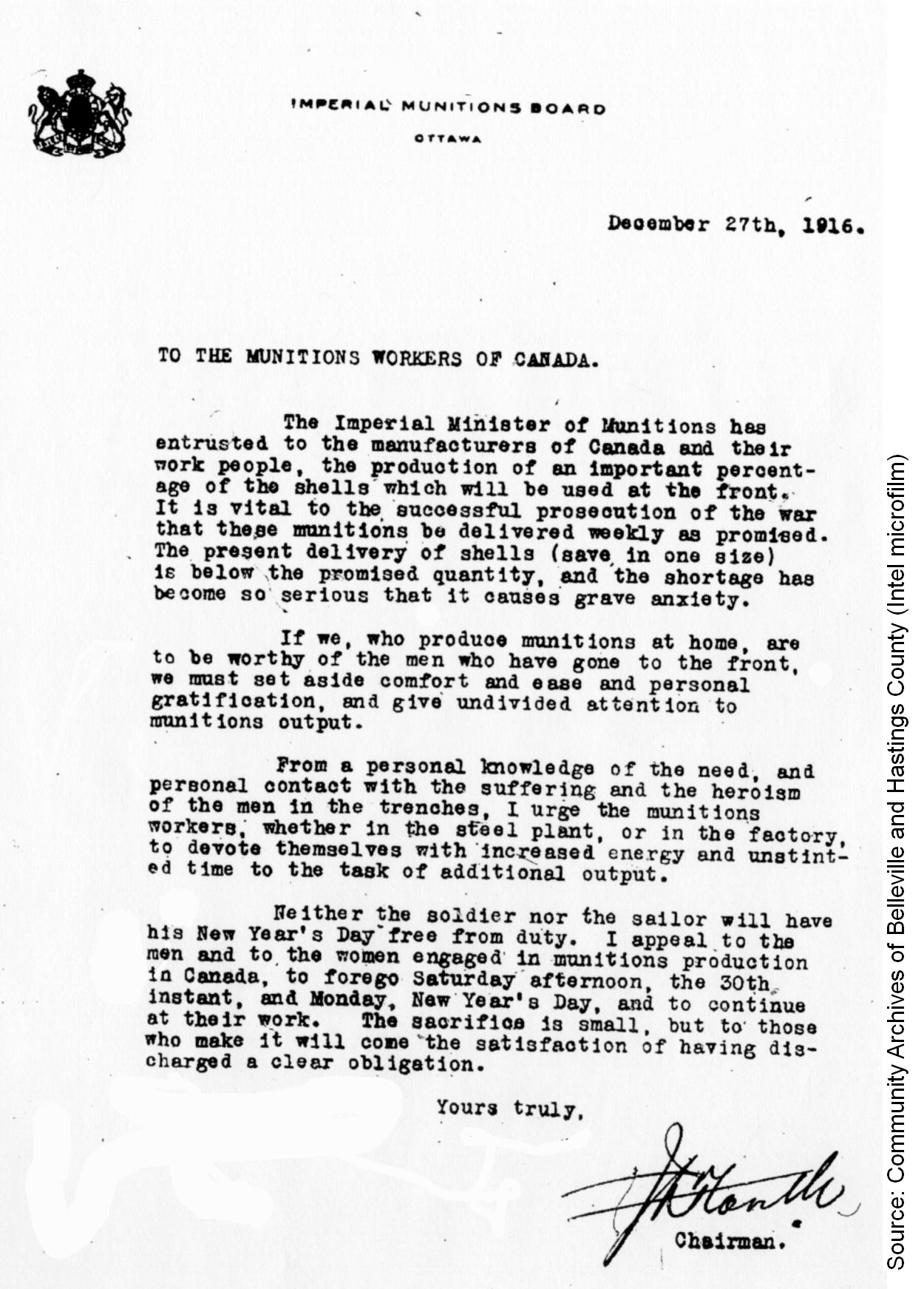
“Imperial Munitions Board, Ottawa. To the Munitions Workers of Canada. The Imperial Minister of Munitions has entrusted to the manufacturers of Canada and their work people, the production of an important percentage of the shells which will be used at the front.

It is vital to the successful prosecution of the war that these munitions be delivered weekly as promised. The present delivery of shells (save in one size) is below the promised quantity, and the shortage has become so serious that it causes grave anxiety.

If we, who produce munitions at home, are to be worthy of the men who have gone to the front, we must set aside comfort and ease and personal gratification, and give undivided attention to munitions output. …

Neither the soldier nor the sailor will have his New Year’s Day free from duty. I appeal to the men and to the women engaged in munitions production in Canada, to forego Saturday afternoon, the 30th instant, and Monday, New Year’s Day, and to continue at their work. The sacrifice is small, but to those who make it will come the satisfaction of having discharged a clear obligation. Yours truly, J. W. Flavelle, Chairman.”

100 Years Ago: National Service Week Coming, 235th Intermediates Prepare for Opening Hockey Game in Kingston

The Intelligencer December 28, 1916 (page 5)

“Regarding the inventory of available man power which is to be taken during the first week in the new year, the following communication has been issued from the National Service headquarters:

National Service Week is drawing very near and the fact that the first week of the new year bears that title is something in which everyone in Canada has an interest. The men are interested because it is obligatory upon each of them, between the ages of 16 and 65 years, to fill out one of the cards the Government is sending to them through the post-office authorities.

The women are interested because their co-operation is being invited in seeing that their men-folk attend to this important duty. The children are interested because their school teachers have explained to them the meaning of National Service and the way in which father and the big brothers at home have to reply to the various questions. …

National Service means that we are to get into that frame of mind which will cause us to think of the needs of the country, to realize that the interests of the State have a greater claim on us than our self-interest. …

There are many ways of serving the nation besides going to the front. The man on the farm and the mechanic in a workshop may be serving the nation as usefully as the man in the trenches. …

The war is teaching us, or should be teaching us, great lessons. Terrible as are its effects, those who have faith in Canadian manhood hope and believe that the nation will emerge from this experience a stronger and a better people. If the meaning of National Service is understood, if the Government’s call for information is responded to in the right spirit, the coming year will be the banner year in Canada’s history.”

The Intelligencer December 28, 1916 (page 6)

“Good Workout Last Evening. Both Junior and 235th Intermediate teams had a splendid workout last evening, in fact one of the best this season. Several new men were out in both the junior and intermediate ranks, and for about an hour the men were matched together in a very stiff game, under able coaching of Ernie Lang. …

A good representation of the 235th Intermediates were out. All these players are little known in Belleville, and are being watched with interest by the local fans. The team is composed of some very good men and is gradually rounding into shape, and with good ice and weather, a strong line-up will face the puck at the opening game on Monday, Jan. 8th, with the Frontenac at Kingston.”

100 Years Ago: Corporal Troup Not Killed, Bible of Raymond Hudson Found, Ernest Geen Returning, Hospital Supplies for French Wounded

The Intelligencer December 27, 1916 (page 2)

“Corporal Troup Not Killed. Some time ago it was announced through the columns of the Intelligencer that Corporal Troup of Belleville, had been killed in action. This evidently was an erroneous report as the following communication has been received by his brother, Mr. Alexander Troup, from the Record office, Ottawa: 59999, Corporal Troup, 21st Battalion. No record in this office, killed in action. Further enquiries will be made.

The many friends of Corporal Troup in Belleville will be pleased to learn that he evidently still is in the land of the living.”

The Intelligencer December 27, 1916 (page 3)

“Private R. G. Hudson. The following communications, received by Mrs. R. E. Hudson, of Belleville, will prove interesting reading for friends of the young man referred to.

Canadian Red Cross Society, London. 8th December, 1916. Dear Madam,—re Pte. R. G. Hudson, 622,703, 27th Canadians.

We put through enquiries some time ago regarding your son who has been officially reported missing since 15th Sept. last. A comrade, Pte. D. Weir 71745, 27th Canadians, gave the enclosed Bible to the British Red Cross Society who, in turn forwarded same to us. Pte. Weir also gave an explanation as to how he found the Bible and we are enclosing copy herewith.

We have noticed your name and address inside and therefore we were able to send the Testament on to you at once. You will of course understand that this is not proof that Pte. Hudson was killed and we are continuing our enquiries.

Now that we have your name and address, we shall only be too pleased to let you know on receiving further information. We shall be pleased to know whether you receive the enclosed safely. I am, Yours truly, M. G. Harrison.

Mrs. Hudson, 26 Hillcrest Ave., late of 42, Gt. St. James Street. Belleville, Ontario, Canada.

Havre, Nov. 9th, 1916, Canadian Infantry 27, M. Sept. 15, 1916. Hudson, R. G. 6222703. He is in A Co. I found a Bible in an old German trench behind Courcelette; they called it the Sugar trench. The Bible was lying on the floor of the funk hole, and has written in it Hudson’s name and the name and address of his mother as well as a photograph. The trench was taken on Sept. 15th, 1916; and I found the Bible about 40 days afterwards.

Informant Pte. D. Weir, 71745. 27th Canadians, C Co. Harfleur, R. D. M. Address, 9 Mordaunt Place, Brighton, Glasgow.”

The Intelligencer December 27, 1916 (page 5)
geen-ernest

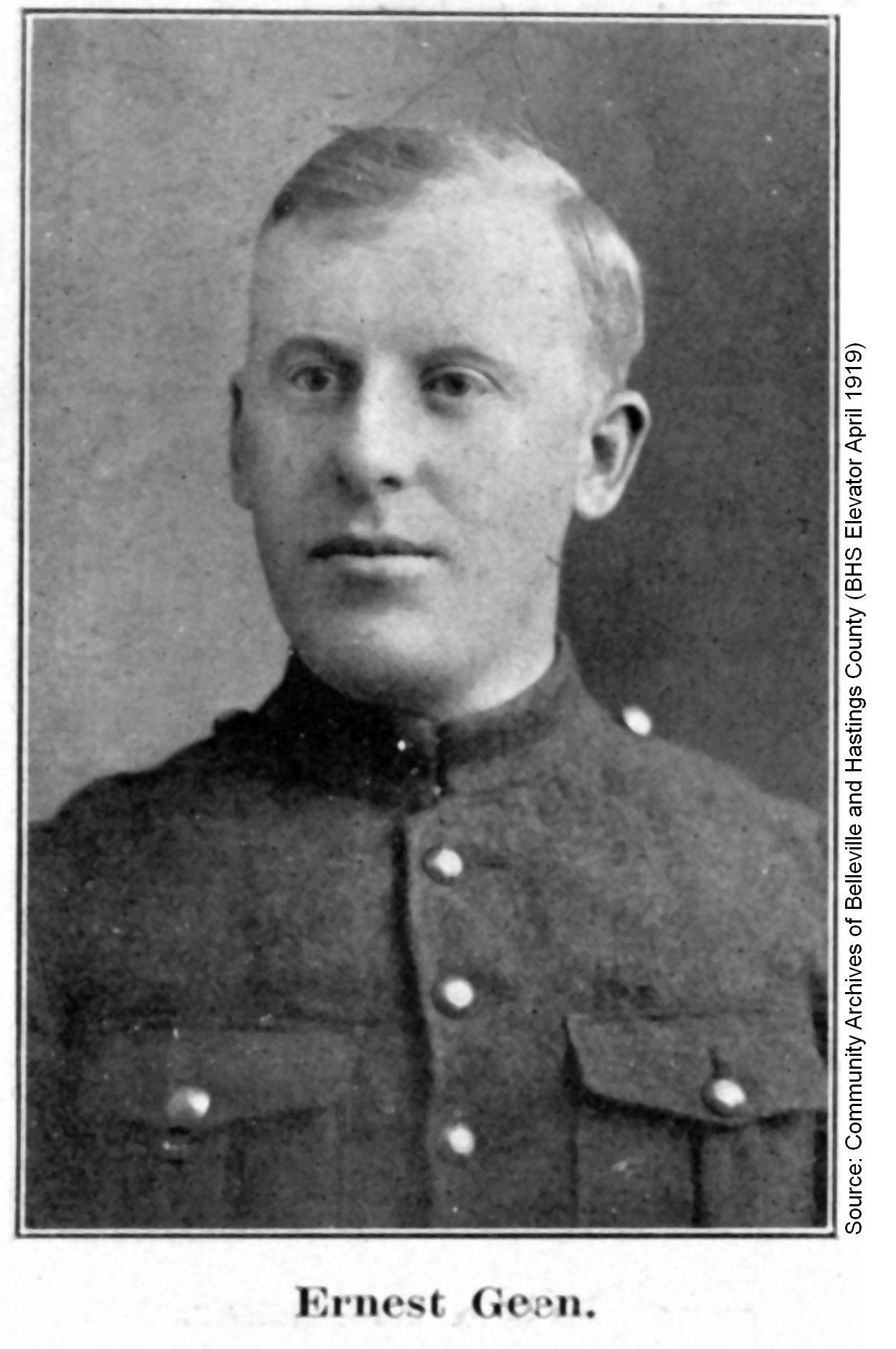
“Lieut. Ernest Geen who has been transferred from the 21st Battalion to the 254th Battalion, sailed for Canada from England on Sunday, Dec. 24th.

Lieut. Geen, left Belleville as a private in the 21st Battalion, holding rank of Lieut. in the 15th Regt.; by his faithfulness to duty he received his promotion on the field of battle some time ago.”

The Intelligencer December 27, 1916 (page 5)

“French Wounded. 44 Lowndes Square, London, S. W. December 11th, 1916. Mrs. Lazier, 186 John Street, Belleville, Ont., Canada.

Dear Mrs. Lazier:—I was most delighted to receive three cases containing such excellent supplies for the hospitals and coming from the River Valley Womens’ Institute and Roslin Institute, the Tweed Red Cross Society.

May I ask you to convey to all the ladies who so kindly made and donated these excellent things, the sincere thanks of the Committee of the French Wounded Emergency Fund, assure them that we will send the things to France as soon as possible, choosing the most needy hospitals requiring this help.

Our delegates report a great deal of distress through lack of warm clothing in Brittany and in the southeast of France, especially in the smaller towns and villages where there is no wealthy population to assist in keeping up the supplies for the hospitals, as well as hospital appliances of all kinds, which, through constant use have deteriorated very much after two years of warfare.

It gives me very great pleasure as a Canadian, to receive bales such as yours, from my own country, and I have been most gratified by the many donations sent from Canada to our work.

We are expecting this morning a visit from H. R. H. The Duchess of Connaught, who has kindly consented to become our patroness. I shall have much pleasure in telling her of the consignment received from Belleville district, and I know she is still keenly interested in all that concerns Canada and its people. Sincerely yours, C. M. Dobell, Hon. Sec. Canada.”
100 Years Ago: The King’s Message, Farmers Need Hotel Stables

The Intelligencer December 26, 1916 (page 1)

“The King’s Message. Ottawa, Dec. 24—The following messages have been received from his Majesty the King by the Governor-General to be communicated to soldiers and sailors:

‘London, Dec. 23—I send you, my sailors and soldiers, hearty good wishes for Christmas and the New Year. My grateful thoughts are ever with you for victories gained, for hardships endured and for your unfailing cheerfulness.

Another Christmas has come round, and we are still at war. But the Empire, confident in you, remains determined to win. May God bless and protect you.’ George, R. I.

Also the following cable to the sick and wounded:

‘At this Christmastide the Queen and I are thinking more than ever of the sick and wounded among my sailors and soldiers. From our hearts we wish them strength to bear their sufferings, speedy restoration to health, a peaceful Christmas and many happier years to come.’ George, R. I. ”

The Intelligencer December 26, 1916 (page 1)

“Farms Are Calling for Accommodation. Kingston. Farmers are complaining about lack of accommodation for their horses, now that several hotels have closed their doors since the new Temperance Act went into force.

In this cold and stormy weather good stabling is required; and just at present it cannot be got because of the closing of hotels and the fact that the military authorities have rented a number of hotel stables. The farmers think that those directly responsible for this condition of affairs should devise ways and means at once of meeting their needs.”

100 Years Ago: Soldiers’ Christmas Menu, National Service Notice

The Intelligencer December 23, 1916 (page 3)

“Christmas Dinner, Monday, December 25th, 1916. The following list of good things is the menu of Christmas Dinner to be served to the men of the 235th Battalion at their barracks on Monday. It is evidence of care and interest that is being taken in the men by the officers who have been untiring in their efforts to make it a huge success.

Cream Tomato Soup, Roast Turkey, Cranberry Sauce, Potato Salad, Roast Pork, Brown Gravy, Bread Dressing, Vegetable Salad, Mashed Potatoes, Mashed Turnips, Creamed Carrots, Creamed Green Peas, Buttered Beets, Olives, Mixed Pickles, Celery, Plum Duff, Hard Sauce, Apple Pie, Mince Pie, Layer Cake, Tea and Coffee, Assorted Fruit and Nuts, Cigars and Cigarettes.”

The Intelligencer December 23, 1916 (page 4)

national-service167

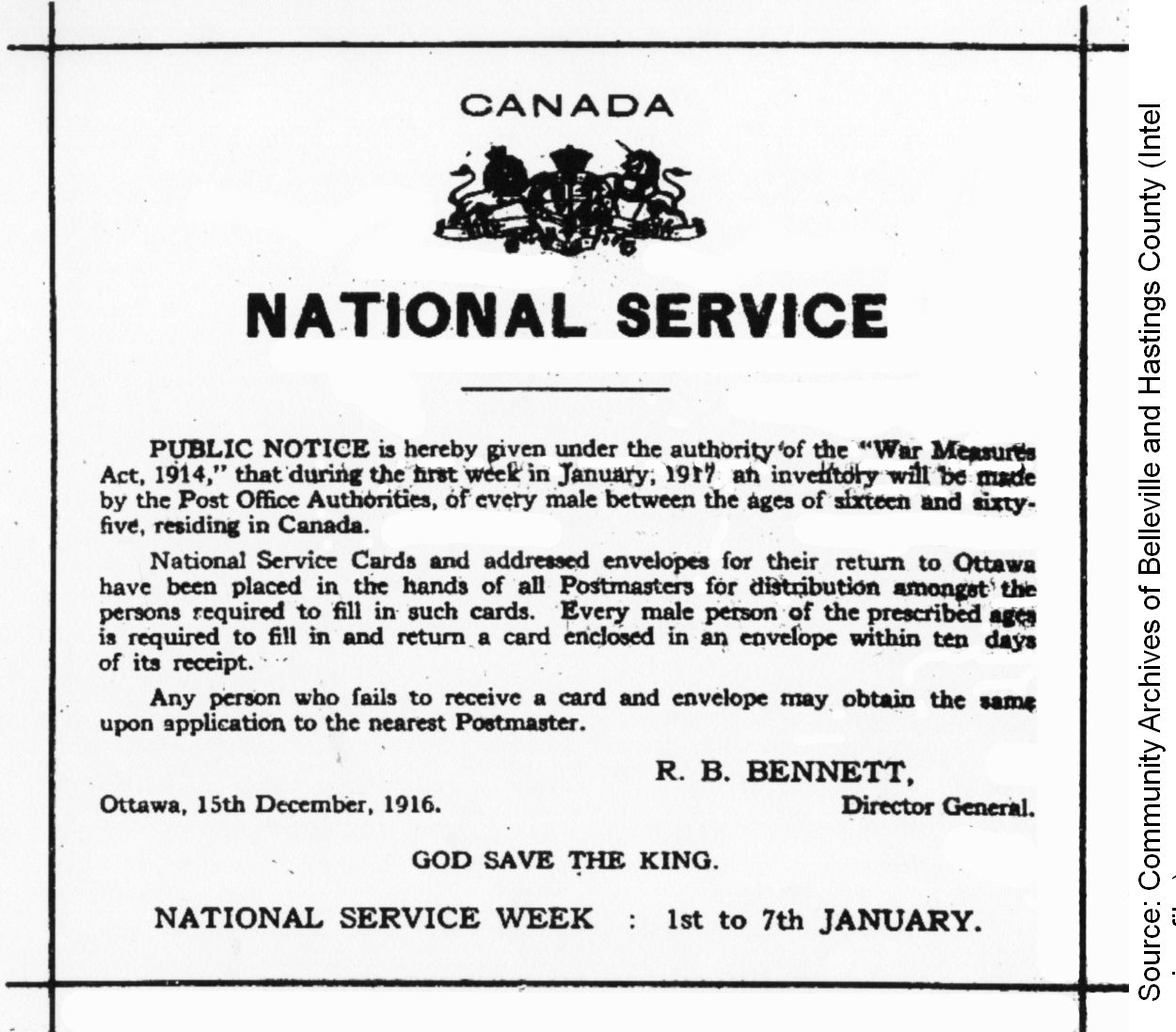
“Canada National Service. Public Notice is hereby given under the authority of the ‘War Measures Act, 1914,’ that during the first week in January, 1917, an inventory will be made by the Post Office Authorities, of every male between the ages of sixteen and sixty-five, residing in Canada.

National Service Cards and addressed envelopes for their return to Ottawa have been placed in the hands of all Postmasters for distribution amongst the persons required to fill in such cards. Every male person of the prescribed ages is required to fill in and return a card enclosed in an envelope within ten days of its receipt.

Any person who fails to receive a card and envelope may obtain the same upon application to the nearest Postmaster. R. B. Bennett, Director General. Ottawa, 15th December, 1916.

God Save the King. National Service Week: 1st to 7th January.”

100 Years Ago: Christmas Day Plans for Soldiers, Dinner for the Poor

The Intelligencer December 22, 1916 (page 2)

“Christmas Day is to be fittingly observed by the men of the 235th Battalion, by holding a monster dinner at the barracks on Pinnacle street. Twenty turkeys have been secured and together with the usual Yuletide luxuries will go to make up a feast that will long be remembered by the soldiers. Lt.-Col. Scobell and the company officers of the battalion, will be present.

Major Southey of No. 2 Company will relate to the men at dinner how Christmas was celebrated last year in the advanced Canadian trenches, with Mr. Boche only 30 yards away. Sergt. Greenwood of the same company will also describe how Christmas was celebrated in a base hospital, somewhere in France, where he was unfortunate enough to find himself a year ago.

No recruiting meeting will be held this Sunday, Christmas Eve, but the soldiers suggest that the most fitting gift that can be made in this terrible time of war is a gift of a man to the country and Empire. The military authorities respectfully submit this for the consideration of all loyal citizens.

Fifty per cent of the men of the 235th Battalion have been given Christmas leave. The remainder of the men will be given leave at New Years.”

The Intelligencer December 22, 1916 (page 2)

“Xmas Dinner for Poor. Every arrangement has been made whereby every poor family in the city will be provided with a Christmas dinner. At 2 o’clock tomorrow afternoon at St. Thomas church Parish Hall they will give the dinner. This generous act has been made possible by the various churches and other organizations in the city.”

100 Years Ago: Captain Joseph Edward McCorkell on Furlough, Railway Lines Taken Up and Sent to France, Driver Frank Palmer Dies, 235th Hockey Team at Practice

The Intelligencer December 21, 1916 (page 2)

“Reception to Returned Soldier. Capt. J. E. McCorkell, a member of the 39th Battalion which left here over two years ago returned to this city yesterday on a short furlough, coming over from England in charge of a number of invalided soldiers and was tendered by the citizens of Belleville a most hearty reception. It was anticipated that other returned heroes would have arrived here yesterday but from some cause they did not.

Capt. McCorkell arrived here at 3 p. m., by the G. T. R. International Express and many citizens were at the station to give him welcome. Prominent among them were Mayor Ketcheson, ex-Mayor Col. Marsh and ex-Mayor Ackerman. Upon alighting from the train the Capt. was received with cheers and entered ex-Mayor Ackerman’s car which was appropriately decorated with the Union Jack and bunting.

A parade was then formed and triumphantly Capt. McCorkell was escorted down Station street to Front street. At intervals he was loudly cheered. The procession was headed by the 235th Battalion Band, followed by an escort of the 254th Battalion under Lieut. Leavens, after which came the car containing Capt. McCorkell followed by a number of cars decorated with flags, etc.

The procession proceeded down Front St., to Bridge and up Bridge St. to the Post Office building where Capt. McCorkell will visit his father-in-law, Mr. S. F. Haight. After alighting at the Post Office, Capt. McCorkell made a brief speech thanking the citizens for their enthusiastic welcome after which he was cheered by the assemblage.”

The Intelligencer December 21, 1916 (page 6)

“Material For The Firing Line. Three hundred miles of Canadian Government Railways and some 220 miles of privately owned railway lines in this country are to be immediately taken up to supply railway material for military lines in France.

Other trackage on Government and private lines will later be removed until in all at least 1,000 miles of complete roadway has been supplied by Canada. Such was the announcement made after to-day’s meeting of the Cabinet. …

The transportation facilities in France have been inadequate to permit the Allies to take full advantage of the material and supplies available, and it is felt that the war could be materially shortened and thousands of lives saved if sufficient additional railway facilities could be provided promptly. …

It became apparent that the munitions work on which the Canadian mills are at present engaged precluded any possibility of early delivery of rails, tie plates, bolts, etc., from those quarters and it was evident that the situation could be properly and promptly met only by the taking up of Canadian tracks. …  the first 20-mile section, sufficient to load one steamer, is on the way, and other material will be forwarded as promptly as British boats can take care of it at the seaboard.

It is expected that at least one thousand miles of complete roadway be supplied by Canada, and in order to facilitate the taking up of rails all local labor available will be used, but where this is not sufficient troops will be employed to rush the work through.”

The Intelligencer December 21, 1916 (page 7)

“Corbyville Family Sorely Bereaved. Heartfelt sympathy will be extended to Mr. and Mrs. R. R. Palmer of Corbyville, owing to the death of their son, Driver Frank Palmer, which occurred at Kingston hospital yesterday.

The sorrow is to a certain sense a double one as only some weeks ago another son, Private J. J. Palmer was killed in action at the front. Two other sons, Private Arthur C. and Allen C. are at present in the firing line somewhere in France.

Driver Palmer who was 26 years of age, enlisted in a battery but owing to illness was prevented from going overseas. He was at Kingston and his illness became so acute as to prevent his removal. He was born at Corbyville where he always lived. Deceased was a bright young man and his demise is sincerely regretted by his comrades in arms who knew him.

The remains were today brought from Kingston and taken to the parents home at Corbyville. In addition to the parents and two brothers at the front two others are living namely, James E., of Rochester, N. Y. and S. B. at home.”

The Intelligencer December 21, 1916 (page 7)

“First Practice. About twelve men of the 235th Hockey Team turned out for their first practice of the season last evening. Two of the Belleville Juniors also were out, and from 6.45 to after 8 o’clock a stiff workout was held.

The 235th Battalion has some very good fast material on their team who will it is hoped bring the bacon home this year. Among those taking part in last night’s workout were Huffman, Kent, Cryderman and Marshall. All these men show lots of speed and considerable stick handling ability.

The next practice will be held on Friday evening, when it is expected that sufficient men will turn out to form two teams which will make things interesting.”

100 Years Ago: Robert Troup Killed, George Hearns Killed, John Drury Wounded, Munitions Needed

The Intelligencer December 20, 1916 (page 2)

“Another Local Soldier Killed. Word has been received in this city of the death at the front of Corporal Robert Troup of Belleville. ‘Bob’ as he was familiarly called, was a Grand Trunk engineer, having been running an engine in Belleville for three years and was about 30 years of age. He enlisted with the 21st Battalion at Kingston, and has been at the front for some time. He was a transport driver, and also won an extra stripe on the field.

With the death of Robert Troup also came the official notice that his brother, an officer in the Seaforth Highlanders, had been wounded. Deceased has one brother in Canada, who resides at Gananoque. He was a highly respected member of the Brotherhood of Locomotive Engineers of this city, and his heroic death is sincerely regretted by his brother trainsmen.”

The Intelligencer December 20, 1916 (page 3)

“News has been received that Private George Hearns of the 80th Battalion, has been killed. No particulars as to how he met his death have as yet been received. He had been in the trenches about three months and had written letters frequently during that period.

Pte. George Hearns enlisted on November 20, 1915, and left Belleville on Saturday evening, May 13th, 1916 with the 80th Battalion to go overseas. He spent the summer in England and reached the fighting scene in the fall.

Private George Hearns was taken from the ‘Children’s Shelter’ in Belleville when he was a little boy by Mr. and Mrs. Donald Robertson of Roslin, Ontario, where he soon came to be regarded as a member of the family. He attended the Carter school on the 8th Concession of Tyendinaga where he was always a favorite with his teachers and school mates.

In the fall of 1914 he hired to Mr. George Henderson, a farmer, who resides on the 4th Concession of Tyendinaga, and he stayed with him one year, during which time he frequently visited his home in Roslin where he ever received a warm welcome. As soon as the time he had hired for was expired, he went to the home of his foster-brother, Mr. W. D. Robertson, also of the 4th Concession of Tyendinaga.

It was while he was staying there that the call of duty came home to him, and he enlisted in Belleville, November 20, 1915, leaving Mr. Robertson’s home the following Monday to begin his training as a soldier of the King. As long as he was in Belleville his friends often saw him and he visited them quite frequently and spent a happy week with them last Christmas.

Private George Hearns was 20 years of age, and a young man of handsome appearance and fine physique, and he was possessed of very pleasing manners which endeared him to all with whom he came in contact with.

Another young life laid down for King and Country given up for the principles of righteousness and justice. Although he is buried many miles away from here and those who grieve for him are not privileged to strew flowers on his grave as tokens of their affection for him. Still the memory of his noble sacrifice will ever be treasured as sacred in the hearts of those who loved him as their own.”

[Private George Hearns died on November 18, 1916. He is commemorated on Page 101 of the First World War Book of Remembrance.]

The Intelligencer December 20, 1916 (page 3)

“Mrs. Emily Drury, residing in Belleville, yesterday received the following telegram which explains itself: Ottawa, Ont., 18th, 1916. Mrs. Emily Drury, 21 Murney St., Belleville, Ont.

Sincerely regret to inform you that 310949 Private John Charles Drury, artillery, officially reported wounded, December 4th, 1916, will send further particulars when received. Officer in Charge Records.”

The Intelligencer December 20, 1916 (page 5)

munitions166

“The Roar of our Destroying Guns on the Firing Line cannot go on without the roar of machinery in the Munitions Plant.

The giant guns belch their unending stream of munitions fed ceaselessly from the storehouse in the rear.

Our soldiers are second to none.

Our production of munitions must exceed that of our enemies.

Munitions are the need of the hour.

Every Shell is a Life Saver. Mark H. Irish, Director of Munitions Labor, National Service Board, Canada.”