100 Years Ago: Belleville Canadian Patriotic Association Notice

The Intelligencer March 16, 1915 (page 2) Canadian Patriotic Association

“Belleville Canadian Patriotic Association. A Meeting will be held in the Armouries on Tuesday Evening, March 16, at 8 o’clock for the purpose of Arranging for a Campaign for Funds for the Canadian Patriotic Association.

All the Men of Belleville are requested to be present. God Save the King. W.H. Panter, President. H. Sneyd, Hon. Secretary.”


100 Years Ago: In the Trenches

The Intelligencer March 15, 1915 (page 1)

“Belleville’s Splendid Boys Fear Not Germans or Shells. At the special request of Sir Mackenzie Bowell the following interesting letter, received today, is given for publication:

France, Sunday, 21st Feb., 1915. Dear Dad: Well, we have had our baptism of fire and have just returned to billets for a few hours’ rest. We were up in the first line trenches, some of which are only 100 yards from the Germans. It was great. After the first half hour was over it becomes something indescribable. A great intense zest arises and one immediately begins to call all his thinking powers together in order to outshoot and outpost the enemy.

We went into the trenches at 3 a.m. on Friday, amidst bursting shells and machine gun fusilades in addition to searchlights and huge star shells. Such a sight and sound it was. Wonderful! By the time dawn came we had settled down to our work and overcome any little nervousness men naturally have when marching in, and in front appeared the trenches of the Germans. Shells started at dawn again, but our artillery was quite equal to the occasion. …

The country around here is in an awful state, bearing tragic witness to the great struggle that has lasted for weeks. Of course we notice these things more now than we will later on, but everything is laid waste. …  The men behaved splendidly and their work was highly complimented by British officers who have been here for weeks. All the Belleville 15th and 49th boys are fine and untouched so far. …  Now, dad, I am off to bed in a very comfortable billet, and from the way I feel I will sleep every minute of the few hours I have. Good-bye and dear love to you all. DICK.”

[Note: this letter is from Richard D. Ponton]

100 Years Ago: Belleville Patriotic Association Update

The Intelligencer March 13, 1915 (page 2)

“Belleville Patriotic Association. 113 citizens of Belleville have each made one or more individual contributions, ranging from $200 to 50¢ each. Included in this list are 25 citizens, who have promised regular payments each month as long as the war lasts; and one citizen who promised regular monthly contributions for a stated number of months.

In addition to the above list of 113 citizens, there are 52 groups of contributers, comprising Brotherhoods, Lodges, Fraternities, Societies, Entertainment Committees, Church Associations, Employees of Railways, of Mercantile Houses, and of banks, officers in the Government Service, Woman’s Clubs, Staffs of Colleges and of Schools, Companies, etc., who have each made contributions ranging from $516., down to $5.00. Ten of these groups have promised regular monthly contributions as long as the war lasts. A good many of the 113 Citizens above mentioned are also contributing through the Lodges, Societies, Associations.

There is still, however, a large portion of Belleville’s population of 11,000 who have not yet signified what they intend to contribute to the Patriotic Fund.”

100 Years Ago: 15th Regiment Return of Military Clothing and Equipment

The Intelligencer March 9, 1915 (page 2)

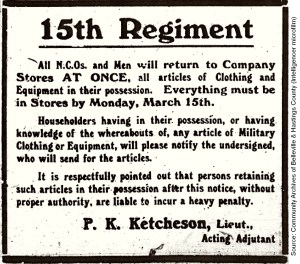
“15th Regiment. All N.C.Os. and Men will return to Company Stores AT ONCE, all articles of Clothing and Equipment

15th Regiment
15th Regiment

in their possession. Everything must be in Stores by Monday, March 15th.

Householders having in their possession, or having knowledge of the whereabouts of, any article of Military Clothing or Equipment, will please notify the undersigned, who will send for the articles.

It is respectfully pointed out that persons retaining such articles in their possession after this notice, without proper authority, are liable to incur a heavy penalty. P.K. Ketcheson, Lieut., Acting Adjutant”

100 Years Ago: Second Contingent Reaches Shorncliffe

The Intelligencer March 8, 1915 (page 1)

“Shorncliffe Camp Greets the Second Contingent from Canada. London. (Special) The four thousand men of the second Canadian expeditionary force who have reached England will be quartered at Shorncliffe camp, which is a big improvement over Salisbury Plain, and the men will be more comfortably quartered than the Canadians who came across in October. The camp at Shorncliffe is within a mile of the railway station, and is located on dry soil. There are paved roads and sidewalks, and there are brick huts to quarter the troops. The camp is also within easy reach of Folkestone, one of the most pleasant and picturesque seaside resorts in England.

Although the arrival of the contingent was quietly effected, the Canadians were given an enthusiastic reception when they reached Liverpool on Thursday night, the welcome being all the more hearty because the appearance of the troopships dispelled the rumors from hostile sources. The movement of the troops from the port to the camp was begun on Friday, and by midnight on Saturday the last of the troops had reached Shorncliffe.

The health of the men on the voyage is reported to have been excellent. On one of the ships a grand military athletic tournament was held during the voyage. Some of the men seem to fear that they will not get a chance to go to the front like the first Canadian contingent. This is caused by the belief that the war will be over before their period of training in England is completed.”

100 Years Ago: Banquet for 49th Hastings Officers

The Intelligencer March 6, 1915 (page 1)

“It was a thoughtful and most generous act on the part of Col. W.G. Ketcheson, the popular commanding officer of the 49th Hastings Regiment, when at Hotel Quinte last night he tendered a complimentary banquet to seven officers of his regiment who have volunteered as members of the second and third overseas contingents. Two officers, namely Capt. J.H. Mills and Lieut. A.P. Miller, are in the second contingent, and those on the honor roll of the 3rd contingent are Major A.E. Bywater, Capt. R. Vandervoort, Capt. J.L. McLean, Lieut. H.B. McConnell, Lieut. G.E.G. Craig, and Lieut. W.W. Wallace. All were present and occupied seats together at the head of the table.

The spread provided by mine host Mr. J.V. Jenkins, was all that could have been desired, and it was faultlessly served. It is needless to state that all did justice to the fine spread provided.

The menu was as follows: MENU. Oyster Cocktail, Queen Olives, Celery, Cream of Tomatoes, Filet of Halibut au Vin Blanc, Sliced Cucumbers, Pommes Anna, Sweetbreads a la Toulouse, Saratoga Chips, Young Stuffed Turkey, Cranberry Sauce, Mashed Potatoes, Asparagus, Black Duck, Currant Jelly, Fried Hominy, Steamed English Plum Pudding, Brandy Sauce, Neapolitan Ice Cream, Assorted Cakes, Mixed Fruit, Cheese, Cafe Noir.

Whilst supper was being partaken of an inspiring programme of music was furnished by the Sills Orchestra. The selections were much enjoyed. At the conclusion of the repast the first toast proposed was that of ‘The King.’ The National Anthem was sung by the company.”
100 Years Ago: Poster for Artillery Recruits

The Intelligencer March 5, 1915 (page 2)

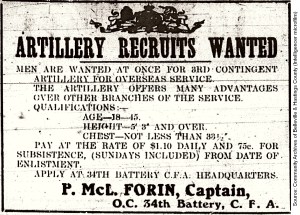
“Artillery Recruits Wanted. Men are wanted at once for 3rd contingent artillery for overseas service. The artillery Artillery Recruits Wantedoffers many advantages over other branches of the service.

Qualifications: Age—18–45. Height—5′ 3″ and over. Chest—not less than 33 1/2″.

Pay at the rate of $1.10 daily and 75¢ for subsistence, (Sundays included) from date of enlistment.

Apply at 34th Battery C.F.A. Headquarters. P. McL. Forin, Captain, O.C. 34th Battery, C.F.A.”

100 Years Ago: Letters Pass the Censor

The Intelligencer March 4, 1915 (page 2)

“Letter from Gunner Wm. Paterson, 34th Battery. France. Feb. 16, 1915. Dear mother.—We are in France, ten miles from the firing line. We are not allowed to tell where, how or when. We can hear the gun fire distinctly. I was in a nearby village last night and saw a shell burst ten miles away on the firing line. We are billeted at a farm house, and sleep up in a loft over the barn—it is great.

We landed on the west coast of France and came across to the front by train. It has been raining ever since we landed until today. Now it is fine weather, and nice and warm, with the sun shining. It is sure La Belle France, when the sun shines.

When the Germans were advancing in France they slept in the barn that we occupy now. This is the last piece of paper I have got, so with your reply send paper and envelopes. My address is: Gunner Wm. M. Paterson, 4th Battery 1st Artillery Brigade, 1st Canada Contingent, British Expeditionary Force, France. Your loving son, BILL.

The boys can’t write long letters now, telling all they know. This letter had to pass the censor.”

100 Years Ago: Nine Foreigners to Fort Henry

The Intelligencer March 3, 1915 (page 2)

“Nine Foreigners Go to Fort Henry. Last evening, under an escort of a sergeant and members of the 15th regiment, who have enlisted here as members of the third contingent, nine foreigners were taken to Kingston, it being alleged that they were endeavoring to leave this country for the United States. There were eleven arrested but a man and his wife, who were amongst the party were allowed to return to their home at Point Ann.

When the escort and party arrived at Kingston they were compelled to march about three miles to Fort Henry where the foreigners were placed in charge of the military authorities.”

100 Years Ago: Foreigners Interned in Belleville

The Intelligencer March 2, 1915 (page 2)

“Eleven Foreigners Are Interned in Belleville. Ten Men and One Woman Comprise the Party. …  Yesterday afternoon it came to the ears of the military authorities of this city, that a number of foreigners who had been employed at the Cement Works at Point Ann, were about to leave the city owing to the fact that the cement works were closed down and had been closed down for some weeks.

These foreigners comprised Hungarians, Austrians and others who were formerly residents of countries who are at war with Great Britain and other allies. …  Five were apprehended at the G.T.R. station and six at the C.N.O.R. station. They were taken in charge and escorted to the police station, where they were detained, nominally on the charge of leaving the country without the proper passports. …  Three of them at least were anxious to remain in Canada, and all of the men stated that they were by no means friendly to Germany in the present conflict.”

[Note: G.T.R. = Grand Trunk Railway;  C.N.O.R. = Canadian Northern Railway]