100 Years Ago: New Food Regulations Include Lawn Socials and Picnics, Widows’ Pensions in Ontario, More Men Than Needed for Farms

The Intelligencer July 13, 1918 (page 1)

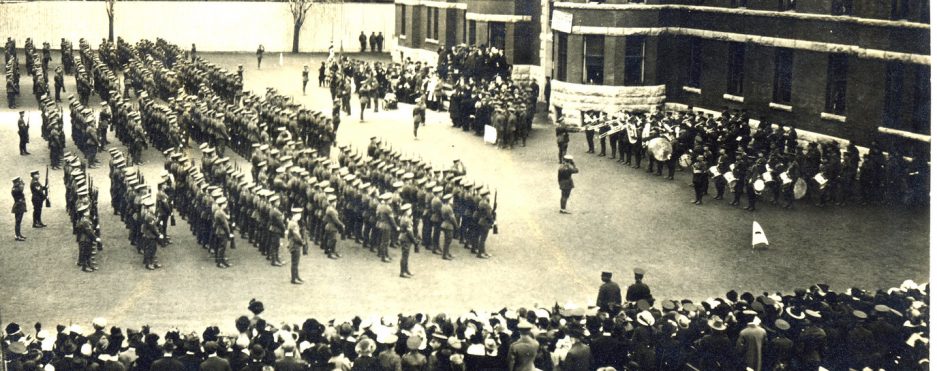
“Canada’s New Food Regulations Include Lawn Socials and Picnics. The following regulations shall apply to all: Public eating places [which] shall include hotel, restaurant, cafeteria, club or club-room, private family keeping boarders, boarding house, school, dining car, steamship, or any place whatsoever where meals or refreshments are regularly served or sold to others than members of the family or household of the proprietor or caterer

Public entertainments, lawn socials, bazaars and tea meetings, public luncheons, dinners and picnics, fairs and exhibitions, lodge, club and fraternal societies’ meetings; and all such places of a like or similar character

Private and semi-private luncheons, dinners, parties and picnics where food or refreshment is served to fifteen or more persons other than members of the family or household of the proprietor; save and except fishing and cargo vessels, military, lumber, logging, mining construction and fish curing camps, hospitals and such places as may hereafter be excepted by the Canada Food Board. …

Sugar receptacles shall not be left on dining tables or counters, except in railway trains and steamships.

Sugar shall not be served unless and until asked for.

For sweetening beverages, not more than two teaspoonfuls or an equal weight of sugar shall be served to any person at any one meal.”

The Intelligencer July 13, 1918 (page 1)

“Pensions For Widows Necessary In Ontario. Toronto. The wisdom of undertaking a scheme of mothers’ pensions is being impressed upon the Ontario Government. These pensions are—or would be monthly allowances to widows with children which would enable them to stay home and care for their family, instead of going to work and sending the little folks to institutions. It is pointed out that the State has to bear a large portion of cost maintaining such places, and that it would be relieved of a part of this burden if it pensioned the mother instead.

In addition, the children would be brought up in the home under a mother’s care, which is the natural and desirable condition. And the great army of children who are not even sent to an institution while their mother works, but who are left to play around home, or to be the careless oversight of some neighbor, would be given a start in life under much more auspicious conditions. The mother would, in reality, be paid to look after her family instead of being paid for some outside work.”

The Intelligencer July 13, 1918 (page 2)

“More Men Offer Than Needed for Farms. Ottawa. There should be no dearth of farm labor for harvesting the crop in Ontario this fall. Senator Gideon Robertson, head of the Canada Registration Board, when seen stated that the number of men signifying their willingness to work on farms during the harvesting season was much larger than could possibly be utilized in the Province.”

 

Nurses of World War I: Nonie Winnifred Milburn

Nonie Winnifred Milburn was born at Belleville on September 7, 1873 daughter of Edward Milburn and Isabella Benjamin. The father of our subject was a teacher and served as principal of the Belleville High School from 1894 to 1908; he was a life-long friend of Sir William Osler. She lived with her parents at 216 Charles Street and maintained that address for the duration.

House at 216 Charles Street, Belleville

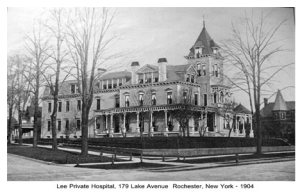
She was educated locally and was probably a graduate of the Nursing School at the Dr. John Lee Private Hospital in Rochester, N.Y. about 1909; following graduation she remained in the employ of the Hospital.

Miss Milburn enlisted in the Canadian Army Medical Corps on February 19, 1917 at Kingston.

Height: 5’ 4”

Weight:  142lb

Age: 43 (stated age: 33)

Nursing Sister Milburn served in military hospitals in England including Westenhanger, Brighton, Buxton and Shorncliffe and at St. Claud, France. Here she was bothered by recurrent sciatica and was hospitalized for treatment and later treated for influenza at Kinmel Park Medical Hospital. She returned to Canada setting sail aboard the S.S. Celtic on July 3, 1919 and was discharged on July 15, 1919. Miss Milburn worked at the Belleville Hospital for some years after her return.

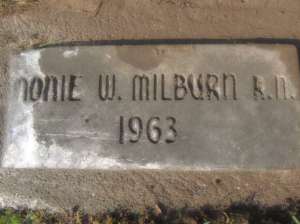
Nonie Winnifred Milburn died at Kingston on February 20, 1963 aged 89 years 5 months 13 days. She is interred at the Belleville Cemetery Section K Row 7 Grave 3.

100 Years Ago: Shell Shock Treated at Cobourg, West Hastings Registration

The Intelligencer July 11, 1918 (page 1)

“Shattered Nerves Restored at Cobourg. In this war as in no former war, heavy artillery and high explosives play a leading part. This feature has brought about a type of casualty which was rarely known in other wars, namely, shell shock, bringing with it mental or nervous disability.

On various occasions prominent medical men have tried to prove that there is really no such thing as shell shock, but in spite of that large numbers of men are returning to Canada, rendered unfit for further military service by nervous or mental collapse, due to the strain of modern warfare and the conditions under which men live and fight on the battlefields overseas. These men are, in many cases, in worse condition than those who have lost their limbs, and only the most skilled and careful treatment will ever fit them for former civilian occupations. …

Fortunately for them, the medical staff of our army is fully alive to their needs and have provided special hospitals for them where every device and treatment known to the medical world is provided with a view to bringing about cures. The centre for such treatment in Ontario is at Cobourg and the institution goes under the name of the Ontario Military Hospital.”

The Intelligencer July 11, 1918 (page 1)

“Registration In West Hastings. Mr. J. A. Kerr, of this city, registrar for West Hastings, has received the complete returns from the various deputy registrars appointed in the riding and they show that the total registration was 24,011, of which, 12,108 were males and 11,903 were females.”

100 Years Ago: Belleville Board of Trade Discusses Coal Situation, Food Purveyors’ Ads Must Include License Number, Fine Potato Crop

The Intelligencer July 10, 1918 (page 1)

“Coal Question Taken Up By Belleville Board of Trade. At the monthly meeting of the Board of Trade held last evening, there was a goodly number of members present, and during the session several matters appertaining to the city’s welfare were discussed. After considerable discussion a committee was appointed to investigate the coal situation in the city having especial reference to the price charged. …

President Marsh said he had obtained prices from several places and the only place where the prices were the same as Belleville was Peterboro. This was a serious question affecting Belleville, said the President, and something should be done to equalize conditions in the city. …

Mr. C. J. Wills—The Fuel Controller cannot regulate the price as he has not the authority to do so. He does not receive a cent for the time he spends as Fuel Controller, but is paid a salary for another civic office he holds. The local controller cannot dispute the figures which are given him by the dealers. …

Mr. W. B. Deacon was of the opinion that some other person than the Fuel Controller could get quotations better than he could. Our Fuel Committee is run by a bunch of amateurs, said Mr. Deacon, who stated that last winter the committee procured some coal at $3 per ton and sold it for $12. This Fuel Committee has got into a muddle in this matter. We cannot blame our coal dealers for the price they secure. The coal dealers should be asked to come to the Board and explain the coal situation. There is a feeling that we are paying too much for coal.

He moved that a committee composed of Col. Marsh, Messrs. C. M. Reid, H. F. Ketcheson, W. B. Deacon and E. P. Frederick be appointed to confer with the coal dealers as to the supply and price of coal. …  The motion of Mr. Deacon was unanimously adopted.”

The Intelligencer July 10, 1918 (page 1)

“Notice to Advertisers. The Daily Intelligencer has been notified by the Canada Food Board that all purveyors of food who publish advertisements in the newspapers must insert the number of their license in each advertisement, as follows: ‘Canada Food Board—License No. ____.’

Those under license asked to observe this notice are: Grocers (wholesale and retail), bakers (manufacturing and retail), manufacturers of breakfast foods and cereals, millers, retail butchers, fish dealers (wholesale and retail), dealers in fresh fruits and vegetables (wholesale and retail), canners and packers.

The Food Board earnestly requests the fullest co-operation of those interested in the observation of this regulation. The Intelligencer trusts that all advertisers will note the request.”

The Intelligencer July 10, 1918 (page 5)

“Fine Crop of Potatoes. Mr. George Ketcheson, residing on Alexander street, in this city, has a patch of potatoes of which he is justly proud. Yesterday from one hill he secured six potatoes whose combined weight was two and three-quarters pounds, which is exceptionally good for this season of the year.”


100 Years Ago: Wartime Cook Books, Victory Bread, Price of Fish, Men of 19 Can Enlist, Vincent Asselstine Seriously Ill

The Intelligencer July 9, 1918 (page 2)

“Food Board Flashes for Feminine Folk. Do you know that four new booklets which every Canadian woman should possess for herself have now made their bow to the public? Hundreds of so-called war-time cook books have come out during the last two or three years until women are a little bored with what other people are trying to tell them.

But these are different. They deal with bread-making, cooking of fish, the cooking of fruit and vegetables, and preserving and canning. They have attractive covers which are but the outward index to the authoritative and practical contents. In short, they are distinctive from any of the war-time cook books which have been issued in Canada, up-to-date and each is prepared by an expert.

A nominal five cent fee is being charged for each, on the principal that people value more highly what they have to pay for. Send to the Food Board, Ottawa, without delay for these books. Every woman should give them a place of honor in her home and follow their advice day by day in her kitchen.”

“Victory Bread for Canada. How many people realize what it means? For one thing, after this, no woman will be able to buy flour without at the same time buying a certain proportion of substitutes. In effect it means that no bread can now be made in Canada, either in the bake-shop or the home, without a specified percentage of substitutes.

For those who are doubtful about the use of substitutes and the proportions necessary to make bread, a special booklet containing bread recipes and dealing with all the substitutes available on the market, has been issued by the Canada Food Board. It can be obtained direct from any of the provincial committees at five cents a copy.

Let every woman watch out for the ‘Victory’ label on the loaves she buys. If it is not there then it is her duty to report the baker for he is breaking the law.”

The Intelligencer July 9, 1918 (page 2)

“Not Cheap Fish, but Fish Cheap! ‘Cheap fish or fish cheap!’ Sounds the same, doesn’t it? But there is a difference. In substituting fish for meat, Canadian housewives have become very discriminating. ‘Cheap fish’ sounds like it. It is invariably associated with cheap dress goods, cheap furniture and cheap other things. In fact it falls under the odium of cheapness as applied to mean and worthless articles.

The Canada Food Board in the early days of food conservation, made the pardonable mistake of advocating ‘cheap’ fish as a substitute for beef and pork. It hadn’t learned the psychology of the human and feminine mind with regards to the term and their efforts suffered a little in consequence.

The housewife who was offered ‘cheap’ cod, haddock, pullock, skate, whitefish or flatfish by the local fish dealer disliked the sound and passed these varieties by for the luxurious and expensive salmon and halibut. These fish, because of their high price must necessarily be much superior in quality and food value, she reasoned but at the same time registered a strong protest at the prices charged. …

Then someone—a woman probably—said to a Food Board official, ‘The women of Canada don’t want cheap fish. They want fish cheap!’ This terse remark opened up an entirely new point of view and the Board realized that its members would have to do some educational work, and explain.”

The Intelligencer July 9, 1918 (page 2)

“Boys of 19 Given Chance to Enlist. Men of the nineteen year of age class will be permitted to voluntarily enlist in any branch of the service open for recruits is the information contained in a report from Militia Headquarters. Permission is also given for men in category B to enlist as mechanics in the R. A. F. …  There is an opening for a large number of B men in forestry and similar battalions and it is possible that a call for them will be made very soon. The permission to enlist in the R. A. F. only holds good as long as the infantry do not require men.”

The Intelligencer July 9, 1918 (page 5)

“Seriously Ill in England. A telegram received from the Record Office to-day conveyed the news that Private Vincent Asselstine of this city, was seriously ill in England from an attack of pneumonia. Pte. Asselstine left Canada with the 59th Battalion, and was at the front for some time. On the 30th of October last he was severely wounded, since which time he has been in England. He was about to be invalided home when he was taken seriously ill.”

[Note: Private Vincent Asselstine died on July 10, 1918. He is commemorated on Page 361 of the First World War Book of Remembrance.]


100 Years Ago: Most Disabled Soldiers Making Good, Successful Garden Party

The Intelligencer July 6, 1918 (page 3)

“Returned Disabled Soldiers Nearly All Making Good. Toronto. Mr. Fred Holmes of the Invalided Soldiers’ Commission addressed a joint meeting of the American Society of Mechanical Engineers, Ontario section, and the Engineering Institute of Canada, Toronto branch, at the Engineers’ Club on ‘The Training of Disabled Soldiers in the Industries.’ He described the advantage that has already accrued to many returned disabled soldiers by re-education in industry. …

It would pay the Government, he said, inside of five years to spend $20,000,000 on this work, by the saving in pensions, and the advantage to the men would be incalcuable. Eighty to ninety per cent of the men made good, and with the remainder it was largely a question of patience and experiment.”

The Intelligencer July 6, 1918 (page 7)

“Successful Garden Party. A very successful garden party was held on the lawn of Mr. and Mrs. F. E. O’Flynn east Bridge street yesterday afternoon and last evening in the interests of the Red Cross and Patriotic Association. The grounds were tastefully decorated with flags and bunting, and at the entrance, and in prominent places in the decorations the American flag was in evidence.

A large variety of flowers in the terraces, consisting of roses, pansies, sweet peas, forget-me-nots, primroses, were greatly admired by the guests and added to the beauty of the scene. Tea and refreshments were served and the head table was presided over by Mrs. (Col.) Lazier, President of the Association, and Mrs. E. Guss Porter. The table of homemade cooking was in charge of Mrs. Boyes, with a splendid group of assistants, and the demand for the homemade products was so great that the stock was entirely disposed of.

The flower tables were in charge of Miss Corby, Miss Ida Thompson, Miss Kelso and Miss Rathbun. The many beautiful flowers were artistically arranged and very much admired by the many who were present and were sold for the benefit of our boys overseas. The ice cream table was in charge of Mrs. J. A. Borbridge and an able band of assistants, and they were the hardest worked ladies on the ground. The fish pond was an attractive corner of the ground and Mrs. Waddell, Mrs. Horie, Miss Corbett and Miss Newton, who so successfully managed it, was ample proof of its success.

The day was an ideal one ‘just enough shadow to temper the light of the sun.’ A pleasant feature of the afternoon was the presentation of certificates of life membership in the Red Cross Society from the members of the Red Cross and Patriotic Association to Miss Annie Hurley, the secretary, and Miss Clara Yeomans, the treasurer. The presentation was made by Mrs. (Col.) Lazier and Mrs. (Dr.) Yeomans.

In the evening the band of the 15th Battalion, A.L.I., furnished a program of music and the decorations, flowers and music, together with the tables and many things presented a beautiful and animated scene.

The playing of God Save the King at 9.30 brought to a close one of the most successful garden parties held by the association.”


100 Years Ago: Magazines for Soldiers

The Intelligencer July 3, 1918 (page 4)

“Magazines for Soldiers. The call comes strong and urgent from overseas for books and magazines for the soldiers. Sir Douglas Haig writing of the need of reading matter for the soldier says that ‘the demand to be met is very great’ and underlines that sentence. The Earl of Derby writes on the same subject that ‘the matter is urgent.’

In the United States the Post Office Department makes the sending of magazines to American soldiers very easy by providing that the placing of a one-cent stamp upon a magazine without wrapping, and depositing the same in a post office will ensure the delivery of the magazine to one of their soldiers overseas. There does not seem to be any good reason why this method can not be adopted by the Canadian and British Post Office authorities.

The soldiers need reading matter—the kind that is light and cheery, entertaining rather than educational. Let us give them what they ask for.”


100 Years Ago: National Day of Prayer

The Intelligencer July 2, 1918 (page 4)

“Canadians Pray For Peace With Victory. A service solemn and impressive closed the national day of prayer in Belleville with Griffin’s Theatre filled to the doors and all of the city churches represented on the stage. In accordance with the proclamation of the Dominion of Provincial governments Sunday was observed in all the churches with special prayers for the success of the Allied armies and for an early, permanent and righteous peace.

It had been arranged that after the church services in the evening a mass meeting would be held on the Court House grounds but the rain interfered and the meeting was held in Griffin’s theatre. …  The visiting Salvation Army band played the music for the hymns and added materially to the interest of the meeting.”


Nurses of World War I: Minnie Pearl McBride

Minnie Pearl McBride was born at the farm house near Selby, Camden East on February 18, 1891 daughter of Nelson McBride and Elizabeth Waddell.

She was educated locally, moved with her family to Humboldt, Saskatchewan in 1907 and graduated from the Nursing School at Belleville in 1914. There were seven in her graduating class for a total of sixty graduates to date. Miss McBride enlisted in the Canadian Army Medical Corps on May 5, 1915.

Height:  5’ 6”

Weight:  N/A

Age: 24

Nursing Sister McBride served in the military hospitals at Étaples and Étretat, France before becoming disabled and invalided to England in September 1915. Miss McBride resigned her commission on January 21, 1916 and returned to Canada. She was united in marriage to Frederick Neelin at Selby on October 1, 1916 and resided at 28 Chamberlain Avenue in Toronto.

Minnie Pearl Neelin’s house in Toronto

Mr. Neelin died in 1937 and Minnie continued to work for over 20 years as a nurse; later she lived the retired life in Belleville.

Minnie Pearl Neelin died in Belleville on September 12, 1985 aged 94 years 6 months 24 days. She is interred at Prospect Cemetery in Toronto, Section 23, Lot 106.

Neelin headstone in Prospect Cemetery

100 Years Ago: Plea for Salvation Army Wives and Daughters, Girls with Knowledge of Chemistry Required, Point Anne Lawn Party, Successful Garden Party, Announcement of Fall Wheat Seed

The Intelligencer June 29, 1918 (page 5)

“Will the Ladies Have to Walk? Adjutant Trickey, in charge of the Salvation Army Work here, will be grateful if automobile owners will be kind enough to meet the 5.40 G.T.R. train this afternoon and bring the wives and daughters of the visiting bandsmen down town. The veterans are looking after the transportation of the bandsmen, and it would be a serious reflection upon the open-handed hospitality of Belleville citizens to let the visiting ladies walk.”

The Intelligencer June 29, 1918 (page 5)

“Chemical Girls Wanted. Twenty-five University or High School girls or girls who have some knowledge of chemistry between the ages of 20 and 25 absolutely physically fit, are required for a Government chemical plant at Shawinigan Falls, Que., to take the place of the men who have gone overseas.

A new home has been built for the purpose, which will be in charge of a Welfare worker and a nurse, and everything has been done for the comfort, the welfare, and the happiness of the girl workers. There will be an eight-hour shift from 7 to 3 and from 3 to 11, and the pay will start at $2.40 a day, going up to $3. and $7. will be paid for board and lodging. The home is built on a most picturesque spot. Canoes and boats will be provided on the river, and many tennis courts.

It is proposed that the twenty-five girls now chosen will be eventually trained as forewomen to superintend the three hundred that will be eventually required. The Government Bureau, 45 King Street west, Toronto is in charge of the applications.”

The Intelligencer June 29, 1918 (page 5)

“Lawn Party at Point Anne. On Tuesday evening, June 25, an enjoyable and successful lawn party was given on the Point Anne school lawn by the third section of the Sunshine Knitting Circle. The 15th Regiment Band added much to the evening’s entertainment. Mr. Thompson, M.P. for East Hastings, and Mr. Montgomery, County Warden, gave interesting addresses on patriotic work.

The attractive booths were well patronized and the goodly sum of $245.00, the net proceeds of the evening, will be used by Thurlow Red Cross, of which the Point Anne Society is a branch, for wool and other materials for soldiers overseas.

The tapestry cushion donated by Mrs. J. Taylor, was drawn by Mrs. J. Selden. The embroidered table runner, donated by Mrs. Donald MacDonald, who generously gave it back and it was sold at auction.”

The Intelligencer June 29, 1918 (page 5)

“Announcement. Fall Wheat Seed. In view of the partial failure of the Fall wheat crop in this Province this year it will be necessary for farmers to make early arrangements for the supply of seed which they will need for Fall sowing.  Under these circumstances farmers who have on hand quantities of wheat suitable for Fall seeding are urged to conserve them for this purpose.

If there is no demand locally, the information should be supplied to this Department in your County, so that every effort may be made to have an equitable and satisfactory distribution. The need for foodstuffs justifies a large acreage of Fall wheat in this Province again this year, and the co-operation of the farmers in the mobilization and distribution of the available seed supplies is invited.

Ontario Department of Agriculture. Geo. T. Henry, Minister of Agriculture, Parliament Buildings, Toronto, Ontario.”