100 Years Ago: Soldiers Honorably Discharged, Poster for Greater Production Meeting at City Hall, Theatres Open on Mondays

The Intelligencer March 11, 1918 (page 2)

“Service Records. Soldiers from this vicinity recently granted honorable discharge at Kingston include the following:

Private Arnold, enlisted 5th March, 1916, in the 155th Battalion in Marmora. He trained at Barriefield till the unit went overseas. In England he was stationed at Bramshott, where he transferred to the 254th Battalion. On going to France he was drafted to the 4th C.M.R. He was in action on the Vimy front. He was returned to Canada over age, coming back last month. His home is in Marmora.

Private J. H. York, enlisted on January 22nd, 1916, in the 155th Battalion in Marlbank. After training at Belleville and Barriefield he went overseas. In England the unit went to Bramshott, from there he transferred to the 21st Battalion in France, and was in action on the Vimy front, where he was wounded April 9th, 1917. He was four months and two weeks in France. After being wounded he went to Beechborough Park Hospital, Folkestone, and later at Epsom Convalescent. He returned to Canada February 7th. His home is in Marlbank.”

The Intelligencer March 11, 1918 (page 6)

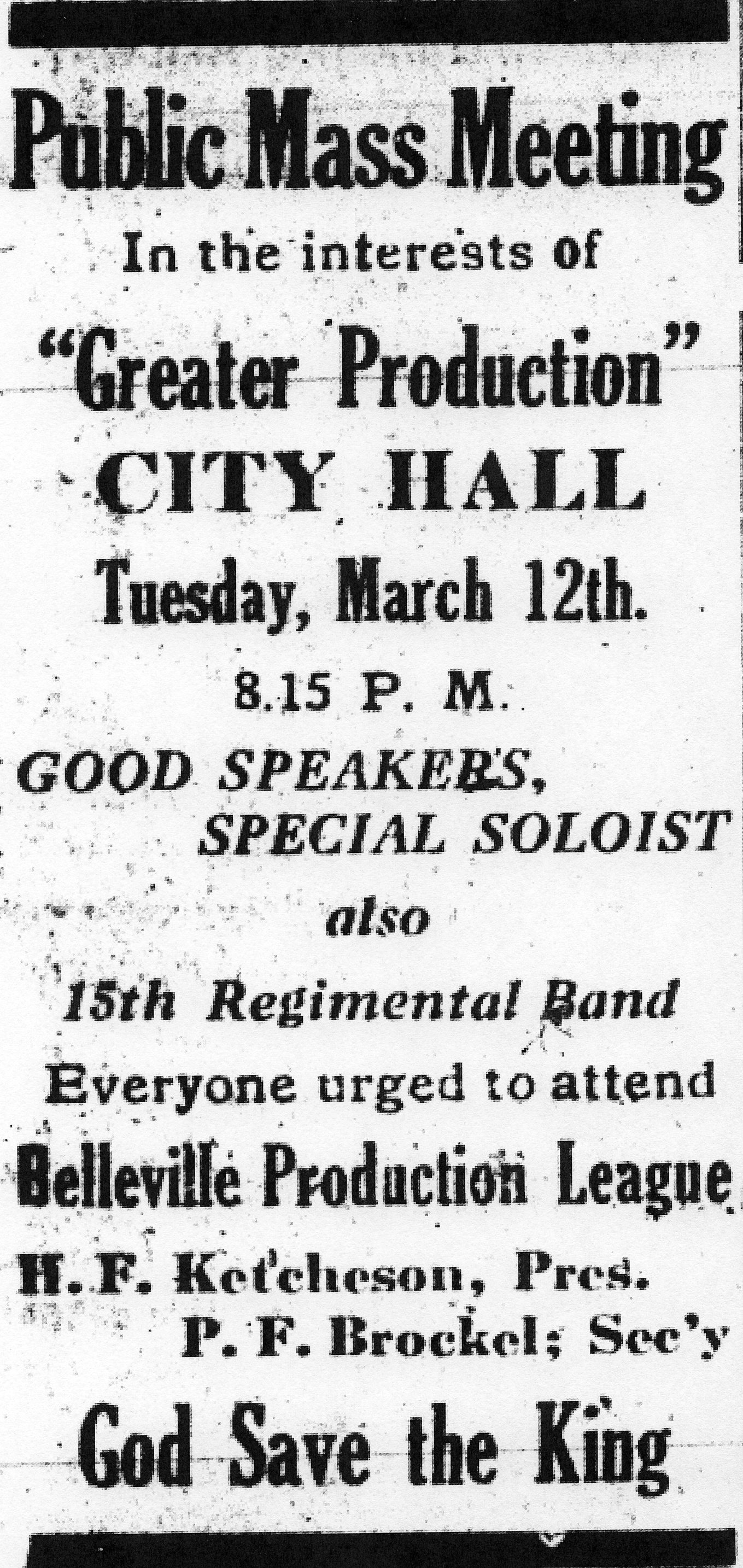
“Public Mass Meeting. In the interests of ‘Greater Production.’ City Hall, Tuesday, March 12th. 8.15 P. M. Good Speakers, Special Soloist, also 15th Regimental Band.

Everyone urged to attend Belleville Production League. H. F. Ketcheson, Pres. P. F. Brockel, Sec’y. God Save the King.”

The Intelligencer March 11, 1918 (page 7)

“Theatres Open Tonight. Heatless Mondays having been abolished by the Government, theatres and other places of amusement will be open tonight as usual and on all Mondays hereafter. At Griffin’s and the Palace theatres special programs will be given this evening to mark the return to the regular order of things.”

Nurses of World War I: Ida Georgina Denmark

Ida Georgina Denmark was born in Belleville on July 13, 1886 daughter of George Denmark and Margaret Matthie. The father of our subject was a barrister and served on city council; the family lived on the corner of Alexander and Rear (now John) Streets.

Denmark residence on Alexander Street, Belleville

She was educated locally and was a graduate of the Nursing School at the Royal Victoria Hospital in New Westminster, B.C. in 1912. In August 1909 she was a nurse-in-training at the Montreal Maternity Hospital; her father travelled to Montreal to visit his daughter, collapsed and died. Miss Denmark enlisted in the Canadian Army Medical Corps on September 18, 1914 in Montreal.

Height: 5’ 3”

Weight: 132lb

Age:  28

No. 2 Canadian Stationary Hospital in Le Touquet

Nursing Sister Denmark served with the No. 2 Canadian Stationary Hospital in Le Touquet, France; this unit had the distinction of being the first of all Canadian units to place foot upon French soil. On November 27, 1914 it opened up the well-known Hôtel du Golf as a hospital of 300 beds. She served for 23 months before resigning “for private reasons” on July 15, 1916 and was united in marriage to Dr. Louis Wellington MacNutt shortly thereafter. Dr MacNutt went overseas as a Captain with No. 1 Canadian General Hospital, rising to the rank of Major. He served in a casualty clearing station and commanded the Hyde Park Place Hospital for Officers in London. Mrs. MacNutt returned to Canada in April 1919 aboard the S.S. Mauritania and the couple established themselves in Vancouver B.C. She was awarded the 1914 Star and the 1916 British War and Victory Medals.

Ida Georgina MacNutt died at the Amherst Private Hospital on February 12, 1969 aged 82 years 6 months 29 days. Her remains were cremated at the Mountain View Cemetery.

100 Years Ago: Managers Object to Exemption Declined for Bank Clerks, Demand for Maple Syrup, Easter Message Popular, Food Production Meeting Held, Easter Bonnets Made by Wounded Soldiers

The Intelligencer March 9, 1918 (page 1)

“ ‘Bolt from the Blue’ Say Banks of Draft. Toronto. ‘A bolt from the blue’ very feebly describes the feelings of the local bank managers and executive officers towards the decision of Mr. Justice Duff in declining exemption to bank clerks in Category A. Managers and supervisors of most of the leading banks were unanimous in their opinion that the order cannot be carried out if the business of the country is to go on, and in particular no more Victory Loan business can be undertaken by the banks. …

Girls can take the place of men only to a limited extent, and cannot be expected in a few weeks to acquire the knowledge which men have taken years to acquire, say the bankers. …  ‘In the country a girl can be used as a teller where the manager has time to give close supervision, but no woman is able to come in and take charge of a city teller’s desk.’ ”

The Intelligencer March 9, 1918 (page 2)

“Great Demand for Maple Syrup. Before the war many owners of fine sugar maple groves had dropped out of the business or contented themselves with producing enough only for their own use. The chief reason for this was that the market for the pure maple products was undermined by the manufacturers of adulterants. …  An amendment to the Adulteration Act was passed in 1915, making it unlawful to adulterate maple sugar or syrup. …

Up to the present time 75 per cent of the Canadian maple products have been consumed in Canada. Most of the balance has found a ready market in the United States. In addition there is now being developed the foundation for a splendid market in Great Britain and France, where maple sugar has been introduced by the Canadian soldiers. Thousands of pounds have been sent to the Canadian army overseas by the Red Cross, and firms in London report a growing British demand and the possibilities of an enormous trade after the war. …

It behooves all those who have maple trees available to get to work this year and make the most of the short sap-running season. …  By tapping 100 trees at a time of year when the farmer is least busy with regular farm work, he can make 500 pounds of sugar or 100 gallons of syrup, netting him $100 to $150 for three weeks activity. This is more than the soldier fighting in France at the risk of life and limb earns in thrice that time, sad in view of the need it behooves farmers to bring out the sap buckets, old and new, and show that the ‘Land of the Maple’ can prove clear title to the name.”

The Intelligencer March 9, 1918 (page 7)

“The Easter Message. The Easter message to Canadians in khaki across the sea, prepared by Rev. A. M. Hubly and freely distributed in Emmanuel Church last Sunday to anyone in the congregation who desired a copy, has met with such public favor that a second edition was found necessary. The prose letter is to comrades and is a suitable expression of any relative or friend.”

The Intelligencer March 9, 1918 (page 7)

“Greater Production. The third meeting of those interested in greater production of food was held in the Council chambers, Friday afternoon, March 8th. President H. F. Ketcheson was in the chair. The meeting was attended by representatives of the various women’s organizations in the city, also a number of the city clergymen.

It was decided the official name of this organization should be ‘The Belleville Production League,’ and that the object should be to encourage greater production along all lines in the coming season.

Representatives were appointed for each ward who would become responsible for listing all vacant land which in turn will be allotted to those who will agree to properly cultivate the same. Assistance will be given in the matter of seed. A special seed committee was appointed for this purpose. The ward chairmen were appointed as a committee on registration of lots and also on plowing of them.

The Agricultural Society and Horticultural Society, both of whom were represented at this meeting, are co-operating to the limit of their ability. Arrangements were made for a special mass meeting of citizens to be held in the City Hall on Tuesday, March 12th, at 8:15, when the great need for production and the plans of the local organization will be placed before the public.”

The Intelligencer March 9, 1918 (page 10)

“Easter Bonnets Made by Wounded Soldiers. Wounded soldiers in the white cots of the military convalescent hospitals are as interested in the progress of the spring millinery season as any of their sweethearts or wives. They are big factors in Canada’s millinery trade this year through their weaving, milliners are on their knees to them.

The smartest houses in Montreal and Toronto have featured Turkish turbans of soft raffia textiles woven by the soldiers and the vogue has spread from coast to coast. Even New York has sent inquiries after reviewing the south-going millinery of the Canadian rich.

A fabric of very fine raffia, woven on the bed looms in the hospitals as occupational work has been termed the most beautiful straw of many seasons. It has a dull satin lustre which has rarely been seen and turned out in exquisite colorings which cannot be had elsewhere for love nor money, enjoys great distinction.

The men are very proud of their work. …  The orders already placed will employ the men until the season is well started. There is a certain soothing monotony in weaving which makes it possible for many men who are unable to do any other kind of bed work. The medical officers recommend it in many nerve cases.”


100 Years Ago: Poster for Dominion Income War Tax, Victory War Club Entertainment Successful, Benefit Given at Griffin’s by Argyle Chapter I.O.D.E.

The Intelligencer March 8, 1918 (page 6)

“The Dominion Income War Tax. Its Meaning and Application. The Dominion Income War Tax Act, passed at the last session of Parliament is now in force and all those liable to taxation under the provisions of the Act must file the required returns for the year 1917, on or before 31st March, 1918.

The Act provides that there shall be assessed, levied, and paid upon the 1917 income of every person residing or ordinarily resident in Canada, a tax upon income exceeding $1500 in the case of unmarried persons and widows or widowers without dependent children, and upon income exceeding $3000 in the case of all other persons.

Department of Finance, Ottawa, Canada.”

The Intelligencer March 8, 1918 (page 7)

“Jack Canuck’s Treasure House. Victory War Club Entertainment Was a Great Success—Many Turned Away. Everybody was apparently after ‘The Key to Jack Canuck’s Treasure House’ last evening for the crowd began to come early to the City Hall to the Patriotic concert under the above title, given under the auspices of the Victory War Club. So generous was the patronage that before eight o’clock every seat was taken and hundreds had to be turned away.

In view of the exceptional interest taken in the entertainment and the fact that so many were disappointed in not being able to gain admittance, Mayor Platt, chairman of the evening, announced that it had been decided to give another performance.

The Victory War Club is worthy of unstinted praise for the excellence of the entertainment provided, and each one taking part deserves congratulations, for there was not a single hitch in the entire program, which moved smoothly from beginning to end.

A pleasing feature was the military drills of the Boy Scouts and Cadets, who showed great proficiency. The various drills of the little and big girls were also well done and interesting.

‘The Key to Jack Canuck’s Treasure House’ is an interesting lesson on the importance of keeping out of Canada undesirable immigrants, of developing a strong national spirit with high ideals, the keynote being ‘Canada for Canadians.’ …

Mayor Platt filled the position of chairman very acceptably, and at the close of the entertainment, on behalf of the Club, presented Miss Chrissie Turney with a prize for having sold the greatest number of tickets.”

The Intelligencer March 8, 1918 (page 8)

“ ‘Poppy’ Pleased. ‘Poppy,’ with Norma Talmadge in the title role, pleased a large audience at Griffin’s last evening on the occasion of the benefit entertainment given under the auspices of Argyle Chapter, I.O.D.E. to raise funds for the purchase of comforts for soldiers overseas.

The story of ‘Poppy’ is intensely interesting and full of heart interest cleverly brought out by the talented star, Norma Talmadge, supported by a good cast.”

100 Years Ago: Food Dealers Under License, Marriage Certificates to Be Carried, Claude Caverley Wounded, First Depot Battalion Leaves Belleville, Musical to Be Presented at City Hall

The Intelligencer March 7, 1918 (page 1)

“Dealers In Food Being Brought Under License. The license system of the Canada Food Board is being rapidly extended to all dealers in foodstuffs. It will be illegal to transact business in any of the following trades after the dates given below, except under license from the Food Board:

Produce Wholesalers, March 15, 1918; Produce Commission Merchants, March 15, 1918; Produce Brokers, March 15, 1918; Wholesale Grocer, April 1, 1918; Wholesale Grocery Jobber, April 1, 1918; Wholesale Grocery Commission Agent, April 1, 1918; Whole Grocery Broker, April 1, 1918; Retail Grocer, May 1, 1918; Retail Butcher, Retail Baker, Retail Produce Dealer, Retail Flour and Feed Dealer, Retail Fruit and Vegetable Dealer, Retail Fish Dealer, May 15, 1918.

Every effort is being made to furnish all wholesale and retail dealers in food and food products with forms of application by mail, but any failure to receive such notice will not be deemed a good and sufficient reason for neglect to obtain the necessary license by the dates given above.”

The Intelligencer March 7, 1918 (page 2)

“Military Notes. Every married man between the ages of 20 and 34 should carry his marriage certificate from now on, for he may be challenged on the street or in any public place. Single men just under 20 or just over 34, who might appear to be within class 1, should also carry birth certificates.”

The Intelligencer March 7, 1918 (page 7)

“Reported Wounded. In today’s casualty list appears the name of Private C. Caverley of Canifton, who is officially reported as wounded. The unfortunate young man is the son of Mr. Charles Caverley, clerk of Thurlow township.”

The Intelligencer March 7, 1918 (page 7)

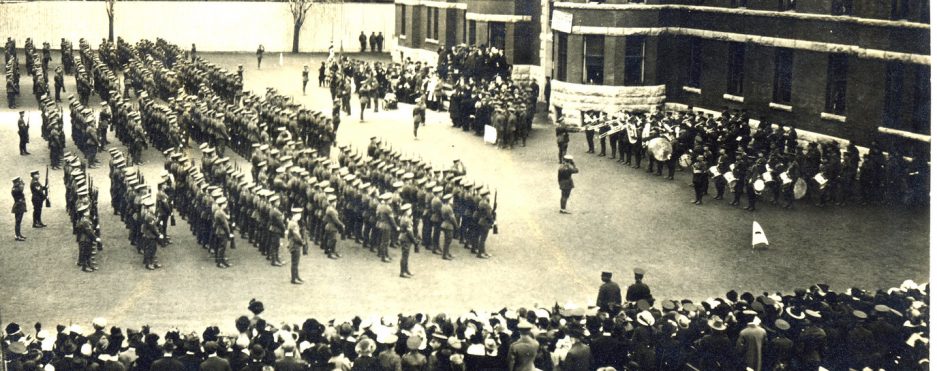
“Soldiers Left for Kingston. The remaining members of the First Depot Battalion who have been in this city for some weeks, were today transferred to Kingston, under command of Capt. K. G. Lech. At first the company totalled upwards of 200 men but was reduced to 80 by reasons of drafts being sent to an eastern training station. Soldiers from Peterboro joined the local soldiers here and proceeded with them to Kingston.”

The Intelligencer March 7, 1918 (page 7)

“The Key to Jack Canuck’s Treasure Will Be Found at the City Hall To-Night—For the Boys Over There. ‘The Key to Jack Canuck’s Treasure House’ will be presented at the City Hall this evening by a company of sixty including the cute and clever kiddies who take a prominent part in the production. The entertainment is largely musical with catchy choruses and solos, and is well worthy of patronage besides being for patriotic purposes and under the auspices of the Victory War Club.

Remember it’s for the soldiers and pack the City Hall.”


100 Years Ago: Poster for Royal Flying Corps, Belleville Soldier Injured in Explosion

The Intelligencer March 6, 1918 (page 5)

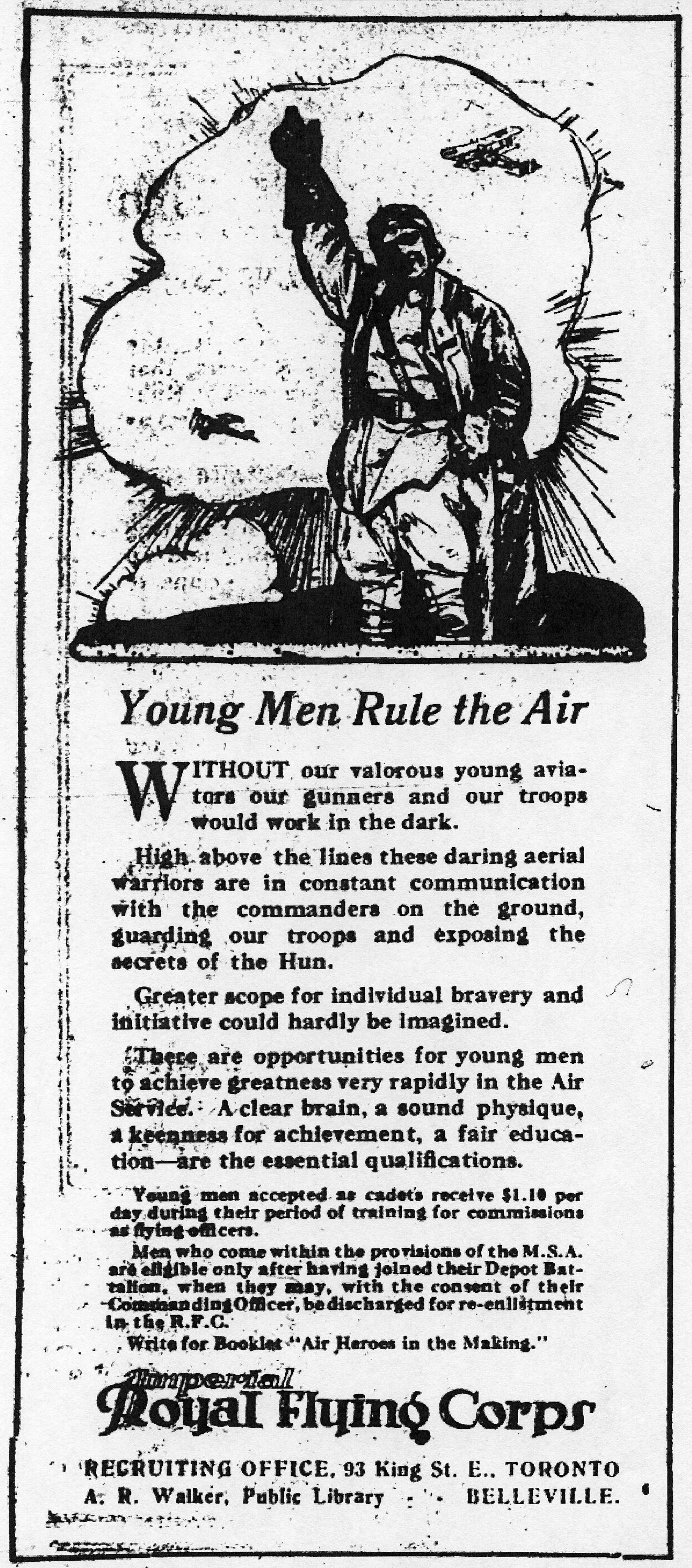
“Young Men Rule the Air. Without our valorous young aviators our gunners and our troops would work in the dark. High above the lines these daring aerial warriors are in constant communication with the commanders on the ground, guarding our troops and exposing the secrets of the Hun. Greater scope for individual bravery and initiative could hardly be imagined.

There are opportunities for young men to achieve greatness very rapidly in the Air Service. A clear brain, a sound physique, a keenness for achievement, a fair education—are the essential qualifications.

Men who come within the provisions of the M.S.A. are eligible only after having joined their Depot Battalion, when they may, with the consent of their Commanding Officer, be discharged for re-enlistment in the R.F.C. Write for Booklet ‘Air Heroes in the Making.’

Imperial Royal Flying Corps. Recruiting Office, 93 King St. E., Toronto. A. R. Walker, Public Library, Belleville.”

The Intelligencer March 6, 1918 (page 7)

“Explosion in a Dugout. Mr. and Mrs. Wm. Rogers, Foster Avenue, have received word that their son, Gunner Arthur Rogers, was severely wounded by an explosion which took place in a dugout when an armful of wood was thrown on an open fire. Gunner Rogers was burned about the head and face and was also rendered unconscious by gas fumes. Fortunately his eyes were not injured. At present he is in a hospital. The young gunner went overseas with the Cobourg Heavy Battery.”

100 Years Ago: Nursing Sister Mary Hambly Decorated by Queen Alexandra, Three Belleville Boys Return to Active Service, Marmora Soldier Home, 1,500 Soldiers to Return on Leave

The Intelligencer March 5, 1918 (page 1)

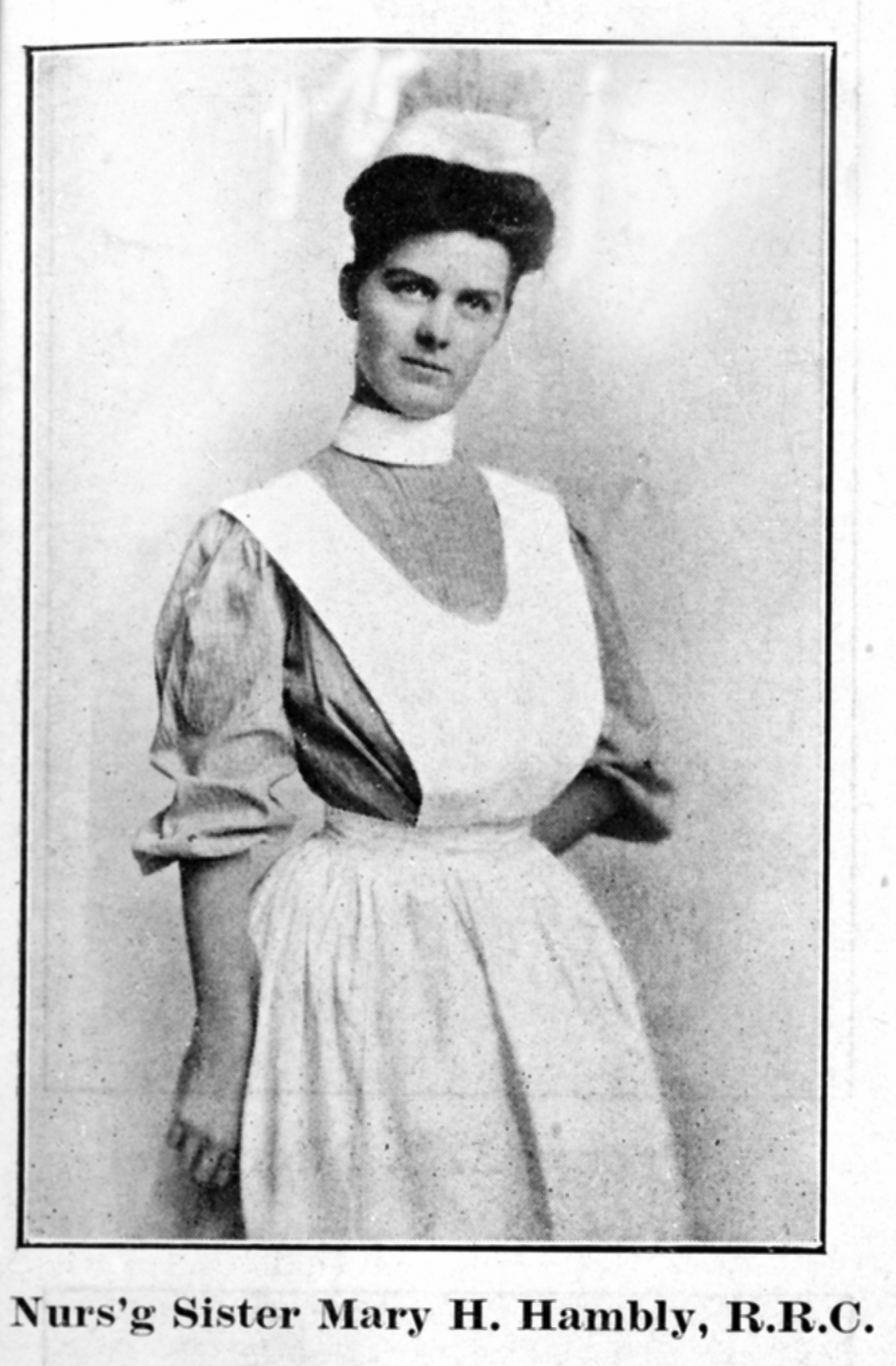
“Decorated by Queen Alexandra. Investiture of Nursing Sister Hambly with Royal Red Cross. Col. Phillip H. Hambly, 46 Alexander street, city, has received some interesting papers in connection with the investiture of his daughter, Nursing Sister Miss M. Hambly, A.R.R.C., with the decoration of the Royal Red Cross, which took place at Buckingham Palace, London, Her Majesty performing the pleasing and important ceremony.

Nursing Sister Hambly has served faithfully and well overseas and many a wounded soldier has cause to remember with gratitude her gentle and efficient administration. Honored by being singled out for royal recognition for her services in the great cause of Empire. Nursing Sister Hambly’s many friends rejoice in her distinction.

After the ceremony of investiture at Buckingham Palace Nursing Sister Hambly with other nurses included in the royal honors were the guests of Queen Alexandra at Marlborough House.

The official papers referred to read as follows: Telegram. O.H.M.S. Buckingham Palace. Sister Mary Hambly No. 10 Canadian Gen. Hosp’l Brighton. Your attendance is required at Buckingham Palace on Wednesday next, the thirtieth inst. at eleven thirty a.m. indoor uniform. Please telegraph acknowledgment. Lord Chamberlain, London.

War Office, London, S.W.1. 28th January, 1918. Madam,—I am directed to inform you that Her Majesty Queen Alexandra has expressed a wish that all ladies who attend an Investiture at Buckingham Palace to receive the decoration of the Royal Red Cross should afterwards proceed to Marlborough House to see Her Majesty.

I am accordingly to request that you will attend at Marlborough House on Wed. 30th inst., at 1.30 on your return from Buckingham Palace. I am, Madam, Your obedient servant, L. D. Holland. Nursing Sister Miss M. Hambly, A.R.R.C. No. 10 Canadian Gen. Hospital, Brighton.”

The Intelligencer March 5. 1918 (page 7)

“Returning to Active Service. Mrs. J. I. Newton, 46 Hillcrest avenue, has received a letter from her soldier son, H. G. Newton, dated from an eastern port on February 28, stating that he was on his way back to England and active service. Travelling with him were several other Belleville boys including Pete Belnap and Daw Whelan.”

The Intelligencer March 5, 1918 (page 7)

“Marmora Soldier Home. Pte. J. W. Burns, of Marmora, wounded in the spine, arrived at Toronto yesterday with a party of wounded soldiers invalided home from the front.”

The Intelligencer March 5, 1918 (page 8)

“1,500 Soldiers to Return On Leave. Ottawa. Fifteen hundred soldiers will return to Canada under the regulation permitting the granting of furloughs of three months to members of the first Canadian contingent. Already a number of the men have arrived in the Dominion.

The furloughs are granted to the veterans on the understanding that applications for extensions of time or for discharge will not be entertained. Already, however, a considerable number of men who have reached home have asked to be allowed to remain for domestic reasons. It is understood that the conditions upon which leave of absence is granted will have to be observed, inasmuch as the privilege of returning to Canada has been secured by specific arrangement between the Canadian and British army authorities.”

100 Years Ago: Flight-Lieut. Douglas Reid Injured, Souvenirs of War Sent to Tweed

The Intelligencer March 4, 1918 (page 1)

“Flight-Lieut. Douglas Reid Injured in Aerial Accident. Leg Broken and Thigh Dislocated in Accident at Fort Worth Texas.

Twice within a week has the winged messengers of the electric telegraph brought sorrowful tidings to the home of Mr. and Mrs. C. M. Reid. Just a week ago yesterday a cable message brought the sad news that their son, Flight-Lieutenant Harold Mackenzie Reid had met death in an aeroplane accident while serving his King and country overseas.

Yesterday, while the hearts of the parents were still heavy with sorrow at the loss of their splendid soldier son, came another message to add to the already heavy burden of grief in the news that their other aviator son, Flight-Lieutenant Douglas Reid had been seriously injured in an aeroplane accident at Fort Worth, Texas. Fortunately the anxiety of Mr. and Mrs. Reid is lightened by the intelligence that their son’s injuries, while serious, are not of a dangerous nature.

The telegram read as follows: Fort Worth, Texas, March 2, 1918. C. M. Reid, Belleville. Regret to inform you that Charles Douglas Reid was seriously but not dangerously injured today in an aeroplane accident. Extent of injuries, leg broken above the knee and thigh dislocated. Will communicate further tomorrow. Officer Commanding Aerial Gunnery Squadron. …  Mr. C. M. Reid’s brother at St. Louis, Missouri, left last night for Texas to see that everything possible is being done for Douglas. A telegram received this morning says that Flight Lieut. Reid is resting quite comfortably, and the Intelligencer joins with a host of friends and well wishers in the hope that the gallant young aviator may have a speedy recovery.”

The Intelligencer March 4, 1918 (page 7)

“Souvenirs of the War. Mr. and Mrs. A. Godfrey, Tweed, are in receipt of a parcel from France which contained a number of souvenirs of the war, the property of their late son, Sergt.-Maj. Percy Godfrey. Amongst the number are two finger rings made of French shell nose pieces, one engraved ‘Ypres’ and the other decorated with a small compass; a pearl crucifix mounted with silver, found in the ruins of a cathedral; a pearl maple leaf pin; an old gold brooch with sapphire, ruby and diamond studding, and an amber medal with silver maple leaf and crown which the deceased wore suspended to a chain about his neck.

The parcel was sent by a friend of the deceased and the souvenirs are highly prized by the parents, whose son before leaving on his last and fatal trip to the front line trenches where he fell a victim to the Hun bullets, the deceased placed his private belongings in charge of his brother, Pte. Lyman, of the transport service, at the same time saying that he felt it was his last call to action. Sergt.-Maj. Godfrey met his death in action on November 4th, 1917.”

[Note: Sergeant Percy Godfrey died on November 3, 1917. He is commemorated on Page 244 of the First World War Book of Remembrance.]


Nurses of World War I: Irene Pearl Courtice

Irene Pearl Courtice was born in Bethany, Ontario on September 26, 1887 daughter of Reverend Richard Courtice and Bessie Davis; Reverend Courtice was a Methodist Minister in the Bay of Quinte Conference for more than 40 years.

She spent her childhood in the Bay of Quinte district attending schools where her father was a preacher. After attending Albert College, Miss Courtice obtained a normal education certificate and taught school for a few years in the small rural community of Fortescue, Ontario. Following this she commenced studies and graduated from the Nursing School at the Toronto General Hospital in 1913. She enlisted in the Canadian Army Medical Corps on April 7, 1915 in Toronto; this was within two weeks of when her brother, Dr. John Thomas Courtice, enlisted.

Height:  5’ 3”

Weight: 135lb

Age: 27

Nursing Sister Courtice treated the sick and wounded military at the No. 4 Canadian General Hospital in Shorncliffe, England and later in France and Salonica. She returned to Canada providing transport duty, setting sail on June 29, 1918 aboard the H.M.H.S. Araguaya, following which Miss Courtice was appointed Matron and head of nursing at the Whitby Military Convalescent Hospital. On March 30, 1920 she was united in marriage to Reverend Sidney Lambert, a Veteran of World War 1 who served with the Canadian Chaplain Service and rose to the rank of Captain. He was wounded at the Battle of Vimy Ridge, had his left leg amputated and subsequently founded and served as the first President of the Amputee Association of the Great War or War Amps.

Irene Pearl Lambert died in Toronto on August 17, 1963 aged 75 years 10 months 21 days. She is interred at Prospect Cemetery in Toronto.

100 Years Ago: Canada to Rebuild Vimy

The Intelligencer March 2, 1918 (page 5)

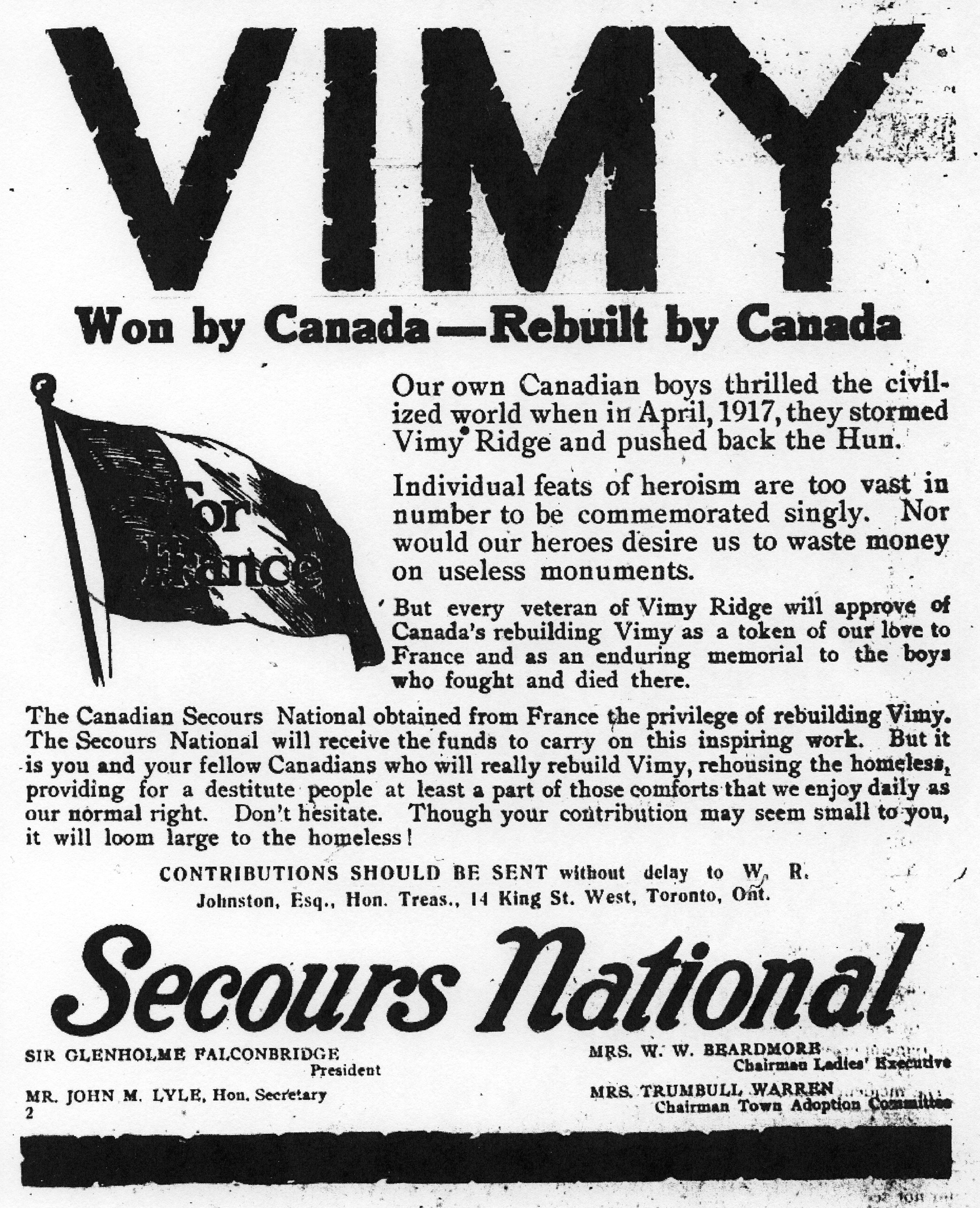
“VIMY Won by Canada—Rebuilt by Canada.

Our own Canadian boys thrilled the civilized world when in April, 1917, they stormed Vimy Ridge and pushed back the Hun.

Individual feats of heroism are too vast in number to be commemorated singly. Nor would our heroes desire us to waste money on useless monuments.

But every veteran of Vimy Ridge will approve of Canada’s rebuilding Vimy as a token of our love to France and as an enduring memorial to the boys who fought and died there.

The Canadian Secours National obtained from France the privilege of rebuilding Vimy. The Secours National will receive the funds to carry on this inspiring work. But it is you and your fellow Canadians who will really rebuild Vimy, rehousing the homeless, providing for a destitute people at least a part of those comforts that we enjoy daily as our normal right. Don’t hesitate. Though your contribution may seem small to you, it will loom large to the homeless!

Contributions should be sent without delay to W. R. Johnston, Esq., Hon. Treas., 14 King St. West, Toronto, Ont.

Secours National.”