100 Years Ago: Card of Sympathy from Prime Minister, Memorial Altar Vases Dedicated at Christ Church, Memorial Service for Two Soldiers at Baptist Church, Nursing Sister Merle Lazier a War Bride

The Intelligencer October 1, 1917 (page 2)

“Words of Sympathy. Mrs. Harold Prest, whose husband, Pte. Harold Prest, was recently killed in action, has received from Ottawa a card of sympathy, which reads as follows: ‘The Prime Minister and members of the Government of Canada, send their deepest sympathy in the bereavement which you have sustained.”

The Intelligencer October 1, 1917 (page 2)

“Memorial Altar Vases Dedicated in Loving Memory of Two Brave Young Soldiers. The annual Harvest Festival services of Christ Church were held yesterday with Holy Communion services at Christ Church and St. George’s at 8 a.m. and Choral Communion at 11 a.m. The church was beautifully decorated for the occasion, flowers being provided in abundance. …

An interesting feature of the morning’s service was the dedication of two beautiful vases for use on the altar, presented by Mrs. Charlotte Carroll in memory of her son Horace, and his dear friend, Reginald Smith, both of whom were killed in action in France. …

Following are the inscriptions: ‘In memory of Lieut. Reginald Smith, 77th Battalion, Ottawa, killed in action May, 1917, battle of Vimy Ridge.’

‘In memory of Lieut. Horace Y. Carroll, 77th Battalion, Ottawa, killed in action October, 1916, battle of the Somme.’ ”

The Intelligencer October 1, 1917 (page 7)

“Memorial Service at Baptist Church. A large audience was present in the Baptist Church last night, when a solemn memorial service was held to commemorate the death, in action at the front, of two of the boys of the Baptist Church and Sunday School—Raymond Hudson, missing since Sept. 15th, 1916, and now presumed dead, and Harold Prest, whose death was reported last Wednesday.

The pastor, Rev. Chas. Geo. Smith, B. D., conducted the service. …  Speaking of the two Sunday School scholars, Mr. Smith said that Raymond Hudson was a scholar in Miss Lounsberry’s class and was one of the first to enlist when the war broke out. He was in the attack on the sugar refinery at Courcelette on Sept. 15th, 1916, and has been missing ever since. …

Raymond was only 21 years of age when he gave his life for Canada and the Empire. He wrote home to his mother faithfully every week right up until the day before going into his final fight at Courcelette. In his last letter he said: ‘Do not worry about me, Mother, for if I am killed I am not afraid to die, for I am trusting in God and my Saviour, Christ Jesus.’

Harold Prest, said the minister, grew up in this church and Sunday School from a little boy, and all his family are associated here. He passed through all the Sunday School grades from the primary department to the young men’s Bible class. …  He was a bright scholar and a faithful attendant for many years. Harold was devoted to his mother, and not a week passed but she received a newsy letter from him full of cheer and hope. In one of his last letters home he confessed his faith in Christ in a most manly and sincere way and bade his mother not be anxious for his welfare as he was hopeful of coming through safely and returning home at the close of the war. …

Truly we can say, as we realize our privileges of blessings today with a great sum, these boys obtained for us this freedom of life, liberty and the pursuit of happiness in the British Empire. Let us prove worthy of that freedom so dearly bought. So shall we truly revere the memory and pay tribute to the gallantry and self-sacrifice of our dear departed boys.”

The Intelligencer October 1, 1917 (page 7)

“Belleville Lady a War Bride. Another popular young Belleville lady has joined the ranks of the war brides. A cable from London announces the marriage there of Nursing Sister Merle Lazier, daughter of Colonel T. C. Lazier of Edmonton, formerly of this city, to Captain Lorne Tyrer, C.A.M.C.

Nursing Sister Lazier left Belleville more than a year ago to nurse the wounded, having obtained a commission in the Canadian Army Medical Corps, and was stationed at Salonica, Greece, remaining on duty there for some months, returning later to England.

Miss Lazier was very popular with her many Belleville friends, who are pleased to join in hearty congratulations and best wishes.”
100 Years Ago: Eddie Elliott Returns Home, Canada’s Conscript Army, Poster on Pay for Men Selected Under Military Service Act

The Intelligencer September 29, 1917 (page 2)

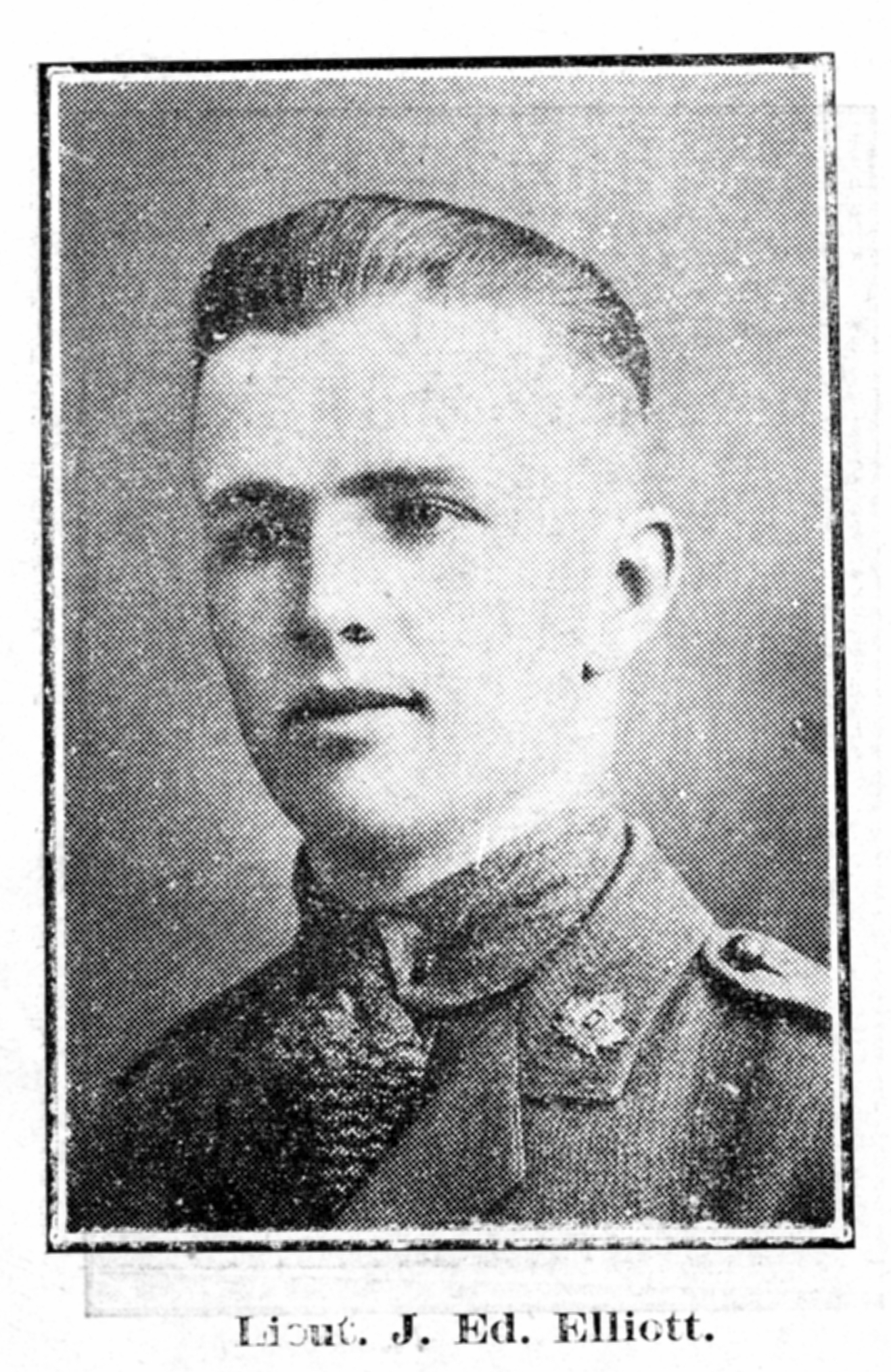
“Lieut. Elliott Home. Lieut. Eddie Elliott, second son of Mr. John Elliott, manager of the Standard Bank, Belleville, arrived home on Thursday afternoon and was very heartily welcome. Lieutenant Elliott left here with the 80th Battalion, and later being transferred to the front, was associated with the 54th.

Whilst at the front, he contracted blood poisoning, and was confined to a hospital for some months. He has received his permanent discharge, and a rest, it is hoped, will restore him to his former vigorous health.”

The Intelligencer September 29, 1917 (page 3)

“The New Army. Canada’s conscript army will enjoy but a brief stay this side of the Atlantic if present arrangements are adhered to. Immediately after mobilization Grade A men will be entered upon a fourteen weeks’ training syllabus, but according to the official understanding at the moment this training will not be progressed with very far in Canada before the men will be sent overseas to receive their real training in camps already prepared for them.

This move has the approval of the military authorities on both sides, and therefore it is not unlikely that many thousands of the draftees will spend the winter overseas, where conditions are more favorable to training.”

The Intelligencer September 29, 1917 (page 10)

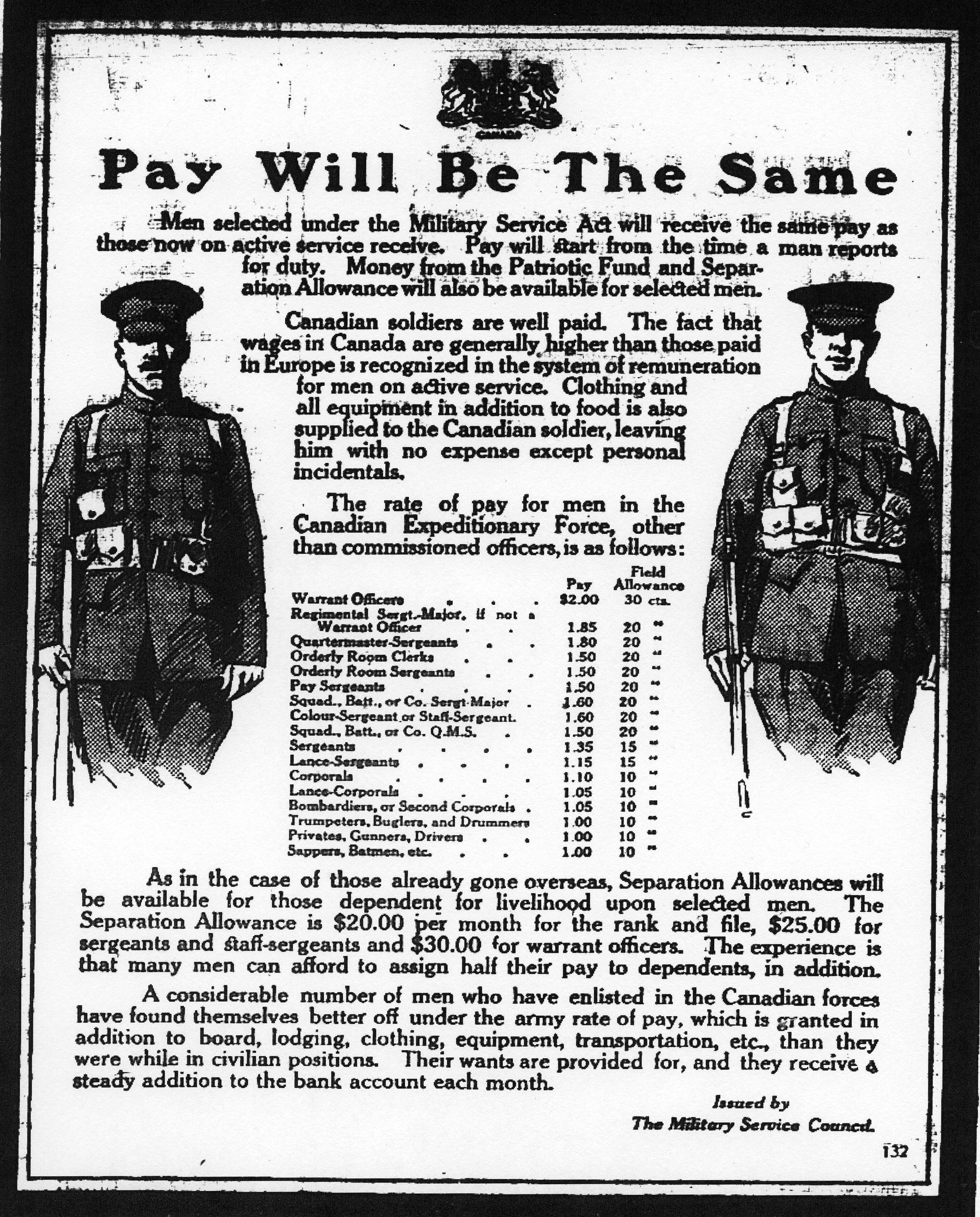
“Pay Will Be The Same. Men selected under the Military Service Act will receive the same pay as those now on active service receive. Pay will start from the time a man reports for duty. Money from the Patriotic Fund and Separation Allowance will also be available for selected men.

A considerable number of men who have enlisted in the Canadian forces have found themselves better off under the army rate of pay, which is granted in addition to board, lodging, clothing, equipment, transportation, etc., than they were while in civilian positions. Their wants are provided for, and they receive a steady addition to the bank account each month. Issued by The Military Service Council.”

100 Years Ago: Local Medical Board Results, Letter of Thanks, Sympathy from Minister of Militia

The Intelligencer September 28, 1917 (page 2)

“Fit or Unfit? Up until noon yesterday the local Medical Board, under the Military Service Act, Drs. MacColl, Gibson and Tennant, had examined 103 applicants. Fifty-eight were passed as ‘fit’ for any class of military service; sixteen passed for restricted service; twelve passed for home defence and seventeen were totally unfit for service.”

The Intelligencer September 28, 1917 (page 7)

“ ‘Cheery O Sister’ Soldiers Grateful. The following letter was received by Miss Edith McLean, 62 Alexander St. in reply to a parcel sent by the Belleville Branch of the Canadian War Contingent Association, 62 West Street. France, June 16, 1917. My Dear Miss McLean, Our battalion received today fifty parcels from the C.W.C.A., Belleville, amongst which was yours. The O.C. was so taken with the generosity and usefulness of the articles, that the whole regiment drew for them, and besides getting the presents, it afforded a lot of pleasure to the whole unit.

I do not know who you are, but I thank God for you kind, brave women in Canada, and your gifts were appreciated by all of us: the officers because the men got them, and the men because it brings a breath of home to them. Cheery O Sister, and thank you, Douglas Kerr, Capt., 1st Can. Lab. Batt., B.E.F.”

The Intelligencer September 28, 1917 (page 7)

“Sympathy from Minister of Militia. Mrs. Catherine Stark, 173 Mary street west, has received from Sir A. E. Kemp, Minister of Militia, the following letter of sympathy in the loss of her husband, Pte. Andrew Stark, who gave his life that the Empire might live: Sept. 20, 1917. Dear Mrs. Stark:—I desire to express to you my very sincere sympathy in the recent decease of your husband No. 455153 Pte. Andrew Stark, who in sacrificing his life at the front in action with the enemy, has rendered the highest services of a worthy citizen.

The heavy loss which you and the nation have sustained would indeed be depressing were it not redeemed by the knowledge that the brave comrade for whom we mourn performed his duties fearlessly and well as became a good soldier, and gave his life for the great cause of human liberty and the defence of the Empire.

Again extending to you in your bereavement my condolences and heartfelt sympathy. I am, yours faithfully, A. E. Kemp, Minister of Militia and Defence for Canada.”

[Note: Private Andrew Stark died on October 8, 1916. He is commemorated on Page 167 of the First World War Book of Remembrance.]


100 Years Ago: Ad for Hydro Electric Irons, Food Controller Speaks

The Intelligencer September 27, 1917 (page 2)

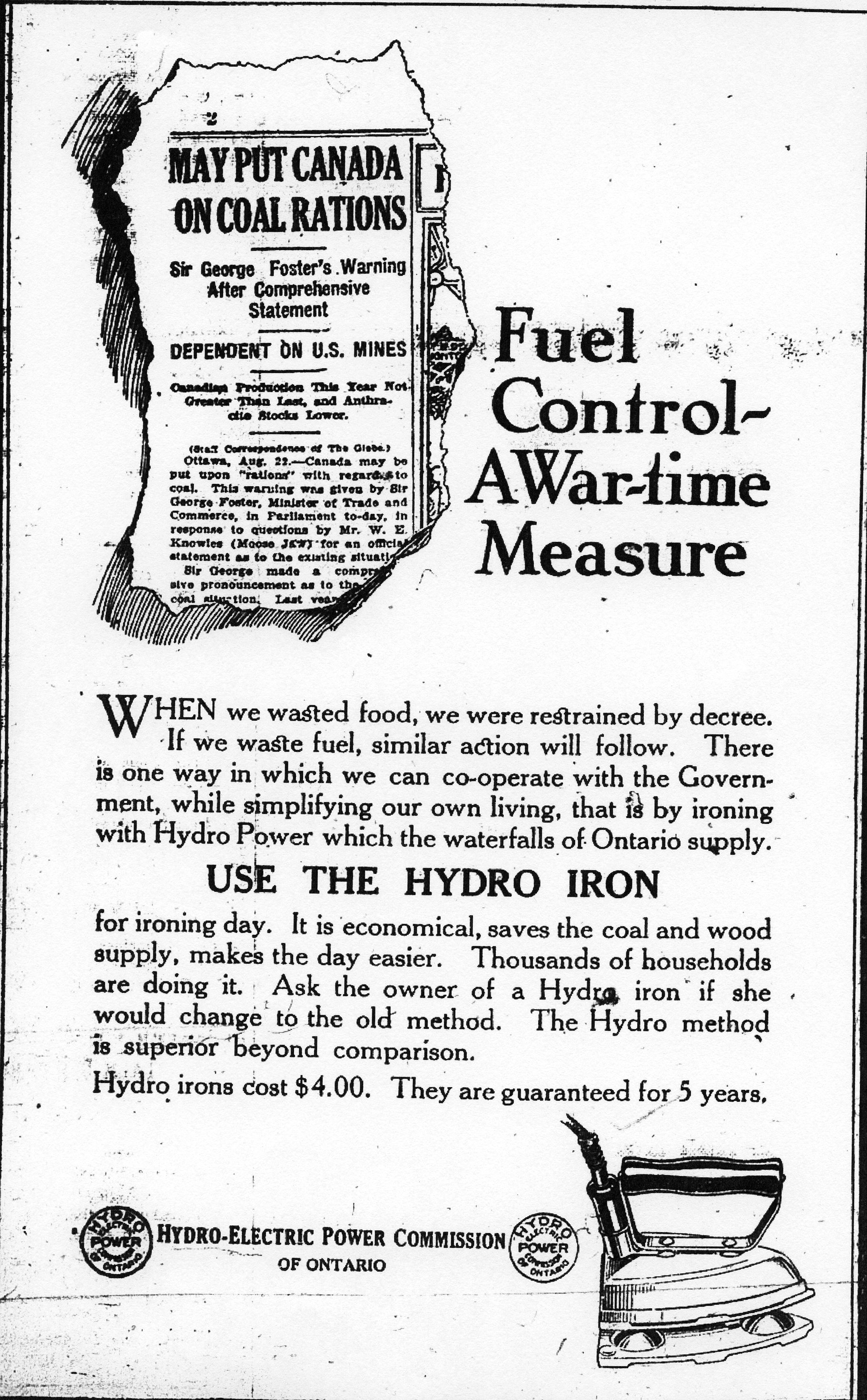
“Fuel Control—A War-time Measure. When we wasted food, we were restrained by decree. If we waste fuel, similar action will follow. There is one way in which we can co-operate with the Government, while simplifying our own living, that is by ironing with Hydro Power which the waterfalls of Ontario supply.

Use the Hydro Iron for ironing day. It is economical, saves the coal and wood supply, makes the day easier. Thousands of households are doing it.

Hydro irons cost $4.00. They are guaranteed for 5 years. Hydro-Electric Power Commission of Ontario.”

The Intelligencer September 27, 1917 (page 6)

“Ottawa. An excessive number of middlemen is the greatest obstacle to the reduction of prices, and under present conditions the adoption of a drastic policy of arbitrary cutting would mean ‘temporary ruin to every city and town in the country,’ according to a statement by Hon. W. J. Hanna, Food Controller, in an interview with the Canadian Press, Ltd. …

‘I must remind those Canadians who are perhaps unaware of the fact, that seven main factors may be said to govern the present prices of food: (1) The disproportion between demand and supply, consumption and production. Food cannot be cheap while there is such a growing disparity between the numbers of producers and the numbers of consumers. (2) Unrestrained competition between great foreign buyers of foodstuffs in our markets. (3) Unequal distribution of the available supplies, surplus production in one province being unavailable for provinces in which shortages exist. (4) The food speculator. (5) The greedy middleman. (6) The supernumerary unnecessary and inefficient middleman, and (7) The waster. …

The first duty of the Food Controller, let me remind you, is not to cut prices, eliminate middlemen, sell goods at cost, or correct in a day economic evils which an unthrifty and luxurious use has allowed, even encouraged to grow up, but to protect Canada, the Canadian troops, and our share of the war of the Empire against disaster through famine—I use the word without any exaggeration. I can do this only by decreasing consumption, and as far as possible increasing production.”

100 Years Ago: Harold Prest Killed in Action, Military Hospital at Whitby Opened, Coal Dealers Warned, Scientists Interested in Military Service Act Medical Examination Results

The Intelligencer September 26, 1917 (page 1)

“Belleville Boy Killed in Action. Mr. A. N. Prest, residing at 45 Herchimer Street, Belleville, received a sad message this morning from the Director of Records at Ottawa. It was to the effect that his son, Private Harold Prest, of this city, had been killed in action on the 16th inst. Pte.

Prest was 23 years of age, and enlisted with the 59th Battalion at Brockville, going overseas with that battalion. Previous to enlistment he was a clerk in the G.T.R. shops here. Harold was popular with all who knew him and his death will be sincerely regretted by a host of friends. A wife and young daughter survive in addition to his parents. Mr. Myles Prest of The Intelligencer Office, is a brother of the deceased.”

[Note: Private Harold Prest died on September 16, 1917. He is commemorated on Page 311 of the First World War Book of Remembrance.]

The Intelligencer September 26, 1917 (page 1)

“ ‘The finest military hospital on this continent’ was the tribute of His Excellency the Duke of Devonshire after he had inspected the big hospital and vocational training centre of the Military Hospitals Commission at Whitby. His Excellency formally opened the great $55,000 recreation hall, which has just been completed and a big day of sports and exhibitions were staged by the convalescent men in honor of the occasion.

The veterans’ band under the directorship of Bandmaster Reeves played, two teams from the various cottages in the institution put on a baseball game, and all the champions around the hospital were pointed out to the Governor-General. These ‘champions’ represent nearly every branch of sport, for the facilities are there for all athletics, and the returned boys are a lively bunch, even in convalescence.

The splendid buildings housing the wards and the vocational training rooms were praised highly by the vice-regal party, and the men beamed over their work. Whitby is said to be unsurpassed in any country in the world to-day in its location and equipment, as a centre for the convalescence and training of soldiers.”

The Intelligencer September 26, 1917 (page 2)

“Coal Dealers Warned. The office of the Dominion Fuel Controller, Ottawa, repeats the warning to coal dealers throughout the country that objection will be taken to any advance in the price of coal being made without notification first being sent to the Fuel Controller. The view of the Fuel Controller is that the coal dealers had a liberal profit last summer, sufficiently so to enable them to continue the present prices into the winter, and give the smaller users of coal the same price, notwithstanding any increase that the mines may make at this time.”

The Intelligencer September 26, 1917 (page 6)

“Spotlight on Canada’s Men. Ottawa. Medical men throughout the country are taking a keen interest in the coming examination of the physical condition of Canadians who are liable for service under the Military Service Act. …  Many authorities have held that Canadians, as a race, are unusually hardy, owing to the rigorous weather experienced in this country.

Never in Canada’s history has there been such a thorough examination of men in the country between certain ages. …  It will establish a new basis of fact for scientific men to work on, and the records will be of value for universities and scientific bureaus not only in Canada but throughout the civilized world.

The object of the medical examination, primarily, is to inform those liable to service if they will be drafted or not, since men found physically unfit are sure of exemption Tribunals. Employers will also be able to calculate as to what removals they may expect from their business houses, factories, etc. But the scientific importance of the country-wide physical examination of men between certain ages looms large in the eyes of a great many medical authorities.”

100 Years Ago: Belleville Aviator Prisoner of War, Major Miller Awarded D.S.O., Ad for Bakery Goods

The Intelligencer September 25, 1917 (page 2)

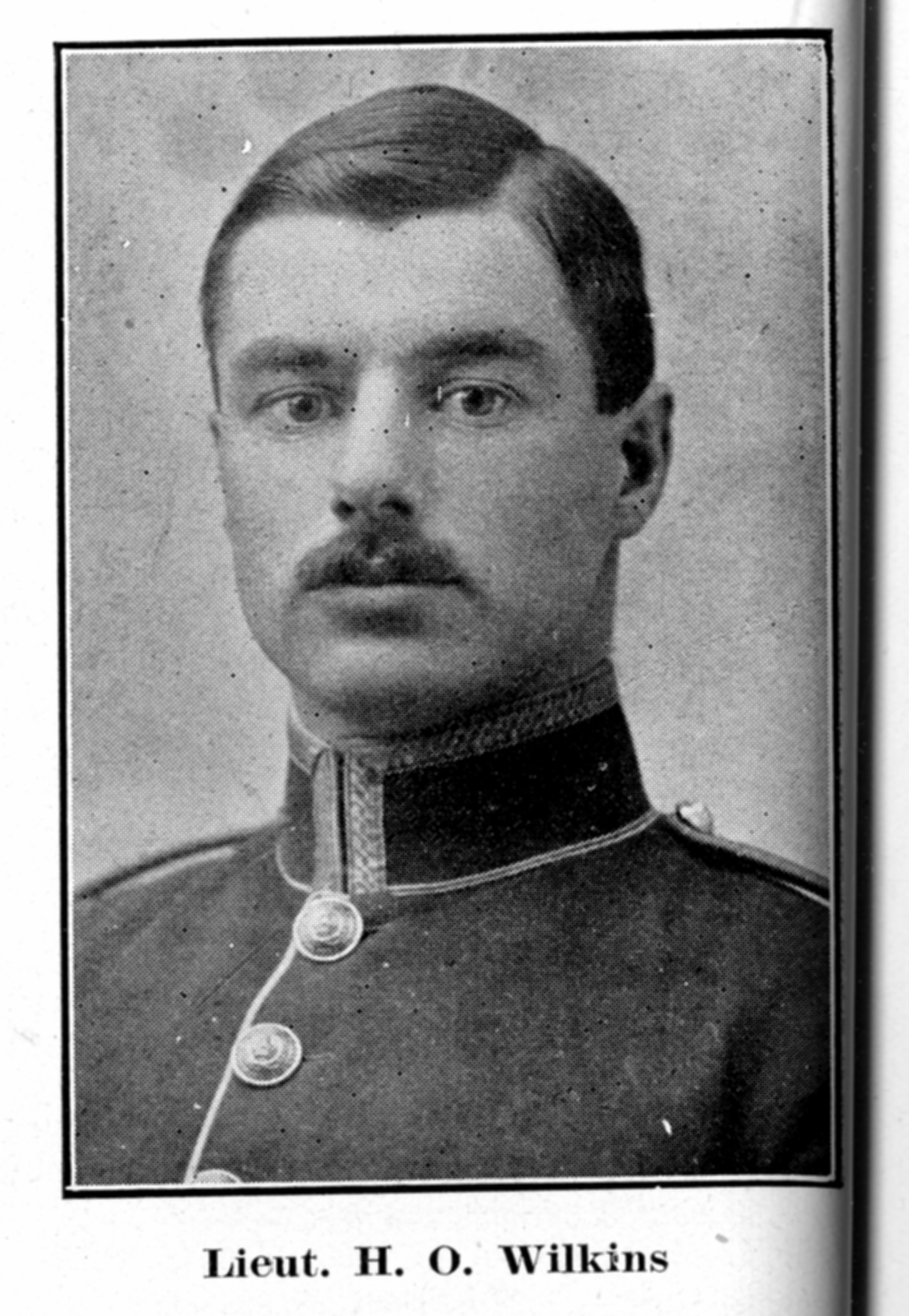
“Capt. Harold O. Wilkins, of the Royal Flying Corps, now a prisoner in Germany, writes to relatives in London that he is well, but would appreciate a supply of tobacco, while food of any kind would be very acceptable. Capt. Wilkins is a nephew of Miss Wilkins, Albert Street, and was brought up in Belleville, a graduate of the High School here and an active member of St. Thomas’ Church. …

While flying over the enemy lines one day his machine was badly shattered  in an aerial battle and although he made a gallant attempt to reach the British lines he was obliged to descend about three miles from headquarters and within the German lines. Two minutes after he landed he was surrounded and taken prisoner. Shortly after he had been officially reported as missing a German aviator flew over the British aerodrome to which Capt. Wilkins had been attached and dropped a message stating that the young aviator was a prisoner but in good health, also giving his address.

Since then letters have been received by relatives from Capt. Wilkins confirming the first tidings so kindly conveyed by an enemy aviator. Capt. Wilkins’ many friends in Belleville will be pleased to know that although a prisoner he is in good health and that he will not be permitted to go without food or tobacco goes without saying. His address is as follows: Capt. H. O. Wilkins, Officer Kriegsgefangenen, Lager, Karlsruhe, Germany.”

The Intelligencer September 25, 1917 (page 3)

“Major Miller of 21st Batt. Awarded D.S.O. Acting Maj. A. F. Miller, who went overseas with the 21st Battalion as a lieutenant, has been awarded the D.S.O. In the battle of Lens he, after the Germans had recaptured ground taken by the Canadians, again won the ground back for the Canadians and himself accounted for several Germans with his revolver. His home is in Glen Miller, Ont.”

The Intelligencer September 25, 1917 (page 8)

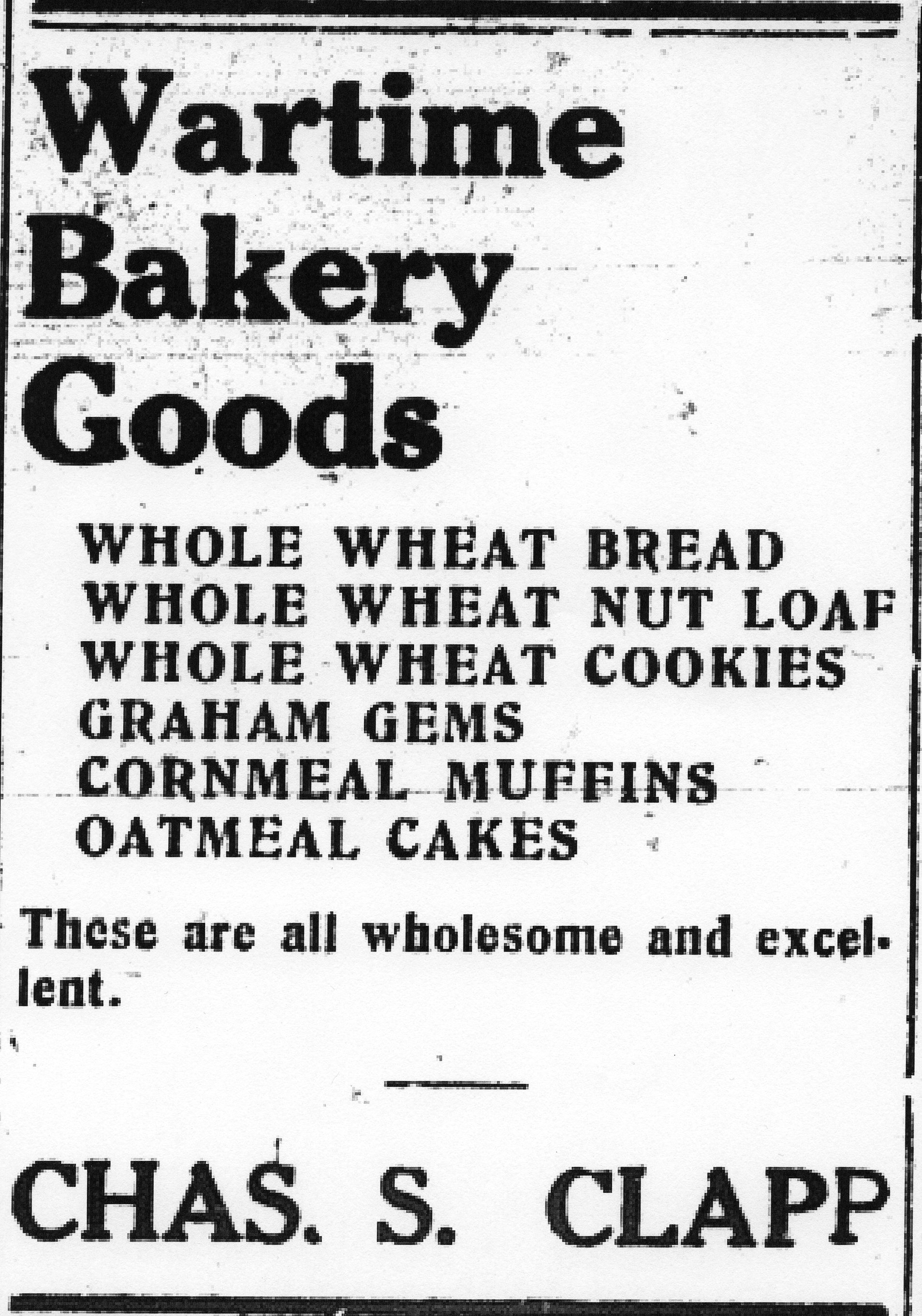
“Wartime Bakery Goods. Whole Wheat Bread. Whole Wheat Nut Loaf. Whole Wheat Cookies. Graham Gems. Cornmeal Muffins. Oatmeal Cakes. These are all wholesome and excellent. Chas. S. Clapp.”

100 Years Ago: Memorial Service for Archibald Lambert, Gunner Alf Belton Returning, Gunner William Charles Burgis Seriously Ill, Women Must Save or Soldiers Starve, Christmas Joy for Boys in the Trenches

The Intelligencer September 24, 1917 (page 2)

“Memorial Service. At Christ Church yesterday morning, a memorial service was held for Lance-Corporal Archibald Lambert, a member of that church, who was killed in action on September 11th. The rector, Rev. Dr. Blagrave, referred feelingly to the hero who had given his life in a noble cause. During the service the Dead March in Saul was rendered upon the organ by Mrs. Col. Campbell, organist, the congregation remained standing while it was being rendered.”

The Intelligencer September 24, 1917 (page 2)

“Gunner Belton Returning. Mrs. Belton, 219 Front street, has received a letter from her husband, Gunner Alf. Belton, who has been wounded three times and is now on his way to Canada after serving three years at the front and passing through many hard battles with exciting experiences.

He states in his letter that he has been up to London to bid good-bye to his many friends there. His wounds still give him some trouble, and medical treatment will be continued in Canada. Gunner Belton will receive a cordial welcome from his many friends here.”

The Intelligencer September 24, 1917 (page 2)

“Gunner Burgiss Seriously Ill. Mr. J. W. Burgiss, residing in this city received the following telegram which refers to his son: Ottawa, Sept. 22, 1917. J. W. Burgiss, 111 Foster Avenue, Belleville, Ont. Sincerely regret to inform you 40286 Gunner W. E. Burgiss, artillery, officially reported seriously ill, 30th general hospital, Calais. Sept. 18th, 1917. Will send further particulars when received. Director of Records.

Gunner Burgiss enlisted with the 34th Battery the day the battery left this city. Previous to enlistment, he was employed at the rolling mills, being a horse shoe bender. He had previously been reported as both wounded and gassed.”

The Intelligencer September 24, 1917 (page 4)

“Women Must Save or Soldiers Starve. …  The housewives of Canada are not urged to save food so that they may save money or reduce the prices of food, though there may be an indirect tendency in this direction. They are asked to save food so that our soldiers may eat it. If they have to rise from the table with appetites not wholly appeased they are asked to remember that their inconvenience or even discomfort is as nothing compared with what our armies are called upon to endure. …

In reply to the suggestion that the people at home should go on eating as before the war, while the soldiers be permitted to eat the substitutes, it is only necessary to say that the substitutes cannot be preserved or packed and shipped as readily as white flour, bacon and beef. …

To waste in these days is a crime, for the sufferer is not the person who wastes, but the person who may go hungry because of that waste. We must eat up the scraps. The old-fashioned doctrine of the clean plate must be preached again. Housewives who have entrusted the whole duty of buying and preparing the food to service must recognize that they have a personal responsibility in the matter.

The work of the women of Canada is of vital importance. They must do the saving; the men must do the financing and the fighting. …  The women of Canada who have already shown such magnificent spirit, have it in their power to strike a blow for the Allied cause comparable to the blow their sons and brothers struck at Vimy Ridge.”

The Intelligencer September 24, 1917 (page 5)

“ ‘Merry Christmas.’ Christmas Joy for the Boys in the Trenches—Send a Message of Cheer. Not that any one of us thinks that such a thing could be possible, unless this awful war is ended, and even in that case it would not be a ‘Merry Christmas’ in many, many homes.

Our own happy day is not what we are considering. What we want is to give our dear ones far across the seas, in the trenches, in hospitals, in all places of peril and loneliness as merry a Christmas as we can provide through our individual efforts. With this aim, the collection in the Red Cross Penny Bags this month will not be divided as usual, and given for capital supplies and comforts for the soldiers, but will be given in its entirety for Christmas packages for our own soldiers. The more money we get the finer the package sent.

We want, if possible, to collect $500.00 or more in the bags, for this purpose, and this can easily be if every citizen who is giving through the Red Cross Penny Bags will double or treble his or her usual giving this month. Will you make this a special Christmas gift for our boys?

Separate parcels containing socks, other comforts and confections are to be addressed and sent to every officer and man who went from Belleville or this vicinity, and the committee in charge will be very much obliged if every person having the addresses of such men, will give these addresses to the collectors when they call for the bags or send them to Mrs. S. S. Lazier, corner of Victoria Ave. and John Street, Miss Hurley, 46 Queen Street, Mrs. St. Charles, Moira Street, or leave them at the Merchant’s Bank, corner of Bridge and Front Streets. Let no one be forgotten.”

100 Years Ago: Poster for Food Service Pledge

The Intelligencer September 21, 1917 (page 5)

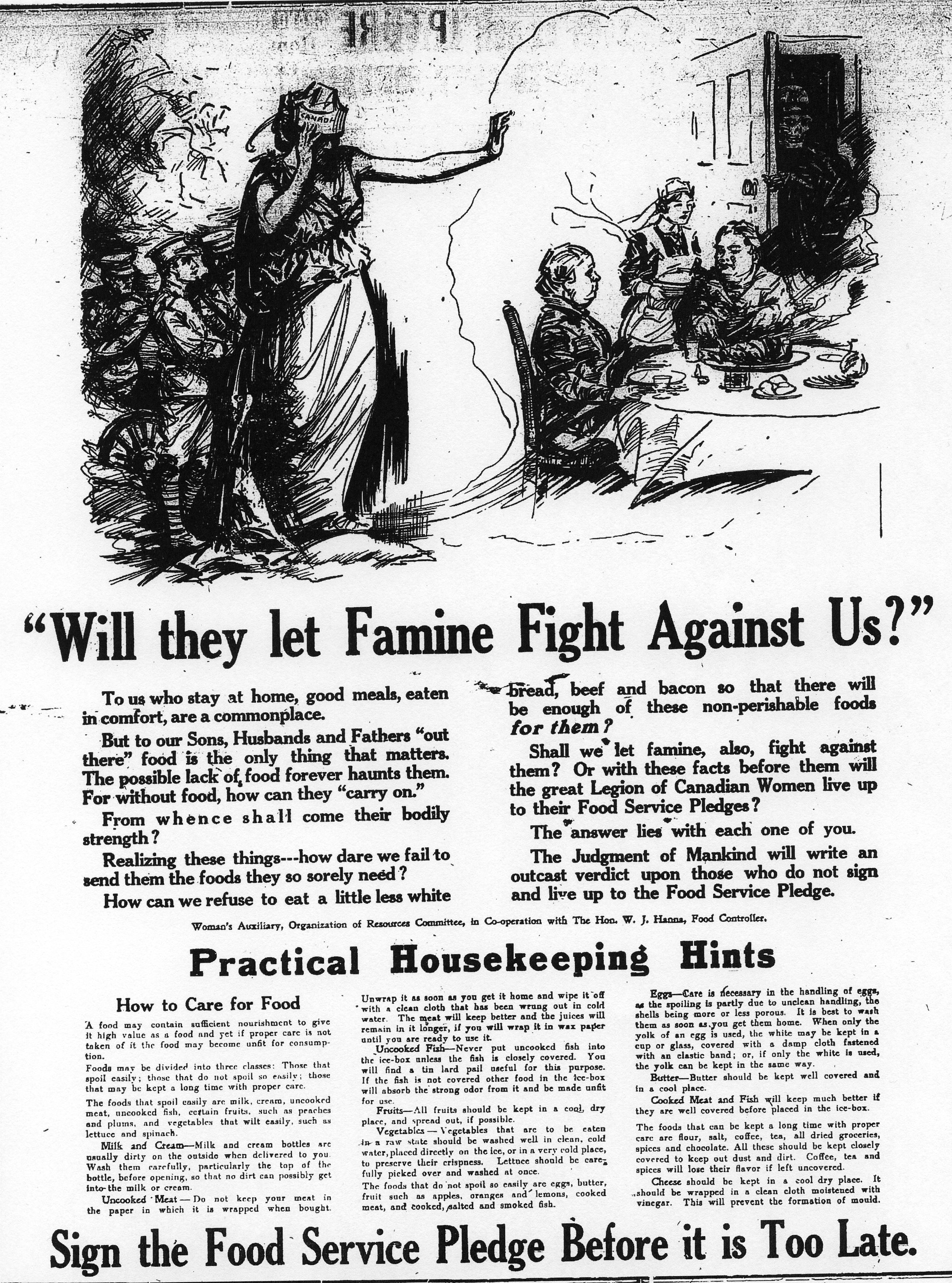
“‘Will they let Famine Fight Against Us?’ To us who stay at home, good meals, eaten in comfort, are a commonplace. But to our Sons, Husbands and Fathers ‘out there’ food is the only thing that matters. The possible lack of food forever haunts them. For without food, how can they ‘carry on.’

How can we refuse to eat a little less white bread, beef and bacon so that there will be enough of these non-perishable foods for them? The answer lies with each one of you.

Sign the Food Service Pledge Before it is Too Late.”

100 Years Ago: Patriotic Societies Request Soldiers’ Addresses, Ad for Hydro Electric Irons

The Intelligencer September 20, 1917 (page 3)

“Address Wanted. Belleville Patriotic societies desire to secure a correct list of officers and soldiers from this vicinity who are serving overseas, whether in hospital or on the firing line, and relatives will confer a favor by sending the addresses to the Intelligencer office as soon as possible.”

The Intelligencer September 20, 1917 (page 6)

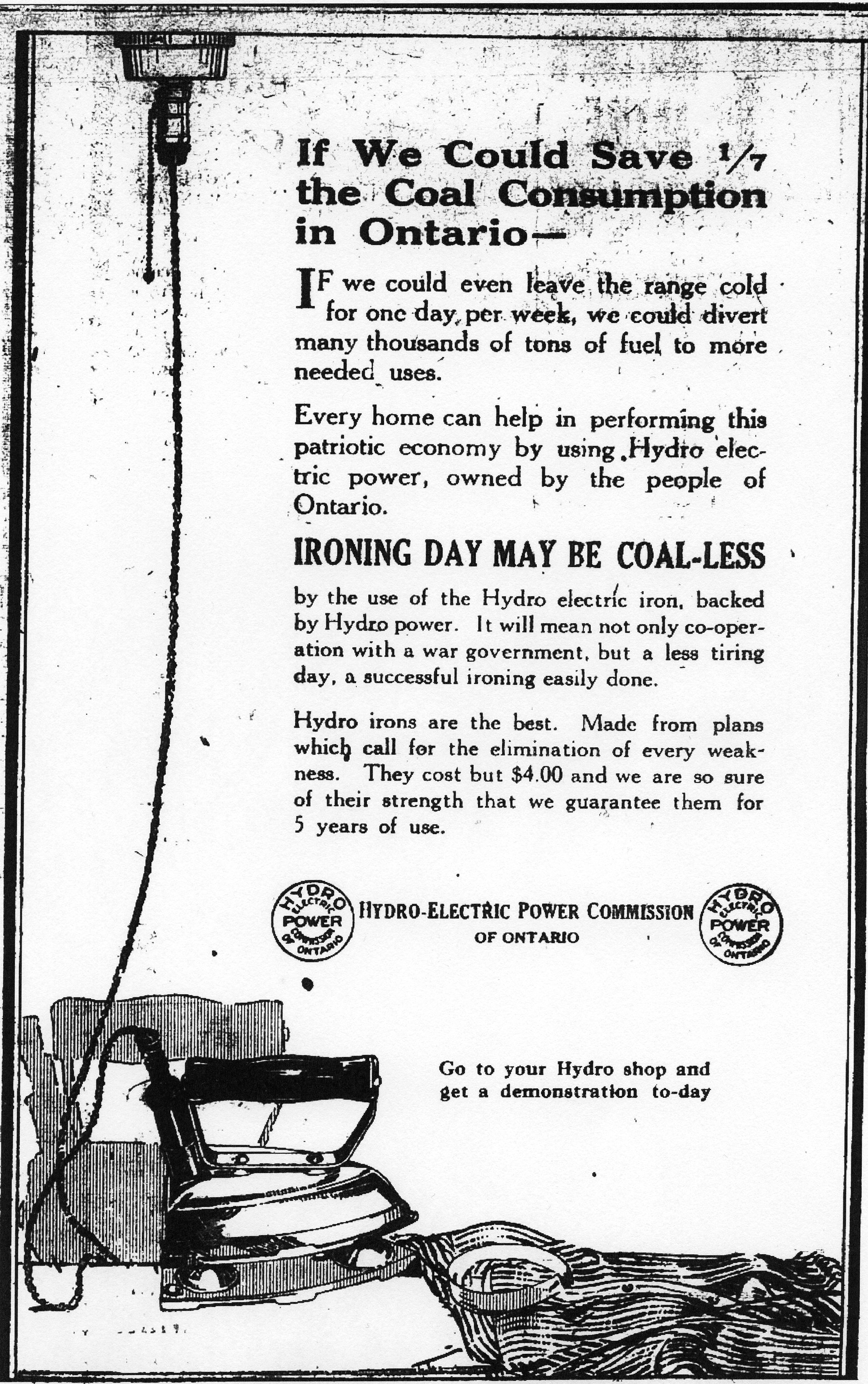
“If We Could Save 1/7 the Coal Consumption in Ontario—If we could even leave the range cold for one day per week, we could divert many thousands of tons of fuel to more needed uses.

Ironing Day May Be Coal-Less by the use of the Hydro electric iron, backed by Hydro power. It will mean not only co-operation with a war government, but a less tiring day, a successful ironing easily done.

Hydro irons are the best. Made from plans which call for the elimination of every weakness. They cost but $4.00 and we are so sure of their strength that we guarantee them for 5 years of use.

Hydro-Electric Power Commission of Ontario. Go to your Hydro shop and get a demonstration to-day.”

100 Years Ago: Food Card Pledges Signed, Belleville Medical Board Appointed, Douglas Graham Wins Military Cross, Poster for Food Service Pledge

The Intelligencer September 19, 1917 (page 2)

“Food Card Pledges. This city was yesterday and today canvassed by a number of ladies and Food Controller pledge cards were left in all the houses. In a great majority of cases the signature of the housewife was readily obtained. In many cases it was necessary to make an explanation of the object in signing the cards, which explanation was readily given and had the desired effect.”

The Intelligencer September 19, 1917 (page 2)

“The Medical Board of this city in connection with the Military Service Act is composed of Major Dr. A. E. McColl, Capt. Dr. W. J. Gibson and Capt. Dr. R. Tennent. The Board has been organized and have opened quarters upstairs in the Armouries. The office will be opened for a portion of the forenoon, the latter portion of the afternoon, and in the evening when necessary.

The object of the Board meeting now is to examine those who come under the first draft, namely from 20 to 34 years, before the rush of applicants as will be the case when the proclamation is issued.

Two copies of each man’s medical history sheet will be prepared and the applicant must sign both. One goes to the military headquarters, the other is retained by himself to be attached to his application for service or for exemption later on. …

Under the Act all males between the ages designated must appear before the Medical Board, no matter whether the applicant has previously been rejected or even returned from active service. None whatever are exempt. It is advisable that as many as possible get examined before the Board prior to the proclamation being issued.”

The Intelligencer September 19, 1917 (page 2)

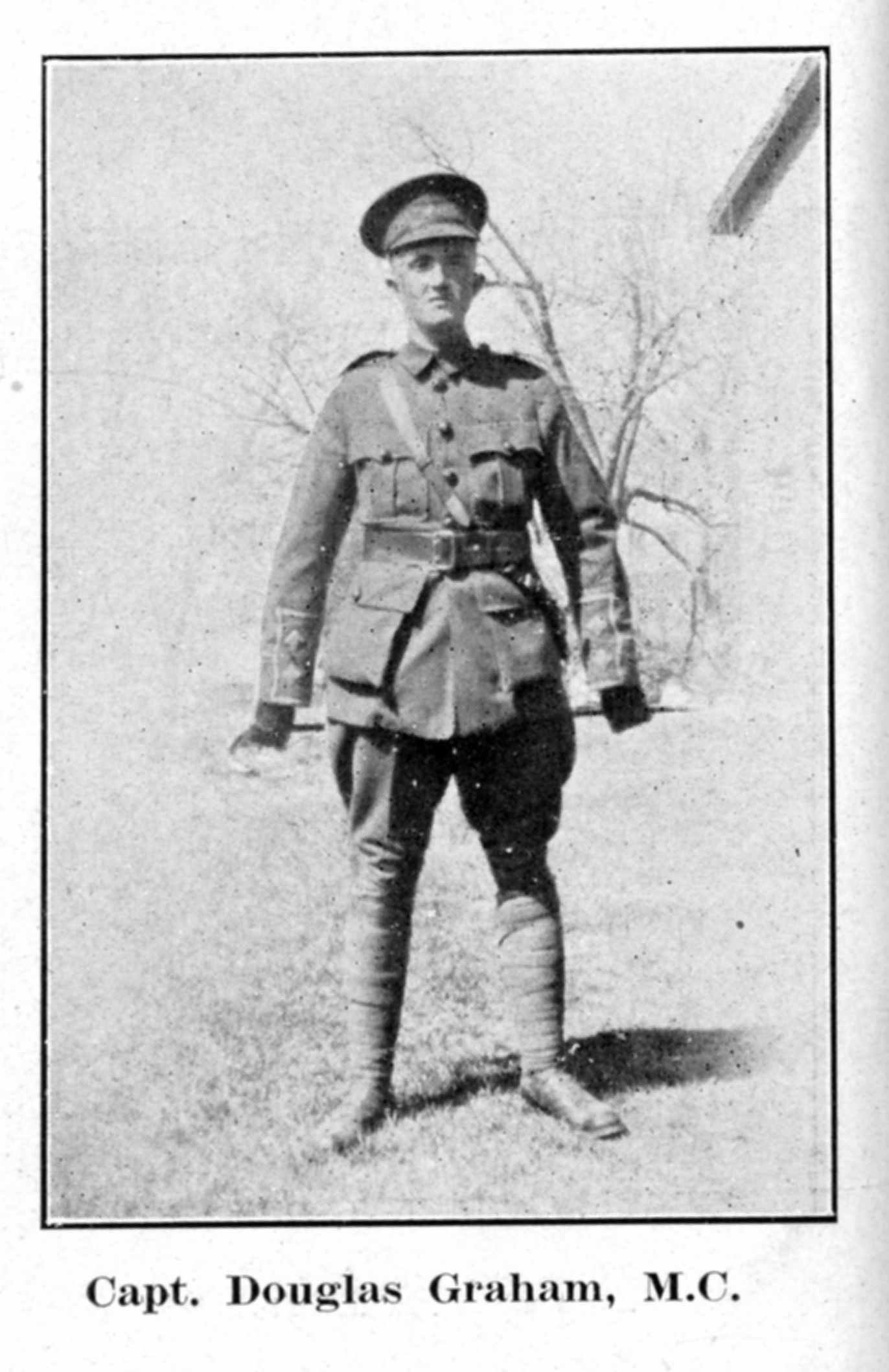
“Lieut. Graham Won Military Cross. In the issue of ‘Canada,’ an English publication, under date of Aug. 25th, 1917, appears the following: ‘Lieut. Douglas Graham was awarded the Military Cross for conspicuous gallantry and devotion to duty in leading forward reinforcements at a critical moment, his energy and determination enabled counter attacks to be driven off, one of which he repulsed practically unaided except by one N.C.O. He personally accounted for six of the enemy and his initiative and gallantry saved a difficult situation. Lieut. Graham is a resident of Sidney Township.’ ”

The Intelligencer September 19, 1917 (page 5)

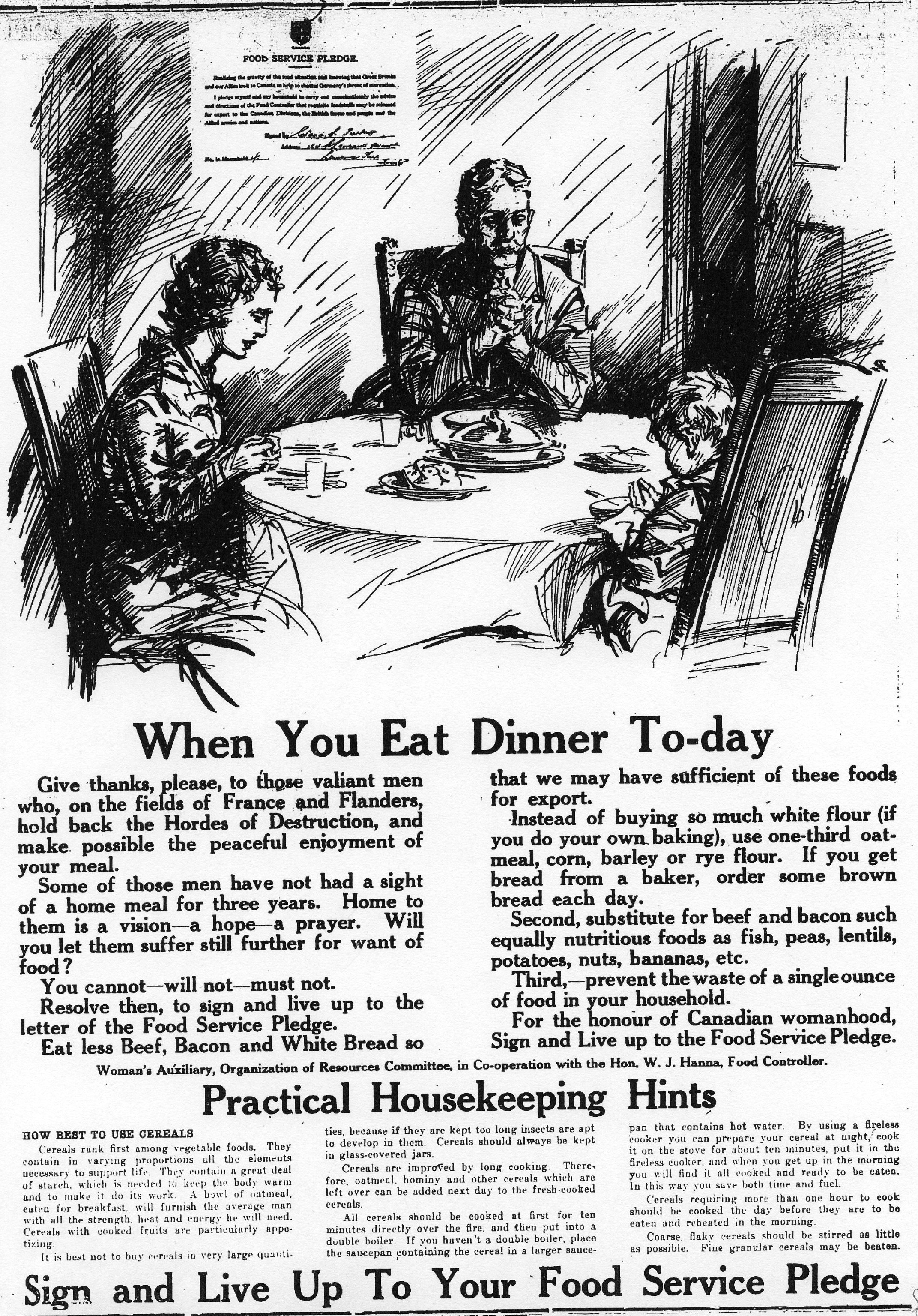
“When You Eat Dinner To-day. Give thanks, please, to those valiant men who, on the fields of France and Flanders, hold back the Hordes of Destruction, and make possible the peaceful enjoyment of your meal.

Some of those men have not had a sight of a home meal for three years. Home to them is a vision—a hope—a prayer. Will you let them suffer still further for want of food? You cannot—will not—must not.

Resolve then, to sign and live up to the letter of the Food Service Pledge.”