100 Years Ago: Alderman Smith Resigns to Join Flying Corps, Letter from Burb Symons

The Intelligencer May 15, 1917 (page 2)

“Ald. Smith Resigns from City Council. At the City Council meeting last evening, Mayor Ketcheson read the following letter, which explains itself. To the Mayor and Aldermen, City of Belleville. Dear Sir:—Having enlisted for active service in our great struggle for civilization against accursed German militarism, I respectfully resign as member of our Municipal Council.

In severing my relations with you, I desire to express my sincere thanks, to the citizens for the kind and generous manner in which they repeatedly honored me with their confidence, and which it has always been my aim to merit. …  I have endeavored to give efficient service to the citizens although I am not fortunate enough, as many of you are, in being able to claim Belleville as my birthplace.

However, I was born in the Province of Ontario, of British parents and British grandparents and in a larger measure I feel that I owe a more pressing duty, involving a greater service, not only to my family, or to my friends in Belleville, but a service that I owe to my country, to the whole British Empire, and to humanity at large, and that duty and that service is to do my share, however little it may be, to uphold our cherished institutions of British freedom and justice, and to help to achieve such a victory. …

For more than a year past I have tried to arrange my business affairs to permit me to enlist, and I am glad that I can now give my service for the great cause of civilization, which in my opinion, is worthy of every sacrifice. Yours truly, W. S. Smith.”

The Intelligencer May 15, 1917 (page 2)

“From Burb Symons. Aldershot, April 26. My Dear Mother:—Received your most welcomed letter written on the 9th of March, and was surely glad to hear from you. The last time I wrote I was in the Isolation Hospital. I have been transferred to the Cambridge Hospital, Aldershot. While I had the mumps I was taken with appendicitis. After my time was up for the mumps I came here. I had an operation for appendicitis last Monday. This is Thursday. I am feeling fine. The stitches will come out Monday I expect, if everything goes well. …

They are all English in this ward. They call me Canada. The Duke of Connaught is coming here to-morrow. I have to write lying on my back, and it is not comfortable, so I will not write very much, as I am quite weak. …  I guess I will close now. Don’t worry as you get excellent care here, and I am getting along fine. Love to all at home. Kiss little Mabel for me. I remain, Your loving son, Burb.”

100 Years Ago: 155th Battalion Colors Deposited at Church of St. Thomas, Kenneth Campbell Made Supreme Sacrifice, Discarded Uniform Found, Three Belleville Soldiers Wounded in Action

The Intelligencer May 14, 1917 (page 1)

“The Parish Church of St. Thomas was filled to its extreme capacity, at the eleven o’clock service yesterday morning, when the Colors of the 155th Battalion, C.E.F., were presented and deposited for safe-keeping in that Church. Lieut.-Col. A. P. Allen, O.C. of the 254th Batt., C.E.F., supported by ten other officers of his regiment, formed the escort. …

Opening Hymn.—Onward Christian Soldiers. …  Then shall the Commanding Officer present the colors to the Rector of the Church, saying as follows: Reverend Sir:—On behalf of the Officers and Men of the 155th Battalion, Canadian Expeditionary Forces, I ask you to accept the charge of the Colors of the Battalion for safekeeping in your Church.

Then shall the Rector reply: We do willingly receive from your hands the Colors of the 155th Battalion for safekeeping in our Church, and do pledge ourselves to preserve and guard them with all due care as a most honorable and solemn charge for such time as they shall remain entrusted to our safe-keeping. …

Capt. The Rev. Canon Dawe was invited by Archdeacon Beamish to deliver the address. Capt. Dawe is on leave from the front where he has lost two of his sons killed in action and two others are still there. He spoke very impressively and feelingly of the war and our need for self-sacrifice and earnest labor in greater production and greater saving.”

The Intelligencer May 14, 1917 (page 5)

“Made Supreme Sacrifice. At the service at St. Thomas’ Church yesterday morning the Rector Ven. Archdeacon Beamish, made special mention of the late Major Kenneth Campbell, who on April 28th made the supreme sacrifice somewhere in France. The late Major, when a youth, was a member of St. Thomas Church.”

[Note: Major Kenneth Leon Taylor Campbell died on April 28, 1917. He is commemorated on Page 212 of the First World War Book of Remembrance.]

The Intelligencer May 14, 1917 (page 5)

“Discarded Uniform. A parcel this morning was picked up from a lawn on Moira street, and when opened was found to contain a khaki tunic and a soldier’s cap. Written on the paper which wrapped the article, was a request that they be taken back to the guard room of the barracks on Pinnacle street, occupied by the 254th Battalion. Upon the inside of the tunic was the number of the enlister to whom it had been issued. The matter was reported to the military authorities, who took charge of the articles found.”

The Intelligencer May 14, 1917 (page 5)

“John A. Rickett Wounded. Ottawa, Ont., May 12, 1917. Mrs. Agnes Rickett, 106 Mill St., Belleville. Sincerely regret to inform you that 637104 Pte. John Albert Rickett, infantry, officially reported admitted to fourth Stationary Hospital, Argues, May 4th, 1917, gunshot wound right arm, slight. Will send further particulars when received. Record Office.

John Chamberlain. Ottawa, Ont., May 12, 1917. John Byron Chamberlain, 14 Wickett Street, Belleville, Ont. Sincerely regret to inform you that 636896 Pte. John Chamberlain infantry, officially reported admitted to fourth Stationary Hospital, Arques, May 4, 1917. Slightly wounded scalp. Will send further particulars when received. Record Office.

Everett Smith. Ottawa, May 12. Mrs. Emma Smith, 27 Mill Street, Belleville. Sincerely regret to inform you 636759 Everett Smith, infantry, officially reported admitted to Twenty-Two General Hospital, Camiers, May 4th, 1917. Gunshot wound right arm, slight. Will send further particulars when received. Officer in Charge of Records.

The above was a motor driver with Col. Adams, who enlisted with the 155th. He resided on Mill street, this city.”


100 Years Ago: Christ Church Choir Comfort Club, 15th Battalion Makes Good Start, Robert Black Drowns on Hospital Ship, Vincent Smith Invalided Home, Women May Now Vote

The Intelligencer May 12, 1917 (page 2)

“Christ Church Choir Comfort Club held their annual meeting in the Parish Hall last Thursday evening. This club aims to send field comforts to those of its members having either relatives in this country or whose relatives are unable to furnish them with extras. During the year we have sent 50 parcels, 51 pairs of socks and have 7 pair on hand. We have raised by giving teas, concerts, etc., $148.94: expenditure, $126.41, balance on hand, $22.53.

Many letters have been written to the boys, and acknowledgements received from them assure and encourage us to further our efforts for them. We thank all friends who in various ways have helped our club by donations, etc., and ask for future like kindnesses.”

The Intelligencer May 12, 1917 (page 3)

“15th Battalion Makes Good Start. In response to an appeal many citizens last evening assembled at the Armouries for the purpose of signifying their intention of joining the 15th Battalion, A.L.I. for the purpose of drilling for the home defence.

Col. Barragar, Officer Commanding, was present, and previous to drilling addressed a few remarks to those present. He stated that instructions had been received from headquarters at Ottawa to recruit the 15th Battalion up to full strength, and he would command same. It was necessary at the present time to drill men for home defence, as well as for overseas service in case of an emergency. Men from the age of 18 to 60 years were eligible to join and drill. It was proposed during the months of May and June to drill three evenings a week, namely Monday, Wednesday and Friday, and to resume again in September. Proper instructors would be available, and he (Colonel Barragar) would give all the assistance he could, and would be present every Friday evening, which evening would be devoted to battalion drill.

He was led to believe it would be a success, and he would urge upon all present to endeavor to secure at least one recruit for the next drill. If all would act as a recruiting officer the success of the movement was assured.”

The Intelligencer May 12, 1917 (page 7)

“Invalid soldier drowned. Pte. Robert Black, whose home was at L’Amable, Hastings County, was drowned recently when a hospital ship in which he was crossing the English Channel was torpedoed by the Germans.”

The Intelligencer May 12, 1917 (page 7)

“Pte. Vincent Smith, of Eldorado, Madoc Township, who enlisted with the 38th Battalion about 2 years ago, and who has seen about a year of active service, has been invalided home, having been wounded in the Somme fight. Pte. Smith arrived in Madoc Tuesday and despite the fact of hardships at the front looks hale and hearty. Previous to going to the front Pte. Smith spent some time in Bermuda.”

The Intelligencer May 12, 1917 (page 9)

“Women May Now Vote. Toronto. Hon. I. B. Lucas to-day announced that he had proclaimed the Ontario Franchise Act, which gives the vote to women and returned soldiers. The proclamation will be published in the Ontario Gazette on Saturday.

The proclamation of the Act brings into force all the recent amendments passed. Assessors will prepare their rolls under the new Act, instructions for which have already been sent out. It also means that any municipal elections of bye-elections held in the Province from now on, all women, so entitled, under the Act will have a vote.”

100 Years Ago: Returned Veterans Organize, George Maracle Killed in Action, Post Boxes for Postal Use Only, John Robbins Died in France

The Intelligencer May 11, 1917 (page 2)

“Returned Veterans Have Organized. At a meeting of the returned soldiers held at the Corby Building last night and which was fairly well attended, it was decided to form a Returned Soldier’s Club and to apply for admission to the Great War Veteran’s Association of Canada.

The following officers were elected: President, Corporal Ed. Blaylock. Vice-President, Sg’t. Maj. Chas. Gibson. Secretary, Private Porter. Fin.-Secr’y, Private Duffy. Treasurer, Serg’t. John Gilbey. Ex-Committee, officers of Club, Pte. Melburn Sprague, Cpl. Carr.

The idea of the club is to assist returned men to secure suitable employment and to assist them to fit themselves for better positions, to protect the interests of the men abroad and to be in a position to help them when they return.

It is the intention of the club to endeavor to open club rooms and for this purpose they intend to have a tag day the date to be arranged later. The club will meet again on Wednesday night the 16th inst., and all returned men are cordially invited to attend.”

The Intelligencer May 11, 1917 (page 2)

“Killed in Action. Official word has been received that George M. Maracle, son of Mr. Albert Maracle, of Point Ann, was killed in action on April 12th. He enlisted and went overseas with the 157th Battalion. He was a member of the Mohawk band and very popular in this vicinity.”

[Note: Private George Mark Maracle died on April 12, 1917. He is commemorated on Page 290 of the First World War Book of Remembrance.]

The Intelligencer May 11, 1917 (page 5)

“For Postal Use Only. The public in general—particularly in general—seem to persist in confusing the waste paper boxes with the Post Office parcel post boxes, stationed throughout the city. Collectors are continually delayed by finding paper scraps and refuse material in these boxes. A degree of intelligence on the part of our people would be appreciated by the Postal Department.”

The Intelligencer May 11, 1917 (page 5)

“Another Home Bereaved. Word was received at Bancroft on Monday that Pte. Jno. Robbins, who enlisted with the 155th Battalion, had died from pneumonia in France. Pte. Robbins leaves a widow and four small children.”

[Note: Private John Robbins died on April 15, 1917. He is commemorated on Page 316 of the First World War Book of Remembrance.]


100 Years Ago: 73rd Battery Likely to Move to Belleville, Procedure to Secure Personal Effects and Balance of Pay Due Deceased Soldier

The Intelligencer May 10, 1917 (page 3)

“Kingston Likely to Lose All the Artillery But 72nd Battery. The authorities have decided to distribute the units of the Kingston Depot Artillery Brigade so that each place from which men have been recruited will have an opportunity of supplying more men and thus keep the units up to the strength. …

The 73rd Battery will be moved to Belleville and thus have a closer chance of drawing men from Hastings and Prince Edward counties. The 74th goes to Peterboro, and will draw from that city and county. Cornwall will get the 75th Battery and the ‘united counties’ will thus be able to have more of its sons signed. …  The move will not be made before Petawawa Camp closes this season, but these places will then be the headquarters of the units named.”

The Intelligencer May 10, 1917 (page 6)

“Procedure to Follow. Since the list of casualties has so rapidly increased, many inquiries reach us regarding what procedure should be taken by the relatives to secure the personal effects and any balance of pay there may be due to a deceased soldier.

When a man is killed at the front, his personal effects are gathered together under the direction of the O. C., of the Battalion, and forwarded to the Base where they are checked. They are then forwarded to London, where they are sent to the officer in charge of Estates, Ottawa. Approximately five months elapse generally speaking before these effects reach Ottawa.

In reference to pay, six months after the death of the soldier, the last pay certificate is sent by the Overseas Paymaster to the Office in charge of Estates in Canada, when the necessary audit and adjustment takes place. Communication is then had with the next of kin of the deceased, when information is secured as to the domicile of the deceased; this being determined, the estate is divided pursuant to the law of the province in which the deceased had his domicile.

A minor soldier, that is one under twenty-one, has greater rights than a civilian in reference to the making of his Will. A civilian has to be twenty-one years of age, and in Ontario have his Will attested before witnesses. A soldier, however, by an English statute of 1837, made applicable to Ontario, and even although a minor, may make his Will and no witnesses are required. This, of course, only applies to the deceased’s personal estate.

Inquiries in reference to estates and personal effects should be addressed to the Office in charge of Estates Branch, Militia Department, Ottawa.”

100 Years Ago: Graham Company to Rebuild After Fire, Male Teachers Encouraged to Assist on Farms, Memorial Service Held for Sergeant McCrodan and Private Mondeville

The Intelligencer May 8, 1917 (page 2)

“It will be gratifying to the citizens of Belleville and vicinity, to learn that the Graham Company will restore their premises in this city, which were destroyed by fire on the morning of April 11th last. Plans and specifications have been prepared and the work of rebuilding will be proceeded with at once. It will be an extensive plant, fire-proof and up-to-date in every respect. …  It is confidently expected that the cold storage and packing plant will be completed by the 1st of September of the present year. The increase in the plant the company feel they are justified in making, and expect the farming community to assist in more production of food stuff.

The company have already orders which will keep them busy packing until next spring. This means that much vegetables will have to be secured.

Mr. J. Bone, in conversation with a representative of The Intelligencer, stated that in addition to the large evaporating plant the Graham Company will erect at the station, there will be another branch for the Fruit Machinery Company, which at present is doing an extensive fruit business. …  The railway sidings leading into the new premises from off Pinnacle street will be concreted between the rails, so as to enable driving upon them to be done. When completed there is no doubt but that the building will not only be an ornament to the city, but will provide employment for a large number of women and men. Work is already being commenced in the preparation of the foundations for the buildings.”

The Intelligencer May 8, 1917 (page 5)

“Teachers for Farms. Chief Inspector Cowley, of Toronto, has issued a circular to all the male teachers in city schools, urging that those who are capable of assisting on farms, and who are able to go, to arrange with the local inspector through the principal of the school, and that the period of leave, which should commence as early next week as possible, will include ten school days.”

The Intelligencer May 8, 1917 (page 5)

“Memorial Service. At St. Thomas Church on Sunday evening a memorial service was held for the late Sergt. T. H. G. McCrodan, and Pte. Frank Mondeville, who were recently killed in action. The Rector, Ven. Archdeacon Beamish in his discourse referred in an appropriate manner to the departed heroes. During the service the Dead March was played by Prof. Wheatley, organist of the Church.”

100 Years Ago: John Emerson Killed in Action, James Meens Killed in Action, Price of Coal Increases, 15th Regiment Ordered to Mobilize for Drill

The Intelligencer May 7, 1917 (page 2)

“Mrs. Isabella Emerson of Thomasburg, Ont., received a telegram on Friday last, April 27th, stating that her son, John Miller Emerson, was killed in action on April 9th. John enlisted with the 39th Battalion in Belleville in February, 1915, going overseas the following June. Although he has been very ill and in the hospital for several months, he escaped injury until now. It came as a great shock to all his friends, as John was always so cheerful and spoke so often of the war ending, and his return home again.”

[Note: Private John Miller Emerson died on April 9, 1917. He is commemorated on Page 234 of the First World War Book of Remembrance.]

The Intelligencer May 7, 1917 (page 5)

“In the casualty list last week appeared the name of Private J. E. Meens, who was killed in action. Previous to enlistment in the 59th Battalion, Pte. Meens was a G.T.R. fireman, who resided with his brother also a fireman whose home is on Herchimer Avenue. The young fireman was held in high esteem by his fellow employees, who will regret to learn of his death.”

[Note: Private James Ernest Meens died on April 9, 1917. He is commemorated on Page 292 of the First World War Book of Remembrance.]

The Intelligencer May 7, 1917 (page 5)

“Dealers Selling Coal at $9.50 Now. Following in the footsteps of everything else, coal is the latest necessity to jump in price, $9.50 per ton, being the price announced for May.

A local coal dealer stated that all deliveries made by his company since May 1, had been made subject to the price to be fixed, and this price was placed at $9.50.

One of the principle reasons for the advance in the price is the increase of 29 per cent granted to the miners by the coal operators, and which amounts to about $30,000,000 a year. Just at present the coal dealers do not know where the upward trend will stop, and some of them are looking for an advance in freight rates, which will mean further boosts.”

The Intelligencer May 7, 1917 (page 6)

“The Fifteenth Regiment, A. L. I. Orders were received by Colonel Barragar last week from the G. O. Commanding the 3rd Military District to at once mobilize the 15th Regiment for drill. All men in the City of Belleville between the ages of 18 and 60 years are eligible for enrollment on the strength of the Regiment. The orders means that the Regiment will be required to be filled up by new men as the old members enrolled have practically all gone overseas. The 15th Regiment is not connected with either the C.E.F. or C.D.F. and only entails the work of drilling and instruction two or three evenings a week.

Colonel Barragar wants all men in the City between the said ages to come to the Armouries next Friday night, the 11th inst., at 8 o’clock, and enroll. There is no pay; there is no going to camp; there is no medical examination; you can continue your work as usual; there is only the desire required on the part of the citizens to take the necessary precaution to be drilled in order to more capably protect those they are responsible for in case of emergency.

There should be 1000 men at least in the Regiment. Instruction in drill will be given by competent sergeants. Let there be a full attendance of the men. The Colonel has arranged for the rifles and equipment so that drill will be carried on the same as before the war. We heartily endorse this movement and we consider it desirable for our Citizens to turn out and muster the 15th Regiment A. L. I. to its full strength.”


100 Years Ago: Belleville Khaki Club, Thomas Dack Wounded, William Wenn Wounded, Two 155th Battalion Men Killed, One 80th Battalion Man Wounded, Two Former Belleville Teachers Presented with Gifts, Former Bellevillian Killed in Action, Women’s Red Cross and Patriotic Association Report, Letter from Queen Mary’s Needlework Guild, Frank Houston of Tweed Receives Military Medal

The Intelligencer May 5, 1917 (page 2)

“Belleville Khaki Club. The Khaki Club was opened in November 1915 for the men of the 80th Battalion, later for the men of the 155th and 235th. The officials have been waiting for orders from Lt.-Col. Allen, the Officer Commanding 254th Battalion to open the Club and regret exceedingly that Col. Allen’s latest order is not to do so on account of the probability of the Battalion leaving Belleville within a few days.

The Khaki Club is maintained in the following manner: The rent is paid also insurance, piano rent free, etc., by twelve ladies; note paper, ink, etc. also provided. The Club is practically handed over to whatever battalion is in town for the exclusive use of the N.C.O.’s and men. The proceeds of the Canteen go back into the Regimental Fund; on Wednesday evenings a musical programme is given and free refreshments are served. A Battalion Sergeant lives at the Club and is in charge.”

The Intelligencer May 5, 1917 (page 2)

“T. V. Dack Wounded. Ottawa, April 21, 1917. Mrs. Annie Dack, 15 Yeoman St., Belleville, Ont. Sincerely regret to inform you 636901 Pte. Thos. Victor Dack, infantry, officially reported admitted to No. 3 General Hospital, Boulogne, April 13, 1917, gunshot wound right thigh, slight. Will send further particulars when received. Officer In Charge of Records.”

The Intelligencer May 5, 1917 (page 2)

“Wm. T. G. Wenn Wounded. Ottawa, Ont., May 4, 1917. Mrs. M. E. Wenn, 70 Gordon Street, Belleville. Sincerely regret to inform you that 306340 Pte. William George Thomas Wenn, artillery, officially reported admitted to No. 18 General Hospital, Dannes Camiers, April 26, 1917, wounded severely chest, abdomen. Will send further particulars when received. Record Office.”

The Intelligencer May 5, 1917 (page 2)

“Killed in Action. Two members of the 155th Battalion who enlisted in Marmora and trained here a year ago, have been killed in action. They are David Emmorey and Jas. Caldwell.

Pte. Emmorey is survived by his mother and two brothers, Matthew and Bert.

Pte. Caldwell’s home was in Rawdon township. The relatives of both have the sympathy of the community in their bereavement.

Corp. Monto Bertrand, who went overseas with the 80th Battalion, has been reported wounded. Marmora Herald.”

[Note: Private David Belford Emmorey died on April 9, 1917. He is commemorated on Page 234 of the First World War Book of Remembrance.]

[Note: Private James Caldwell died on April 9, 1917. He is commemorated on Page 211 of the First World War Book of Remembrance.]

The Intelligencer May 5, 1917 (page 2)
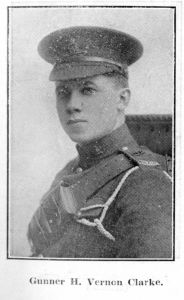
Presented with Pens. Corp. Vernon H. Clarke and Bombardier Bullock, of this city, who are members of the Cobourg Heavy Battery were last night the recipients of fountain pens from the Epworth League of Bridge Street Methodist Church, of which Society they were officers. To the presentation suitable replies were made. Since joining the battery their worth has been recognized by the commanding officer as Mr. Clarke was made a Corporal and Mr. Bullock a bombardier. Previous to enlistment the young men were popular teachers in the Belleville schools.”

The Intelligencer May 5, 1917 (page 3)

“Former Bellevillian Killed in Action. Mrs. M. E. Mahon, of 14 Asquith Ave., has been in receipt of the following telegram: Ottawa, April 27th, 1917. Deeply regret to inform you that Pte. Alex. Daniel Smith, Mounted Rifles, officially reported killed in action April 11th, 1917.

Pte. Smith was a Belleville boy, who lived with his aunt, Mrs. Fred Oram, Gilbert Street, ‘College Hill.’ Roy Smith as he was better known, was a former employee of the Wm. Davies Co., Ltd. before coming to Toronto, where he enlisted with the 169th Battalion and left for overseas last October. He was very popular among the young people and will be deeply mourned by his hosts of friends both in Belleville and Toronto.”

[Note: Private Alexander Daniel Smith died on April 11, 1917. He is commemorated on Page 327 of the First World War Book of Remembrance.]

The Intelligencer May 5, 1917 (page 5)

“The regular monthly meeting of the Women’s Red Cross and Patriotic Association was held on Tuesday evening May 1st. Mrs. O’Flynn acting President presided. The Secretary’s report was read and adopted. A letter thanking the Association for socks was read from Capt. F. M. Brown. Also a very interesting letter from Nursing Sister Jessie Morrice who received supplies for the Canadian Hospital in France where she has been stationed, but is now in a Convalescent home in London. The letter describes the work of transporting the patients from the clearing stations, then crossing the Channel to England and from boat to train in London and then to the different hospitals.

Cards have again been received from the Belleville boys, prisoners of war in Germany, thanking the Association for parcels of food and clothing.”

The Intelligencer May 5, 1917 (page 5)

“Queen Mary’s Needlework Guild, Friary Court, St. James’ Palace, S. W. London, Jan. 25th, 1917. Dear Mrs. Forbes Angus:—I am so glad to tell you of the safe arrival of seven cases which were sent off on December 8th. The Queen desires me to convey to you and all the kind workers Her Majesty’s grateful thanks for these splendid gifts, and the Queen asks me to send special thanks to the Women’s Red Cross and Patriotic Association of Belleville, for the very nice socks which they so kindly sent to Her Majesty’s Guild. Do tell them how useful the socks are as we are asked for such quantities of them for the men at the front.

The Queen desires me to say how much she appreciates your continued help. I wish you could see all the grateful letters we get from the Matrons and the men, and I can only add our grateful and renewed thanks. Yours sincerely, Aimee Dawson. (Lady Dawson) acting Hon. Sec.”

The Intelligencer May 5, 1917 (page 7)

“Wins Military Medal. Spr. Edward Alger, who is now at Crowborough Camp forwarded us, this last week, a copy of the Weekly Mirror dated Mar. 29th. It is full of war illustrations, etc., among others is a picture of our own Frank Houston (Gunner) being decorated by Major-General Turner with the Military Medal, at the Woodcote Park Convalescent Home, Epsom. He with eight others was thus honored on Mar. 21st. Gunner Frank is winning a name and fame for himself. He is a combination of good sound sense, a liberal supply of Canadian wit and has the nerve of the British lion.

His comrades in arms and his officers are proud of this gallant soldier laddie, and so are we all here at home and we are proud to know too, that there are a lot of just such boys as Frank at the front. Tweed News.”
100 Years Ago: Sandy Mindle of Coe Hill Dies of Wounds and Brother Ora Acile Mindle Wounded, Queen Mary School Cadets Inspected

The Intelligencer May 4, 1917 (page 7)

“Doubly Afflicted. Mr. F. Mindle of Coe Hill, received the sad intelligence that his son, Pte. S. A. Mindle died of wounds and the day following he received another telegram stating that his second son, Pte. A. A. Mindle had been severely wounded. The boys enlisted over a year ago and went overseas with the 155th Battalion. They were transferred to the 21st Battalion after going overseas, and have been at the front about two months. The bereaved family have the sympathy of their many friends.”

[Note: Private Sandy Alexander Mindle died on April 12, 1917. He is commemorated on Page 295 of the First World War Book of Remembrance.]

[Note: Private Ora Acile Mindle died on November 9, 1917. He is commemorated on Page 295 of the First World War Book of Remembrance.]

The Intelligencer May 4, 1917 (page 7)

“Queen Mary School Cadets. The annual inspection of Queen Mary School Cadet Corps No. 8, took place on Tuesday, May 1st, at 1.30 P. M. The inspecting officer was Major Ponton, a veteran of the 2nd Battalion, C. E. F. The corps was given a thorough inspection, being tested in company drill, rifle drill, extended order, etc. Each officer did his work in a very efficient manner. The corps has two companies and eighty-six on the roll. This year the officers are all new, as the old ones have passed into the High School. One of the handicaps of the Cadet Corps in the Public School is that we are constantly training officers for the High School.

Major Ponton, in his address to the Cadets after inspection, said that he was delighted with the way the officers did their work. He complimented the corps upon their appearance, discipline and steadiness, and said they had the best officers and were the best Cadet Corps in the Belleville Public Schools.”

100 Years Ago: William Gibson Wounded, May Day Tea in Aid of Red Cross, Harold Reid Relates First Flying Trip

The Intelligencer May 3, 1917 (page 2)

“Wounded in Action. Ottawa, Ont., April 28, 1917. Mrs. Gertrude J. Gibson, 517 Coleman St., Belleville, Ont. Dear Madam:—I have the honor to state that information has been received by mail from England to the effect that 455,899 Private William Gibson was admitted to No. 22 General Hospital, Danness Camiere, France, on March 27th, 1917, suffering from a severe gunshot wound in the right knee. Any further information received will be communicated to you without delay. I have the honor to be, madam. Frank Beard, Record Office.”

The Intelligencer May 3, 1917 (page 2)

“May Day Tea in Aid of Red Cross. It is greatly to be regretted that the very disagreeable weather on Tuesday, May 1st, prevented many from attending one of the prettiest teas yet given in aid of Red Cross work. It was given by the Cardinal Circle, Mrs. P. C. MacLaurin, Convenor, and held in the Y.M.C.A. reception room.

Even before entering the building, the splendid music of the 254th orchestra sent out into the stormy weather an irresistible invitation and, within, no disappointment lay in wait.

The large reception room, dressed for May day, was a veritable bower of spring beauty. From the centre of the snowy tables rose the May Pole, twined and woven about with ribbons in palest spring shades of mauve, pink, primrose and green, the ends being caught to the corners with bouquets of Hepatica. The table centre was a large mirror-pond, banked about with flower-starred moss and fern, in which graceful dogtooth violets and waxen blood-root bent above their delicate images, and it seemed a glimpse from the very depths of the spring woods. Moss and May Flowers were also banked against the mantel mirror and everywhere was a profusion of the dainty Hepatica, fairy of the woods. Even the refreshments were served from Hepatica-trimmed baskets tied with streamers of the delicate spring colors.

Mrs. F. E. O’Flynn, as head of the Belleville Women’s Patriotic Association, Mrs. (Dr.) Yeomans as head of the Rainbow Circles and Mrs. MacLaurin received the numerous guests, while Mrs. C. M. Stork and Mrs. B. Malory presided at the table, assisted by an efficient staff of the young ladies of the circle. The refreshments were dainty and abundant and were served in perfect order under the direction of Mrs. David Waters.

The 254th Orchestra rendered a splendid programme and Pte. Rickwood gave several humorous sketches which were especially appreciated by all.

During the afternoon the raffle of the beautiful handworked gown donated to the Circle by Miss Lucy Grant was decided by Mayor Ketcheson, the lucky winner being Mrs. S. A. Lazier, 91 Bridge Street.

Despite the most unfavorable weather, the circle realized on tea and raffle combined $68.25, which goes to the funds of the Association for wool and other comforts for the soldiers.”

The Intelligencer May 3, 1917 (page 7)

“Harold Reid Relates His First Flying Trip. The following is an extract from a letter received by Mr. C. M. Reid from his son, Harold, who is in France with the British Naval Flying Corps. The letter was written on the 8th of April. They spend the first couple of months learning all the details of the engine and other mechanisms.

‘During the first morning there was a crash not serious but a crash. One of the old machines and a number of boys went out to get something of what was left. …  While the boys were bringing the pieces in, one of the instructors was going up in one of the newer machines so I asked him if I might go up with him and much to my surprise and delight he said yes, so I borrowed a helmet and goggles and prepared for the journey. I was a little nervous, but before we left the ground the feeling had entirely left and I set in to enjoy it to its fullest extent.

The machine sped quickly over the ground, which made it seem very bumpy, but all of a sudden the machine was going along as smoothly as could be imagined, so I looked over the side of the fuselage and the ground was getting farther and farther away from us and I was really flying above the earth. Since I had never been in a machine before the pilot wished me to have a few of the real sensations to see how I liked it, and I did. I shall not say what all we did, but the earth seemed on one side and then on the other and then straight in front and then behind, and for a second I was completely lost, but soon found myself again.

It was the greatest sensation that I have ever experienced, and I attained the greatest speed too, which was over 80 knots at one time. After about ten minutes we came down again and I was sorry when the wheels went bump on the ground and we were on land once more.

I expect our class will start flying in earnest in another week or two and I shall not be at all sorry as I have waited quite long enough, I think.’ “