100 Years Ago: Severely Wounded Soldiers to Be Cared for in Canada, Charles Brook Wins Military Medal, Letter of Thanks, Men Urged to Fill Out National Service Cards

The Intelligencer January 4, 1917 (page 1)

“Will Care for Wounded Soldiers. Ottawa. ‘Bad cases’ will commence arriving from England shortly at the rate of about 300 a week. The Dominion Hospitals Commission has secured accommodation for 1,610 of the soldiers to be sent from Britain before reaching the convalescent stage. This is an innovation. Previously very few ‘bad cases’ have been received in the Dominion.

A 450-bed hospital is being prepared at Pier 2 at Halifax, and at St. John provision is being made for 500 bed cases at the armory, while 200 beds will be available in the General Hospital, Toronto.

The hospital trains of ten cars being supplied by the Government railway will be ready by January 12. The train will run as far as Winnipeg.”

The Intelligencer January 4, 1917 (page 2)
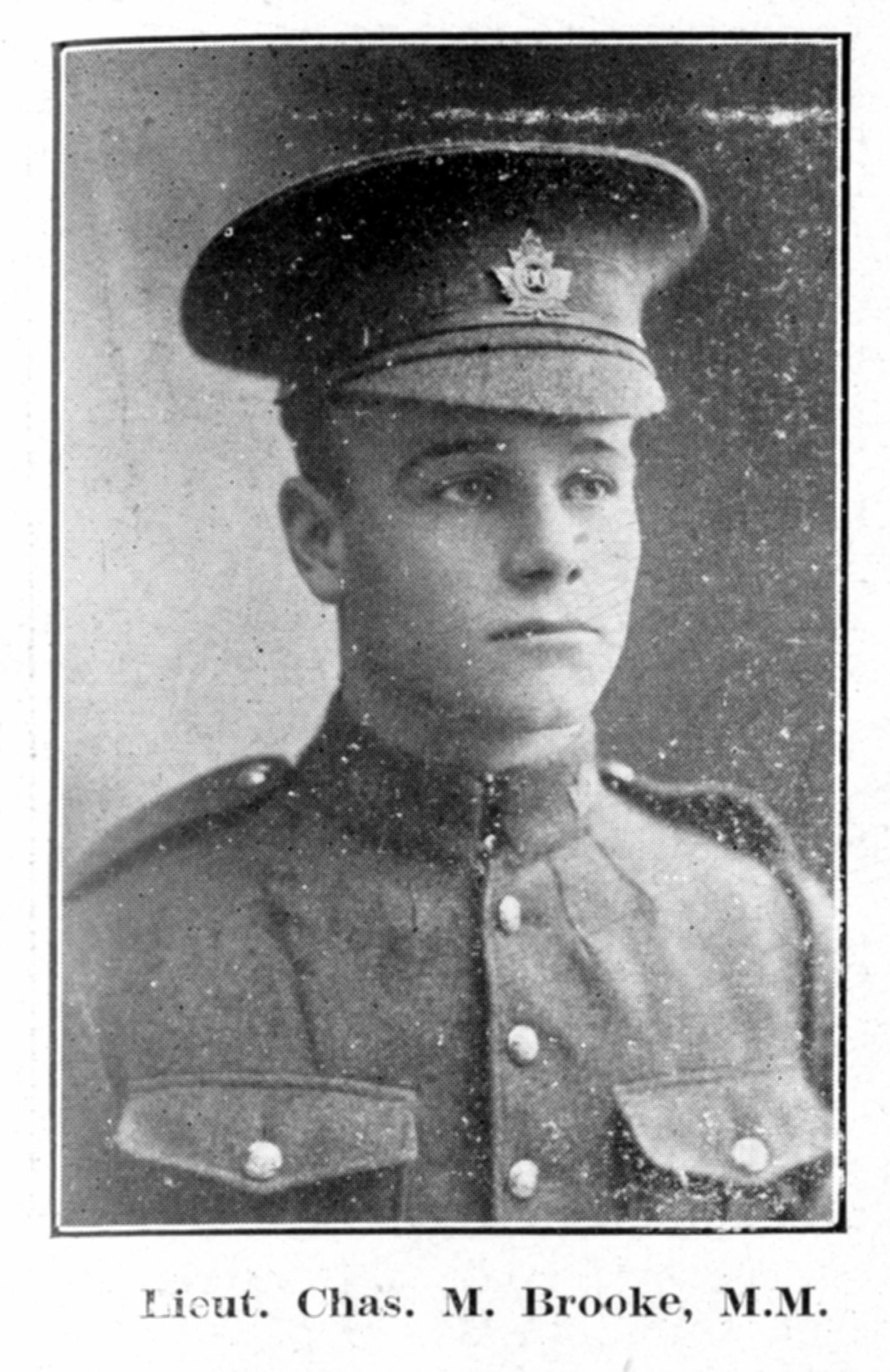
“Belleville Boy Wins Military Medal. Corpl. Chas. H. Brook, of the 72nd Seaforth Highlanders, formerly of the 80th Battalion and well known in Y. M. C. A. and Church circles, displays bravery and skill on the field of battle and is presented with the Military medal by the Canadian Army Corps commander.

The following extract from the report of Corpl. Brook’s work, read at the presentation by a Lieut.-Col. of the staff, gives evidence of the faithful discharge of his duty as a soldier.

An official extract says: Corpl. Chas. H. Brook, who on the night of Sunday, Nov. 19, 1916, showed extraordinary skill and devotion to duty while in charge of a reconnoitering patrol, whose duty it was to locate the position of two battalions in the line, that had successfully advanced to a new position, and arrange guides for the relieving unit. This N. C. O. though without food since morning and though working in new land under shell and machine gun fire in the dead of night, successfully located the new position and after arranging guides for the relieving unit, selected an advanced position for consolidation. The relieving unit was successfully guided in and the tired troops relieved.

Corpl. Brook’s commanding officer recommended him for the Military medal, and he was presented with his award at the Brigade inspection, Dec. 11, 1916.”

The Intelligencer January 4, 1917 (page 3)

“Of Interest to Knitters. Bramshott, Dec. 14, 1916. Dear Mrs. McFee:—No doubt you will be interested in knowing what disposition was made of the socks so kindly furnished to the 155th Battalion by the ladies of Belleville and Hastings County.

First every man from Belleville and Hastings were given two pair. Then when our first draft of 95 men were ordered to go to France, we could not procure any socks from ordnance stores; they did not have one pair in stock. We fitted this draft out with the socks sent me by the ladies. …  You can see that good use was made of the socks and that they brought comfort to many of the men.

The 155th Battalion marched into Bramshott, and it has been publicly stated by our Brigadier that they were as good as any that ever marched in. They were so good that the most of the men were sent to France within a very short time after our arrival. They did not need nor did they receive any further training in England. The small number remaining here were then drafted into another battalion, and all there is left of the 155th Battalion is the Senior Officers. We are expecting orders to go to France almost any day now.

Thanking you and all the ladies of Hastings and Belleville for their kind thoughtfulness, I remain Yours very truly, Lt.-Col. M. K. Adams, O. C. 155th Battalion, C. E. F.”

The Intelligencer January 4, 1917 (page 4)

“Fill up the Cards. Every resident of Belleville between the ages of 16 and 65 years should fill out the National Service card which his postman has left with him, as a patriotic duty. If the matter, when presented to him in this light, does not appeal to him, he would do well to act in his own interest. One thing is certain, he will save himself further annoyance by filling out and promptly returning the card. If he fails to do so, his case will surely be followed up by the authorities.

There are no impertinent questions on the card. These are not as searching as those propounded by the census taker every ten years. No attempt is made to pry into your private affairs. Even if you do answer every question you are no more liable for military service than you are today. If you are of military age, if your circumstances are such as to permit you to enter the ranks without the sundering of family ties or leaving a gap hard to fill in the industrial army, the local recruiting officers, after the close census they have taken, are already in possession of that information.

There is nothing about the cards that suggests conscription. You are threatened with no penalty if you refuse to answer the question, but the penalty will come later if you do not act, just as conscription will most certainly be resorted to if the voluntary system breaks down.

There are men needed to make munitions for the Allies just as urgently as recruits are wanted for the army. When these cards are returned, the Government will be in a position to readjust industrial affairs so that men can be employed to the best advantage in the work designed to bring the war to a successful conclusion.

Again, then, fill out the cards. It is your duty to do so as a patriotic Canadian and by doing so you are likely to save yourself considerable trouble, for this information the Government is bound to secure, if not voluntarily on the part of the public, then by the employment of harsher methods.”
100 Years Ago: Invalid Chair Donated, Letter from Fred Dixon, Presentation to Sergeant Major Lavin, New Year’s Night at The Khaki Club, North Atlantic Patrol Service Recruits Needed

The Intelligencer January 3, 1917 (page 1)

“West Belleville Women’s Institute to Send Practical Contribution for Comfort of The Wounded Soldiers. Much attention will be attracted to the invalid chair placed in the window of the Thompson’s furniture store. This chair is being sent to a hospital in England by the Women’s Institute of West Belleville, for the use of wounded soldiers.

Several friends of the ladies gave subscriptions for the purchase of this piece of equipment. The chair will bear the inscription of the Women’s Institute, and will no doubt cheer the hearts of some Canadian boys who have been so unfortunate as to need it.”

The Intelligencer January 3, 1917 (page 5)

“Dear Sir:—Once again I take great pleasure of writing you this letter wishing you and the staff a Happy New Year, with every success to the paper, which we boys over here read with interest, knowing it to be from the many kind friends in Belleville.

I am now resting and getting ready for the trenches again. I now have the pleasure to inform you that Pte. J. Kennedy is mentioned with the party of stretcher bearers for the D.C.M. for carrying wounded off the field while under heavy shell fire. I hope he gets it. The Belleville boys are making a good name for themselves and a credit to the place they came from. We are very thankful to the Daughters of the Empire in forwarding us the parcels, which contain so many useful things needed by us. We are still awake. I now close with best wishes to all. I remain Yours sincerely, Pte. Fred Dixon.”

The Intelligencer January 3, 1917 (page 5)

“Presented with Walking Stick. The following incident connected with the 155th Battalion, now overseas, explains itself: Bramshott, Hants. We have called this meeting to-night to endeavour to express in a few words, our appreciation of our worthy friend and supporter, B. S. M. Lavin. Since being under his command and supervision, he has always been a friend to those who have deserved his consideration. His interest in the Mess has been specially noticeable and I am sure that the members will all agree with me that he has helped to raise the Mess to the high standard which it holds to-day.

In our pleasures he has always been with us, and has never failed when things did not look so bright. I do not know what plans Sgt. Major has made for the future, but hope that whatever course he decides on, prosperity and good luck will follow him.

We hardly thought that words of appreciation and praise would be sufficient to express the kind sentiments in our minds, so hope that Bn. Sgt. Major Lavin will accept from the Sgts. of the 155th Batt., a small token of remembrance. I have the honor to be, Sir, on behalf of the Sgts. of the 155th Batt, C. E. F.

S. H. Turner, C. S. M., President. J. Neville, C. Q. M., Sec. of Mess. The presentation was a gold mounted walking stick.”

The Intelligencer January 3, 1917 (page 5)

“New Year’s Night at the Khaki Club was a pleasant affair, in spite of the hockey match and other special attractions there was a fair attendance. The ladies in charge were all old friends and workers of the club.

Mrs. MacColl presided at the piano, and many choruses were sung. Mrs. W. J. Brown was in charge of the canteen which was a sure guarantee of plenty of good things for the soldiers, and Mrs. Edwards looked after the coffee. It is worth mentioning that these last two named members have never missed a Khaki Club evening, except through sickness, since the 80th Battalion came up from Barriefield camp, over a year ago. Chief Brown made a substantial donation towards the refreshments for the evening.”

The Intelligencer January 3, 1917 (page 6)

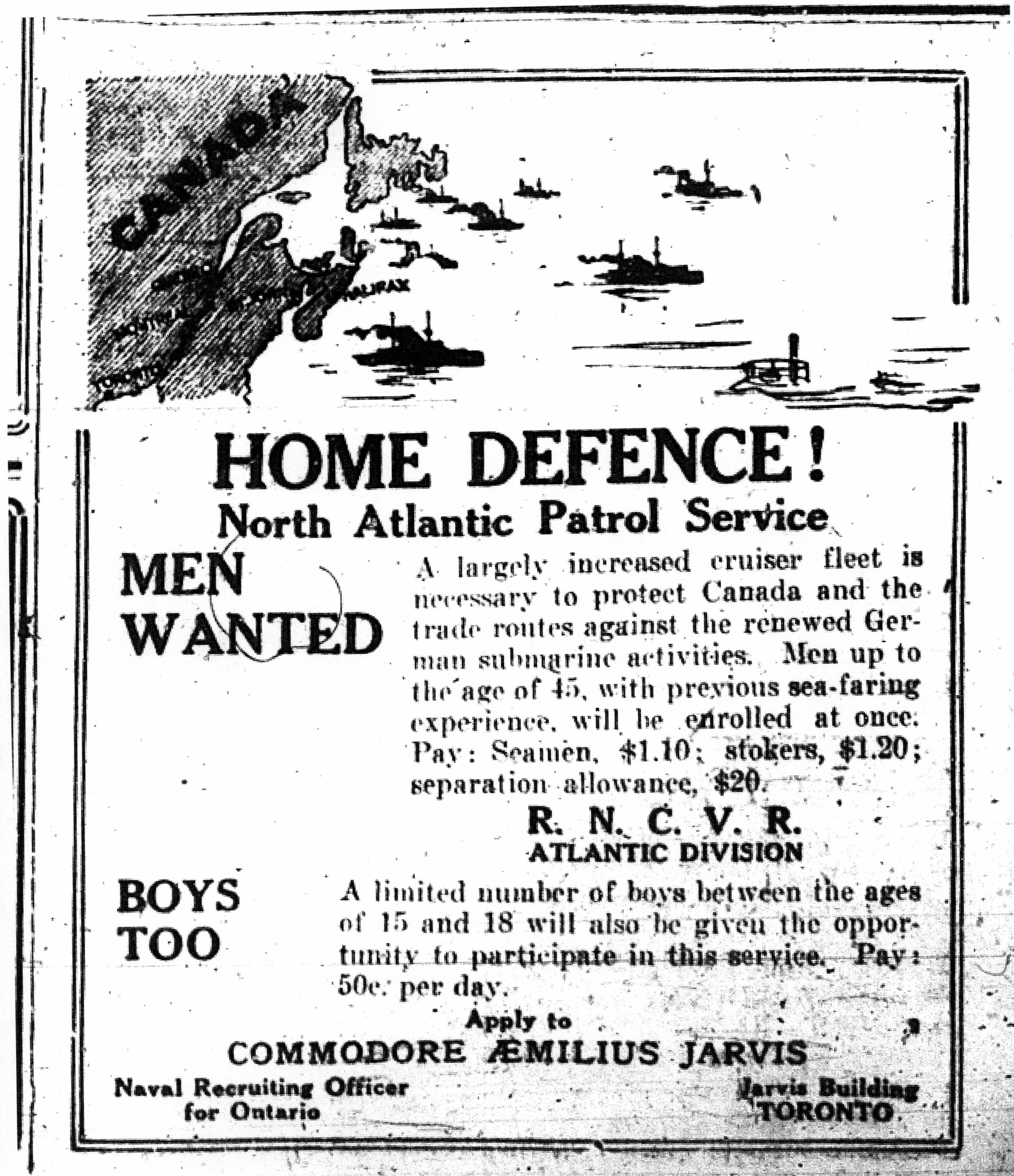
“Home Defence! North Atlantic Patrol Service. Men Wanted. A largely increased cruiser fleet is necessary to protect Canada and the trade routes against the renewed German submarine activities. Men up to the age of 45, with previous sea-faring experience, will be enrolled at once. Pay: Seamen, $1.10; stokers, $1.20; separation allowance, $20.

R. N. C. V. R. Atlantic Division. Boys Too. A limited number of boys between the ages of 15 and 18 will also be given the opportunity to participate in this service. Pay: 50c. per day. Apply to Commodore Aemilius Jarvis. Naval Recruiting Officer for Ontario, Jarvis Building, Toronto.”

100 Years Ago: 80-Year-Old Knits 100 Pairs of Socks, Concert by 254th Battalion Band, George Irvine Enlists, Edward Bellow Is Wounded

The Intelligencer January 2, 1917 (page 2)

“The Soldiers’ Friend. Great honor is due Mrs. James Nobes of Wallbridge, who at the age of 80 years, has knitted 100 pairs of socks for the boys in the trenches. Surely this aged lady has done her bit for the soldiers.”

The Intelligencer January 2, 1917 (page 2)

“At Griffin’s Opera House on Sunday night, a large audience appreciated greatly a sacred concert which was given by the 254th Battalion band. Under the capable leadership of Bandmaster Hinchey, a number of tuneful selections were rendered in a manner that was most pleasing to all present. Bandsman Ayling gave a brief but appropriate recruiting address, and a ladies’ quartette composed of Mesdames Grant, Allen, Nicholson and Duff, rendered a selection which was greatly appreciated.”

The Intelligencer January 2, 1917 (page 2)

“Closed Old Year by Enlisting. George A. Irvine, of the Belleville Post Office staff, is now a full-fledged gunner in the overseas draft of the Cobourg Heavy Battery. He decided to start the new year right and was sworn in at Cobourg on Saturday night.

There are still a few vacancies in the sixth draft which will be leaving for England shortly, and authority is expected this week for the raising of the seventh draft, which several other Belleville men have signified their intention of joining as soon as authorized.”

The Intelligencer January 2, 1917 (page 7)

“Edward Bellow in Scotch Hospital. Mrs. Edith Asselstine, 78 Mill Street, Belleville, On. Dear Madam:—I have the honor to state that information has been received by mail from England, to the effect that 219365 Pte. Edward Bellow, Canadian Expeditionary Force, was admitted to the Voluntary Aid Detachment Auxiliary Hospital, Perth, Scotland, on November 30th, 1916, suffering from a shrapnel wound in the left groin.

Any further communication received will be sent to you without delay. I have the honor to be, Madam, Your obedient servant, Frank Beard, Record Office.”

100 Years Ago: Report of John Phelan’s Death Untrue, National Service Cards

The Intelligencer December 30, 1916 (page 2)

“Mr. J. V. Truiasch of the Belleville Post Office staff, has received a communication from the Militia Department, Ottawa, in reference to Lieut. John Malcolm Phelan. It is to the effect that he was transferred from the 80th Battalion to the 47th Battalion. He was officially reported wounded but evidently returned to duty on November 11th.

It will be remembered that Lieut. Phelan was reported killed about the 7th of December, but this was certainly an error as letters received in Belleville, written by him, bore the date of December 11th, 1916. Lt.-Col. Barragar to-day received a letter from Lt. Phelan bearing the date of December 11th.

His many friends in this city will be pleased to learn that the report of his death was erroneous.”

The Intelligencer December 30, 1916 (page 6)

national-service-cards169

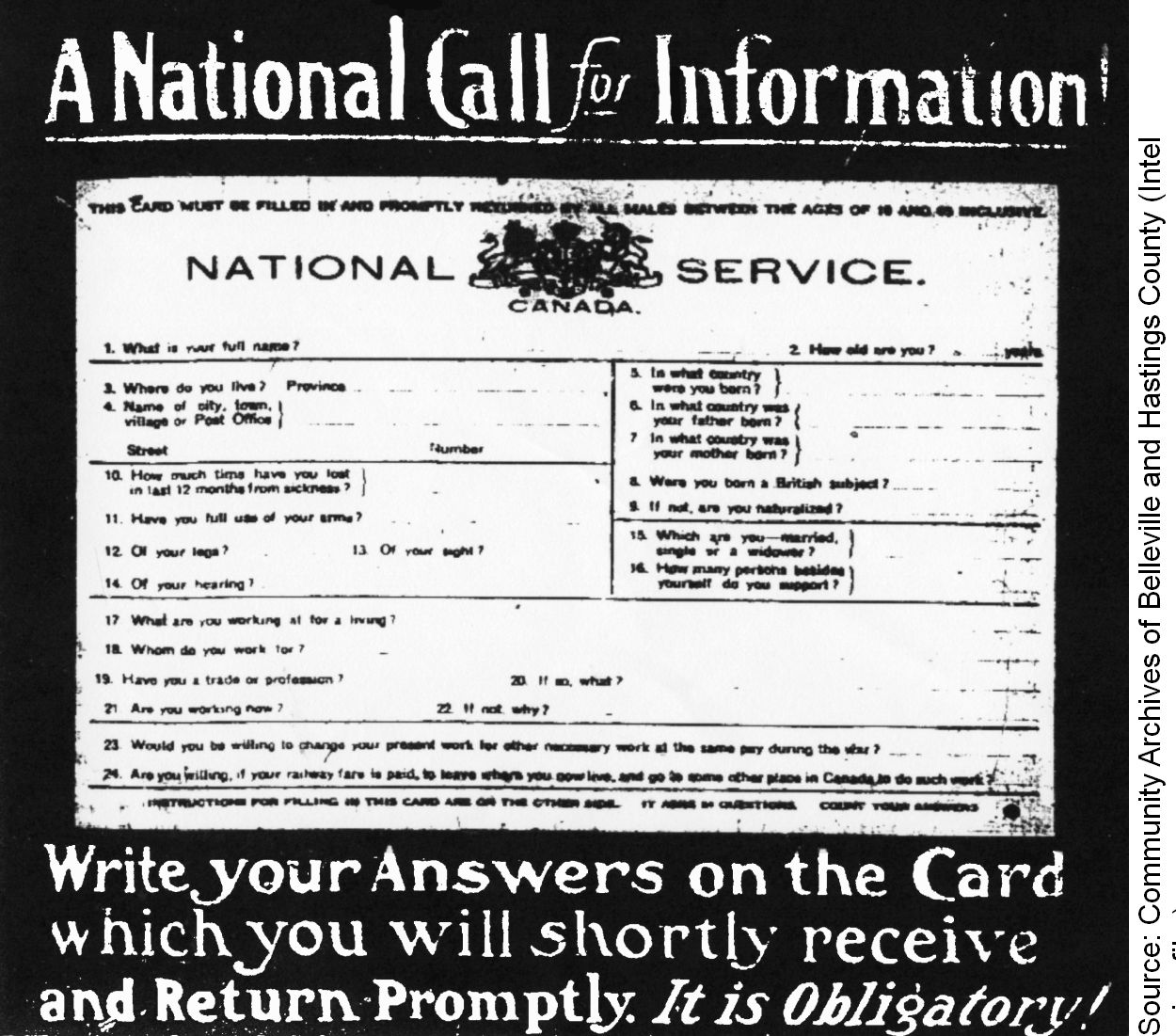
“A National Call for Information! National Service Canada.

Write your Answers on the Card which you will shortly receive and Return Promptly. It is Obligatory!”

100 Years Ago: Postmen to Deliver National Service Cards, James Vincent Ross Coming Home, Letter to Munitions Workers

The Intelligencer December 29, 1916 (page 1)

“Distribution of National Service cards by the letter carriers in Belleville commences to-morrow and the collection will start on January 3, Postmaster Gillen announced to-day. …

The letter carrier will ask the keeper of every house on his route how many males between the ages of 16 and 65 reside there and will leave a corresponding number of cards. The keeper of the premises is to distribute the cards to all the male residents in the house between the prescribed ages and to collect same and have them ready for the letter carrier when he calls for them. The letter carrier will check the number of cards returned with the number left at each house. …

Recipients of cards are asked to answer all the twenty-four questions and to write plainly.”

The Intelligencer December 29, 1916 (page 2)

“Coming Home. Mrs. J. V. Ross, No. 1, Emily St., received a letter from her husband, written by him on the 11th of December, stating he was expecting to sail for home in two or three days. Mrs. Ross is expecting him home with this boat that is about to land at Quebec.”

The Intelligencer December 29, 1916 (page 3)

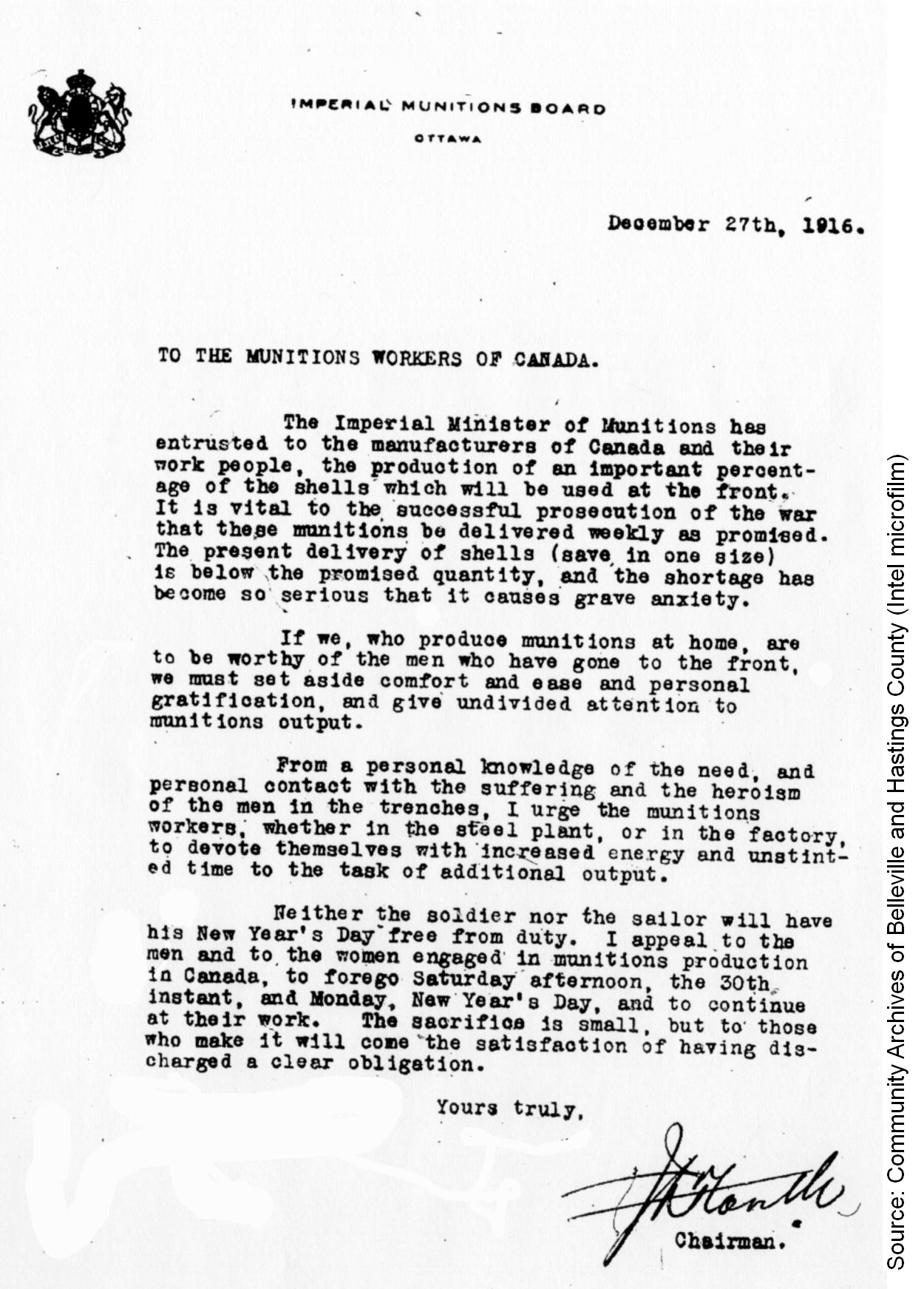
letter-to-munitions-workers168

“Imperial Munitions Board, Ottawa. To the Munitions Workers of Canada. The Imperial Minister of Munitions has entrusted to the manufacturers of Canada and their work people, the production of an important percentage of the shells which will be used at the front.

It is vital to the successful prosecution of the war that these munitions be delivered weekly as promised. The present delivery of shells (save in one size) is below the promised quantity, and the shortage has become so serious that it causes grave anxiety.

If we, who produce munitions at home, are to be worthy of the men who have gone to the front, we must set aside comfort and ease and personal gratification, and give undivided attention to munitions output. …

Neither the soldier nor the sailor will have his New Year’s Day free from duty. I appeal to the men and to the women engaged in munitions production in Canada, to forego Saturday afternoon, the 30th instant, and Monday, New Year’s Day, and to continue at their work. The sacrifice is small, but to those who make it will come the satisfaction of having discharged a clear obligation. Yours truly, J. W. Flavelle, Chairman.”

100 Years Ago: National Service Week Coming, 235th Intermediates Prepare for Opening Hockey Game in Kingston

The Intelligencer December 28, 1916 (page 5)

“Regarding the inventory of available man power which is to be taken during the first week in the new year, the following communication has been issued from the National Service headquarters:

National Service Week is drawing very near and the fact that the first week of the new year bears that title is something in which everyone in Canada has an interest. The men are interested because it is obligatory upon each of them, between the ages of 16 and 65 years, to fill out one of the cards the Government is sending to them through the post-office authorities.

The women are interested because their co-operation is being invited in seeing that their men-folk attend to this important duty. The children are interested because their school teachers have explained to them the meaning of National Service and the way in which father and the big brothers at home have to reply to the various questions. …

National Service means that we are to get into that frame of mind which will cause us to think of the needs of the country, to realize that the interests of the State have a greater claim on us than our self-interest. …

There are many ways of serving the nation besides going to the front. The man on the farm and the mechanic in a workshop may be serving the nation as usefully as the man in the trenches. …

The war is teaching us, or should be teaching us, great lessons. Terrible as are its effects, those who have faith in Canadian manhood hope and believe that the nation will emerge from this experience a stronger and a better people. If the meaning of National Service is understood, if the Government’s call for information is responded to in the right spirit, the coming year will be the banner year in Canada’s history.”

The Intelligencer December 28, 1916 (page 6)

“Good Workout Last Evening. Both Junior and 235th Intermediate teams had a splendid workout last evening, in fact one of the best this season. Several new men were out in both the junior and intermediate ranks, and for about an hour the men were matched together in a very stiff game, under able coaching of Ernie Lang. …

A good representation of the 235th Intermediates were out. All these players are little known in Belleville, and are being watched with interest by the local fans. The team is composed of some very good men and is gradually rounding into shape, and with good ice and weather, a strong line-up will face the puck at the opening game on Monday, Jan. 8th, with the Frontenac at Kingston.”

100 Years Ago: Corporal Troup Not Killed, Bible of Raymond Hudson Found, Ernest Geen Returning, Hospital Supplies for French Wounded

The Intelligencer December 27, 1916 (page 2)

“Corporal Troup Not Killed. Some time ago it was announced through the columns of the Intelligencer that Corporal Troup of Belleville, had been killed in action. This evidently was an erroneous report as the following communication has been received by his brother, Mr. Alexander Troup, from the Record office, Ottawa: 59999, Corporal Troup, 21st Battalion. No record in this office, killed in action. Further enquiries will be made.

The many friends of Corporal Troup in Belleville will be pleased to learn that he evidently still is in the land of the living.”

The Intelligencer December 27, 1916 (page 3)

“Private R. G. Hudson. The following communications, received by Mrs. R. E. Hudson, of Belleville, will prove interesting reading for friends of the young man referred to.

Canadian Red Cross Society, London. 8th December, 1916. Dear Madam,—re Pte. R. G. Hudson, 622,703, 27th Canadians.

We put through enquiries some time ago regarding your son who has been officially reported missing since 15th Sept. last. A comrade, Pte. D. Weir 71745, 27th Canadians, gave the enclosed Bible to the British Red Cross Society who, in turn forwarded same to us. Pte. Weir also gave an explanation as to how he found the Bible and we are enclosing copy herewith.

We have noticed your name and address inside and therefore we were able to send the Testament on to you at once. You will of course understand that this is not proof that Pte. Hudson was killed and we are continuing our enquiries.

Now that we have your name and address, we shall only be too pleased to let you know on receiving further information. We shall be pleased to know whether you receive the enclosed safely. I am, Yours truly, M. G. Harrison.

Mrs. Hudson, 26 Hillcrest Ave., late of 42, Gt. St. James Street. Belleville, Ontario, Canada.

Havre, Nov. 9th, 1916, Canadian Infantry 27, M. Sept. 15, 1916. Hudson, R. G. 6222703. He is in A Co. I found a Bible in an old German trench behind Courcelette; they called it the Sugar trench. The Bible was lying on the floor of the funk hole, and has written in it Hudson’s name and the name and address of his mother as well as a photograph. The trench was taken on Sept. 15th, 1916; and I found the Bible about 40 days afterwards.

Informant Pte. D. Weir, 71745. 27th Canadians, C Co. Harfleur, R. D. M. Address, 9 Mordaunt Place, Brighton, Glasgow.”

The Intelligencer December 27, 1916 (page 5)

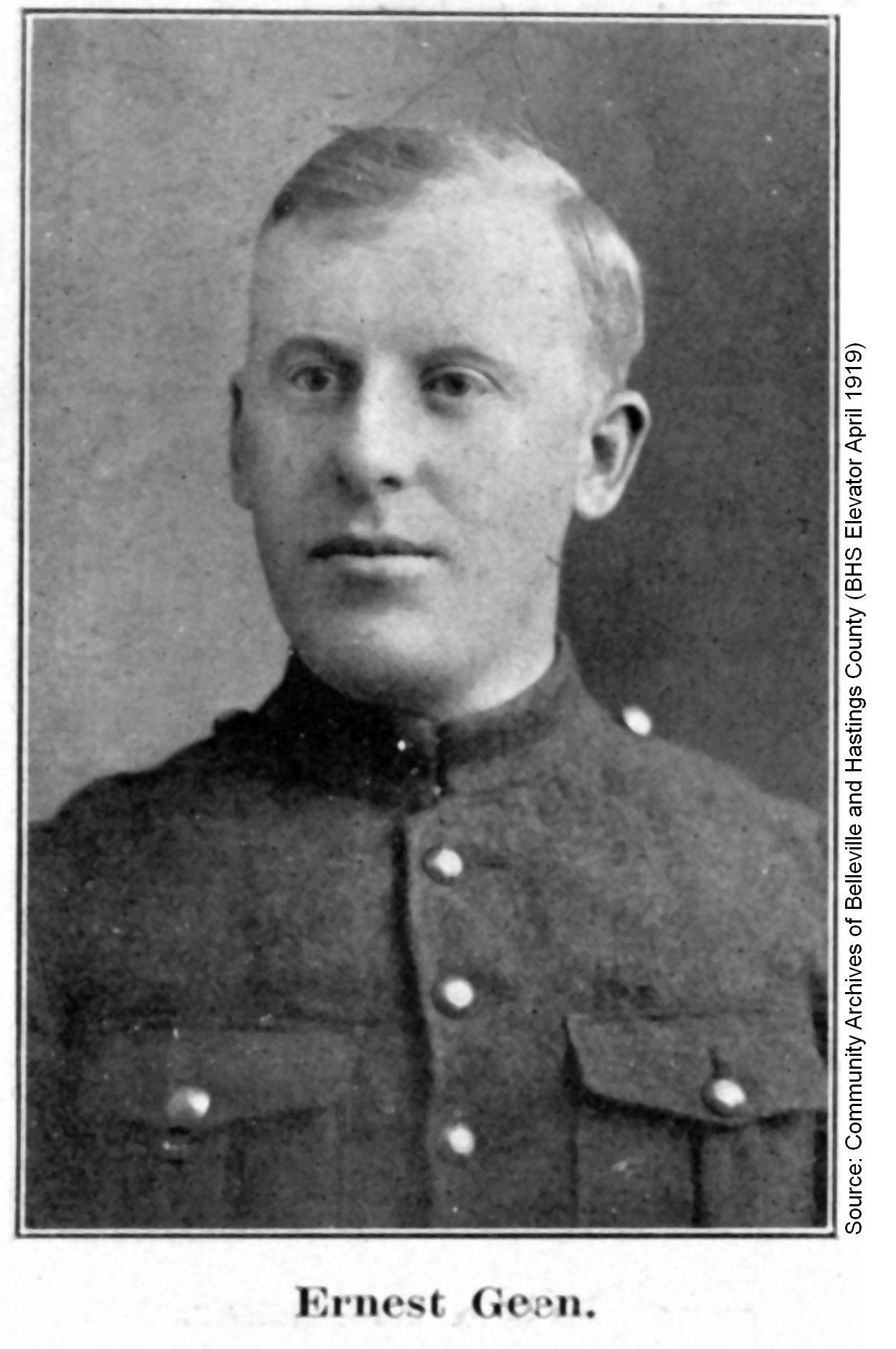
geen-ernest

“Lieut. Ernest Geen who has been transferred from the 21st Battalion to the 254th Battalion, sailed for Canada from England on Sunday, Dec. 24th.

Lieut. Geen, left Belleville as a private in the 21st Battalion, holding rank of Lieut. in the 15th Regt.; by his faithfulness to duty he received his promotion on the field of battle some time ago.”

The Intelligencer December 27, 1916 (page 5)

“French Wounded. 44 Lowndes Square, London, S. W. December 11th, 1916. Mrs. Lazier, 186 John Street, Belleville, Ont., Canada.

Dear Mrs. Lazier:—I was most delighted to receive three cases containing such excellent supplies for the hospitals and coming from the River Valley Womens’ Institute and Roslin Institute, the Tweed Red Cross Society.

May I ask you to convey to all the ladies who so kindly made and donated these excellent things, the sincere thanks of the Committee of the French Wounded Emergency Fund, assure them that we will send the things to France as soon as possible, choosing the most needy hospitals requiring this help.

Our delegates report a great deal of distress through lack of warm clothing in Brittany and in the southeast of France, especially in the smaller towns and villages where there is no wealthy population to assist in keeping up the supplies for the hospitals, as well as hospital appliances of all kinds, which, through constant use have deteriorated very much after two years of warfare.

It gives me very great pleasure as a Canadian, to receive bales such as yours, from my own country, and I have been most gratified by the many donations sent from Canada to our work.

We are expecting this morning a visit from H. R. H. The Duchess of Connaught, who has kindly consented to become our patroness. I shall have much pleasure in telling her of the consignment received from Belleville district, and I know she is still keenly interested in all that concerns Canada and its people. Sincerely yours, C. M. Dobell, Hon. Sec. Canada.”

100 Years Ago: The King’s Message, Farmers Need Hotel Stables

The Intelligencer December 26, 1916 (page 1)

“The King’s Message. Ottawa, Dec. 24—The following messages have been received from his Majesty the King by the Governor-General to be communicated to soldiers and sailors:

‘London, Dec. 23—I send you, my sailors and soldiers, hearty good wishes for Christmas and the New Year. My grateful thoughts are ever with you for victories gained, for hardships endured and for your unfailing cheerfulness.

Another Christmas has come round, and we are still at war. But the Empire, confident in you, remains determined to win. May God bless and protect you.’ George, R. I.

Also the following cable to the sick and wounded:

‘At this Christmastide the Queen and I are thinking more than ever of the sick and wounded among my sailors and soldiers. From our hearts we wish them strength to bear their sufferings, speedy restoration to health, a peaceful Christmas and many happier years to come.’ George, R. I. ”

The Intelligencer December 26, 1916 (page 1)

“Farms Are Calling for Accommodation. Kingston. Farmers are complaining about lack of accommodation for their horses, now that several hotels have closed their doors since the new Temperance Act went into force.

In this cold and stormy weather good stabling is required; and just at present it cannot be got because of the closing of hotels and the fact that the military authorities have rented a number of hotel stables. The farmers think that those directly responsible for this condition of affairs should devise ways and means at once of meeting their needs.”

100 Years Ago: Soldiers’ Christmas Menu, National Service Notice

The Intelligencer December 23, 1916 (page 3)

“Christmas Dinner, Monday, December 25th, 1916. The following list of good things is the menu of Christmas Dinner to be served to the men of the 235th Battalion at their barracks on Monday. It is evidence of care and interest that is being taken in the men by the officers who have been untiring in their efforts to make it a huge success.

Cream Tomato Soup, Roast Turkey, Cranberry Sauce, Potato Salad, Roast Pork, Brown Gravy, Bread Dressing, Vegetable Salad, Mashed Potatoes, Mashed Turnips, Creamed Carrots, Creamed Green Peas, Buttered Beets, Olives, Mixed Pickles, Celery, Plum Duff, Hard Sauce, Apple Pie, Mince Pie, Layer Cake, Tea and Coffee, Assorted Fruit and Nuts, Cigars and Cigarettes.”

The Intelligencer December 23, 1916 (page 4)

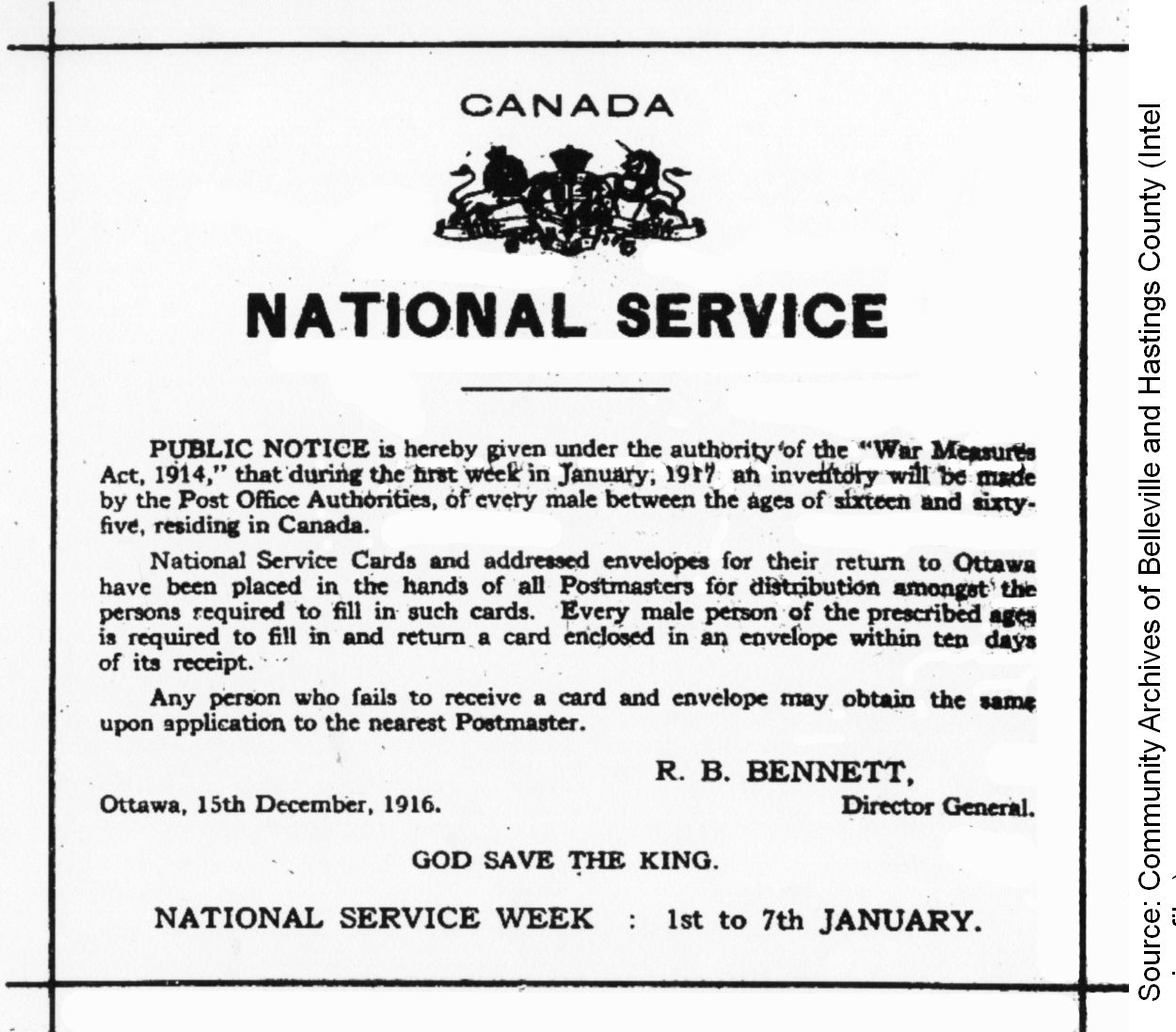
national-service167

“Canada National Service. Public Notice is hereby given under the authority of the ‘War Measures Act, 1914,’ that during the first week in January, 1917, an inventory will be made by the Post Office Authorities, of every male between the ages of sixteen and sixty-five, residing in Canada.

National Service Cards and addressed envelopes for their return to Ottawa have been placed in the hands of all Postmasters for distribution amongst the persons required to fill in such cards. Every male person of the prescribed ages is required to fill in and return a card enclosed in an envelope within ten days of its receipt.

Any person who fails to receive a card and envelope may obtain the same upon application to the nearest Postmaster. R. B. Bennett, Director General. Ottawa, 15th December, 1916.

God Save the King. National Service Week: 1st to 7th January.”

100 Years Ago: Christmas Day Plans for Soldiers, Dinner for the Poor

The Intelligencer December 22, 1916 (page 2)

“Christmas Day is to be fittingly observed by the men of the 235th Battalion, by holding a monster dinner at the barracks on Pinnacle street. Twenty turkeys have been secured and together with the usual Yuletide luxuries will go to make up a feast that will long be remembered by the soldiers. Lt.-Col. Scobell and the company officers of the battalion, will be present.

Major Southey of No. 2 Company will relate to the men at dinner how Christmas was celebrated last year in the advanced Canadian trenches, with Mr. Boche only 30 yards away. Sergt. Greenwood of the same company will also describe how Christmas was celebrated in a base hospital, somewhere in France, where he was unfortunate enough to find himself a year ago.

No recruiting meeting will be held this Sunday, Christmas Eve, but the soldiers suggest that the most fitting gift that can be made in this terrible time of war is a gift of a man to the country and Empire. The military authorities respectfully submit this for the consideration of all loyal citizens.

Fifty per cent of the men of the 235th Battalion have been given Christmas leave. The remainder of the men will be given leave at New Years.”

The Intelligencer December 22, 1916 (page 2)

“Xmas Dinner for Poor. Every arrangement has been made whereby every poor family in the city will be provided with a Christmas dinner. At 2 o’clock tomorrow afternoon at St. Thomas church Parish Hall they will give the dinner. This generous act has been made possible by the various churches and other organizations in the city.”