100 Years Ago: Belleville Boy Returns to Enlist

The Intelligencer August 17, 1916 (page 2)

“Belleville Boy Returns to Enlist. Mr. William O. Wardhaugh of Washington, D.C., accompanied by Mrs. Wardhaugh and three children, who has just arrived in this city, to-day signed up with the 155th Battalion, and will shortly report at Barriefield.

In company with Recruiting Officer Henry Foltz, also an old resident of Belleville, Mr. Wardhaugh visited the Intelligencer Office this morning and expressed his determination to do his bit toward defeating the Germans. He is a splendid specimen of the perfect athlete, and was passed without hesitation by Dr. MacColl.

Mr. Wardhaugh is a son of Mr. Oliver Wardhaugh of Front street, this city, was born here, and fifteen years ago left for the United States, settling finally in the American Capital, where he has been following the occupation of a contractor, with prosperous results. Like many another full-blooded Canadian, his loyalty came to the surface, and he now gives his best energies for his country’s cause. He is 31 years of age. The act of this loyal subject should be an incentive for other local young men to follow.”

100 Years Ago: Canadians Moved to Somme Front

The Intelligencer August 16, 1916 (page 1)

“Canadians Moved to the Somme Front. Ottawa. The Canadians have been withdrawn from the famous blood-soaked Ypres salient, where so many sons of the Dominion have lost their lives in the past year. Word to this effect has been received by the Militia Department.

This does not mean that the Ypres salient has been abandoned nor that the Canadian troops have been withdrawn from the fighting line. As a matter of fact the Canadians apparently will now be taking part in the general British offensive, as they have been moved to the Somme district, where the great push is taking place.

The Canadians have been in the Ypres salient almost from the time the First Division landed in France. The salient will be always associated with the name of Canada, as it was here the First Division won undying fame by holding back the whole German onrush in April of 1915.

When the Battle of Verdun became serious and the British took over part of the French line the Canadians were moved to the most dangerous part of the salient, the apex, subject to a constant crossfire from three sides. The Canadian casualty list since then has been terrific.”

100 Years Ago: Ad for Zam-Buk

The Intelligencer August 15, 1916 (page 3)

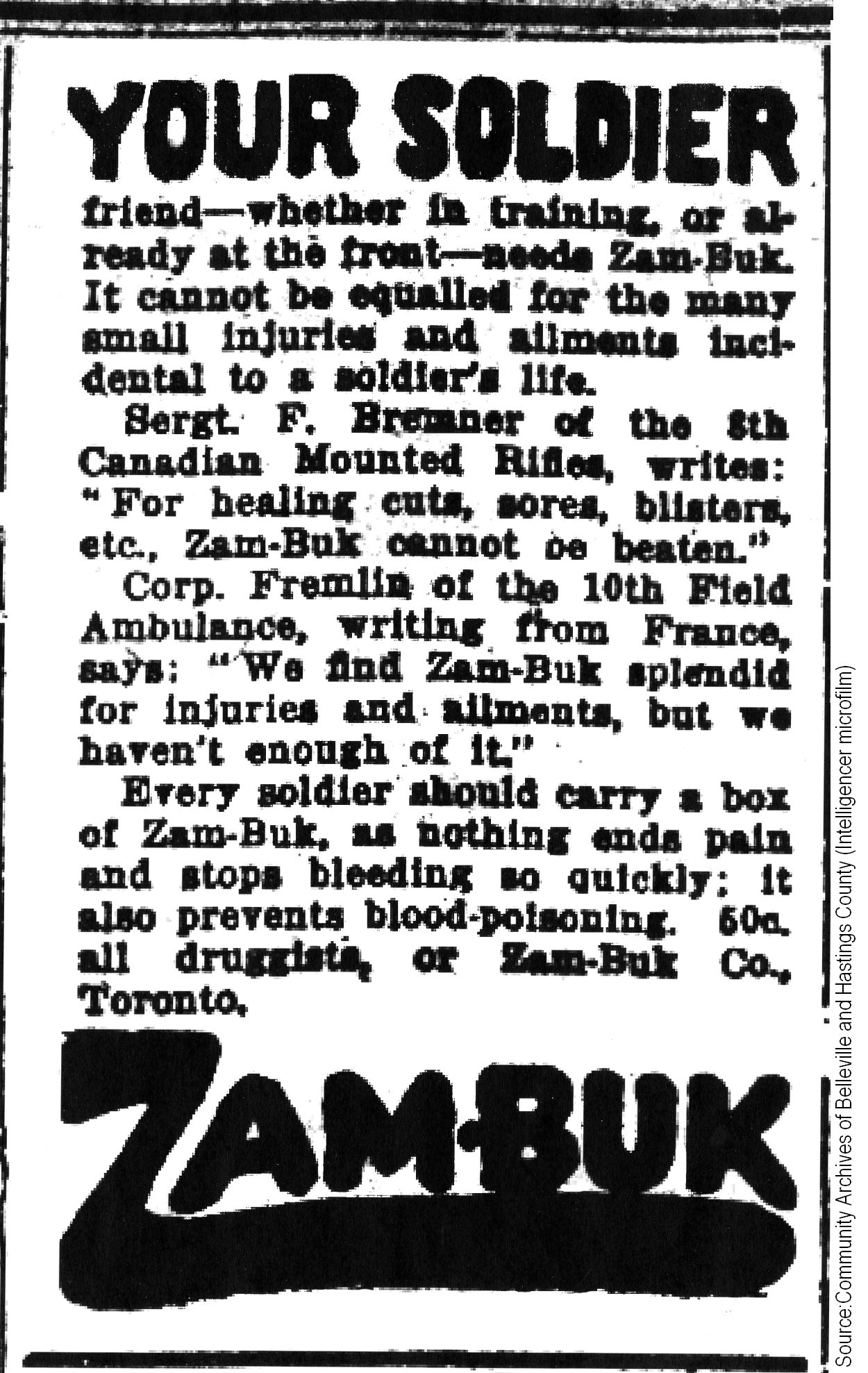
Zam-Buck017

“Your Soldier friend—whether in training, or already at the front—needs Zam-Buk. It cannot be equalled for the many small injuries and ailments incidental to a soldier’s life.

Sergt. F. Bremner of the 8th Canadian Mounted Rifles, writes: ‘For healing cuts, sores, blisters, etc., Zam-Buk cannot be beaten.’ …

Every soldier should carry a box of Zam-Buk, as nothing ends pain and stops bleeding so quickly; it also prevents blood-poisoning. 50c. all druggists, or Zam-Buk Co., Toronto.”


100 Years Ago: Canadian Prisoners of War Receive Red Cross Parcels

The Intelligencer August 12, 1916 (page 3)

“One of the admirable features of Canadian Red Cross Work is the provision made for supplying Canadian prisoners of war with clothes and other comforts, and weekly parcels of food. For this purpose a special fund has been created, and in addition, by arrangement with Government authorities, any Canadian prisoner has the privilege of assigning part of his pay to the Red Cross; which in return will send him such goods as he desires and the German authorities permit.

Some people profess to doubt whether the prisoners actually receive the parcels. The Canadian Red Cross has had, however, many letters from Canadian prisoners in Germany. Many of them are published from month to month in the Red Cross Bulletin.

A prisoner in Giessen stated, ‘I received my first parcel of food through the Canadian Red Cross on November 25th, and since then they have been coming regularly. Have also had shirts, underwear, socks, gloves, muffler, blanket, overcoat, sweater and a pair of slippers. All here join in thanking the Red Cross for its kindness.’ …

There are innumerable other letters of a similar nature, and there is not the least doubt that the Canadian Red Cross, owing to the special privileges conferred on Red Cross Societies by the Hague Convention, is the best medium through which to communicate with Canadian prisoners in Germany.”

100 Years Ago: Canada to Send Another Division

The Intelligencer August 8, 1916 (page 2)

“Canada to Send Another Division. Ottawa. The announcement in England by General Sir Sam Hughes that Canada would place two more divisions in the field was expected here and in anticipation of such an increase in our army in Flanders, about forty thousand troops now in training in Canada will be sent overseas before the middle of October.

Canada now has four divisions in Flanders and with the two others to be organized will have 250,000 men on the firing line, or the equivalent of three army corps.

There have been sent overseas 22,000 men and allowing 20,000 for wastage in killed, prisoners and permanently unfit for service by wounds and sickness, the new war organization will have 120,000 men at the front and 80,000 in reserves in England. To bring the reserves up to 100 per cent, there will be sent from Canada as soon as possible an additional 40,000 men. …

It is believed that few additional regiments will be now authorized. When the six divisions are at the front this will mean 72 infantry battalions, whose identity will be preserved. Beyond this number it is very doubtful if other battalions will be permitted to preserve their identity.

The new recruiting system being considered is to have the parent militia organization enlist drafts for the allied battalions at the front. Every one of the 72 battalions in the army in Flanders is in a great measure identified with some particular regiments and it is believed that the home regiments will be able to furnish enough partially trained recruits to keep the ranks of the regiment on service filled. Drafts for this purpose will probably consist of one hundred non-commissioned officers and men and two lieutenants.”

100 Years Ago: Gathering at the Armouries, Letter of Thanks from Celestina Geen, Belgian Relief Fund

The Intelligencer August 5, 1916 (pages 1, 2)

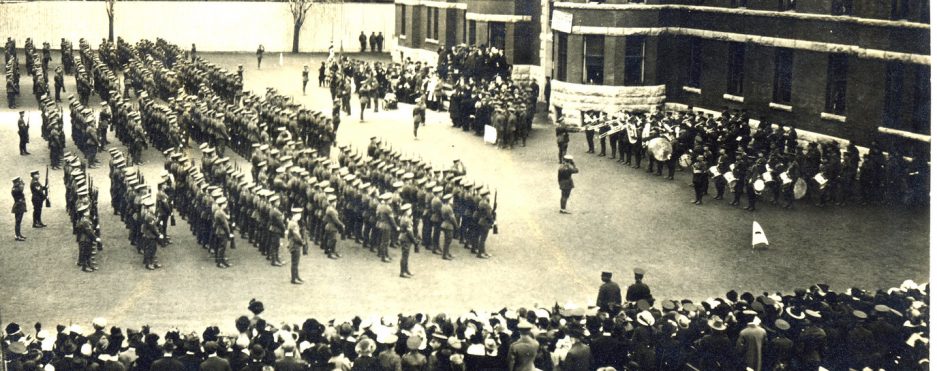
“Second Anniversary of Declaration of War. In response to a proclamation issued by Mayor Ketcheson a goodly number of the citizens of Belleville assembled at the Armouries last evening, despite the fact that the weather was exceedingly warm. The ladies present were by far more numerous than the gentlemen.

The meeting was called in response to a request from the Lieutenant-Governor of Ontario, asking the citizens of Ontario to commemorate the anniversary of the declaration of war and to publicly discuss the great problems that face this Province as part of our Empire and to re-affirm our belief in the righteousness of the cause for which we are fighting, and our inflexible determination to continue the struggle until victory has been achieved.

His Worship occupied the Chair and associated with him on the platform were Sir Mackenzie Bowell, Mr. E.G. Porter, K.C., M.P., Mr. W.B. Northrup, K.C., M.P., Revs. Dr. Blagrave, E.C. Currie, S.C. Moore, Dr. Scott, and Canon Beamish; Mr. John Elliott and Sergt A. Gibson, the latter of whom received a hearty welcome upon being requested to go upon the platform.

In a few well chosen remarks the Mayor stated the object of the meeting as outlined above. The proceedings were then formally opened by the singing of the National Anthem, followed by an appropriate prayer. …  During the evening patriotic hymns were sung. …

Four addresses were given and the speakers certainly confined their remarks to the occasion, and each spoke eloquently. Rev. Dr. Blagrave, rector of Christ Church, was the first speaker and in his opening remarks referred to the fact that two years of this war had passed and that it found the Canadian people with as much determination to assist in prosecuting it to a successful issue as a year ago or when the struggle commenced. …

Mr. E.G. Porter, K.C., and M.P. for West Hastings, was called upon and spoke as follows: To anyone who knows in even a general way, as I think I know, the make-up of the average Belleville citizen it would not require a public meeting or a public resolution to convince him of the loyalty and patriotism of our people. …  And now the question is asked, shall we, the people of Belleville, discontinue our efforts? Shall we withhold our help or shall we go on increasing our activity? …  I know how the people of Belleville will answer the question.

Rev. S.C. Moore, pastor of the Tabernacle Methodist Church, being called upon, said he spoke as the representative of the Ministerial Association of the city. …  After two years of struggle we are gathered to commemorate the declaration of war and to consider what we can do more. …  We need to confess our national sins and plead to God to make us a clean nation and a righteous people.

Mr. W.B. Northrup, K.C., and M.P. for East Hastings, was the last speaker. …  When this war is over it is up to the nation and the church as a body, to see that patriotism alone is not preached, but other great principles involved in a nation’s welfare are promulgated.

Mr. Northrup said there was one absurdity of our educational system, and that was that history was not taught as it should be taught, and any Government that does not in the future make this a speciality should be denounced from platform and pulpit. Canadian history should be more thoroughly taught and understood. Let us have a true teaching of history in our schools.

In his closing remarks the speaker said it was up to us all to see that we do all we can intelligently and wisely for ourselves and our beloved country as a whole.

This completed the speech-making, and Mayor Ketcheson on behalf of those present, thanked the various speakers for their able and inspiring addresses.

After the singing of the National Anthem the Rev. Dr. Scott pronounced the benediction and the audience dispersed.”

The Intelligencer August 5, 1916 (page 3)
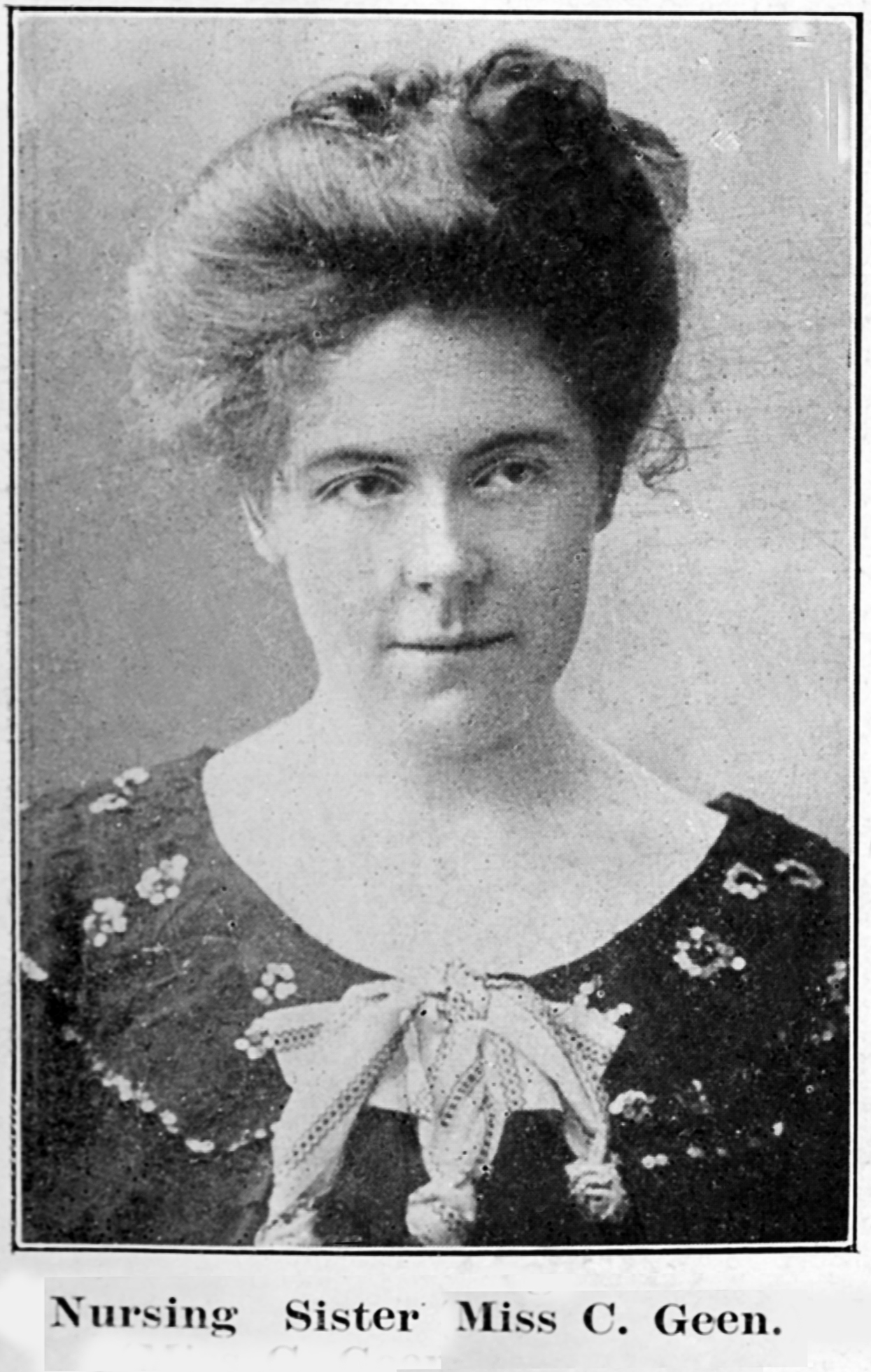
Celestina Geen

“Belleville Cheese Board Red Cross Society reports that official receipts and acknowledgments have been received from the following …  A letter from Nursing Sister C. Geen, in whose care two cases were sent to No. 2 Stationary Hospital:

Dear Mrs. Lazier:—How can I tell you how much the contents of those two boxes are being appreciated, both by the fortunate boys who are getting the good things and by me, to whom you good home people have given the pleasure of distributing them.

When I received a note from the O.C. of No. 2, Canadian Stationary Hospital at Outreau, a few miles from here, saying two boxes had arrived there for me, I had not the faintest idea who they were from or what they contained, so you can imagine what a delightful surprise I had when I opened them.

You could not have had these articles arrive at a more opportune moment, for they came when we were in the midst of the greatest rush this unit has ever had, and when almost double the amount of beds that we are supposed to have, had to be ready to receive patients, and of course that means we were not over supplied with sheets, and in the emergency huts we had to put the patients between blankets. Putting patients between blankets may not sound very serious to you, but when I explain that certain small animals which many of the poor men bring in on their clothes, can be more easily discovered on sheets, you will understand.

I hope you will convey to all the different ladies who helped to furnish the boxes with its golden store, my most sincere thanks for everything.

I traded my pillow for one of those in the box. It really gave me so much pleasure to think I was sleeping on feathers from home.

The ‘Old Chum’ and cigarettes are very acceptable and I give those to Canadians only for they like home brands.

The khaki shirts have been much in demand and I always enjoy new sheets, towels and pillow slips.

I might add that these are the first two large boxes that have been sent to me directly and I have often rather envied girls getting them from home, so you know how happy these made me.

Since the rush has been on we sisters take turns in giving from 8 to 12 p.m. a sort of supper to the boys who have to be up to help with the convoys—in fact some of them have worked night and day and through it all are so bright and jolly and so kind to the patients, though the poor boys look ready to drop themselves.

Again thanking you all for all the pleasure you have given many, I am, Sincerely yours, Celestina Geen.”
100 Years Ago: 2nd Anniversary of Declaration of War, Organize for Victory, Sister Leeky Expresses Thanks

The Intelligencer August 4, 1916 (page 4)

“Two Years Ago. To-day marks the completion of the second year of war between Great Britain and the German nation. It finds the Empire still engaged in the struggle with an unfaltering determination to fight until victory shall have been attained. …

After two years of the bloodiest war the world has known, Belgium is still in the iron grip of the foe. Poland has yet to be released from occupation by the Teuton armies. …  But the situation on every front is favorable and the Empire and its Allies are at last meeting the enemy on something approaching equal terms of preparedness. …

Details of the great conflicts are needless; they are too fresh in the memories of the world’s people. Suffice to say that Britain and her Allies, now fully prepared, are on the offensive, and as the enemy in the eastern and western zones are gradually withdrawing from their positions, the spirits of our people rise accordingly, and will continue to rise until, the enemy nations brought to their knees, a uniform cry of victory will be heard from end to end of our land.”

The Intelligencer August 4, 1916 (page 6)

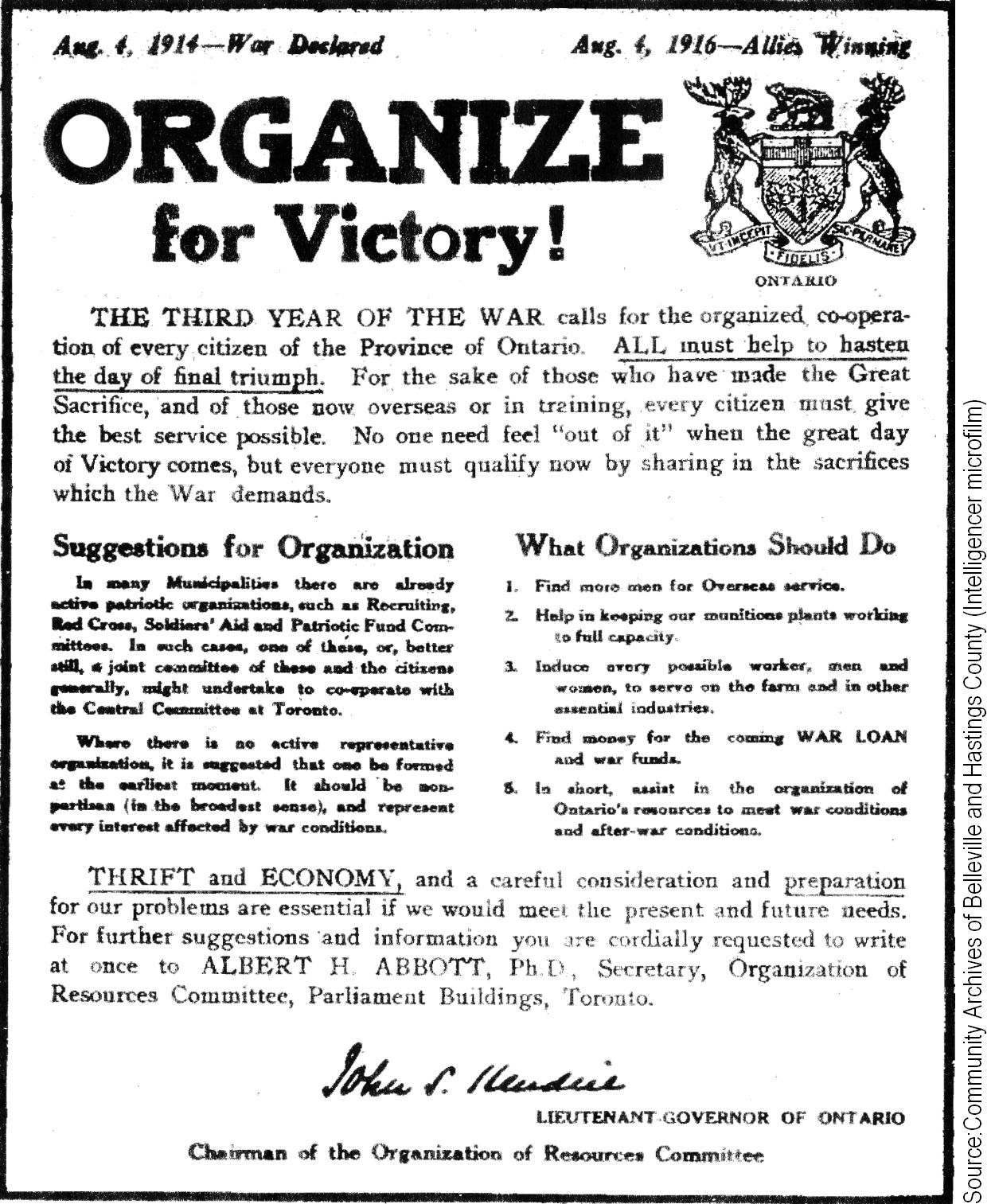
Organize for Victory016“Aug. 4, 1914—War Declared. Aug. 4, 1916—Allies Winning. Organize for Victory!

The Third Year of the War calls for the organized, co-operation of every citizen of the Province of Ontario. All must help to hasten the day of final triumph. …  Thrift and Economy, and a careful consideration and preparation for our problems are essential if we would meet the present and future needs.

For further suggestions and information you are cordially requested to write at once to Albert H. Abbott, Ph.D., Secretary, Organization of Resources Committee, Parliament Buildings, Toronto. John S. Hendrie, Lieutenant-Governor of Ontario. Chairman of the Organization of Resources Committee.”

The Intelligencer August 4, 1916 (page 7)

“Expression of Thanks. The following words of appreciation have been received by the Belleville branch of the Patriotic Red Cross Association, and Belleville Cheese Board:—Richmond Whitworth and Tardwicke Hospitals, Dublin, 6th July, 1916.

Wounded soldiers in the above hospitals send their best thanks to the Belleville Cheese Board and Patriotic Red Cross Association for parcels of underclothing and special presents distributed by Dr. Balton. G.F. Leeky, Sister.”

100 Years Ago: Mayor Calls Meeting of Citizens on 2nd Anniversary, Frankford Overseas Club

The Intelligencer August 3, 1916 (page 7)

“Proclamation. His Honor, the Lieutenant-Governor of this Province, has by proclamation set apart Friday, August 4th, the 2nd anniversary of the declaration of war, as a day for the people to discuss publicly the great problems that face this Province as part of our Empire, and on that date reaffirm their belief in the righteousness of the cause for which we are fighting, and their inflexible determination to continue the struggle until victory has been achieved.

Following the wishes of the Government I have called a meeting of citizens to be held in the Armouries at eight o’clock on the evening of FRIDAY, AUGUST 4TH. Every man, woman and child is invited to attend. Several short addresses will be delivered and an attractive and entertaining programme provided. The meeting will be held on the floor of the Armouries and seat accommodation provided.

God Save the King. H.F. Ketcheson, Mayor.”

The Intelligencer August 3, 1916 (page 7)

“The Frankford Overseas Club. On the Public School Grounds, on Friday evening last, a public reception was tendered by the Club and citizens to Pte. E.E. Ketcheson, who has recently returned from the front incapacitated for further active service.

The following address was read by the President, Miss A.L. Carroll:—Dear Pte. Ketcheson,—It is with feelings of greatest happiness that we, the members of the Frankford Overseas Club, assemble here this evening to greet and extend to you a thousand welcomes to this your boyhood home.

Three months ago, the sad tidings, ‘Ed. Ketcheson is wounded.’ flashed over the wires. The deepest sorrow prevailed for yourself and your dear ones at home. …  This indeed is an unique event. It is the first opportunity we have had to welcome home a Frankford hero.

You answered the first call of King and Country, and by your manly courage and noble heroism you have helped to make the name ‘Canada’ a household word throughout the civilized world, and helped the Allied nations realize that Canada is indeed a nation. …

With Rev. B.F. Byers as chairman, many of the townsmen were called on for a few remarks. Later Dr. J.U. Simmons read an address and presented Pte. Ketcheson with a gold watch-chain and locket from the citizens, after which lunch was served.”

100 Years Ago: Welcome to Sergeant Charles Gibson, Canada Is Asked for Two More Forestry Battalions, Frank Ward Is Wounded

The Intelligencer August 1, 1916 (page 1)

“A Hearty Welcome to Returned Soldier. The demonstration last night accorded to Sergt. Charles A. Gibson of this city, a returned hero from the front, was of such a nature as to exceed the sanguine expectation of his numerous friends in the city. The popular Sergeant who arrived home on Sunday in a rather unexpected manner, will remain here on furlough for a few weeks.

When it became generally known that Sergt. Gibson had arrived home it was decided that he should be tendered an ovation, and last night he was certainly given one. Friends including Mayor Ketcheson yesterday got busy and the fruits of their labor was apparent.

At a few minutes after 7 o’clock the I.O.O.F. band, the members of which gratuitously rendered their services, left the armouries and was followed by a number of automobiles, one of which was decorated with a union jack. The parade grew in length as it proceeded on its way to Sergt. Gibson’s residence on Victoria avenue.

The popular sergeant as he came out of the house, was loudly cheered, and at once escorted by Mayor Ketcheson to an automobile. Seated in a rear seat of the auto with him was his father, Mr. Robt. Gibson, and father-in-law, Mr. James Marshall. The car was driven by Mr. Blaylock, who is also a returned soldier, and beside him sat Capt. Eddie O’Flynn, who came home a few days ago.

A procession was then formed, headed by the band, and it proceeded down Victoria avenue to Front street, up Front street to the upper bridge, where it was joined by the two hose carts and ladder truck of the fire department with Chief Brown in command. The hose carts and truck were tastefully decorated with flags and bunting.

The parade then proceeded down Front street, up Bridge street east to Charles street, and thence down Victoria avenue to the point of starting. On the line of march the streets were crowded with citizens, who cheered and cheered as the auto bearing the brave sergeant passed by. It was an inspiring scene, and one that will linger long in the memory of those who were privileged to participate in it.

Arriving at the Sergeant’s home, Mayor Ketcheson spoke briefly, referring to the pleasure it gave the citizens to welcome home again Charles Gibson, who had done his bit for King and Country. It was owing to such heroes that our Canadian homes were free from the invasion of the enemy.

Mr. E.G. Porter, K.C., M.P., and Sir Mackenzie Bowell were called upon, and both speakers spoke eulogistically of Sergt. Gibson and the valuable services he had rendered for his country.

Sergt. Gibson in a few well chosen remarks, returned his heartfelt thanks for the demonstration accorded him. He had only done what he considered was his duty in going to fight for King and Country. (Loud cheering.)

The rendering of the National Anthem by the band brought the pleasing function to a close, and all returned to their respective homes conscious of the fact that they had done what was right and fitting.

A pleasing incident of the event was the present by ladies of the Rainbow Patriotic Association of a beautiful bouquet of flowers.”

[Note: I.O.O.F. = Independent Order of Odd Fellows.]

The Intelligencer August 1, 1916 (page 1)

“Canada Asked For More Army Lumbermen. Ottawa. It is expected that the two forestry battalions now being raised in Canada, the 238th and 246th, will provide all the lumbermen that will be needed for operations in the Old Country, in addition to the 1,550 men already there—members of the 224th Battalion. The three battalions will have a total strength of over 3,600 men, who will be able to cut a lot of wood.

The 224th is doing most of its work in the north of Scotland cutting Scotch pine. There is a company at work in the park at Windsor Castle, cutting trees there, and a third company at New Forest. There is a party in a camp near Dover and some men still at Bramshott.

The new battalions will likely be sent to France. Lieut.-Col. White was over the ground there and found a great deal of timber suitable for lumbering; so that it is likely, if not all, at least the majority of the men now joining will soon be laying low the trees in France.

Eight sawmills have been sent from Canada to England, six for the 224th Forestry Battalion and two for the Forestry Committee in England, which has supervision over the lumbering operations there during the war.

They are mills typical of the Canadian lumbering industry and are generally known in Canada as portable mills, although they cannot be transported with the facility of most mills which carry the name ‘portable.’

They are entirely new to the British Isles and their wonderful efficiency is said to be causing much interest. They each have a capacity of from 15,000 to 20,000 feet a day and include the edgar, slash saw, saws for making railway ties, etc., in addition to their big 56-inch circular saw. They have 40 horsepower locomotive boilers.”

The Intelligencer August 1, 1916 (page 7)

“Wounded at Front. Mrs. Annie Ward, a widow, of 114 Canifton Road, has received a letter from her son, Frank Ward, to the effect that he is now lying in the base hospital in France, suffering from a broken ankle. He enlisted with the 34th Battery in August, 1914, and has been in France since April, 1915.”