100 Years Ago: 34th Battery at Langemarck, Letters from Soldiers, Leo Ross Reported Wounded

The Intelligencer May 26, 1915 (pages 1, 4, 8)

“The 34th Battery at Langemarck. By Sergt. Gerald Spafford. On the Firing Line, Belgium, May 7th, 1915. Dear Mr. Bowell: …  You all have heard the story of what the infantry did, and those acquainted with the situation and formation of the line here will appreciate the following brief sketch of the part the boys of Belleville’s Fighting 34th Battery—now a part of the 2nd Battery, 1st Brigade—played in the battle. We were in the thickest part of it from beginning to end. …

While the sacrifice is a noble one, and we realize that they have done their duty for their King and Country—’tis sad. I herewith refer to one of my comrades who has been associated with the 34th Battery since its inception—a lad well known and popular with all who knew him, and many of the G.T.R. boys will regret to hear of his death. I refer to Gunner Leo Ross, who died as only any hero dies, fighting at his post of duty. No braver or more efficient soldier ever wore a uniform.

Leo was one of the 1st Brigade’s best gunlayers, and while fulfilling this duty in action on April 31st, 1915, under a terrific fire, he was killed. Our position enfiladed the enemy’s trenches. We were exposed to frontal, enfilade, and rear fire, but had to stick to it to support our infantry, who were rushing a position. We saw him buried in a beautiful garden of a near-by chateau. A cross marks the spot. We all extend our heartfelt sympathy to his bereaved parents. May it be a source of comfort to them to know Leo did his duty, never flinching, and did it well.

We also lost our section commander, Lieut. Helmer, the following day. We feel his loss keenly. His fine example and unselfishness shall always be remembered. Many of our boys with the other section are wounded. I cannot learn their names. Driver E.A. Carre, one of my boys has been wounded, but is still doing his duty. I cannot express my true feelings as to the splendid behavior of everyone of our boys. We all send our kind regards, and trust a speedy termination of the war will bring us back soon. Respecfully, SPAFFORD.”

The Intelligencer May 26, 1915 (page 2)

“The following letter has been received by Mrs. Lavin of 23 Charlotte street, Belleville, from her husband, Sergt. J. Lavin. St. Johns & Elizabeth Hospital, London, N.W.

I am getting on fine, but I had a very painful time. I have four bullet holes in me but one bullet did the lot. It struck me in the back of the arm, about 4 inches above the wrist, went through my arm, breaking a bone, entered my hip and came out through my back about 1/2 inch off my back bone. I was very lucky I did not bleed to death. …  We had a terrible time. Out of six officers in my company four were killed and two wounded. …

This is a fine hospital. It is a Catholic Hospital, but they treat anyone here no matter what religion, and the nuns are splendid; they will do anything for us. …

I forgot to tell you where I was wounded. It was at a place called Ypres, which is nothing but a hell upon earth. It is impossible for me to describe its wholesale slaughter.”

The Intelligencer May 26, 1915 (page 2)

“Gunner Paterson Wounded. Mrs. D. Patterson, 8 Victoria Ave., Belleville, has received the following telegram from the Adjutant General, dated Ottawa, May 25:—Sincerely regret to inform you 40469 Gunner William Paterson, 1st Field Artillery Brigade officially reported wounded. Further particulars when received will be sent you. Adjutant General.

The following is the last letter received by Mrs. Paterson from her son: Belgium, April 30, 1915. Dear Mother:—I have received all letters and papers up to this date. …  I got a wound on the fingers of my left hand and am back of the horse lines. …  Do not worry about my fingers. I would not have told you, only I was afraid it would get in the papers and you would not know what happened.

I was lucky to what some of the others were. I also had the side of my serge torn by a piece of shell, but my aluminum cup in my pocket turned it.”

The Intelligencer May 26, 1915 (page 8)

“Gunner Leo Ross Reported Wounded. Mr. James Ross of this city, this morning, received the following telegram: Ottawa, May 26th. Mr. James Ross, Belleville,—I sincerely regret to inform you that No. 40488 Gunner James L. Ross is officially reported as wounded. Further particulars, when received, will be sent you. Adjutant General.”
100 Years Ago: Ladies’ Patriotic and Red Cross Society Appeal, Victoria Day Observed

The Intelligencer May 25, 1915 (page 2)

“An Appeal By the Ladies’ Patriotic and Red Cross Society of Belleville. …  Boxes of Hospital supplies have been sent to the Queen’s Hospital at Shorncliffe and to the 2nd Canadian Expeditionary Hospital at Le Touquet, France, and another is about ready to be sent to the Toronto University Hospital. …

The funds raised by the entertainment in the Armouries and by contribution from members and others is exhausted, and if the Society is to continue its good work more money is required at once. The executive, after full consideration, has decided to make an appeal to the citizens for contributions to the funds of the Society, feeling sure of a generous response considering the great and growing necessity caused by the thousands of our wounded soldiers streaming back from the battle line maimed and invalided, and it was decided to make the appeal through the churches.

The clergymen of all denominations on Sunday last brought the matter before the members of their congregations. It is proposed to place envelopes in the pews of all the churches so that the contributions can be made on Sunday next, May thirtieth, at both services. All contributions will be acknowledged through the daily papers.”

The Intelligencer May 25, 1915 (page 2)

“Victoria Day was fittingly commemorated in this city. Taking advantage of the 39th Battalion being in the city it was decided to have a military parade and sports at the Agricultural Park, the proceeds of which were to be devoted to the 39th Battalion funds. …  there was a hearty response by the citizens who gathered at the grounds in large numbers.

At 1:30 p.m. a parade was formed led by the 39th Battalion Band. It was composed of the 39th Battalion, being 1,000 strong, the 15th Regiment Band and the Cadets of the High School, Queen Mary, Queen Victoria, Queen Alexandra and St. Michael’s Schools. …  The line of march was up Pinnacle street, down Victoria Avenue to Front Street, to West Bridge Street and thence to the Park. The streets were lined by spectators during the march.

Upon arrival on the ground the troops formed up—the 39th on the right and the High School Cadets and 8th (Queen Mary School) Cadets on the left …  Accompanied by his A.D.C., Col. Sir Mackenzie Bowell repaired to the saluting base immediately opposite the grand stand, when the Battalion marched past in columns of platoons. …  Col. Preston on behalf of the 39th Battalion, thanked Sir Mackenzie for his kind words of encouragement. The members of the Battalion were then dismissed and a programme of sports was carried out.”


100 Years Ago: Gallantry of 49th Hastings Rifles at Ypres, Cheese Board Makes Grant to 39th Battalion

The Intelligencer May 22, 1915 (page 7)

“Great Gallantry of 49th Hastings Rifles. France, May 5th, 1915. My Dear Colonel Ketcheson,—I feel it my duty to write to you to tell how the men of the 49th Hastings Rifles did honor to themselves, their country and the Empire; and yet, in relating the glorious achievements that they have accomplished there is a sadness and regrettable result in that some of the brave fellows have fallen.

Never were men called upon to show such courage and fortitude that these men were from April 23 to April 27, and I can only say, Colonel, that I am proud—as every officer is proud—of the behavior and conduct of these men under such fire. …  Accept my deepest sympathy for the loss of these gallant fellows. …  Fraternally yours, Richard D. Ponton, Capt., 2nd Batt.”

The Intelligencer May 22, 1915 (page 8)

“Cheese Board Makes Grant to 39th Batt. For Extra Comforts for the Men Who are Soon to Leave. At a very enthusiastic meeting of the Cheese Board this morning a grant of $500 was made to the 39th Battalion. This money will be used for extra comforts for the men, which were not supplied by the government.

Colonel Preston addressed the board and stated that he wanted $10,000 for this purpose and the government allowance would be entirely separate from this amount. …  The motion was unanimously passed upon the motion of Mr. Sprague, seconded by Mr. George Nicholson, of the Sidney Town Hall Cheese Board.”

100 Years Ago: Ad for Victoria Day, Five Soldiers Recover from Meningitis

The Intelligencer May 20, 1915 (page 2)Victoria Day Citizen's Celebration1

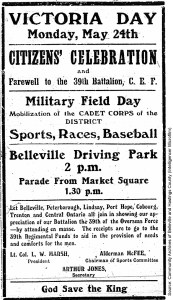
“Victoria Day Monday, May 24th. Citizens’ Celebration and Farewell to the 39th Battalion, C.E.F. Military Field Day, Mobilization of the Cadet Corps of the District. Sports, Races, Baseball. Belleville Driving Park 2 p.m. Parade From Market Square 1.30 p.m. God Save the King.”

The Intelligencer May 20, 1915 (page 2)

“Five Recover From Meningitis. Very encouraging news was received this morning from the spinal meningitis cases. For some time there have been seven cases in the local hospital and for the last couple of days five of these patients have been able to be walking about and today they will be allowed passes and leave. …  These men are Privates McDinnick, Beard, Milberry, Scruver and Murray.

There have been no outbreak of any new cases for some time, and no carriers have been discovered for the last ten days. Apparently this epidemic is completely obliterated. Out of the 80 carriers, who were at one time at the exhibition camp, the number has dwindled down to 30.”

100 Years Ago: Reported Death of Leo Ross, Gunner Gomes Killed in Action, Victoria Day Plans

The Intelligencer May 19, 1915 (page 1)

“No Official News of His Having Been Killed Has Been Received to Date. Mr. J. Ross, father of Leo Ross, who was stated in a letter from the front to have been killed, received the following letter this morning from the Adjutant-General:—’Name of Gunner, J.L. Ross, 1st Artillery Brigade, has not appeared on any official casualty list received at military headquarters to date. So far as is known he is still serving with the corps. Any casualty will be telegraphed to you as soon as received. Adjutant General.”

The Intelligencer May 19, 1915 (page 7)

“Batteryman Killed At the Front. Word has been received in this city that Gunner M.A. Gomes who went from this city with the 34th Battery, has been killed. His death was the result of a shell bursting beneath the horse he was riding. The victim was twenty-six years of age, and was born in British Guiana. He attended the Ontario Business College here and was for some time night clerk at the Grand Trunk Railway station. He left his city with the 34th Battery and went to the front with the First Contingent. The news of Gomes’ death is much regretted by those who knew him.”

[Note: Gunner Manuel Antonio Gomes died on April 26, 1915. He is commemorated on Page 16 of the First World War Book of Remembrance.]

The Intelligencer May 19, 1915 (page 8)

“Military Field Day, Victoria Day, May 24. As the 39th Battalion is likely to be ordered to the front at once, the Citizens Celebration Committee has made arrangements for a Grand Re-union and Military Field Day for the officers and men of the 39th Battalion and their friends from their own home district, to meet at the Driving Park on Victoria Day.

The committee will perfect arrangements to-night. There will be military manoeuvres by our fine regiment, which is in good shape now for the front, as well as manoeuvres by the Boys Cadet Corps. …  Get busy to extend to the 39th a splendid farewell.”

100 Years Ago: Children Send Scrapbooks to Front, Letters from Overseas, Rumored Death of Leo Ross

The Intelligencer May 18, 1915 (page 3)

“From Scholars To Old Boys At the Front. The various Public Schools of the city have from week to week been sending to the front scrap books of interesting clippings culled and selected by the pupils boys and girls for the benefit of the men at the front, in order to keep them in touch with their city and county, and so that the lines of communications may not be broken with the dear old homes. …

Queen Alexandra School has been particularly fortunate in enlisting

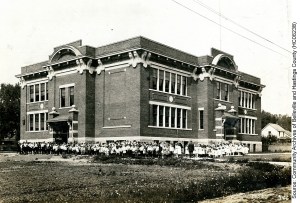
Queen Alexandra School, Belleville

the voluntary services of a genuine artist who, with loyal fervor, each week illuminates the backs of the books which are being sent forward, in most artistic fashion. With a modest patriotism which becomes him, he does not desire his name mentioned, but the identity of an honored citizen and professional man, who has attained his three score years and ten, and who can still wield the colors and the brush as he does, cannot remain long a secret. He has also done some splendid work for the boys and girls of Grier street and Queen Mary’s schools. …

Colonel Ponton, Chairman of the Board of Education, has placed eight copies of this week’s work in the windows of the Merchants’ Bank, so that the public may share in the delight, which the boys at the front will feel when they receive the covers and the contents prepared by loving hands.”

The Intelligencer May 18, 1915 (page 7)

“Cambridge Military Hospital, Aldershot. Dear Mrs. Yatman, I am writing to you for your son Thomas, who arrived here 1st May. He sends you his very best love and to say he is not too badly wounded, but I’m so very sorry to have to tell you the truth, that he is seriously injured, his spine has been damaged; but he is such a hero and talks and laughs quite a lot and there is never a murmur of complaint from him.

His chief worry I think is that you will be worrying about him, and, so please, when you write, cheer him up. I will write to you every week and let you know how he goes along. We got 150 wounded in on Saturday last, and quite a lot of Canadians, and the majority of them such laddies. I feel it an honor to nurse them. Yours sincerely, PEGGY M. BOLAND.”

The Intelligencer May 18, 1915 (page 8)

“Driver Tryon. May 5th, 1915. Dear Nellie:—As I sit down here to write you these few lines, I hope they find you all well, as it leaves myself well at present, but I have sad news to tell you. We have lost a few of our Belleville boys, which does seem hard, and yesterday morning we lost one of our officers. We have had some very hard and severe fighting the last ten days which is not over yet. It is something fierce; no one has any idea. There never was a war before like this. We have been under shell fire for the last ten days. …

It’s a shame to see the towns and villages which have been torn down and burned. It is terrible to see the poor people having to leave. No homes to go to. …  Well, Nellie, Leo Ross was killed on May 1st, which was very hard for us to get over. He was killed in action. It will be hard for his poor mother but you know our turn will come in time. Good bye, Driver Tryon, 2nd Battery, 1st Brigade, Canadian Contingent; British Expeditionary Force.”

The Intelligencer May 18, 1915 (page 8)

“The Rumored Death of Leo Ross. In reference to the above letter, which states that Leo Ross was killed on May 1st, a reporter of the Intelligencer, saw Mr. Walter Ross, father of Leo, this morning and stated that he had heard nothing of his son’s death.”

100 Years Ago: Local Victim of Gas Fumes

The Intelligencer May 17, 1915 (page 7)

“Mr. Charles Dickens of this city, received the following telegram which refers to his son: Ottawa, May 15th, 1915. C.C. Dickens, Belleville. Sincerely regret to inform you 1646 Private Harry C. Dickens 8th Battalion, officially reported sick with gas fumes. Further particulars when received will be sent you. Adjutant General.

Private Harry Dickens was at Winnipeg when the war broke out and enlisted with the 96th Regiment, Winnipeg Rifles. His many friends in this city will wish for him a speedy recovery.”

100 Years Ago: Mess Dinner at Quinte Hotel

The Intelligencer May 14, 1915 (page 3)

“An exceedingly pleasant evening was spent at the Quinte Hotel last Quinte Hotel in Belleville, ca. 1908night at a ‘Mess Dinner’ given by Col. Preston and the officers of the 39th Battalion, now stationed in this city awaiting orders to join their comrades who are doing brave and noble work in the trenches at Ypres, in Belgium, in defence of the Empire.

The Colonel and officers had extended invitations to a number of our leading citizens, many of whom had served in the Volunteer force of Canada, who could and did wear long service medals. …  After the sumptuous repast, provided by the genial host of the Quinte, had been disposed of, the toast of the King was proposed and received in true British style. …  Sir Mackenzie Bowell, in a few words, proposed the health, and a long and valiant future for the Colonel and officers of the 39th Battalion, coupled with the hope that all might return from the conflict in health, covered with glory. …  The gathering separated after singing the National Anthem, highly pleased with the evening’s entertainment.”

100 Years Ago: Letters from Wounded Soldiers, Gunner Yateman Paralysed

The Intelligencer May 12, 1915 (page 3)

“Mrs. J. Lavin, of 23 Charlotte St., Belleville, has received a letter from her husband, Pte. Jack Lavin, who went away with the first contingent, the letter written from the Hospital of St. John and St. Elizabeth, 40 Grove End Road, London, N.W., and dated April 29th. ‘Just a line,’ he says in the letter, ‘to let you know that I have arrived in London and staying in a very good Hospital, in charge of the Sisters of Mercy. Everybody here are very kind and I am likely to stay here for some time.”

The Intelligencer May 12, 1915 (page 3)

“Gunner E.G. Blaylock, of 2nd Field Battery, 1st Brigade, C.F.A., writes as follows to his parents in Belleville:—The British Hospital, Hotel Bellevue, Wimereux, Boulogne, April 28th, 1915. Dear Mother and Father,—Just a few lines to let you know that I have been wounded, but not seriously. …  I was wounded last Sunday morning at 9 o’clock by a piece of shrapnel. One piece went into my right thigh and the other grazed my right side just below the arm. I have been operated on …  I have the pieces of shrapnel that were in me, and am going to keep them as German souvenirs.”

The Intelligencer May 12, 1915 (page 3)

“a letter to his parents at Belleville by Pte. Jim Gorman, of the 2nd Battalion. April 28, 1915. Dear Mother,—Just a few lines to let you know I am in the City of London Hospital, wounded in the back with a piece of shrapnel when we made the big charge.”

The Intelligencer May 12, 1915 (page 3)

“The following letter was received by Mr. W.A. Yatman, 82 Mill street, this morning, regarding his son, Thos. A. Yatman, who was wounded at the second battle of Ypres. No. 11 General Hospital, British Expeditionary Force, April 24, 1915. Dear Mr. Yatman, I am sorry to have to tell you that your son, Pte. Yatman, was brought into hospital today suffering from a gun shot wound in the neck. I am afraid it must have injured his spine for the time being, as he is paralysed. He is quite cheerful, and a very good patient. I am hoping soon to let you know that he is much better. Yours truly, M. WOODHOUSE, Sister.”


100 Years Ago: Bert Lavender Killed in Action, Letter from Harry Ablard

The Intelligencer May 11, 1915 (page 2)

“Another Belleville Soldier Killed. Bert Lavender, whose name appears amongst the list of killed at the front, is a Bellevillian, having enlisted with the First Contingent. He joined the Regiment here. Relatives of the unfortunate patriot, who reside in this city, have not officially been notified of his death, but his name appears amongst members of the 2nd Battalion whose lives have been sacrificed.”

[Note: Private Bert Lavender died on April 22, 1915. He is commemorated on Page 23 of the First World War Book of Remembrance.]

The Intelligencer May 11, 1915 (page 3)

“Letter From Dead Soldier. Sergt. Harry C. Ablard Says He Is ‘Ready for Whatever Comes.’ …  It bears the date of the field postoffice, March 20th: ‘Somewhere’ in France. Dear Rector:—Just a line to let you know that I am getting on fine out here. …

I wish you could pop into our little ‘dug-out’ and see our novel surroundings. It is very dark, and quiet to-night, and it is difficult to believe that a few yards away are the much talked of ‘rival’ of ours.

In the actual realities of this road of warfare, one loses a good deal of the bitterness one feels towards them at first. They are always singing and whistling and appear to take their lot as easily as we. Of course, there are times when we feel like putting them all to sleep and that is when you see some one you know being taken away for the last time. …  Sincerely yours, Harry C. Ablard.”