100 Years Ago: Ad for War Loan, Poster for Farm Service

The Intelligencer March 17, 1917 (page 5)

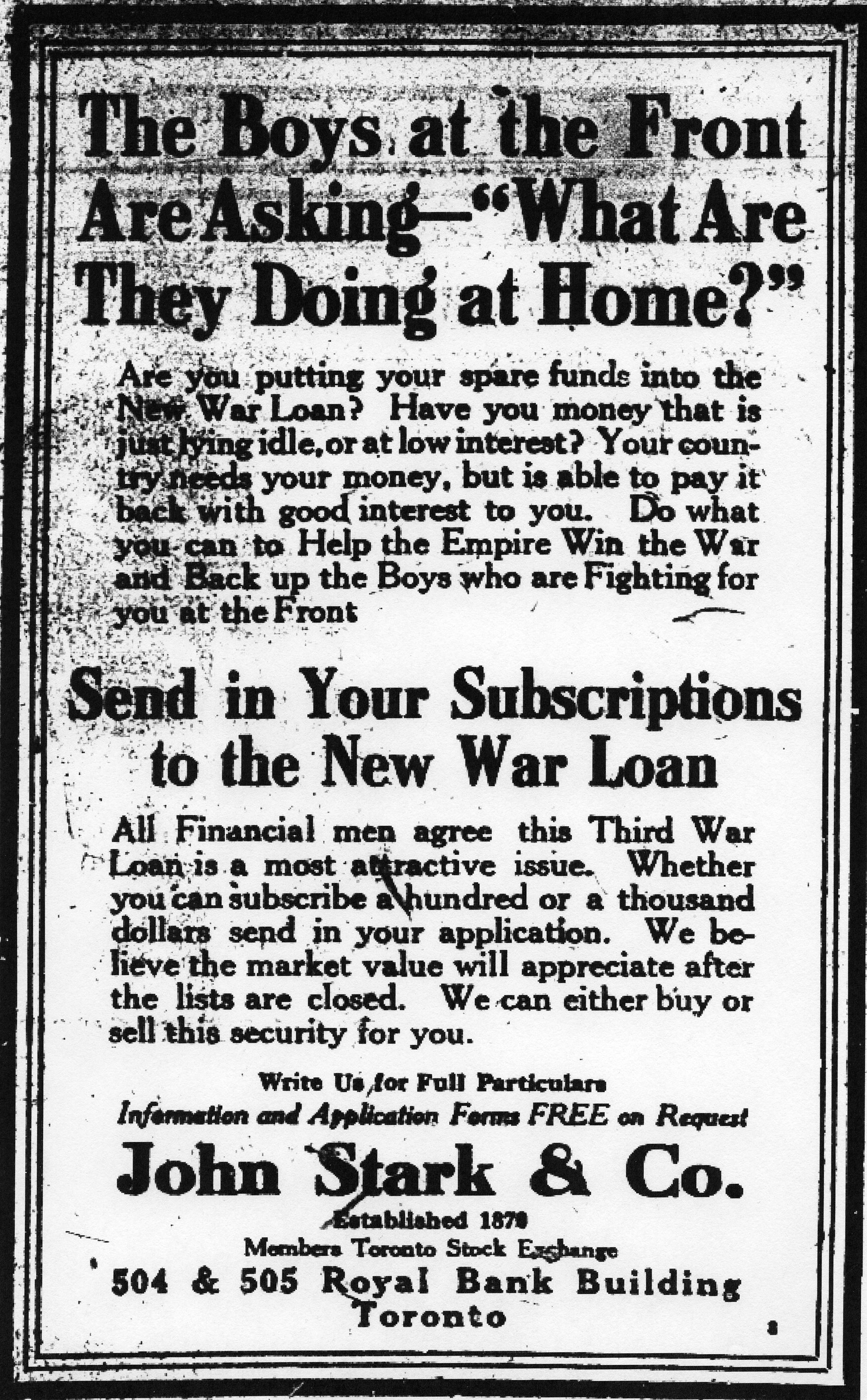
“The Boys at the Front Are Asking—’What Are They Doing at Home?’ Are you putting your spare funds into the New War Loan? Have you money that is just lying idle, or at low interest? Your country needs your money, but is able to pay it back with good interest to you. Do what you can to Help the Empire Win the War and Back up the Boys who are Fighting for you at the Front.

All Financial men agree this Third War Loan is a most attractive issue. Whether you can subscribe a hundred or a thousand dollars send in your application.

John Stark & Co., Toronto.”

The Intelligencer March 17, 1917 (page 5)

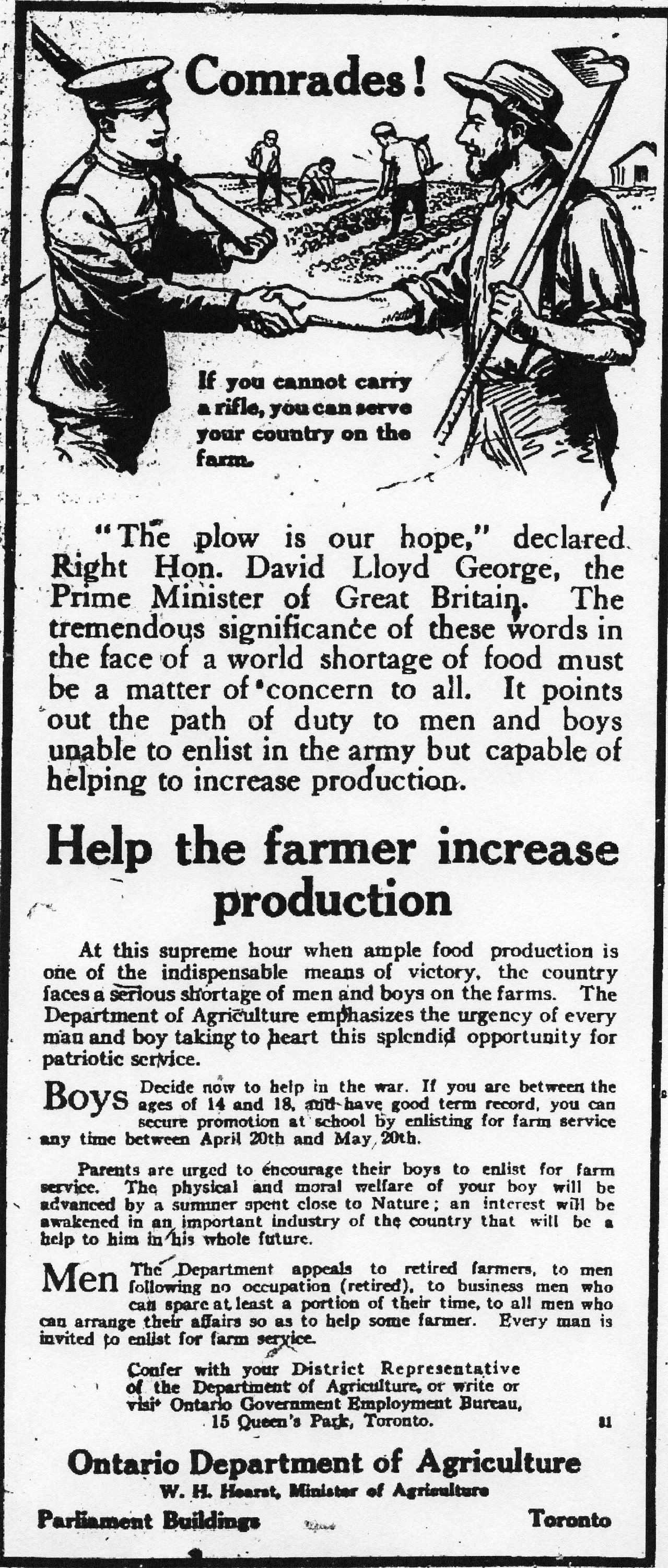
“Comrades! If you cannot carry a rifle, you can serve your country on the farm. ‘The plow is our hope,’ declared Right Hon. David Lloyd George, the Prime Minister of Great Britain.

Help the farmer increase production. BOYS. Decide now to help in the war. If you are between the ages of 14 and 18, and have good term record, you can secure promotion at school by enlisting for farm service any time between April 20th and May 20th.

MEN. The Department appeals to retired farmers, to men following no occupation (retired), to business men who can spare at least a portion of their time, to all men who can arrange their affairs so as to help some farmer. Every man is invited to enlist for farm service.

Ontario Department of Agriculture.”

100 Years Ago: Corporal E.A. Carr Returns, Corrections to Arena Benefit Report

The Intelligencer March 14, 1917 (page 1)

“Reception to Returned Hero. The officers and members of Benjamin Lodge, L.O.L. No. 274, entertained a returned hero, one of its own members in the person of Brother Corporal E. A. Carr of the 1st Battery, 1st Brigade, C. F. A. A large number of the members and visiting brethren were present. After the business of the lodge had been concluded the W. M., Bro. C. Johnson in a short address made known the reason of the gathering and in the name of the brethren welcomed Bro. Carr home, telling how proud the lodge was to have among its numbers a man, who from August, 1914, down to the present had done his duty to King and Country, so nobly and well.

Short addresses were made by Bros. Arthur McGinnis, A. R. Walker, W. C. Mikel, F. M. Clarke, W. C. Reid, John Harris and others and Bro. Carr briefly and modestly replied.

A bounteous repast had been provided and the brethren spent a pleasant hour in song and story and the meeting was brought to a close with the singing of the National Anthem.”

The Intelligencer March 14, 1917 (page 2)

“Letters to the Editor. An Error. Dear Sir:— In Tuesday’s issue of The Intelligencer an error was made in your report of the ‘Skating Festival’ held at the Arena on Monday night, under the auspices of the 254th Battalion Band. The musical numbers were furnished entirely by two sections of the 254th Band, one section playing at each end of the rink, the 15th Band taking no part in the programme whatever.

Mention was also made that the entire proceeds went to the 254th Band, which was also an error. The receipts were divided equally between the band and the Rink management. Trusting you will make these corrections. Respectfully yours, Member 254th Band”

100 Years Ago: 254th Battalion Benefit at Rink, Small Subscriptions Wanted for War Loan, Many Citizens View Film Canadian Army in Action

The Intelligencer March 13, 1917 (page 2)

“254th Benefit at Rink. One of the largest crowds of the season were present at the Arena last evening, the proceeds of which went to the 254th Battalion Band. An attraction which brought out many of the skaters was the presence of two bands, the 15th Regimental Band and the 254th Band, continuous music being discoursed throughout the evening, there being twenty bands. The former band was seated in the west end of the rink, the 254th Band was placed in the reserved seat portion of the arena.

The ice was in fairly good condition considering the lateness of the season, although it became considerably cut up by the tenth band, when it was necessary to clean off the heavy slush.”

The Intelligencer March 13, 1917 (page 4)

“Want Small Subscriptions. Small subscriptions are an important factor in the success of our war financing. …  Our banks have much to do in financing war orders placed here and in carrying the increasing volume of agricultural and industrial production. Financial and other corporations will subscribe liberally to the coming war loan, but it is absolutely necessary that many thousands of subscriptions ranging from $100 to $5,000 should be received in order to make the loan a real success.

Dominion war loan bonds are one of the world’s best investments and have a patriotic flavor. A subscription to our war loans is not a sacrifice. It is a duty, and incidentally it remunerates the subscriber handsomely. …

There are many thousands of people who have from $100 to $5,000 for investment. Their duty is to lend this money to their country. The security of the war bond is excellent, the income yield is high and the bonds are readily saleable at any time, should the holder desire to sell.”

The Intelligencer March 13, 1917 (page 6)

“Life at the Front Is Seen Just as the Men Experience It. Impressive beyond words are the views of the Canadian Army in Action, as shown yesterday afternoon and last evening to large audiences at Griffin’s Opera House, this city, and never were Belleville citizens moved to higher admiration for the men of Canada and the work they are doing at the front, than when they saw in actual reality the men engaged in the daily heroism and labor of the war zone. …  Every boy who left Canada with the freshness and immaturity of youth upon him, is seen as a man, expert in every line of action, and whether that be handling shells, unloading the provision trains, scaling the parapet or deftly giving first-aid, the impression is always the same—here are experts and they are our boys, and boys whom the whole world might well be proud.

Another very strong feeling that takes possession of the spectator as the scenes come to one from the canvas, is the paradoxical idea of the humanity of the men and the inhumanity of the things upon which their whole energies are bent. …  Every man is using muscle and sinew to the straining point, but the motive is determination to win and to die if necessary in doing it.”


100 Years Ago: Khaki Club Bids Farewell to 235th Battalion, David Ketcheson Is Improving, Ads for War Loan, Poster for Canadian Army in Action

The Intelligencer March 12, 1917 (page 2)

“On Saturday, March 3rd, the men of the 235th Battalion were given a farewell evening, at the Khaki Club. The musical programme was in charge of the Misses Grant assisted by Miss Aileen Jenkins. Bright songs and choruses were sung and the boys thoroughly enjoyed themselves. The officials of the Club provided and served the refreshments.

A splendid spirit of cheerfulness prevailed even though many a heart was sad; sincere regrets were expressed on all sides at having to say good-bye. The 235th Battalion will not be forgotten in Belleville, a finer, better behaved lot of men have never been in town. The singing of ‘Auld Lang Syne’ and ‘God Save The King’ brought the evening to a close at eleven o’clock.”

The Intelligencer March 12. 1917 (page 2)

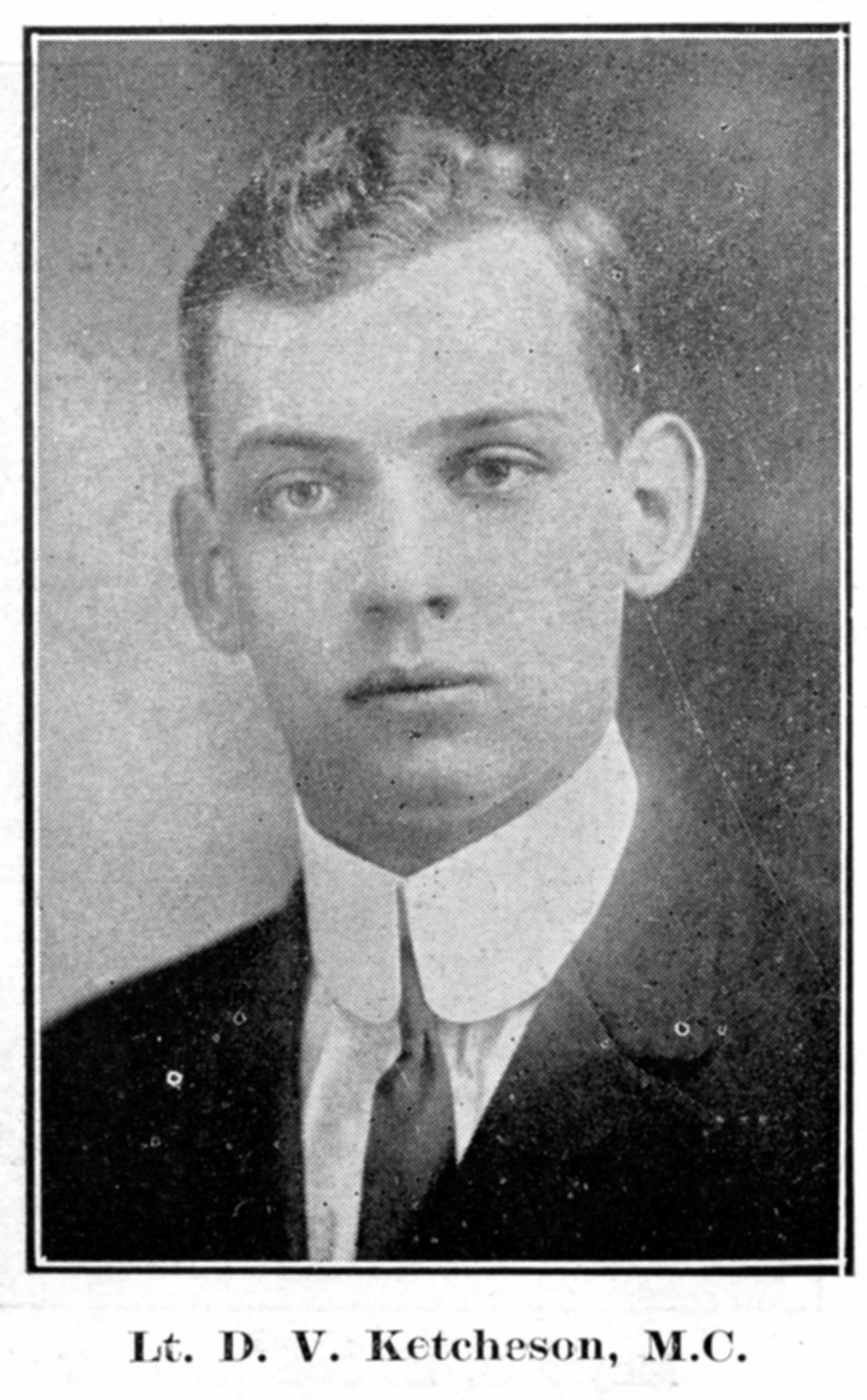
“Mayor Ketcheson yesterday received the following telegram in reference to his son, Lieut. D. V. Ketcheson, who was recently wounded whilst doing his bit. The many friends of the popular Lieut. will be pleased to learn that he is no longer dangerously ill.

Ottawa, March 10, 1917. H. F. Ketcheson, 231 Albert Street, Belleville, Ont. Cable received today states Lieut. David Vanderwater Ketcheson, Infantry, officially reported no longer dangerously ill, March 9th, General Hospital, Gunshot wound, right arm and back.”

The Intelligencer March 12, 1917 (page 5)

“War Loan Dominion of Canada. Issue of $150,000,000 5% Bonds Maturing 1st March, 1937. Department of Finance, Ottawa.

The New War Loan. A Safe and Attractive Investment. Lend Your Money to Your Country. John Stark & Co. Toronto.

War Loan. The present loan, having regard to its object, its yield, its period and its wide market, makes an irresistible appeal to the pride, the patriotism and the business instinct of all Canadians. A. E. Ames & Co. Toronto.

A Call to Lend! You get 5.40 per Annum. Wood, Gundy & Co. Toronto.”

The Intelligencer March 12, 1917 (page 6)

“The Canadian Army in Action and the Advance of the Tanks. The Behemoth of Modern Battles, The British Tank, Has Revolutionized Man’s Conception of War on Land. To-day and To-morrow. Matinee and Night. Two Matinee Performances. To-morrow, 2.30.

School Children’s Matinee 4.30. Admission for Children 10¢. Two Performances Nightly—7.45 and 9.00. Will be presented the official film of the Canadian War Record Office, showing the Canadian Army in Action in France, and the Advance of the Tanks as photographed for motion pictures September 15 and 16, 1916, at the Battle of Courcelette, and issued by authority to the people of Canada as a record of the bravery of her soldiers and a tribute to their glory.

Under the Auspices of The Belleville Intelligencer. Griffin’s Theatre.”


100 Years Ago: Poster for a Vegetable Garden for Every Home, Canadian War Contingent Association

The Intelligencer March 10, 1917 (page 5)

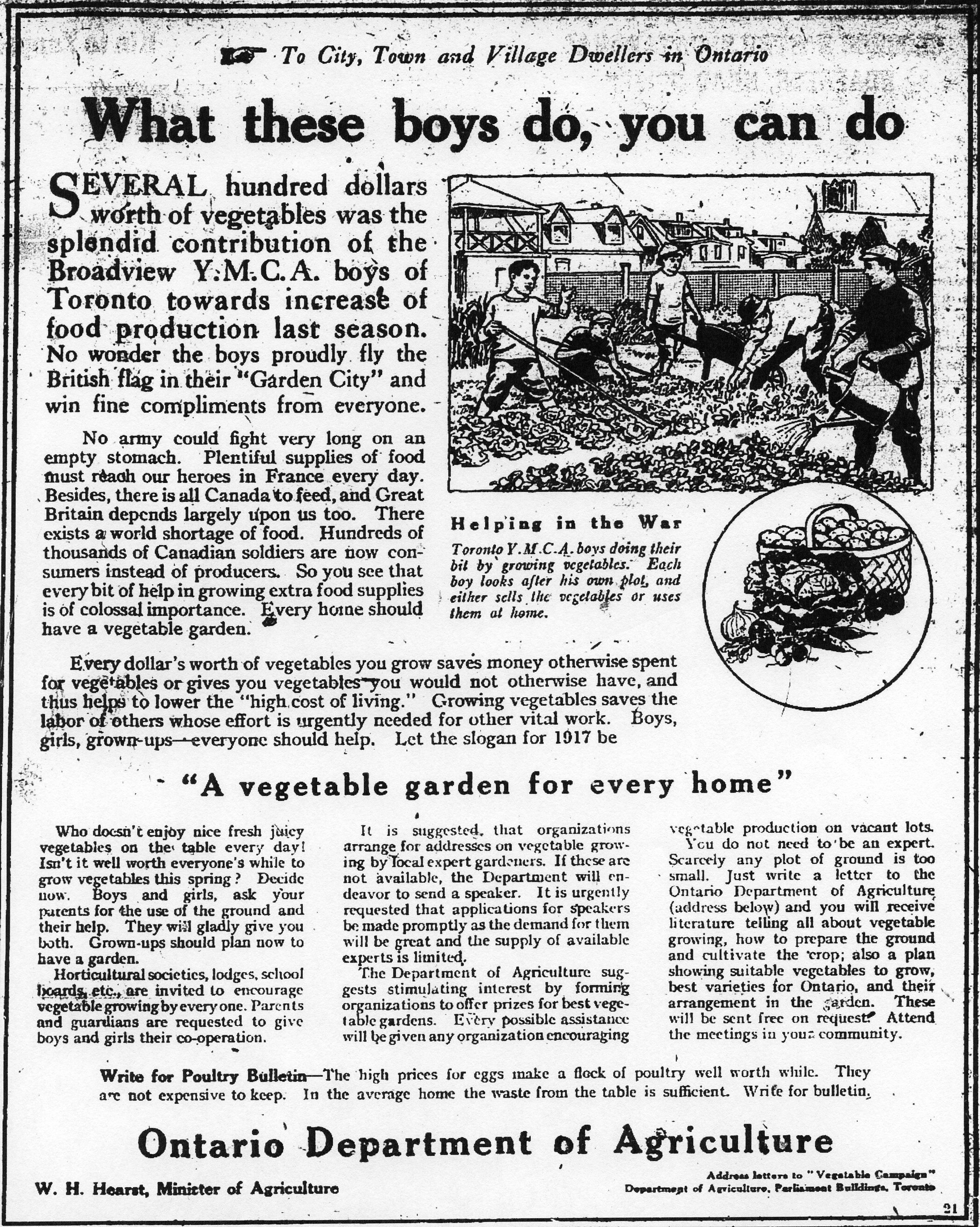
“To City, Town and Village Dwellers in Ontario. What these boys do, you can do. Several hundred dollars worth of vegetables was the splendid contribution of the Broadview Y.M.C.A. boys of Toronto towards increase of food production last season. No wonder the boys proudly fly the British flag in their ‘Garden City’ and win fine compliments from everyone.

No army could fight very long on an empty stomach. Plentiful supplies of food must reach our heroes in France every day. Besides, there is all Canada to feed, and Great Britain depends largely upon us too. …  Boys, girls, grown-ups—everyone should help. Let the slogan for 1917 be ‘A vegetable garden for every home.’

Write for Poultry Bulletin—The high prices for eggs make a flock of poultry well worth while. They are not expensive to keep. In the average home the waste from the table is sufficient. …  Ontario Department of Agriculture.”

The Intelligencer March 10, 1917 (page 8)

“Canadian War Contingent Association. 56 Church Street, Toronto, March 8, 1917. Miss Falkiner, 62 West Bridge Street, Belleville, Ont. Dear Miss Falkiner: I have heard that you have formed a branch of the Canadian War Contingent Association in Belleville, and I write to tell you how glad I am to hear of this and to ask whether I can give you any assistance.

We had a cable from Mr. Colmer last week saying that the need of woollen comforts is urgent, especially socks, and that there are only one hundred and fifteen cases on the way to him, which, of course, will not go very far amongst the thousands of men at the front, but the chief need of the War Contingent is money, and I think it would be a good thing if you tried to get the men of the place interested as well as the ladies, and then you would stand more of a chance of getting cash subscriptions.

I should like the names of your officers. Yours sincerely, Adelaide A. Plumptree (sigd.) Secretary.

The head office of the Canadian War Contingent Association is at the Westminster Palace Hotel, Victoria Street, London, England. The Belleville branch C. W. C. A., 62 West Bridge St., continues to ship all consignments directly to the head office at the above address.”

100 Years Ago: Poster for Canadian Army Film, Maynooth Soldier Charles Ries Dies, 500 Children See Canada in Khaki Film

The Intelligencer March 9, 1917 (page 6)


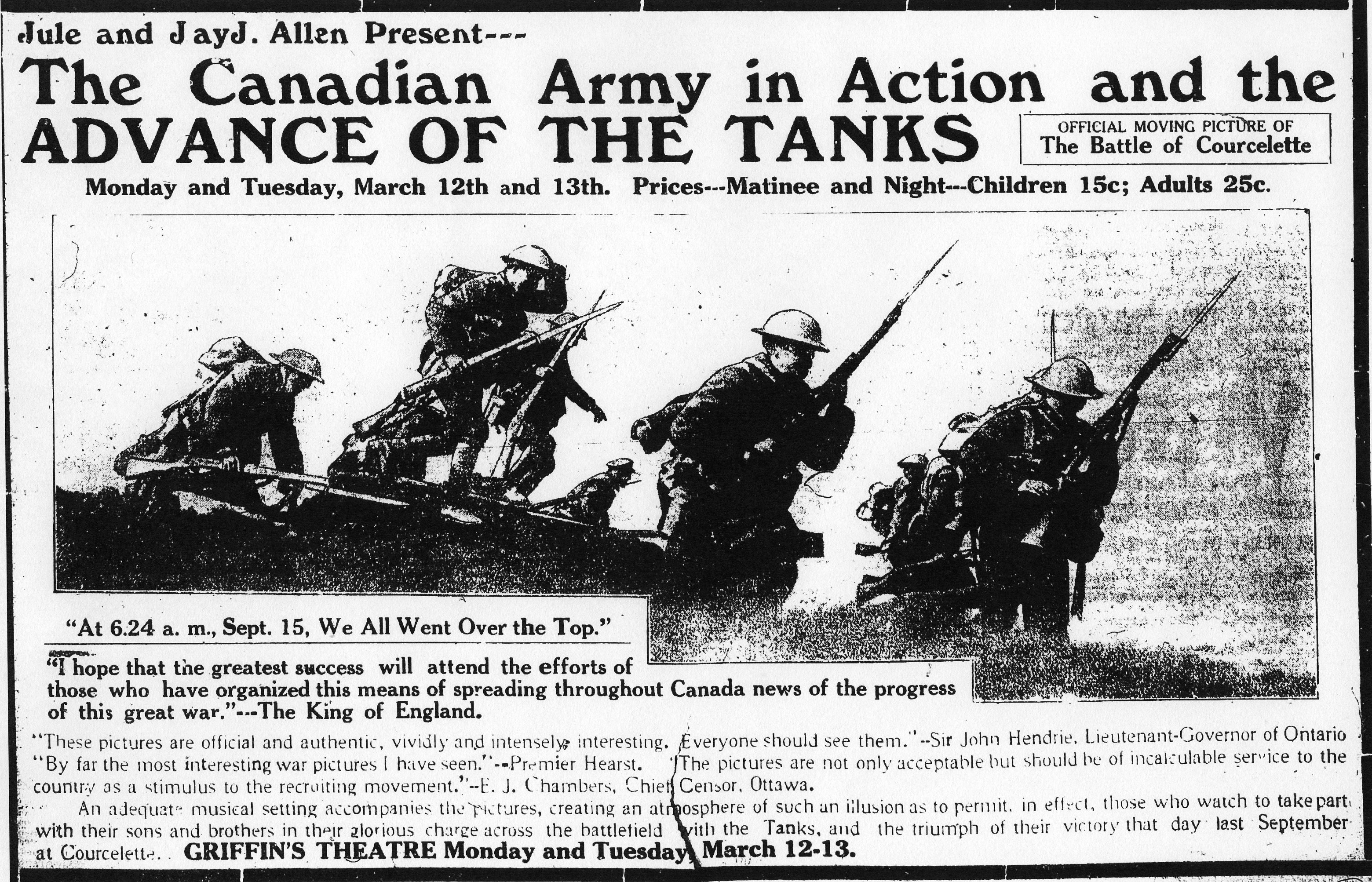
“Jule and Jay J. Allen Present — The Canadian Army in Action and the Advance of the Tanks. Official Moving Pictures of The Battle of Courcelette. Monday and Tuesday, March 12th and 13th. Prices—Matinee and Night—Children 15¢; Adults 25¢.

‘I hope that the greatest success will attend the efforts of those who have organized this means of spreading throughout Canada news of the progress of this great war.’—The King of England.”

The Intelligencer March 9, 1917 (page 7)

“Returned Soldier Dies. The Bancroft Times has the following item in reference to the death of a member of the 80th Battalion who returned home. The death took place in the Peever Settlement on March 5th of Charles H. Reiss, who arrived home only about two weeks ago from overseas. The deceased enlisted in the 80th Battalion and served for over a year in the trenches.

He was wounded and appears to have been discharged from the hospital while still in a very weak condition. When he landed at Maynooth it is alleged he could not get anyone to drive him home. He had to walk a distance of seven or eight miles and the effort was too much for him. He contracted a severe cold which developed into pneumonia and caused his death.”

[Note: Private Charles Ries died on March 4, 1917. He is commemorated on Page 316 of the First World War Book of Remembrance.]

The Intelligencer March 9, 1917 (page 7)

“About 500 school children witnessed the presentation of the Canada in Khaki film at Griffin’s yesterday afternoon. During the performance the children sang several patriotic songs and showed their hearty approval of the pictures in a general way.”

100 Years Ago: Private Harvey Smith Wounded

The Intelligencer March 8, 1917 (page 2)

“Mrs. Harvey Smith, residing at 36 ½ Church street, in this city, yesterday received a telegram from the Record Office, Ottawa, conveying the intelligence that her husband, Pte. Harvey Smith, was wounded on February 24th.

Pte. Smith enlisted and went overseas with the 155th Battalion, but was transferred to the 4th Mounted Rifles. The many friends of the unfortunate soldier will hope that his injuries are not of a serious nature.”

100 Years Ago: I.O.D.E. Tea Room on Front Street, Frankford Detachment Moves to Belleville

The Intelligencer March 7, 1917 (page 2)

“The ladies of Quinte Chapter, I. O. D. E. of this city, have opened up a tea room in the store formerly occupied by Mr. W. B. Riggs on Front street, the object of which is to secure means for Red Cross Work. Mr. Riggs kindly allowed the ladies the use of the store premises, which privilege is much appreciated by him.

A representative of the Intelligencer visited the tea room, and was enchanted with the artistic arrangement of the room, which arrangement was under the supervision of Mrs. S. D. Lazier and Miss Clark. They would feel quite elated, I am sure, to hear the many complimentary remarks made about their artistic ability. They have a victrola, too, kindly loaned by the Lindsay Co., who are always so generous, rendering sweet music while you sip your delicious cup of tea, served in such a dainty manner by the different ladies of the Chapter each day. On Thursday they expect to have home-made cooking for sale.

On display they have a beautiful lunch cloth, beautifully worked, donated by Mrs. W. N. Perry. They have also on view a very pretty picture, painted and donated by Mrs. Geo. Stewart of this city, which is an artistic piece of work. All who visit the tea room will be amply repaid after they have partaken of the good things provided by the ladies, as well as doing your bit to help swell the funds which will be used for Red Cross Work, also encouraging the ladies in their undertaking.”

The Intelligencer March 7, 1917 (page 7)

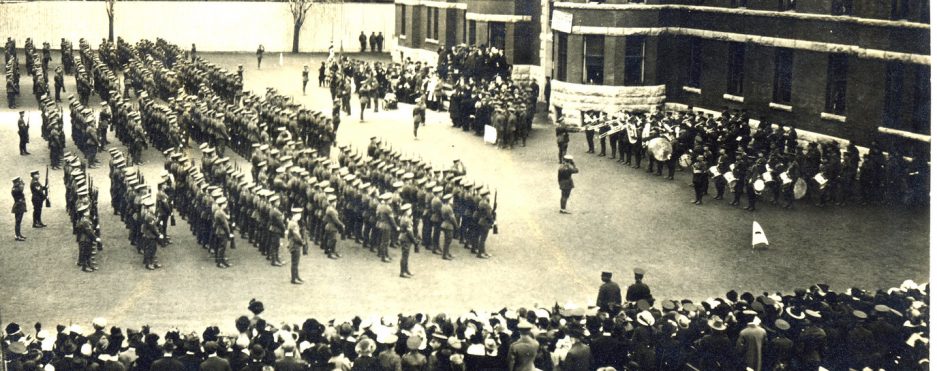
“A meeting of all the officers of the 254th Battalion, is to be held at the Battalion’s Headquarters in the Armouries to-morrow evening. The men of the Frankford detachment of the 254th Battalion, have been called into Belleville, and will be attached to the local company. Recruiting for the 254th Battalion is very slow at present. The officers believe this state of affairs is due to the recent heavy snow, which hinders the recruiting officers in their work.”

100 Years Ago: Extension for National Service Cards, Free Use of Office Quarters

The Intelligencer March 6, 1917 (page 7)

“The time for the return of the National Service cards by those who have not yet returned them or have returned them improperly signed, has been extended to March 31st, 1917, and further cards have been issued to the postmasters for distribution, among those who have made default.

It is understood that the returns from this Military District have been most gratifying. There are however, even in this district, a number who have not made their returns. The National Service Board has expressed the wish that everyone in the District will use his or her very best efforts in order to make the returns from this district as nearly perfect as possible.”

The Intelligencer March 6, 1917 (page 7)

“A Letter of Thanks. The officers of the 235th Battalion, C.E.F., sent a very graceful letter of thanks to Messrs. Northrup & Ponton, solicitors for the Corby Company, for the free use of their splendid office quarters on Front Street, during the stay of the battalion in Belleville.”

100 Years Ago: 235th Battalion Farewell Recruiting Meeting, Cadet Shooting Contest at Queen Alexandra School, 235th Battalion Leaves for Ottawa, Red Cross Ad for Sinclair’s, Ad for Wrigley’s, Sergeant Chas. Asselstine Killed in Action

The Intelligencer March 5, 1917 (page 1)

“Farewell Recruiting Meeting at Griffin’s. The farewell recruiting meeting held in Griffin’s Opera House last night under the auspices of the 235th Battalion was one of the best ever held in the city. The spacious building was filled to the doors with a representative gathering and the addresses given were in keeping with the occasion. Expressions of regret were general that the Battalion is leaving the city, as the officers and men alike have, by their manners, found a warm place in the hearts of the citizens of Belleville. …  After a selection rendered by the fine band under the able leadership of Bandmaster Laugher and the National Anthem, the meeting was opened.

Mr. Sinclair in assuming the chair said he considered it a great privilege and pleasure to preside as chairman at the farewell meeting of the 235th Battalion in Belleville. For several months the Battalion has been in our midst, and all citizens had learned to esteem the officers and men: We will wish them godspeed to their new quarters at Ottawa and also to their trip overseas. We all regret their removal from Belleville, but like good soldiers they had to obey the call where duty called them. …

Mr. Sinclair then read the following letter which speaks for itself: Belleville, Feb. 4, 1917. To Lt.-Col. Scobell, Officer Commanding 235th Battalion, C.E.F., City. Dear Col. Scobell: On behalf of the City Council and all the citizens of Belleville and myself personally, I desire to express the regret we all feel of parting from the officers and men of your splendid battalion. You have been living among us for several months, and we have learned to respect and honor you. The conduct of your men have been most exemplary. They are gentlemen and soldiers, and we know that wherever duty may call them, they will give a good account of themselves.

We wish you God speed and a safe return, and trust that after this unhappy war, in which we are now engaged, is over, we may be able to welcome you back here again. Yours sincerely, H. F. Ketcheson, Mayor.

Capt. Stewart being called upon said the officers and men of the 235th Battalion regretted the departure from Belleville. He would like to see the young men present take the place of the young men and others who have been wounded. The Germans are not beaten yet. It behoves all to get into the game before it is too late. God pity the young man who does not do his duty at the present time. We have the money and the munition but have we the men. The Empire has a great job before it, and she will make good. We will show to the world we are not a defaulting people.

There are young Canadians to-day who should enlist, but they do not. What is the trouble? Are we too wealthy? Are they Canadians? If they are, they should be in the ranks of the British army. What privileges we enjoy under the old flag. If the Militia Act is put in force we are hopeful the young men will enlist. If they do not enlist then it will be conscription. We have got to get the women and the old men to help in recruiting if the young men will not. …

Lt.-Col. Scobell, upon rising to speak, was most enthusiastically received. In his opening remarks the Colonel said it was hard to say good-bye to Belleville. Four happy months had been spent in Belleville. All citizens had done all they could for the members of the 235th Battalion. He referred to the Khaki Club and the good it had and was doing. Some of the boys of the Battalion had no homes in this country, but the Khaki Club was a home to them. We owe much to the ladies of Belleville who have done so much for the officers and men. For this he was thankful. We are sorry to go, but as good soldiers we must obey orders. …

There are young men walking around in Belleville who should be in khaki. If the young men have not enlisted in the 235th then go and enlist with the 254th Battalion. We hold no bad feelings towards the 254th Battalion as we hope to meet them in France and fight side-by-side with them in this struggle for the Empire. …  The meeting closed by the band playing the National Anthem.”

The Intelligencer March 5, 1917 (page 2)

“At the Queen Alexandra. A very pleasing function took place Friday afternoon at Queen Alexandra School, Ann St. The occasion of the school assembling in the auditorium was to see the crack shots among our cadets, receive the prizes they so well merited by their excellent shooting. The boys not only covered themselves with laurel, but their school as well, by taking ten out of fifteen prizes given to the cadets of the Public Schools in the city. To win a prize it was necessary to make at least nineteen out of a possible twenty-five. All riflemen will admit that the boys’ shooting augurs well for the future marksmen of Belleville.

Mr. Sneyd, Chairman of the School, and Inspector H. J. Clarke, B.A., officiated in the presentation. …  Mr. Sneyd gave a very interesting talk to the pupils. He complimented them on the amounts of their savings in the Penny Banks, and exhorted them to bank more, as every penny saved means so much towards winning the war. He told them about the special war bonds now issued by the Government, which, by buying, each child can materially aid in financing the war.

The speaker then encouraged the boys and girls to have vegetable plots of their very own this summer, and spoke of the probability of prizes being awarded to the pupil growing the best specimens. This all aids in winning the war.

Mr. Sneyd then delighted the children and riveted their interest by a vivid description of the submarine menace to England. They listened breathlessly as he described in detail the British method of netting a submarine.

A hearty vote of thanks was unanimously given Mr. Sneyd, voiced by the Principal, Mr. Mott, and our Inspector. All greatly appreciated his talk, and only hope to see him call again.”

The Intelligencer March 5, 1917 (page 2)

“235th Battalion Leaves For Ottawa. Despite the inclement weather this morning hundreds of citizens of all classes were present at the Canadian Northern Ontario Railway Station for the purpose of saying good-bye to the officers and men of the 235th Battalion, who entrained for Ottawa, where they will be stationed until they leave for Overseas.

Owing to the prevailing storm the proposed march out through Front and other streets was abandoned. Many present at the station expressed regret that the Battalion was leaving the city. The hour of 9.30 was set for entraining but the train which came from Cobourg with the detachments from that town did not arrive until 10.15.

From Cobourg the officers and men totalled 83, and a fine body of soldiers they were. As the officers and men marched in front of the station they were loudly cheered. Many of the ladies of the Belleville Khaki Club were present and the soldier boys were remembered with a supply of oranges and cigarettes, which gift it is needless to say was much appreciated.

Col. Scobell, officer commanding of the Battalion, thanked the ladies for their kind remembrance. At eleven o’clock the train moved off en-route to the Capital. This will be the last appearance of the Battalion in Belleville. It is expected that the Battalion will go overseas in about six weeks’ time.”

The Intelligencer March 5, 1917 (page 2)
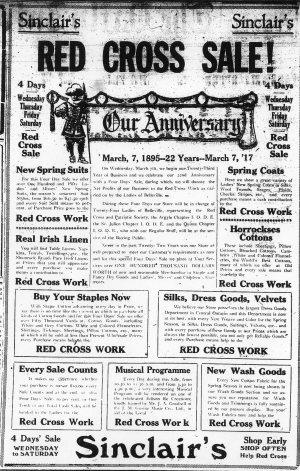
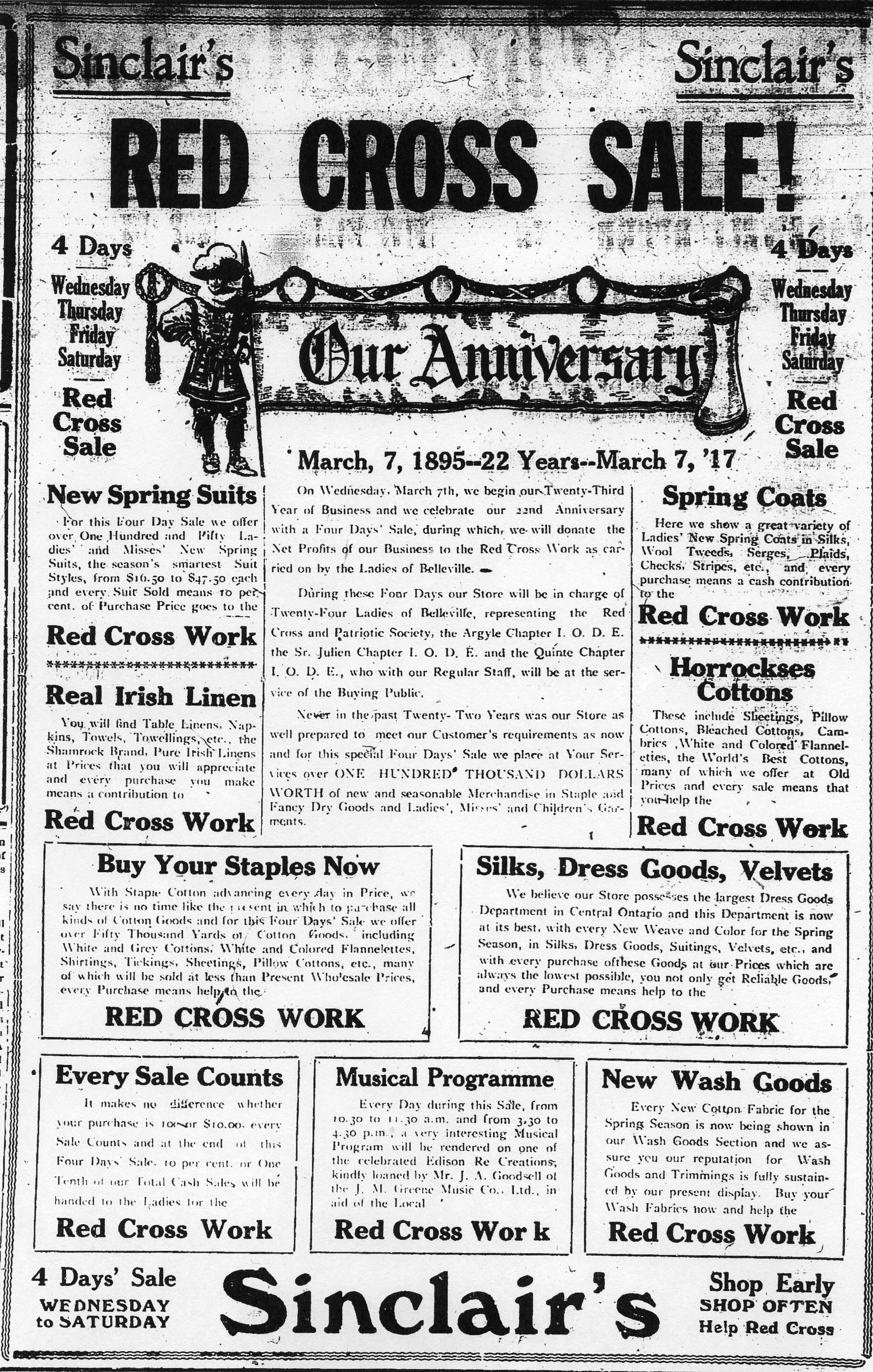
“Sinclair’s Red Cross Sale! 4 Days, Wednesday, Thursday, Friday, Saturday. Our Anniversary, March 7, 1895—22 Years—March 7, ’17.

On Wednesday, March 7th, we begin our Twenty-Third Year of Business and we celebrate our 22nd Anniversary with a Four Days’ Sale, during which, we will donate the Net Profits of our Business to the Red Cross Work as carried on by the Ladies of Belleville.”

The Intelligencer March 5, 1917 (page 3)

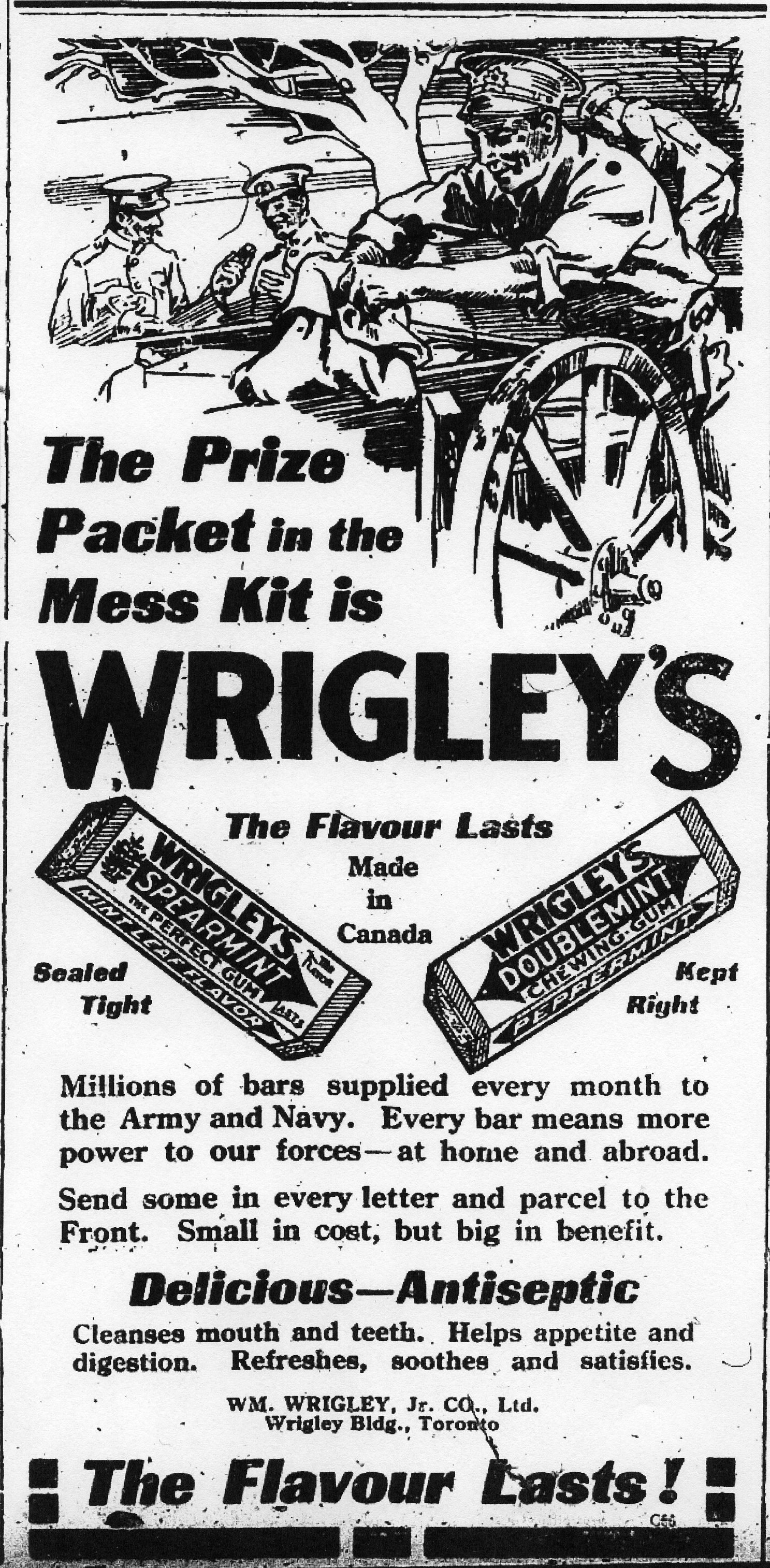
“The Prize Packet in the Mess Kit is Wrigley’s. Millions of bars supplied every month to the Army and Navy. Every bar means more power to our forces—at home and abroad. Send some in every letter and parcel to the Front. Small in cost, but big in benefit.”

The Intelligencer March 5, 1917 (page 5)

“Died Somewhere In France. A few days ago a message was received in this city that Sergt. Chas. N. Asselstine, who left Belleville with the 155th Battalion, was seriously ill, and yesterday a telegram from the Record Office, Ottawa, conveyed the sad intelligence that he was dead. While it is not definitely known, it is surmised that he died at a base hospital in France, as cards recently had been received from him from France.

The brave soldier was well known to this city, where he had resided for the past six years. He, for two years, with Mr. Robert Goudy, conducted the Crystal Hotel in Belleville, and was decidedly popular with the travelling public. Sergt. Asselstine was born at Strathcona, near Napanee, where he resided until moving to this city. He was the second son of Mr. and Mrs. John Asselstine, who reside on Pinnacle street, Belleville. Deceased was a member of the Orange Society, and was a man who was esteemed by all who knew him. His demise will be regretted by a host of friends.

A widow and young daughter survive, also his parents, four brothers and two sisters, all of whom live here. To the bereaved will be extended the heartfelt sympathy of all citizens.”

[Note: Sergeant Charles Nelson Asselstine died on February 28, 1917. He is commemorated on Page 193 of the First World War Book of Remembrance.]