100 Years Ago: 235th Battalion Situation Explained, Canadian Patriotic Fund Aids Recruiting, Leather Shortage for Footwear, Queen Alexandra School Girls Knit Socks, Sergeant’s Mess on Front Street

The Intelligencer November 24, 1916 (page 1)

“Explaining the 235th Battalion Situation. The following communication has been received by His Worship Mayor H. F. Ketcheson of this city: Kingston, Ont., Nov. 20th, 1916. Mayor Ketcheson, Belleville, Ontario.

My Dear Mr. Ketcheson:—My attention has been called to the reports which have been and are continuing to be published in the two Belleville papers, re. Accommodation and movement of the 235th Battalion. …

I would like to place a few facts before you, and will, I hope, tend to straighten matters out, and place everyone in their true light.

Upon the completion of the trek of the 235th Battalion, the town of Bowmanville, which was the headquarters of this battalion, were asked what they could offer as regards quarters, and the Mayor replied under date of October 24, that the town was not in a position to furnish any financial assistance to the 235th Battalion, or any other battalion.

The Dominion Canners had a building in Bowmanville, that they would rent for $200 per month; the cost to the Department for fitting this building would be approximately $6000.

In Cobourg there were quarters available for 255 men. Some minor repairs are necessary, amounting to approximately, $200. Cobourg being situated in this battalion’s area, it was deemed advisable to place as many at Cobourg as could be quartered without expense to the Department.

The whole 235th Battalion were sent to Belleville until necessary repairs were made at Cobourg. It was the intention of the Department from the first to quarter one company in Cobourg. This was quite to the satisfaction of the Officer Commanding the 235th Battalion, for in a letter to this office, dated October 23rd, he strongly recommended that one company of his battalion be quartered at Cobourg.

I would like to draw your attention to the fact that no political or other interference, if there has been any, has influenced the Department in any way, and the original intentions have been carried out to the letter.

With regard to stopping the 235th Battalion recruiting in Hastings, this was found necessary, owing to the fact, the 235th were neglecting their own counties almost all together, making every effort in Hastings County. An organization has built up in the County of Durham and Northumberland at a certain expense, and it was not the intention of this Department to let this organization fall to pieces by being entirely ignored.

It was understood, in fact, it was known, that shortly a new battalion would be raised in Hastings, and would establish and build up an organization, and it was thought advisable to leave this field as clear as possible for the Hastings Battalion, and one which this county would reap full credit. I have the Honor to be, Sir, Your obedient servant, H. R. Wilson, Lt.-Colonel.”

The Intelligencer November 24, 1916 (page 1)

“Aid to Recruiting. The Chairman of the Relief Committee of the Canadian Patriotic Fund in an Ontario city presents a view of the value of the Fund that is not generally appreciated.

He says: ‘Many men could not and would not leave their families in want. They had incurred small debts, and they could not leave their wives to discharge them, in addition to the care of the children. They wanted to enlist, but were thus prevented from doing so.

Under these circumstances, many of them came to officers of the Patriotic Fund with the question, will our wives and children be cared for if we enlist? The Fund, to the extent of the allowances provided, enabled that assurance to be given. The immediate obstacle to the recruiting was thus removed and enlistment made practical.

This, in our opinion, has been the most beneficent work done by the Fund. And if a hundred thousand more soldiers are to be enlisted and sent from Canada, no better agency can be suggested than a continuation and enlargement of the Patriotic Fund.’ ”

The Intelligencer November 24, 1916 (page 2)

“Footwear to Become Dearer in Price. There have been alarming reports about that before long people will be paying $20 a pair for shoes, or be forced to resort to wooden clogs, for footwear or some makeshift of their own contrivance.

While prices will continue to increase, it is unlikely, however, that they will reach that appalling figure, at least for some time to come. The indications, nevertheless, are that the advance will be a substantial one. For instance, fine shoes now selling at $6.00 and $6.50 a pair, will go to $9.00 before many months, and workmen’s shoes, which now sell at about $3, will be selling at $5 next March. …

The reason for the continued advance in prices is in the increasing scarcity of leather. The war has shut off the supply of white leather from the Balkan states and of fine leather from Russia. Then the war department demands enormous quantities of leather, not only for shoes and leggings for the men, but in many other ways in which leather is required.

Manufacturers are already seriously considering the advisability of cloth-tops as the leading thing in shoes for men and women in order to maintain a price which will enable the average person to wear even ordinary shoes.”

The Intelligencer November 24, 1916 (page 3)

“Received Thanks For Socks Sent. A few days ago Doris Roe, aged 11, received a letter from a soldier now in England. He wrote to thank her for the very excellent pair of socks he had just received, and to tell her how much he appreciated them.

On the following day she received another letter thanking her for a pair received that day by another soldier. This was from a West Belleville Boy, Pte. Plumpton, also in England.

Doris is only one of the many girls at Queen Alexandra School who formed a knitting circle last winter and worked faithfully for the benefit of ‘Our Soldier Boys.’ They have already begun their work for this winter and are planning to knit wash cloths and to hem handkerchiefs.

The boys at school feel that they want to have a share in this good work and they have agreed to save their pennies to buy knitting cotton which the girls will use. The circle will meet each Wednesday from 4 to 4.30 p.m., in the assembly room.

Many of the scrap books of local news that are made each week by the pupils with the help of the teachers are being mailed to the boys now ‘Somewhere in France’ who formerly were members of the Q. A. S., C. C., No. 404.”

The Intelligencer November 24, 1916 (page 6)

“The Sergeant’s Mess. Apartments have been secured up one flight in the old Victoria Hotel Building, Front Street, and fitted up for the use of the sergeants of the 235th Battalion. A representative of The Intelligencer, dropping in on the boys Thursday evening, found them enjoying the comforts of their new quarters, known as ‘The Sergeant’s Mess Rooms.’

While plans for fitting up the eight or nine rooms have progressed, there is still need of furniture, pictures and little home articles, which will be gladly received. Among the necessities is an upright piano (a second-hand one preferable), which, if loaned, would be well cared for. This would be a boon, as many of the soldiers are good musicians, and miss this particular instrument.

In the pleasant dining room, which is ever amply supplied with food, additional articles in crockery, cutlery, etc., would be appreciated. The boys have gone deep into their own pockets to acquire their needfuls, and casual assistance would be now in order. Drop in and have a chat, size up the needs, and then quietly send in your donation. They won’t forget the favor.”
100 Years Ago: Appeal by the Queen, Concert Ticket Sale, New Khaki Club Rule, Capt. Allan Harper Wounded

The Intelligencer November 23, 1916 (page 1)

hc01990

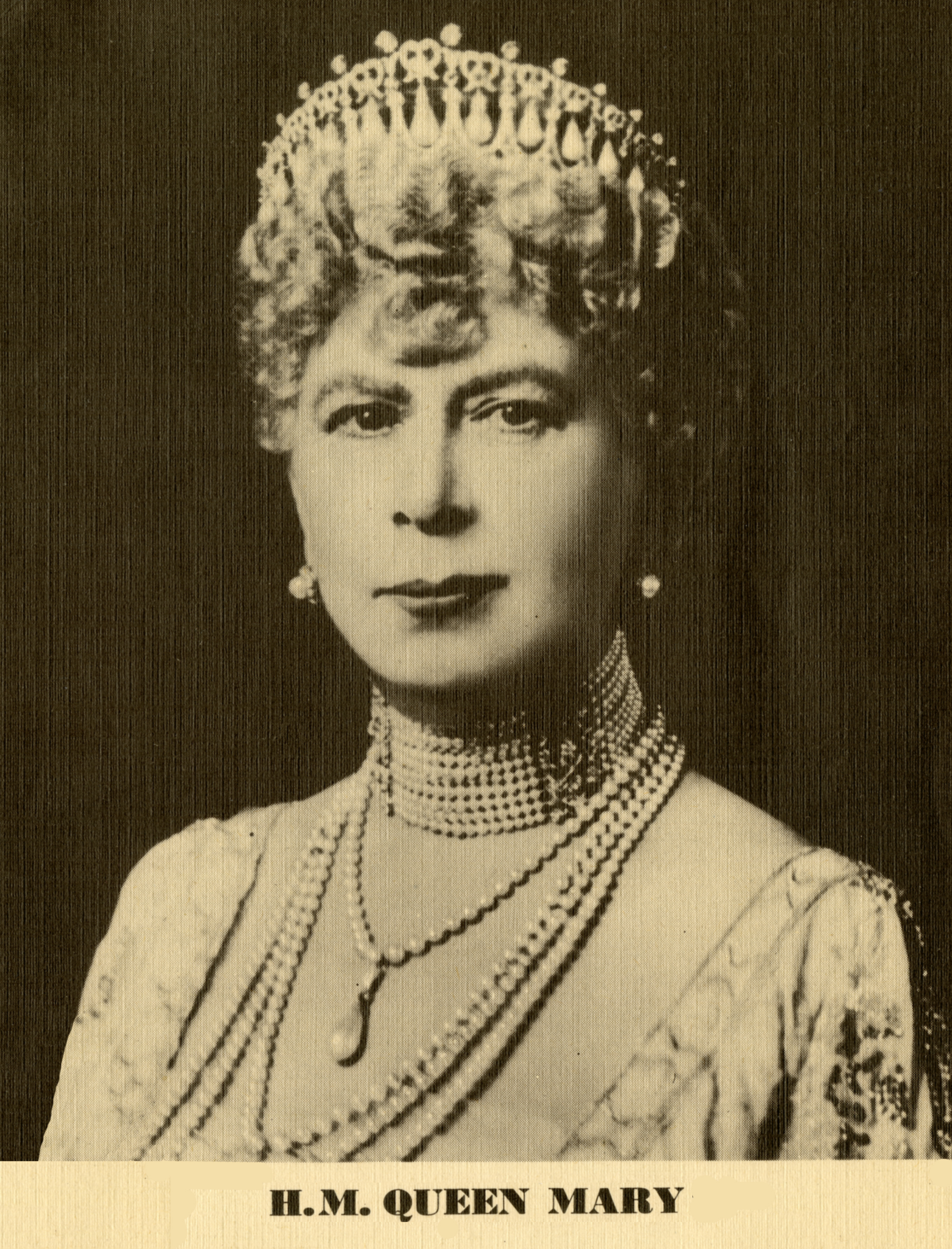
“An Appeal by The Queen. Buckingham Palace, Oct. 24, 1916.

On the threshold of the third winter since the beginning of the war, I appeal to all those who have generously responded to my requests for work during the past two years, not to relax their efforts in providing comforts for our soldiers and sailors.

The applications from regiments and hospitals at home and abroad increase instead of diminish, and an almost unlimited number of things is needed if the Queen Mary’s Needlework Guild is to meet all the demands made upon it.

As Sir Edward Ward has recently pointed out, the chief needs at the present moment are mittens, mufflers, helmets, socks, gloves and cardigans, and my Guild is also being specially asked for pyjamas, day shirts, bed jackets, blankets and sheets.

I wish to take this opportunity of thanking again the many workers in many lands, who have so kindly contributed to the splendid total of 3,290,784 garments, which have been sent out in 26 months from Friary Court. Signed Mary R.

A copy of the above appeal was enclosed to Mrs. Arthur Van Koughnet, President for Ontario, the following being an extract from the letter: ‘I feel sure you will like to know how much Her Majesty appreciates your generous support of Her Guild, and I hope you will be able to help us as loyally in the future as you have done in the past.’ A copy of the appeal has just been inserted in all the newspapers. Signed Aimee Dawson. (Lady Dawson)

In answer to the appeal Lady Hendrie has graciously arranged a Shower for Soldiers’ Comforts, to be held at the Government House on Thursday afternoon, December 7th, and all those desiring to contribute in response to the Queen’s request, may send their gifts of comforts or money, by post, to Lady Hendrie, Government House, Toronto, at any time before the 7th of December.”

The Intelligencer November 23, 1916 (page 1)

“In order to further the sale of tickets for the concert to be held in Griffin’s Opera House by the 235th Battalion to-morrow night, a wrist-watch is to be given to the man who sells the largest number. The proceeds of the concert will be turned over to the battalion fund. …  Bets are being freely made as to who will win. Private Watts seems to be the favorite but there are several dark horses.”

The Intelligencer November 23, 1916 (page 1)

“Wednesday Night at the Khaki Club. The weekly concert was given at the Khaki Club on Wednesday evening, and was very much enjoyed by the men present. The music was in charge of Mrs. MacColl, assisted by Prof. Staples of Albert College, and Miss Jessie Tuite, who gave several readings in her own inimitable style. The canteen was looked after by Miss McLean.

At the close of the evening, Miss Falkiner, the President, requested the men to sing all the verses of the National Anthem instead of one verse. This met with favor by the men, and will henceforth be a rule of the Club. Copies of all verses were provided through the kindness of Mrs. MacColl, and will be posted up in the Club House until every man knows them.”

The Intelligencer November 23, 1916 (page 1)

“Seriously Wounded. In yesterday’s casualty list appeared the name of Capt. Allan D. Harper, whose original home was in Moncton, New Brunswick, but who is well known in Belleville; he having been a valued member of the local branch of the Bank of Montreal.

Captain Harper went overseas with the 80th Battalion. His many friends in this city hope for his speedy recovery, though private cable advices say he is suffering from severe wounds and shell shock. Captain Harper was the commanding officer of A Company of the 80th Battalion, and was a deservedly popular officer, not only with the members of the company he presided over, but with all members of the battalion.”

100 Years Ago: Plans Begun for British Red Cross Campaign, War Souvenir Arrives

The Intelligencer November 22, 1916 (page 1)

“Will Collect Fund for the British Red Cross. In response to a notice from Mayor Ketcheson, a public meeting was last evening held in the City Hall for the purpose of organizing the city for a one day’s campaign for funds for the British Red Cross Society. The meeting, while not largely attended, was representative, and a few ladies were present.

In the absence of Mayor Ketcheson from the city, Ald. Woodley opened the meeting, and outlined the object of the meeting. The speaker eulogized the Red Cross Society, and the noble work it was engaged in. Committees should be formed to make a thorough canvass of the city, to procure funds for the worthy object.

On motion Judge Wills was voted as Chairman of the Red Cross Campaign, and His Honor thanked those present for the honor conferred upon him. It was not necessary, he stated, to elaborate upon the work of the British Red Cross Society. It is a Society that is doing a grand work.

The Lieut.-Governor of Ontario, has asked Mayor Ketcheson for the City of Belleville to contribute to this noteworthy Society. The amount we should contribute is with ourselves, and the giving should be done by each and every individual in the city.

We should impress upon the citizens the necessity of contributing to two funds, namely the Red Cross and the Patriotic Fund. These demands are increasing, but we should contribute to the same. The needs of the patriotic fund now are about $5,000 a month, and next year we must look forward to subscribing too.

We should prepare an organization to canvass the city for the Red Cross fund. Committees should be appointed to carry on the campaign in a systematic manner. …  Work was needed to be done to make the campaign a success. People were waiting to give to the Red Cross Fund. Perfect the organization of the city, and the Ward system considered was the best means of attaining the end aimed at.

Ald. Deacon was in favor of the appointing of the same committee, which so successfully conducted the patriotic campaign fund. The ladies would co-operate, and the Ward system be approved of. There was considerable detail work to be done, and various committees would have to be appointed to carry on the campaign. A permanent organization could be formed, and the committees appointed could have power to add to their numbers. …

Chairmen and Vice-Chairmen were selected for the various polling sub-divisions of the Wards, and they are to select their working committees. They will meet in the Council Chamber on Friday evening next.”

The Intelligencer November 22, 1916 (page 4)

“A War Souvenir from the Trenches. The Women’s Khaki Club of this city, of which Miss Faulkner is the energetic President, and Miss Evalyn McCarthy, Secretary, devoted much of their time in collecting and making useful articles for the boys who had gone to the front to meet their country’s foes. Among the many useful articles collected and sent overseas were small pads, upon which to write letters to their parents and friends at home.

To make these pads more interesting, post-cards which had been received by members of the Club, were pasted upon the covers of the pads. One of the cards which had a picture of High Park, Toronto, was picked up on a street in France by one of the boys, and finding the name of Miss McCarthy upon it, returned it to her, with the following letter. It is needless to say it is highly prized as a souvenir of the war:

Sept. 27, 1916, 440013, No. 2 D. Unit of 8. C.A.S.C. A.P.O. 8 11, France. Dear Miss McCarthy:—No doubt you will be surprised to have this post-card returned to you, which will be quite a souvenir for you to keep, having been found somewhere in France. I cannot give you the exact location as we are not permitted to disclose names of places. Kindly let me know if you receive this. Yours sincerely, Pte. Tommy Glover.”

100 Years Ago: Y.M.C.A. Campaign Goal Reached, 150 Men of 235th to Cobourg, Socks Appreciated, Christmas Time in the Trenches

The Intelligencer November 21, 1916 (page 1)

“The Desired Goal Attained in the $15,000 Y.M.C.A. Campaign. When the final returns of the great $15,000 Y.M.C.A. Campaign were tabulated at the Assembly room of the Y.M.C.A. last evening it was found that $14,654.75 had been subscribed to the Campaign. The small balance was soon provided for by two or three members of the Executive, who will see that this amount is made good and therefore the Campaign closed with the full amount of $15,000 realized.

It was thought at first an impossible task to undertake to raise such a large sum of money and not a few felt that it could not be done, but Belleville citizens responded to the call of the Y.M.C.A. because they believed in it for what it has done in the past, is doing at the present, especially for soldiers at home and abroad and the work that it will be able to do locally, because of the splendid financial condition in which the Association would be placed when the amount asked for was provided. …

Too much credit cannot be given to the business men of the city of Belleville who sacrificed practically their whole time during the Campaign in order that the desired results might be realized.

The boys of Belleville are the mightiest asset she possesses, and no boys could have given of their means, their time and their enthusiasm more freely than the boys did throughout the Campaign. To the 20 or 25 boys who worked actually in the Campaign $1,613.50 is due to their energies in going out in almost every case for the small subscription to the out-of-the-way places. These very embodiments of the Association got many subscriptions that might not have been given to a grown-up person. …

Dr. Yeomans took occasion to commend the very great services that C. Boardman Brown the Campaign Director rendered in bringing the Campaign to a successful conclusion. Mr. Brown came here an absolute stranger and by his vast experience in work of this nature, his fine executive ability, and splendid Christian spirit, realized what was his ambition as much or more than any man in Belleville, the success of the Campaign. Mr. Brown leaves a host of friends in Belleville.

To every one who subscribed whether the amount was great or small, and to those who refused for reasons best known to themselves the thanks of the Directors is extended. The Association is open to the people of Belleville and a glad welcome is awaiting one and all who may find time or occasion to drop in. The Young Men’s Christian Association belongs to Belleville, come in and possess it.”

The Intelligencer November 21, 1916 (page 2)

“Military Movements. One hundred and fifty-two men of the 235th Battalion left at 10.30 this morning, by special G.T.R. train for their new quarters in Cobourg. The troops entrained at the Canning factory and proceeded up Pinnacle St. to the main line of the Grand Trunk.”

The Intelligencer November 21, 1916 (page 2)

“Socks Appreciated. The following letter received by Mrs. W. S. Minns, residing at 146 Yeomans street, Belleville, explains itself:

No. 91522, Headquarters Staff, 3rd Can. Divisional Artillery, B.E.F., France. Dear Mrs. Minns,—I have just been presented with a most beautiful pair of hand-knitted socks, and finding the attached slip of paper inside, I am taking the liberty of writing a few lines to let you know that somewhere in France is a very happy soldier, who highly appreciates your lovely gift.

A terrible bombardment is taking place at present, and the sky is illuminated for miles.

Again thanking you for your great interest in the boys, and assuring you that a prayer will be said for the donor, who spent many hours knitting for Yours truly, Fred Mawdesley. October 1st, 1916.”

The Intelligencer November 21, 1916 (page 3)

“Christmas Time in the Trenches. It’s Christmas Day in the trenches. With a sack filled with good things, letters of love, of friendship, and parcels of good things, an orderly comes into the ‘gang’ which lost no time after the trumpet sound of ‘mail,’ in getting ready to greet him.

For the time being that orderly is probably the most popular man in the battalion. Words of chummyness are called out to him in the hope that they might lead to the caller being one of the lucky bunch. …

One after another of the boys in turn, receives some little token, shows he is not quite forgotten, until there are a dozen or so left without even a Christmas card. As gloom settles upon their faces and as, one by one, they move away to some quiet corner to feel sad and allow tears to well up in their eyes at the thought of being ‘quite out of it’ their disappointment grows, developing strange thoughts of the world in general, and oftimes a desire for recklessness the next time they ‘go in.’

They are forgotten! None cares a button about them! What use is there in caring, anyway? Why not just take a bigger chance next time? Their Christmas Day is one filled with bitterness, instead of happiness, and that desire to ‘stick it through.’ As their eyes wander around, those disappointed and sad visaged men see a wonderful contrast on every side.

Laughter, joy, the great fun of opening parcels containing everything, that brings good cheer. Small plum puddings, with all the trimmings, some without, but all mightily welcome. Almonds, raisins, pocket games, candies, cigarettes, tobacco, a pipe, one or two pairs of socks, warm lined gloves—which are just the right size—and the happiness of the boys is complete with the reading of news of their loved ones and friends.

Some of the boys are especially favored and received two or three parcels of good things. Very quickly those who received nothing are located and invited to share with some of their luckier comrades. Yet, somehow, it is vastly different from being the actual recipient, though it tends to soften the hard feelings towards those who might have written, but that carelessness and forgetfulness, responsible for many hour’s agony of mind, could have been easily avoided by a few minutes devoted to those who are so far away and who are nobly offering themselves in their country’s cause.

Last Christmas Day, you may probably have thought of those in the trenches or in England and wondered what they might be doing. This year see that you can imagine the joy and pleasure they have in hearing from you.

Christmas Soon Here. Now is the time to get ready. You may commence mailing right away. In any case allow a full five weeks for delivery. Take into consideration the increased amount of mail carried at Christmas time. But don’t forget! If you cannot afford to send a parcel, write anyway.”

100 Years Ago: Recruiting Meeting for 235th Battalion, Last Day of Y.M.C.A. Campaign, British Red Cross Society Campaign to Organize, Memorial Service for Robert Logan, Christmas Gifts for Soldier Lads, Money for Y.M.C.A., Ad for Patriotic Concert

The Intelligencer November 20, 1916 (pages 1, 2)

“Inspiring Addresses at Recruiting Meeting. Interest in the recruiting meetings held Sunday evenings at Griffin’s Opera House under the auspices of the 235th Battalion is, if possible, increasing. Last night the audience was such as to fill the spacious building from the pit to the dome, and although the meeting was of considerable length the great majority remained to the close.

The chief speaker was a young hero from Toronto, Sergt. Gibbons, whose address held the audience spell bound. His experience of being in the battle of St. Julien, of being wounded and taken a prisoner to Germany, was given in a manner that captivated all present. …

The proceedings opened by a selection by the 235th Battalion band, which has been augmented by a number of the members of the 15th Battalion band. The selection was much appreciated. …

Capt. Stewart of the 235th Battalion, being called upon, made a capital recruiting address. Among other things he said, the days were going quickly and the call to duty is strong. Come on boys. In Belleville there are many young men who would be handsome in khaki. …  No man of military age in Canada today, should be in civilian clothes.

The greater portion of the first contingent were of British birth. They are gone, at least the greater number of them. Boys enlist, and help the boys back from the front; help those back who are prisoners in Germany, and also the sailors who are tossed about on the billows of the deep, doing their duty. …  We want you to enlist now. No matter in what battalion or battery you may feel inclined to enlist in, come and fight for the grand old flag. (Applause.)

During the meeting, Mrs. C. Wilmot rendered a solo in her usual sweet and meritorious manner. A selection by the band brought the proceedings to a close.”

The Intelligencer November 20, 1916 (page 1)

“Last Day of the Y.M.C.A. Campaign. The Young Men’s Christian Association campaign will officially close tonight. A little less than $1,000 is needed to win a grand victory and secure the $15,000 needed to make the campaign a success.

There are many people in the city who have not as yet contributed anything. The Association makes a last earnest appeal to these and all others to do something today and help save the Y.M.C.A. and secure two conditional pledges of $2,500 each which have been given with the understanding that the entire $15,000 be raised. …

The Board of Directors feel that no citizen or tax payer in the city can afford to have the Y.M.C.A. in any way embarrassed. The Association is more than ever the headquarters of the young men and boys of Belleville including the soldiers. The necessity of keeping the Y.M.C.A. open is emphasized now that the saloons have been closed and our young men and boys need a place more than ever where they can spend their evenings and enjoy social life such as is afforded in the bright and cheery rooms of the Y.M.C.A. …

This afternoon large numbers of the boys’ departments will be out making their final calls and it is hoped by this evening that there will be a sufficient sum realized from those who have not as yet contributed to close the campaign with a grand jubilee.

It is felt by many the reputation of Belleville is at stake in this campaign for after all the fact remains that the interest any city takes in its young men and boys may be considered the true index of character of the city. Everybody therefore, is invited to help if not already called upon to phone their subscription to the Y.M.C.A. Pledges are payable in four payments beginning January 1st 1917.”

The Intelligencer November 20, 1916 (page 2)

“To Meet at City Hall. A meeting of the Belleville citizens will be held, in the City Hall tomorrow night at 8 o’clock to determine the manner and giving of Belleville’s contribution to the British Red Cross Society, and to organize for the same. A large attendance is requested.”

The Intelligencer November 20, 1916 (page 2)

“Memorial Service. Ensign and Mrs. Lang of Truro, N.S., formerly of Belleville, yesterday conducted services in the Salvation Barracks, in this city. In the evening many were present at a memorial service conducted for Private Robert Logan of this city, who was recently killed in action.

Appropriate addresses were given by Ensign and Mrs. Lang, and hymns, suitable to the occasion, were sung. It was an impressive service.”

[Note: Private Robert McPherson Logan died on October 1, 1916. He is commemorated on Page 120 of the First World War Book of Remembrance.]

The Intelligencer November 20, 1916 (page 5)

“Have You Mailed That Gift to Your Soldier Lad? Time is flying, and with each day that passes the necessity becomes more urgent that the Christmas gifts to the boys at the front should be sent on their journey.

By sending the packages off right away, or at any rate at an early date, the enormous rush which will almost inevitably occur later will be avoided. This point should be again and again impressed upon the relatives and friends of those brave men who are so worthily upholding the best traditions of the empire in their fight for the supremacy of right. …

Although the question of packing has been referred to in previous issues …  this paper again gives in detail what the postal authorities believe to be the best methods of dealing with sending of packages to the soldiers who have proceeded overseas, which is as follows:

1. Strong double cardboard boxes, preferably those made of corrugated cardboard, and having lids which completely enclose the sides of the box are strongly advised. Thin cardboard boxes, such as shoe boxes, and thin wooden boxes should not be used. Nor does a single sheet of brown paper afford sufficient protection.

2. Strong wooden boxes.

3. Several folds of stout packing paper.

4. Additional security is afforded by an outer covering of linen, calico or canvas, which should be securely sewn up. …

Care, of course should be taken to see that the parcel is legibly addressed. Ink should be used, and it is advisable that the address should be written on two sides of the package. The address of the sender of the parcel should also be stated on the cover in order that it may be returned if undeliverable.

In the case of soldiers who may be with the allied armies in the Saloniki district the parcels should be exceedingly strongly packed. They should be as nearly round as possible and well padded with shavings, crumpled paper or similar protective material. The outer covering should consist of strong linen, calico or canvas, and should be securely sewn up.

The use of wooden or metal boxes with square corners is undesirable, as parcels so packed are liable to injure other parcels in transit. No perishable articles should be sent and anything likely to become soft or sticky, such as chocolates, should be enclosed in tins. Parcels merely wrapped in thin cardboard boxes cannot be accepted by the post office authorities.

One word again of the stores that are making a specialty of Christmas gifts for our soldier boys. These local tradesmen have made a deep study of suitable presents which greatly do away with the ever perplexing problem of what to send ‘him.’

Look over these tradesmen’s stores. …  Much time and trouble will be saved by a visit to such stores as these where something most suitable will be found to satisfy every wish. This is the main point, and having chosen the gift do not keep it at home until the last minute, but have it dispatched without delay.”

The Intelligencer November 20, 1916 (page 5)

“A Soldier’s Mother. One of the Y.M.C.A. Campaign workers related the following incident in connection with the present effort to raise $15,000 to help save the institution:

‘A widow lady called at my store yesterday and asked if I was one of those who received the money for the Y.M.C.A. Campaign and when I told her I was, she said ‘The little Yeomans boy called on me yesterday for a subscription for the Y.M.C.A. and I gave him $1.00 and I have been thinking of it since receiving a letter from my son who is at the front.

He said ‘I want to tell you, mother, about the Y.M.C.A. here.’ He told of the number of Y.M.C.A. huts in the rear of the trenches, how beautifully and comfortably they were fixed up, also reading matter such as magazines and papers, writing material and a bouquet is put on the table. Easy chairs are placed in the huts and everything is so comfortable and pleasant that the boys find it restful both to mind and body after the strenuous hours spent in the trenches.

This soldier went on to say: ‘Mother you can’t do too much for the Y.M.C.A. It is doing much good work for us fellows over here.’

She said, ‘I have been thinking of it since and this morning I took some old silverware, that I didn’t want to use, down town and sold it and, ‘handing me $2.00,’ she said: ‘Here is the proceeds. I want to make that a further contribution to the Y.M.C.A., and here is $1.00 from my sister.’

Asking her who I would credit with the subscriptions she said: ‘Just put it down to a soldier’s mother.’ She also told me where we might get a couple more subscriptions.’ ”

The Intelligencer November 20, 1916 (page 6)

grand-patriotic-concert154

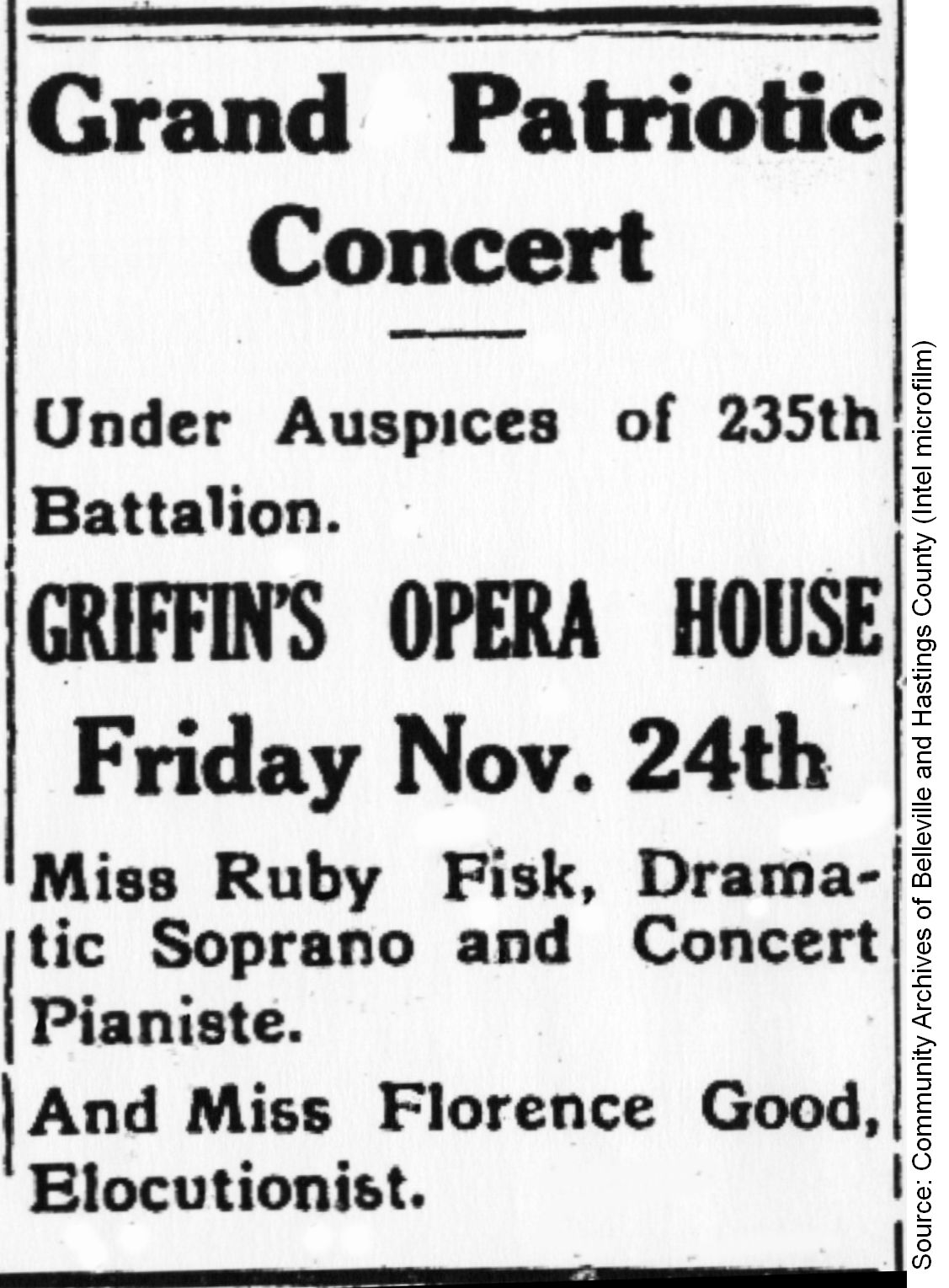
“Grand Patriotic Concert Under Auspices of 235th Battalion. Griffin’s Opera House Friday Nov. 24th. Miss Ruby Fisk, Dramatic Soprano and Concert Pianiste. And Miss Florence Good, Elocutionist.”

100 Years Ago: Married Male Teachers Preferred to Single, Y.M.C.A. Campaign Rally, Jack Phelan Wounded, Deceased Soldiers’ Personal Effects to Ottawa

The Intelligencer November 18. 1916 (page 1)

“Married Men to Have the Preference During the War. A regular monthly meeting of the Board of Education was held in the Council Chamber last night. The business transacted was chiefly of a routine nature. …

Col. Ponton moved, seconded by Mr. McGie, that the Board give notice to all teachers under its jurisdiction, that upon any future engagement or re-engagement of male teachers, preference be given to married men, or those physically unfit by age, or otherwise for active military service.

Col. Ponton spoke in support of the motion. …  This would be an incentive he believed to the senior boys in the school. We will be reflecting public opinion in the move.

Mr. T. E. Ketcheson was in hearty accord of the motion, and he was pleased the motion had been introduced. The motion was adopted by an unanimous vote.”

The Intelligencer November 18, 1916 (page 1)

“Enthusiastic Gathering at Y.M.C.A. Building. The Y.M.C.A. rally last night was an occasion long to be remembered. The auditorium was almost packed full with the canvassers and members of the Ladies Auxiliary. It was certainly an inspiring sight. When the grand total was announced it was found that the Association lacked only $1,300 of reaching the goal of $15,000.

It was unanimously determined to continue the Campaign until Monday evening until 9 o’clock, when the final reports will be handed in. In the meantime every citizen in Belleville, who has not contributed, is most earnestly asked to contribute something, no matter how small.

Great credit is due the boys’ division; there are three teams under the leadership of Captains Ernest Taylor, Max Herity and R. Lazier. They have succeeded in securing $1,343.50. It is believed the boys will be able, with the aid of the men’s teams, to secure to-day and Monday, the balance needed.

Mr. P. C. MacLaurin, Principal of the High School, will organize the boys for a special Campaign, and every one in the city, who has not subscribed, will be invited to do something. It is earnestly hoped that no one will turn these faithful boys away.

Last evening stirring addresses were given by Chairman H. A. Yeomans, M.D., and a hearty vote of thanks was tended him by the entire audience rising. Principal MacLaurin, who has done such effective work in the Campaign, received an ovation. …

The Association feels grateful also to the Press of the city for their liberal reports, and to the ministers of the various churches for their active co-operation. …

The Ladies Auxiliary came in for recognition also, and in a neat speech Mrs. D. V. Sinclair, President of the Auxiliary, told of the interest she and her associates had always had in the success of the Y.M.C.A. A hearty vote of thanks was tended the Auxiliary, and the audience with enthusiasm sang ‘He’s a Jolly Good Fellow.’

The benediction was pronounced by the Rev. Mr. Smith, and the Campaign workers adjourned to start in to get the remaining $1,300 before Monday evening.”

The Intelligencer November 18, 1916 (page 2)

“Lieut. J. M. Phelan Wounded. Yesterday’s casualties, mentioned the name of Lieut. J. M. Phelan, as wounded. ‘Jack’ as he was familiarly known by his many Belleville friends, went overseas with the 80th Battalion last May.

While a native of Ireland, and reported in the list as from that country, he had been a resident of this city for several years, and an efficient employee at the Grand Trunk offices. The extent of his injuries have not yet been learned.”

The Intelligencer November 18, 1916 (page 6)

“The Personal Effects of Deceased Soldiers to Be Sent First to Ottawa. It has been ordered that the personal effects of deceased soldiers are in future to be forwarded immediately to Major Ralph, officer in charge of estates, headquarters, Ottawa, and not sent to next of kin of deceased.

Questioned as to the significance of the order, Major Ralph stated that it is absolutely necessary so that the legal question of heirs and assignees may be properly considered. In several cases, he declares, paymasters have handed out personal effects to claimants who were not legally entitled to them.”

100 Years Ago: Belleville Y.M.C.A. Campaign Goal Almost Reached, Huntingdon Township Gives Generous Donation, Ad for Neilson’s Chocolates

The Intelligencer November 17, 1916 (page 2)

“Desired Goal Almost Reached. The campaign inaugurated to raise $15,000 for the Belleville Y.M.C.A. will be brought to a close this evening and the prospects are bright for the realizing of the amount aimed at.

The noon-day lunch to-day at the Y.M.C.A. building was largely attended by workers of the various teams. The ladies who are members of the Ladies Auxiliary of the Association provided a most tempting repast which they themselves served.

Dr. Yeomans presided over the gathering. At the close of the dinner reports were presented by captains of the various teams and they reported since yesterday that $1,261 had been collected. The total subscriptions secured up to noon today were $12,450 leaving $2,550 to be collected in order to reach the desired amount. It was confidently expected that the goal would be reached.

Before adjourning Mr. D. V. Sinclair moved and Mr. P. O. McLaurin seconded a hearty vote of thanks to the members of the Ladies Auxiliary for their interest in the campaign and the providing of the noon day luncheon. The motion was unanimously adopted by a standing vote and the singing of ‘They are Jolly Good Fellows.’ ”

The Intelligencer November 17, 1916 (page 2)

“Huntingdon Township Gives Another Generous Donation for Red Cross and Patriotic Purposes. Recently Mr. J. Elliott, received from Mr. D. L. Fleming, Treasurer of the Township of Huntingdon, $577.20 being donations from the Township of Huntingdon, Moira School Section No. 5 and Bethesda Sunday School …  all of which was used for Red Cross and Patriotic purposes.

The generosity of the ratepayers of the Township of Huntingdon, as evidenced by the above liberal donation sets a good example for other portions of the County of Hastings to follow and those who have so generously contributed are to be congratulated.”

The Intelligencer November 17, 1916 (page 8)

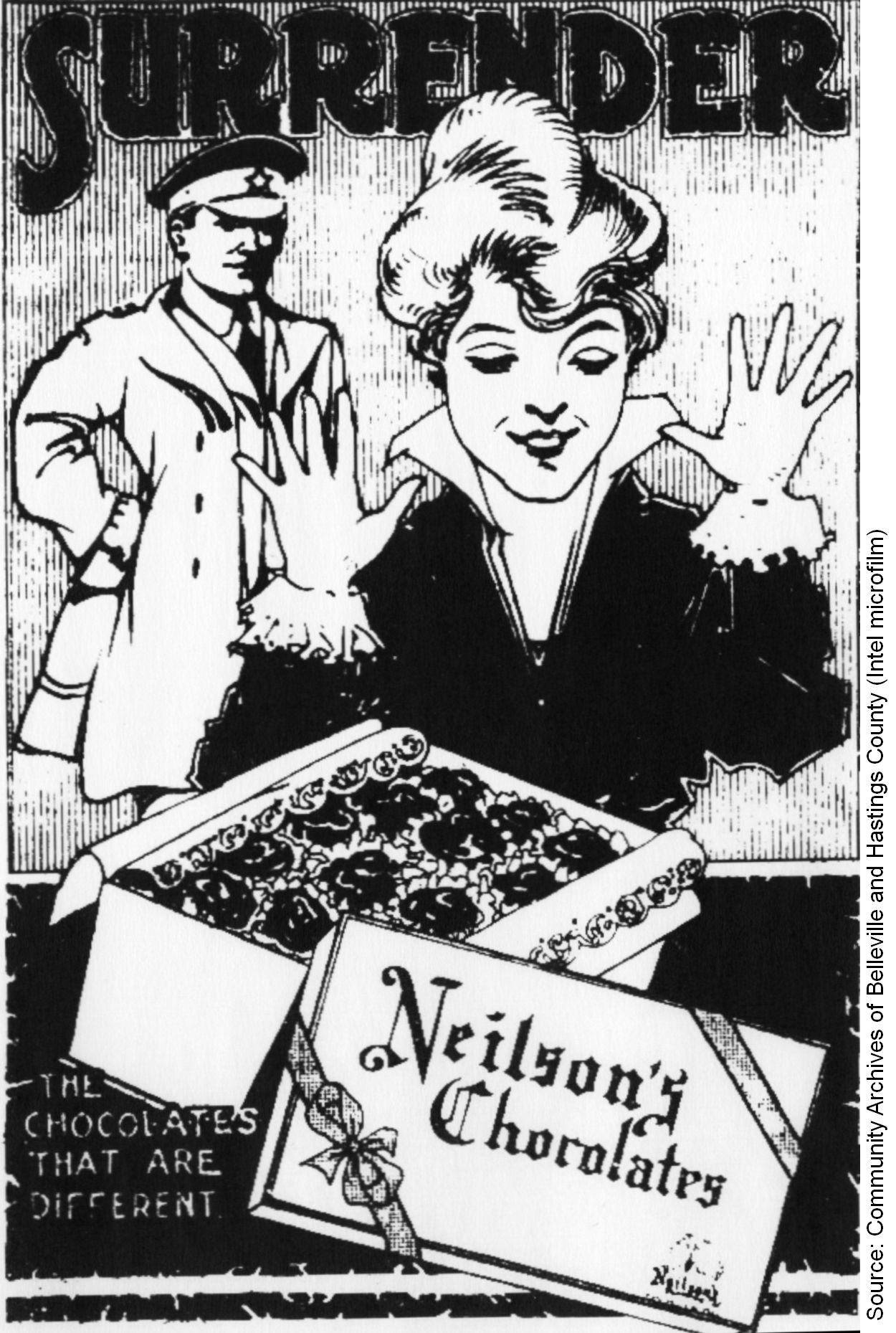
neilsons153

“Surrender. Neilson’s Chocolates. The chocolates that are different.”


100 Years Ago: Update on Belleville Y.M.C.A. Campaign, The Khaki Club

The Intelligencer November 16, 1916 (page 1)

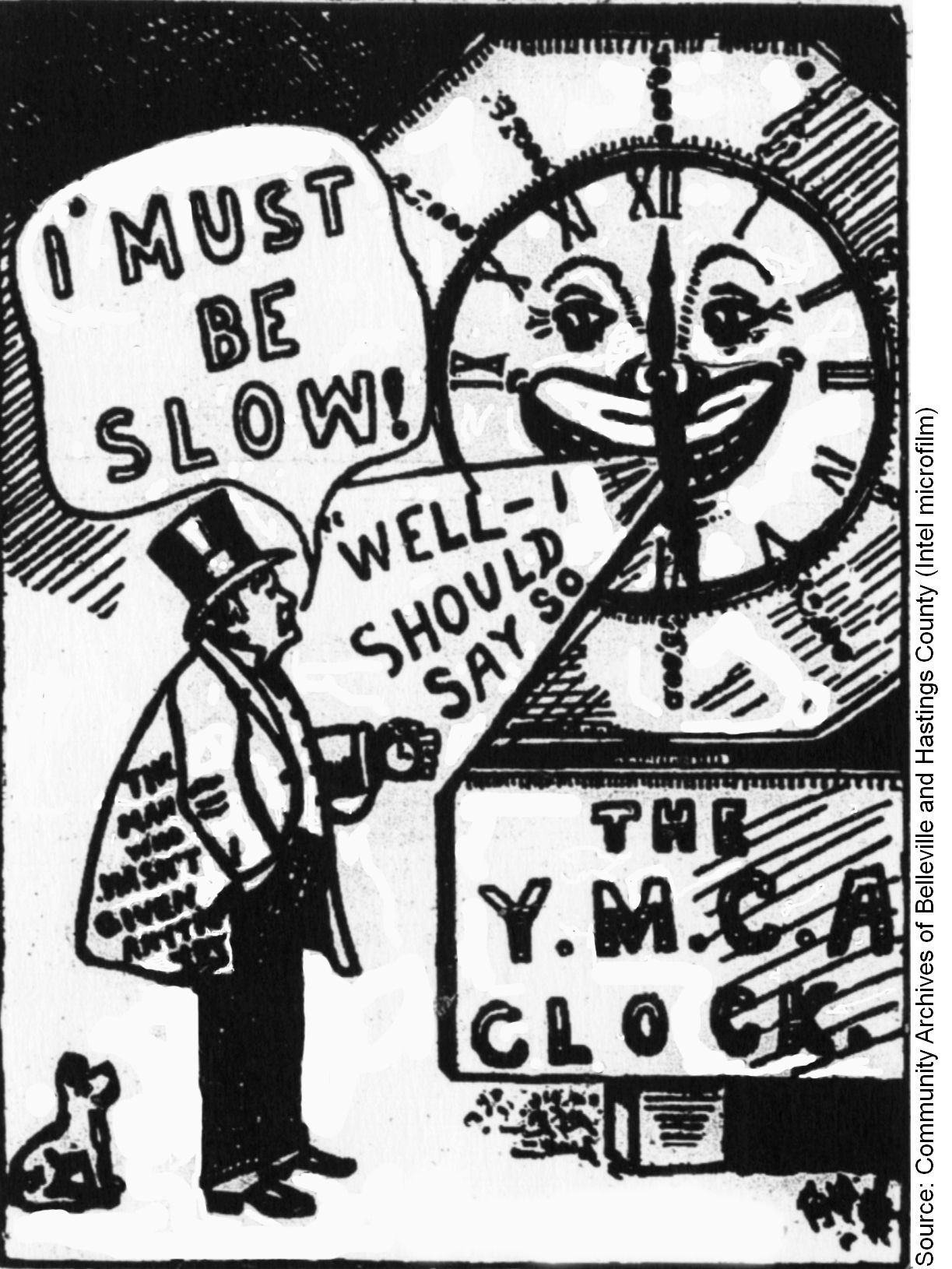
ymca-clock152

“About $4300. Subscribed to Y.M.C.A. Fund. The Campaign to raise $15,000 for the Belleville Y.M.C.A. is making steady progress.

Yesterday the total subscriptions reached $2,438.50, which together with the first day’s reports brings the total to date up to $4283.50. It is understood that there are some subscriptions of larger amounts, which it is hoped will be secured to-day.

The workers are encouraged, and leaving no stone unturned to win in the campaign. Much hard work, however, needs to be done in the two remaining days of the Campaign. A most earnest appeal is being sent out by the managers of the Campaign to every citizen of Belleville to do something. The Association feels that this is an exceptional opportunity for our citizens to show their interest in the young men and boys of Belleville, by contributing to the Campaign fund. …

There has never been a time in the history of Belleville Y.M.C.A. when they were doing as much for the soldiers that have been staying in our city, not only as the Association providing comfortable sleeping rooms for them, but they have had many other things and hundreds of them have come to the building, which has been their headquarters for the past three months.

The Association feels that the work that is being done for boys of Belleville, is also very important. 35 boys have volunteered their help in the Campaign and are giving all their spare time to the canvass.

The directors feel that no citizen or tax bearer can be indifferent to a Campaign that is going to mean so much for the welfare of the city. The basis of all business and moral prosperity, is always centred in the character of our young men.

Only two days remain of the Campaign, and the Board of Directors wish every citizen to do his part to help win out for one of the most necessary and valuable institutions in the City of Belleville.”

The Intelligencer November 16, 1916 (page 8)

“The Khaki Club. Ladies night at the Club was much enjoyed by the men of the 235th Battalion. A bright musical programme was given by Miss Helena Vermilyea, Miss Doris Vermilyea and Miss Moore. The canteen was in charge of Miss Eva Panter, Miss Philinda Docter and Miss C. Docter, assisted by Miss Dolan, Miss Bessie Dolan and Miss Hunter. The evening ended at 10.30 by the singing of the National Anthem.

The Club is greatly in need of a rug or carpet for the music room. One that has been slightly used would be much appreciated.”

100 Years Ago: Billy Dingman Writes from Front, Patriotic Meeting Postponed

The Intelligencer March 19, 1915 (page 2)

“Mr. Wm. A. Rodbourne of this city, yesterday was in receipt of a postal card from Billy Dingham, who is in France, and went from here with the First Contingent. The date of the communication was February 26th, and its contents are as follows:

We have just come out of the trenches, which were only 80 yards from the Germans. Believe me, this is real fighting. Have had splendid luck. I can not give you anything very definite as it would not be sent. All the boys join in sending their best respects to you and the bunch. Yours truly, BILLY DINGMAN.”

The Intelligencer March 19, 1915 (page 2)

“Announcement. THE PATRIOTIC MASS MEETING which was to be held at Griffin’s Opera House on Friday Evening has been postponed until Tuesday Evening, March 23rd. The Committee in charge have changed the date to accommodate some of the speakers who are to be brought to Belleville to inaugurate the Local Campaign for the Patriotic Fund. The names of the speakers, who are the foremost orators of the Dominion of Canada, will be announced in to-morrow’s Intelligencer.

Remember the date, MARCH 23rd. Belleville must wake up and get in line with the other Patriotic Cities, of Ontario, so let no able-bodied citizen of Belleville be absent from Griffin’s Opera House next Tuesday night. GOD SAVE THE KING.”


100 Years Ago: Robert Logan Killed in Action, Roscoe Vanderwater Honoured, Signaller Harold Davis Wounded

The Intelligencer November 15, 1916 (page 2)

“Another local Boy Wounded in Action. Another Belleville boy has made the supreme sacrifice and given his life for his King and Country. Mr. William Logan residing at 150 Church street this morning received a message which bore the sad intelligence that his son Private Robert McPherson Logan, No. 454,870, infantry, was killed in action on October 1st 1916.

The young man referred to was well known in this city, where he had lived with his parents for some years. He was for some time an employee of the Intelligencer Office. He enlisted in the 39th Battalion and went overseas with that Battalion. Another brother is in khaki. The parents and members of the family will receive the heartfelt sympathy of all citizens.”

[Note: Private Robert McPherson Logan died on October 1, 1916. He is commemorated on Page 120 in the First World War Book of Remembrance.]

The Intelligencer November 15, 1916 (page 2)

“Honors Awarded a Gallant Canadian. A number of Canadian soldiers have of late been gazetted as having been awarded the Distinguished Service Order. Among them is one well known in Belleville and vicinity, namely Major Roscoe Vandewaters.

The gallant officer commanded an attacking party with great determination, held and consolidated the captured trench, and personally supervised the digging of new communication trenches.

The popular Major left Belleville with the 39th Battalion and is an officer who is highly respected by all members of the Battalion. His father Mr. Charles Vandewaters resides in Sidney Township being an ex-Deputy Reeve of the Township.”

The Intelligencer November 15, 1916 (page 6)

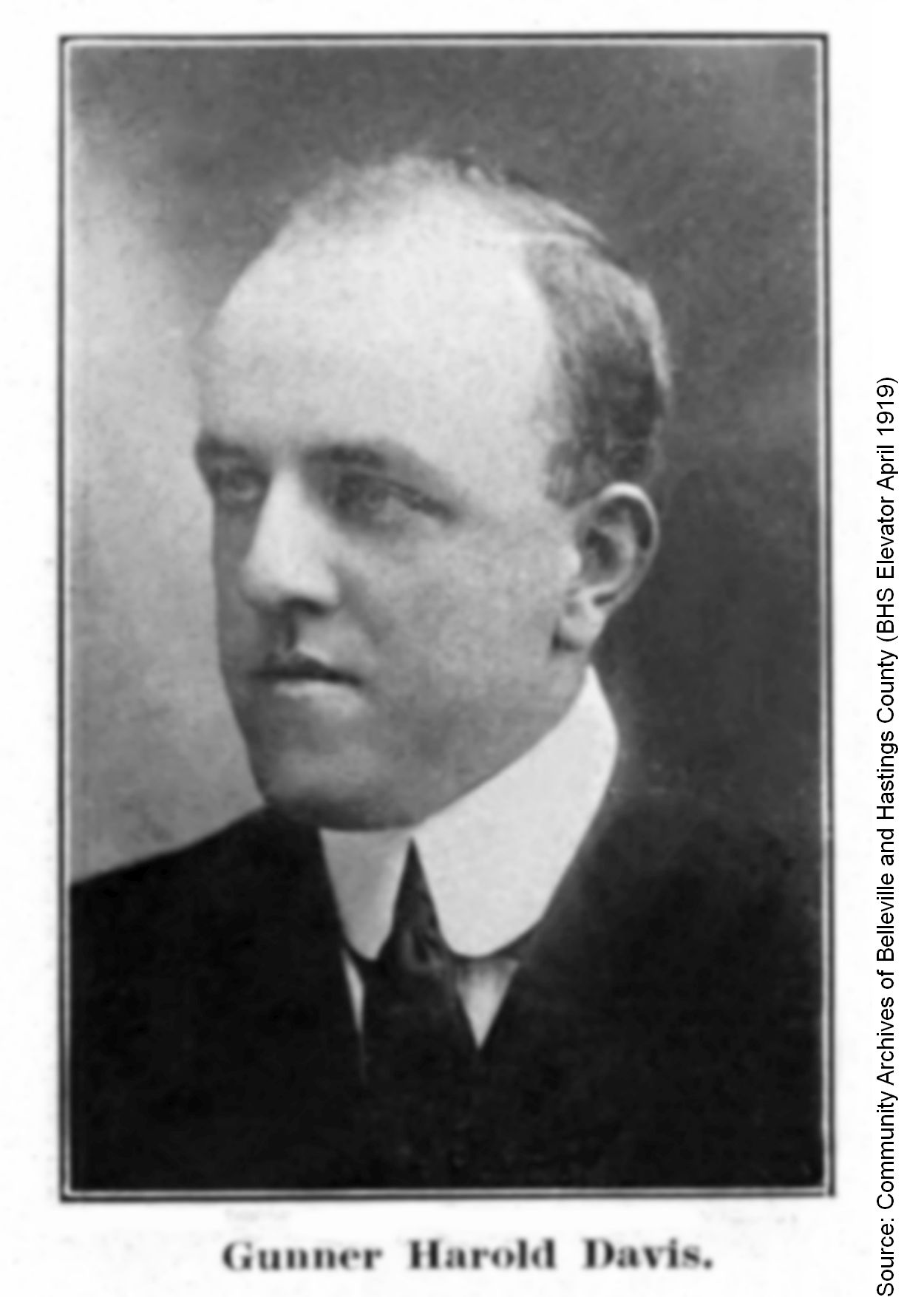
davis-harold

“Signaller J. Harold Davis Wounded. Word was received yesterday by John R. Davis, Albert Street, that his oldest son, Signaller J. Harold Davis, had been wounded on November 2nd. Particulars later.

Harold enlisted in the 33rd Battery at Kingston, last year, as a Gunner. On reaching England in December, he, with several others, were detained there to take a signalling course. He was sent to France in June, and since then has been with the 3rd Brigade, H.Q.S., C.F.A., as a Signaller, with the 1st Division, B.E.F., France.”