100 Years Ago: 3000 Soldiers to Trek to Belleville, Dealing with Deserters

The Intelligencer September 12, 1916 (page 1)

“3000 Soldiers Will Trek to Belleville. Members of the 154th, 155th and 156th Battalions at Barriefield Will Take Part in the March—Soldier-Boys Will Be Royally Welcomed at This City.

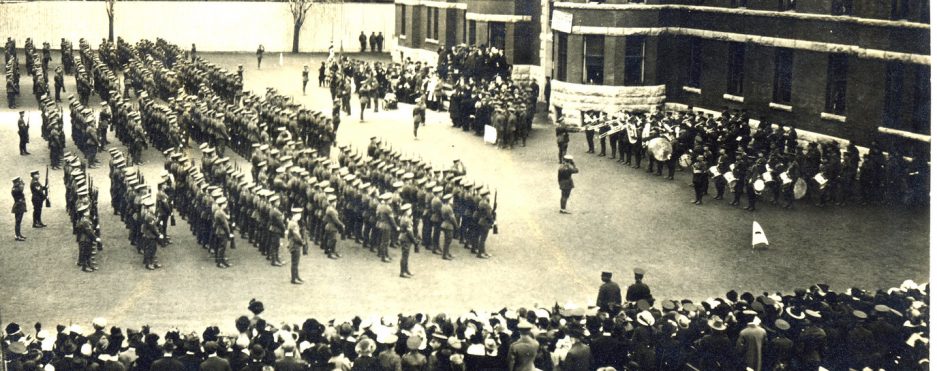
Mayor Ketcheson and Mr. E.G. Porter, K.C., M.P., of this city, were in Kingston yesterday, and had an interview with Col. Hemming, D.O.C. for the military district of Eastern Ontario, in reference to the proposed trek of the battalions, which are in camp at Barriefield. The result of the visit was that 3,000 of the men in khaki will visit Belleville within a few days. Unless anything unforeseen occurs on Wednesday the 20th inst., the three battalions, including the 155th, will leave Barriefield camp for a route march to Belleville. It is expected that the men will reach here late Friday night or early Saturday morning, and will bivouac at Zwick’s Island during their stay here of two days.

It is expected that the citizens will do all in their power for the entertainment and comfort of the soldier boys, and there is not the slightest doubt but they will do so. The coming of the boys is eagerly looked forward to by all citizens, and a royal welcome will be accorded them.”

The Intelligencer September 12, 1916 (page 7)

“Dealing with Deserters. Several deserters have been severely punished since the camp opened. In every case they were taken before a civil magistrate who showed no sympathy with the man who deserted the flag under the present strenuous circumstances. Many of the men punished were not merely absentees, but real deserters, who never thought of returning to military life and would never have seen the camp again, but for the fact that they were brought back under escort.

The men who go absent, and have no thought of forsaking a military career until the war is over, but who are afraid to return because of the consequences of absence without leave, the camp authorities are willing to consider generously, and instead of punishing these men are willing to restore them to their units.”

100 Years Ago: Memorial Service for Private Morley Rutter

The Intelligencer September 11, 1916 (page 2)

“Memorial Service. At Holloway Street Methodist church in this city, yesterday morning a memorial service was held for the late Pte. Morley Rutter, who was killed in action at the front some weeks ago. A large number were present at the service, which was most impressive.

The pastor, Rev. J.N. Clarry, conducted the service and preached a most appropriate sermon, speaking pathetically and eloquently of the young man who had sacrificed his life for King and country. The choir rendered especial selections for the occasion. The late Pte. Rutter was a member of Holloway street church, and a young man who was esteemed by all who knew him.”

[Note: Private Morley Rutter died on July 25, 1916. He is commemorated on Page 158 of the First World War Book of Remembrance.]

100 Years Ago: Machine Gun Demonstrations to Be Given at Fairs

The Intelligencer September 9, 1916 (page 3)

McGie, Wm.

“Will Tour for Recruits. Two Officers of the 155th Battalion to Give Exhibitions. Now that the School of Machine Gunnery has been discontinued, Lieut. McGie is able to devote more time to the training of the machine gun section of the 155th Battalion as a unit.

Through careful choosing and the support of the various company commanders in allowing him the best men, Lieut. McGie has now thirty very efficient soldiers in his section.

There is now a plan being considered that Lieut. Allen, in charge of the bayonet fighting and physical training of the battalion, and Lieut. McGie, commanding the machine gun section, should do a little recruiting with the men.

If the present plans are passed as recommended these two officers with the machine gun section will visit every fair in Hastings and Prince Edward counties. They will take machine guns, etc., and give exhibitions of what is done in the army, and at the close of each exhibition a call will be made for recruits. It should certainly be a most successful plan.”

100 Years Ago: Band of the 155th, Recruiting in No. 3 Military District

The Intelligencer September 8, 1916 (page 3)

“Good band of 155th. Too much credit cannot be given the band of the 155th Battalion for its work at the concert on Tuesday evening and its general work as a battalion band. Bandmaster Hinchey has received many words of congratulation on his work, and the band is now equal to, if not better, than any that has ever been at Barriefield.”

The Intelligencer September 8, 1916 (page 5)

“Recruiting in 3rd Military District. It Is Good Only Where Battalions Have Been Organized. Major G.I. Campbell, chief recruiting officer for No. 3 military district in conversation with a press representative stated that where battalions were organized and actively enlisting men recruiting was as good as it was a year ago. Where, however, no battalions were organized it was practically dead. On the front, from Belleville east, where there were no battalions actively recruiting, very few recruits are being secured.

Asked if more battalions would be organized in this district, Major Campbell replied in the affirmative, but he thought it would be some little time yet before they were authorized, not until, in fact, the battalions now in training were ready to go overseas.

The major stated that details for the national registration scheme were being worked out, and that he expected announcement in a short time.”

100 Years Ago: Private John Beaton Buried, Letters of Thanks, Red Cross Penny Bag Collection

The Intelligencer September 7, 1916 (page 2)

“Buried with Honors. Yesterday afternoon the remains of the late Private John Y. Beaton of the 155th Battalion, who met an untimely death at Kingston, were interred in St. James cemetery here. A number were in attendance at the obsequies. Rev. Father Hyland of St. Michael’s church officiated at the church and grave. A number of floral tributes and mass cards were contributed by relatives and friends.

An escort and firing party of the 155th Battalion were present, being in charge of Sergt. Lynn. At the grave a volley was fired and the last post sounded by the bugler. The bearers were six comrades in arms, namely, Privates W. Reese, L. Sullivan, J. Cronan, W. Heffernan, C. and P. Babcock.”

The Intelligencer September 7, 1916 (page 2)

“Expression of Thanks. Somewhere at the Front, August 21st, 1916. Editor Intelligencer. Dear Sir:—Will you please express my thanks through the columns of your paper, to the good ladies of Belleville, who sent the parcels of socks? Last night, when I got into camp, my feet were wet, for it had been raining all day. I was glad to get such good socks.

We are all getting along nicely, and we all feel sure of a victorious peace. Yours very truly, Gunner Alphonse Bochateg. No. 40126. 1st Batt. 1st Brigade, Divisional Artillery. British Expeditionary Force.”

“Contribution Is Acknowledged. London, July 27th, 1916. Miss Minnie Fleming, 68 1/2 Cedar Street, Belleville, Ont. Dear Madam,—In a consignment recently received through Miss Falkiner was a case containing 31 packs of cards, 60 games, and 1 mouthorgan contributed by some of the Belleville school children. I am directed to convey through you most grateful thanks for this very welcome contribution.

The children possibly would be pleased to know that we are asked for large numbers of games, mouthorgans and cards by the men at the front. By sending such things as the children collected, they can rest assured that their kindness and thoughtfulness will help to cheer many a Canadian ‘somewhere in France.’ With grateful thanks, Sincerely yours, Eleanor McLaren Brown, Hon. Sec., Ladies Committee, C.W.C.A.”

The Intelligencer September 7, 1916 (page 3)

“Red Cross Penny Bag Collection for August. While for the month of August Murney Ward again leads the wards in the amount given, Baldwin Ward really belongs the palm. It is the only ward showing an increase over its givings during the three preceding months since this method was adopted for adding to the Red Cross funds used in providing comforts for our brave soldiers at the front, who are suffering and enduring hardships, that we may enjoy the comforts, peace and happiness of our homes and holidays.

Those in charge of the Red Cross Penny Bag collections, regret to announce a decrease in every ward, but Baldwin Ward, and a total decrease of more than twenty dollars on the money collection in July. We are convinced that this is because of no lack of interest or desire to help on the part of our citizens, but on account of the absence from the city of so many of our collectors and givers.

Can we not in this month make up this deficit, and rise again beyond the two hundred. Every Penny Helps; and there can be no easier way of giving, than by dropping an occasional penny into the Red Cross Penny Bags.

Following are the receipts according to wards: Murney Ward $34.05; Sampson Ward $31.67; Baldwin Ward $28.80; Ketcheson Ward $26.39; Bleecker Ward $18.71; Coleman Ward $16.90; Foster Ward $13.62. Total $170.14.”


100 Years Ago: Patriotic Fund Delinquents, John Beaton Dies, Absentees and Deserter Apprehended

The Intelligencer September 5, 1916 (page 2)

“Mr. Editor,—You know, and so does everyone else, that all take a deep interest in the welfare of our dear boys who are now in the trenches in France, and that it is the duty of everyone to do all that’s possible to render their lives as happy and comfortable as possible and prevent those they have left behind suffering from want. To accomplish these ends, money is an important element.

At the patriotic meeting held in this city some time ago, the people responded nobly to the extent, I learn of about $40,000. Rumor on the streets, however, just now is current that some of those who subscribed have neglected to pay up, forgetfulness, no doubt.

You newspaper men are supposed to know everything. Can you inform the public whether these rumors are true? Your obedient servant, ONE WHO HAS PAID. Belleville, Sept. 4, 1916.

Note.—No, no. ‘One Who Has Paid,’ we have no information on the subject to give you. Surely the rumors are not true? Go and inquire of the Treasurer, Mr. Robert Tannahill, manager of the Bank of Montreal in this city. He knows, and can give you the information sought.

All we have to say in the matter is, that if there are any delinquents, and they neglect to toe the mark, relegate them in the Division Court, and unless we mistake the temperament of Judge Wills, he will make them ‘fork over.’ ”

The Intelligencer September 5, 1916 (page 2)

“Killed by Freight Train. While attempting to board a freight train, two and a half miles east of Kingston, Pte. John Y. Beaton, a Belleville member of the 155th Battalion, was thrown under the wheels and met an almost instant death.

The unfortunate young man, resided up to time of his enlistment, with his mother at 421 Bleecker Avenue, and was an employee on the local G.T.R. section staff. He was born in North East Mabou, N.S., coming to this city about six years ago.”

[Note: Private John Beaton died on September 2, 1916. He is commemorated on Page 52 of the First World War Book of Remembrance.]

The Intelligencer September 5, 1916 (page 3)

“Apprehended Soldiers. Three absentees from the 155th Battalion and one deserter from the 146th Battalion were gathered in by the local police during Sunday and yesterday. They were sent to Barriefield this morning.”

100 Years Ago: Belgian Relief Fund, Liquor Sale to Stop on Dining Cars

The Intelligencer September 2, 1916 (page 6)

Belgian relief

“Millions of Dollars Given—Millions of Belgians Fed—Yet Millions More Are Needed. Nothing else has ever so roused the indignation and practical sympathy of the English-speaking world as the fate of Belgium.

At the first call for help some of the leading business men of neutral United States organized the Belgian Relief Committee, arranging with the British Government to co-operate, and with the Germans to keep their hands off—and the work of feeding the starving Belgians began.

Since then many million dollars have been contributed to the Belgian Relief Fund, chiefly in the British Empire and the United States, about half of it coming from Belgians living in these countries.”

The Intelligencer September 2, 1916 (page 7)

“Stop Liquor Sale on Dining Cars. Travel by train as a means of securing liquid refreshment of more than 2 1-2 per cent, proof in strength will not avail after prohibition goes into effect next month. …

Recently Chairman Flavelle communicated with the responsible officers of all the railways doing business in Ontario in order to learn their attitude in respect to the Ontario Temperance Act. …  all of the railways communicated with, have, it is stated declared their intention of eliminating the sale of liquor in dining cars in the province after the law goes into effect.”

100 Years Ago: Private James Vincent Ross Visits Son Leo’s Grave

The Intelligencer September 1, 1916 (page 5)

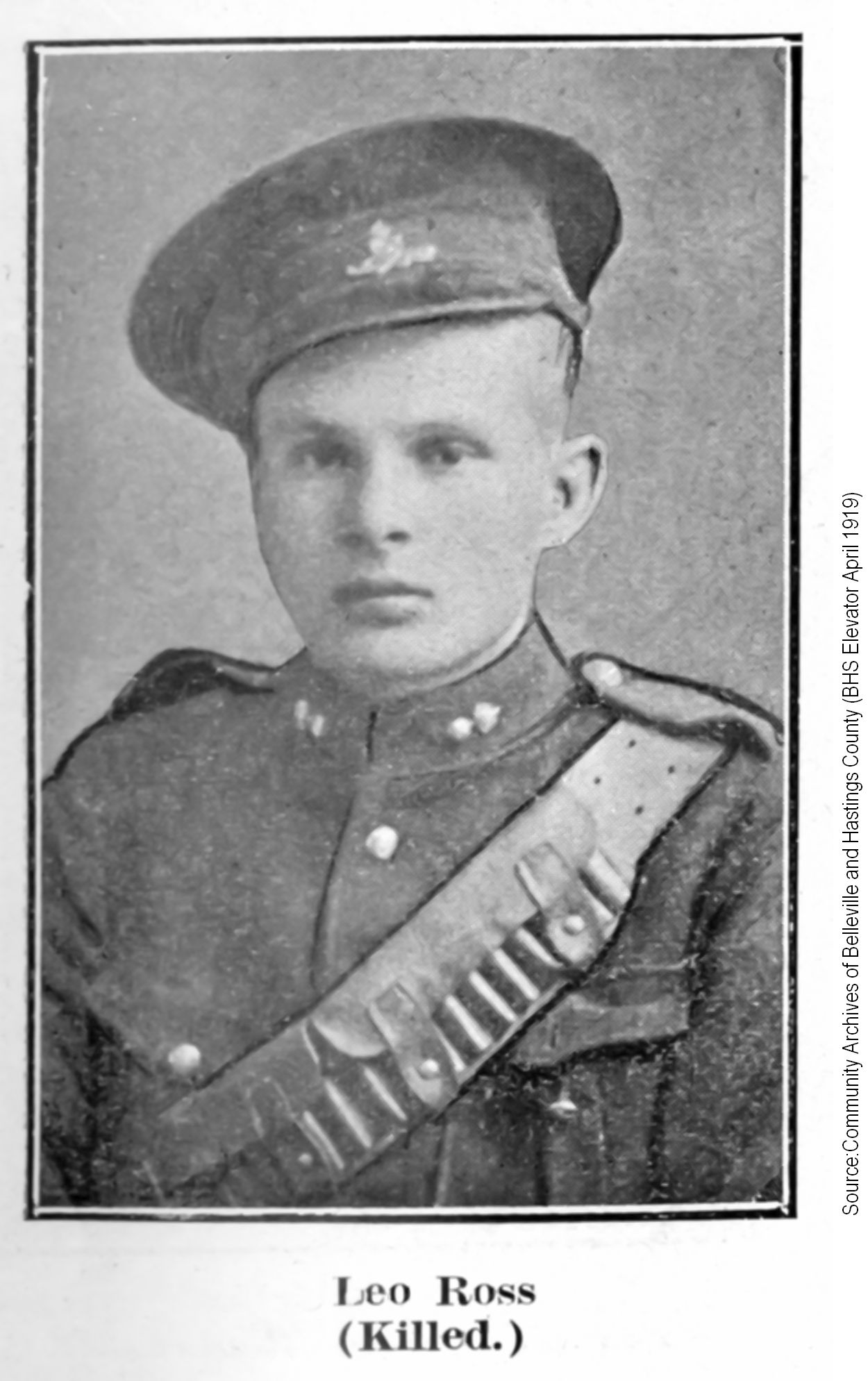
Ross, Leo
“From Pte. J.V. Ross. Dear wife and family: I saw our dear son’s grave, it was the same as they left him last April, with flowers all around him and the grave kept nice, you couldn’t make any improvements on it. I went during the night, it is about eleven hundred yards from the German front line.

Saw his major, he is a fine man, gave me two guides, one was Mr. Summers the man who buried Leo, and the other was Mr. Chipman, one of the men who was on the gun with him. They, Jimmy McDonald, Davy Thomas, Curly Sharpe (Curly’s twin), Jack Turile, young Day, young Harris, and all of Leo’s friends who were with him. They showed me the place that the gun was in when he got hit.

I picked some wild flowers that were growing on the grave. I will send them in this letter. Our colonel gave me a pass to go to the grave, every one of the officers are gentlemen. It isn’t any trouble for them to do anything for their men. Well I have seen what I came to see and I don’t care how soon the war comes to a close.

I saw Percy River’s grave, it was in good shape, he came from Vancouver. I wish you would write to his father and tell him it was alright and kept in good shape.

Met Jimmy Donohue last night going by the trenches, he looks fine and hasn’t been touched yet. J.W. Ross (455895) Canadian Entrenching Batt’n, 3rd Division, France B.E.F.”

100 Years Ago: Wearing of Uniforms by Unauthorized Persons, Funeral of Private James Clark, Lieutenant Leo Blaker Wounded, Terms of Service for Nurses

The Intelligencer August 30, 1916 (page 2)

“Wearing of Uniforms by Unauthorized Persons. It is published for the information of all concerned that the following order and Regulation is made at the Government House at Ottawa, dated August 15th, 1916:—

‘If any unauthorized person wears any Naval or Military uniform or any uniform so nearly resembling any such uniform as to be calculated to deceive or if any person without lawful authority supplies a Naval or Military uniform to any person not being a member of His Majesty’s Forces or of the Canadian Militia, or if any person without authority or right wears a Naval or Military decoration or medal, he is guilty of an offence under the Criminal Code, to a penalty not exceeding $50.00, and in default of payment of the said penalty is liable to imprisonment for a term not exceeding three months.’ ”

The Intelligencer August 30, 1916 (page 2)

“Pte. James Clarke. Under auspices of the Sons of England Society and a military escort the funeral of the late Private James Clarke took place yesterday afternoon and was largely attended. At the family residence McDonald St. College Hill. Rev. Mr. Egan conducted the services and was assisted by Chaplain Capt. Dodds of the 155th Battalion. The latter officiated at the interment at the Belleville cemetery.

After the burial services of the Sons of England Society had been conducted at the grave, the firing party fired a volley and the last post was sounded by a bugler. The bearers were six comrades of the deceased, who are members of the 155th Battalion and also members of the S.O.E. Society. That deceased had many friends was evidenced by the numerous floral tributes which were beautiful in design.”

The Intelligencer August 30, 1916 (page 2)

“Lieut. Blaker of 80th Batt. Wounded. In yesterday’s Canadian Casualty list appeared the name of Lieut. Leo Baker of Cornwall, who was reported as wounded. It was Lieut. Blaker who was wounded, and he was well known to many in Belleville having been assistant Adjutant of the 80th Battalion and left with that Battalion for the front a few months ago.

How seriously his wounds are is not known. Lieut. Blaker was a most amiable officer and was much liked by all the members of the battalion.

Mrs. Blaker who has been residing in this city left today for England accompanied by her three children.”

The Intelligencer August 30, 1916 (page 5)

“Terms for the Nurses. The terms of service for 200 Canadian nurses asked for by the British War Office for service with the Queen Alexandra Imperial Military Nursing Service are: ‘One year, renewable or for duration of war. Pay: sister, £50; staff nurse, £40 per annum board, washing, one guinea abroad, fifteen shillings in United Kingdon; uniform £9 abroad, £8 at home.

Passage will be provided to and from Canada to destination and return passage except engagement terminates voluntarily by resignation or for misconduct.’

Everything necessary will be provided upon arrival in England. As the sisters will travel in mufti to England it is necessary to obtain passes from the Department of External Affairs. The nurses are for service in the Q.A.I.M.N.S. and not with the C.E.F.”

100 Years Ago: Harper McElrath Wounded, Soldier Writes to Schoolboy, Alfred Smith Dies from Wounds

The Intelligencer August 29, 1916 (page 2)

“Belleville Soldier Wounded. Mrs. Mary McElrath, Belleville, Ont., Sincerely regret to inform you 59712 Private Harper McElrath, infantry officially reported admitted Military Hospital York, August 25th. Gunshot wound side slight. Will send further particulars when received. Officer in charge Record Office.

The above telegram was received this morning by Mrs. Mary McElrath of this city, conveying the information that her son has been wounded in action. Private McElrath, was well known in this city, having enlisted in the 21st Battalion, which left for overseas a little over a year ago. His many friends in the city trust for a speedy recovery from his wounds.”

The Intelligencer August 29, 1916 (page 2)

“Received an Acknowledgement. In response to the wish of a teacher in one of the Public schools in Belleville, Master Jim Day, a young son of Mr. and Mrs. Harry Day, of this city, sent a game of authors to the front, and Master Jim yesterday received the following letter:—Somewhere in Belgium, Aug. 12th, 1916. Dear Jim:—I wish to thank you for gift, the game ‘Authors,’ its some game Jim, we have lots of fun with it.

Will you please convey to your teacher our thanks for the interest taken, and say that all the boys are grateful for what is being done for them.

What do you think of the war Jim? I suppose your teacher tells you all about it.

We are having a great time over here fighting Fritz, he doesn’t like Canadians at all—why sometimes he even shoots at us, and we shoot right back. Did you ever see a real aeroplane, Jim? They are as thick as flies over here. It is a wonderful sight to see them flying together thousands of feet up, and to see the shells bursting about them makes your nerves tingle.

We will tell you all about it when we get back to the land of the ‘Maple Leaf.’ Best wishes to you and your pals. I am your chum, Corpl. Harry V. Doudy.”

The Intelligencer August 29, 1916 (page 6)

“Sergt. Alf Smith Makes the Supreme Sacrifice. Word has been received in this city conveying the sad intelligence that Sergt. Alfred Smith died in France on the 11th inst., from wounds. Sergt. Smith was well and favorably known in Belleville. He was by occupation a linotype operator and worked for some time in the Intelligencer office.

Deceased enlisted at Kingston and went overseas some months ago. Sergeant Smith’s father, Capt. Smith, is one of Cobourg’s well known citizens, and a brother is a rector of an Anglican church.”

[Note: Sergeant William Alfred Smith died on August 11, 1916. He is commemorated on Page 165 of the First World War Book of Remembrance.]