100 Years Ago: Pat Yeomans Awarded D.C.M. for Bravery, Children Help Red Cross

The Intelligencer November 13, 1915 (page 7)

“Belleville Boy Awarded D.C.M. We have learned from a reliable source, that Bombardier (Pat) H.E. Yeomans of this city, who left with the 34th Battery, in August, 1914, has been promoted to the rank of Corporal and has also received the D.C.M. for bravery on the field at the battle of Ypres. This is the second time that he has received promotion since being at the front. The honor conferred upon him has been mentioned in order on account of the good work he has performed.

‘Pat,’ as he is familiarly called, is a son of Dr. Yeomans of this city, and his host of friends will be pleased to learn that his valuable services have been fittingly recognized.”

[Note: D.C.M. = Distinguished Conduct Medal.]

The Intelligencer November 13, 1915 (page 7)

“Children’s Red Cross Work. Miss Bailey, of school section No. 20, Thurlow, invited a Red Cross worker to visit her school and a very pleasant hour was spent with the children. Each week they have been contributing small amounts until there was a large box of coppers and silver. Advice was asked as to the investment for supplies. Material for hot water bottle covers and knitting cotton for wash clothes was supplied. The boys wished to roll bandages which will be begun. The children then added two dollars of their money to go to the Lady Jellicoe Fund for the Grand Fleet.

An interesting fact in connection with this visit was that the Red Cross worker’s father was a pupil at this school over fifty years ago and then Major Farley who is now serving his King and Country in France, was also a pupil some years ago. This work may suggest to other rural schools a very practical way of teaching patriotism and also of doing helpful work.”

100 Years Ago: Christmas Post Office Instructions, Y.M.C.A. Serves Soldiers

The Intelligencer November 10, 1915 (page 1)

“When to Forward Gifts to Soldiers. Mail for Canadian soldiers in France and England, if it is to be delivered before Christmas, ought to leave Belleville before the end of this month. Post office officials say that parcels, etc., mailed before December 7th have a pretty good chance of being delivered before Christmas; things mailed after that date have a pretty poor chance. …

Every parcel must carry a customs declaration properly filled out and securely attached. There are four conditions which have to be observed in respect of every parcel. First, it must be prepaid. …  Second, it must be so completely addressed as to be reasonably sure of finding the person to whom it is sent. …  Third, a parcel must in no circumstances exceed 11 pounds in weight. Fourth, it must be so packed as to be reasonably secure against the inevitable abuses to which it will be subjected in transit. The address should be written on the cover, preferably more than once. Address tags should not be employed, because they are liable to be torn off and lost.

As already stated, the Belleville postmaster fixes December 7th as the last day for sending Christmas mail to the trenches. …  The reason for the uncertainty is the disorganization of the ocean mail traffic. Before the war schedules of mail boat sailings were prepared six months in advance. It was possible to predict a mail delivery with almost mathematical accuracy. But nobody knows now what mail boats will be in the business. For members of the expeditionary force in the Dardanelles parcels should be sent away from Belleville before November 25th. …

Mail for prisoners of war in Germany and Austria goes absolutely free. Newspapers, however, may not be sent; and it is not advisable to send books because they are liable to be held up by the censor so long as to be useless. Tobacco is a good article to send.”

The Intelligencer November 10, 1915 (page 7)

“Following the soldier boys wherever they go is a Y.M.C.A. representative, who is appointed by the National Council of that organization to serve the soldiers in every way possible. Along with the battalion that arrived to take up winter quarters in town is a member of the Barriefield Y.M.C.A. staff, Mr. C.T. Sharpe, who is already very well known to the men. He will make his headquarters in Belleville and supervise the work of the Y.M.C.A. for the men here and those at Picton and Napanee as well.

As soon as the quarters are ready a reading and recreation room will be opened and a programme similar in many ways to the one carried on at the camp all summer will be conducted. Mr. Sharpe can make use of any number of magazines and books in his work, as well as articles of furniture that will help make the barracks life and the regimental recreation room a cheery place. For the present he is located at the city Y.M.C.A. and if messages are left there he will be glad to send for parcels of books, or that chair or table that you are no longer using.”

100 Years Ago: 80th Battalion Reach Belleville, Ad for Wrigley’s Gum

The Intelligencer November 8, 1915 (page 1)

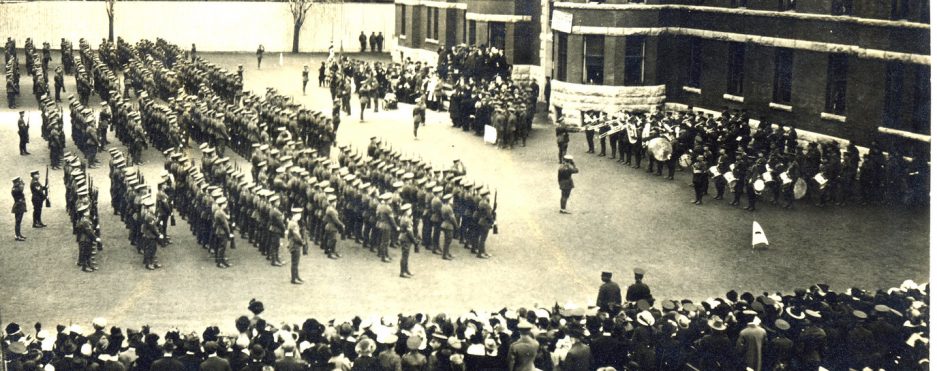
“80th Battalion Reach Belleville. Many men in khaki who have enlisted for overseas service in defence of the British Empire were to be seen upon the streets of Belleville this afternoon. This was owing to the fact that members of A and B Companies of the 80th Battalion who have been in camp at Barriefield for some time, arrived here and will remain here for some time. There were 530 all told, composing officers and men, and were under command of Lt.-Col. W.G. Ketcheson. …

The men quickly detrained and marched from the station to the barracks on Pinnacle street where they will be quartered during their stay in the city. Lt.-Col. Ketcheson led his brave soldiers, and during their route of march were repeatedly cheered by citizens who were fortunate enough to witness their arrival.

When the city hall was reached Mayor Panter approached Lt.-Col. Ketcheson and on behalf of the citizens of the city extended a hearty welcome to the officers and men and expressed the hope that their stay in the city would prove to be both pleasant and profitable. The Mayor was by the commanding officer thanked for his kind expressions.

The men then proceeded to the parade ground in connection with the barracks and were put through some manoeuvres previous to entering the building for dinner, for which, it is needless to state they were prepared. The dinner was provided by the members of the Ladies’ Rifle Club, and was all that could have been desired. Many of the ladies assisted in serving dinner and their efforts were much appreciated by the men. After dinner the men were dismissed and allowed their liberty to go about the city.”

The Intelligencer November 8, 1915 (page 7)

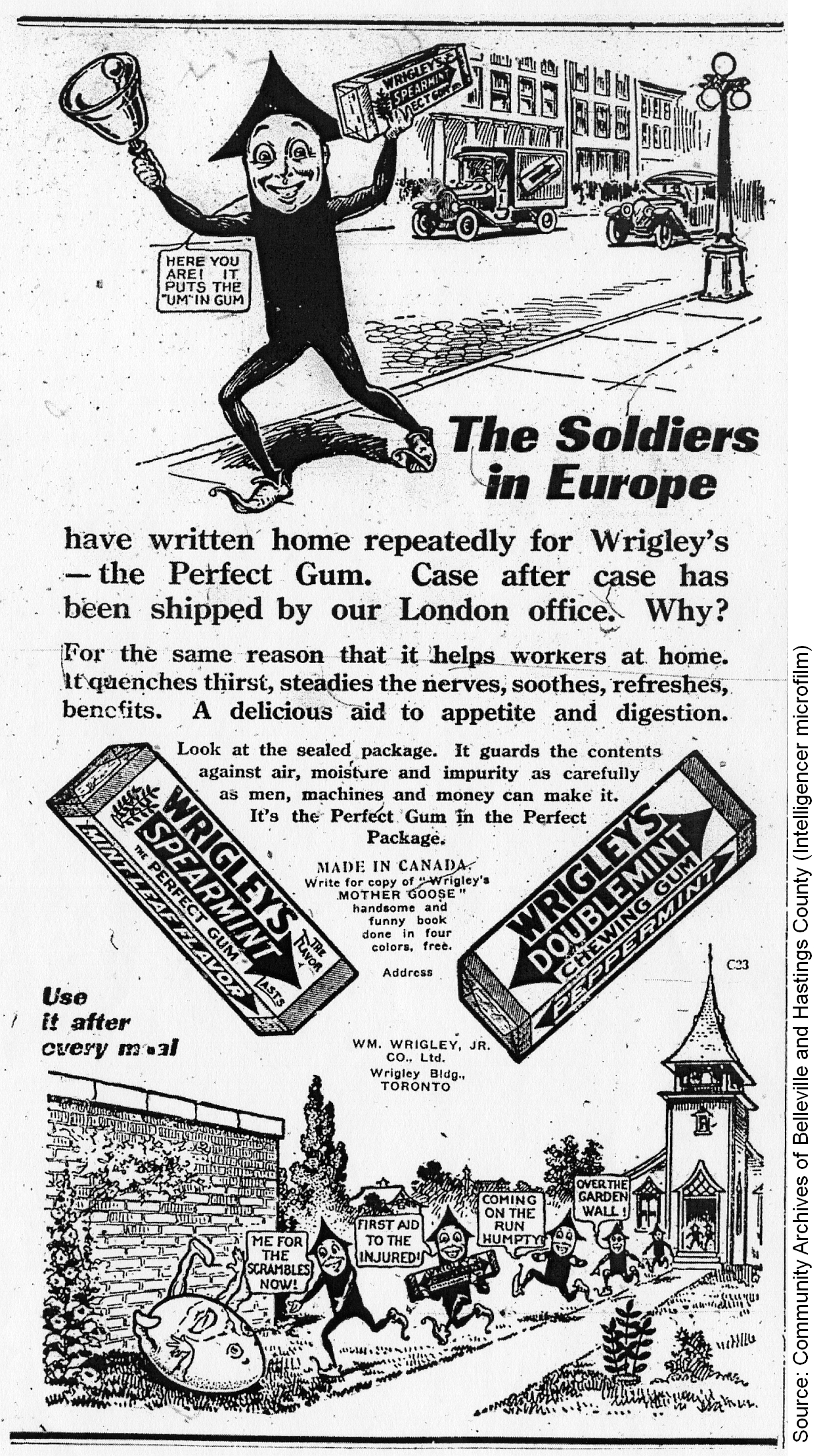
Wrigleys

“The Soldiers in Europe have written home repeatedly for Wrigley’s—the Perfect Gum. Case after case has been shipped by our London office. Why? For the same reason that it helps workers at home. It quenches thirst, steadies the nerves, soothes, refreshes, benefits. A delicious aid to appetite and digestion.

Look at the sealed package. It guards the contents against air, moisture and impurity as carefully as men, machines and money can make it. It’s the Perfect Gum in the Perfect Package.”


100 Years Ago: Bombardier Blaylock Invalided Home, Private William Rawlinson in Hospital

The Intelligencer November 6, 1915 (page 1)

“Returned Hero Welcomed Home. Bombardier E.G. Blaylock, who left Belleville last August with the 34th Battery, has been invalided home and arrived in the city this afternoon by the 3.02 G.T.R. train. He was the second of the returned soldiers to have a public welcome, the first being Capt. R.D. Ponton.

It was difficult to get a band together on Saturday afternoon, but a number of members of the 15th Regimental Band were present at the station. A large crowd assembled and gave the weary warrior a rousing welcome as the train steamed into the station. Escorted by soldiers and citizens, and accompanied by many motor cars, the brave Bombardier was conveyed to his home in Albert St., being loudly cheered en route.”

The Intelligencer November 6, 1915 (page 2)

“In Hospital. Pte. Wm. Rawlinson, who has been discharged from the army through internal injuries, is now in Belleville Hospital. He only arrived in the city on Sunday, and appeared on the stage at the Opera House, at the recruiting meeting. His condition however, was such that he has been removed to hospital.”

100 Years Ago: Frederick Coburn Killed in Action

The Intelligencer November 3, 1915 (page 2)

“Belleville Boy Killed in Battle. Mrs. H.E. Baldree, 81 Mill Street, received a cable from her daughter, Mrs. F. Coburn, to say that they had received a cable from the English Government to say that Pte. F. Coburn, of the 1st Middlesex Regt., had died of wounds received in battle on September 25th. He was a member of the L.O.L. No. 274, and his residence was 149 Lingham street.”

[Note: Private Frederick Coburn died on October 1, 1915. He is commemorated on Page 566 of the First World War Book of Remembrance.]

100 Years Ago: Recruiting Rally on Sunday, Wounded Soldier Discharged, Complaint about Published Letters

The Intelligencer November 1, 1915 (page 1)

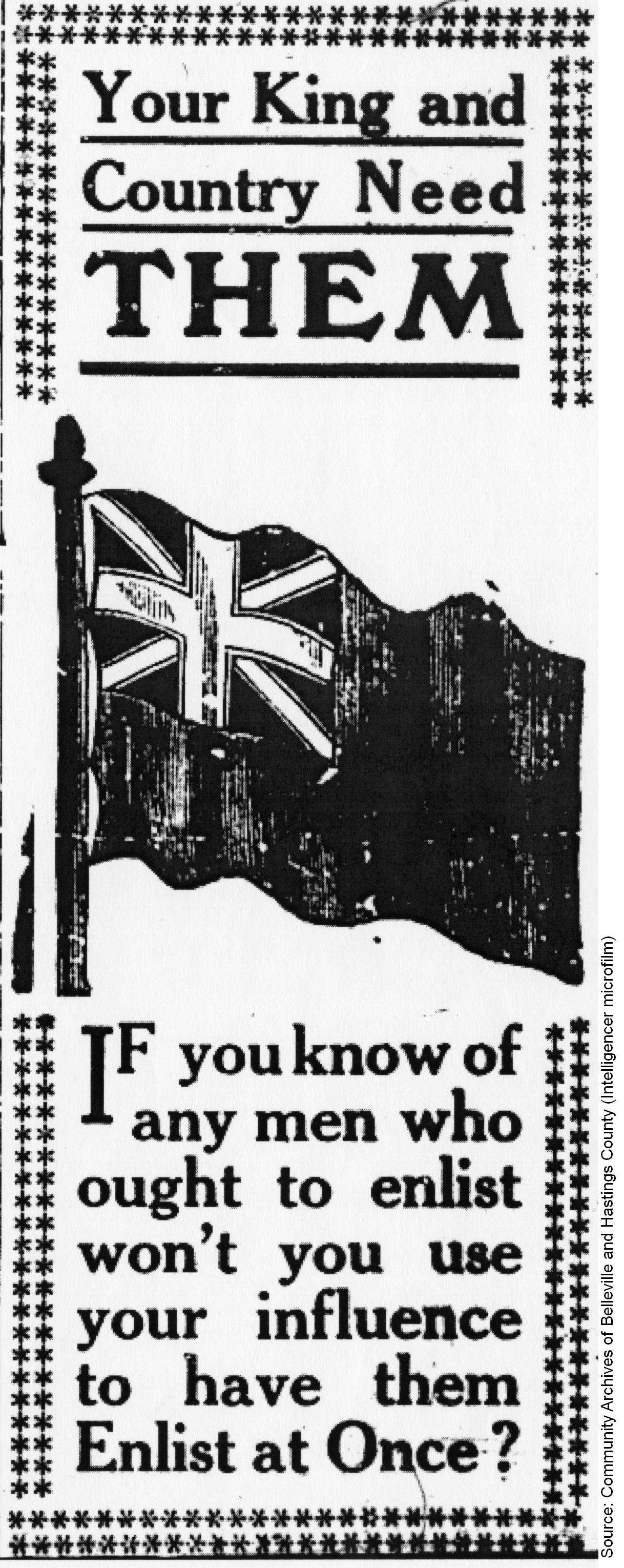
“Recruiting Rally on Sunday Night. The Opera House was last night the scene of an unusual gathering for Sunday. The Speaker’s Patriotic League introduced an innovation as far as Belleville is concerned and arranged for a recruiting meeting, and the novelty attracted a large crowd. The house was packed in every part and the meeting was an eminently successful one. …

The chair was taken by Col. Lazier. …  he said that when Mr. religion and Mr. civilization were at stake no day could be considered too sacred to prepare to fight the dragon of military despotism and brutality. …

He spoke of the work of the women of Canada, who he said had set a noble example. The only class in the community who had not sized up to their responsibility was the young men. It was to them that the country looked to. When he saw crowds of young men attending pool rooms or picture shows, or standing at street corners, he wondered how it was they had withstood the clarion call of duty. It was to reach their hearts and consciences that the Patriotic League was called. …

A strong appeal for recruits was made by Corp. Sandford. ‘Mothers you will have to make up your minds to let your sons go. I am going back in December. I have secured several recruits since I have been here and I want more. If a man gets there once he will never want to come back.’ ”

The Intelligencer November 1, 1915 (page 2)

“Home From Front. Private Rawlinson, of this city, who enlisted as a member of the 15th Regiment, and left here with the first contingent, arrived in the city yesterday, having been invalided home. At the battle of Langemarck, Private Rawlinson was injured and was for some time confined in a hospital owing to the injuries he received. The unfortunate man is also suffering from other ailments which are of a painful nature and necessitate his retirement from active service.

He has not only received his discharge but has been granted a certificate of a clean record and will receive a pension from the Old Country in recognition of the services he rendered for the Empire.”

The Intelligencer November 1, 1915 (page 3)

“Signaller C.M. Sprague. Trenches, Oct. 18, 1915. Dear Sir:—Some time ago I was handed an extract taken from your paper, and referring to a letter I had written from Flanders to Canada. At any time we are adverse to having our letters made public reading matter, and it is regrettable that at times we see, printed over our own names, statements which we have never written but rather are the results of some misguided faker. …

I think it would be well for all papers to make sure that any extract published from soldiers’ letters are genuine. I am Sir, yours respectfully, Chas. M. Sprague.

We would point out to our gallant correspondent that most of the soldiers’ letters appearing in The Intelligencer are sent to this office just as they come from the front—in the original envelopes. In a few cases parents send us copies of the letters, so there is very little opportunity for the ‘misguided faker.’—Ed.”

100 Years Ago: Ontario Children to Sing National Anthem

Intelligencer October 30, 1915 (page 3)

“Children to Sing National Anthem. Must be Included in the Opening Exercises of Every Ontario School. Commencing soon after the issuance of the regulation, every morning at nine o’clock, from every class room the strains of the ‘National Anthem’ will rise, sung by childish voices. This regulation is to be issued by the Department of Education within a few days, and will take effect at an early date. It provides that the singing of the first three verses of the ‘National Anthem’ shall hereafter be a portion of the morning exercises of every school in the province.

‘It is purely a matter of stimulating patriotic sentiment in the minds of the children,’ said Hon. G. Howard Ferguson, acting Minister of Education, by way of explanation. ‘There is not too much of that sort of thing in our schools, and we thought this might help.’ “

100 Years Ago: Khaki Club Formally Opened

The Intelligencer October 28, 1915 (page 3)

“Khaki Club Is Formally Opened. Comfortable Home in Belleville for Men of the 80th Battalion. Yesterday from four to ten the ‘Khaki Club,’ which has been formed for the non-commissioned officers and men of the 80th Battalion, by the Women’s Rifle Club, was auspiciously opened.

Many were in attendance and the whole affair was a pronounced success. There was a collection taken at the door, and the proceeds were exceedingly large. A splendid program was furnished, which consisted of solos …  and piano selections. All the selections were well sustained and were pleasing to those present. The ladies of the Club served refreshments in the canteen, which were much enjoyed by all present. …

That the men of the battalion will have a comfortable club is evident by the magnificent way in which the ladies have furnished and fitted up the building. The furnishings have been mostly donated and a few things have been bought by the ladies. This club is purely for non-commissioned officers and men, no commissioned officers or outsiders being allowed in. It consists of a dry canteen, lounge rooms, music rooms, sitting and recreation room with a piano, reading and smoking room, room for the officer of the day, and other rooms for various purposes. A bath-room is provided with hot and cold water. There is a kitchen, which will be in charge of a sergeant, where lunches and soft drinks will be served.

The Club will be administered by the battalion itself, which will look after the supplies. The profits that are derived from the various sources will go into the Regimental Fund. There is a library and any papers or books will be gladly received. Khaki clubs have been kept in connection with the battalions in Ottawa and Kingston and have been pronounced successes, and by all appearances this one will be a success too.”

100 Years: British Red Cross Appeal, Rainbow Club Boxes Packed, Theatre Recruiting Speeches

The Intelligencer October 27, 1915 (page 1)

“Belleville’s Appeal for British Red Cross. Some Mothers Offer Their Sons to the Empire. Some Wives Give Their Husbands—Some Children Their Fathers—Many Men Their Lives. YOU ARE ASKED FOR MONEY. When You Get Your Envelope Tomorrow Make a Generous Contribution and Have it Ready for SATURDAY.

You are asked, therefore, in humanity’s name, to give as liberally as you possibly can to the fund. We cannot all go to the firing line. But the least we can do is to help those who do—those who are fighting for us. Give on. The Empire expects every man, woman and child to give something. Give a day’s pay. Don’t let some stricken hero languish in his pain and illness for the sake of that dollar you can maybe well spare.”

The Intelligencer October 27, 1915 (page 1)

“Gifts for Belleville Boys. For some days past there has been considerable activity displayed at the quarters of the Belleville Women’s Patriotic and Red Cross Association rooms in the Robertson Block, west side of Front street. A number of the ladies who are active members of the Association have been busily engaged in filling boxes with necessaries and luxuries for the Belleville boys who are at the front.

Recently under the auspices of the circles of the Rainbow Club, a shower was held at the armouries here and the contributions of luxuries, etc., was most gratifying. These donations were collected and were placed in boxes to be forwarded to the boys. The boxes packed were numerous, some hundreds in number and contained the following articles:—Potted meats, jam, chocolates, smoking and chewing tobacco, chewing gum, cigarettes, oxo, confectionery, pipes, cards, fruit cake, mouth organs, pencils and writing material, hickory nuts.

These small boxes were labelled as follows: ‘Belleville Women’s Patriotic and Red Cross Association, Rainbow Club. They have been carefully packed for shipment in larger boxes. At the top of each box was placed a maple leaf tinged with the autumn frost, which were collected about the city and after being pressed, were waxed. This will no doubt be a memento from the city which our boys will appreciate very much.

The work of preparing the boxes has been an arduous one, but at the same time a labor of love. Mrs. (Col.) Lazier as President of the Red Cross Association, has been most active in the work and has been surrounded by a noble band of lady workers, who are intensely interested in looking after the comfort of the Belleville boys who are at the front.”

The Intelligencer October 27, 1915 (page 7)

“Recruiting. Short Addresses Last Night in the Belleville Theatres. Mr. E. Guss Porter, K.C., M.P., opened the campaign to stimulate recruiting by addressing the audience at Griffin’s theatre last evening in a ten minutes’ speech. The audience welcomed his appeal and punctuated his remarks with applause. Griffin’s Theatre was patronized by a good attendance to see their interesting movies.

The effort of Mr. Porter was seconded by Mr. J.F. Wills, K.C., at the Palace Theatre, where there was a large attendance to see the play ‘David Copperfield’. His remarks were listened to with attention and applauded.

The theatres have placed their houses with their usual courtesy freely at the disposal of the Patriotic Speakers League to do their ‘bit’ in assisting as good British citizens the efforts being put forth to bring the large number of young men available in our midst to enlist in the one cause which absorbs all our efforts—our great war.”