100 Years Ago: Nine Foreigners to Fort Henry

The Intelligencer March 3, 1915 (page 2)

“Nine Foreigners Go to Fort Henry. Last evening, under an escort of a sergeant and members of the 15th regiment, who have enlisted here as members of the third contingent, nine foreigners were taken to Kingston, it being alleged that they were endeavoring to leave this country for the United States. There were eleven arrested but a man and his wife, who were amongst the party were allowed to return to their home at Point Ann.

When the escort and party arrived at Kingston they were compelled to march about three miles to Fort Henry where the foreigners were placed in charge of the military authorities.”

100 Years Ago: Foreigners Interned in Belleville

The Intelligencer March 2, 1915 (page 2)

“Eleven Foreigners Are Interned in Belleville. Ten Men and One Woman Comprise the Party. …  Yesterday afternoon it came to the ears of the military authorities of this city, that a number of foreigners who had been employed at the Cement Works at Point Ann, were about to leave the city owing to the fact that the cement works were closed down and had been closed down for some weeks.

These foreigners comprised Hungarians, Austrians and others who were formerly residents of countries who are at war with Great Britain and other allies. …  Five were apprehended at the G.T.R. station and six at the C.N.O.R. station. They were taken in charge and escorted to the police station, where they were detained, nominally on the charge of leaving the country without the proper passports. …  Three of them at least were anxious to remain in Canada, and all of the men stated that they were by no means friendly to Germany in the present conflict.”

[Note: G.T.R. = Grand Trunk Railway;  C.N.O.R. = Canadian Northern Railway]

100 Years Ago: Socks and More Socks

The Intelligencer March 1, 1915 (page 7)

“Busy Red Cross Supply Committee. A visitor at the Red Cross Supply Committee Rooms on Saturday morning, found the ladies very busy indeed, stitching socks together in pairs, putting them up in bundles of half dozen each, and packing away in boxes, to be sent away in the course of a few days. The response has been splendid, but still the cry goes out for more socks.

Some seventeen knitting circles, of fifteen members each, have been formed. These are all knitting socks at the present time.”

100 Years Ago: Sanitation in War, Separation Allowances

The Intelligencer February 27, 1915 (page 1)

” ‘Sanitation in War’ at Canadian Club by Prominent Physician. There was a slim attendance at the Canadian Club supper last night, which was fortunately increased by a considerable number of members dropping in after the supper to hear the address, including a delegation of officers from the local recruiting regiments.

The president, Mr. J.L. Hess, presided with his usual grace and introduced the speaker of the evening, Dr. McCullough, in a short but happily worded address. Dr. McCullough …  outlined the medical examination of a great body of recruits for active service, and told of the thoroughness needed to ensure a sound army both physically and mentally. He opined that too little attention was paid by the medical examiners during the formation of the First Contingent. This resulted in large waste of time, money and energy, all of which has been happily remedied in the gathering of the second and third contingents for Canada’s overseas forces.

The speaker spoke of the care necessary to keep the enlisted soldiers in A1 health while on active service. He must have good substantial clothing, special attention being given to his socks and shoes. Cleanliness is a sine qua non for an efficient soldier. He should bathe his feet daily and powder his socks. …  Cerebro-spinal meningitis was explained and also the methods of its eradication and prevention. …

In concluding his address the speaker paid a tribute to the Canadian soldiers, to the medical and hospital corps at the front, to the societies like the Red Cross, St. John’s Ambulance, and many others, who at home and at the seat of war are laboring to make the lot of our soldiers endurable and victorious. …  A vote of thanks was heartily passed on motion of Mr. R.J. Graham and Col. Ponton. The meeting adjourned by the singing of ‘O Canada.’ ”

The Intelligencer February 27, 1915 (page 7)

“Separation allowance has been granted by the Canadian government to the dependents of volunteers serving in the Canadian Overseas Contingent as follows: Privates $20 a month; sergeants $25 a month; warrant officers $30 a month; lieutenants $30 a month; captains $40 a month; majors $50 a month; Lieut. Colonels $60 a month.

‘Dependents’ include only:—(a) wives. (b) Children of a widower, if they are in the care of a guardian. Girls over sixteen and boys over fourteen years of age not eligible. (c) Widowed mothers, if the son is unmarried and her sole support. A certificate to this effect must be obtained from the local Patriotic Fund Committee or from a clergyman.

The allowance is not payable to the dependents of a soldier who is an employee of the Dominion or any Provincial Government and in receipt of a Government salary in addition to his military pay, or who is a member of the Permanent Force.”
100 Years Ago: Leo Ross Prepares for France

The Intelligencer February 23, 1915 (page 3)

“A Letter From Leo Ross. Devizes, Jan. 29, 1915. Dear Mother.—Just a line to let you know that I have heard we are to go to the base in France next Monday. We have been dished out with our identification tickets, new shoes, knives and an extra suit of under clothes. We are painting our guns and transport wagons all colors of the rainbow, in order to hide them from observation by the enemy. We are also painting our steel a brown color, for the same reason, so you can see things begin to look like business, and about time too.

Our identification card is a circular and is supposed to hang about our neck. It is like this: Gunner Jas. Leo Ross, C. 40488, 2nd Artillery Battalion, 1st Brigade, C.F.A., Roman Catholic. And is of a brick red color. …  With love—Your son, Leo Ross.”

100 Years Ago: Pat Yeomans Extols Beautiful Belleville

The Intelligencer February 22, 1915 (page 3)

“Pat’s Letter. Devizes, Feb. 5th, 1915. Dear Mamma:—Well, we got our Christmas box at last, and talk about being glad! …  That wallet with the photos in, it was the best of all. Oh! I was glad when I saw those photos, they were all so fine. They are going to occupy one pocket by themselves and they will certainly be well taken care of. They are simply great. …  We have gotten much benefit and fun from the jumping-jacks and tin whistles you put in. You ought to hear Ted play ‘Tipperary’ on his. O yes!

And those views of Belleville that you sent are great. I have shown them all around and, believe me, I am some publicity agent. I had everybody in the stables interested in these views …  I was conducting a kind of illustrated lecture on ‘Beautiful Belleville’ and they were all gathered round me listening and watching most intently.”

100 Years Ago: Ads for Oxo and Perrin’s Tipperary Biscuits

The Intelligencer February 20, 1915 (page 11)Oxo Cubes 1

“OXO CUBES at the War. More letters showing how OXO CUBES are valued. …  Diary of a Rifleman of the Queen’s Westminsters with the British Expeditionary Force. For City men we have shaken down wonderfully, and our health generally is very good. The only change we can get from cold food is tea, OXO, etc. We cook in fires and pails, etc. …

The handiness of OXO CUBES is almost as great a recommendation as their food value. By simply adding an OXO CUBE to a cupful of hot water a delicious warming cupful of OXO can be made in a moment.”


Perrin's Biscuits 058The Intelligencer February 20, 1915 (page 12)

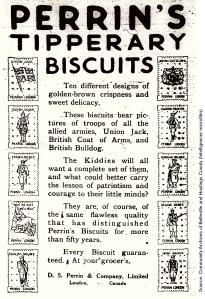
“Perrin’s Tipperary Biscuits. Ten different designs of golden-brown crispness and sweet delicacy. These biscuits bear pictures of troops of all the allied armies, Union Jack, British Coat of Arms, and British Bulldog. The Kiddies will all want a complete set of them, and what could better carry the lesson of patriotism and courage to their little minds?

They are, of course, of the same flawless quality that has distinguished Perrin’s Biscuits for more than fifty years. Every Biscuit guaranteed. At your grocer’s. D.S. Perrin & Company, Limited. London. Canada.

Union Jack, Scotch Soldier, French Soldier, What We Have We’ll Hold [British Bulldog], English Soldier, British Coat of Arms, Canadian Volunteer, Russian Soldier, Belgian Soldier, Irish Soldier.”

100 Years Ago: Letter from Dick Ponton to Father Colonel Ponton

The Intelligencer February 19, 1915 (page 1)

“A Manly Letter From a Sterling Soldier Son. Lieutenant Richard Douglas Ponton Sends Last Message from Salisbury Plain. ‘Many thanks for letters, enclosures and three fine bundles of papers. …  Mother’s socks are the very best ever. No sooner received than worn, the more the merrier. How short the life of even a good sock, and what will it be in France when far from supplies with trenches and marching and fighting day and night. …

The King and Lord Kitchener came to say good-bye to the Canadian Division and from the way the inspection went off we proved to their satisfaction that, all rumours to the contrary notwithstanding, the Contingent is fit and efficient. Lord Kitchener and the King expressed themselves as surprised and pleased at the splendid appearance and work of all units. …

You surely have your hands full with night meetings for the Red Cross and recruiting. Who meets you at the station now that I am gone, when you come back at 2, 3 and 4 a.m. as usually, I suppose?

We will have many minutes, hours and nights in France for reflection and memory, and no doubt the dear old home circles will be in our thoughts all the time. We are prepared for the worst should it come—and for the best. You know our duty will not be shirked at any rate even though our responsibilities be great and many. These we fully realize and these we face. Good night and good-bye. Love to all always, Dick.”

100 Years Ago: Letters from Captain O’Flynn, Militia Clothing Found, Plea for Field Comforts

The Intelligencer February 17, 1915 (page 1)

“Belleville Boys at Front Heard From. Letters were received from Captain O’Flynn this morning, dated February 2nd from Bustard Camp. The Captain says that all the Belleville boys are well and in splendid condition. …  The boys were looking forward to an inspection by the King, which has since taken place. …  The Canadians have made great improvement in the last month and reports show that the King was very much pleased with the inspection.

The Captain sent his best wishes to his Belleville friends, sending special messages to a number. The boys are now at the front, as shown by the cables and it is with hearts full of anxiety and with prayers for their welfare that their friends are waiting at home.”

The Intelligencer February 17, 1915 (page 2)

“Military Clothing Found. Yesterday a good sized valise was found in a yard in this city, and upon examination it was ascertained that it contained a complete khaki suit of clothing, such as worn by the militia. The owner of the valise or the clothing is a mystery. The outfit was taken to the police station, where it is being taken care of. It is possible that it is the property of a deserter, as it is known that an enlister recently deserted from Kingston.”

The Intelligencer February 17, 1915 (page 6)

“Appeal for Comforts. Sir George Perley Cables For Gifts of Extras for Canadians at Front. Ottawa. Feb. 17.—The first official announcement that the Canadian troops are in France was made yesterday morning, and carries with it an appeal which will doubtless evoke a prompt and ready response from all parts of Canada.

Sir George Perley cables urgently for a large stock of field comforts for the use of the Canadian contingent. …  The articles asked for at present are all kinds of heavy woollen articles, especially socks, while later it would be better to confine attention to socks and mitts, woven belts and colored handkerchiefs, well-knit socks being the most important. Gifts of money to purchase woven body belts, sweaters, tobacco and such comforts will also be most acceptable, especially if sent promptly.

The following cable was received by the Governor-General yesterday from London from Rt. Hon. Lewis Harcourt, the Colonial Secretary: ‘Your Ministers will be glad to learn that the whole of the Canadian contingent are doing well at the front, having safely crossed over to France.’ “

100 Years Ago: Letter from Nursing Sister Ida Denmark

The Intelligencer February 16, 1915 (page 2)

“Busy in the Wards. Extracts from a letter received from Miss Denmark at Le Touquet, France: ‘We have been fairly busy lately in the wards, but not so much in the operating rooms. The last case there was a German, an Iron Cross man. You would be pleased to see how kind and generous the English Tommies are to them. We had a visit to-day from some Red Cross people from Boulogne, who gave a very nice concert to the patients. Needless to say the nurses enjoyed it also. Am feeling well. Remember me to all.”