100 Years Ago: Flight-Lieut. Frederick Dies in Aeroplane Accident, Civic Holiday Attractions, Celebration of Victory

The Intelligencer August 6, 1918 (page 2)

“Death of Belleville Aviator In Scotland. Mr. and Mrs. B. O. Frederick, 76 Victoria Avenue, have received the following letters referring to the death of their son, Flight-Lieut. L. M. Frederick, who was killed in an aeroplane accident at Montrose, Scotland, on July 8, while on active service:

St. Mary’s Rectory, Montrose, Scotland, July 15. Dear Mrs. Frederick:—I am writing to you as Chaplain to the R. A. F. at Montrose, to offer to you and your husband my sincere sympathy on the death of your son. I did not know him personally; it is extremely difficult to make acquaintance of individuals in a big station like this where there is so much coming and going.

He was manoeuvring his machine—one of our Scottish customs. The volleys were fired and the Last Post sounded. The burial service of the Prayer book was used. I feel very much for you so far from here, and if I can be of any service to you will you please just let me know.

Again assuring you of my sincere sympathy, I remain Yours faithfully, H. M. Rankin, Chaplain.

6 Training Squadron, R. A. F., Montrose, Scotland, July 7, 1918. Dear Mr. Frederick:—I very much regret having to write this letter to you telling you of your son’s death in an aeroplane accident yesterday afternoon. He went up into the air in a single seated scout to have a sham fight with another pilot. I was watching the fight, and the feats your son performed showed that he was a daring and efficient pilot. During the fight the two machines collided and fell to the ground.

While your son was training here he had always shown himself to be a keen and enthusiastic worker and his loss in the R.A.F. is very great, but nothing of course compared with your own. He had the pluck and stamina which has made our pilots so predominant over the Germans.

I can only add my deepest sympathy and that of his instructor and brother officers in your great loss. If I can furnish you with more details concerning your son’s stay here, I shall be very pleased to do so. Yours sincerely, Arthur C. Jones-William, Capt.”

The Intelligencer August 6, 1918 (page 7)

“Civic Holiday Attractions. Tomorrow is Belleville’s Civic Holiday, and the attractions include a big public picnic at Victoria Park, proceeds in aid of the Orphanage at Picton; baseball match between Trenton and Belleville; aviation camp sports at Deseronto.”

The Intelligencer August 6, 1918 (page 7)

“Celebrating the Victory. The ringing of the bell of the Bridge Street Methodist Church yesterday afternoon woke up some people to the fact that there is a world war on and that a great and momentous victory has just been won by the allied armies. May the joyful notes of the bell be a happy augury of other and greater victories bringing early and permanent peace.”
100 Years Ago: Show Confidence in Victory by Civic Demonstration, Letter from Frank W. Bateman, Lieut. Bill Ketcheson Returns Overseas, Social Held at Myrehall

The Intelligencer August 5, 1918 (page 1)

“Time to Start Something! Give Us a Chance to Cheer! General Foch has given us a great victory—the greatest of the war. …  Under the incessant hammering of the Allied forces the Crown Prince’s army has been practically cut to pieces—many thousands have been killed and wounded, many thousands have been captured.

This victory will in all probability mark the turning point of the war—it has shaken the confidence of the Central Powers, impaired seriously the morale of the enemy soldiers; and adding this disastrous defeat of their ‘invincible’ armies to starvation at home, the military strength of Germany has received what may well be its death blow, although there will likely be hard fighting yet. …

WHY, then, in the face of the great events transpiring on the battle front and the certain prospects of future victories, should we not show our unshakable confidence in complete and decisive allied victory by a civic demonstration? Many people do not follow the progress of the war closely enough to know really how it is going.

WAKE ‘EM UP! Put the gin back into ginger and let us have a big procession with the band playing Rule Britannia, The Maple Leaf, O Canada, God Save the King, Tipperary, The Long, Long Trail, The Marseilles and all the songs of victory and glorious British confidence they know. Strike up the band, and give us all a chance to cheer.

WHY repress our feelings because some faint hearts see a possibility of a set-back, somewhere along the line, sometime? We know that we are going to win gloriously and decisively in the end—we know that we are winning now. Let’s honor the brave soldiers and sailors and airmen of the Allies who have effectually barred the progress of the Hun war machine.

RING THE BELLS and let the bands play and give everybody so inclined a chance to cheer for the genius of a Foch and for the British courage and unconquerable determination which has been the inspiration and backbone of the allied resistance, resulting in the muzzling of the Beast of Berlin, who hoped to enslave and debase the world. …

WHAT ABOUT IT, MAYOR PLATT?”

The Intelligencer August 5, 1918 (page 2)

“Frank W. Bateman on the Overseas Y. M. C. A. The following letter was received by Mr. H. Bateman, 61 Station street of this city from her son Frank W. Bateman, who was wounded some time ago and is now with his battery again. France, July 3rd, 1918. Dear Mother and Father,—Just a few lines in answer to your five welcome letters which I received yesterday, dated April 17th, May 15th, May 20th, May 28th and June 6th, so I had enough reading to keep me busy for some time.

You wanted to know whether I was wounded with a sniper or not. No I was not. I was wounded with some splinters from a large high explosive shell which dropped about 4 feet from me. …  The hospital I was in was an English military hospital. The nurses were very nice and I had a jolly time when I was there.

You asked about how the Y.M.C.A. uses us out here. If it wasn’t for them we would go hungry and thirsty many a time up the line. There is always hot tea, coffee or cocoa to drink or lemonade in the summer time. Sometimes they give biscuits and there is always writing paper and envelopes. They sell cigarettes and chocolate cheaper than you can get them at home and also all kinds of canned goods, and as for selling socks that should be given away, well, the fellow who said that at home, he could never have been up the line or he wouldn’t say such a thing. Those kind of fellows are only trouble-makers and another thing I have never seen socks in the Y. M. C. A. for sale.

I was down to some sports yesterday and saw (Curley) Sharpe, Reg. Hinchey, Ernie Blaind and also (Bill) Wannacott and I was talking to a fellow out of Harry’s battery. …  Well I will close for now, hoping this finds everyone in the best of health. Your loving son, Frank.”

The Intelligencer August 5, 1918 (page 7)

“Returning Overseas. Lieut. W. H. F. (Bill) Ketcheson, son of ex-Mayor Ketcheson, leaves to-day on his return to active duty overseas. Lieut. Ketcheson was severely wounded at the battle of Passchendaele, being buried by a shell explosion.”

The Intelligencer August 5, 1918 (page 7)

“Social at Myrehall. The Myrehall Red Cross held a very successful social at the home of Mr. Wm. Goodfellow, 8th Con. Of Tyendinaga, on the evening of July 24th and on account of the fine weather a large crowd assembled. The Rev. Mr. White of Plainfield acted as chairman, in his usual pleasing style. Mr. McIntosh and Mr. Johnstone of Belleville, gave some bag pipe selections that were much appreciated, while Mr. Elliott’s eloquent speech received the profound attention of all present.

Mr. J. Gow and Miss Ida Pitman of Latta, gave some excellent music, and one of the features of the programme was a flag drill by eight girls in costume. The ladies of the Red Cross furnished an excellent lunch. The luck ticket for the autograph quilt was won by Mr. D. Wellman of Latta. Proceeds of social exceeded $200.”

Nurses of World War I: Vera Harrison Prindle

Vera Harrison Prindle was born at the farm house near Tweed on February 16, 1891 daughter of Silas Prindle and Deborah Harrison. The father of our subject was of United Empire Loyalist stock and served as clerk for the Township of Hungerford for over two decades.

She was educated locally and was a graduate of the Nursing School at Belleville in 1916. Miss Prindle enlisted in the Canadian Army Medical Corps on May 5, 1917 at Kingston.

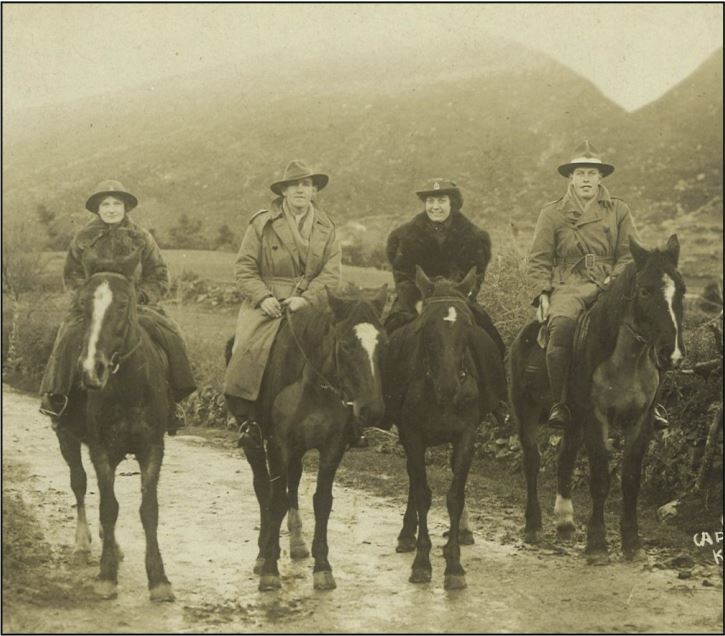
Vera Harrison Prindle (left) on leave in Ireland (photo courtesy of Belleville General Hospital Archives)

Height:  5’ 4”

Weight: 113lb

Age: 26

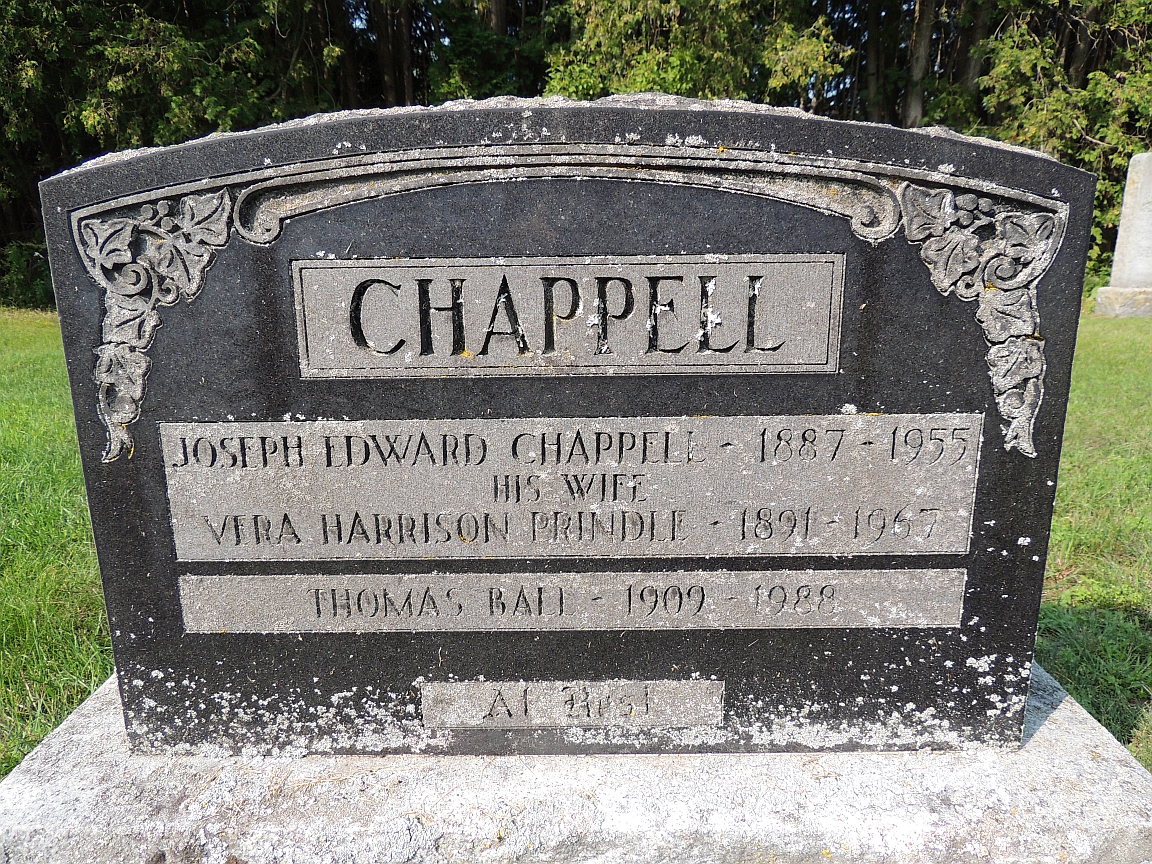
Nursing Sister Prindle served in the military hospitals in Taplow, Buxton, Westenhanger, Orpington and Granville, England; Vera was hospitalized in January 1919 with influenza. She returned to Canada setting sail on September 6, 1919 aboard the S.S. Orduna and was discharged on September 15, 1919. Miss Prindle was united in marriage on December 17, 1919 to Veteran Joseph Edward Chappell. Mrs. Chappell was engaged in private duty nursing at Thomasburg where she lived most of her life; she passed at Hastings Manor in Belleville.

Vera Harrison Chappell died on February 24, 1967 aged 76 years 8 days. She is interred at the Thomasburg Cemetery West Section Row 3 Grave 303.

Grave marker for Vera and her husband.

100 Years Ago: Great War Veterans Association Replace “God Save the King” with “O Canada,” Ad for Gillette Razors, Ad for Purity Oats

The Intelligencer August 3, 1918 (page 1)

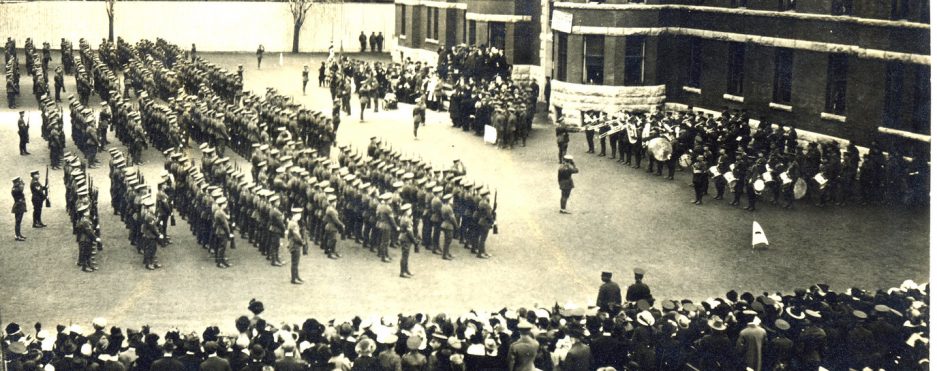
“O Canada Replaces God Save the King. Toronto. The Great War Veterans’ Association of Canada has decided to replace the British National Anthem ‘God Save the King,’ with ‘O Canada’ at the close of branch meetings.

 It was moved by an English clergyman, the Rev. J. C. Davidson now an adopted son of Canada, and carried at the convention.

Except for some doubt expressed also branches without a piano being able to navigate through the subtle modulations of ‘Canada’ no opposition was raised the mover emphasizing that it was for Canada the G. W. V. A. were anxious about.

‘It seems to me a very serious omission not to sing “Canada” at our branch meetings’ he said. ‘We are Britain’s and British subjects but we are all Canadians, and are here to further the interest of our own country. In this period of reconstruction it is expedient that Canada be first and foremost, and our national anthem brings our country more before us.’ ”

The Intelligencer August 3, 1918 (page 6)

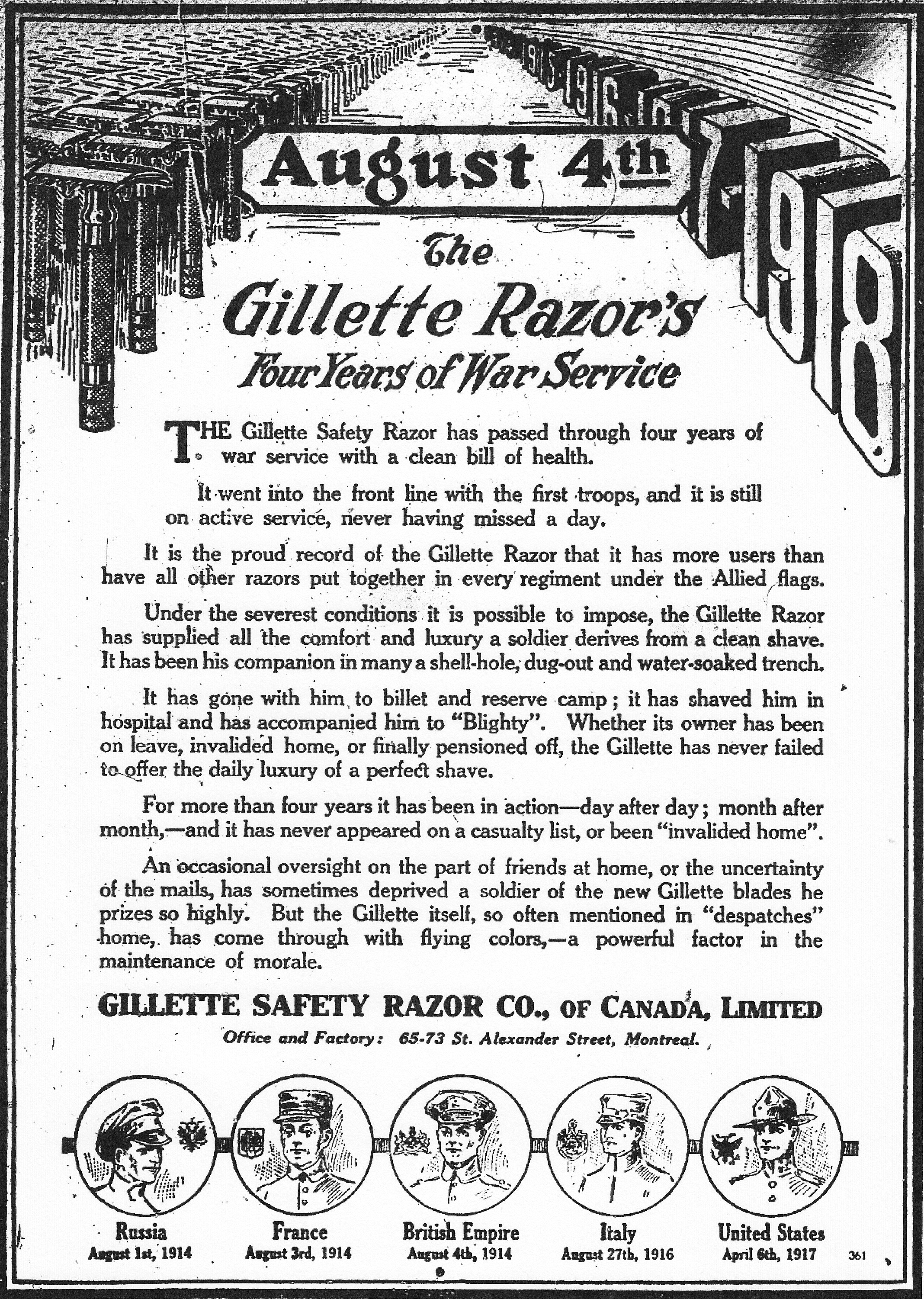
Ad for Gillette razors

“August 4th. The Gillette Razor’s Four Years of War Service. The Gillette Safety Razor has passed through four years of war service with a clean bill of health.

It is the proud record of the Gillette Razor that it has more users than have all other razors put together in every regiment under the Allied flags.

It has gone with him to billet and reserve camp; it has shaved him in hospital and has accompanied him to ‘Blighty’. Whether its owner has been on leave, invalided home, or finally pensioned off, the Gillette has never failed to offer the daily luxury of a perfect shave..

Gillette Safety Razor Co., of Canada, Limited.”

The Intelligencer August 3, 1918 (page 6)

Ad for Purity Oats

“The Allied Armies depend on us for wheat. Our free wheat-saving recipes show you how to save your share of wheat flour.

Purity Oats is the world’s best substitute for wheat flour. Use it in all your baking.

Western Canada Flour Mills Co.”

100 Years Ago: Ernie Phillips Appointed Customs Collector in Belleville

The Intelligencer August 2, 1918 (page 5)

“New Customs Official. Bombardier Ernie L. Phillips, a well known Bellevillian and returned soldier, has been appointed collector of customs in Belleville, in place of the late Mr. William Williamson. The appointment is not only a popular one but is deserving. Bomb. Phillips was a member of the 34th Battery of this city when the war broke out, and went overseas with the 2nd Battalion, 1st Brigade, C.F.A., and was on active service for some time.

He was severely wounded and his wounds were of such a nature that his life was despaired of. He was invalided home, after being in a hospital for months. Previous to his present position Bomb. Phillips was for some time a clerk in the local Post Office. He entered upon his new duties yesterday.”

100 Years Ago: Disease in Germany Not Spanish Flu, Letter of Sympathy for Mother of Teddy Townsend, Sir Robert Borden Proud of Canadians

The Intelligencer August 1, 1918 (page 1)

“Disease Sweeps Over Germany. Paris. The state of health in Germany appears to have become a source of worry to the Imperial Government. The Neue Zurcher Zeitung announced recently that the German censor had forbidden the publication of any news of the progress of the epidemic which at first was mistaken for Spanish influenza, but which the Swiss press, because of the ravaging effects upon the Berlin population declares to be much more serious.

The public hospitals in Berlin already are overtaxed in caring for the legions of wounded soldiers arriving from the western front, but they have had to make room for thousands who fell in the streets from disease.

Scores of deaths are reported each day in the army and the army doctors also declare the condition of the troops, particularly those in the interior, to be alarming. The number of deaths among them is far from being insignificant.”

The Intelligencer August 1, 1918 (page 1)

“Minister of Militia Expresses Sympathy. Mrs. S. M. Townsend, Belleville, received the following sad information from the Minister of Militia and Defence for Canada: Ministers Office, Ottawa, July 29. Dear Mrs. Townsend:—I desire to express to you my very sincere sympathy in the recent decease of your husband, No. 536034, Private Edward James Townsend C.E.F., who in sacrificing his life at the front in action with the enemy, has rendered the highest services of a worthy citizen.

The heavy loss which you and the nation have sustained would indeed be depressing were it not redeemed by the knowledge that the brave comrade for whom we mourn performed his duties fearlessly and well as became a good soldier, and gave his life for the great cause of human liberty and the defence of the Empire.

Again extending to you in your bereavement by condolence and heartfelt sympathy, I am Yours faithfully S. C. Mewburn, Minister of Militia and Defence for Canada.

Pte. Townsend went overseas with the Queen’s Ambulance Corps two years ago and has a brother in the Army Medical Corps. He is survived by his wife and four children.”

[Note: Private Edward James Townsend died on July 20, 1918. He is commemorated on Page 514 of the First World War Book of Remembrance.]

The Intelligencer August 1, 1918 (page 5)

“Proud of Canadians. Rt. Hon. Sir Gilbert Parker in writing to Col. Ponton of this city, refers to a recent address delivered at the Mansion House, London, Eng., by Sir Robert Borden, Premier of Canada, and states that all who heard the masterly address were delighted with it. Sir Robert Borden stated that Canadians had covered themselves with glory in a double capacity, namely upon the battlefield and the field of public life.”


100 Years Ago: Ontario to Observe Anniversary of War, Ad for Hydro Irons, Teddy Townsend Killed in Action

The Intelligencer July 31, 1918 (page 1)

“Ontario to Observe Anniversary of War. Sunday, August 4, the fourth anniversary of the declaration of war has been set aside by proclamation of the Lieutenant-Governor, at the request of the Dominion Government, as a day to be observed in commemoration of the entrance of the British Empire into the war for liberty and civilization.

The proclamation urges the solemn observation of the day by the calling of public meetings throughout the province at which the following resolution is to be submitted and adopted:

‘That on this the fourth anniversary of the declaration of a righteous war, this meeting of the citizens of ————— records its inflexible determination to continue to a victorious end the struggle in maintenance of those ideals of liberty and justice which are the common and sacred cause of the allies.’ ”

The Intelligencer July 31, 1918 (page 6)

Hydro Irons

“Save Coal and Wood in Ironing. Conservation is the war-time warning. Coal is scarce, and cars for shipping it are needed for other purposes. The lack of coal will make wood scarce and dearer.

Make Tuesday a Coal-Less Day. Iron with Hydro. Save coal, save yourself, do better ironing.

Hydro irons are made to the specifications of our engineers. Strong in every part, of proper weight, give greatest heat at the point and have a cool, hand-resting handle. Price $4.50. Guaranteed 5 years.

Hydro-Electric Power Commission of Ontario. For Sale by The Hydro Shop.”

The Intelligencer July 31, 1918 (page 7)

“Teddy Townsend Killed. Ed. J. Townsend, familiarly known as Teddy Townsend, who enlisted with the 12th Battalion, Canadian Engineers, is reported killed in action. His mother who resides on Donald street, will have the sympathy of all.”

[Note: Private Edward James Townsend died on July 20, 1918. He is commemorated on Page 514 of the First World War Book of Remembrance.]

100 Years Ago: Food Board Recommends Jam, Lieut. John Gordon Murray a Prisoner of War

The Intelligencer July 29, 1918 (page 1)

“Food Board Flashes For Feminine Folk. The latest reports from the British Ministry of Food indicate that there will be a serious shortage of jam in Britain this year. Here is a chance for Canadian women to help by using all the fruit they can and by making preserves of wild berries whenever they are able to secure them. The more jam used the more butter and canned goods will be saved for export.

Jam is on the soldier’s ration list and he must not be deprived of this what ever happens. Besides providing a sweet the sugar is extremely essential in his fare and adds to his energy and all-round efficiency.

Ordinarily too much sugar is used in the making of jam. A pound of sugar to a pound of fruit is the old-fashioned theory and it is a wrong one. Three-quarters of a pound of sugar to a pound of fruit makes better jam, while half a pound is sufficient where the fruit is extra sweet.”

The Intelligencer July 29, 1918 (page 5)

“A Prisoner of War. Some time ago a message was received in this city that Lieut. J. G. Murray, son of Mr. J. W. Murray, manager of the Dominion Bank in this city, was missing. In to-day’s casualty list his name appears among the prisoners of war.”

100 Years Ago: Women Like Railway Work, Ad for Purity Oats

The Intelligencer July 27, 1918 (page 3)

“Women Enthusiastic About Railway Work. Toronto. ‘I tell you as how we have a decent few around here, but we need them all if we are to send enough boys over to keep the old flag flying,’ declared a bright little Englishwoman as she stepped aboard Sir George Bury’s private car which arrived at the Union Station this morning.

When seen by The Star the speaker was attired in a trim uniform of khaki and carried her cleaning paraphernalia with her. She commenced to polish up the brass work with a will, while a veritable bevy of khaki clad women followed in her trail carrying mops, dusters, brushes and pails with which to clean the car. …  Several long trains had been thoroughly cleaned since the morning hour and were standing in readiness for their next trip. …

‘You see we clean up these cars every day. …  When we came to Canada we applied for these jobs but the men only laughed so we went into munitions work. It wasn’t long before they needed our assistance however, and now they have 52 women on the cleaning jobs.’ …

‘I believe they have about 15 girls in the engine repair department, too. The Grand Trunk haven’t been as aggressive as our company along this line, as they have only 21 girls in their employ and they are in the locomotive section.”

The Intelligencer July 27, 1918 (page 6)

Ad for Purity Oats

“Save Food for our Allies. Canadian Food Control. License Nos. Flour 15, 16, 17, 18. Cereal 2-009.

Bake Your Bread Cake and Pastry from Purity Oats. Wheat-Saving Recipes Mailed Free.

Western Canada Flour Mills, Co. Limited, Head Office, Toronto.”


100 Years Ago: Food Budget for Family of Five, Hastings County Crop Report, Soldiers’ Aid Commission Branch in Stirling

The Intelligencer July 26, 1918 (page 6)

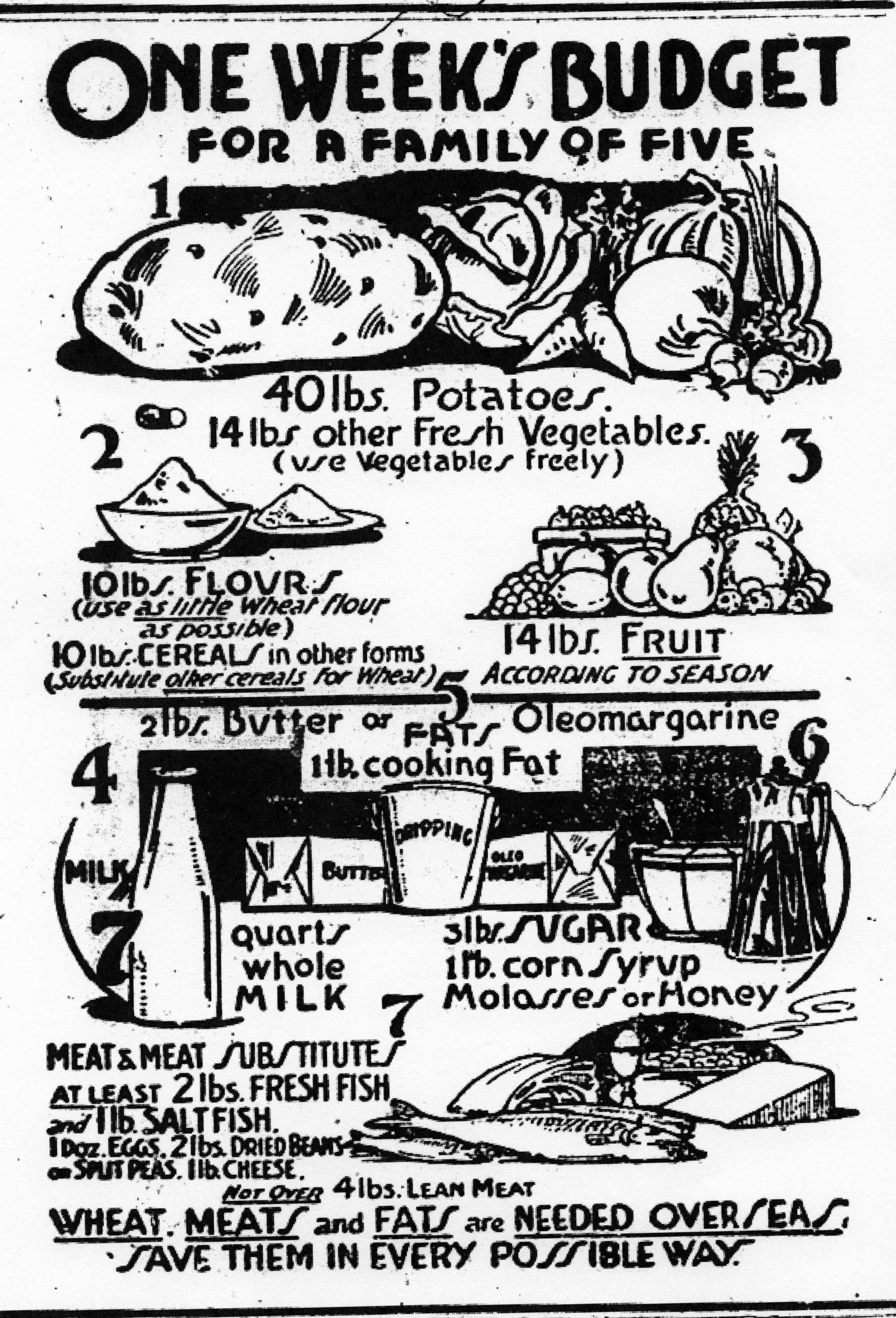
Food budget for family of five

“One Week’s Budget for a family of five. 1. 40 lbs. Potatoes. 2. 10 lbs. Flours. 3. 14 lbs. Fruit. 4. 7 quarts whole milk. 5. 2 lbs. Butter or fats. 6. 3 lbs. Sugar. 7. Meat & meat substitutes.”

The Intelligencer July 26, 1918 (page 7)

“Hastings County Raising Clover. Hastings County has swung into the sweet clover column, says District Representative McIntosh of Stirling. This movement into Hastings began three or four years ago, and there are hundreds of acres in this crop there now. This has proved satisfactory both as a hay and pasture crop and as a soil builder. Hay crops are fair, but there will not be as many hay stacks in Hastings this year as there were last. Grain crops are looking splendid, and even corn is in a fair condition. Buckwheat shows a considerable increase in acreage. Spring wheat has also been more largely sown than usual. The fruit crop will be a very light one in the county, hundreds of apple and pear trees having been killed last winter.”

The Intelligencer July 26, 1918 (page 7)

“Branch Formed in Stirling. A branch of the Soldiers’ Aid Commission of Ontario, has been formed in the Village of Stirling. The chief object of the Association is to take care of and find employment for members of Canadian Expeditionary who have returned to our Municipality.

The officers selected were L. Meiklejohn, chairman; Geo. H. Luery, vice chairman; J. S. Morton, secretary treasurer; finance committee: Dr. Bissonette, J. S. Morton, R. P. Coulter, R. A. Elliott; employment committee: the chairman, vice chairman, Dr. Bissonnette, G. E. Kennedy, E. T. Williams.”