100 Years Ago: 254th Battalion Recruits, Alexander Leonard Williams Killed in Action

The Intelligencer December 8, 1916 (page 1)

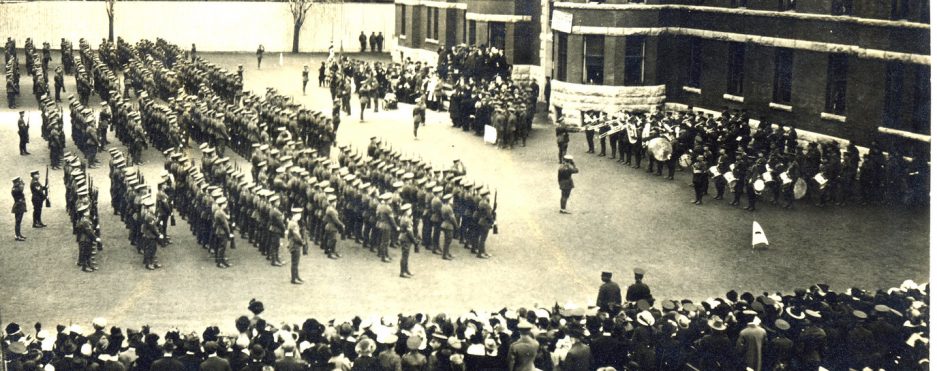
“The 254th Battalion held a very successful recruiting meeting in the Opera House at Deseronto last night. Mr. T. Naylor of that town acted as chairman for the evening. Associated with him on the platform were: Lt.-Col. Allen, Capt. Sandford, Capt. Hyman, and Lieut. Coulter of the 254th Battalion, and the members of the County Council who are in session in this city.”

The Intelligencer December 8, 1916 (page 8)

“Shannonville Soldier Dead. The following communication received by Mrs. Williams of Shannonville, in reference to her son’s death at the front explains itself.

50th Battalion. Mrs. Barbara Williams, Shannonville, Ont. Dear Madam: It is with sincere regret that I write to inform you of the death of your son, Pte. A. L. Williams who was attached to the platoon under my command and who was killed in action on November 15th, 1916.

Pte. Williams was one of a party of five who were working in the support line trenches at the time, when he was hit by a bursting shell which also severely wounded three of the other members of the party. His own comrades buried him there on the spot, having cheerfully volunteered to undertake the task, although they were subjected to heavy shell fire.

I can assure you that the loss of your son will be keenly felt by every man in the Platoon. He was always very popular, very generous, and exceptionally cool under fire. Personally, I always admired and respected him.

In conclusion, allow me to express my sincere regret. I know it will be a great loss to you, but you have the great satisfaction of knowing that your son gave his life for a great cause, and for the country and race which we all love so dearly. Very sincerely yours, P. G. Leadley, Lieut. ‘D.’ Co’y 50th Batt. France.”

[Note: Private Alexander Leonard Williams died on November 16, 1916. He is commemorated on Page 182 of the First World War Book of Remembrance.]

100 Years Ago: Mass Recruiting Meeting for 235th, Death of Private James Meloy, Praise for Motion Picture of Somme Battle

The Intelligencer December 7, 1916 (page 1)

“Big Mass Meeting at Griffins Opera House. Many Speakers From Among the Weighty Liberal Politicians. A large audience filled Griffin’s Opera House last evening at the Recruiting meeting held under the auspices of the Hastings Liberal Club. …  Mr. D.V. Sinclair of this city, occupied the chair for the evening.

The proceedings opened with a selection by the 235th Battalion band, at the close of which Mr. Nelson Parliament, M.P.P. of Prince Edward County, was called upon. Mr. Parliament stated that it gave him great pleasure to make a recruiting speech a call to the young men and women in Canada to do their duty. What is our duty? the speaker questioned: Our duty to our country is one question that must be settled by our own conscience. I feel proud of the young men of Hastings and Prince Edward counties; proud of the bravery of these boys who have gone to the firing line. We are fighting to day for the great principle that man has ever had cause to fight for. …  Great applause greeted Mr. Parliament at the close of his speech.

The orchestra of the 235th Battalion was here called upon to render a selection which was well received by the audience. …

The next speaker was Lt.-Col. Scobell of the 235th Battalion, who received a great reception from the audience on rising to speak. Col. Scobell stated he was much pleased to see so many ladies present. The ladies can help recruiting a great deal. There is also something wrong, he stated, with the young men of Canada. Every year 100,000 men in Canada come of age to enlist and yet we have to go around the country to beg young men to enlist. …  These are dark days for us, it is a time for plain speaking, or we shall lose this war. It is a false idea that we have won, we have not won, we have got to have the men in order to win. In concluding, the speaker declared he hoped that the members of Parliament would enforce a law of conscription. It is the only way for the distribution of the men of Canada. …

Mr. Bowman, M.P.P., the last speaker on the programme, in his remarks stated that even if this war lasts for one or more years longer the Germans cannot win. Germany lost her opportunity to win in the first six months of war, but before this struggle is over, it will be necessary to mobilize the women and men in Canada, and the agriculture resources in order that we may win.

Concluding the speaker stated that he sincerely hoped that one and all would leave this meeting more deeply impressed with the seriousness of the situation that confronts us, so that we will have an opportunity to combat it.

At the conclusion of Mr. Bowman’s speech, Mr. Sinclair gave the audience his appreciation of their attendance, after which the singing of ‘God Save The King,’ brought the meeting to a close.”

The Intelligencer December 7, 1916 (page 3)

“Pte. J.H. Meloy, who was reported in Wednesday’s Intelligencer as killed in action, on the sixteenth of September, enlisted at Belleville with the 49th and was transferred to Brockville with the 59th going overseas last March. He had been through several large battles, but the battle of September sixteenth was his last, when he paid the great price.

The blow is hard for those who mourn his loss. He leaves a sister in Belleville, Mrs. Adamson, 161 Church street; his mother, sisters and brothers are in England. He had resided in Belleville for six years and was a member of Oxford Lodge, Sons of England. He was respected by all who knew him. He had done his duty, and did it like a man. No one misses him more than his widow and children.”

The Intelligencer December 7, 1916 (page 3)

“Expert Operator Praises Pictures. Brings War Home. Terrible Carnage Is Watched With Almost Awesome Reverence. No person is a keener judge or more inclined to delve to the depths of a subject to find criticisms than a motion picture operator. So that when Percy Billinghurst, whose ten years’ experience in that occupation which gives him additional ground for an unprejudiced opinion, declares that the official motion film of ‘The Battle of the Somme’ is the most remarkable bit of photoplay ever produced, his word can be accepted unhesitatingly. …

Billinghurst spoke enthusiastically of the ‘Somme’ pictures, and said that they presented the biggest thing ever done by photography and that no adult should miss them. He said when you look on the screen you turn sick with horror as the scenes of real warfare are flashed. …  The film fascinates everyone who sees it. It brings the war before your eyes, the war as a monstrous instrument for killing human beings, devastating country-sides and leaving ruin, death and sorrow behind.

Until you have seen the film, it is declared, you cannot appreciate all the sublimity and degradation of what you read in the newspapers. Those of us who remain at home are in need of just what the ‘Somme’ pictures bring home—an understanding of the sheer horror of war.”

100 Years Ago: James Meloy Killed in Action, Film “The Battle of the Somme” to Be Shown

The Intelligencer December 6, 1916 (page 2)

“Another Bellevillian Makes Supreme Sacrifice. In the casualty list to-day appears the name of Private James H. Meloy, of Belleville, who is officially reported killed. Meloy enlisted with the 59th Battalion at Brockville, and it is reported that he was killed in September, the first day he went into action.

The hero was a married man residing at No. 18 Jones Street, in this city. A widow and two small children survive. The Private was an Englishman, who had not resided in Belleville for a lengthy period. All citizens will sympathize with Mrs. Meloy in her hour of sore bereavement.”

[Note: Private James Henry Meloy died on September 16, 1916. He is commemorated on Page 134 of the First World War Book of Remembrance.]

The Intelligencer December 6, 1916 (page 4)

“Ready to Begin Somme Pictures. Interest Is Growing. Practically all arrangements preparatory to the exhibition of ‘The Battle of the Somme’ official motion pictures at the Regent Theatre for one week, opening Monday and Tuesday, Dec. 18 and 19, under the auspices of The Daily Intelligencer have been completed.

Exceeding in its scope the anticipations of the most sanguine of its promoters, the interest being manifested in the Somme pictures has not only become city-wide, but continues to grow, daily.

There is hardly a doubt now but that the pictures will stir Belleville as they stirred London, England, where they were first presented. Many people here are talking about them. Many are discussing them. Many are debating the question of whether they are too painful for exhibition. Enquiries are daily received regarding the pictures, and their presentation. Information can be obtained from the Opera House box office.

It is very evident that the Somme films bring the war closer to us than it was ever brought by the written word or by the photograph. The magic of the motion picture camera has done what nothing else could do. It has in one stride outplaced the newspaper and the war correspondent. It does not describe; it reveals. It does not reveal all, but what it does reveal is real reality.

To be shown at Griffin’s Opera House, Monday and Tuesday, December 18 and 19. Matinee and evening. Three performances nightly, 7.15, 8.15 and 9.15.”

100 Years Ago: Palace Theatre Receipts to Red Cross, Bantam Recruits

The Intelligencer December 5, 1916 (page 6)

palace-theatre159

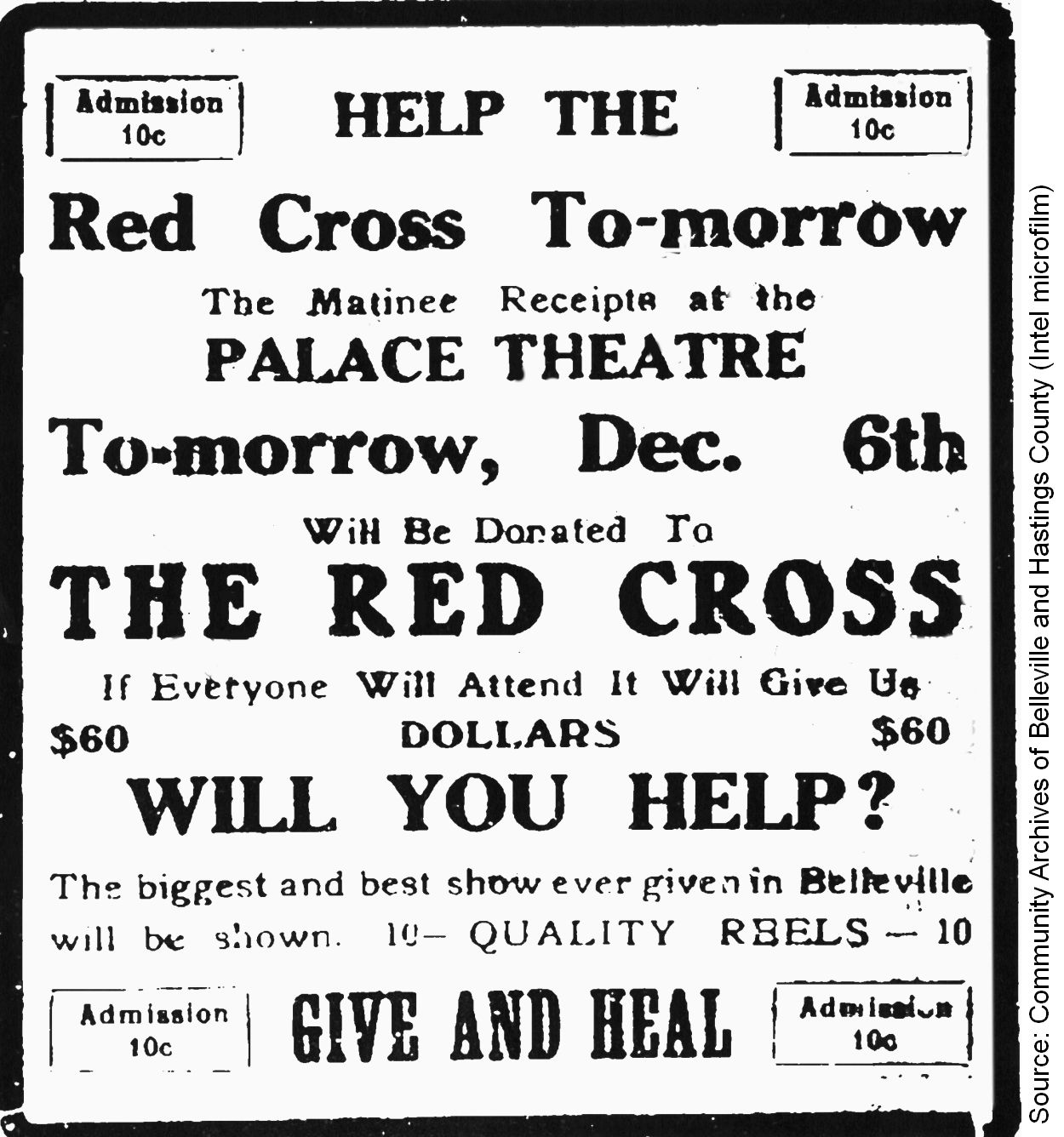
“Help the Red Cross To-morrow. The Matinee Receipts at the Palace Theatre To-morrow, Dec. 6th Will Be Donated To The Red Cross. If Everyone Will Attend It will Give Us $60 Dollars. Will You Help? The biggest and best show ever given in Belleville will be shown. 10—Quality Reels—10. Admission 10c. Give and Heal.”

The Intelligencer December 5, 1916 (page 7)

“Bantam Recruits. The 216th Bantam Battalion, which has been recruiting so rapidly, is certainly long on short men. It has 960 of them.

Men below the average height are quite capable of performing the duties of military life in modern war. The Japanese, a race of short men are recognized as unsurpassed fighters. It is familiar tradition that a great many of the famous generals including Napoleon and Lord Roberts were small men. …

The military view, it is understood, is that tall men are apt to be more rugged than the others, better able to stand hardships and privations. Against this there is the superior agility of the short soldiers. The performances of the Japanese armies seem to remove all objections as to lack of height for active service.

Bantam battalions should become popular in Canada and it might be worth while to increase opportunities of enlistment under desirable conditions for those of short stature. The fast recruiting of the 216th Battalion is a reminder that there are a large number of short men available. Perhaps there is a Napoleon in the ranks of the popular Montreal unit.”

100 Years Ago: Bridge Street Church Unveils Honor Roll, Christmas Shopping, Women Munitions Workers

The Intelligencer December 4, 1916 (page 1)

“Patriotic Service at Bridge Street Church. Last evening the congregation of the Bridge Street Methodist Church of this city, held a service in honor of the boys who have gone to the front. An Honor Roll had been prepared which was covered with the Union Jack, and unveiled at the close of the service.

The pastor, Rev. Dr. Scott, gave a patriotic address, discussing the different phases of the war. …  The pastor then referred to the names of the four who had made the supreme sacrifice, Messrs. C.R. Burrows, H. Boyle, W.H. Green and H.E. Yeomans, and paid a splendid tribute to their gallantry, and expressed the sympathy of the church for the relatives and friends. He then read the names of those who had enlisted. …

After reading the list, Mr. F.E. O’Flynn, the according stewart of the church, was called upon to address the congregation and unveil the Honor Roll. …  Mr. O’Flynn in a feeling way expressed the deep sympathy of the members of the church for those who had died, also for those who were anxious for their boys who were in a post of danger. …

After paying a tribute to the bravery of all who had enlisted, the speaker said that after the war was over a tablet would be placed in the church of marble or brass, bearing the names of all the heroes who had been members of the congregation and enlisted in the cause. He appealed to those who had not yet gone, to help the boys at the Front. He read a recent poem on those who were left behind, and drew the Union Jack from the Honor Roll, unveiling it for the audience.

While the pastor read the names of the four men who died, the congregation rose and Professor Hunt played the Dead March in Saul, on the magnificent organ, which was never better rendered in this city. …  The service closed with ‘God Save the King’; the pastor pronounced the Benediction, and the large congregation slowly dispersed, showing that all were very much impressed with this service.”

The Intelligencer December 4, 1916 (page 3)

“Don’t Delay Your Xmas Shopping. The Christmas season is here, with its buying and giving problems, and under the abnormal conditions existing today these problems are more difficult to solve than before. With so many of the young men—sons, brothers, and fathers—across the seas, the Christmas buying season has been lengthened out because gifts and parcels to reach the soldiers by Christmas had to be sent away before the middle of November.

Yet there is a lot of buying to be done yet; in fact, merchants tell us that the spirit of buying is keen. People are now selecting the articles they wish and having them laid away until Christmas. This is a wise precaution, because the earlier you buy the better choice and service you can get. Putting it off until Christmas week is poor policy. It is not fair to the merchants, the clerks or yourself.”

The Intelligencer December 4, 1916 (page 4)

“Woman Workers in Munition Factories. ‘Women in the production of Munitions in Canada’ is the title of an exceedingly interesting Brochure of sixty-two pages, issued by the Imperial Munitions Board illustrating women in the production of War Munitions in Canada.

It has been often said that Canadian women would not respond in the call for help, that they could not make ammunitions; that they were not sturdy enough or hardy enough for such work.

If anyone still needs to be convinced of what women actually are doing in Canada in munitions works, he or she could not do better than procure one of the books referred to, or visit the factories where they are at work.

The photographs contained in the book before us are selected from a large number taken in the various factories in the Dominion in which women are employed. The pictures show women making shell fuses, in all the various operations, too technical to convey much if described, by mere words, but intensely interesting when seen in the pictures.

This department was formed by the Imperial Munitions Board to assist the Canadian Munition Manufacturers to cope with a depletion of male help and to prevent any diminution of output arising from such a cause, and the women in Canada have nobly responded to the call, and are doing their share not only in Munition Factories, but in every sphere of life, in which delicate hands can be utilized in assisting the empire in its work of suppressing tyranny and militarism.”

100 Years Ago: Joseph Murphy Killed in Action, John Blair Died of Wounds, King George Donates Five Thousand Pounds, Sir Douglas Haig Thanks Munitions Workers

The Intelligencer December 2, 1916 (page 8)

“Pte. J. Murphy Killed. Marmora Herald. After only eight weeks in France, Pte. Joseph Murphy was killed while resting three miles behind the trenches, October 25, according to a letter received from the adjutant of his battalion by Pte. Murphy’s uncle, Mr. J. F. Deadley, 12 Grenadier road, superintendent of the Mimico division of the Toronto and York Radial Railway.

Pte. Murphy was 18 years old when he enlisted with the 80th Battalion in Belleville. He had only graduated from school. He went overseas in June, and reached the front with the draft to another unit.

The message from the trenches reads:—I am directed by the officer commanding to express to you on behalf of himself and all ranks under his command, the sympathy of all, on the occasion of the death of Pte. J. J. Murphy which occurred yesterday. In company with three companions he was just outside his dugout, when an enemy high explosive shell exploded about ten feet away, killing instantly the whole party.

‘For some days Pte. Murphy had been employed as a battalion runner being especially recommended for that important duty, and I am pleased to say that his work in that capacity was very commendable.

A funeral service was conducted in the afternoon, attended by the officers and men of the unit. In his death the unit has sustained the loss of a well-conducted soldier, and one who was ever willing to do his duty most cheerfully.’ Deceased was a brother of Pierre Murphy, of Marmora township.”

[Note: Private John Joseph Murphy died on October 25, 1916. He is commemorated on Page 140 of the First World War Book of Remembrance.]

The Intelligencer December 2, 1916 (page 8)

“Crookston. Mrs. Elizabeth Blair of Crookston, received the following telegram: ‘Regret to inform you that No. 220362 Pte. John Blair, Infantry, officially reported died of wounds, Nov. 5th, 1916. Gunshot wounds inside.’

This makes the third Crookston boy who makes the supreme sacrifice. The others were reported killed a few weeks ago. Private Blair enlisted last winter with the 80th at Belleville making the remark at the time ‘that he would get to France sooner by enlisting with that Battalion, than with the 155th’ who were recruiting at the same time.

Only three weeks ago Mrs. Blair lost her eldest daughter by death and now comes the sad news of the eldest boy and the bread-winner of the family, going down in the firing line in France.”

[Note: Private John Blair died on November 11, 1916. He is commemorated on Page 55 of the First World War Book of Remembrance.]

The Intelligencer December 2, 1916 (page 9)

“Copy of Cablegram Received by Organization of Resources Committee. The King’s Message.

The work of mercy jointly carried out by the British Red Cross Society and the Order of St. John of Jerusalem has evoked among my people the deepest feeling of gratitude and pride. From what I have seen at home and at the front I fully appreciate the splendid work the Society has accomplished.

As it is only by a United Kingdom that victory will be secured so for the relief of those who suffer in its attainment must we stand equally united. I have great pleasure in giving five thousand pounds as a donation to the Fund upon the resources of which there must be ever increasing demands. (Signed) GEORGE R. I.”

[Note: George R. I. stands for “Rex Imperator” or “King and Emperor.”]

The Intelligencer December 2, 1916 (page 11)

douglas-haig158

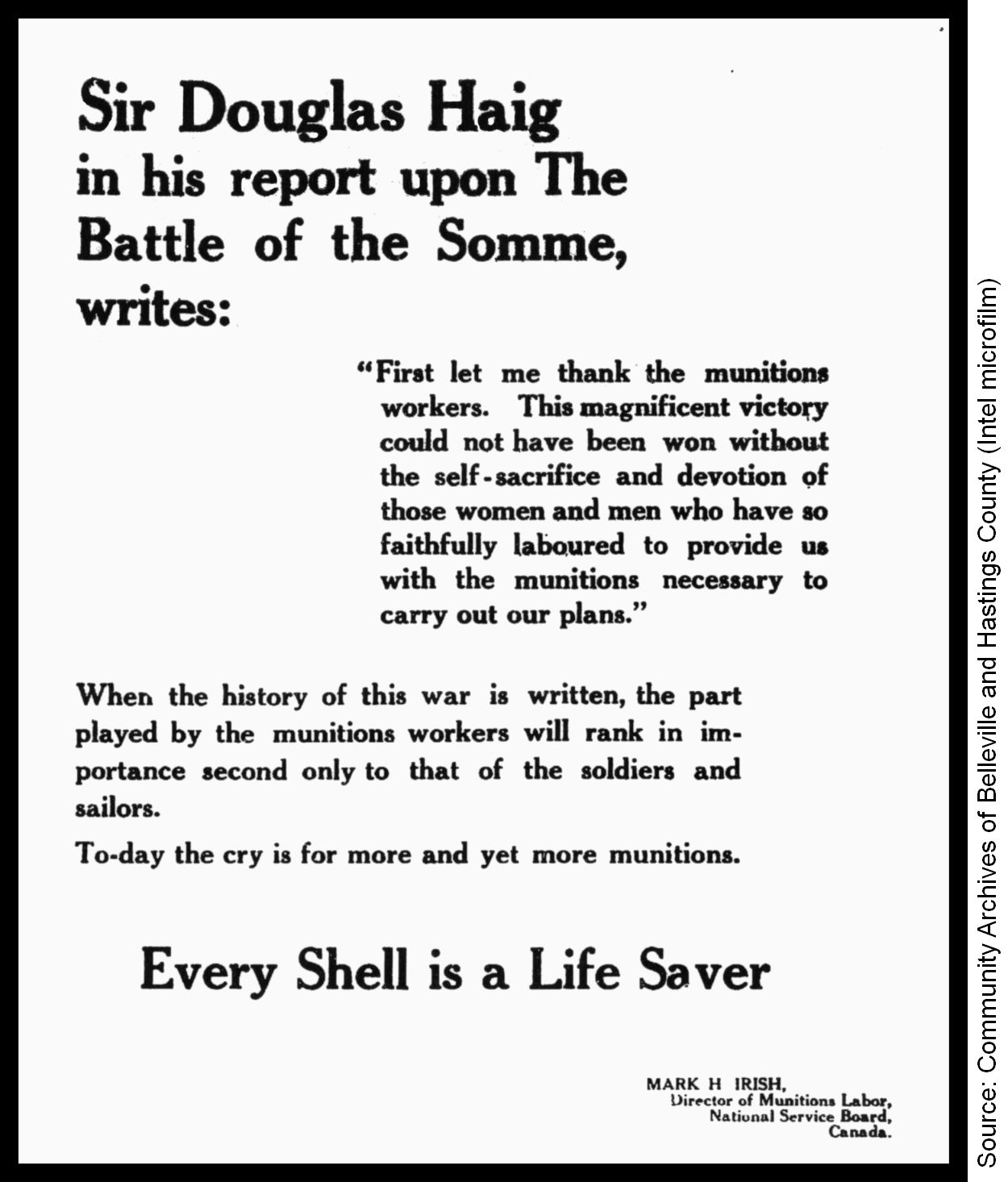
“Sir Douglas Haig in his report upon The Battle of the Somme, writes: ‘First let me thank the munitions workers. This magnificent victory could not have been won without the self-sacrifice and devotion of those women and men who have so faithfully laboured to provide us with the munitions necessary to carry out our plans.’

When the history of this war is written, the part played by the munitions workers will rank in importance second only to that of the soldiers and sailors. To-day the cry is for more and yet more munitions.

Every Shell is a Life Saver.

Mark H. Irish, Director of Munitions Labor, National Service Board, Canada.”

100 Years Ago: British Red Cross Society Appeal, Edward Bellow Wounded, Dr. W.C. Brown Ill with Typhoid, Recruiting at Bancroft

The Intelligencer December 1, 1916 (pages 1, 2)

“Citizens of Belleville. The British Red Cross Society gives medical and surgical aid to the wounded. The nurses and doctors who give their heroic services on the firing line, at the base hospitals, on the emergency trains and hospital ships, must have bandages, splints, medicines, stretchers, conveyances, ambulances and everything that goes to succour and heal the wounded. Beds, clothing, antiseptics, instruments, X-Ray apparatus, operating equipment and a thousand other necessary hospital requirements, to take care of the thousands of our brave, cheerful soldiers, who are dying or being maimed for life that we may still be free men.

Money is now urgently needed to carry on this great work. Give and heal. …  All cannot fight—but everyone can give something to heal and comfort the wounded soldiers.

On Tuesday morning next, Dec. 5 you will be asked to help in this great work. The appeal is urgent. Will you give liberally? Will Belleville’s donation be one of which all citizens may be proud? Let everyone do their duty and do it well.”

The Intelligencer December 1, 1916 (page 3)

“Edward Bellow Is Wounded In Action. Ottawa, Nov. 30, 1916. Mrs. Edith Asselstine, 78 Hill Street, Belleville, Ont.

Sincerely regret to inform you 219365 Pte. Edward Bellow, Infantry, officially reported admitted to No. 1 General Hospital, Etratrae, Nov. 21st, 1916, gunshot wound in groin. Will send further particulars when received. Record Office.

Pte. Edward Bellow was an employee of the R. J. Graham Co. for years, and enlisted with the 80th Battalion.”

The Intelligencer December 1, 1916 (page 7)

“Victim of Typhoid. Mr. and Mrs. Henry Brown, of Bellview, Hastings County, received the sad news by cable, of the serious illness of their son, Dr. W. C. Brown, who is in a military hospital in France. He was operated on for appendicitis and is now seriously ill with typhoid.”

The Intelligencer December 1, 1916 (page 7)

“Recruiting Meeting at Bancroft. At the town hall, Bancroft, last night a recruiting meeting was held under the auspices of the 247th Battalion. Among the speakers were Lt.-Col. Ackerman, Commanding Officer of the battalion, and Major E. D. O’Flynn. A number of war relics from the battlefield of France, were exhibited and explained.”

100 Years Ago: Ontario Prime Minister and Leader of Opposition Laud British Red Cross, Khaki Club Honour Roll, James Lawler Wounded

The Intelligencer November 30, 1916 (page 1)

“What Men Say Who Have Seen the Work of the British Red Cross. The Prime Minister of Ontario and The Leader of The Opposition Highly Commend The Great Work of This Society.

‘My visit to England and France has aroused deeper appreciation than ever of the splendid work of the Red Cross. It deserves every support, and I trust the people of Ontario will respond with their usual generosity to the British Red Cross appeal.’ Hon. W. H. Hearst, Prime Minister of Ontario.

‘I bring a message of cheer to those who have relatives at the front and who fear they may be wounded. I believe everything human skill can do, that human care and sympathy can provide, is being done and provided each day and each night throughout the year by the Army Medical corps and the Red Cross. It is a perfect marvel of efficiency.’ Mr. N. W. Rowell, K.C., Leader of the Opposition.

On Tuesday morning next, December 5, every home in Belleville will be visited, and subscriptions asked in support of the British Red Cross Society. Great Britain has asked for Canada’s aid in this great work, and we must not fail the Motherland. The appeal is urgent. Let your donation be liberal.”

The Intelligencer November 30, 1916 (page 2)

“The Khaki Club. A delightful musical programme was given on Wednesday night at the Khaki Club, by Miss Bessie Dolan, assisted by Miss Currie and Mr. Charles Dolan, who played the mandolin. The boys joined in all the choruses, and enjoyed themselves thoroughly. Miss Helen Fraleck and Miss Jessie Fraleck were in charge of the canteen.

During the evening an Honor Roll was hung in the music room, containing the names of members of the 80th Battalion killed in action and wounded. The Club is most grateful to Mrs. R. J. Graham for the gift of a rug.”

The Intelligencer November 30, 1916 (page 2)

“James Vincent Lawler Wounded. Mrs. H. Lawler of 154 1/2 Church street, Belleville, has received the following notification from overseas:

Sincerely regret to inform you that 305649 Gunner James Vincent Lawler, Artillery, officially reported admitted to No. 10 General Hospital, Rouen, Nov. 21st, 1916. Gunshot wound in ankle. Will send further particulars when received. Office in charge of Records.”

100 Years Ago: British Red Cross Campaign, Sydney Hollgerson Killed in Action, Canadian Women Should Stay Out of England, Poster for British Red Cross Day, Donation for British Red Cross Society from Sulphide, Message from Lloyd George

The Intelligencer November 29, 1916 (page 1)

“Every Home To Be Visited. A meeting of the workers in charge of the campaign to raise funds for the British Red Cross Society, was held in the Council Chamber at the City Hall, last evening. His Hon. Judge Wills, presided. The work of organizing was completed, and arrangements made so that every home in Belleville will be visited on Tuesday morning next, December 5th.

It is to be hoped that everyone will have their subscription ready when called upon. The need of money to carry on the great work of this society is most urgent, and Great Britain has asked for Canada’s aid. Other cities, towns and villages have given most liberally, and it is the duty of every citizen to see that the donation to be made by the City of Belleville, will be one of which we may be proud.”

The Intelligencer November 29, 1916 (page 1)

“Belleville Soldier Killed. The following telegram was received in the city this morning: ‘No. 453195, Sydney Hollgerson, 58th Battalion, previously reported wounded, now killed in action on October 8th.’ Mrs. Hollgerson, the mother of Sydney Hollgerson, resides in this city.”

[Note: Private Sydney Hollgerson died on October 8, 1916. He is commemorated on Page 104 of the First World War Book of Remembrance.]

The Intelligencer November 29, 1916 (page 1)

“Should Stay Out of England. Ottawa. The Government again calls attention to the undesirability of Canadian women going to England at the present time, except in cases of necessity. It is pointed out that every additional person in England now who is not doing some real national service becomes a drain upon the food supply there.

The warning is again repeated that transportation limitations may make it very difficult for these women to return to Canada if they wait until the movement of troops begins.”

The Intelligencer November 29, 1916 (page 2)

british-red-cross156

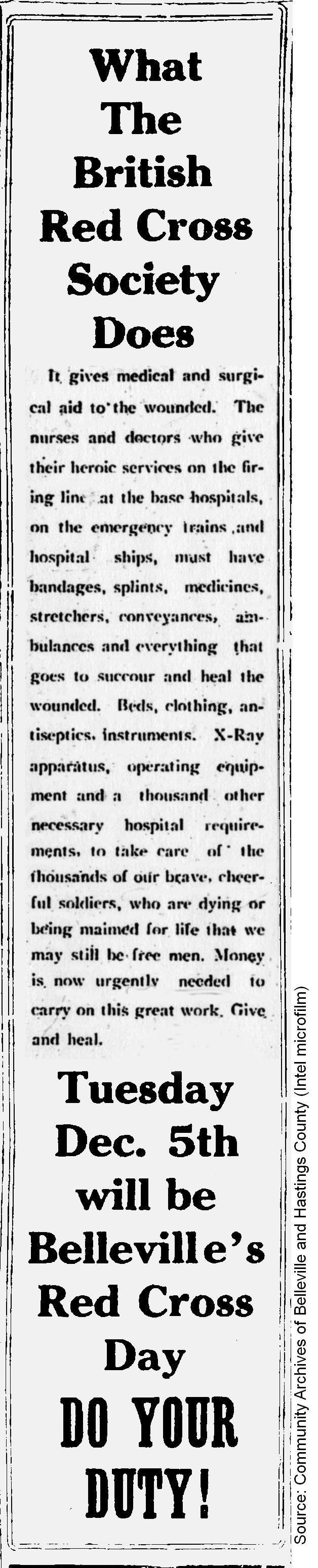
“What The British Red Cross Society Does.

It gives medical and surgical aid to the wounded. The nurses and doctors who give their heroic services on the firing line, at the base hospitals, on the emergency trains and hospital ships, must have bandages, splints, medicines, stretchers, conveyances, ambulances and everything that goes to succour and heal the wounded. Beds, clothing, antiseptics, instruments, X-Ray apparatus, operating equipment and a thousand other necessary hospital requirements, to take care of the thousands of our brave, cheerful soldiers, who are dying or being maimed for life that we may still be free men. Money is now urgently needed to carry on this great work. Give and heal.

Tuesday Dec. 5th will be Belleville’s Red Cross Day. DO YOUR DUTY!”

The Intelligencer November 29, 1916 (page 2)

“British Red Cross. The Tweed branch of the Bank of Montreal has forwarded to the Hon. T. W. McGarry, treasurer, British Red Cross Fund, $417 being the donation to the fund of the employees of the Nichols Chemical Co., Sulphide, Ont.”

The Intelligencer November 29, 1916 (page 5)

lloyd-george157

“A Message From Lloyd George. The Right Hon. David Lloyd George, speaking on ‘The Lesson of Sacrifice,’ said:—

‘We have been living in a sheltered valley for generations. We have been too comfortable and too indulgent, many perhaps too selfish. But the stern hand of fate has scourged us to an elevation where we can see the everlasting things that matter for a Nation, the great peaks we had forgotten—of Honour, Duty, Patriotism, and clad in glittering white, the towering pinnacle of Sacrifice, pointing like a rugged finger to Heaven.’

Compared to service in the trenches, Service in the Munitions Plant is the lesser sacrifice, but it is hardly less vital to the Empire. Mark H. Irish, Director of Munitions Labor, National Service Board, Canada.”

100 Years Ago: Gunner James Miller Wounded, Corporal George Bowen in Hospital, Lecture on Women’s Work Abroad, 235th Battalion Not to Become Draft Battalion, 235th Battalion Hockey Team, Ad for Wallbridge & Clarke’s, Letter from A.J. Stewart, Red Cross Penny Bags

The Intelligencer November 28, 1916 (page 1)

“Gunner James Miller Wounded. The following despatch tells its own story: Ottawa, Ont., Nov. 23 1916. Mrs. L. Miller, Snell Terrace, E. Moira Street, Belleville, Ont.

Sincerely regret to inform you that 300271, Gunner James Miller, artillery, officially reported admitted to No. 2 General Hospital, Letreport, Nov. 15th 1916, gunshot wound in abdomen, will send further particulars when received. Officer in charge records.”

The Intelligencer November 28, 1916 (page 1)

“Corporal G. T. Bowen Reported Seriously Ill. Ottawa, Ont. Nov. 26. Mrs. Geo. Bowen, Belleville, Ont.

Sincerely regret to inform you that 434902, Acting Corporal Geo. Thomas Bowen, infantry, officially reported seriously ill, 13th stationary hospital, Boulogne, Nov. 24th, 1916. Gunshot wound, face and shoulder. Will send further particulars when received. Officer in charge records.

The above refers to a Belleville boy, familiarly known as ‘Dode,’ who enlisted with the 50th Battalion at Calgary.”

The Intelligencer November 28, 1916 (page 1)

“Splendid Lecture Before Women’s Canadian Club. A very interesting lecture was delivered before the Women’s Canadian Club in the commodious assembly room of the High School building, Monday evening, with Mrs. R. W. Reford as the speaker.

The advance announcement that the popular lady had thrilled many audiences during the past few weeks, was fully substantiated, for last night’s discourse on the aspects of the war, and what is being done by the women in England, was an educator that will not soon be forgotten. …

A point that should not be lost sight of, said the speaker, is the aptness with which the women are substituting for the men in all lines of work, with the result that to-day mammoth armies have been organized by the Allies, fully equipped, with munitions galore, coming direct from the hands naturally dainty, but strong in purpose.

The varied branches of work were included in the address, the Red Cross, the magnificent hospital staffs, and particularly the never failing labors of the nurses, many from our own fair Dominion; the dainty little attentions, apparently casual, but nevertheless telling of deep sympathy; and the thousand and one methods of making the boys in the trenches, the soldiers on the cot, the ever arriving reinforcements, feel that the hand of friendship and love is ever ready to assist. …

Thrilled to the innermost recesses of the heart, the large and appreciative audience left the building with a renewed determination to continue the alloted bit for the protectors of the nation. And to the Women’s Canadian Club of Belleville is due an unstinted vote of thanks for securing Mrs. Reford for the evening’s speaker.”

The Intelligencer November 28, 1916 (page 2)

“235th Battalion Team in O.H.A. Arrangements have been completed for the entering of a hockey team of the 235th Battalion in the intermediate O.H.A. for the coming winter. This will be the only intermediate team in the city this winter and the soldier players should receive a great support from the local fans. Some good players have signed up with the 235th Battalion and a number of fast games may be expected.

Any hockey players who are desirous of enlisting will be welcomed by the Battalion and will be given every possible chance to gain a place on the team.”

The Intelligencer November 28, 1916 (page 2)

wallbridge-and-clarkes155

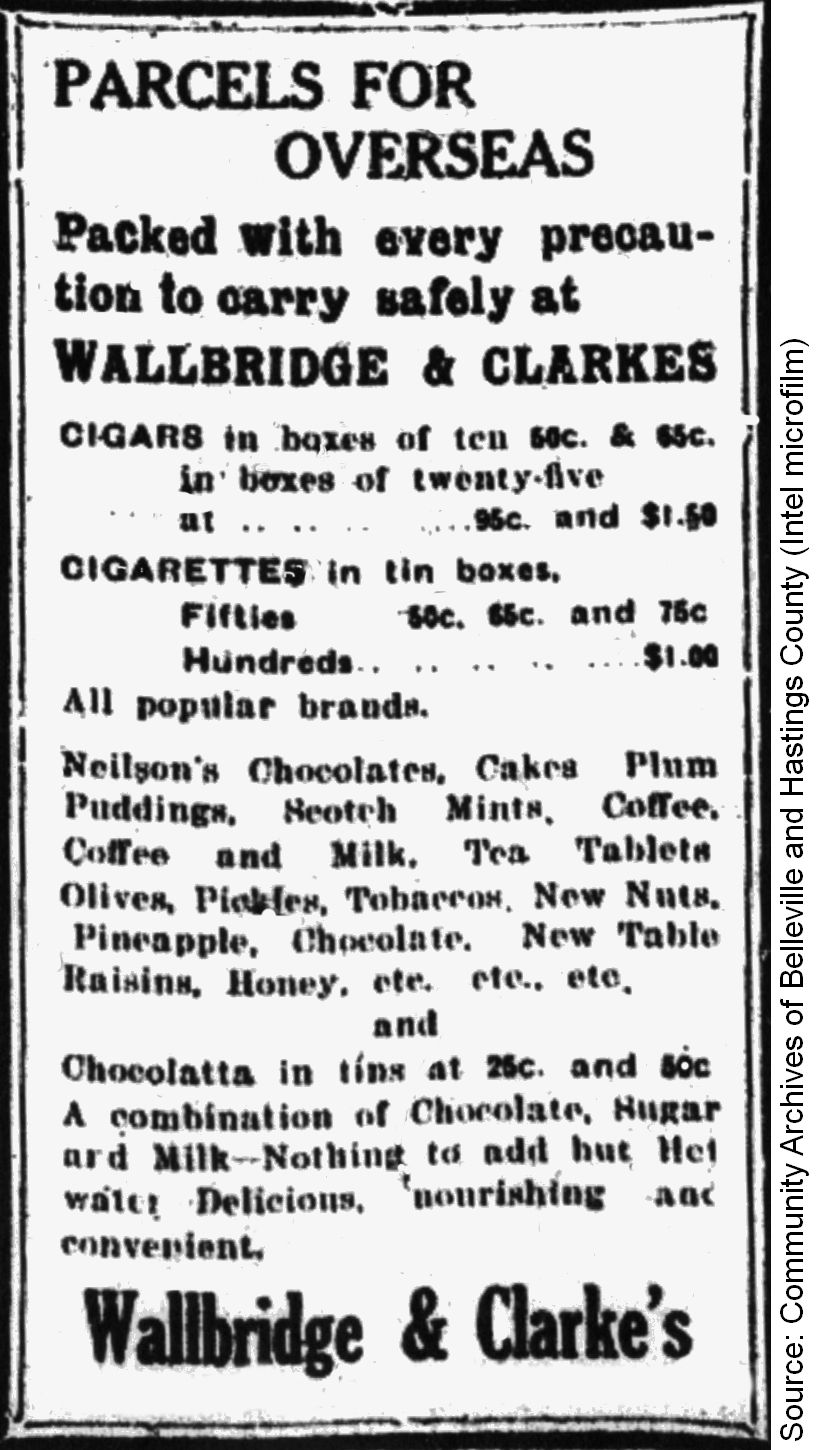
“Parcels for Overseas. Packed with every precaution to carry safely at Wallbridge & Clarkes. Cigars in boxes of ten 50c. & 65c. In boxes of twenty-five at 95c. and $1.50. Cigarettes in tin boxes. Fifties 50c. 65c. and 75c. Hundreds $1.00. All popular brands.

Neilson’s Chocolates, Cakes, Plum Puddings, Scotch Mints, Coffee, Coffee and Milk, Tea Tablets, Olives, Pickles, Tobaccos, New Nuts, Pineapple, Chocolate, New Table Raisins, Honey, etc., etc., etc. and

Chocolatta in tins at 25c. and 50c. A combination of Chocolate, Sugar and Milk—Nothing to add but Hot water—Delicious, nourishing and convenient. Wallbridge & Clarke’s.”

The Intelligencer November 28, 1916 (page 3)

“From A. J. Stewart. France, Nov. 5th, 1916. Dear wife—Just a few lines to let you know I am well, trusting you and the children are the same.

I have not much to write about, only we have moved to another part of France, much better than where we were. We are in good billets and our horses under cover, so don’t worry, for we are all O.K.

You have been busy getting ready for winter no doubt. I would like to have seen you and Mabel putting up the stove pipes. I am glad you sent the snapshot of Arthur Jr., he is growing like everything. …

Well, we had some exciting times in September, but I think it will never be as bad again. You were talking to W. Hutcheson. I am glad you saw him. I met him here. He must have had sometime at Ypres, but I don’t think it was as bad as the Somme. It is fall weather here, just like dear old Canada. …

I got your box the last day of October. The tobacco just came in fine. …

I can talk French very good now and will keep you guessing when I come home. I had the privilege of going through a coal mine one night and was much surprised to see so many young men and girls working in it. They are working for their country, it shows the grand spirit they have.

I think I must close. Remember me to Mabel and all the friends. With best of love to you and the children. I remain your loving Soldier boy A. J. Stewart.”

The Intelligencer November 28, 1916 (page 3)

“The Red Cross Penny Bags. Many of our citizens have complained that they either have not received bags, in which to put their pennies for our soldier boys, or that their bags have not been called for.

The work of the collectors is exacting and not always pleasant, and we ask them only to make one call each month at each house in their section. If those having bags find it impossible, for any reason, to receive the collectors on the last Wednesday of each month, would they kindly assist us by leaving their bags at a neighbors, or take it themselves to the collector or convenor of their district.

Miss Mary Yeomans, 45 Bridge Street West, will be very pleased to furnish bags to anyone, not already having them.”