100 Years Ago: Poster for Soldiers of the Soil, Jack Wallbridge Returns

The Intelligencer March 22, 1918 (page 5)

“200,000 Soldiers Can Be Fed By 25,000 Boys. A boy, working on a farm, can produce, every day, food sufficient to feed eight soldiers—estimating that a boy does half the work of a man.

The 25,000 boys wanted for the S.O.S. Soldiers of the Soil could feed 200,000 Canadian soldiers every day. That would, indeed, be work well done—for there is desperate need of food overseas.

Farm work is not an easy job to tackle. It will test your mettle. But no real Canadian boy, who has any brothers, relatives or friends overseas, will hesitate about going on the farm and ‘doing his bit’ in this grave emergency.

Canada Food Board, Ottawa. Pack the Farm Battalions—From the Front Rank to the Rear.”

The Intelligencer March 22, 1918 (page 7)

“Youthful Warrior Returns. Private Jack Wallbridge, youngest son of Mrs. John Wallbridge, Massassaga, is home from the front. He enlisted in the 254th Quinties Own Battalion, Belleville, December, 1916. Transferred as a volunteer to the 243rd Highland Battalion, Kingston. Left for overseas April, 1917. He was drafted from the 5th Canadian Reserve Battalion into France in August, served three months in the front line as a bomber, also as stretcher bearer, during the Passchendaele battle.

Private Wallbridge was recalled by his family, owing to his extreme youth being only sixteen years of age. He is now awaiting his discharge, and will continue to serve his country in the greater food production at his home on the farm.”


100 Years Ago: Sons of Soil in Khaki Uniform, Poster for Soldiers of the Soil, First Contingent Soldiers Return, More “First Men” Arrive

The Intelligencer March 21, 1918 (page 1)

“ ‘Sons of Soil’ in Khaki Uniform. Ottawa. The Canada Food Board has approved of a standard uniform for the older boy soldiers of the soil, who are being enlisted this week in most of the Provinces for service on the farms. The uniform is smart and at the same time well suited to farm work. It consists of the shirt and pants of militia khaki with brass S.O.S. buttons. They will be sold to the boys, by retailers, at $3.50 per suit, or separately at $1.70 for the shirt and $1.80 for the pants. In addition to the suit the uniform will also consist of a harvester straw hat, pinned up at one side with a one-inch red, white and blue band.

The appearance of the entire uniform is neat and attractive, despite the fact that little regard has been had for its ability. The Board has also approved of the bronze badge of honor which will be awarded to every soldier of the soil who completes three months of satisfactory service on a farm this year. The badges will be presented during the summer at public gatherings. All boys between the ages of thirteen and nineteen are eligible for the badges.”

The Intelligencer March 21, 1918 (page 6)

“When Mother Says: ‘Do you want to go, Son?’ Think of the other Canadian boys, just a few years older, who are holding the fighting line in France, exposed to shot and shell, rain and cold, mud and dust. You wouldn’t feel worthy to shake hands with them when they come back unless you, too, did something big—self-sacrificing—and difficult—to help win the war.

The call to fill the ranks of the Soldiers of the Soil is your big war opportunity. The crucial need of the Allies today is food—more food—and yet more food—so to mother

Speak right up and say: ‘I’m proud to join the S.O.S. Soldiers of the Soil.

Canada Food Board, Ottawa.

The Intelligencer March 21, 1918 (page 7)

“Home on Furlough. In addition to the names published in The Intelligencer yesterday of returned heroes others arriving here were gunners Geo. Hope and Harry Dillnut, Ptes. Geo. Lancaster and Jas. Gordon, all of whom were members of the 1st Canadian contingent. The two former left Belleville with the 34th Battery and both saw considerable fighting. Pte. Leslie Gordon, of this city, who went overseas with the 59th Battalion also arrived home.”

The Intelligencer March 21, 1918 (page 7)

“ ‘First Men’ Arrive. Mayor Platt, Col. Ponton, and Richard Arnott, constituted a civic reception committee which welcomed returned soldiers arriving in Belleville yesterday on the G. T. R. flyer. Among a number who left the train here was George Lancaster, one of the original ‘First’ who left here when the war began. He gained fame and honor as the Bomber of the 2nd Battalion in which capacity he gave Fritz many an uneasy moment, and was the father of many military funerals behind the Hun lines. Bomber Lancaster crossed the sea with Major Dick Ponton and Major Ed. O’Flynn. He has two brothers in France, one of whom is now in hospital with fifteen wounds.

Other returned men greeted by the representatives of the citizens were Pte. Oulson, of Allisonville, a member of the 2nd Battalion and a ‘First’; Corp. Hill, of Madoc, with the 21st Batt., Pte. Anson, of the 59th Batt., and several of the 155th boys going to Campbellford.”

100 Years Ago: Few First Contingent Soldiers Return to Belleville Area, Colors of 80th Battalion to Be Placed in St. Thomas’ Church, Flood in Belleville, Poster for Soldiers of the Soil, Forestry Service Overseas, Poster for Royal Flying Corps

The Intelligencer March 20, 1918 (page 1)

“Soldiers Returned. Mayor Platt and others of this city yesterday made every effort to ascertain if there were any Bellevillians of the first contingent, who were returning home, but their efforts proved fruitless. A few of our boys did however arrive here at an early hour this morning, but the time of their arrival was not announced and a reception could not be accorded them.

They were, however, not members of the first contingent, in fact some had only been overseas but a short time. Those from the city and vicinity who arrived were Sergt. MacDonald, Privates G. Ward, S. Ray, G. Gorman, Gunners Hopkins, McBride and Privates Coughlin, A. Chapman, Pte. Kiser, O’Brien and Sanders.”

The Intelligencer March 20, 1918 (page 1)

“Depositing of Colors. At the morning service at St. Thomas’ Church on Sunday April 28th the colors of the 80th Battalion will be deposited in the church for safe-keeping. His Lordship Bishop Bidwell of Kingston will be present and conduct the service, which will be of an impressive nature. The colors, it will be remembered, were the gift of the Ketcheson families in this district to the battalion previous to going overseas.”

The Intelligencer March 20, 1918 (page 1)

“Flood Conditions. At the hour of 2  o’clock this afternoon there was scarcely any change to note in the situation of that portion of the west side of Front Street flooded yesterday owing to the water in the Moira River overflowing its banks on account of the ice jam. The ice was still held intact at the footbridge but it was apparent that a break was liable to occur at any time. This field of ice extends from the foot bridge to some distance beyond the upper bridge.

From Lazier’s mill on the Canifton Road to Corbyville there is a considerable field of ice and this is liable to come down at any time. Should it arrive before the present jam has been carried down to the mouth of the river more trouble and inconvenience will certainly ensue.

Pedestrians on the west side of the river to-day were compelled to reach Front Street either by way of the upper or lower bridge as water to a depth of two or three feet is in the gangway leading to the foot bridge from Front Street. During last night the jam of ice moved slightly, but was held owing to the firm condition of the ice just below the lower bridge. Back yards from the foot bridge to the upper bridge are still covered with water as are many of the basements of stores in that section. Some of the merchants were compelled to have stoves placed in their stores as furnaces were extinguished by high water.”

The Intelligencer March 20, 1918 (page 5)

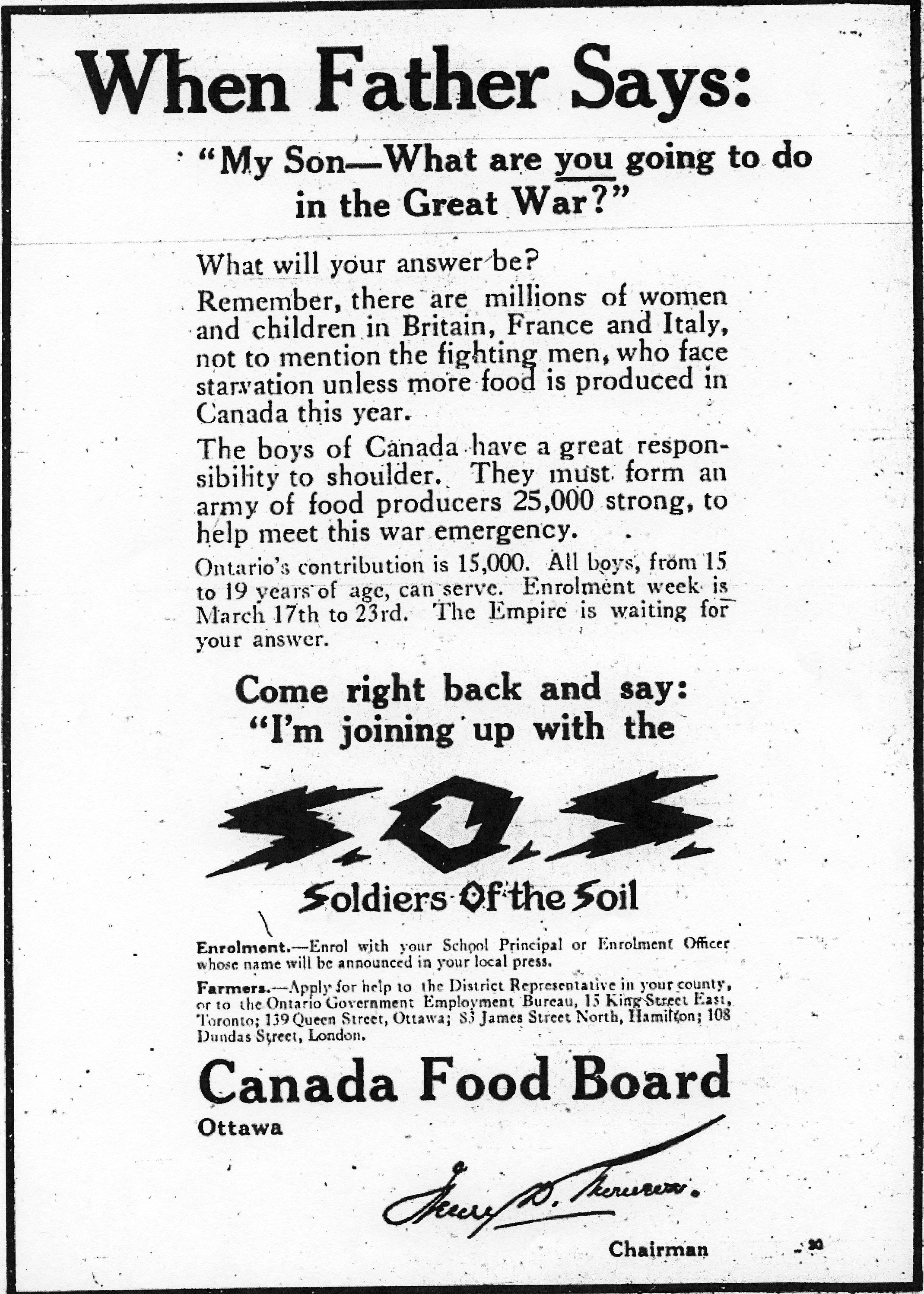
“When Father Says: ‘My Son—What are you going to do in the Great War? What will your answer be? Remember, there are millions of women and children in Britain, France and Italy, not to mention the fighting men, who face starvation unless more food is produced in Canada this year.

The boys of Canada have a great responsibility to shoulder. They must form an army of food producers 25,000 strong, to help meet this war emergency.

Come right back and say: ‘I’m joining up with the S. O. S. Soldiers of the Soil.’ Canada Food Board, Ottawa.”

The Intelligencer March 20, 1918 (page 7)

“With the Foresters. Capt. Fleming has received an interesting letter from his son, Lieut. Alan S. Fleming on active service duty in the Forestry service overseas. Lieut. Fleming went overseas in April 1916 with 1,600 men and the force has been increased to 1,800 and is rendering valuable service to the cause of the Allies. He received his commission overseas being promoted for merit and is now on the personal staff of Gen. MacDougall, Officer Commanding.

Lt. Fleming speaks very highly in his letter of the military record and the personal popularity of Capt. ‘Bill’ Schuster who has been in charge of the traffic department of the Forestry Unit since it arrived in the Old Country and was so successful in that capacity that he was promoted from Lieutenant to Captain with good prospects of a Majority.

Capt. Schuster is at present home on furlough and expects to return to active duty in the near future. Capt. Schuster is highly esteemed by the military authorities overseas as a capable officer and his unfailing good nature and cheery optimism has won him great popularity with the men of the Forestry Unit rank and file. Lieut. Fleming speaks very highly of Capt. Schuster’s kindness to him.”

The Intelligencer March 20, 1918 (page 7)

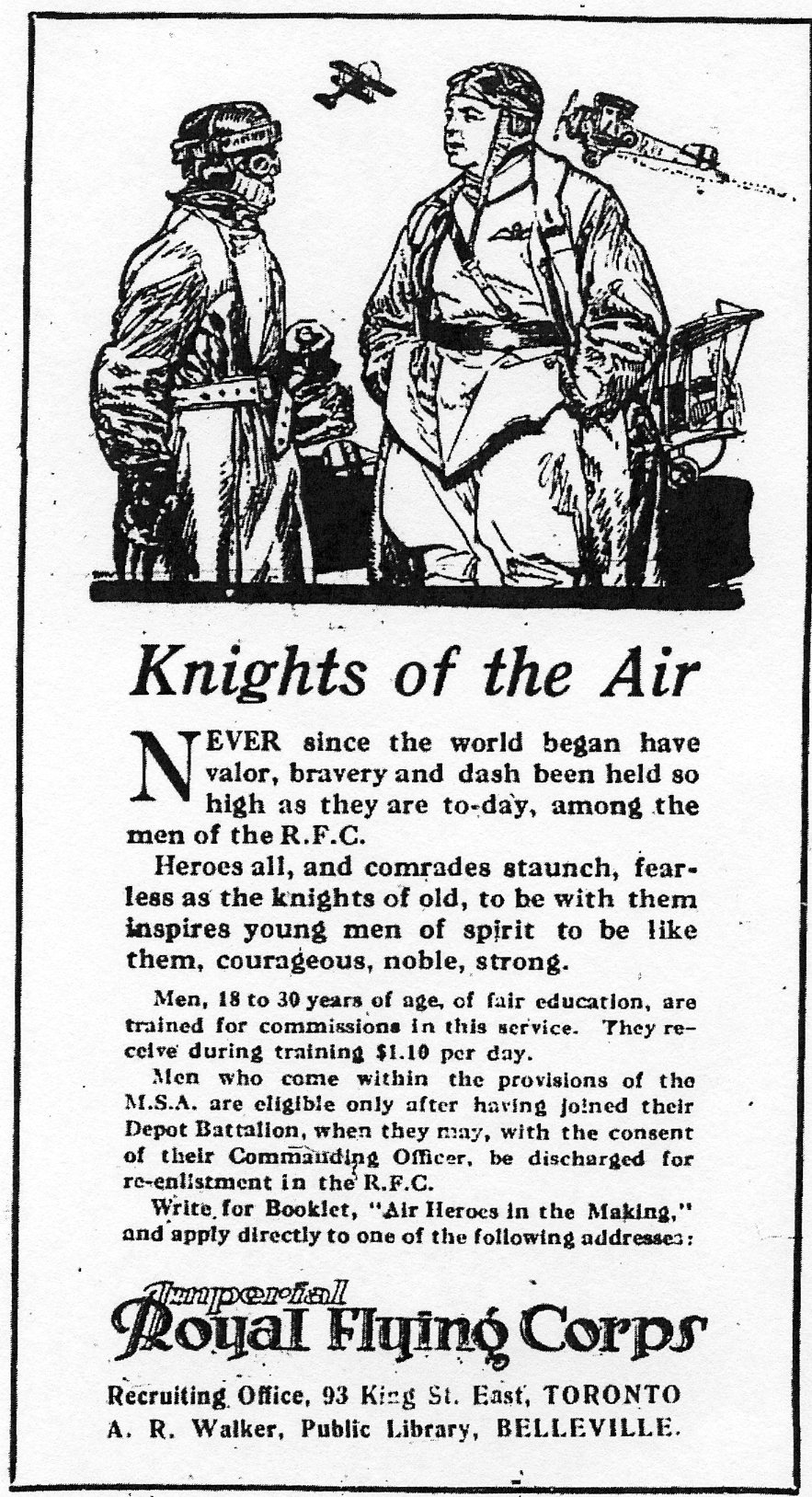
“Knights of the Air. Never since the world began have valor, bravery and dash been held so high as they are to-day, among the men of the R.F.C. Heroes all, and comrades staunch, fearless as the knights of old, to be with them inspires young men of spirit to be like them, courageous, noble, strong.

Imperial Royal Flying Corps. Recruiting Office, A. R. Walker, Public Library, Belleville.”


100 Years Ago: Salvation Army Tag Day Successful, First Contingent Soldiers in Canada, Bank Clerks to Report, Poster for 15,000 Boys to Work on Ontario Farms, Canadian Club Planning Soldiers’ Reception, W. C. Mikel First Speaker

The Intelligencer March 19, 1918 (page 3)

“Salvation Army Tag Day Realized Large Sum of $640.25. The Salvation Army, Pinnacle St., March 19th, 1918. To the Editor of The Intelligencer.

Dear Sir:—Will you kindly permit me on behalf of the officers and members of the local corps of the Salvation Army to extend our sincere thanks and appreciation to Mrs. Waters for her valuable assistance in the organizing and management of the Tag Day effort, to the different captains and their assistants, the principals and teachers of the schools, the press for such liberal space given to advertising of the effort, the different firms who gave such splendid assistance to the effort by donating space in their advertising columns, to Mr. Forhan, manager of Griffin’s Opera House for slide announcements at both houses, and last but by no means least the school scholars, and the public who gave so liberally and made our appeal such a splendid success.

I am confident they will receive their reward, for it says in the good book that a cup of cold water given in His name will receive its reward and when the boys come marching home they will tell you of the comfort the huts were to them. Again thanking you one and all, I remain yours sincerely, Thos. D. Ruston, Treasurer.”

The Intelligencer March 19, 1918 (page 4)

“See the Conquering Hero Comes. The boys of the First Contingent are in Canada again—some of them. Many sleep beneath the poppies which keep watch and ward with the wooden crosses, row on row, marking the resting places of heroes in Flanders. Others are holding the line till their pals get back from this longed-for visit to the home folks.

With hearts bursting with joy, pride of achievement, and glory in being just Canadians, the First boys are back in their beloved Canada and greeting their loved ones after the long and weary vigil on Flanders Plains. …

No welcome can be too warm for these heroes who answered the first alarm calling the Empire to arms. Let us be worthy of our glorious defenders and give them no cause to feel that their sacrifices have been unappreciated.

There will be welcomes, grand and inspiring, but the first and best welcome will be when the soldier boy swings back the gate of cottage or castle home and with a shout rushes into the loving arms of those nearer and dearer than life itself.”

The Intelligencer March 19, 1918 (page 5)

“Boys—Here’s a Real Job for You. Starvation faces millions of the women and children of our Allies. The cry reaches Canada for food, more food and yet more food. Canadian farmers are willing to raise every pound of food the soil will yield. But it takes plenty of work to plant, cultivate and harvest the grain and roots.

S.O.S. Soldiers of the Soil. 15,000 boys, from 15 to 19, must be obtained in Ontario to help in this emergency. Enrolment Week, March 17th to 23rd. Enrol with your School Principal, or Enrolment Officer whose name will be announced in the local press.

Canada Food Board, Ottawa. Become A Soldier of the Soil.”

The Intelligencer March 19, 1918 (page 7)

“Men of First Contingent. The men’s Canadian Club is arranging a reception to the Belleville soldiers of the First Contingent who are returning on furlough. Relatives of friends of first contingent men returning will kindly send their addresses and the names of the soldiers expected and when, to Dr. Yeomans, of the Men’s Canadian Club.”

The Intelligencer March 19, 1918 (page 7)

“The First Gun Fired. W. C. Mikel, K.C., one of the ‘Five-Minute Men’ of the Confidence and Production Army, gave a pleasing rapid-fire address between the acts of ‘Pom-Pom’ at Griffin’s Theatre last evening upon the necessity of banishing war weariness and speeding up our will to win the war and desire to help in overcoming forever the German menace.”


100 Years Ago: Poster for Boys for Farm Work, Soldiers of the Soil, Appeal to Ontario Farmers, Patriotic Tea at Belleville Club

The Intelligencer March 18, 1918 (page 2)

“Can’t You Hear Them Calling—Boys? The Soldiers of the Soil need 15,000 of you in Ontario to swell their ranks and produce food for your brother soldiers overseas. Starvation and defeat face the Allies unless more food is sent from Canada this year.

Boys, this is your grand opportunity to do your bit. You’re too young to serve in the trenches, but you can do something big—self-sacrificing—on the farm. For 3 months’ service on the farm, a Bronze Badge of Honour will be awarded. Make up your mind to win one.

Join Up! Join Up! Your Country’s Calling You! Canada Food Board, Ottawa.”

The Intelligencer March 18, 1918 (page 4)

“The Soldiers of the Soil. This is enrolment week for the Soldiers of the Soil in Canada, when it is hoped that at least 25,000 boys between the ages of fifteen and nineteen will enroll under the banner of Food Production and gladly pledge themselves to assist in the great conflict against German aggression by working on the farms to provide food for the soldiers on the firing line. …

The experiment last season of boy labor on the farms was so successful that plans for this season resulted in the present Soldiers of the Soil movement which, on a much larger and more efficient scale, will bring to the aid of the sorely pressed farmers thousands of boys whose work will be doubly valuable because inspired with true British patriotism. …

Canada is calling to its ‘teen age boys, and they are coming a-running. Heroes many, slackers few. ‘Teen age boys can enroll all this week as Soldiers of the Soil at the Y.M.C.A. building. Y.M.C.A. Secretary Brockel is already out organizing the boys of the district as far east as Cornwall, and with his well-known energy and enthusiasm is bound to meet with abundant success.”

The Intelligencer March 18, 1918 (page 4)

“Special Appeal to Ontario Farmers. With a view to doing its part in the monster greater production campaign under organization by the Dominion Government, the Ontario Department of Agriculture has issued 20,000 large advertising cards calling upon farmers and others to exert every effort on behalf of food production during the coming year. These cards have been distributed to railway stations, post offices, schools and stores throughout the Province.

In addition to the cards, 100,000 pamphlets consisting of four pages of printed matter, setting forth the Government’s aim toward a greater spring wheat production, and giving instructions in regard to the preparation of soils for this purpose have been issued. …

The movement toward registration of labor for agricultural purposes is well under way, and within a short time, it is expected that every man, woman and child, of workable age, will be asked to prove their loyalty to the Empire by working upon the land in the interests of greater production. As this is a Dominion project, the Ontario Government’s part in the scheme will be to place its share of the labor secured by registration.”

The Intelligencer March 18, 1918 (page 6)

“Patriotic Tea. The tea given by Mrs. Hyman’s Knitting circle at the Belleville Club on Saturday afternoon, in aid of the Women’s Red Cross and Patriotic Association was a great success and $120 was made to buy yarn for socks for the men in the trenches. The beautiful sweater coat donated by Miss Jessie Neilson was drawn for, and little Miss Gwen Lazier drew the lucky ticket, No. 43 giving the coat to Mrs. Gain, 302 Bleecker Ave. The prizes for the guessing contest were won by Mrs. Bird, Miss Downey and Miss McKay.”

Nurses of World War I: Agnes Foley Dick

Agnes Foley Dick was born in Lochgelly, Scotland on May 3, 1891 daughter of Elizabeth Dick. Elizabeth was the daughter of William and Jane Dick, born in 1861 and married George Oliver in 1883 but was abandoned by him shortly thereafter. When her daughter was born she named her after her mother Jane and stated that George Oliver was not the father; on March 15, 1892 she petitioned to have her daughter’s name changed to Agnes Foley Dick.

Miss Dick immigrated to Canada on May 24, 1911 and was a graduate of the Nursing School in Belleville in 1917. She established herself in Toronto where she enlisted in the Canadian Army Medical Corps on January 24, 1918.

Height:  5’ 2”

Weight:  136lb

Age: 26

Knox College (later Spadina Military Hospital), Spadina Avenue, north of College Street, between 1889 and 1918. Photo by Galbraith Photo Company. City of Toronto Archives, Fonds 1587, Series 409, Item 47.

Nursing Sister Dick served at the Davisville Military Orthopaedic Hospital, the Spadina Military and Base Hospital in Toronto. Over the course of her military career she was hospitalized a half dozen times at Toronto, Burlington and St. Catherines with influenza and anaemia and was given a disability discharge on August 31, 1919.

Agnes Dick continued to work as a nurse in Toronto following her discharge and would make frequent visits to the United States; it is unknown where she settled or when she died.

100 Years Ago: Address of Parcels for Prisoners of War, Five-Minute Men Encourage Participation, Ad for Gillette, Patriotic Concert at Gilead, Private James Lancaster Wounded, Salvation Army Tag Day, Poster for Soldiers of the Soil

The Intelligencer March 16, 1918 (page 2)

“Address of Parcels For War Prisoners. Ottawa. The German Authorities have issued a memorandum to the effect that parcels for Prisoners of War interned in Germany must be addressed to the ‘parent’ (or main) camps to which the prisoners belong and must not bear the names of any branch or working camps or any other place to which the prisoner might be detailed for special services.

The memorandum states that prisoners who have been detailed for services outside the ‘parent’ camps have been enjoined by the German Authorities from the very first, to inform in this sense any relations or other persons from whom they expect to receive postal parcels. Parcels for Prisoners of War in hospitals also come within the meaning of these regulations.

In the interests of the prisoners it is therefore essential that these regulations should be strictly adhered to as otherwise the German Authorities will not deliver the parcels to the Prisoners of War for which they are intended, and it is suggested that persons in Canada when writing to prisoners in Germany should ascertain definitely the name of the ‘parent’ (or main) camp so that they can comply with the regulations of the German Authorities in addressing parcels to prisoners. R. M. Coulter, Deputy Postmaster General.”

The Intelligencer March 16, 1918 (page 4)

“Daddy, What Did You Do in the War? ‘Peptimism’ is a new word coined by one of the speakers of the War Lecture Bureau in connection with the Greater Production Movement. Pessimism is creeping in and there is need of a liberal injection of ‘Peptimism’ to get the people right up on their toes again purged of war weariness and determined to make Canada’s participation in the war a living sacrifice of joy from the grass roots up with everybody trying to do their bit—a big bit if possible—but even a little bit.

One thousand speakers all over Canada have volunteered as ‘Five-Minute-Men’ and in five minute rapid-fire talks will spread the gospel of ‘Peptimism’ in theatres, movies, concerts and public gatherings of all kinds.

Mr. Frank Yeigh is the officer commanding the ‘Five-Minute-Men’ Battalion and as he is a human dynamo of condensed force it looks as if the movement would accomplish all that is intended.

Pro-German and Pacifist influences are working quietly in Canada—the poison is being introduced in various ways, but the Five-Minute-Men are prepared to inoculate the people against infection. The end of the war is in sight, but if that end is not to be the end of freedom the final effort of the Allies must be the greatest.

The biggest question for the Stay-at-Homes is food production. How about that back-yard garden? Are you studying the seed catalogues and reading up on intensive farming? Wake up and get in the game!

Peptimism is the word—Pep for short—but get it, short or long.”

The Intelligencer March 16, 1918 (page 6)
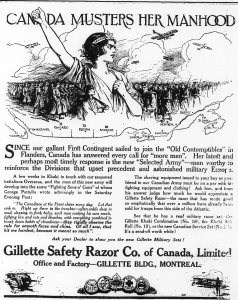
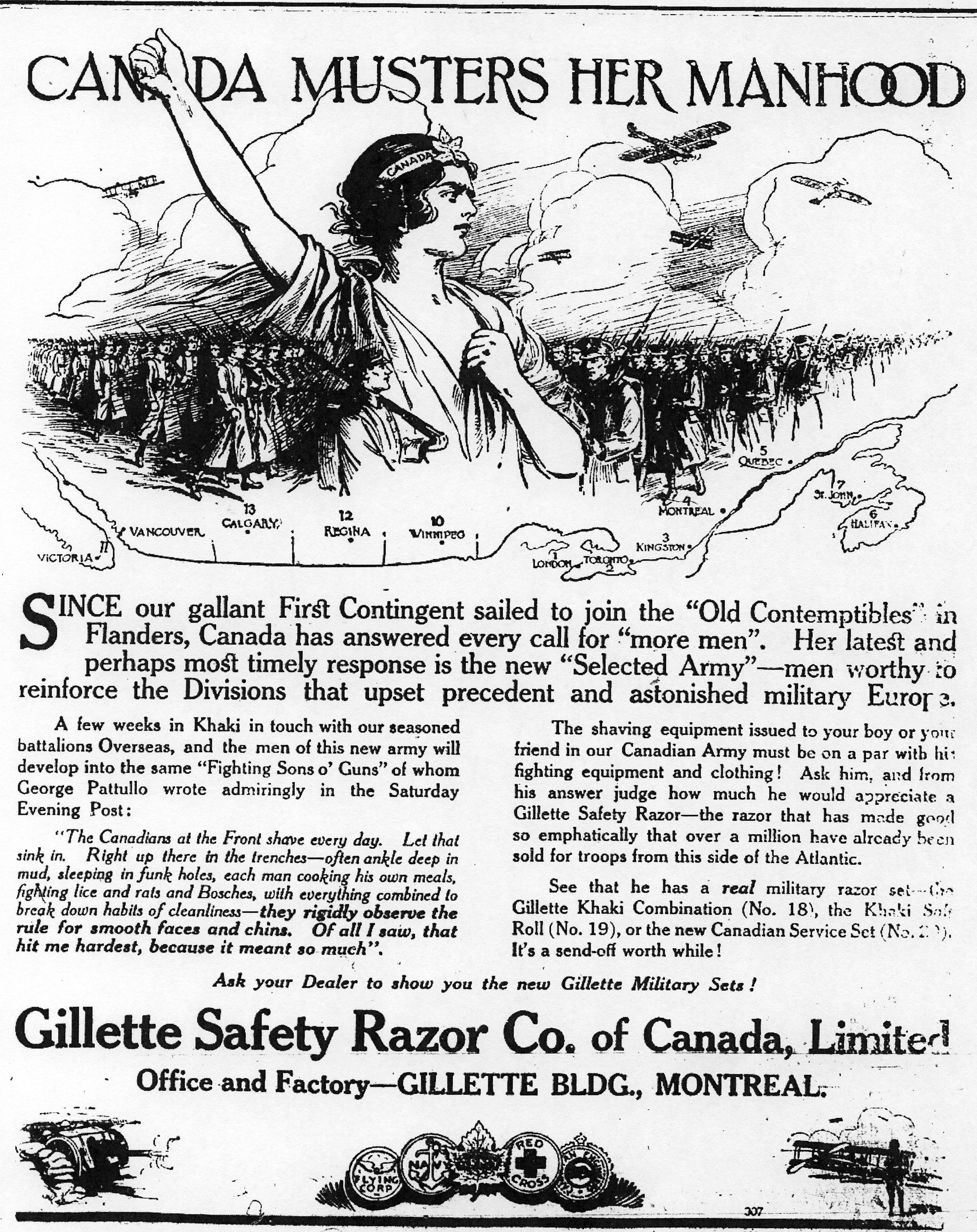
“Canada Musters Her Manhood. Since our gallant First Contingent sailed to join the ‘Old Contemptibles’ in Flanders, Canada has answered every call for ‘more men.’ Her latest and perhaps most timely response is the new ‘Selected Army’—men worthy to reinforce the Divisions that upset precedent and astonished military Europe.

The shaving equipment issued to your boy or your friend in our Canadian Army must be on a par with his fighting equipment and clothing! Ask your Dealer to show you the new Gillette Military Sets!

Gillette Safety Razor Co. of Canada, Limited.”

The Intelligencer March 16, 1918 (page 7)

“Patriotic Concert. At St. Andrew’s Church, Gilead, Thurlow township, last evening, under the auspices of the Red Cross Union Jack Circle of Gilead, a concert was held, which was largely attended. A splendid programme was provided and thoroughly appreciated by all present. Mr. W. C. Mikel, K.C., of this city was chairman filling the position in a most acceptable manner.”

The Intelligencer March 16, 1918 (page 7)

“Pte. Lancaster Wounded. Mrs. E. Lancaster, residing at 95 Station street, received the following message from Ottawa:—’Sincerely regret to inform you that (454519) Pte. Jas. C. Lancaster, infantry, is officially reported admitted to fourth General Hospital, Camiers, March 5, 1918, gunshot wounds left arm, buttock, legs. Director of Records.

Pte. Lancaster lived in Belleville and was a sergeant-instructor in the army, which position he relinquished to go to France in November last as a private.”

The Intelligencer March 16, 1918 (page 7)

“S. A. Tag Day. The Salvation Army with the assistance of those interested in war work have been selling ‘Tags’ today in aid of their ‘Soldiers’ Huts and Comforts.’ It is to be hoped that a goodly sum will be realized. A collection was made in the public schools in the city, which netted over $131.00.

Those in charge of the Tag Day collection are: Organizer, Mrs. Waters, Quinte Chapter; Captains, Mrs. Clarke, Patriotic; Mrs. Ritchie, Salvation Army; Miss Falkiner, C.D.C.A.; Mrs. Ray, Y’S; Mrs. Allen, Argyll Chapter; Mrs. MacColl, St. Julien Chapter; Gordon Robertson, Boy Scouts; Harold Coppin, Y. M. C. A.”

The Intelligencer March 16, 1918 (page 12)
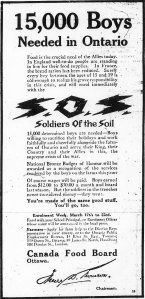
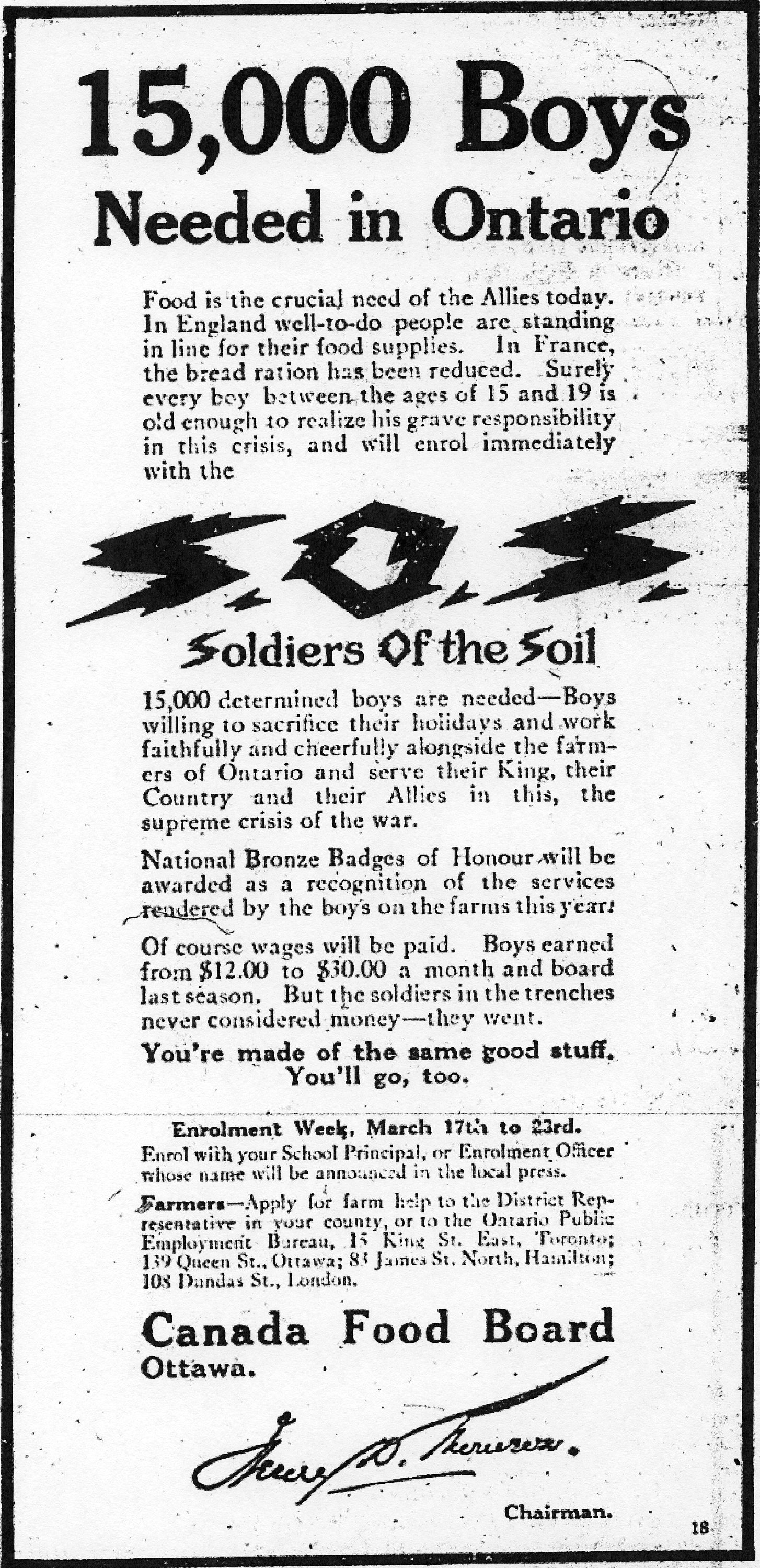
“15,000 Boys Needed in Ontario. Food is the crucial need of the Allies today. In England well-to-do people are standing in line for their food supplies. In France, the bread ration has been reduced. Surely every boy between the ages of 15 and 19 is old enough to realize his grave responsibility in this crisis, and will enrol immediately with the S.O.S. Soldiers of the Soil.

Of course wages will be paid. Boys earned from $12.00 to $30.00 a month and board last season. But the soldiers in the trenches never considered money—they went. You’re made of the same good stuff. You’ll go, too.

Canada Food Board. Ottawa.”
 

100 Years Ago: Salvation Army Tag Day, Twenty-Five Thousand Boys Needed for Farm Work, Poster for Tag Day

The Intelligencer March 15, 1918 (page 5)

Salvation Army Tag Day Tomorrow. Buy a tag on Saturday, buy two tags, yes, buy a dozen and cheer the ladies. The boys need your help. A large percentage of the S. A. men have enlisted which is evidenced by depleted numbers at home. The local corps when conscription came had not a man left to be drafted. Mr. T. Adams, the band-master (who by the way was turned down as medically unfit) is now left with a band composed largely of boys and girls who stepped into the ranks to fill up the places of those who had gone overseas.

There are no less than 40,000 to 50,000 Salvationists under arms and in the trenches and camps of Europe. The Salvation Army officers by persevering effort and bright gospel meetings in the huts and elsewhere have led thousands to Christ, and have the support of the Great War Veterans’ Association, and who knows more about the S. A. overseas than the men who have been to the front and seen for themselves.”

The Intelligencer March 15, 1918 (page 7)

“Boys! Canada Wants You to Join Army of Farm Workers. One of Canada’s war discoveries has been the Canadian boy. …  Last year the call for food producers was heard by eight thousand city boys in Ontario alone. In 1916 nearly three thousand responded to the call of duty in the food producing fields. …  Now Canada asks her boys of teen age to bear a hand in the great fight for food. Canada wants an army of 25,000 sturdy, plucky boys of high resolve to set their hands to this work during the coming summer. Complete organization of all Canada for enrolling the boys has been effected. All boys from 15 to 19 years inclusive are eligible for this youthful army.

The work is directly under the Canada Food Board with Mr. Taylor Statten as national superintendent. Mr. Statten has for years been a leader in boys welfare work and his record of success with boys and his Y.M.C.A. work marked him as the man to handle this army of the Soldiers of the Soil.

The week from March 17 to 23 will be enrollment week throughout Canada. High school teachers, Y.M.C.A. secretaries, scoutmasters and others in close contact with boys and boy life will act as enrollment officers. …

This year, in addition to the wages the boys will earn, Canada will present to each fellow who gives three months on farm service, whether he is a city boy, or works on his father’s farm, a bronze badge of honor, which will be as truly a service medal as the one on the khaki tunic of the hero who has been over the top and is home, honorably discharged. This will be a treasured proof in years to come that the owner did his bit, according to his capacity, in the great war.”

The Intelligencer March 15, 1918 (page 10)

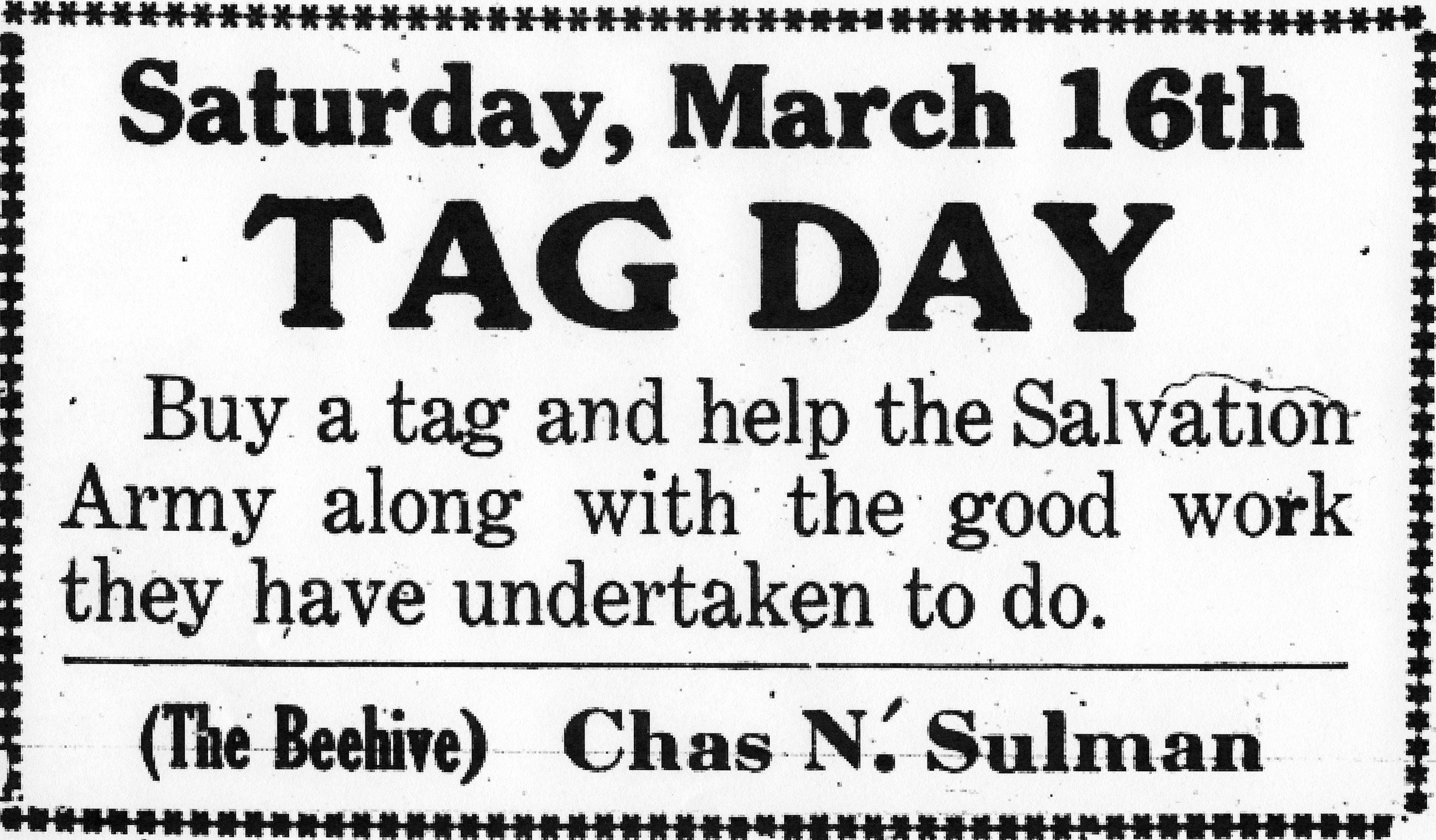
“Saturday, March 16th. TAG DAY. Buy a tag and help the Salvation Army along with the good work they have undertaken to do.

(The Beehive) Chas. N. Sulman.”

100 Years Ago: Approval for Five-Minute Limit to Speeches, Trinket Campaign for Soldiers

The Intelligencer March 14, 1918 (page 4)

“Say It Quick! The five-minute limit to speakers in the new Greater Production Campaign is an encouraging sign of good sense and a happy augury of success. Many men are ever on a hair-trigger ready to explode into a public speech and as a general rule could say much better in five minutes what they generally take twenty-five or more minutes to unload on a long-suffering public. Sowing the seed of Greater Production in Five-Minute Talks is a double-barrelled blessing which the public will certainly appreciate.”

The Intelligencer March 14, 1918 (page 7)

“Trinket Campaign Helps The Soldiers. Many have been the enquiries made as to the amount realized from the Trinket Campaign undertaken in this city recently. The following report, received to-day by Mrs. Williams, President of the ‘Y’s’ will be very gratifying both to the subscribers and collectors:

Hamilton, March 11, 1918. Dear Mrs. Williams:—The Belleville barrels came to hand some days ago, and have been valued at $323.67. This is perfectly splendid, showing more than double any of the places from which we have heard yet, and we congratulate you most heartily on such a valuable contribution to the fund. Yours sincerely, (Signed) A. A. Wickett.

Beside the amount specified above the collectors received $50 in cash, and donations of trinkets and money are still being sent in.”

100 Years Ago: Five-Minute Men Give Patriotic Talks, Belleville Production League Holds Meeting on Food, Honor Roll for St. Thomas’ Church, Soldiers of the Soil

The Intelligencer March 13, 1918 (page 7)

“Are Organizing Five Minute Men. War Bureau of Canada is Working to Maintain Confident War Spirit. The Dominion Government has appointed a Director of Public Information, under whom a War Lecture Bureau has been set up as a nation-wide publicity medium on matters relating to the great struggle.

Already in every province several hundred local representatives have offered their services for this patriotic work, who in turn secure the help of volunteer speakers who are known as ‘Five-Minute Men,’ and who give these brief, crisp addresses in the moving picture and other theatres and wherever ready-made audiences are to be found, in churches, schools, clubs, conventions, etc. …

At an informal gathering of citizens, held in the Council Chamber yesterday afternoon, the value of said publicity campaign was recognized, and a local committee formed as follows, Chairman, W. C. Mikel, K.C.; Secretary, W. L. Doyle; Committeemen, Rev. Canon Beamish, John Elliott, C. M. Reid and Rev. Dr. Scott. Frank Yeigh, of Toronto, the Secretary of Bureau gave an address on the work and plans of the Bureau.

The citizens of Belleville will therefore soon hear frequent five-minute talks on Government topics.”

The Intelligencer March 13, 1918 (page 2)

“Greater Production Was Discussed by Speakers. Under the auspices of the Belleville Production League a mass meeting of the citizens of Belleville was called for last evening at the City Hall for the purpose of hearing an important matter discussed, namely, ‘Greater Production.’ The attendance was by no means large, but those present took a deep interest in the addresses given. Previous to the speaking, excellent music was furnished by members of the 15th Regimental band, which was greatly appreciated.

The gathering was presided over by ex-Mayor Ketcheson, President of the League, and in opening the meeting he briefly outlined its nature, namely, to stimulate all in the city to greater production during the coming season.

Mr. John Elliott, manager of the Standard Bank, was the first speaker, and in his opening remarks referred to the great struggle that is taking place overseas. …  We have done much since the war commenced, we must do more. …  Every garden in Belleville should be got ready to produce so that what the farmers produce can be exported. Let the boys go out and assist in the farm and let the citizens of Belleville produce enough to feed the citizens of the city. …

Mayor Platt stated that he was pleased to be present at such a meeting. He was only too willing to do all he could to help production. The city will plough lots to help production. There is no doubt that we must get food overseas especially as much food is going down through submarines. The situation is serious, and we must do our bit. …

Ex-Mayor Ketcheson—We want every vacant lot in the city cultivated, and we want citizens who have them to give them for this purpose. Committees have been appointed to see that these lots are ploughed up and the best seed possible will be secured. …

Mr. A. R. Walker, public librarian, stated that at the public library pamphlets will be available on planting of various seeds and the other information regarding production. He moved a vote of thanks to those who had sung, to the speakers and the band for music rendered. …  The singing of the National Anthem brought the meeting to a close.”

The Intelligencer March 13, 1918 (page 7)

“A Work of Art. A handsome honor roll has been presented to Ven. Archdeacon Beamish, rector of St. Thomas Church, inscribed with the names of twenty young heroes, members of St. Thomas, who have made the supreme sacrifice for God and home and native land.

The scroll was painted in watercolors by Miss Helen Yarwood, a talented artist, formerly of Belleville, and presented by her to the rector to be placed in the church. The lettering is the work of Sergt. Hancock, a member of the depot battalion which recently left Belleville for Kingston, and is very cleverly done in Old English. The Honor Roll will be dedicated at the Sunday morning service by His Lordship Bishop Bidwell.”

The Intelligencer March 13, 1918 (page 7)

“Soldiers of the Soil. The great need for greater production of farm crops has led the Ontario Resources Committee as their part towards fulfilling this demand to ask for the services of 15,000 boys between the age of 15 to 19 who will pledge themselves to go on the farms for three months this summer. The organization is being set up by the Y. M. C. A. National Boys’ Work Department. Organizers will go out to secure enrollment officers in all the larger towns of the Province, and the week of March 17th to 23rd is being set aside as special enrollment week.

It is said that if the allies fail to win this war it will be because they have not sufficient food, therefore a big effort must be made to increase food production along all lines during the season of 1918. Every loyal organization is expected to lend a hand toward this worthy and necessary cause. Mr. P. F. Brockel is in charge of the organization of the soldiers of the soil.”